ESP CHEVROLET BLAZER 1998 2.G User Guide
[x] Cancel search | Manufacturer: CHEVROLET, Model Year: 1998, Model line: BLAZER, Model: CHEVROLET BLAZER 1998 2.GPages: 416, PDF Size: 22.4 MB
Page 198 of 416
Downloaded from www.Manualslib.com manuals search engine Environmental Concerns
Off-road driving can provide wholesome and satisfying
recreation. However, it also raises environmental
concerns.
GM recognizes these concerns and urges
every off-roader to follow these basic rules for
protecting the environment:
0
0
0
0
0
Always use established trails, roads and areas that
have been specially set aside for public off-road
recreational driving;
obey all posted regulations.
Avoid any driving practice that could damage the
environment
-- shrubs, flowers, trees, grasses -- or
disturb wildlife (this includes wheel-spinning,
breaking down trees or unnecessary driving through
streams or over soft ground).
Always carry
a litter bag . . . make sure all refuse is
removed from any campsite before leaving.
Take extreme care with open fires (where permitted),
camp stoves and lanterns.
Never park your vehicle over dry grass or other combustible materials that could catch fire from the
heat
of the vehicle’s exhaust system.
Traveling to Remote Areas
It makes sense to plan your trip, especially when going
to a remote area. Know the terrain and plan your route.
You are much less likely to get bad surprises. Get
accurate maps of trails and terrain. Try to learn of any
blocked
or closed roads.
It’s also a good idea to travel with at least
one other
vehicle. If something happens to
one of them, the other
can help quickly.
Does your vehicle have a winch? If
so, be sure to read
the winch instructions. In a remote area, a winch can
be
handy if you get stuck. But you’ll want to know how to
use it properly.
Getting Familiar with Off-Road Driving
It’s a good idea to practice in an area that’s safe and
close to home before you
go into the wilderness.
Off-road driving does require some new and different
driving skills. Here’s what we mean.
Tune your senses to different kinds of signals. Your
eyes, for example, need
to constantly sweep the terrain
for unexpected obstacles. Your ears need to listen for
unusual tire or engine sounds. With your arms, hands,
feet and body, you’ll need to respond to vibrations and
vehicle bounce.
4-16
Page 199 of 416
Downloaded from www.Manualslib.com manuals search engine Controlling your vehicle is the key to successful
off-road driving. One
of the best ways to control your
vehicle is to control your speed. Here are some things to
keep in mind. At higher speeds:
you approach things faster and you have less time to
scan the terrain for obstacles.
0 you have less time to react.
0 you have more vehicle bounce when you drive
over obstacles.
0 you'll need more distance for braking, especially
since you're on an unpc"=.?d surface.
Scanning the Terrain
Off-road driving can take you over many different kinds
of terrain. You need to be familiar with the terrain and
its many different features. Here are some things
to consider.
Sugace Conditions. Off-roading can take you over
hard-packed dirt, gravel, rocks, grass, sand, mud, snow
or ice. Each of these surfaces affects the steering,
acceleration and braking of your vehicle
in different
ways. Depending upon the kind
of surface you are on,
you may experience slipping, sliding, wheel spinning,
delayed acceleration, poor traction and longer
braking distances.
Sugace Obstacles . Unseen or hidden obstacles can be
hazardous.
A rock, log, hole, rut or bump can startle you if
you're not prepared for them. Often these obstacles are
hidden by grass, bushes, snow or even the
rise and fall of
the terrain itself. Here are some things to consider:
I
When you're driving off-road, bouncing and
quick changes in direction can easily throw
you
out of position. This could cause you to lose
control and crash.
So, whether you're driving on
or off the road, you and your passengers should
wear safety belts.
0 Does the travel take you uphill or downhill? (There's
0 Is the path ahead clear?
0 Will the surface texture change abruptly up ahead?
more discussion
of these subjects later.)
0 Will you have to stop suddenly or change
direction quickly?
4-17
Page 200 of 416
Downloaded from www.Manualslib.com manuals search engine When you drive over obstacles or rough terrain, keep a
firm grip on the steering wheel. Ruts, troughs or other
surface features can jerk the wheel out of your hands
if
you’re not prepared.
When you drive over bumps, rocks, or other obstacles,
your wheels can leave the ground. If this happens, even
with one or two wheels, you
can’t control the vehicle as
well or at all.
Because you will be on
an unpaved surface, it’s
especially important to avoid sudden acceleration,
sudden turns or sudden braking.
In a way, off-road driving requires a different kind of
alertness from driving
on paved roads and highways.
There are no road signs, posted speed limits or signal
lights.
You have to use your own good judgment about
what is safe and what isn’t.
Drinking and driving can be very dangerous on any
road. And this is certainly true for off-road driving.
At
the very time you need special alertness and driving
skills, your reflexes, perceptions and judgment can be
affected
by even a small amount of alcohol. You could
have a serious
-- or even fatal -- accident if you drink
and drive or ride with a driver who has been drinking.
See “Drunken Driving” in the Index.
Driving on Off-Road Hills
Off-road driving often takes you up, down or across a
hill. Driving safely on hills requires good judgment and
an understanding of what your vehicle can and can’t do.
There are some hills that simply can’t be driven,
no
matter how well built the vehicle.
Many hills are simply too steep for any vehicle, If
you drive up them,
you will stall. If you drive
down them, you can’t control your speed, If you
drive across them, you will roll over. You could be
seriously injured or killed. If you have any doubt
about the steepness, don’t drive the hill.
4-18
Page 209 of 416
Downloaded from www.Manualslib.com manuals search engine Your vehicle will require more frequent service due to
off-road use. Refer to the Maintenance Schedule for
additional information.
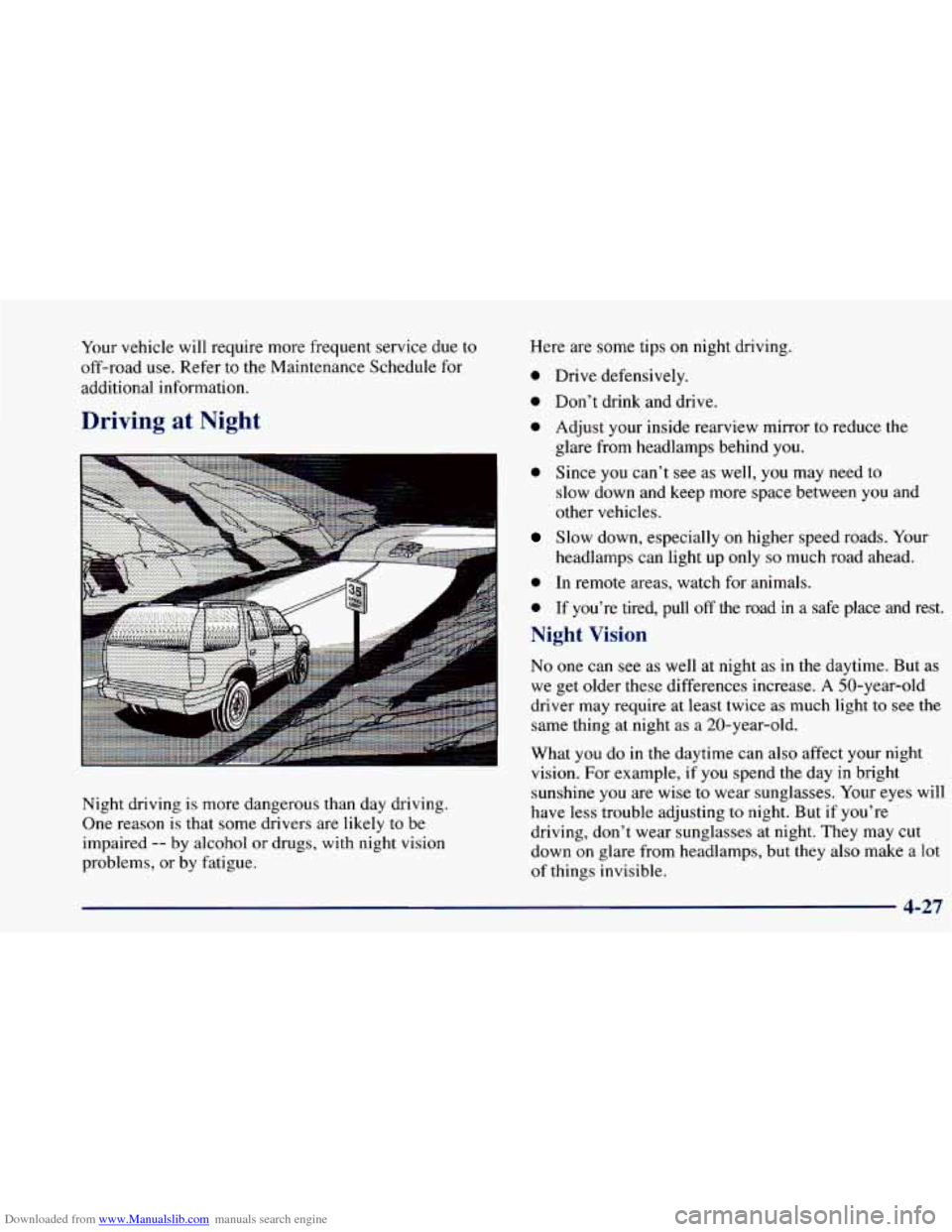
Driving at Night
Night driving is more dangerous than day driving.
One reason is that some drivers are likely to be
impaired
-- by alcohol or drugs, with night vision
problems, or by fatigue. Rere
are some tips on night driving.
0 Drive defensively.
0 Don’t drink and drive.
0 Adjust your inside rearview mirror to reduce the
0 Since you can’t see as well, you may need to
glare
from headlamps behind you.
slow down and keep more space between you and
other vehicles.
Slow down, especially on higher speed roads. Your
headlamps can light up only
so much road ahead.
0 In remote areas, watch for animals.
0 If you’re tired, pull off the road in a safe place and rest.
Night Vision
No one can see as well at night as in the daytime. But as
we get older these differences increase. A 50-year-old
driver may require at least twice as much light to see the
same thing at night as a 20-year-old.
What you do
in the daytime can also affect your night
vision. For example,
if you spend the day in bright
sunshine you are wise to wear sunglasses. Your eyes will
have less trouble adjusting
to night. But if you’re
driving, don’t wear sunglasses at night. They may cut
down on glare from headlamps, but they also make
a lot
of things invisible.
4-27
Page 212 of 416
Downloaded from www.Manualslib.com manuals search engine Hydroplaning
Hydroplaning is dangerous. So much water can build up
under your tires that they can actually ride on the water.
This can happen if the road is wet enough and you’re
going fast enough. When your vehicle is hydroplaning,
it has little or no contact with the road.
Hydroplaning doesn’t happen often. But it can if your
tires do not have much tread or if the pressure
in one or
more is low.
It can happen if a lot of water is standing on
the road. If you can see reflections from trees, telephone poles or other vehicles, and raindrops “dimple” the
water’s surface, there could
be hydroplaning.
Hydroplaning usually happens at higher speeds. There
just isn’t
a hard and fast rule about hydroplaning. The
best advice is to slow down when it is raining.
Driving Through Deep Standing Water
I I
NOTICE:
If you drive too quickly through deep puddles or
standing water, water can come in through your engine’s air intake and badly damage your
engine. Never drive through water that
is slightly
lower than the underbody
of your vehicle. If you
can’t avoid deep puddles or standing water, drive
through them very slowly.
I I
Some Other Rainy Weather Tips
Besides slowing down, allow some extra following
distance. And be especially careful when
you pass
another vehicle. Allow yourself more clear room
ahead, and be prepared to have your
view restricted
by road spray.
0 Have good tires with proper tread depth. (See “Tires”
in the Index.)
4-30
Page 221 of 416
Downloaded from www.Manualslib.com manuals search engine P
-1AUTION:
Snow can trap exhaust gases under your vehicle.
This can cause deadly
CO (carbon monoxide) gas
to get inside. CO could overcome you and kill
you. You can’t see it or smell it,
so you might not
know it is in your vehicle. Clear away
snow from
around the base
of your vehicle, especially any
that is blocking your exhaust pipe. And check
around again from time to time to be sure snow
doesn’t collect there.
Open
a window just a little on the side of the
vehicle that’s away from the wind. This will help
keep CO out.
Run your engine only as long as you must. This saves
fuel. When you run the engine, make
it go a little faster
than just idle. That
is, push the accelerator slightly. This
uses less fuel for the heat that you get and it keeps the
battery charged. You will need a well-charged battery to
restart the vehicle, and possibly for signaling later on
with your headlamps. Let the heater run for
a while.
Then, shut the engine off and close the window almost
all the way to preserve the heat. Start the engine again
and repeat this only when you feel really uncomfortable
from the cold. But
do it as little as possible. Preserve the
fuel as long as you can. To help keep warm, you can get
out of the vehicle and do some fairly vigorous exercises
every half hour or
so until help comes.
Recreational Vehicle Towing
Vehicles with two-wheel drive or the electronic shift
transfer case require special modifications before they
can be towed
in this manner. Please contact your dealer
for the towing information that is appropriate for your
particular vehicle.
4-39
Page 229 of 416
Downloaded from www.Manualslib.com manuals search engine Driving with a Trailer
I
A GA ‘TION:
If you have a rear-most window open and you
pull a trailer with your vehicle, carbon monoxide
(CO) could come into your vehicle. You can’t see
or smell
CO. It can cause unconsciousness or
death. (See “Engine Exhaust” in the Index.) To
maximize your safety when towing
a trailer:
0 Have your exhaust system inspected for
leaks, and make necessary repairs before
starting on your trip.
Keep the rear-most windows closed.
0 If exhaust does come into your vehicle
through a window in the rear or another
opening, drive with your front, main
heating or cooling system on and with the
fan
on any speed. This will bring fresh,
outside air into your vehicle.
Do not use
MAX AfC because it only recirculates the
air inside your vehicle. (See “Comfort
Controls” in the Index.) Towing a
trailer requires
a certain amount of experience.
Before setting out for the open road, you’ll want to get
to know your rig. Acquaint yourself with the
feel of
handling and braking with the added weight of the
trailer. And always keep in mind that the vehicle you
are driving is now a
good deal longer and not nearly as
responsive as your vehicle is by itself.
Before
you start, check the trailer hitch and platform
(and attachments), safety chains, electrical connector,
lamps, tires and mirror adjustment.
If the trailer has
electric brakes, start your vehicle and trailer moving and
then apply the trailer brake controller by hand to be sure
the brakes are working. This lets you check your
electrical connection at the same time.
During your trip, check occasionally to be sure that the
load
is secure, and that the lamps and any trailer brakes
are still working.
Following Distance
Stay at least twice as far behind the vehicle ahead as you
would when driving your vehicle without a trailer. This
can help you avoid situations that require heavy braking
and sudden turns.
4-47
Page 232 of 416
Downloaded from www.Manualslib.com manuals search engine 2. Let up on the brake pedal.
3. Drive slowly until the trailer is clear of the chocks.
4. Stop and have someone pick up and store the chocks.
Maintenance When Trailer Towing
Your vehicle will need service more often when you’re
pulling
a trailer. See the Maintenance Schedule for more
on this. Things that are especially important
in trailer
operation are automatic transmission fluid (don’t
overfill), engine oil, axle lubricant, belt, cooling system
and brake adjustment. Each
of these is covered in this
manual, and the Index will help
you find them quickly.
If
you’re trailering, it’s a good idea to review these
sections before you start your trip.
Check periodically to see that all hitch nuts and bolts
are tight.
Trailer Wiring H-T--- ess
The light duty trailer wir is a six-wire harness
assembly. The optional heavy-duty trailer wiring
is an
eight-wire harness assembly. The harnesses are stored under the vehicle, along the passenger-side frame
crossmember on two-door vehicles or on the driver’s side
corner frame rear crossmember on four-door vehicles. The
heavy-duty trailer wiring has a 30-amp feed wire with
an
inline fuse located by the junction block. See
“Fuses and Circuit Breakers” in the Index. Both
harnesses have
no connector and should be wired by a
qualified electrical technician. The technician
can use
the following color code chart when connecting the
wiring harness to your trailer.
0
0
0
0
0
0
0
0
Dark Blue: Use for electric trailer brakes or
auxiliary wiring.
Red: Use for battery charging; it connects to the
starter solenoid (eight-wire harness only).
Light Green: Back-up lamps (eight-wire
harness only).
Brown: Taillamps and parking lamps. Yellow: Left stoplamp and turn signal.
Dark Green: Right stoplamp and turn signal.
White (Heavy Gage): Ground wire.
White (Light Gage): Auxiliary stoplamp.
Securely attach the harness to the trailer, then tape or
strap
it to your vehicle’s frame rail. Be sure you leave
it loose enough
so the wiring doesn’t bend or break,
but not
so loose that it drags on the ground. Store the
harness in its original place. Wrap the harness together
and tie it neatly
so it won’t be damaged.
Page 253 of 416
Downloaded from www.Manualslib.com manuals search engine If a Tire Goes Flat
It’s unusual for a tire to “blow out” while you’re driving,
especially if you maintain your tires properly. If air goes
out of
a tire, it’s much more likely to leak out slowly.
But if you should ever have a “blowout,” here
are a few
tips about what to expect and what to do:
If a front tire fails, the flat tire will create a drag that
pulls the vehicle toward that side. Take your foot off the
accelerator pedal and grip the steering wheel firmly.
Steer to maintain lane position, and then gently brake to
a stop well out
of the traffic lane.
H rear blowout, particularly on a curve, acts much like a
skid and may require the same correction you’d use in a
skid. In any rear blowout, remove your foot from the
accelerator pedal. Get the vehicle under control
by
steering the way you want the vehicle to go. It may be
very bumpy and noisy, but you can still steer. Gently
brake to a stop
-- well off the road if possible.
If a tire goes flat, the
next part shows how to use your
jacking equipment to change
a flat tire safely.
Changing a Flat Tire
If a tire goes flat, avoid further tire and wheel damage
by driving slowly to a level place.
Turn on your hazard
warning flashers.
Changing a tire can cause an injury, The vehicle
can slip
off the jack and roll over you or other
people.
You and they could be badly injured.
Find
a level place to change your tire. To help
prevent the vehicle from moving:
1. Set the parking brake firmly.
2. Put an automatic transmission shift
lever in PARK
(P) or shift a manual
transmission
to FIRST (1) or
REVERSE (R).
3. Thrn off the engine.
4. Put the wheel blocks at the front and
rear of the tire farthest away from the
one being changed. That would
be the
tire on the other side of the vehicle, at
the opposite end.
5-21
Page 286 of 416
Downloaded from www.Manualslib.com manuals search engine How to Check
Because this operation can be a little difficult, you
may choose to have this done at your GM dealership
Service Department.
If you do it yourself, be sure to follow all the instructions
here, or you could get a false reading on the dipstick.
NOTICE:
~ Too much or too little fluid can damage your
transmission.
Too much can mean that some of
the fluid could come out and fall on hot engine
parts
or exhaust system parts, starting a fire. Be
sure to get an accurate reading if you check your
transmission fluid.
Wait at least 30 minutes before checking the
transmission fluid level
if you have been driving:
When outside temperatures are above 90°F (32°C).
At high speed for quite a while.
In heavy traffic -- especially in hot weather.
0 While pulling a trailer.
To get the right reading, the fluid should be at
normal operating temperature, which is
180°F to 200°F
(82” C to 93 “C). See “Checking Transmission Fluid
Hot”
in the Index.
6-16