night CHEVROLET BLAZER 1998 2.G Owners Manual
[x] Cancel search | Manufacturer: CHEVROLET, Model Year: 1998, Model line: BLAZER, Model: CHEVROLET BLAZER 1998 2.GPages: 416, PDF Size: 22.4 MB
Page 86 of 416
Downloaded from www.Manualslib.com manuals search engine Theft Parking Lots
Vehicle theft is big business, especially in some cities.
Although your vehicle has a number of theft-deterrent features, we know that nothing we put on it can make it
impossible to steal. However, there are ways you
can help.
Key in the Ignition
If you leave your vehicle with the keys inside, it’s an
easy target for joy riders or professional thieves
-- so
don’t do it.
When you park your vehicle and open the driver’s door, you’ll hear a chime reminding you to remove your key
from the ignition and take it with you. Always
do this.
Your steering wheel will be locked, and
so will your
ignition. If you have an automatic transmission, taking
your key out also locks your transmission. And
remember to lock the doors.
Parking at Night
Park in a lighted spot, close all windows and lock your
vehicle. Remember to keep your valuables out of sight.
Put them in a storage area, or take them with
you.
If you park in a lot where someone will be watching
your vehicle, it’s best to lock it up and take your keys.
But what if
you have to leave your ignition key? What if
you have to leave something valuable in your vehicle?
Put your valuables in a storage area, like your
glove box.
0 Lock all the doors except the driver’s.
Passlock@
Your vehicle is equipped with the Passlock
theft-deterrent system.
Passlock is a passive theft-deterrent system. The system
is armed once the key is removed from the ignition.
Passlock enables fuel if the ignition lock cylinder is
turned with a valid key. If a correct key is not used, fuel
is disabled.
During normal operation, the
SECURITY light will go
off after the engine is started.
2-12
Page 115 of 416
Downloaded from www.Manualslib.com manuals search engine Rotate the knob to the right to the master lamps symbol
to turn on all the lamps listed as well as the headlamps.
Rotate the knob all the
way to the left to turn off your
lamps and put the system in auto headlamp mode.
Automatic Headlamp System
When it is dark enough outside, your automatic
headlamp system will turn on your headlamps at the
normal brightness along with other lamps such as the
taillamps, sidemarker, parking lamps and the instrument
panel lights. The radio lights will also be dim.
Your vehicle is equipped with a light sensor on the top
of the instrument panel under the radio speaker grill so
be sure it is not covered, which will cause the system to
be on whenever the ignition is on.
The system may also turn on your headlamps when
driving through a parking garage, heavy overcast
weather, a tunnel or fueling your vehicle in a low-light
area. This is normal. There is
a delay in the transition between the daytime and
nighttime operation of the Daytime Running Lamps
(DRL) and the automatic headlamp systems so that driving
under bridges or bright overhead street lights does not
affect the system. The
DRL and automatic headlamp
system will
only be affected when the light sensor sees a
change in lighting lasting longer than the delay.
To idle your vehicle with the automatic headlamp
system off, set the parking brake while the ignition is
off. Then
start your vehicle. The automatic headlamp
system will stay off until you release the parking brake.
As with any vehicle, you should turn on the regular
headlamp system when you need it.
Lamps On Reminder
A reminder chime will sound when your headlamps or
parking lamps are manually turned on and your ignition
is in
OFF, LOCK or ACCESSORY. To turn the chime
off, turn the knob all the way to the left or turn the
instrument panel dimmer down to the fully dimmed
position. In the automatic mode, the headlamps turn off
once the ignition key is in
OFF.
2-41
Page 119 of 416
Downloaded from www.Manualslib.com manuals search engine At night, when the glare is too high, the mirror will Power Remote Control Mirror
gradually darken to reduce glare (this change may take a
few seconds). The mirror will return to its clear daytime The control is located on the
state when the glare is reduced. driver’s door armrest.
Press the button at the base of the mirror to turn on the
automatic feature. The button has
an indicator light to
show it is on. Press the button again to turn the
automatic feature off.
Time Delay
The automatic mirror has a time delay feature which
prevents unnecessary switching from the night back to
the day position. This delay prevents rapid changing
of
the mirror as you drive under lights and through traffic.
Cleaning the Photocells
Use a cotton swab and glass cleaner to clean the
photocells when necessary.
Outside Manual Adjust Mirror
Adjust your outside mirrors so you can just see the side
of your vehicle.
You can fold them before entering a car wash. Pull the
mirrors
in toward the vehicle. Push the mirrors back out
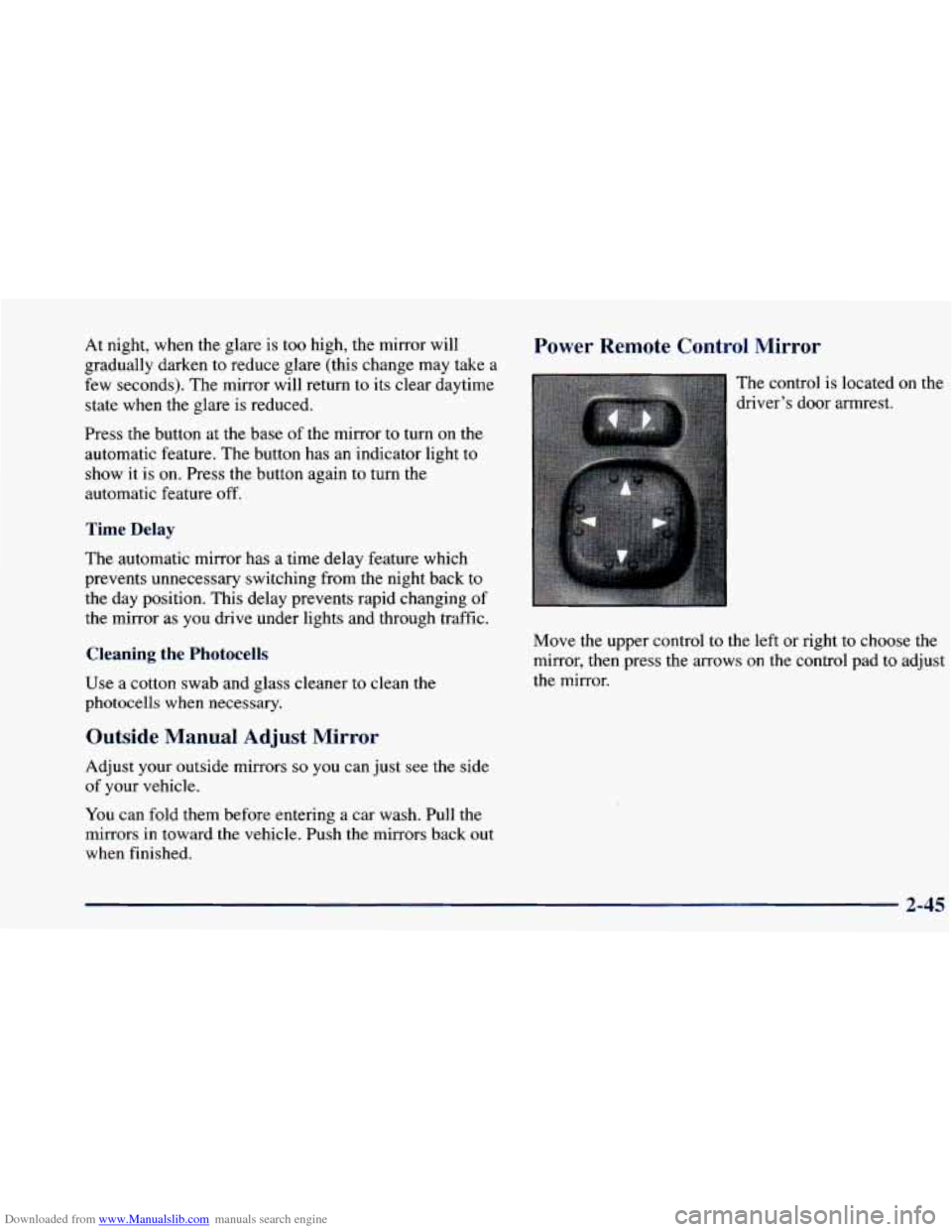
when finished. Move the upper control
to the left or right to
cl. )se me
mirror, then press the arrows on the control paa
IO adjust
the mirror.
2-45
Page 180 of 416
Downloaded from www.Manualslib.com manuals search engine To unlock a secured radio, see “Unlocking the
Theft-Deterrent Feature After
a Power Loss” earlier
in this section.
Understanding Radio Reception
AM
The range for most AM stations is greater than for FM,
especially at night. The longer range, however, can
cause stations
to interfere with each other. AM can pick
up noise from things like storms and power lines. Try
reducing the treble to reduce this noise
if you ever get it.
FM Stereo
FM stereo will give you the best sound, but FM signals
will reach only about
10 to 40 miles (16 to 65 km). Tall
buildings or hills can interfere with
FM signals, causing
the sound to come and go.
Tips About Your Audio System
Hearing damage from loud noise is almost undetectable
until it
is too late. Your hearing can adapt to higher
volumes of
sound. Sound that seems normal can be loud
and harmful
to your hearing. Take precautions by
adjusting the volume control on your radio
to a safe
sound level before your hearing adapts to it.
To help avoid hearing loss or damage:
0 Adjust the volume control to the lowest setting.
Increase volume slowly until you hear comfortably
and clearly.
I NOTICE:
I
I Before you add any sound equipment to your
vehicle
-- like a tape player, CB radio, mobile
telephone or two-way radio
-- be sure you can
add what you want.
If you can, it’s very
important to do it properly. Added sound
equipment may interfere with the operation of
your vehicle’s engine, Delco Electronics radio or
other systems, and even damage them. Your
vehicle’s systems may interfere with the
operation of sound equipment that has been
added improperly.
So, before adding sound equipment, check with
your dealer and be sure to check Federal rules
covering mobile radio and telephone units.
3-28
Page 183 of 416
Downloaded from www.Manualslib.com manuals search engine Section 4 Your Driving an” the Roa”
Here you’ll find information about driving on different kinds of roads and in varying weather conditions. We’ve also
included many other useful tips on driving.
4-2
4-3
4-5
4-6
4-9
4-1 1
4-1
1
4-13
4- 14
4-14 Defensive Driving
Drunken
Driving
Control of a Vehicle
Braking
Steering
Off-Road Recovery
Passing Loss of Control
Driving Guidelines
Off-Road Driving with Your GM
Four-Wheel-Drive Vehicle 4-27
4-28
4-3
1
4-32
4-33
4-34
4-34
4-36
4-39
4-40
4-42 Driving
at Night
Driving
in Rain and on Wet Roads
City Driving
Freeway Driving Before Leaving on a Long Trip
Highway Hypnosis
Hill and Mountain Roads
Winter Driving Recreational Vehicle Towing
Loading Your Vehicle
Towing a Trailer
Page 186 of 416

Downloaded from www.Manualslib.com manuals search engine It’s the amount of alcohol that counts. For example, if
the same person drank three double martinis (3 ounces
or
90 ml of liquor each) within an hour, the person’s
BAC would be close to 0.12 percent. A person who
consumes food just before or during drinking will have
a
somewhat lower BAC level.
There
is a gender difference, too. Women generally have
a lower relative percentage
of body water than men. Since
alcohol is carried in body water, this means that a
woman generally will reach a higher BAC level than
a
man of her same body weight when each has the same
number
of drinks.
The law in many U.S. states sets the legal limit at a BAC
of
0.10 percent. In a growing number of U.S. states, and
throughout Canada,
the limit is 0.08 percent. In some
other countries, it’s
even lower. The BAC limit for all
commercial drivers in the United States
is 0.04 percent.
The BAC will be over
0.10 percent after three to six
drinks (in one hour). Of course,
as we’ve seen, it
depends
on how much alcohol is in the drinks, and how
quickly the person drinks them.
But
the ability to drive is affected well below a BAC of
0.10 percent. Research shows that the driving skills of
many people are impaired at a BAC approaching
0.05 percent, and that the effects are worse at night. All
drivers are impaired at BAC levels above 0.05 percent.
Statistics show that the chance
of being in a collision
increases sharply for drivers who have a BAC
of
0.05 percent or above. A driver with a BAC level of
0.06 percent has doubled his or her chance of having a
collision. At a BAC level of 0.10 percent, the chance of
this driver having a collision is 12 times greater; at a
level of 0.15 percent, the chance is 25 times greater!
4-4
Page 209 of 416
Downloaded from www.Manualslib.com manuals search engine Your vehicle will require more frequent service due to
off-road use. Refer to the Maintenance Schedule for
additional information.
Driving at Night
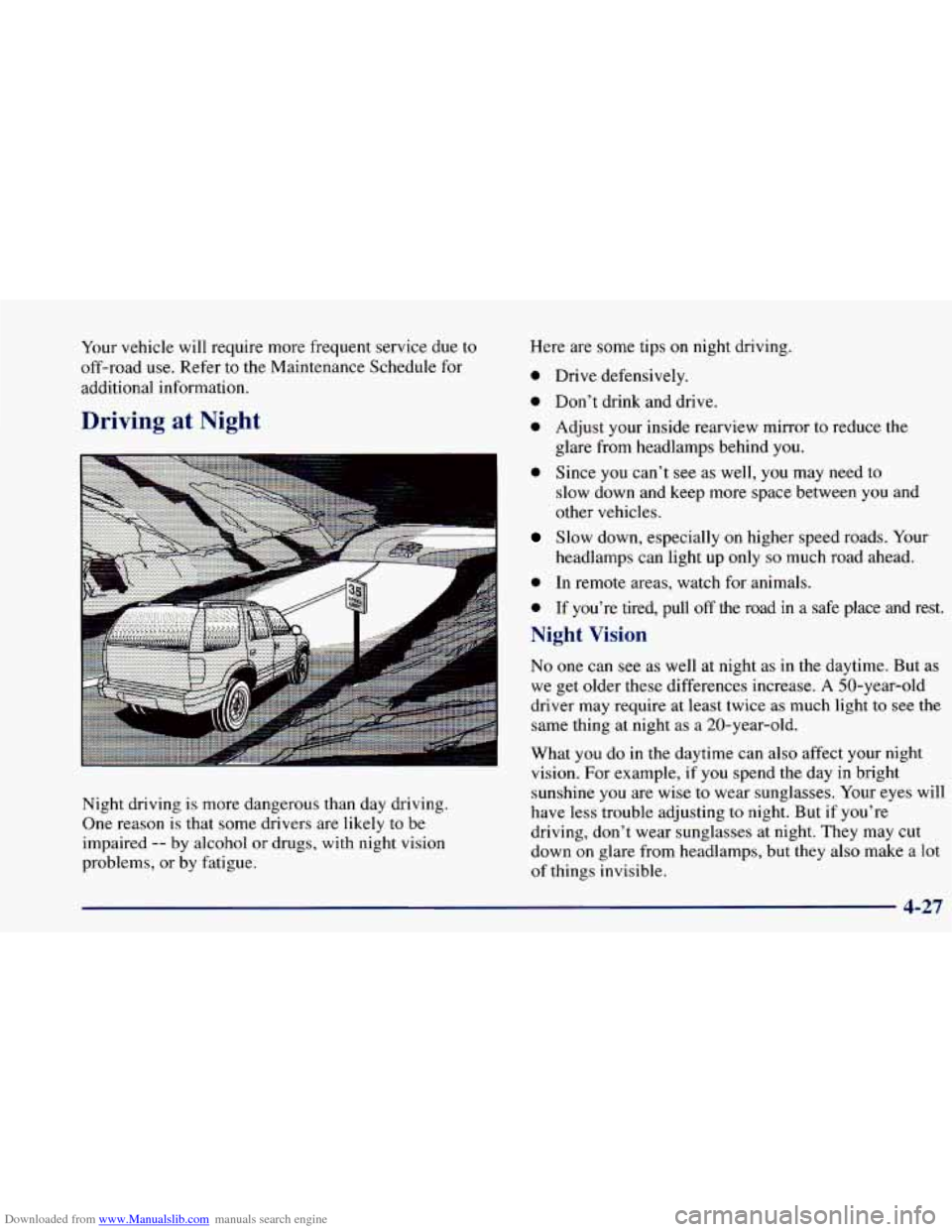
Night driving is more dangerous than day driving.
One reason is that some drivers are likely to be
impaired
-- by alcohol or drugs, with night vision
problems, or by fatigue. Rere
are some tips on night driving.
0 Drive defensively.
0 Don’t drink and drive.
0 Adjust your inside rearview mirror to reduce the
0 Since you can’t see as well, you may need to
glare
from headlamps behind you.
slow down and keep more space between you and
other vehicles.
Slow down, especially on higher speed roads. Your
headlamps can light up only
so much road ahead.
0 In remote areas, watch for animals.
0 If you’re tired, pull off the road in a safe place and rest.
Night Vision
No one can see as well at night as in the daytime. But as
we get older these differences increase. A 50-year-old
driver may require at least twice as much light to see the
same thing at night as a 20-year-old.
What you do
in the daytime can also affect your night
vision. For example,
if you spend the day in bright
sunshine you are wise to wear sunglasses. Your eyes will
have less trouble adjusting
to night. But if you’re
driving, don’t wear sunglasses at night. They may cut
down on glare from headlamps, but they also make
a lot
of things invisible.
4-27
Page 210 of 416
Downloaded from www.Manualslib.com manuals search engine You can be temporarily blinded by approaching
headlamps. It can take a second or
two, or even several
seconds, for your eyes to readjust to
the dark. When you
are faced with severe glare (as from a driver who
doesn’t lower the high beams, or a vehicle with
misaimed headlamps), slow down a little. Avoid staring
directly into the approaching headlamps.
Keep your windshield and all the glass on your vehicle
clean
-- inside and out. Glare at night is made much
worse
by dirt on the glass. Even the inside of the glass
can build up a film caused by dust. Dirty glass makes
lights dazzle and flash more than clean glass would,
making the pupils of your eyes contract repeatedly.
Remember that your headlamps light up far less of a
roadway when
you are in a turn or curve. Keep your
eyes moving; that way,
it’s easier to pick out dimly
lighted objects. Just as your headlamps should be
checked regularly for proper aim,
so should your eyes
be examined regularly. Some drivers suffer from night
blindness
-- the inability to see in dim light -- and aren’t
even aware of it.
1 -I and on Wet Roads
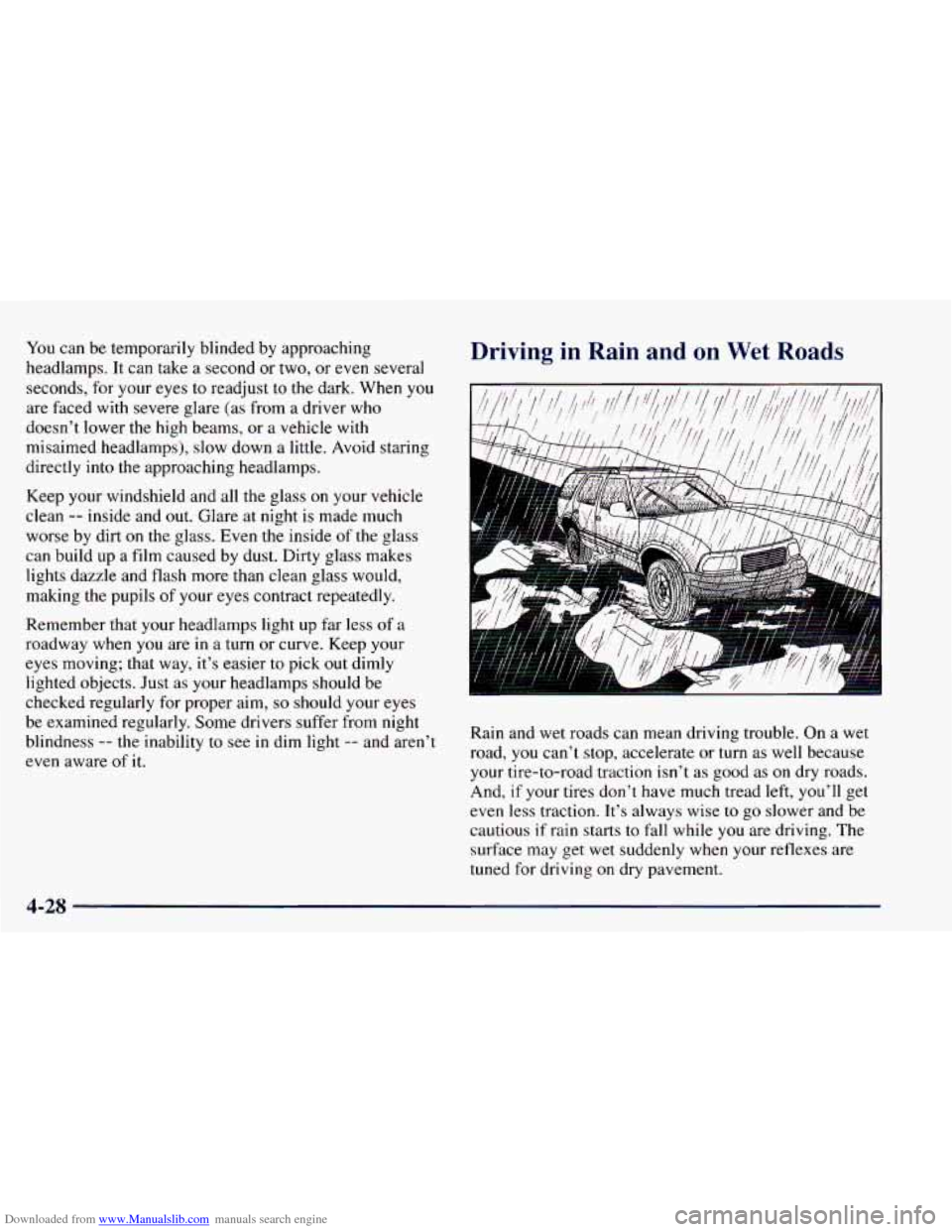
Rain and wet roads can mean driving trouble. On a wet
road,
you can’t stop, accelerate or turn as well because
your tire-to-road traction isn’t as
good as on dry roads.
And,
if your tires don’t have much tread left, you’ll get
even less traction. It’s always wise to go slower and be
cautious
if rain starts to fall while you are driving. The
surface may get wet suddenly when your reflexes are
tuned for driving
on dry pavement.
4-28
Page 214 of 416
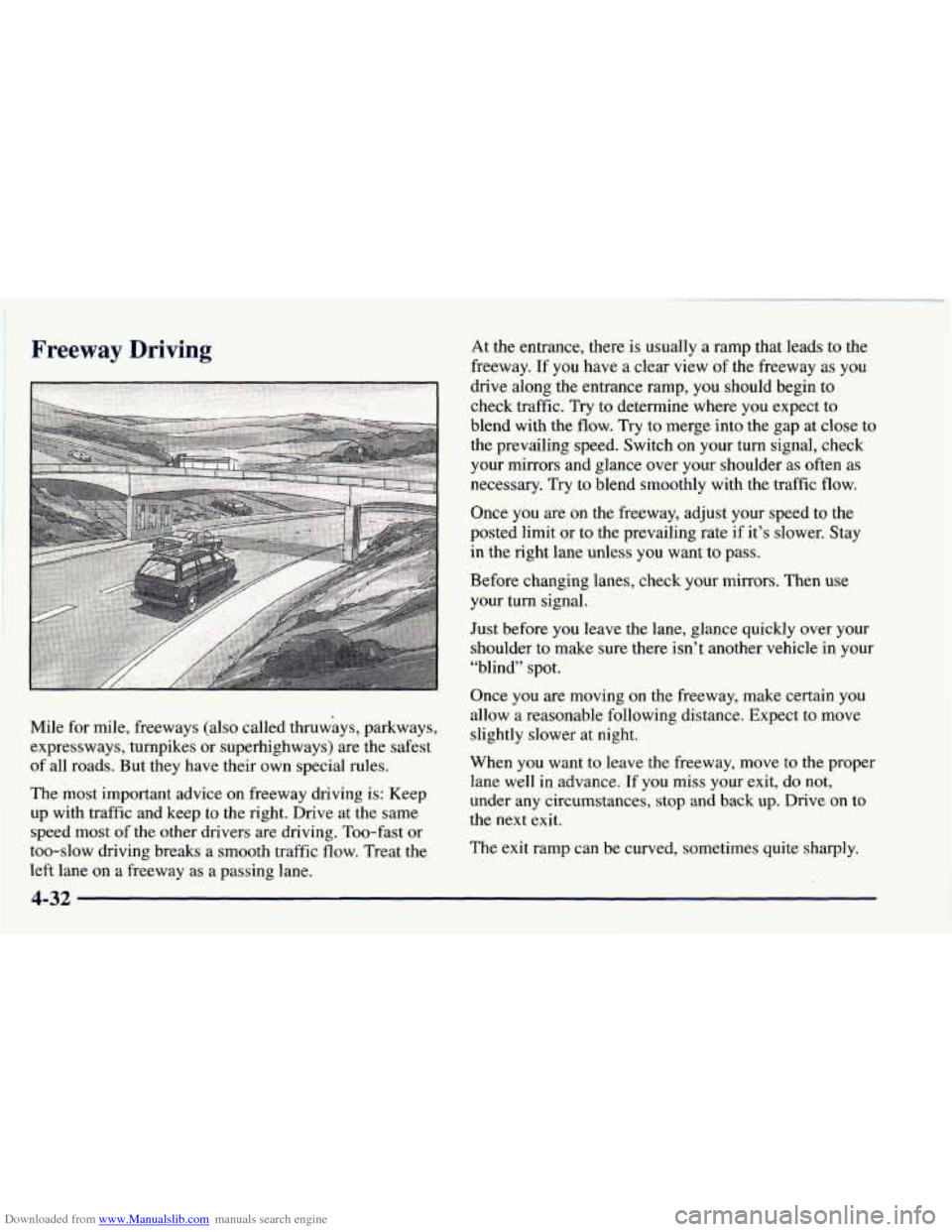
Downloaded from www.Manualslib.com manuals search engine Freeway Driving At the entrance, there is usually a ramp that leads to the
freeway. If you have a clear view
of the freeway as you
drive along the entrance ramp, you should begin to
check traffic. Try to determine where you expect to
blend with
the flow. Try to merge into the gap at close to
the prevailing speed. Switch on your turn signal, check
your
mirrors and glance over your shoulder as often as
necessary.
Try to blend smoothly with the traffic flow.
Once
you are on the freeway, adjust your speed to the
posted limit
or to the prevailing rate if it’s slower. Stay
in the right lane unless you want to pass.
Before changing lanes, check your mirrors. Then use
your turn signal.
Just before you leave the lane, glance quickly over your
shoulder
to make sure there isn’t another vehicle in your
“blind” spot.
Once you
are moving on the freeway, make certain you
allow a reasonable following distance. Expect to move
Mile for mile, freeways (also called thruways, parkways, slightly
slower at night.
expressways, turnpikes or superhighways) are the safest
of all roads. But they have their own special rules. When you wa\
nt to leave the freeway, move to the proper
up with traffic and keep
to the right. Drive at the same
speed most
of the other drivers are driving. Too-fast or
too-slow driving breaks a smooth traffic flow. Treat the The e\
xit ramp can be curved, sometimes quite sharply.
left lane on a freeway
as a passing lane. lane well
in advance. If you miss your exit, do not,
the next exit.
The most advice On driving is: under any circumstances, stop and back up. Drive on to
4-32
Page 394 of 416

Downloaded from www.Manualslib.com manuals search engine Courtesy Transportation
Chevrolet offers Courtesy Transportation for customers
needing warranty service. Courtesy Transportation will
be offered in conjunction with the coverage provided by
the Bumper
to Bumper New Vehicle Limited Warranty
to retail purchasers of
1998 Chevrolet passenger cars
and light duty trucks (please see your selling dealer
for details).
Courtesy Transportation includes:
One way shuttle ride for any warranty repair
completed during the same day.
Up to $30 maximum daily vehicle rental allowance
Up to $30 maximum daily cab, bus or other
for
any overnight warranty repair up to five days,
OR
transportation allowance in lieu of rental for any
overnight warranty repair up to five days,
OR
Up to $10 daily fuel allowance for rides provided by
another person (i.e., friend, neighbor, etc.) in lieu of
rental for any overnight warranty repair up to five days.
Note: All Courtesy Transportation arrangements
will be administered
by your Chevrolet dealer
service management. Claim amounts should
reflect all actual costs.
Chevrolet Courtesy Transportation is not part of the
Bumper to Bumper New Vehicle Limited Warranty.
Chevrolet reserves the right to make any changes or
discontinue Courtesy Transportation at any time
without notification.
For additional program details, contact your
Chevrolet dealer.
Some state insurance regulations make it impractical to
rent vehicles to people under
21 years of age. If you are
under
21 and have difficulty renting a vehicle, Chevrolet
will reimburse up
to $30/day for documented
transportation you receive.
For warranty repairs during the Complete Vehicle
Coverage period in the
New Vehicle Limited Warranty,
interim transportation may be available under the
Courtesy Transportation Program. Please consult your
dealer for details. The Roadside Assistance program is
available only in the United States and Canada.
In Canada, please consult your GM dealer for
information on Courtesy Transportation.
8-8