air condition CHEVROLET C/K 2003 User Guide
[x] Cancel search | Manufacturer: CHEVROLET, Model Year: 2003, Model line: C/K, Model: CHEVROLET C/K 2003Pages: 386, PDF Size: 5.79 MB
Page 202 of 386
4-9
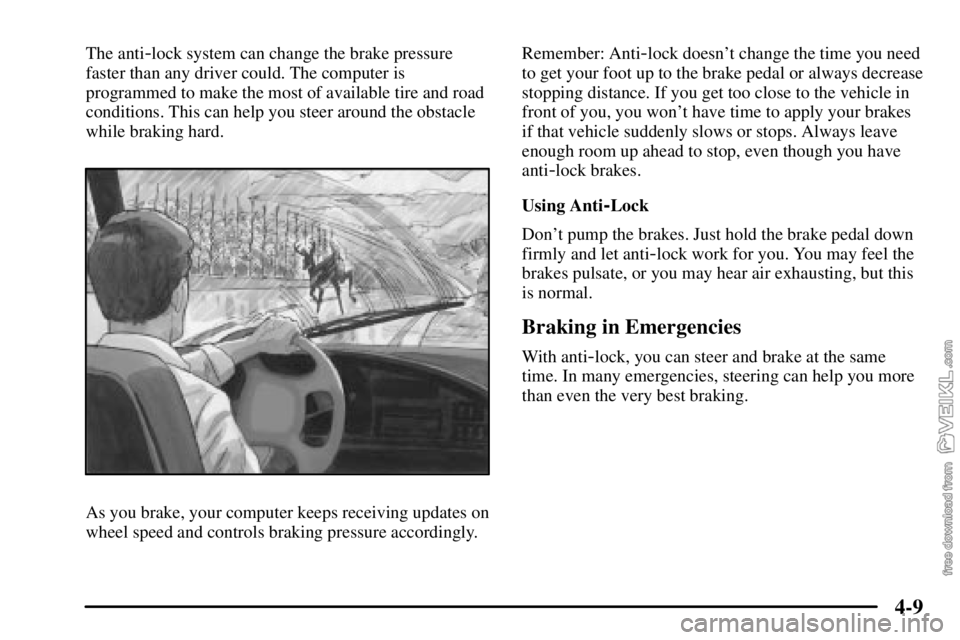
The anti-lock system can change the brake pressure
faster than any driver could. The computer is
programmed to make the most of available tire and road
conditions. This can help you steer around the obstacle
while braking hard.
As you brake, your computer keeps receiving updates on
wheel speed and controls braking pressure accordingly.Remember: Anti
-lock doesn't change the time you need
to get your foot up to the brake pedal or always decrease
stopping distance. If you get too close to the vehicle in
front of you, you won't have time to apply your brakes
if that vehicle suddenly slows or stops. Always leave
enough room up ahead to stop, even though you have
anti
-lock brakes.
Using Anti
-Lock
Don't pump the brakes. Just hold the brake pedal down
firmly and let anti
-lock work for you. You may feel the
brakes pulsate, or you may hear air exhausting, but this
is normal.
Braking in Emergencies
With anti-lock, you can steer and brake at the same
time. In many emergencies, steering can help you more
than even the very best braking.
Page 251 of 386

5-26
Engine Fan Noise
Your vehicle has a clutched engine cooling fan. When
the clutch is engaged, the fan spins faster to provide
more air to cool the engine. In most everyday driving
conditions, the clutch is not fully engaged. This
improves fuel economy and reduces fan noise. Under
heavy vehicle loading, trailer towing and/or high outside
temperatures, the fan speed increases when the clutch
engages. So you may hear an increase in fan noise.
This is normal and should not be mistaken as the
transmission slipping or making extra shifts. It is merely
the cooling system functioning properly. The fan will
slow down when additional cooling is not required and
the clutch disengages.
You may also hear this fan noise when you start the
engine. It will go away as the fan clutch disengages.
If a Tire Goes Flat
It's unusual for a tire to ªblow outº while you're driving,
especially if you maintain your tires properly. If air goes
out of a tire, it's much more likely to leak out slowly.
But if you should ever have a ªblowout,º here are a few
tips about what to expect and what to do:
If a front tire fails, the flat tire will create a drag that
pulls the vehicle toward that side. Take your foot off the
accelerator pedal and grip the steering wheel firmly.
Steer to maintain lane position, and then gently brake to
a stop well out of the traffic lane.
A rear blowout, particularly on a curve, acts much like a
skid and may require the same correction you'd use in a
skid. In any rear blowout, remove your foot from the
accelerator pedal. Get the vehicle under control by
steering the way you want the vehicle to go. It may be
very bumpy and noisy, but you can still steer. Gently
brake to a stop
-- well off the road if possible.
If a tire goes flat, avoid further tire and wheel damage
by driving slowly to a level place and turn on your
hazard warning flashers. The next part tells you what
to do.
Page 298 of 386

6-44 Four-Wheel Disc Brakes (Hydraulic Only)
Your vehicle has four-wheel disc brakes.
Some driving conditions or climates may cause a brake
squeal when the brakes are first applied or lightly
applied. This does not mean something is wrong with
your brakes.
Brake linings should always be replaced as complete
axle sets.
Four-Wheel and Six-Wheel Drum Brakes
(Air Only)
The brake drums should be removed and inspected each
time the tires are removed for rotation or changing.
When you have the front brakes replaced, have the rear
brakes inspected, too.
Brake linings should always be replaced as complete
axle sets.
Page 311 of 386
6-57 Front Wheel Bearings with Oil-Filled Hubs
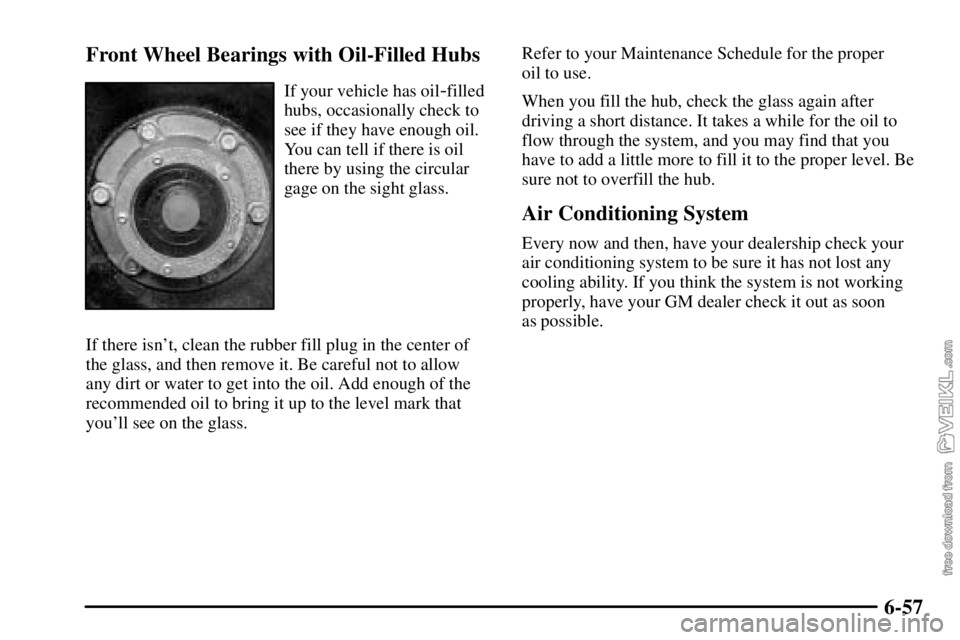
If your vehicle has oil-filled
hubs, occasionally check to
see if they have enough oil.
You can tell if there is oil
there by using the circular
gage on the sight glass.
If there isn't, clean the rubber fill plug in the center of
the glass, and then remove it. Be careful not to allow
any dirt or water to get into the oil. Add enough of the
recommended oil to bring it up to the level mark that
you'll see on the glass.Refer to your Maintenance Schedule for the proper
oil to use.
When you fill the hub, check the glass again after
driving a short distance. It takes a while for the oil to
flow through the system, and you may find that you
have to add a little more to fill it to the proper level. Be
sure not to overfill the hub.
Air Conditioning System
Every now and then, have your dealership check your
air conditioning system to be sure it has not lost any
cooling ability. If you think the system is not working
properly, have your GM dealer check it out as soon
as possible.
Page 336 of 386

6-82
Fuse Block 2
Circuit Breaker Usage
1 Stoplamps
2 Center High Mounted Stop Lamp
3 Parking Lamps
4 Powertrain Control Module
5 Auxiliary Wiring
6 Heater/Air ConditioningCircuit Breaker Usage
7 Hazard Warning Flashers
8 Power Post
9 Courtesy Lamps
10 Warning Lights, Gages
and Indicators
11 Crank
12 Rear Axle
13 Trailer Turn Signals/Hazard
Warning Flashers
14 Radio/Chime
15 Daytime Running Lamps
16 Air Bag System
17 Exterior/Interior Lamps
18 Parking Brake
19 Accessory Power
20 Ignition
21 Sidemarker Lamps
22 Turn Signal/Backup Lamps
23 Transmission
24 Chassis
A Spare
B Spare
Page 339 of 386

6-85
Fuse Usage
BLANK Empty
A/C COMP Air Conditioning Compressor
ABS 1 Anti
-Lock Brake System 1
ABS 2 Anti
-Lock Brake System 2
ABS 3 Anti
-Lock Brake System 3
ENGINE Engine
E/A PUMP Electronic/Automatic Pump
HORN Horn
NOTE 2 L18/LB7 Fuel, LG4 Powertrain
Control Valve, LG5 Electronic
Control Module
BLANK Empty
STUD A Spare
STUD B Spare
Secondary Underhood Fuse Block
Fuse Usage
IGN 1 Ignition 1
IGN 4 Ignition 4
IGN 3 Ignition 3
BATT/HAZ Battery/Hazard Warning Flashers
HEADLAMP Headlamps
LIGHTING Interior/Exterior Lamps
HVAC Comfort Control System
NOTE C4/C5 Electric Brake,
C6/C7/C8 Brake Lamps
Page 341 of 386

6-87 Cooling System Capacity
The following approximate capacities are given in
English and metric conversions.
Please refer to ªRecommended Fluids and Lubricantsº
in the Index for more information.
C4/C5 Models Quarts (Liters). . . . . . . . . . . . . . . . .
8.1L with manual transmission 30.1 (28.5). . . . . . . .
8.1L with automatic transmission 29.8 (28.2). . . . . .
6.6L with manual transmission 27.6 (26.1). . . . . . . .
6.6L with automatic transmission 27.3 (25.8). . . . . .
C6/C7/C8 Models Quarts (Liters). . . . . . . . . . . . . .
8.1L with manual transmission 33.3 (31.5). . . . . . . .
8.1L with manual transmission,
air conditioning and increased
cooling 34.9 (33.0). . . . . . . . . . . . . . . . . . . . . . . . . . .
8.1L with automatic transmission 32.5 (30.8). . . . . .
7.8L 200
-230 hp engine with
manual transmission 31.6 (29.9). . . . . . . . . . . . . . . .
7.8L 200
-230 hp engine with manual
transmission, air conditioning and
increased cooling 35.3 (33.4). . . . . . . . . . . . . . . . . . . C6/C7/C8 Models Quarts (Liters). . . . . . . . . . . . . .
7.8L 200
-215 hp engine with
automatic transmission 33.7 (31.9). . . . . . . . . . . . . .
7.2L 175
-230 hp engine with
manual transmission 29.3 (27.7). . . . . . . . . . . . . . . .
7.2L 175
-230 hp engine with
manual transmission, air conditioning
and increased cooling 33.0 (31.2). . . . . . . . . . . . . . .
7.2L 175
-210 hp engine with
automatic transmission 31.4 (29.7). . . . . . . . . . . . . .
7.8L 250
-275 hp engine with
manual transmission 34.9 (33.0). . . . . . . . . . . . . . . .
7.8L 250
-275 hp engine with
manual transmission, air conditioning
and increased cooling 35.4 (33.5). . . . . . . . . . . . . . .
7.8L 230
-275 hp engine with automatic
transmission 33.3 (31.5). . . . . . . . . . . . . . . . . . . . . .
7.2L 250
-300 hp engine with manual
transmission 32.8 (31.0). . . . . . . . . . . . . . . . . . . . . .
7.2L 250
-300 hp engine with manual
transmission, air conditioning and
increased cooling 33.3 (31.5). . . . . . . . . . . . . . . . . . .
7.2L 250
-300 hp engine with automatic
transmission 31.2 (29.5). . . . . . . . . . . . . . . . . . . . . .
Page 344 of 386

6-90 Rear Axle Lubricant Capacity
Single Speed Axle Pints (Liters). . . . . . . . . . . . . . . .
80 10.0 (4.7). . . . . . . . . . . . . . . . . . . . . . . . . . . . . . . .
S135 26.0 (12.3). . . . . . . . . . . . . . . . . . . . . . . . . . . .
19060S 31.0 (14.7). . . . . . . . . . . . . . . . . . . . . . . . . .
21060D 31.0 (14.7). . . . . . . . . . . . . . . . . . . . . . . . . .
21060S 31.0 (14.7). . . . . . . . . . . . . . . . . . . . . . . . . .
S150 28.0 (13.0). . . . . . . . . . . . . . . . . . . . . . . . . . . .
23090S 40.0 (19.0). . . . . . . . . . . . . . . . . . . . . . . . . .
23105S 56.0 (26.5). . . . . . . . . . . . . . . . . . . . . . . . . .
26105S 54.0 (25.5). . . . . . . . . . . . . . . . . . . . . . . . . .
Tw o
-Speed Axle Pints (Liters). . . . . . . . . . . . . . . . .
19060T 38.0 (18.0). . . . . . . . . . . . . . . . . . . . . . . . . .
21060T 38.0 (18.0). . . . . . . . . . . . . . . . . . . . . . . . . .
23082T 40.0 (19.0). . . . . . . . . . . . . . . . . . . . . . . . . .
26080T 44.0 (20.8). . . . . . . . . . . . . . . . . . . . . . . . . .
Tandem Axles Pints (Liters). . . . . . . . . . . . . . . . . . .
DS344 (front) 32.0 (15.1). . . . . . . . . . . . . . . . . . . . .
RS344 (rear) 31.0 (14.7). . . . . . . . . . . . . . . . . . . . . .
DSH44 (front) 32.0 (15.1). . . . . . . . . . . . . . . . . . . . .
RSH44 (rear) 31.0 (14.7). . . . . . . . . . . . . . . . . . . . . .
DS404, DS404P (front) 32.0 (15.1). . . . . . . . . . . . . .
RS404 (rear) 31.0 (14.7). . . . . . . . . . . . . . . . . . . . . .
Air Conditioning Refrigerant
Capacity
If you do your own service work, you'll need the proper
service manual. See ªDoing Your Own Service Workº in
the Index for additional information. It is recommended
that service work on your air conditioning system be
performed by a qualified technician.
Air Conditioning Refrigerant
R134a 2.1 lbs. (1.0 kg). . . . . . . . . . . . . . . . . . . . . . .
Use Refrigerant Oil, R143a Systems
Normal Maintenance
Replacement Parts
Allison Transmission External Filters
See the Allison Transmission Operator's Manual in your
vehicle for external filter part numbers and information.
Air Compressor Filter
Air Compressor Part Number
Bendix Tu
-Flo
550 (13.2 CFM)2467368
Page 348 of 386

7-2
Have you purchased the GM Protection Plan? The Plan
supplements your new vehicle warranties. See your
Warranty and Owner Assistance booklet or your dealer
for details.
Introduction
Your Vehicle and the Environment
Proper vehicle maintenance not only helps to keep your
vehicle in good working condition, but also helps the
environment. All recommended maintenance procedures
are important. Improper vehicle maintenance can even
affect the quality of the air we breathe. Improper fluid
levels or the wrong tire inflation can increase the level
of emissions from your vehicle. To help protect our
environment, and to keep your vehicle in good
condition, please maintain your vehicle properly.
Maintenance Requirements
Maintenance intervals, checks, inspections and
recommended fluids and lubricants as prescribed in this
manual are necessary to keep your vehicle in good
working condition. Any damage caused by failure to
follow recommended maintenance may not be covered
by warranty.
Page 349 of 386
7-3 How This Section is Organized
This maintenance schedule is divided into four parts:
ªPart A: Scheduled Maintenance Servicesº explains
what to have done and how often. Some of these
services can be complex, so unless you are technically
qualified and have the necessary equipment, you should
let your dealer's service department or another qualified
service center do these jobs.
CAUTION:
Performing maintenance work on a vehicle can
be dangerous. In trying to do some jobs, you can
be seriously injured. Do your own maintenance
work only if you have the required know
-how
and the proper tools and equipment for the job.
If you have any doubt, have a qualified
technician do the work.
If you want to get the service information, see ªService
and Owner Publicationsº in the Index.ªPart B: Owner Checks and Servicesº tells you
what should be checked and when. It also explains what
you can easily do to help keep your vehicle in good
condition.
ªPart C: Recommended Fluids and Lubricantsº lists
some recommended products necessary to help keep
your vehicle properly maintained. These products, or
their equivalents, should be used whether you do the
work yourself or have it done.
ªPart D: Maintenance Recordº is a place for
you to record and keep track of the maintenance
performed on your vehicle. Keep your maintenance
receipts. They may be needed to qualify your vehicle
for warranty repairs.