oil change CHEVROLET CAMARO 1967 1.G Chassis User Guide
[x] Cancel search | Manufacturer: CHEVROLET, Model Year: 1967, Model line: CAMARO, Model: CHEVROLET CAMARO 1967 1.GPages: 659, PDF Size: 114.24 MB
Page 276 of 659
ENGINE 6-11
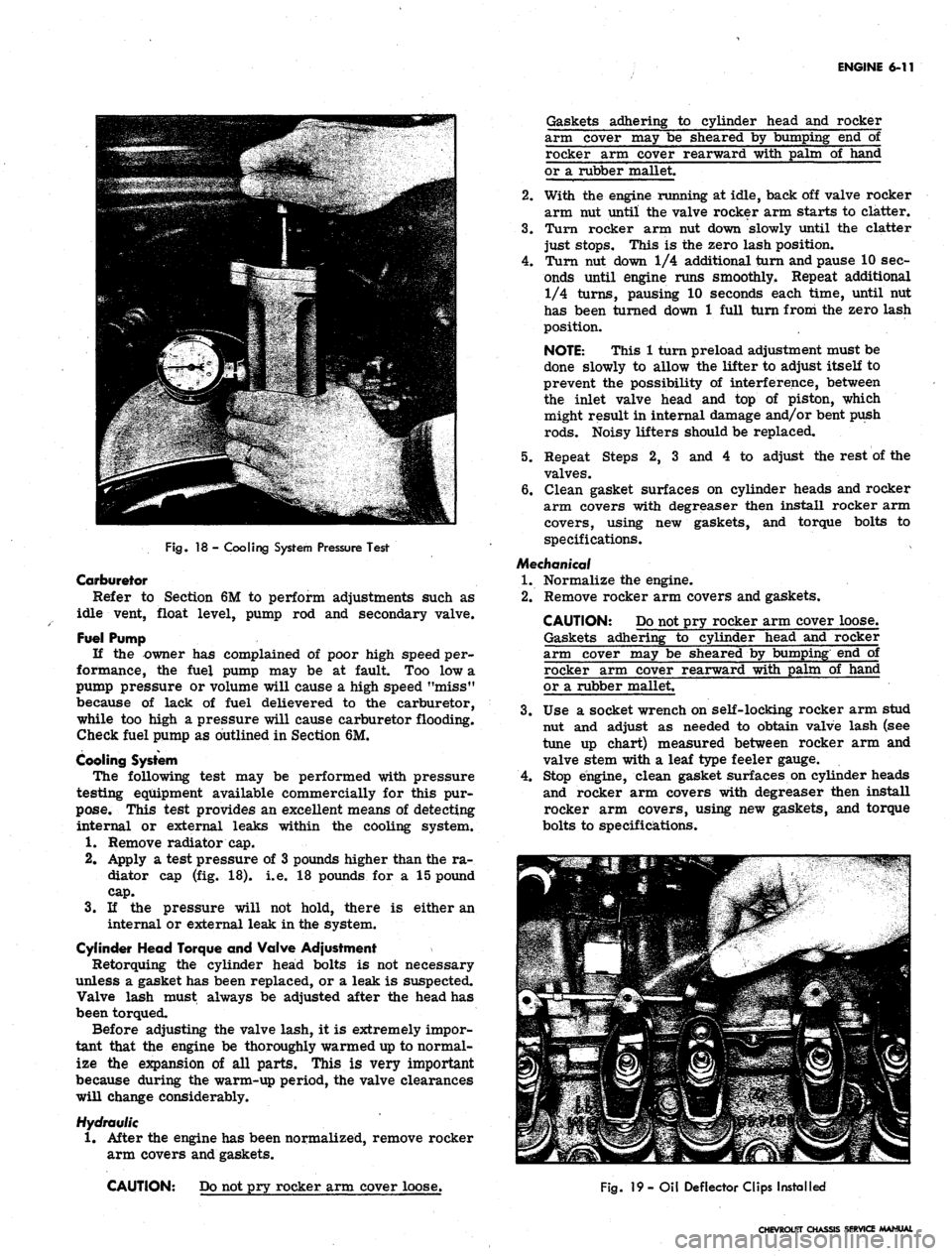
Fig.
18 - Cooling System Pressure Test
Carburetor
Refer to Section 6M to perform adjustments such as
idle vent, float level, pump rod and secondary valve.
Fuel Pump
If the owner has complained of poor high speed per-
formance, the fuel pump may be at fault. Too low a
pump pressure or volume will cause a high speed "miss"
because of lack of fuel delievered to the carburetor,
while too high a pressure will cause carburetor flooding.
Check fuel pump as outlined in Section 6M.
Cooling System
The following test may be performed with pressure
testing equipment available commercially for this pur-
pose.
This test provides an excellent means of detecting
internal or external leaks within the cooling system.
1.
Remove radiator cap.
2.
Apply a test pressure of 3 pounds higher than the ra-
diator cap (fig. 18). i.e. 18 pounds for a 15 pound
cap.
3.
If the pressure will not hold, there is either an
internal or external leak in the system.
Cylinder Head Torque and Valve Adjustment
Retorquing the cylinder head bolts is not necessary
unless a gasket has been replaced, or a leak is suspected.
Valve lash must always be adjusted after the head has
been torqued.
Before adjusting the valve lash, it is extremely impor-
tant that the engine be thoroughly warmed up to normal-
ize the expansion of all parts. This is very important
because during the warm-up period, the valve clearances
will change considerably.
Hydraulic
1.
After the engine has been normalized, remove rocker
arm covers and gaskets.
CAUTION: Do not pry rocker arm cover loose.
Gaskets adhering to cylinder head and rocker
arm cover may be sheared by bumping end of
rocker arm cover rearward with palm of hand
or a rubber mallet.
2.
With the engine running at idle, back off valve rocker
arm nut until the valve rocker arm starts to clatter.
3.
Turn rocker arm nut down slowly until the clatter
just stops. This is the zero lash position.
4.
Turn nut down 1/4 additional turn and pause 10 sec-
onds until engine runs smoothly* Repeat additional
1/4 turns, pausing 10 seconds each time, until nut
has been turned down 1 full turn from the zero lash
position.
NOTE: This 1 turn preload adjustment must be
done slowly to allow the lifter to adjust itself to
prevent the possibility of interference, between
the inlet valve head and top of piston, which
might result in internal damage and/or bent push
rods.
Noisy lifters should be replaced.
5.
Repeat Steps 2, 3 and 4 to adjust the rest of the
valves.
6. Clean gasket surfaces on cylinder heads and rocker
arm covers with degreaser then install rocker arm
covers, using new gaskets, and torque bolts to
specifications.
Mechanical
1.
Normalize the engine.
2.
Remove rocker arm covers and gaskets.
CAUTION: Do not pry rocker arm cover loose.
Gaskets adhering to cylinder head and rocker
arm cover may be sheared by bumping end of
rocker arm cover rearward with palm of hand
or a rubber mallet.
3.
Use a socket wrench on self-locking rocker arm stud
nut and adjust as needed to obtain valve lash (see
tune up chart) measured between rocker arm and
valve stem with a leaf type feeler gauge.
4.
Stop engine, clean gasket surfaces on cylinder heads
and rocker arm covers with degreaser then install
rocker arm covers, using new gaskets, and torque
bolts to specifications.
Fig.
19
- Oil Deflector Clips Installed
CHEVROLET CHASSIS SERVICE MANUAL
Page 277 of 659
ENGINE
6-12
ENGINE
MECHANICAL
IN LINE
INDEX
Page
General Description . „ 6-12
Component Replacement and Adjustment 6-12
.Engine Assembly 6-12
Removal 6-12
Installation 6-13
Manifold Assembly 6-14
Removal . 6-14
Installation 6-14
Rocker Arm Cover . 6-14
Removal 6-14
mstallation . . . 6-14
Valve Mechanism
......
1 6-14
Removal 6-14
Installation and Adjustment . 6-14
Valve Lifters
..............
6-15
Locating Noisy Lifters
„.;....
6-15
Removal
.'.*...•
6-15
Installation . 6-15
Valve Stem Oil Seal and/or Valve Spring . 6-16
Replacement . 6-16
Cylinder Head Assembly . 6-16
Removal 6-16
Installation . 6-16
Oil Pan . » 6-17
Removal . . . ; . . 6-17
Installation
.........
. 6-17
Oil Pump . 6-18
Page
Removal . 6-18
Installation . 6-18
Oil Seal (Rear Main) . 6-19
Replacement 6-19
Crankshaft Pulley and Hub 6-19
Removal 6-19
Installation 6-19
Torsional Damper 6-19
Removal 6-19
Installation 6-19
Crankcase Front Cover . 6-20
Removal . 6-20
Installation 6-20
•
Oil Seal (Front Cover) 6-20
Replacement 6-20
Camshaft 6-21
Measuring Lobe Lift . ... .
.-.••.-.
6-21
Removal 6-21
Installation 6-22
Timing Gears
..••••.............••• 6—22
Replacement
6-22
Flywheel
6-22
Removal
* 6-22
Installation
6-22
Engine
Mounts
6-23
Replacement
(Front)
6-23
Replacement
(Rear)
. 6-23
GENERAL DESCRIPTION
The
In
Line engines
(fig. 1L)
covered
in
this section
are
the 1H3 cu. in. L4, the 194,
230
and
250
cu. in. L6,
regardless
of
which passenger vehicle they
are
used
in.
This section covers
the
removal
and
installation
of en-
gine assemblies;
the
removal, installation
and
adjustment
of some sub-assemblies
and
replacement
of
some
com-
ponents.
For
service
to all
components
and
sub-assem-
blies (after removal)
and
removal
of
some sub-assem-
blies,
refer
to
Section
6 of the
Chassis Overhaul Manual.
Because
of the
interchangeability
and
similarity
of
many engine sub-assemblies
and
engine parts, regardless
of which passenger vehicle they
are
used
in,
typical illus-
trations
and
procedures
are
used except where specific
illustrations
or
procedures
are
necessary
to
clarify
the
operation. Although illustrations showing bench opera-
tions
are
used, most single operations, when
not
part
of a
general overhaul, should
be
performed
(if
practical) with
the engine
in the
vehicle.
COMPONENT REPLACEMENT
AND
ADJUSTMENT
ENGINE ASSEMBLY
Removal
1.
Drain cooling system
and
engine
oil.
2.
Remove
air
cleaner
and
disconnect battery cables
at 7.
battery.
3.
Remove hood
as
outlined
in
Section 11.
4.
Remove radiator
and
radiator shroud
as
outlined
in
Section 13.
5.
Remove
fan
blade
and
pulley
as
outlined
in
Section
6K.
6. Disconnect wires
at:
• Starter Solenoid
8.
• Delcotron
9.
Temperature Switch
Oil Pressure Switch
Coil
Disconnect:
Accelerator linkage
at
manifold bellerank.
Exhaust pipe
at
manifold flange.
.
Fuel line (from tank)
at
fuel pump.
Vacuum line
to
power brake unit
at
manifold
(if
so equipped).
• Power steering pump lines
at
pump
end (if so
equipped).
Raise vehicle
and
place
on
jack stands.
Remove propeller shaft.
CHEVROLET CHASSIS SERVICE MANUAL
Page 290 of 659
ENGINE 6-25
refer to Section 6 of the Chassis Overhaul Manual.
Because of the interchangeability and similarity of
many engines, engine sub-assemblies and engine parts,
regardless of which passenger vehicle they are used in,
typical illustrations and procedures are used except
where specific illustrations or procedures are necessary
to clarify the operation. Although illustrations showing
bench operations are used, most single operations, when
not part of a general overhaul, should be performed (if
practical) with the engine in the vehicle.
COMPONENT REPLACEMENT AND ADJUSTMENT
ENGINE ASSEMBLY
Removal
• .1. Drain cooling system and engine oil.
2.
Remove air cleaner and disconnect battery cables at
battery.
3.
Remove hood as outlined in Section 11.
4.
Remove radiator and shroud as outlined in Sec-
tion 13.
5. Remove fan blade and pulley as outlined in Sec-
tion 6K.
6. Disconnect wires at:
• Starter solenoid
• Delcotron
• Temperature switch
• Oil pressure switch
• Coil
7. Disconnect:
• Accelerator linkage at pedal lever.
• Exhaust pipes at manifold flanges.
• Vacuum line to power brake unit at manifold (if
so equipped),
• Power steering pump lines at pump end (if so
equipped).
• Fuel line (from tank) at fuel pump.
• Engine cooler lines (if so equipped).
• Oil pressure gauge line (if so equipped).
8. Raise vehicle and place on jack stands.
9. Remove propeller shaft.
NOTE:
If plug for propeller shaft opening
in transmission is not available, drain
transmission.
10.
Disconnect:
• Shift linkage at transmission.
• Speedometer cable at transmission.
• Transmission cooler lines (if so equipped).
11.
On synchromesh equipped vehicles, disconnect clutch
linkage at cross-shaft then remove cross-shaft en-
gine bracket.
12.
Remove rocker arm covers as outlined, then attach
engine lifting adapter at the proper cylinder head bolt
locations.
13.
Remove front mount bolts.
14.
Attach lifting device and raise engine to take weight
off front mounts, then remove rear mount bolts.
15.
Raise engine to take weight off rear mount, then re-
move crossmember.
NOTE:
On Chevrolets it will be necessary to
remove mount from transmission before cross-
member can be removed.
16.
Remove engine-transmission assembly from vehicle
as a unit.
17.
Remove transmission (and clutch):
Synchromesh Transmission
a. Remove clutch housing cover plate screws.
b.
Remove bolts attaching the clutch housing to en-
gine block then remove transmission and clutch
housing as a unit.
NOTE:
Support the transmission as the last
mounting bolt is removed, and as it is being
pulled away from the engine (to prevent damage
to clutch disc).
c. Remove starter and clutch housing rear cover
plate.
d. Loosen clutch mounting bolts a turn at a time (to
prevent distortion of clutch cover) until the spring
pressure is released. Remove all bolts, clutch
disc and pressure plate assembly.
Automatic
Transmission
a. Lower engine, secured by the hoist, and support
engine on blocks.
b.
Remove starter and converter housing underpan.
c. Remove flywheel-to-converter attaching bolts.
d. Support transmission on blocks.
e. Remove transmission-to-engine mounting bolts.
f. With the hoist attached, remove blocks from the
engine only and slowly guide the engine from the
transmission.
18.
Mount engine in stand.
Installation
1.
Attach lifting device to engine and remove engine
from engine stand.
2.
Install transmission (and clutch):
Synchromesh Transmission
a. Install the clutch on flywheel as outlined in Sec-
tion 7.
b.
Install clutch housing rear cover and starter.
c. Install transmission and clutch housing as out-
lined in Section 7.
d. Install clutch housing cover screws and tighten
securely.
Automatic
Transmissions
a. Position engine adjacent to the transmission and
align the converter with the flywheel.
b.
Bolt transmission to engine, then raise engine and
transmission assembly and install flywheel to
converter attaching bolts.
c. Install converter housing underpan and starter.
3.
Tilt and lower engine and transmission assembly into
the chassis as a unit, guiding engine to align front
mounts with frame supports.
4.
Install front mount bolts and torque to specifications.
5. Raise engine enough to install rear crossmember,
then install crossmember, install rear mount, lower
engine and torque rear mount to specifications.
CHEVROLET CHASSIS SERVICE MANUAL
Page 309 of 659

SECTION 6M
ENGINE FUEL
CONTENTS OF THIS SECTION
Page
Carburetors 6M-1 Fuel Pumps .
Air Cleaners 6M-7 Special Tools
Page
6M-10
6M-12
CARBURETORS
INDEX
Page
General Description 6M-1
Service Procedures 6M-1
Preliminary Checks 6M-1
Idle Speed and Mixture Adjustment ........... 6M-1
Fast Idle Adjustment .................. 6M-3
Choke Adjustment 6M-3
Float Adjustment 6M-4
Page
Additional Adjustments 6M-4
Removal 6M-4
Test Before Installation 6M-5
Installation 6M-5
Fuel Filter Maintenance 6M-5
Choke Coil Replacement 6M-5
Throttle Linkage Adjustment . . 6M-6
GENERAL DESCRIPTION
Various carburetors (fig. lc) are used with Chevrolet,
Chevelle, Chevy II, Camaro and Corvette passenger
vehicles. These carburetors are designed to meet the
particular requirements of engines, transmissions and
vehicles, therefore carburetors that look alike are not
always interchangeable. (Refer to carburetor part num-
ber and/or specifications.)
Because many service procedures for the various
carburetors are similar, typical illustrations and pro-
cedures are used except where specific illustrations or
procedures are necessary to clarify the operation.
This section covers removal, installation and adjust-
ments (on engine) of carburetors. Also covered in this
section are maintenance procedures for choke coils,
throttle linkage and fuel filters. For carburetor .over-
haul procedures and additional adjustments (bench), re-
fer to Section 6M of the Overhaul Manual under the
carburetor being serviced.
Specifications for carburetors are located in the back
of this manual.
SERVICE PROCEDURES
Preliminary Checks
1.
Thoroughly warm-up engine. If the engine is cold,
allow to run for at least 15 minutes.
2.
Inspect torque of carburetor to intake manifold bolts
and intake manifold to cylinder head bolts to exclude
the possibility of air leaks.
3.
Inspect manifold heat control valve (if used) for free-
dom of action and correct spring tension.
Idle Speed and Mixture Adjustment (Except Air Injection
Reactor System)
NOTE:
This adjustment should be performed
with engine at operating temperature and park-
ing brake applied.
1.
Remove Air Cleaner.
2.
Connect tachometer and vacuum gauge to engine, then
set hand brake and shift transmission into neutral.
3.
As a preliminary adjustment, turn idle mixture
screws lightly to seat and back out 1-1/2 turns.
CAUTION: Do not turn idle mixture screw
tightly against seat or damage may result.
4.
With engine running (choke wide open) adjust idle
speed screw to specified idle speed, (automatic
transmission in drive, synchronized transmission in
neutral).
5. Adjust idle mixture screw to obtain highest steady
vacuum at specified idle speed.
NOTE:
On air conditioned vehicles, turn air
conditioning to the "on" position and hold the
hot idle compensator valve closed while adjust-
ing idle speed and idle mixture screws.
NOTE:
On Rochester BV carburetors the idle
mixture screw should be turned out 1/4 turn
from the "lean roll" position. The definition
of "lean roll" point is a 20 to 30 rpm drop
in engine speed obtained by leaning the idle
mixture.
6. Repeat Steps 4 and5 as needed for final adjustment.
NOTE:
If necessary, final adjustment of the \
carburetor may be made with the air cleaner
installed.
7. Turn engine off, remove gauges and install air
clearer.
CHEVROLET CHASSIS SERVICE MANUAL
Page 315 of 659
ENGINE FUEL 6M-7
5. On vehicles equipped with automatic transmission
hold throttle rod in full throttle position, pull TV
rod to full detent position and adjust TV rod to just
enter hole on throttle lever, then connect TV rod at
throttle lever.
NOTE:
If equipped with anti-stall device (dash-
pot),
set carburetor fast idle cam on high step
and adjust dash-pot to just contact throttle
lever.
327
CU.
IN.
427
CU.
IN.
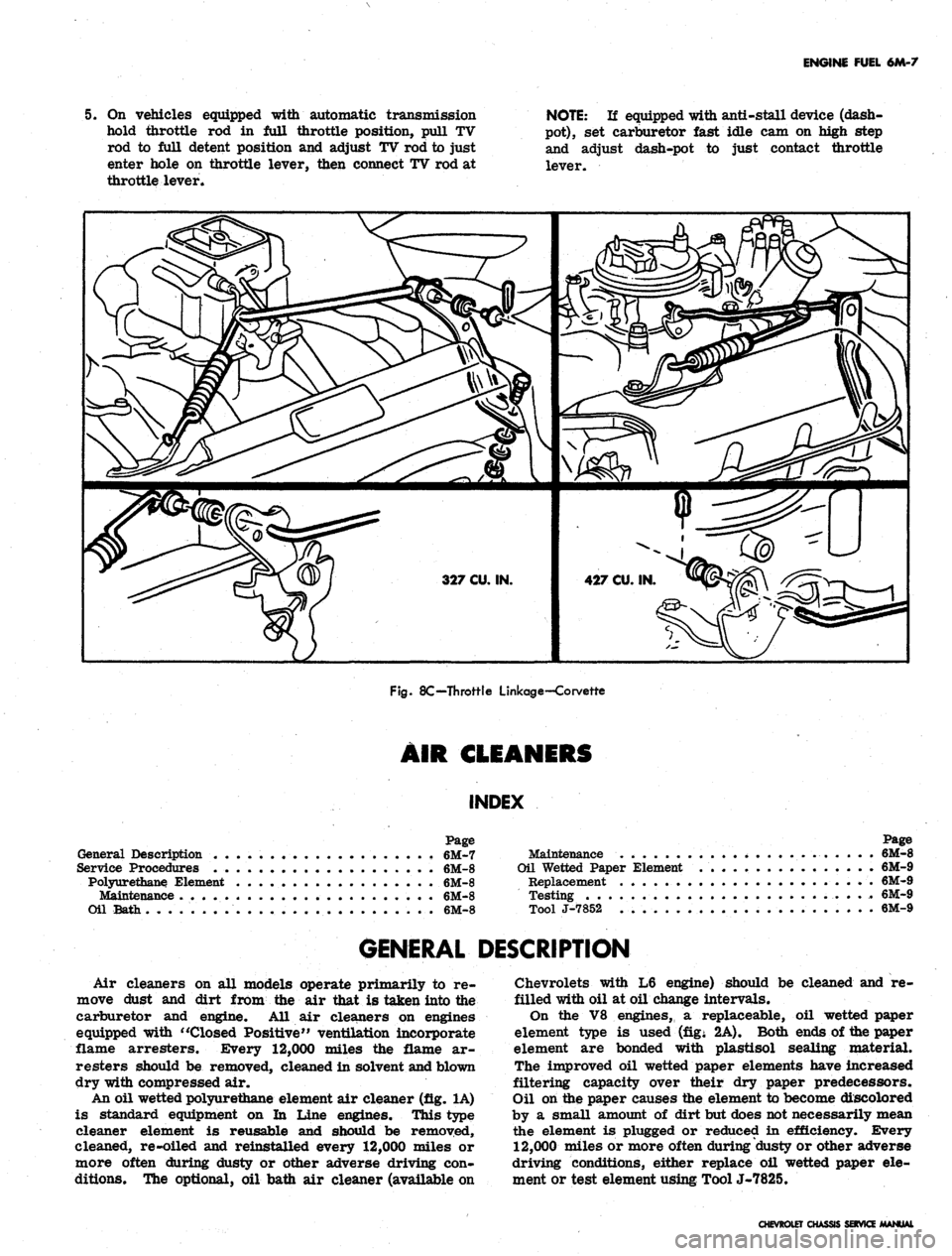
Fig.
8C—Throttle Linkage-Corvette
AIR
CLEANERS
INDEX
Page
General Description 6M-7
Service Procedures . . 6M-8
Polyurethane. Element 6M-8
Maintenance 6M-8
Oil Bath 6M-8
Page
Maintenance
...........* 6M-8
Oil
Wetted
Paper
Element
6M-9
Replacement
* . 6M-9
Testing 6M-9
Tool J-7852 . 6M-9
GENERAL DESCRIPTION
Air cleaners on all models operate primarily to re-
move dust and dirt from the air that is taken into the
carburetor and engine. All air cleaners on engines
equipped with "Closed Positive" ventilation incorporate
flame arresters. Every 12,000 miles the flame ar-
resters should be removed, cleaned in solvent and blown
dry with compressed air.
An oil wetted polyurethane element air cleaner (fig. 1A)
is standard equipment on In Line engines. This type
cleaner element is reusable and should be removed,
cleaned, re-oiled and reinstalled every 12,000 miles or
more often during dusty or other adverse driving con-
ditions. The optional, oil bath air cleaner (available on
Chevrolets with L6 engine) should be cleaned and re-
filled with oil at oil change intervals.
On the V8 engines,, a replaceable, oil wetted paper
element type is used (fig; 2A). Both ends of me paper
element are bonded with plastisol sealing material.
The improved oil wetted paper elements have increased
filtering capacity over their dry paper predecessors.
Oil on the paper causes the element to become diBcolored
by a small amount of dirt but does not necessarily mean
the element is plugged or reduced in efficiency. Every
12,000 miles or more often during dusty or other adverse
driving conditions, either replace oil wetted paper ele-
ment or test element using ToolJ-7825.
CHEVROLET CHASSIS SOVICE/MANUAL
Page 332 of 659
ENGINE-ELECTRICAL 6Y-7
CHARGING SYSTEM
INDEX
Page
General Description . 6Y-7
Maintenance and Adjustments 6Y-9
Static Checks . 6Y-10
System Condition Check and Voltage
•Regular Adjustment. 6Y-10
General Output 6Y-11
Generator Diode and Field Test 6Y-12
Indicator Lamp-Initial Field Excitation
Circuit Tests . 6Y-12
Page
Field Circuit Resistance Wire Tests 6Y-13
Field Relay Test and Adjustment 6Y-14
Other Harness Checks 6Y-14
Service Operations 6Y-14
Generator 6Y-14
Removal and Installation 6Y-14
Pulley Replacement. 6Y-14
Brush Replacement (6" Delcotron). 6Y-15
Double Contact Regulator . . . . . . 6Y-16
GENERAL DESCRIPTION
The charging system includes the battery, generator,
regulator, telltale light, and necessary wiring to connect
these components. The Delcotron is offered as standard
equipment, although there are various capacities avail-
able on all models.
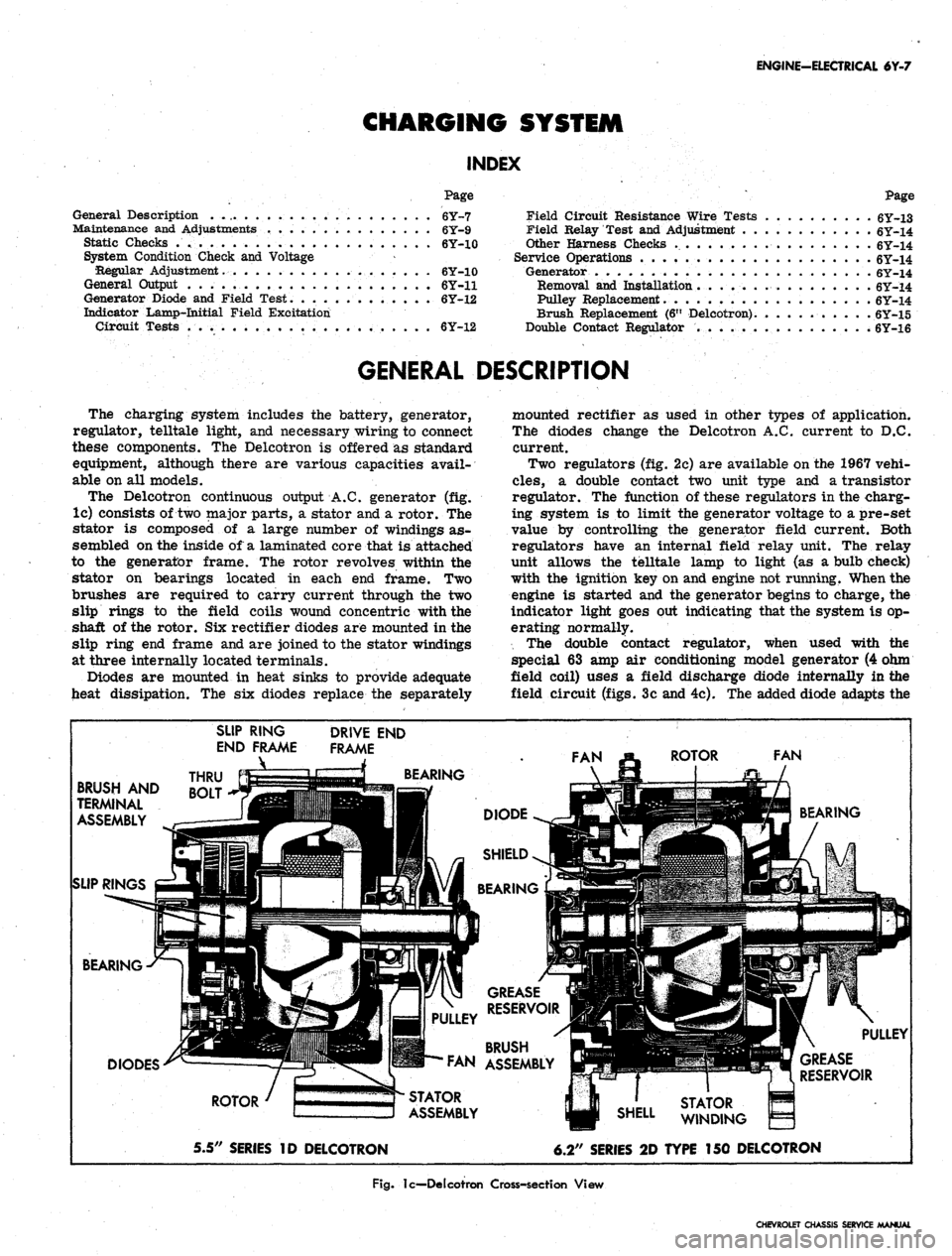
The Delcotron continuous output A.C. generator (fig.
lc) consists of two major parts, a stator and a rotor. The
stator is composed of a large number of windings as-
sembled on the inside of a laminated core that is attached
to the generator frame. The rotor revolves within the
stator on bearings located in each end frame. Two
brushes are required to carry current through the two
slip rings to the field coils wound concentric with the
shaft of the rotor. Six rectifier diodes are mounted in the
slip ring end frame and are joined to the stator windings
at three internally located terminals.
Diodes are mounted in heat sinks to provide adequate
heat dissipation. The six diodes replace the separately
mounted rectifier as used in other types of application.
The diodes change the Delcotron A.C. current to D.C.
current.
Two regulators (fig. 2c) are available on the 1967 vehi-
cles,
a double contact two unit type and a transistor
regulator. The function of these regulators in the charg-
ing system is to limit the generator voltage to a pre-set
value by controlling the generator field current. Both
regulators have an internal field relay unit. The relay
unit allows the telltale lamp to light (as a bulb check)
with the ignition key on and engine not running. When the
engine is started and the generator begins to charge, the
indicator light goes out indicating that the system is op-
erating normally.
The double contact regulator, when used with the
special 63 amp air conditioning model generator (4 ohm
field coil) uses a field discharge diode internally in the
field circuit (figs. 3c and 4c). The added diode adapts the
BRUSH AND
TERMINAL
ASSEMBLY
SLIP RINGS
SLIP RING
END FRAME
_\
THRU
BOLT
DRIVE END
FRAME
BEARING
BEARING
DIODES
ROTOR
5.5" SERIES ID DELCOTRON
STATOR
ASSEMBLY
GREASE
RESERVOIR
BRUSH
FAN ASSEMBLY
6.2" SERIES 2D TYPE 150 DELCOTRON
Fig.
lc—Delcotron Cross-section View
CHEVROLET CHASSIS SERVICE MANUAL
Page 345 of 659
ENGINE-ELECTRICAL 6Y-20
cause oxidized contact points. Check for these conditions
where burned contacts are experienced. An
out-of-
balance condition in the ignition system, often the result
of too much or too little condenser capacity, is indicated
where point pitting is encountered.
REPLACEMENT
Four and Six Cylinder Engine Distributor
1.
Release distributor cap hold-down screws, remove
cap and place it out of work area.
2.
Remove rotor.
3.
Pull primary and condenser lead wires from contact
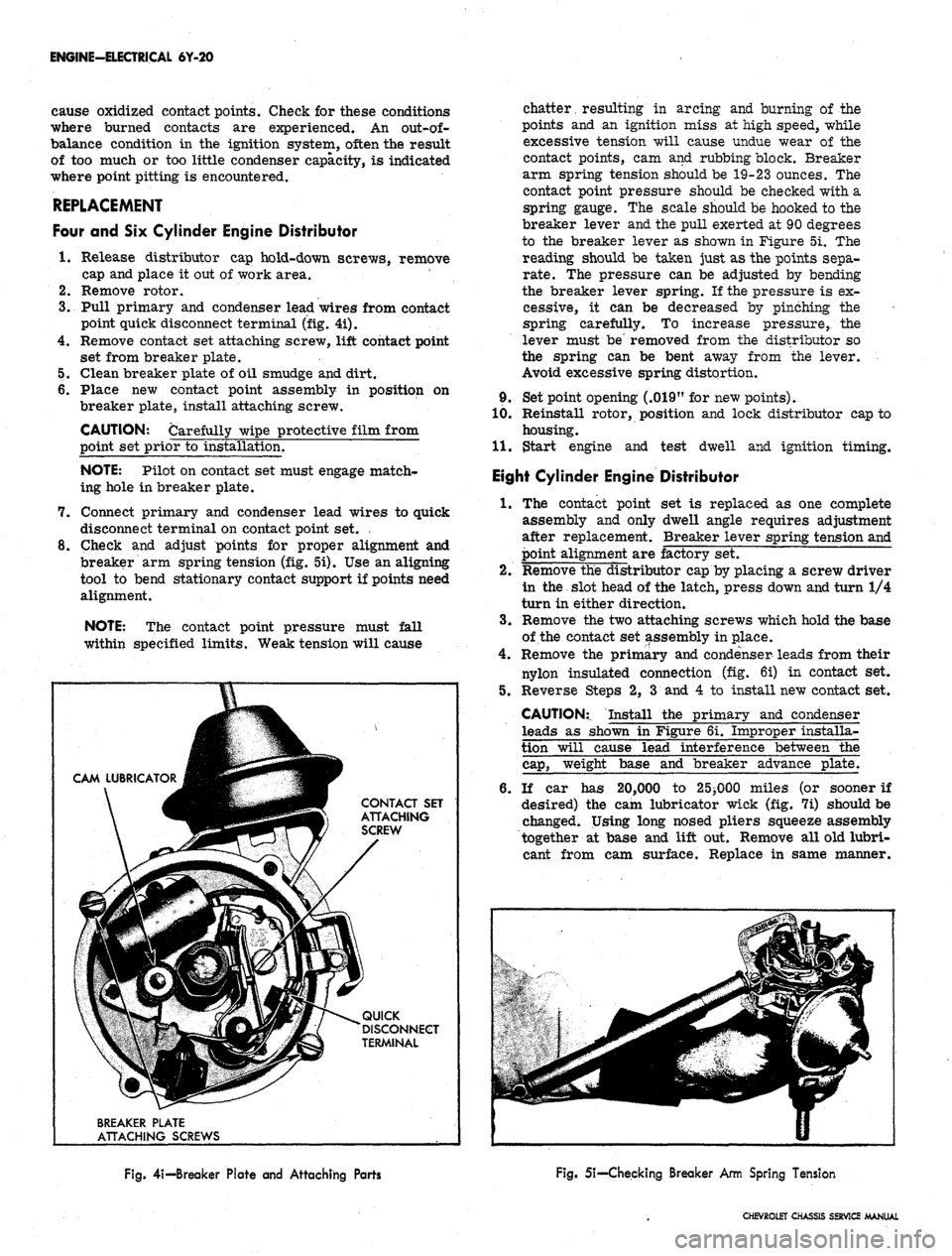
point quick disconnect terminal (fig. 4i).
4.
Remove contact set attaching screw, lift contact point
set from breaker plate.
5.
Clean breaker plate of oil smudge and dirt.
6. Place new contact point assembly in position on
breaker plate, install attaching screw.
CAUTION: Carefully wipe protective film from
point set prior to installation.
NOTE: Pilot on contact set must engage match-
ing hole in breaker plate.
7.
Connect primary and condenser lead wires to quick
disconnect terminal on contact point set. .
8. Check and adjust points for proper alignment and
breaker arm spring tension (fig. 5i). Use an aligning
tool to bend stationary contact support if points need
alignment.
NOTE: The contact point pressure must fall
within specified limits. Weak tension will cause
CONTACT SET
ATTACHING
SCREW
QUICK
DISCONNECT
TERMINAL
BREAKER PLATE
ATTACHING SCREWS
chatter, resulting in arcing and burning of-the
points and an ignition miss at high speed, while
excessive tension will cause undue wear of the
contact points, cam and rubbing block. Breaker
arm spring tension should be 19-23 ounces. The
contact point pressure should be checked with a
spring gauge. The scale should be hooked to the
breaker lever and the pull exerted at 90 degrees
to the breaker lever as shown in Figure 5i. The
reading should be taken just as the points sepa-
rate.
The pressure can be adjusted by bending
the breaker lever spring. If the pressure is ex-
cessive, it can be decreased by pinching the
spring carefully. To increase pressure,, the
lever must be' removed from the distributor so
the spring can be bent away from the lever.
Avoid excessive spring distortion.
9. Set point opening (.019" for new points).
10.
Reinstall rotor, position and lock distributor cap to
housing.
11.
$tart engine and test dwell and ignition timing.
Eight Cylinder Engine Distributor
1.
The contact point set is replaced as one complete
assembly and only dwell angle requires adjustment
after replacement. Breaker lever spring tension and
point alignment are factory set.
2.
Remove the distributor cap by placing a screw driver
in the slot head of the latch, press down and turn 1/4
turn in either direction.
3.
Remove the two attaching screws which hold the base
of the contact set assembly in place.
4.
Remove the primary and condenser leads from their
nylon insulated connection (fig. 6i) in contact set.
5.
Reverse Steps 2, 3 and 4 to install new contact set.
CAUTION:. Install the primary and condenser
leads as shown in Figure 6i. Improper installa-
tion will cause lead interference between the
cap,
weight base and breaker advance plate.
6. If car has 20,000 to 25^000 miles (or sooner if
desired) the cam lubricator wick (fig. 7i) should be
changed. Using long nosed pliers squeeze assembly
together at base and lift out. Remove all old lubri-
cant from cam surface. Replace in same manner.
Fig.
4i—Breaker Plate and Attaching Parts
Fig. 5i—-Checking Breaker Arm Spring Tension
CHEVROLET CHASSIS SERVICE MANUAL
Page 379 of 659

CLUTCH
AND
TRANSMISSIONS
7-20
COMPONENT PARTS REPLACEMENT
3.
4.
5.
6.
TRANSMISSION REPLACEMENT
(EXC.
CORVETTE)
Removal From Vehicle
1.
Remove shift lever trim plate and dust boot.
Remove shift lever assembly.
Raise vehicle
to
desired working height.
Disconnect
the
speedometer cable from speedometer
driven gear fitting.
.
~
. •
Remove propeller shaft, then support engine
at the
oil
pan
rail with
a
jack
or
other suitable support
capable
of
supporting
the
engine when transmission
is removed.
Disconnect shift lever bracket assembly from exten-
sion
and
remove
all 3
transmission shifter levers
from shifter shafts, (leave linkage connected
to
levers)
and
remove bracket assembly levers
and
linkage.
Remove extension mount7 to-crossmember attaching
bolts.
Loosen transmission crossmember
and
move rear-
ward
or
remove.
Remove
the
transmission-to-clutch housing retaining
bolts
and
install two guide pins, J-1126,
in
top holes.
Slide
the
transmission straight back until
the
input
shaft
is
free
of
splines
in the
clutch disc.
Slide
the
transmission rearward
to
allow sufficient
clearance
of
input shaft
and
clutch housing. Then tilt
input shaft
end of
transmission downward and with-
8.
9.
10.
11.
draw transmission from vehicle.
installation
to
Vehicle
1.
Raise transmission
and
rotate
as
necessary-to start
input shaft into clutch disc
and
slide transmission
forward until
it
bottoms against clutch housing.
Re-
move guide pins.
2.
Install
the
transmission-to-clutch housing retaining
bolts.
Torque
all
four retaining bolts
to 50 ft. lbs.
3.
Raise engine
and
position extension mount
to
cross-
member,
and
loosely install
the
retaining bolts.
Tighten crossmember
to
frame retaining bolts.
4.
Remove temporary support from engine, and torque
the extension mount retaining bolts.
5. Install propeller shaft.
6. Install control lever bracket assembly
to
transmis-
sion extension
and
connect shifter levers
to
shifter
shafts.
7. Fill transmission
to
level
of
filler plug hole with
correct lubricant specified
in
Section
0.
8. Lower vehicle and install shift lever assembly, check
shift pattern and adjust linkage
as
required.
9. Install trim plate and dust boot.
CORVETTE TRANSMISSION REPLACEMENT
Refer
to
similar procedure under 3-Speed Corvette
Transmission.
FOUR-SPEED (SAGINAW) TRANSMISSION
INDEX
Page
General Description
7-20
Maintenance
and
Adjustments
. . 7-21
Shift Linkage Adjustment.
. 7-21
Speedometer Driven Gear
and
Oil Seal ................
(See
Muncie 4-Speed)
Side Cover
7-22
Page
Removal
. . , 7-22
Disassembly
. . 7-22
Assembly
. . . 7-22
Installation
. 7-22
Extension
Oil
Seal
(See
Muncie 4-Speed)
Transmission Replacement (See Muncie 4-Speed)
GENERAL DESCRIPTION
The Saginaw four speed fully synchronized
(all
forward
gears) transmission incorporates helical drive gears
throughout.
The main drive gear
is
supported
by a
ball bearing
at
the front
end of the
transmission case and
is
piloted
at its
front
end in an oil
impregnated bushing mounted
in the
engine crankshaft.
The
front
end of the
mainshaft
is
piloted
in a row of
roller bearings
set
into
the
hollow
end
of
the
main drive gear
and the
rear end
is
carried
by a
ball bearing mounted
in the
front
of the
extension housing.
The countergear
is
carried
on a
single
row of
rollers
at both ends while thrust
is
taken on thrust washers
lo-
cated between
the
ends
of the
gear and
the
thrust bosses
in
the
case. Ah anti-rattle plate assembly
at the
front
of
the countergear provides
a
constant spring tension
be-
tween
the
counter
and
clutch gears
to
reduce torsional
vibrations.
The
sliding reverse idler gear
is
carried
on
a bushing finish bored
in
place.
It
rotates
on a
short
idler shaft retained by
a
woodruff
key.
The synchronizer assemblies consist
of a
clutch
hub,
clutch sleeve,
two
clutch
key
springs and three energizer
clutch keys
and are
retained
as an
assembly on
the
main
shaft
by a
snap ring.
A great deal
of
similarity
and
interchangeability
now
exists between
the new 3 and
4-speed Saginaw trans-
missions.
However,
the
synchronizer assembly
at the
front
of the
mainshaft
is
used
for the
third and fourth rather than
the
second
and
third shift.
The
synchronizer assembly
at
the rear
of the
mainshaft
is
used
for the
first and second
rather than
the
first
and
reverse shift. Gear teeth
cut
in
the
first and second synchronizer sleeve (reverse gear)
distinguish
it
from
the
third
and
fourth synchronizer
sleeve.
Starting from
the
front, gears
on the
mainshaft
are
third, second
and
first rather than second, first and
re-
verse.
A
fourth blocker ring
is
used between
the 1-2
synchronizer assembly
and
first gear
on the
four-speed
transmissions.
The cover
on the new
four-speed transmission
is lo-*
cated
on the
left-hand side
of the
case.
It is
similar
to
the three-speed cover with
the
addition
of a
reverse
shifter shaft assembly, detent ball
and
detent spring.
Disassembly
and
assembly procedures
are
covered
in
this section.
CHEVROLET CHASSIS SERVICE MANUAL
Page 382 of 659
CLUTCH
AND
TRANSMISSIONS
7-23
Assembly (Fig.
4X)
1.
With detent spring tang projecting
up
over
the 3rd
and
4th
shifter shaft cover opening install
the
first
and second detent
cam
onto
the
detent
cam
pivot
pin.
With
the
detent spring tang projecting
up
over
the
first
and
second shifter shaft cover hole install
the
3rd
and 4th
detent
cam,
NOTE:
The 1-2
detent
cam has a
.090" greater
contour
on the
inside detent notch.
2.
3.
Install detent
cam
retaining
"C"
ring
to
pivot shaft,
and hook spring into detent
cam
notches.
Install
1-2 and 3-4
shifter shaft assemblies
in
cover
being careful
not to
damage seals. Install both shift
forks
to
shifter shaft assemblies, lifting
up on
detent
cam
to
allow forks
to
fully seat into position.
4.
Install reverse detent ball
and
spring
to
cover, then
install reverse shifter shaft assembly
to
cover.
5.
Install outer shifter levers, flat washers, lock wash-
ers
and
bolts.
Installation
1.
Shift shifter levers into neutral detent (center) posi-
tion. Position cover gasket
on
case.
2.
Carefully position side cover into place making sure
the shift forks
are
aligned with their respective
mainshaft clutch sliding sleeves.
Install cover attaching bolts
and
tighten evenly
to
specified torque.
Remove filler plug
and add
lubricant specified
in
Section
0, to
level
of
filler plug hole.
3.
4.
ALUMINUM POWERGLIDE
INDEX
Page
General
Description
7-23
Maintenance
and
Adjustments .............. 7—23
Oil
Level Check
7-23
Periodic
Oil
Change
7-24
Periodic
Low
Band Adjustment
7-24
Manual
Shift Linkage Check
and
Adjust
7-24
Floor
Shift Linkage
7-25
Floor
Mounted Control Lever
and
Bracket
Assembly
7-29
Throttle
Valve Linkage
.... 7-29
Neutral
Safety Switch
.. . 7-30
Throttle
Return Check Valve (Dashpot)
7-30
Component
Parts Replacement
7-30
Transmission
Replacement .............. 7—30
Page
Other
Service Operations
7-32
Diagnosis
7-32
Warming
Up
Transmission
7-32
Shop
Warm
Up , 7-32
Road
Warm
Up 7-32
Checking
Fluid Level
and
Condition
7-32
Manual
Linkage
7-32
Oil
Leaks
7-33
Basic
Pressure Checks
7-33
Wide
Open Throttle Upshift Pressure Check
.... 7-33
Idle
Pressure
in
Drive Range
7-33
Manual
"Low"
Range Pressure Check .......
7-33
Drive
Range Overrun (Coast) Pressure
.
.......
7-33
Powerglide
Shift Points
. . 7-35
GENERAL DESCRIPTION
The case
and
converter housing
of the two
speed alumi-
num Powerglide Transmission
is a
single case aluminum
unit. When
the
manual control
is
placed
in the
drive
po-
sition,
the
transmission automatically shifts
to low
gear
for initial vehicle movement.
As the car
gains speed
and
depending
on
load
and
throttle position,
an
automatic shift
is made
to
high gear.
A
forced downshift feature
pro-
vides
a
passing gear
by
returning
the
transmission
to low
range.
The
oil
pump assembly
is a
conventional gear type
and
the
oil
pump housing
is of the
large diameter type acting
as
the
front bulkhead
of the
transmission.
The
torque
converter
is a
conventional three element welded design
bolted
to the
engine flywheel which drives through
a
two-
speed planetary gearset.
The
high clutch assembly
is
typical
of the
designs used
in
this type transmission.
The
aluminum Powerglide uses
an
output shaft mounted
gov-
ernor which requires
a
hole through
the
output shaft.
The
reverse clutch assembly
is a
multiple disc type clutch.
The steel plates
are
splined directly
to the
case while
the
face plates
are
splined
to the
internal
or
ring gear.
The
clutch piston operates within
the
rear portion
of the
case.
The internal diameter
of the
pistoh
is
sealed to
an
integral
hub portion
of the
case rear bulkhead.
The
outside
dia-
meter
is
sealed
to a
machined portion
of the
case.
The
piston
is
hydraulically applied
and is
released
by
separate
coil springs.
The
valve body assembly
is
bolted
to the
bottom
of the
transmission case
and is
accessible
for
service
by
removing
the oil pan
assembly.
The
valve
body consists
of an
upper
and
lower body located
on
either
side
of a
transfer plate.
The
vacuum modulator
is lo-
cated
on the
left rear face
of the
transmission case.
The
modulator valve bore
is
located
in the
upper valve body.
MAINTENANCE
AND
ADJUSTMENTS
OIL LEVEL CHECK
The transmission
oil
level should
be
checked period-
ically
as
recommended
in
Section
0. Oil
should
be
added
only when level
is on or
below
the
"ADD" mark
on the dip
stick with
oil hot or at
operating temperature.
The oil
level
dip
stick
is
located
at the
right rear
of the
engine
compartment. Fill with
oil
specified
in
Section
0.
In order
to
check
oil
level accurately,
the
engine should
be idled with
the
transmission
oil hot and the
control
lever
in
neutral (N) position.
It
is
important that
the oil
level
be
maintained
no
higher than
the
"FULL" mark
on the
transmission
oil
level gauge.
DO NOT
OVERFILL,
for
when
the oil
level
CHEVROLET CHASSIS SERVICE MANUAL
Page 383 of 659
CLUTCH AND TRANSMISSIONS 7-24
is at the full mark on the dip stick, it is just slightly be-
low the planetary gear unit. If additional oil is added,
bringing the oil level above the full mark, the planetary
unit will run in the oil, foaming and aerating the oil. This
aerated oil carried through the various oil pressure pas-
sages (low servo, reverse servo, clutch apply, converter,
etc.) may cause malfunction of the transmission assem-
bly, resulting in cavitation noise in the converter and
improper band or clutch application. Overheating may
also occur.
If the transmission is found consistently low on oil, a
thorough inspection should be made to find and correct
all external oil leaks.
PERIODIC OIL CHANGE
The transmission oil should be changed periodically as
recommended in Section 0, and whenever transmission is
to be removed from the vehicle for repairs.
1.
Run engine for one minute in neutral prior to chang-
ing.
2.
Be sure vehicle is level or raise from the rear only.
3.
Remove the oil pan drain plug and allow oil to drain
thoroughly into a pan or can.
Replace drain plug and refill with approximately two
quarts of oil specified in Section 0.
NOTE: To refill the transmission, remove dip
stick from oil filler tube and refill transmission
with oil specified in Section 0 using filler tube
and funnel J-4264. Then, after shifting into all
ranges at idle speed to fill all oil passages, the
engine should be run at 800-1000 rpm with the
transmission in Neutral until the oil warms up,
then add oil as required to raise the fluid level
to the full mark on the dip stick. Refill capacity
is approximately 2 qts.
4.
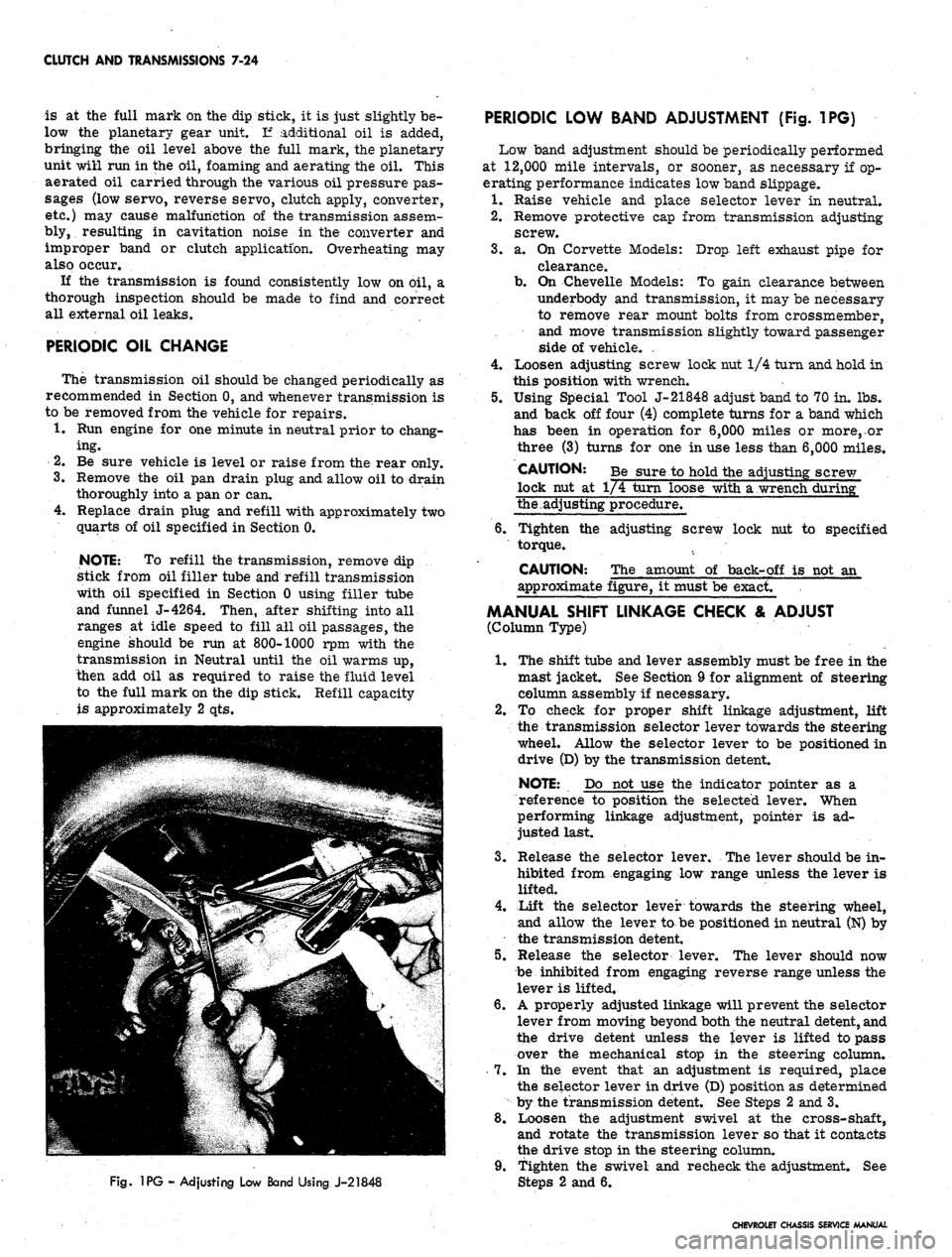
Fig.
1PG - Adjusting Low Band Using J-21848
PERIODIC LOW BAND ADJUSTMENT (Fig. 1PG)
Low band adjustment should be periodically performed
at 12,000 mile intervals, or sooner, as necessary if op-
erating performance indicates low band slippage.
1.
Raise vehicle and place selector lever in neutral.
2.
Remove protective cap from transmission adjusting
screw.
3.
a. On Corvette Models: Drop left exhaust pipe for
clearance.
b.
On Chevelle Models: To gain clearance between
underbody and transmission, it may be necessary
to remove rear mount bolts from crossmember,
and move transmission slightly toward passenger
side of vehicle. .
4.
Loosen adjusting screw lock nut 1/4 turn and hold in
this position with wrench.
5.
Using Special Tool J-21848 adjust band to 70 in. lbs.
and back off four (4) complete turns for a band which
has been in operation for 6,000 miles or more,.or
three (3) turns for one in use less than 6,000 miles.
CAUTION: Be sure to hold the adjusting screw
lock nut at 1/4 turn loose with a wrench during"
the.adjusting procedure.
6. Tighten the adjusting screw lock nut to specified
torque.
CAUTION: The amount of back-off is not an
approximate figure, it must be exact.
MANUAL SHIFT LINKAGE CHECK & ADJUST
(Column Type)
1.
The shift tube and lever assembly must be free in the
mast jacket. See Section 9 for alignment of steering
column assembly if necessary.
2.
To check for proper shift linkage adjustment, lift
the transmission selector lever towards the steering
wheel. Allow the selector lever to be positioned in
drive (D) by the transmission detent.
NOTE: Do not use the indicator pointer as a
reference to position the selected lever. When
performing linkage adjustment, pointer is ad-
justed last.
3.
Release the selector lever. The lever should be in-
hibited from engaging low range unless the lever is
lifted.
4.
Lift the selector lever towards the steering wheel,
and allow the lever to be positioned in neutral (N) by
the transmission detent.
5.
Release the selector lever. The lever should now
be inhibited from engaging reverse range unless the
lever is lifted.
6. A properly adjusted linkage will prevent the selector
lever from moving beyond both the neutral detent, and
the drive detent unless the lever is lifted to pass
over the mechanical stop in the steering column.
7.
In the event that an adjustment is required, place
the selector lever in drive (D) position as determined
by the transmission detent. See Steps 2 and 3.
8. Loosen the adjustment swivel at the cross-shaft,
and rotate the transmission lever so that it contacts
the drive stop in the steering column.
9. Tighten the swivel and recheck the adjustment. See
2 and 6.
CHEVROLET CHASSIS SERVICE MANUAL