heating CHEVROLET CAMARO 1974 2.G Owners Manual
[x] Cancel search | Manufacturer: CHEVROLET, Model Year: 1974, Model line: CAMARO, Model: CHEVROLET CAMARO 1974 2.GPages: 85, PDF Size: 32.84 MB
Page 16 of 85
Downloaded from www.Manualslib.com manuals search engine STARTING AND OPERATING
Engine Exhaust Gas Caution (Carbon Monoxide)
AvoId Inhaling exhaust gases because
they contain carbon monoxide, which by
itself is colorless and odorless. Carbon
monoxide is
a dangerous gas that can
cause unconsciousness and is potentially
lethal.
" at any time you suspect that exhaust fumes are entering the passenger com
partment, have the cause determined and
corrected as soon as
possible. If you
must drive under these conditions, drive
only with aU windows fully open.
The best protection against carbon
monoxIde entry Into the car body Is a
properly maintained engine exhaust sys
tem, car body and body ventilation system.
It is recommended that the exhaust sys
tem and body Is Inspected by a competent
mechanic:
• Each time the vehicle Is raised for 011
change.
• Whenever a change is noticed in the
sound
of the exhaust system.
• Whenever the exhaust system, under
body or rear of the vehicle Is damaged.
See your Maintenance Schedule folder
for inspection
procedure.
To aI/ow proper operation of the car's
ventilation system, keep front ventilation
inlet
grille clear of snow, leaves or other
obstruction at al/ tImes.
SITTING IN A PARKED CAR WITH
ENGINE RUNNING
FOR AN EXTENDED
PERIOD IS NOT RECOMMENDED.
Do not run engIne In confined areas such as garages any more than needed
to
move vehicle in or out of area. When
vehicle is stopped in
an UNCONFINED
area with the engine running for any more
than
a short period, adjust heating or
cooling system to force outside air into
car as follows:
13
1. On cars not equipped with air condi
tioning, set fan to medium or high
speed and upper control lever to any
position
except OFF.
2. On cars equipped with air condition-• ing, set fan to medium or high speed
and upper control lever to any position
except OFF or MAX •
The trunk lid should be closed while
driving to help prevent inadvertently
drawing
exhaust gases into the car. It is
unwise
to drive at high speeds for long
durations with the trunk
lid open. However, if for some reason the trunk must
remain open for
a perIod while moving,
or electrical wiring or other cable con
nections to a trailer must pass through
the seal between
trunk lid and body, the
following precautions should
be observed:
• Close all windows.
• Adjust heating or COOling system to
force outside air into car as described
in items 1 and 2 above but with fan set
at high speed.
• On cars equipped with outside air vents
in or under instrument panel, open
vents fully.
Page 22 of 85
Downloaded from www.Manualslib.com manuals search engine In a normal turning situation
such
as turning a corner, the turn
signal
is cancelled automatically
after the turn
is completed. How
ever, in some driving maneuvers
such
as changing lanes on an ex
pressway, the steering wheel
is not
turned back sufficiently after com
pleting the turn to automatically
cancel the turn signal. For con
venience in such maneuvers, the
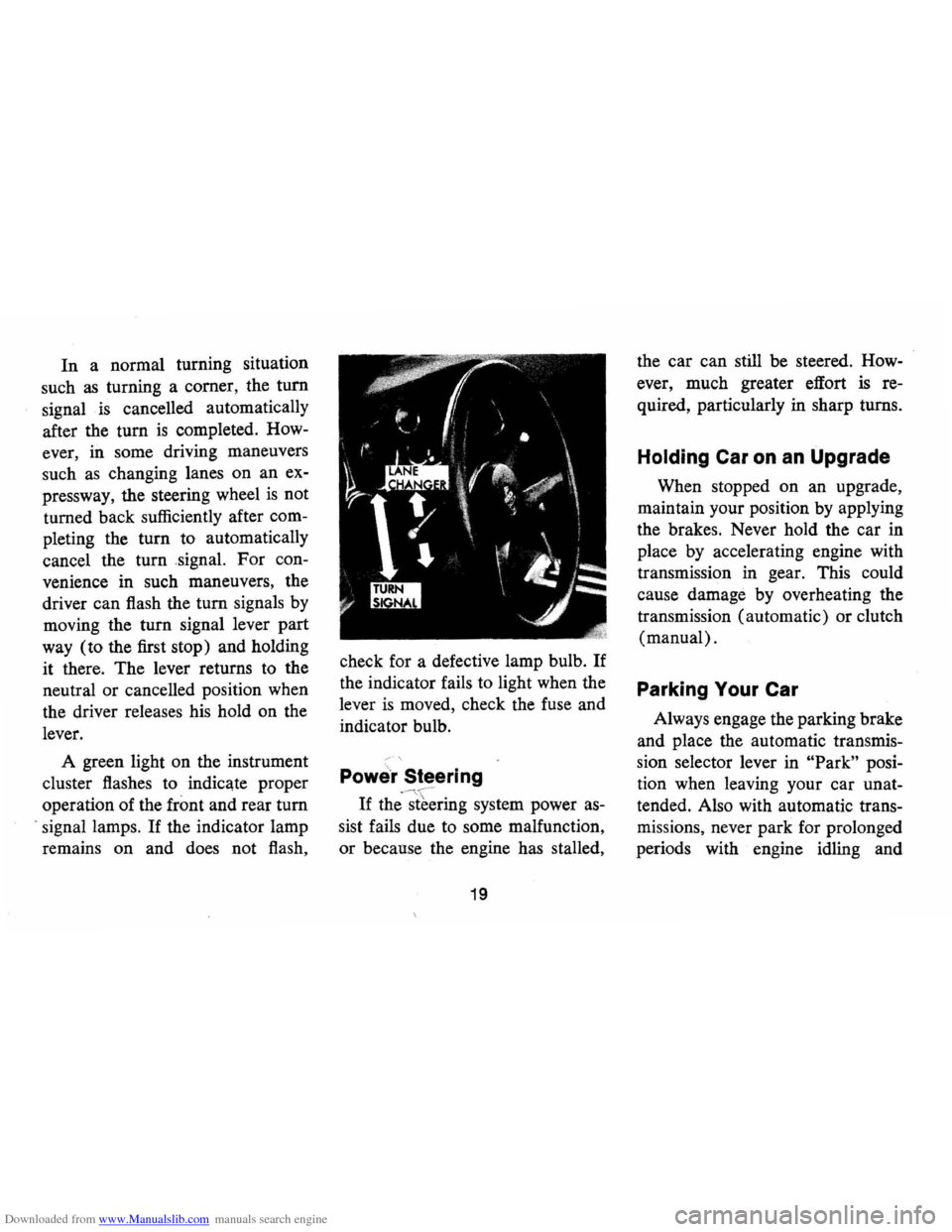
driver can flash the turn signals by
moving the turn signal lever part
way (to the first stop) and holding
it there. The lever returns to the
neutral or cancelled position when
the driver releases his hold on the
lever.
A green light on the instrument
cluster flashes to indicate proper
operation of the
front and rear tum
> signal lamps. If the indicator lamp
remains on and does not flash, check
for a defective lamp bulb.
If
the indicator fails to light when the
lever
is moved, check the fuse and
indicator bulb.
Powe'r Steering
If
the'-~[~~ring system power as
sist fails due to some malfunction,
or because the engine has stalled,
19
the car can still be steered. How
ever, much greater effort
is re
quired, particularly in sharp turns.
Holding Car on an Upgrade
When stopped on an upgrade,
maintain your position by applying
the brakes. Never hold the car in
place by accelerating engine with
transmission in gear. This could
cause damage by overheating the
transmission (automatic) or clutch
(manual).
Parking Your Car
Always engage the parking brake
and place the automatic transmis
sion selector lever in
"Park" posi
tion when leaving your car unat
tended. Also with automatic trans
missions, never park for prolonged
periods with engine idling and
Page 23 of 85
Downloaded from www.Manualslib.com manuals search engine transmiSSIOn in gear, especially if
your car
is equipped with air con
ditioning. This practice
is detri
mental to the transmission, due to
overheating.
Tilt Steering Wheel
The optional tilt steering wheel
can be tilted up above normal posi
tion to provide additional room for
entrance and exit
as well as selected
driving positions below normal
Horn
The horn on your Camara is
actuated by firmly pressing on the
horn button in the center of the
steering wheel. height.
This permits individual
se
lection of the most natural position
for all driving conditions.
On long
trips
the steering wheel position can
be changed to minimi ze tension and
fatigue.
The
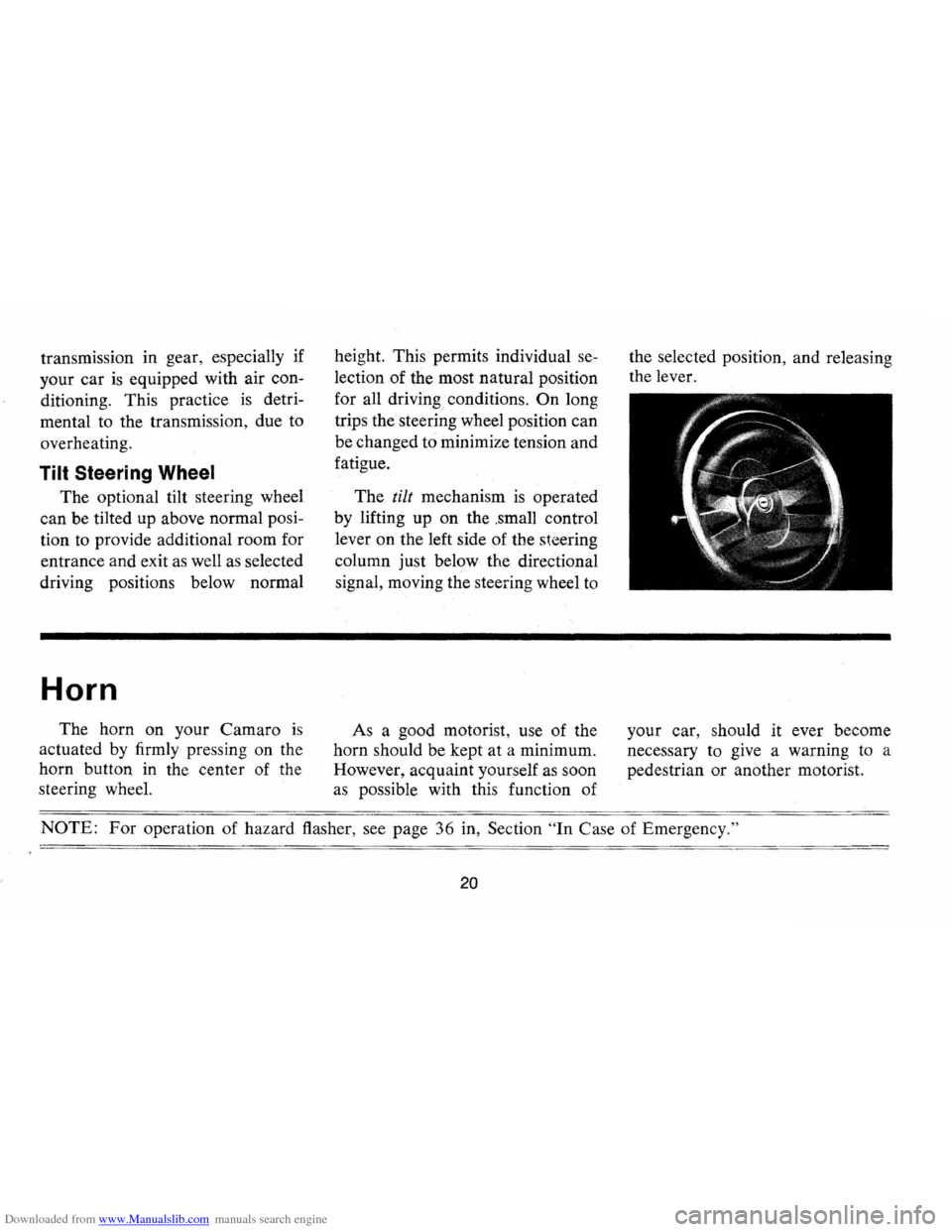
tilt mechanism is operated
by lifting up on the .small control
lever on the left side of the
steering
column just below the directional
signal, moving the steering wheel to
As a good motorist , use of the
horn should be kept at a minimum.
However , acquaint yourself
as soon
as possible with this function of the
selected position, and releasing
the lever.
your car, should it ever become
necessary to give a warning
to a
pedestrian or another motorist.
NOTE: For operation of hazard flasher, see page 36 in, Section "In Case of Emergency. "
20
Page 32 of 85
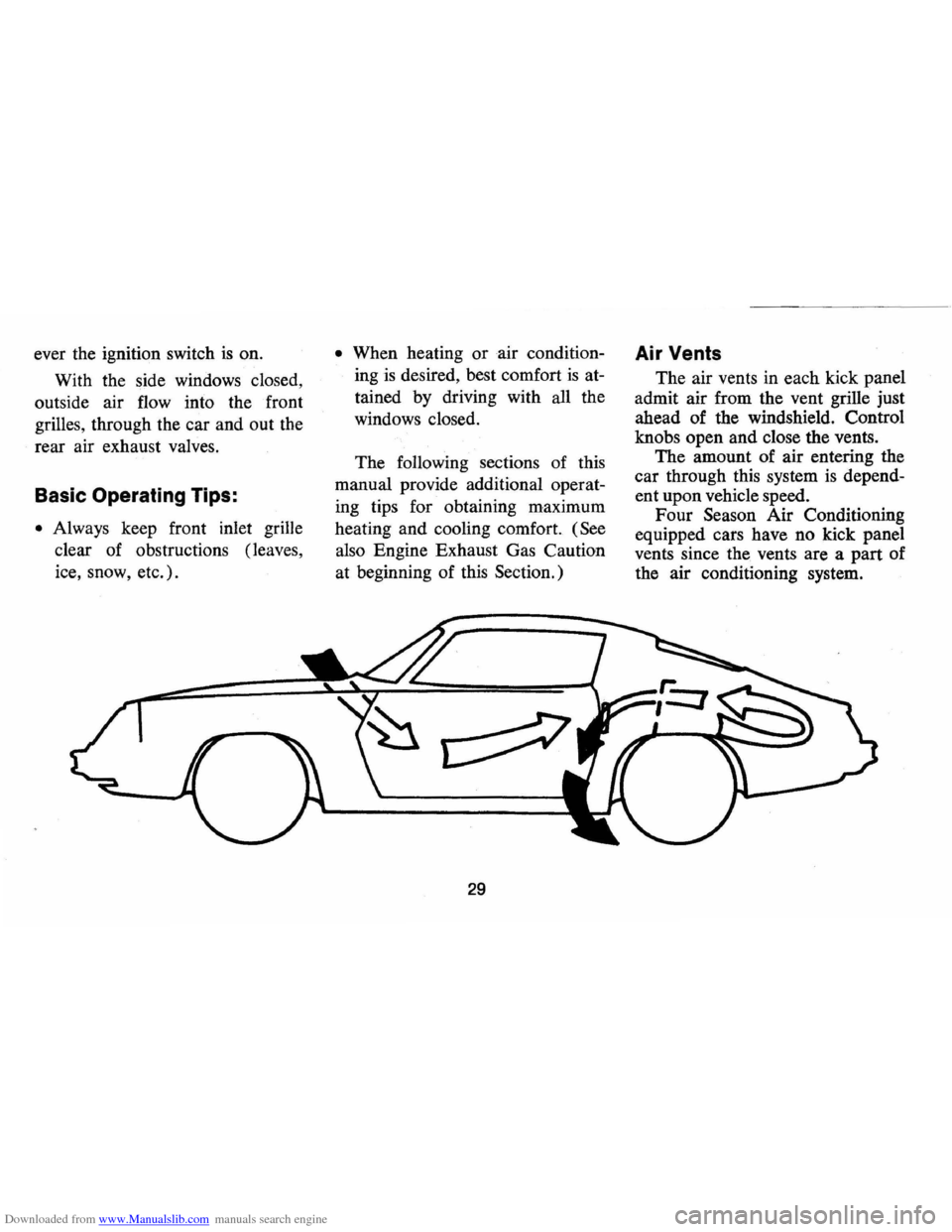
Downloaded from www.Manualslib.com manuals search engine ever the ignition switch is on.
With the side windows closed,
outside air flow into the front
grilles, through the car and out the
rear air exhaust valves.
Basic Operating Tips:
• Always keep front inlet grille
clear of obstructions (leaves,
ice, snow, etc.).
• When heating or air condition
ing
is desired, best comfort is at
tained by driving with all the
windows closed.
The following sections of this
manual provide additional operat
ing tips for obtaining maximum
heating and cooling comfort.
(See
also Engine Exhaust Gas Caution
at beginning of this Section.)
29
Air Vents
The air vents in each kick panel
admit air from the vent grille just
ahead of the windshield. Control
knobs open and close the vents.
The amount of air entering the
car through this system
is depend
ent upon vehicle speed.
Four Season Air Conditioning
equipped cars have no kick panel
vents since the vents are a part of
the air conditioning system.
Page 34 of 85
Downloaded from www.Manualslib.com manuals search engine • Keep all windows and vents
closed to reduce dust, road and
wind noise and uncomfortable
drafts .
• For most satisfactory heater op
eration and air circulation, oper
ate fan on low or medium speeds
for normal operation and high
speed for quick warm-up and
during extremely low tempera
tures.
• For adequate rear seat heating,
the area beneath the front seat
must not be blocked by carpet
ing, rags, paper
or other mate
rial and fan should operate on
.high blower.
• For additional summer ventila
tion move the
AIR lever to mid
position and the
DEFROSTER
lever to DEE If greater air
flow is desired, move the FAN
lever down to operate the three
speed blower.
Rear Window Defroster
To insure clear vision through
the rear window during
incH:ment
weather, the Rear Window De
froster has become established
as a
popular accessory . This unit draws in
air from the passenger compart
ment and direct s it against the back
window to remove frost or mois
ture. Its blower has a two-speed
control switch on the instrument
panel.
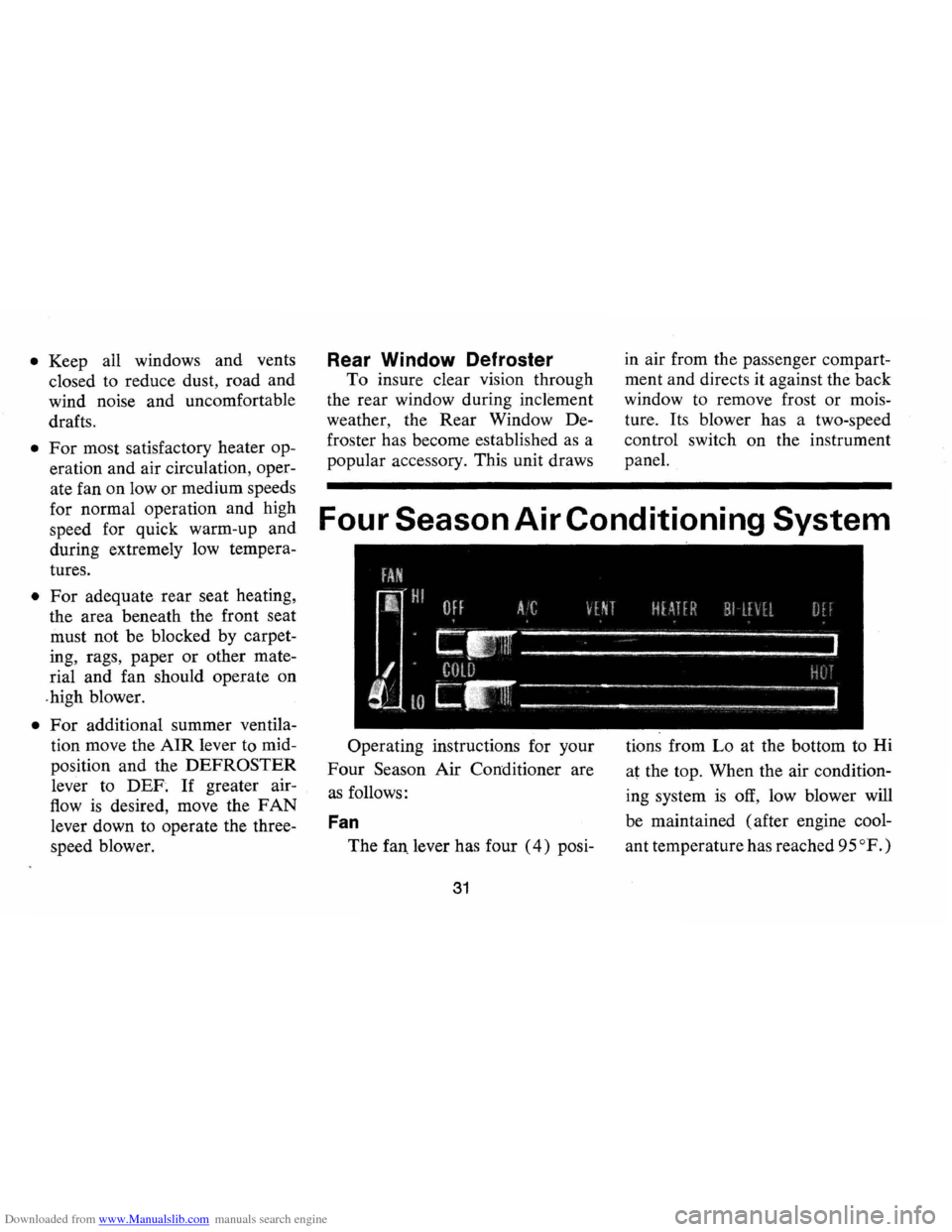
Four Season Air Conditioning System
Operating instructions for your
Four Season Air Conditioner are
as follows:
Fan
The fan. lever has four (4) posi-
31
tions from Lo at the bottom to Hi
at the top. When the air condition
ing system
is off, low blower will
be maintained (after engine cool
ant temperature has reached
95 of.)
Page 35 of 85
Downloaded from www.Manualslib.com manuals search engine no matter which position the fan
switch
is in.
Temperature (Lower Level)
The temperature lever allows a
selection of air temperature from
Cold at the far left to Hot at the
far right. When the temperature
lever
is in the COLD position the
system will provide the coldest air
possible. When the temperature
lever
is moved to the right (toward
HOT), the system will operate on
outside air.
Selector (Upper Lever)
This lever provides a selection of
systems available to handle various
heating and cooling requirements
throughout the year . The
"Air Con
ditioning" and "Heating" groups have
several
posItIons which im
prove the effectiveness of the
sys
tem for various demands.
OFF-The system operates on low
blower regardless of fan switch
position with air discharged into
vehicle through heater outlet.
A/C-Air from the passenger com
partment
is recirculated through
the system with some outside air
and discharged from the upper
outlets when the temperature lever
is in Full COLD or extreme left. If
the Temperature lever is moved
right to the first stop or further,
the system will automatically go
on outside air. The
AIC position,
with Temp. lever in Full
COLD ,
is used when maximum cooling is
required under conditions of high
temperature and humidity. High
32
fan speed is automatically attained
in this position.
AI C (with Temp lever right to first
stop)-Outside air
is passed through
the system and discharged through
the upper outlets. This position
is
recommended for most air condi
tioning situations because of re
duced blower noise and reduction
of cigarette smoke within the
vehicle.
Fan speed may be varied
as required.
VENT -Outside air is passed
through the system and discharged
from the defroster, upper, and
lower outlets. This position
is pro
vided for cool
to moderate weather
when refrigeration
is not required.
HEATER-Outside air is delivered
through the heater outlet and with
Page 59 of 85
Downloaded from www.Manualslib.com manuals search engine temperatures are not expected.
• Add ethylene glycol base coolant
that meets GM Specification
1899-M when coolant additions
are required because of coolant
loss or to provide additional pro
tection against freezing at tem
peratures lower than
-20°F
(-35°F in Canada).
NOTE: Alcohol or methanol base
coolants or plain water are not
recommended for your Camaro at
any time.
Radi~tor Pressure Cap
The radiator cap, a 15 lb. pres
sure type, must be installed tightly,
9therwise coolant may be lost and
damage to engine may result from
overheating.
Radiator pressure
caps should be checked periodi
cally for proper operation.
If re
placement
is required specify AC.
Thermostat
The cooling system is protected
and controlled by a thermostat in
stalled in the engine coolant outlet
to maintain a satisfactory operat
ing temperature of the engine. This
Tires
NOTE: The factory installed tires
on your car are either bias-belted thermostat
is designed
for continu
ous
. use through both winter and
summer and need not be changed
seasonally. When replacement
is
necessary, Delco parts are recom
mended.
or optional steel-belted radial tires.
Additional owner information about
steel-belted radial tires
is contained
in the special steel-belted radial tire
guarantee booklet.
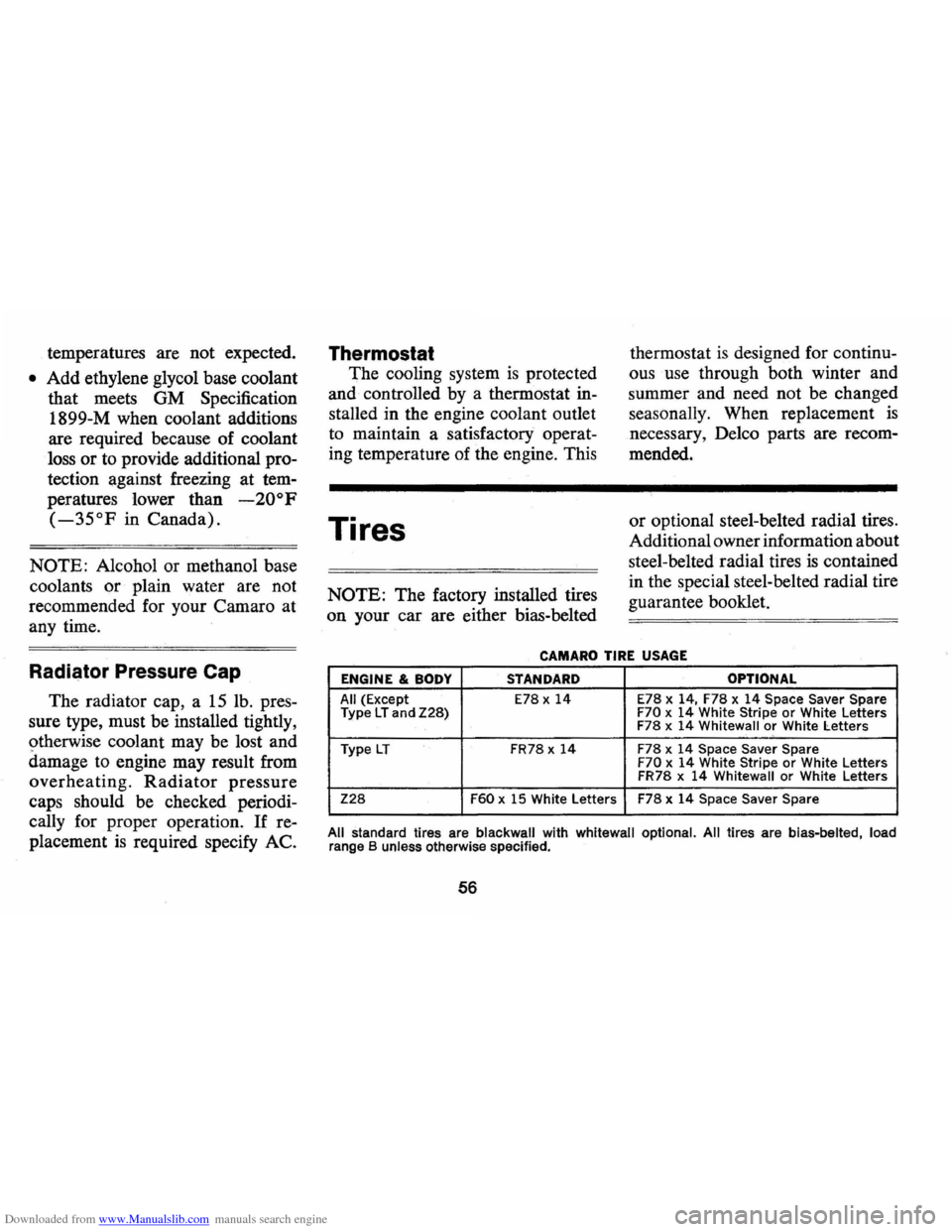
CAMARO TIRE USAGE
ENGINE & BODY STANDARD OPTIONAL
All (Except E78 x 14 E78 x 14, F78 x 14 Space Saver Spare
Type LTand Z28) F70 x 14 White Stripe or White Letters
F78 x 14 Whitewall or White Letters
Type
LT FR78 x 14 F78 x 14 Space Saver Spare F70 x 14 White Stripe or White Letters
FR78 x 14 Whitewall or White Letters
Z28 F60 x 15 White Letters F78 x 14 Space Saver Spare
All standard tires are blackwall with whitewall optional. All tires are bias-belted load range B unless otherwise specified. '
56
Page 72 of 85
Downloaded from www.Manualslib.com manuals search engine as each spark plug cable for
tightness.
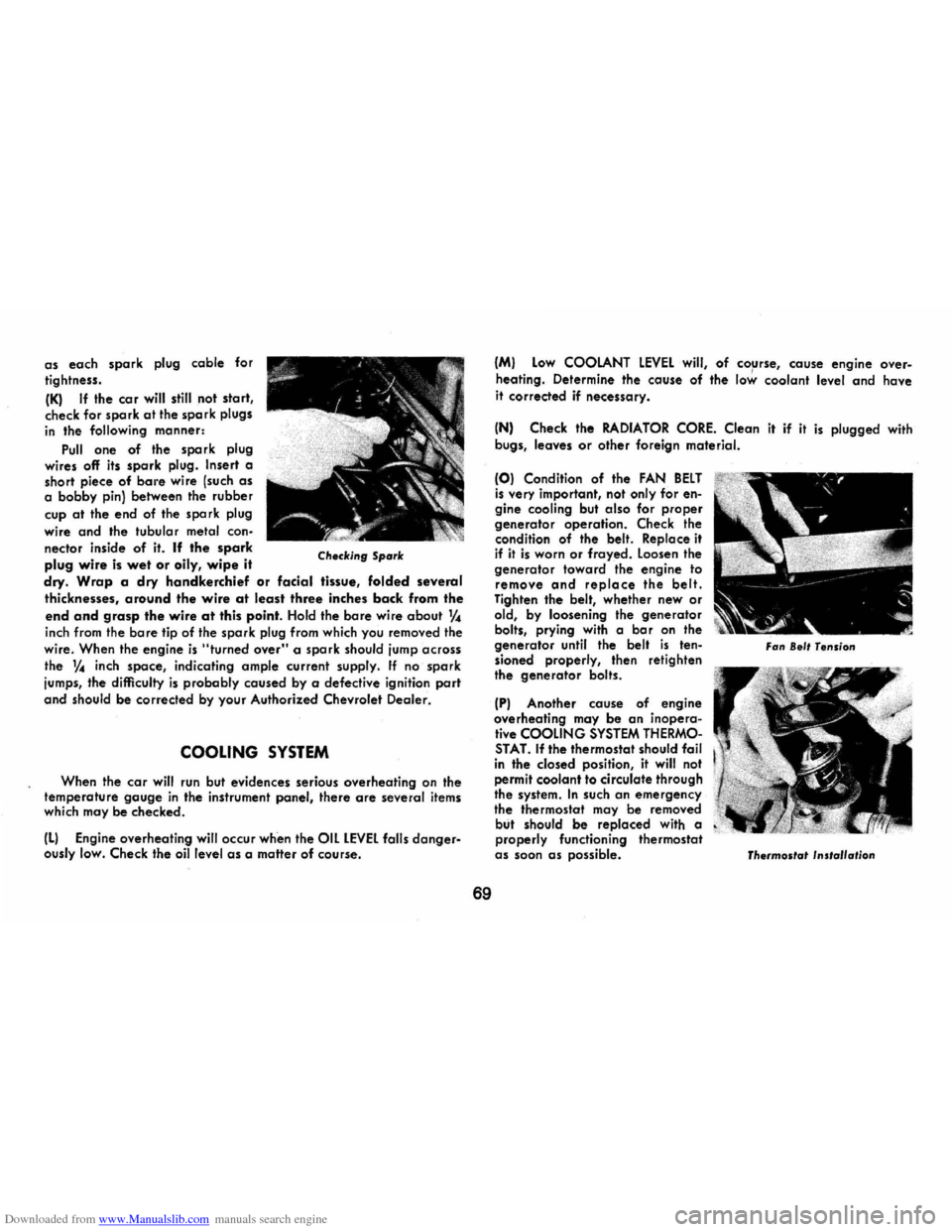
(K) If the co r will still not sta rt, check for spark at the spark plugs in the following manner:
Pull one of the spark plug
wires off its spark plug. Insert a
short piece of bare wire (such as a bobby pin) between the rubber
cup
at the end of the spark plug
wire
and the tubular metal connector inside of it. If the spark
plug wire is wet or oily, wipe it Checking Spark
dry. Wrap a dry handkerchief or facial tissue, folded several
thicknesses, around the wire at least three inches back from the
end and grasp the wire at this point. Hold the bare wire about 1f ..
inch from the bare tip of the spark plug from which you removed the
wire. When the engine is "turned over" a spark should jump across
the
~ inch space, indicating ample current supply. If no spark
jumps, the difficulty
is probably caused by a defective ignition part
and should be corrected by your Authorized Chevrolet Dealer.
COOLING SYSTEM
When the car will run but evidences serious overheating on the
temperature gauge in the instrument panel, there are several items
which may be checked.
(L) Engine overheating will occur whim the OIL LEVEL falls dangerously low. Check the oil level as a matter of course.
69
(M) Low COOLANT LEVEL will, of co~rse, cause engine over
heating. Determine the cause of the low coolant level and have
it corrected if necessary.
(N) Check the RADIATOR CORE. Clean it if it is plugged with
bugs, leaves or other foreign material.
(0) Condition of the FAN BELT is very impartant, not only for engine cooling but also for proper generator operation. Check the
condition of the belt. Replace it if it is worn or frayed. Loosen the generator toward the engine to remove and replace the belt. Tighten the belt, whether new or old, by loosening the generator bolts, prying with a bar on the generator until the belt is tensioned properly, then retighten
the generator bolts.
(P) Another cause of engine
overheating may be an inopera
tive COOLING SYSTEM THERMOSTAT. If the thermostat should fail in the closed position, it will not
permit coolant to circulate through
the system. In such on emergency
the thermostat may be removed but should be replaced with a
properly functioning thermostat
as soon as possible.
Fan 8e/f Tension
ThermoS/of Insfallafion
Page 81 of 85
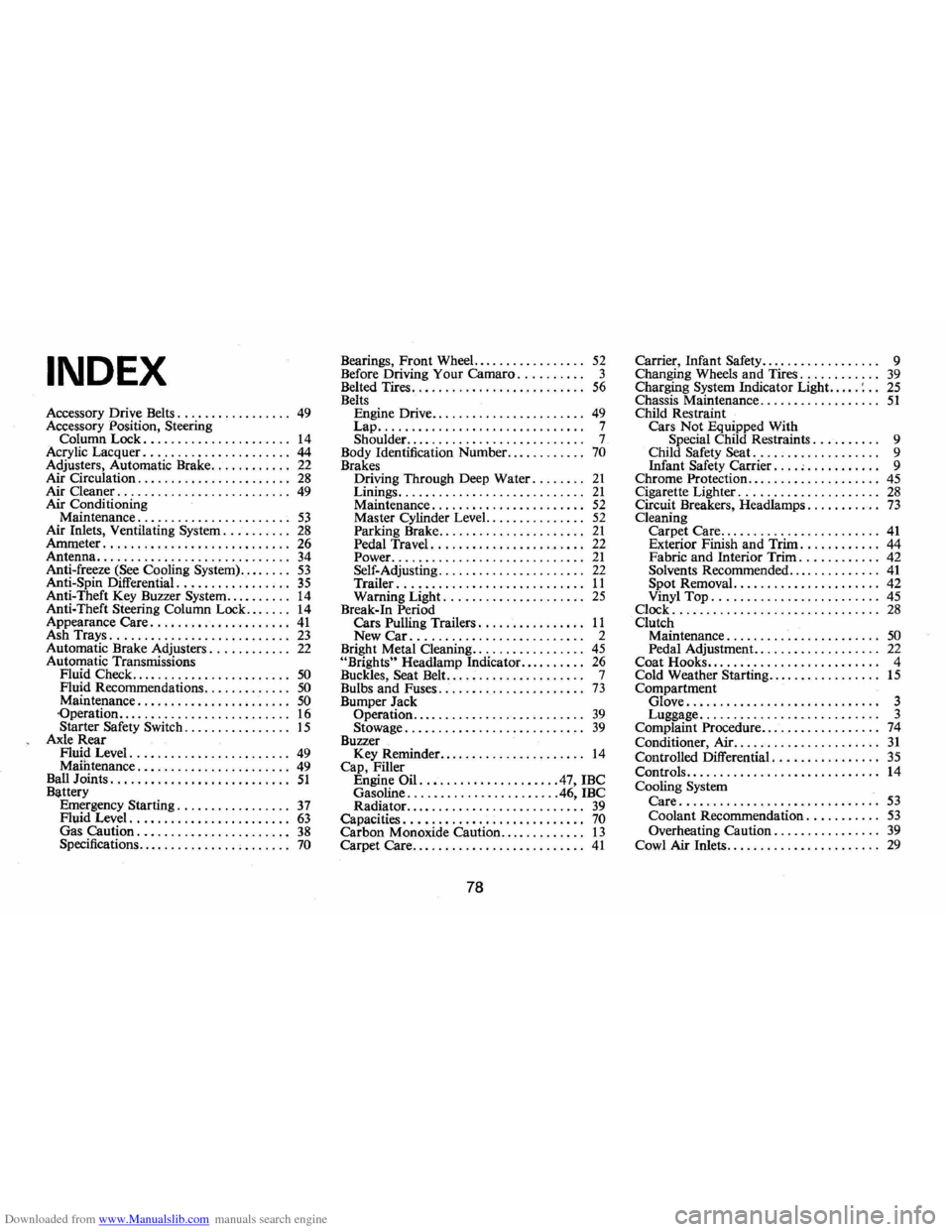
Downloaded from www.Manualslib.com manuals search engine INDEX
Accessory Drive Belts. . . . . . . . . . . . . . . .. 49 Accessory Position, Steering
Column Lock. . . . . . . . . . . . . . . . . . . . .. 14 Acrylic Lacquer ...................... 44 Adjusters, Automatic Brake. . . . . . . . . . .. 22 Air Circulation. . . . . . . . . . . . . . . . . . . . . .. 28 Air Cleaner. . . . . . . . . . . . . . . . . . . . . . . . .. 49 Air Conditioning
Maintenance. . . . . . . . . . . . . . . . . . . . . .. 53 Air Inlets, Ventilating System. . . . . . . . .. 28 Ammeter ............................ 26
Antenna ............................. 34 Anti-freeze (See Cooling System) ........ 53 Anti-Spin Differential. . . . . . . . . . . . . . . .. 35 Anti-Theft Key Buzzer System .......... 14 Anti-Theft Steering Column Lock ....... 14 Appearance Care ..................... 41 Ash Trays. . . . . . . . . . . . . . . . . . . . . . . . . .. 23 Automatic Brake Adjusters. . . . . . . . . . .. 22 Automatic Transmissions
Fluid Check ........................ 50 Fluid Recommendations ............. 50 Maintenance. . . . . . . . . . . . . . . . . . . . . .. 50 -Operation ...... _ ... _ ...... _ ........ 16 Starter Safety Switch _ . . . . . . . . . . . . . .. 15 Axle Rear Flu!? Level. ....................... 49 Mamtenance. . . . . . . . . . . . . . . . . . . . . .. 49 Ball Joints. . . . . . . . . . . . . . . . . . . . . . . . . .. 51 Battery
Emergency Starting ................. 37 Fluid Level. . . . . . . . . . . . . . . . . . . . . . .. 63 Gas Caution. . . . . . . . . . . . . . . . . . . . . .. 38 Specifications. . . . . . . . . . . . . . . . . . . . . .. 70
Bearings, Front Wheel. . . . . . . . . . . . . . . .. 52 Before Driving Your Camaro.......... 3
Belted Tires. . . . . . . . . . . . . . . . . . . . . . . . .. 56 Belts
Engine Drive. . . . . . . . . . . . . . . . . . . . . .. 49 Lap ............................... 7 Shoulder........................... 7
Body Identification Number ............ 70 Brakes
D.riying Through Deep Water. . . . . . .. 21 Lmmgs ............................ 21 Maintenance. . . . . . . . . . . . . . . . . . . . . .. 52 Master Cylinder Level. .............. 52 Parking Brake. . . . . . . . . . . . . . . . . . . . .. 21 Pedal Travel ....................... 22
Power. ............................ 21 Self-Adjusting. . . . . . . . . . . . . . . . . . . . .. 22
Trailer ............................ 11 Warning Light. .................... 25 Break-In Period
Cars Pulling Trailers. . . . . . . . . . . . . . .. 11 New Car .......................... 2
Bright Metal Cleaning ................. 45 "Brights" Headlamp Indicator .......... 26 Buckles, Seat Belt. . . . . . . . . . . . . . . . . . . . . 7
Bulbs and Fuses. . . . . . . . . . . . . . . . . . . . . . 73 Bumper Jack
Operation.. . . . . . . . . . . . . . . . . . . . . . . .. 39 Stowage ........................... 39 Buzzer
Key Reminder. . . . . . . . . . . . . . .. . . . . .. 14 Cap, Filler
Engine Oil. ................... .47, IBC
Gasoline ....................... 46, IBC
Radiator. . . . . . . . . . . . . . . . . . . . . . . . . .. 39 Capacities. . . . . . . . . . . . . . . . . . . . . . . . . .. 70 Carbon Monoxide Caution.. . . . . . . . . . .. 13 Carpet Care .......................... 41
78
Carrier, Infant Safety.... . . . . . . . . . . . . .. 9
Changing Wheels and Tires. . . . . . . . . . .. 39 Charging System Indicator Light. .... : .. 25 Chassis Maintenance. . . . . . . . . . . . . . . . .. 51 Child Restraint
Cars Not Equipped With Special Child Restraints. . . . . . . . .. 9
Child Safety Seat. . . . . . . . . . . . . . . . . .. 9
Infant Safety Carrier .... ; . . . . . . . . . .. 9
Chrome Protection .................... 45 Cigarette Lighter ..................... 28 Circuit Breakers, Headlamps. . . . . . . . . .. 73 Cleaning
Carpet Care. . . . . . . . . . . . . . . . . . . . . . .. 41 Exterior Finish and Trim. . . . . . . . . . .. 44
Fabric and Interior Trim. . . . . . . . . . .. 42
Solvents Recommended .......... , ... 41 Spot Removal. . . . . . . . . . . . . . . . . . . . .. 42
Vinyl Top. . . . . . . . . . . . . . . . . . . . . . . .. 45 Clock ............................... 28 Clutch Maintenance. . . . . . . . . . . . . . . . . . . . . .. 50 Pedal Adjustment. . . . . . . . . . . . . . . . . .. 22 Coat Hooks. . . . . . . . . . . . . . . . . . . . . . . . .. 4
Cold Weather Starting ................. 15 Compartment Glove............................. 3 Luggage........................... 3
Complaint Procedure .................. 74 Conditioner, Air ...................... 31 Controlled Differential. . . . . . . . . . . . . . .. 35 Controls ............................. 14 Cooling System Care .............................. 53 Coolant Recommendation. . . . . . . . . .. 53 Overheating Caution. . . . . . . . . . . . . . .. 39 Cowl Air Inlets ....................... 29
Page 82 of 85
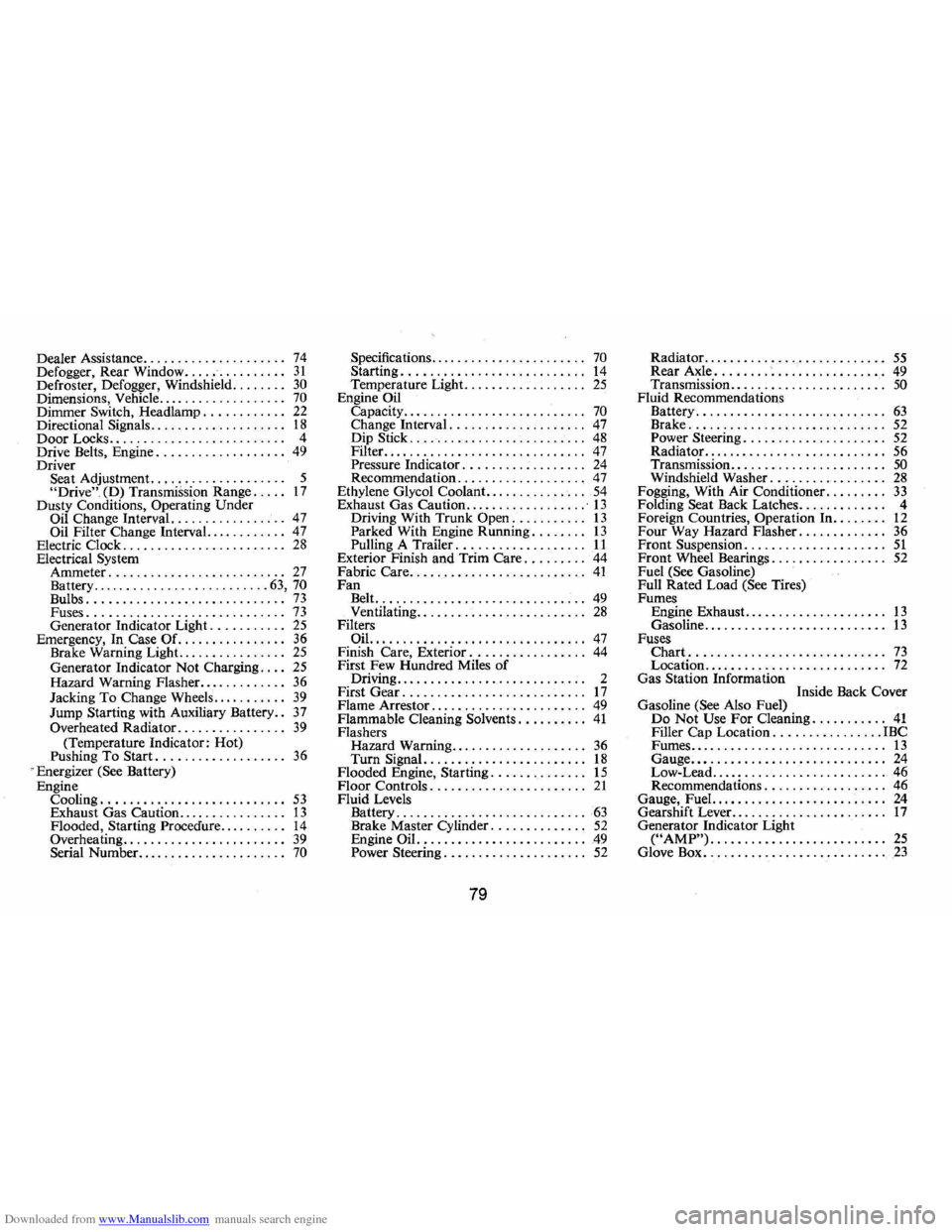
Downloaded from www.Manualslib.com manuals search engine Dealer Assistance ..................... 74 Defogger, Rear Window ............... 31 Defroster, Defogger, Windshield ........ 30 Dimensions, Vehicle ................... 70 Dimmer Switch, Headlamp. . . . . . . . . . .. 22 Directional Signals.. . . . . . . . . . . . . . . . . .. 18 Door Locks. . . . . . . . . . . . . . . . . . . . . . . . .. 4
Drive Belts, Engine. . . . . . . . . . . . . . . . . .. 49 Driver Seat Adjustment. . . . . . . . . . . . . . . . . . . . 5 "Drive". (D) Transmission Range. . . .. 17 Dusty Conditions, Operating Under Oil Change Interval. ................ 47 Oil Filter Change IntervaL ........... 47 Electric Clock. . .. .. . . . . .. .. . .. . .. . . .. 28 Electrical System Ammeter .......................... 27 Battery .......................... 63, 70 Bulbs ............................. 73 Fuses ............................. 73 Generator Indicator Light. . . . . . . . . .. 25 Emergency, In case Of. ............... 36 Brake Warning Light ................ 25 Generator Indicator Not Charging. . .. 25 Hazard Warning Flasher ............. 36 Jacking To Change Wheels ........... 39 Jump Starting with Auxiliary Battery .. 37 Overheated Radiator. . . . . . . . . . . . . . .. 39 (Temperature Indicator: Hot)
Pushing To Start. . . . . . . . . . . . . . . . . .. 36 ' Energizer (See Battery)
Engine Cooling
........................... 53 Exhaust Gas Caution ........ , . . . . . .. 13 Flooded, Starting Procedure .......... 14 Overheating. . . . . . . . . . . . . . . . . . . . . . .. 39 Serial Number ...................... 70
Specifications ................. , . . . .. 70 Starting ........................... 14 Temperature Light. . . . . . . . . . . . . . . . .. 25 Engine Oil Capacity ..... , . . . . . . . . . . . . . . . . . . . .. 70 Change Interval. ................... 47 Dip Stick. . . . . . . . . . . . . . . . . . . . . . . . .. 48 Filter .............................. 47 Pressure Indicator. . . . . . . . . . . . . . . . .. 24 Recommendation ............... ' ... 47 Ethylene Glycol Coolant. . . . . . . . . . . . . .. 54 Exhaust Gas Caution ............ ' ..... ' 13 Driving With Trunk Open. . . . . . . . . .. 13 Parked With Engine Running. . . . . . .. 13 Pulling A Trailer. . . . . . . . . . . . . . . . . .. 11 Exterior Finish and Trim care. . . . . . . .. 44
Fabric Care .......................... 41 Fan Belt. .............................. 49 Ventilating ......................... 28 Filters OiL ............................... 47 Finish Care, Exterior. . . . . . . . . . . . . . . .. 44 First Few Hundred Miles of Driving............................ 2 First Gear. . . . . . . . . . . . . . . . . . . . . . . . . .. 17 Flame Arrestor ......... , . . . . . . . . . . . .. 49 Flammable Cleaning Solvents .......... 41 Flashers
Hazard Warning .................... 36 Turn Signal. . . . . . . . . . . . . . . . . . . . . . .. 18 Flooded Engine, Starting. . . . . . . . . . . . .. 15 Floor Controls ....................... 21 Fluid Levels
Battery ............................ 63 Brake Master Cylinder. . . . . . . . . . . . .. 52 Engine Oil. ........................ 49 Power Steering ..................... 52
79
Radiator ........................... 55 Rear Axle. . . . . . . . . . . . . . . . . . . . . . . .. 49 Transmission ....................... 50 Fluid Recommendations
Battery ......................... , .. 63 Brake ............................. 52 Power Steering. . . . . . . . . . . . . . . . . . . .. 52 Radiator. . . . . . . . . . . . . . . . . . . . . . . . . .. 56
Transmission ....................... 50 Windshield Washer. . . . . . . . . . . . . . . .. 28 Fogging, With Air Conditioner. . . . . . . .. 33 Folding Seat Back Latches. . . . . . . . . . . .. 4 Foreign Countries, Operation In ........ 12 Four Way Hazard Flasher ............. 36 Front Suspension ..................... 51 Front Wheel Bearings. . . . . . . . . . . . . . . .. 52 Fuel (See Gasoline)
Full Rated Load (See Tires)
Fumes Engine Exhaust. . . . . . . . . . . . . . . . . . .
.. 13 Gasoline. . . . . . . . . . . . . . . . . . . . . . . . . .. 13 Fuses Chart. ............................ 73 Location ........................... 72 Gas Station Information
Inside Back Cover
Gasoline
(See Also Fuel) Do Not Use For Cleaning ........... 41 Filler Cap Location ................ IBC
Fumes ............................. 13 Gauge ............................. 24 Low-Lead .......................... 46 Recommendations. . . . . . . . . . . . . . . . .. 46 Gauge, FueL... . . . . . . . . . . . . . . . . . . . . .. 24 Gearshift Lever.. . . . . . . . . . . . . . . . . . . . .. 17 Generator Indicator Light ' ("AMP") .......................... 25 Glove Box. . . . . . . . . . . . . . . . . . . . . . . . . .. 23