brake CHEVROLET CAMARO 1982 Repair Guide
[x] Cancel search | Manufacturer: CHEVROLET, Model Year: 1982, Model line: CAMARO, Model: CHEVROLET CAMARO 1982Pages: 875, PDF Size: 88.64 MB
Page 57 of 875
GM – CAMARO 1982-1992 – Repair Guide (Checked by WxMax) 57
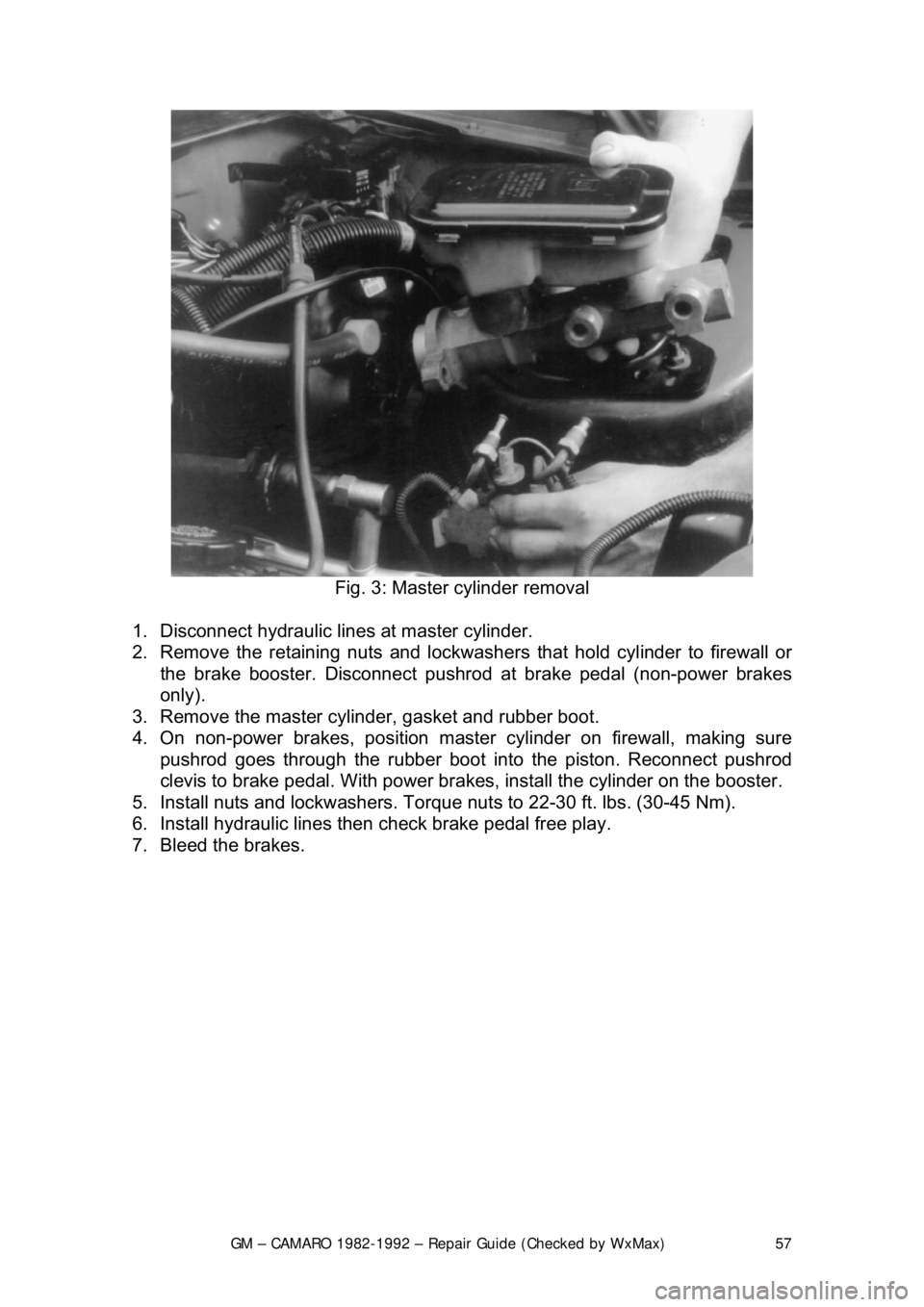
Fig. 3: Master cylinder removal
1. Disconnect hydraulic lines at master cylinder.
2. Remove the retaining nuts and lockwasher s that hold cylinder to firewall or
the brake booster. Disconnect pushrod at brake pedal (non-power brakes
only).
3. Remove the master cylinder, gasket and rubber boot.
4. On non-power brakes, position master cylinder on firewall, making sure pushrod goes through the rubber boot in to the piston. Reconnect pushrod
clevis to brake pedal. With power brakes, install the cylinder on the bo\
oster.
5. Install nuts and lockwashers. Torque nut s to 22-30 ft. lbs. (30-45 Nm).
6. Install hydraulic lines t hen check brake pedal free play.
7. Bleed the brakes.
Page 64 of 875

GM – CAMARO 1982-1992 – Repair Guide (Checked by WxMax) 64
This is a tedious, time-consuming job. You
can save yourself a lot of trouble by
buying a rebuilt master cylinder from y our dealer or parts supply house. The
small difference in price between a r ebuilding kit and a rebuilt part usually
makes it more economical, in terms of time and work, to buy the rebuilt part.
1. Remove the reservoir cover and diap hragm. Discard any brake fluid in the
reservoir.
2. Inspect the reservoir cover and diaphr agm for cuts, cracks, or deformation.
Replace any defective parts.
3. Depress the primary pist on and remove the lock ring.
4. Direct compressed air into the outle t at the blind end of the bore and plug
the other outlet to remove primary and secondary piston.
5. Remove the spring retainer and s eals from the secondary piston.
6. Clamp the master cylinder in a vise. Do not clamp it on the master cylinder
body. Use a pry bar to re move the reservoir.
7. Do not attempt to remove the quick take-up valve from the body. This valve
is not serviced separately.
8. Remove the reservoir grommets.
9. Inspect the master cylinder bore for corrosion. If corroded, replace the
master cylinder. Do not use any abrasive on the bore.
10. Reassemble, using new seals and gr ommets. Lubricate all parts with brake
fluid.
11. Install the reservoir grommets.
12. Install the reservoir.
13. Install the spring retainer and seals from the secondary piston.
14. Install primary and secondary piston.
15. Depress the primary pist on and install the lock ring.
16. Fill with brake fluid. Install the reservoir cover and diaphragm.
17. Bleed brake system.
Page 65 of 875
GM – CAMARO 1982-1992 – Repair Guide (Checked by WxMax) 65
POWER BRAKE BOOSTER
REMOVAL & INSTALLATION
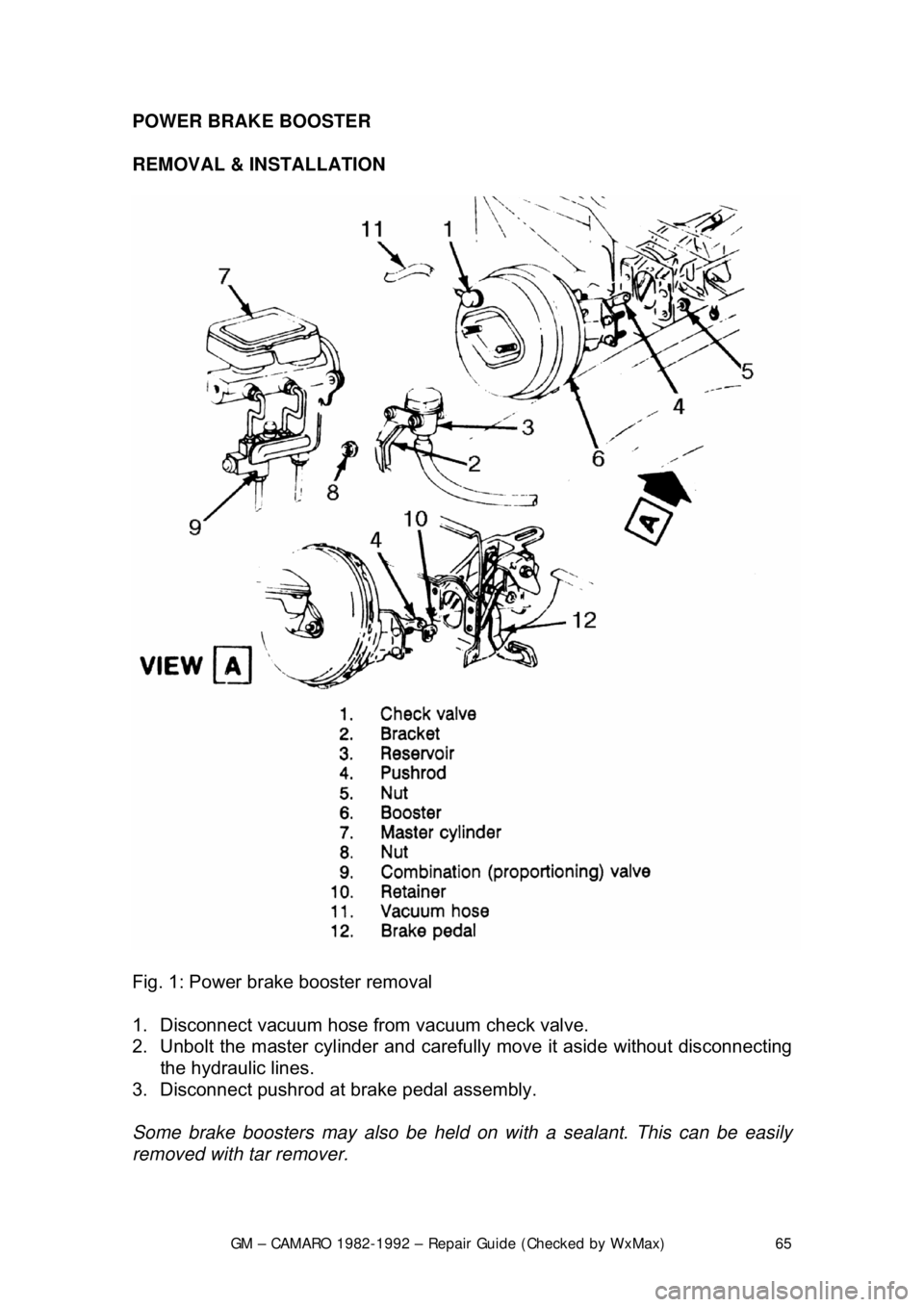
Fig. 1: Power brake booster removal
1. Disconnect vacuum hose from vacuum check valve.
2. Unbolt the master cylinder and carefu
lly move it aside without disconnecting
the hydraulic lines.
3. Disconnect pushrod at brake pedal assembly.
Some brake boosters may also be held on with a sealant. This can be easily
removed with tar remover.
Page 66 of 875

GM – CAMARO 1982-1992 – Repair Guide (Checked by WxMax) 66
4. Remove nuts and lockwashers that se
cure booster to firewall and remove
booster from engine compartment.
5. Install by reversing removal procedure. Make sure to check operation of stop
lights. Allow engine vacuum to build before applying brakes.
COMBINATION VALVE
REMOVAL & INSTALLATION
This valve is not repairable and only serviced as a complete assembly.
1. Disconnect the hydraulic lines from t he valve. Plug the lines to prevent fluid
loss and dirt contamination.
2. Disconnect the electrical connection.
3. Remove the valve.
To install:
4. Position the valve.
5. Connect the electrical connection.
6. Connect the hydraulic lines to the valve.
7. Bleed the brake system.
Page 67 of 875
GM – CAMARO 1982-1992 – Repair Guide (Checked by WxMax) 67
BRAKE HOSES AND LINES
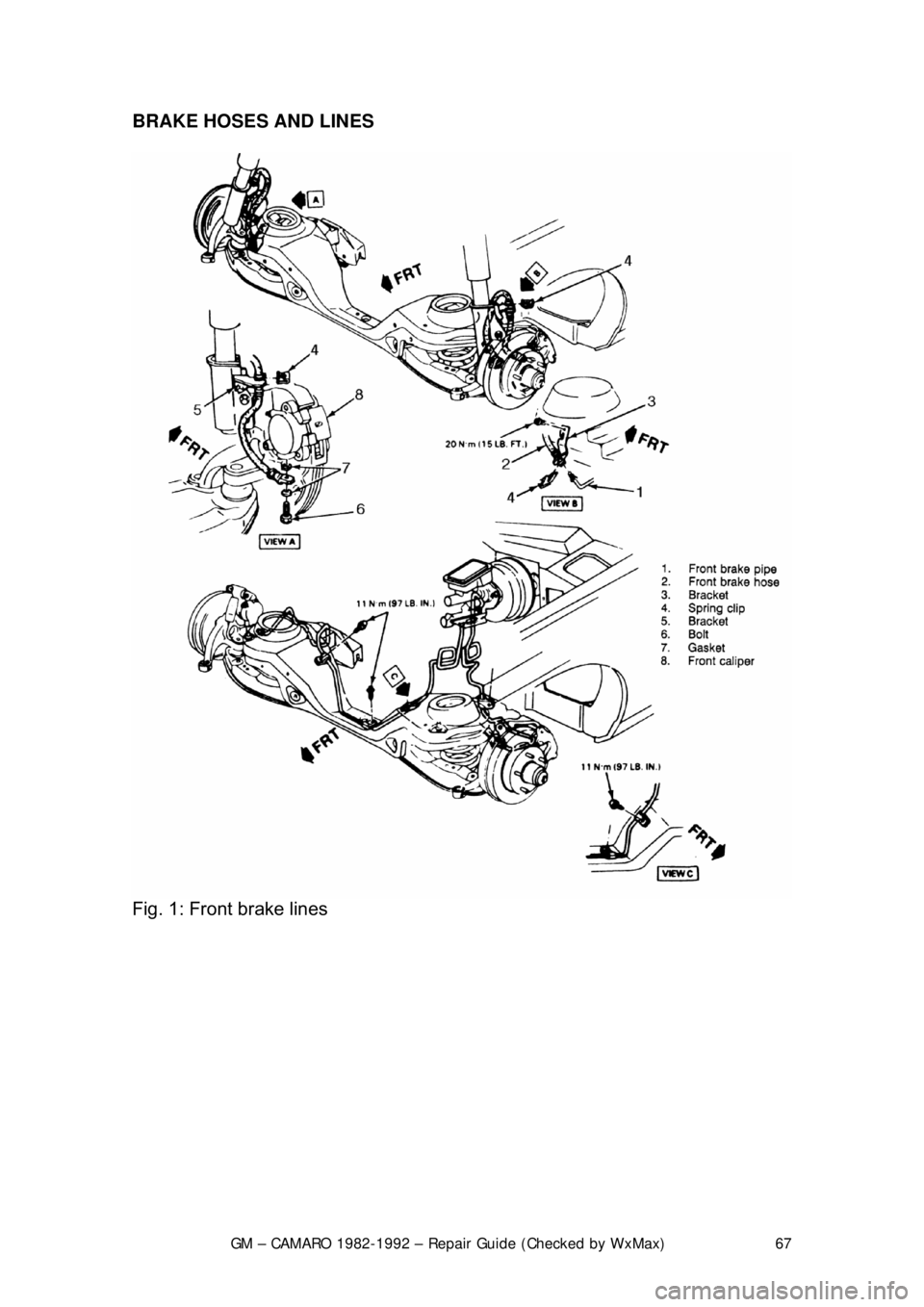
Fig. 1: Front brake lines
Page 68 of 875
GM – CAMARO 1982-1992 – Repair Guide (Checked by WxMax) 68
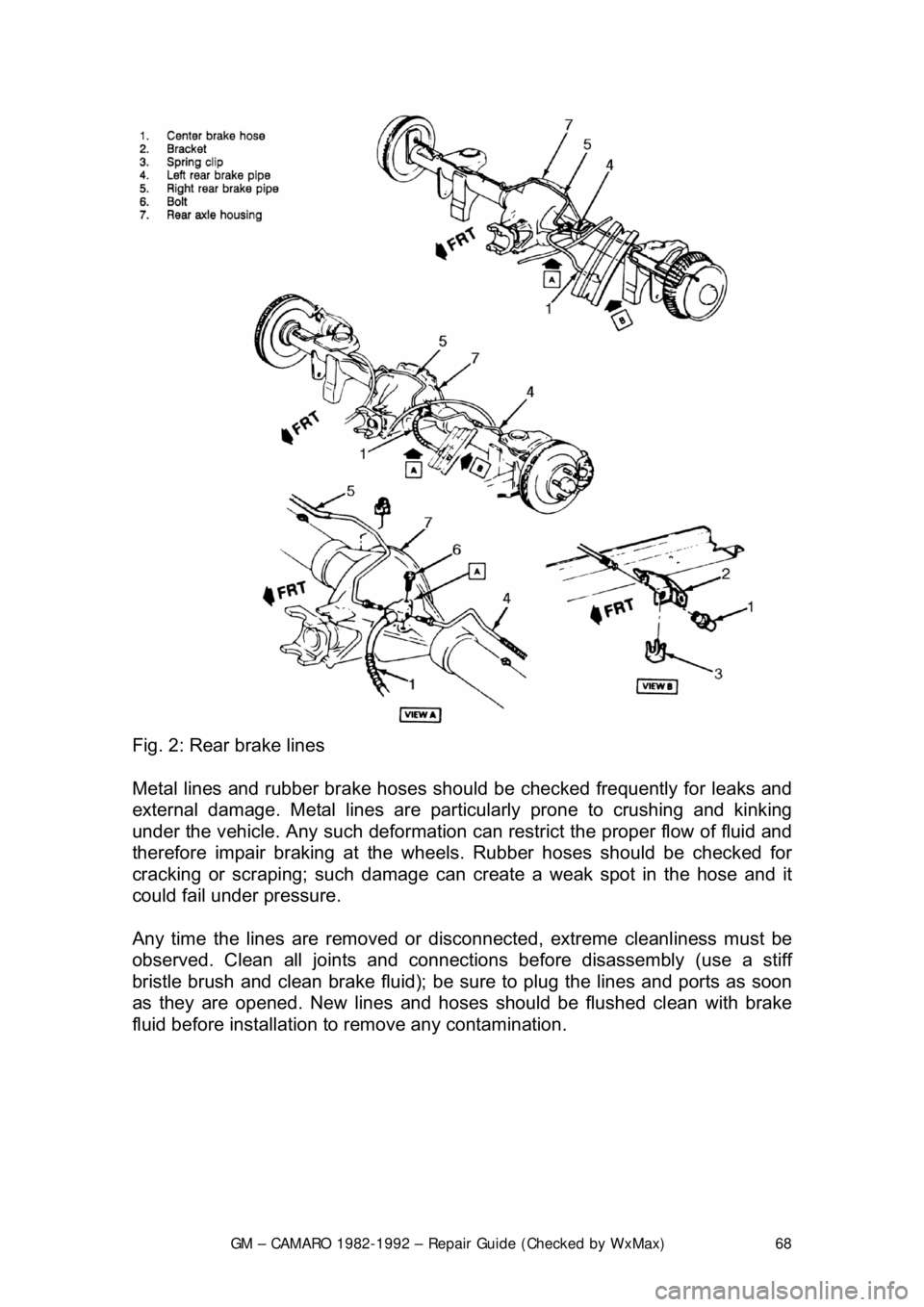
Fig. 2: Rear brake lines
Metal lines and rubber brake hoses shou ld be checked frequently for leaks and
external damage. Metal li nes are particularly prone to crushing and kinking
under the vehicle. Any such deformation can restrict the proper flow of fluid and
therefore impair braking at the wheels. Rubber hoses should be checked for
cracking or scraping; such damage can cr eate a weak spot in the hose and it
could fail under pressure.
Any time the lines are removed or di sconnected, extreme cleanliness must be
observed. Clean all joints and connecti ons before disassembly (use a stiff
bristle brush and clean brake fluid); be su re to plug the lines and ports as soon
as they are opened. New lines and hoses should be flushed clean with brake
fluid before installation to re move any contamination.
Page 71 of 875
GM – CAMARO 1982-1992 – Repair Guide (Checked by WxMax) 71
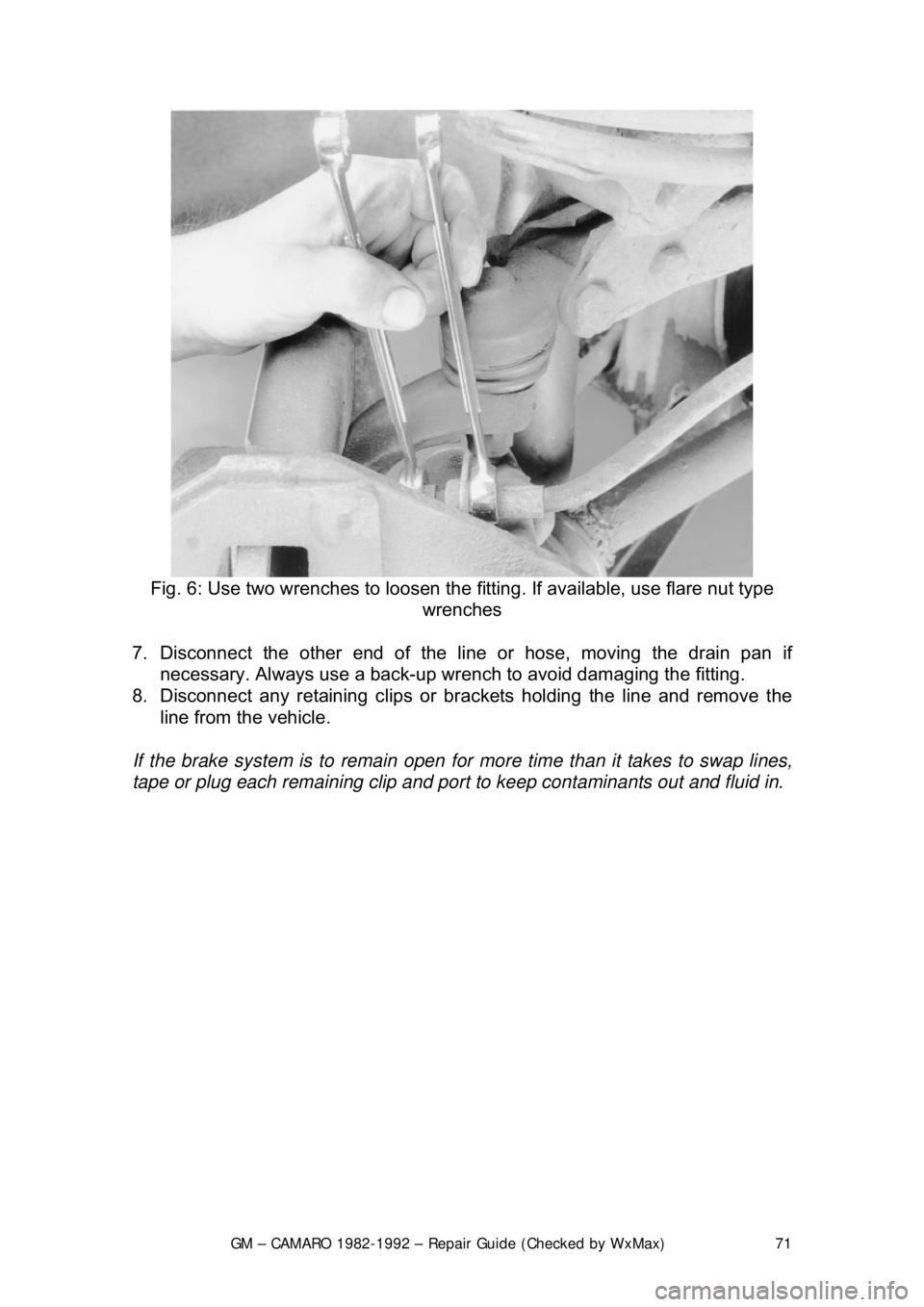
Fig. 6: Use two wrenches to loosen the fi tting. If available, use flare nut type
wrenches
7. Disconnect the other end of the li ne or hose, moving the drain pan if
necessary. Always use a back-up wrench to avoid damaging the fitting.
8. Disconnect any retaining clips or br ackets holding the line and remove the
line from the vehicle.
If the brake system is to rema in open for more time than it takes to swap lines,
tape or plug each remaining clip and port to keep contaminants out and fluid in.
Page 73 of 875
GM – CAMARO 1982-1992 – Repair Guide (Checked by WxMax) 73
To install:
9. Install the new line or hose, starti
ng with the end farthest from the master
cylinder. Connect the other end, then confirm that both fittings are correctly
threaded and turn smoothly using finger pressure. Make sure the new line
will not rub against any ot her part. Brake lines must be at least 1/2 in.
(13mm) from the steering column and other moving parts. Any protective
shielding or insulators must be rein stalled in the original location.
WARNING - Make sure the hose is NO T kinked or touching any part of the
frame or suspension after installation. These conditions may cause the hose to
fail prematurely.
10. Using two wrenches as bef ore, tighten each fitting.
11. Install any retaining clips or brackets on the lines.
12. If removed, install the wheel and tire assemblies, then carefully lower the
vehicle to the ground.
13. Refill the brake master cylinder re servoir with clean, fresh brake fluid,
meeting DOT 3 specifications. Pr operly bleed the brake system.
14. Connect the negative battery cable.
BLEEDING
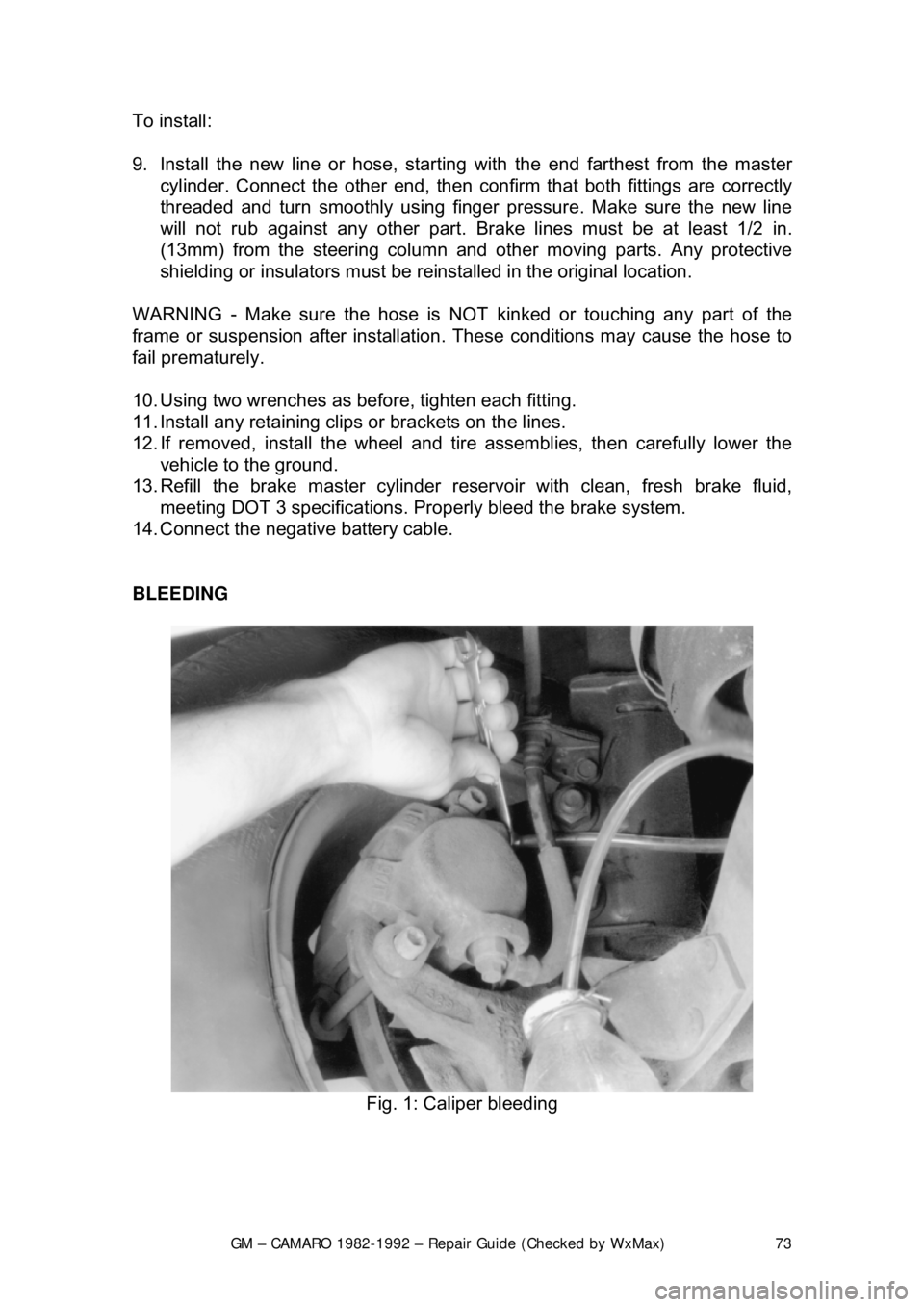
Fig. 1: Caliper bleeding
Page 74 of 875
GM – CAMARO 1982-1992 – Repair Guide (Checked by WxMax) 74
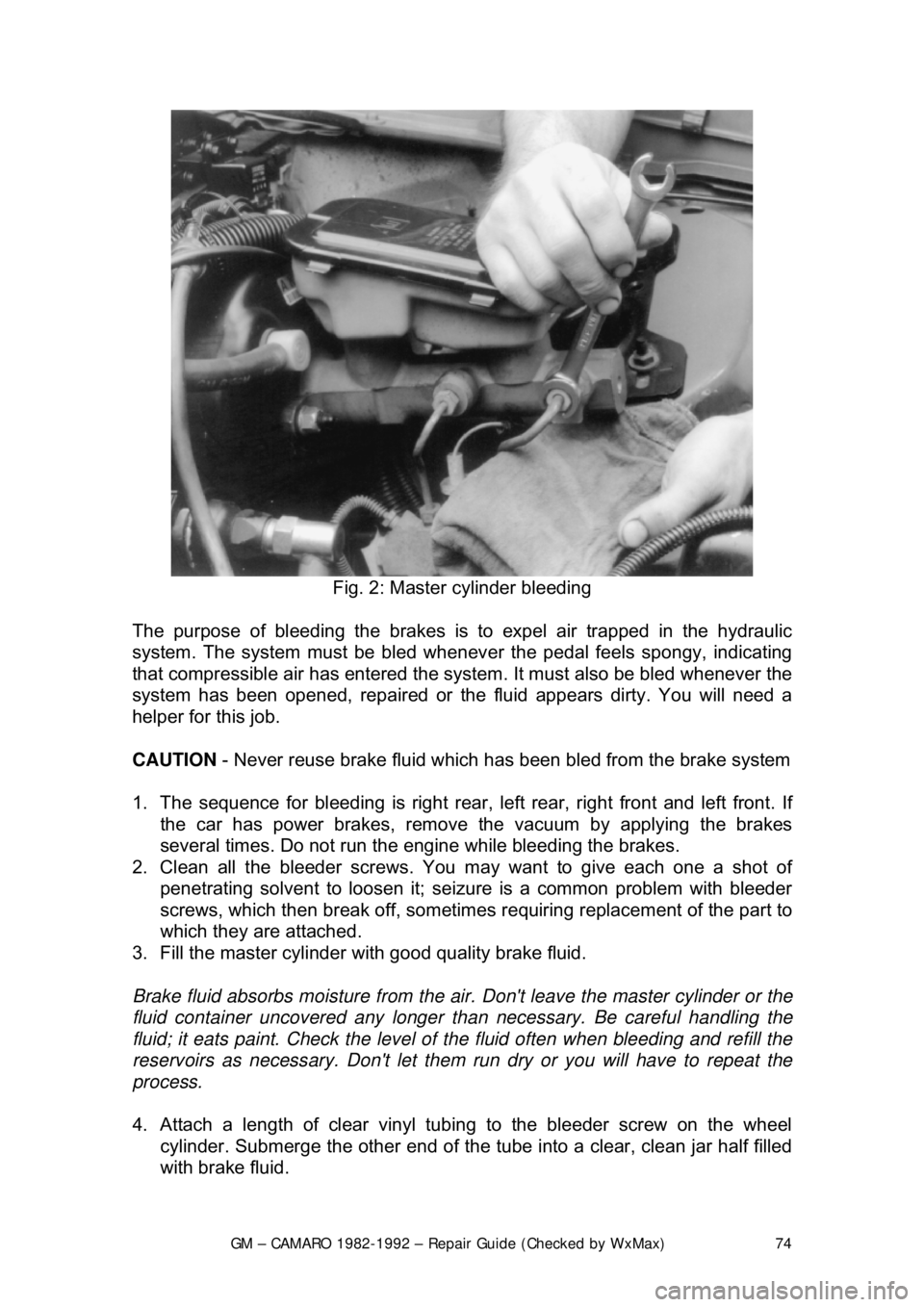
Fig. 2: Master cylinder bleeding
The purpose of bleeding the brakes is to expel air trapped in the hydraulic
system. The system must be bled whenever the pedal feels spongy, indicating
that compressible air has ent ered the system. It must also be bled whenever the
system has been opened, repaired or the fluid appears dirty. You will need a
helper for this job.
CAUTION - Never reuse brake fluid which has been bled from the brake system
1. The sequence for bleeding is right rear , left rear, right front and left front. If
the car has power brakes, remove the vacuum by applying the brakes
several times. Do not run the engine while bleeding the brakes.
2. Clean all the bleeder screws. You ma y want to give each one a shot of
penetrating solvent to loosen it; seiz ure is a common problem with bleeder
screws, which then break off, sometimes requiring replacement of the part to
which they are attached.
3. Fill the master cylinder with good quality brake fluid.
Brake fluid absorbs moisture from the air. Don't leave the master cylinder or the
fluid container uncovered any longer t han necessary. Be careful handling the
fluid; it eats paint. Check the level of the fluid often when bleeding and refill the
reservoirs as necessary. Don't let them run dry or you will have to repeat the
process.
4. Attach a length of clear vinyl t ubing to the bleeder screw on the wheel
cylinder. Submerge the other end of the tube into a clear, clean jar half filled
with brake fluid.
Page 75 of 875

GM – CAMARO 1982-1992 – Repair Guide (Checked by WxMax) 75
5. Have your assistant sl
owly depress the brake pedal. As this is done, open
the bleeder screw 3/4 of a turn and allow the flui d to run through the tube.
Then close the bleeder screw before the pedal reaches the end of its travel.
Have your assistant slo wly release the pedal. Rep eat this process until no
air bubbles appear in the expelled fluid.
6. Repeat the procedure on the other three br akes, checking the level of fluid in
the master cylinder reservoir often.
7. Upon completion, check the brak e pedal for sponginess and the brake
warning light for unbalanced pressure . If necessary, repeat the entire
bleeding procedure.
FRONT DISC BRAKES
CAUTION - Some brake pads contain asbest os, which has been determined to
be a cancer causing agent. Never clean the brake surfaces with compressed
air! Avoid inhaling any dust from any brake surface! When cleaning brake
surfaces, use a commercially available brake cleaning fluid.
BRAKE PADS
CAUTION - Some brake pads contain asbest os, which has been determined to
be a cancer causing agent. Never clean the brake surfaces with compressed
air! Avoid inhaling any dust from any brake surface! When cleaning brake
surfaces, use a commercially available brake cleaning fluid.
INSPECTION
The pad thickness should be inspected ever y time that the tires are removed for
rotation. The outer pad can be checked by looking in each end, which is the
point at which the highest rate of wear occurs. The inner pad can be checked by
looking down through the inspection hole in the top of the caliper. If the
thickness of the pad is worn to within 0.030 in. (0.8mm) of the rivet at either end
of the pad, all the pads should be replaced.
Always replace all pads on both front wheel s at the same time. Failure to do so
will result in uneven braking action and premature wear.
REMOVAL & INSTALLATION