fuse CHEVROLET CAMARO 1982 Repair Guide
[x] Cancel search | Manufacturer: CHEVROLET, Model Year: 1982, Model line: CAMARO, Model: CHEVROLET CAMARO 1982Pages: 875, PDF Size: 88.64 MB
Page 219 of 875
GM – CAMARO 1982-1992 – Repair Guide (Checked by WxMax) 219
FUSE BLOCK
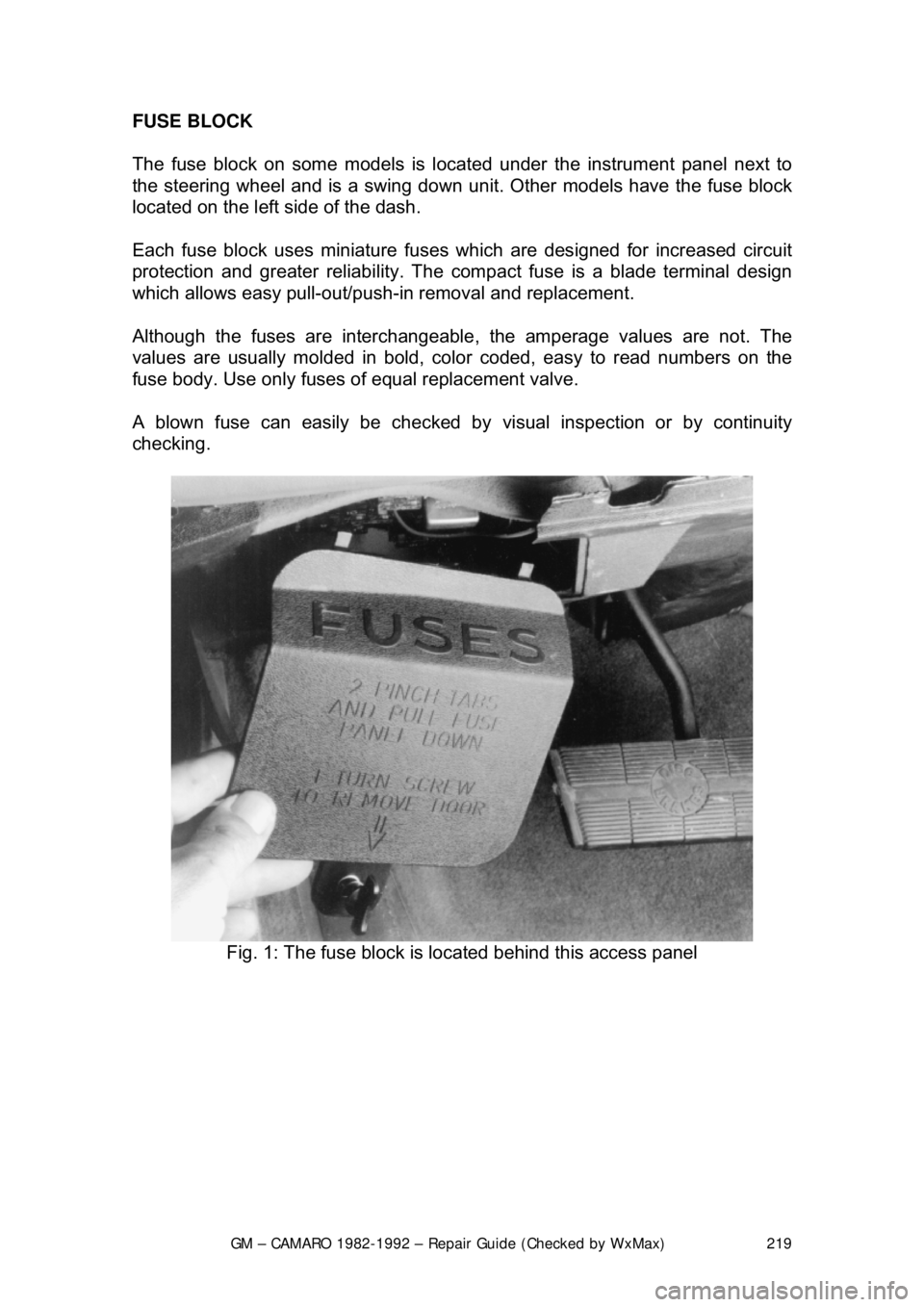
The fuse block on some models is loca
ted under the instrument panel next to
the steering wheel an d is a swing down unit. Other models have the fuse block
located on the left side of the dash.
Each fuse block uses miniature fuse s which are designed for increased circuit
protection and greater reliabi lity. The compact fuse is a blade terminal design
which allows easy pull-out/push- in removal and replacement.
Although the fuses are interchangeable , the amperage values are not. The
values are usually molded in bold, color coded, easy to read numbers on the
fuse body. Use only fuses of equal replacement valve.
A blown fuse can easily be checked by visual inspection or by continuity
checking.
Fig. 1: The fuse block is located behind this access panel
Page 220 of 875
GM – CAMARO 1982-1992 – Repair Guide (Checked by WxMax) 220
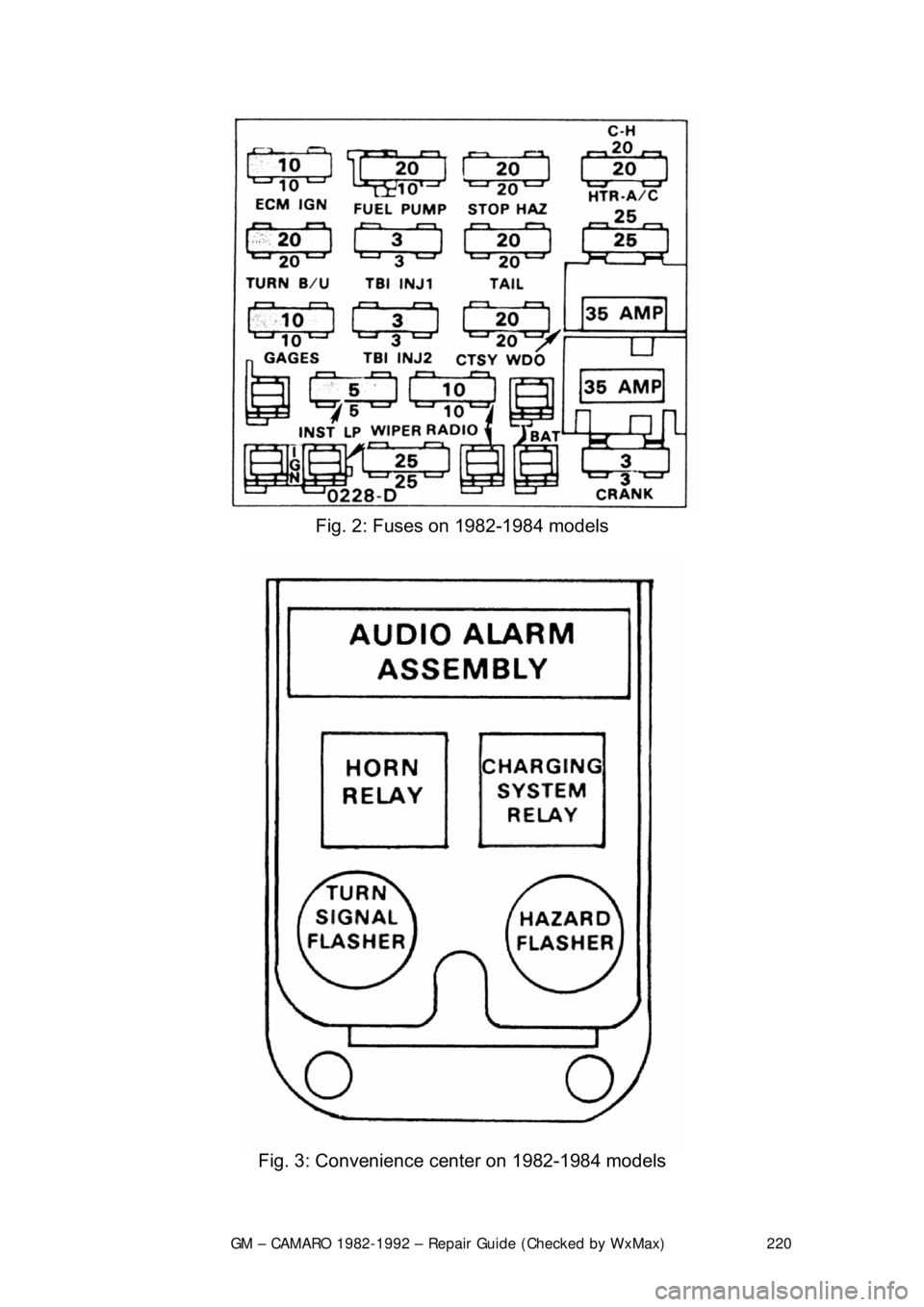
Fig. 2: Fuses on 1982-1984 models
Fig. 3: Convenience center on 1982-1984 models
Page 221 of 875
GM – CAMARO 1982-1992 – Repair Guide (Checked by WxMax) 221
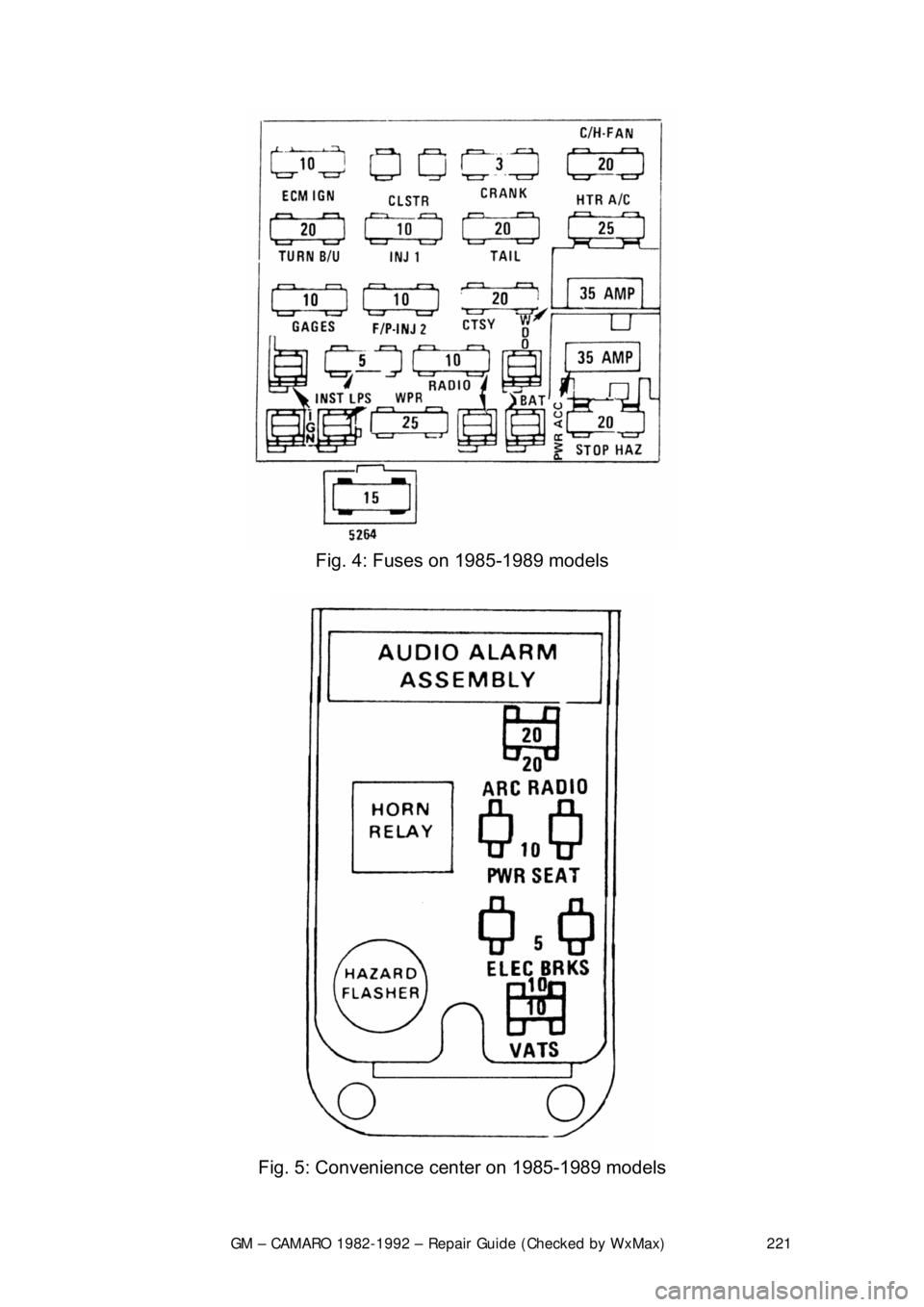
Fig. 4: Fuses on 1985-1989 models
Fig. 5: Convenience center on 1985-1989 models
Page 222 of 875
GM – CAMARO 1982-1992 – Repair Guide (Checked by WxMax) 222
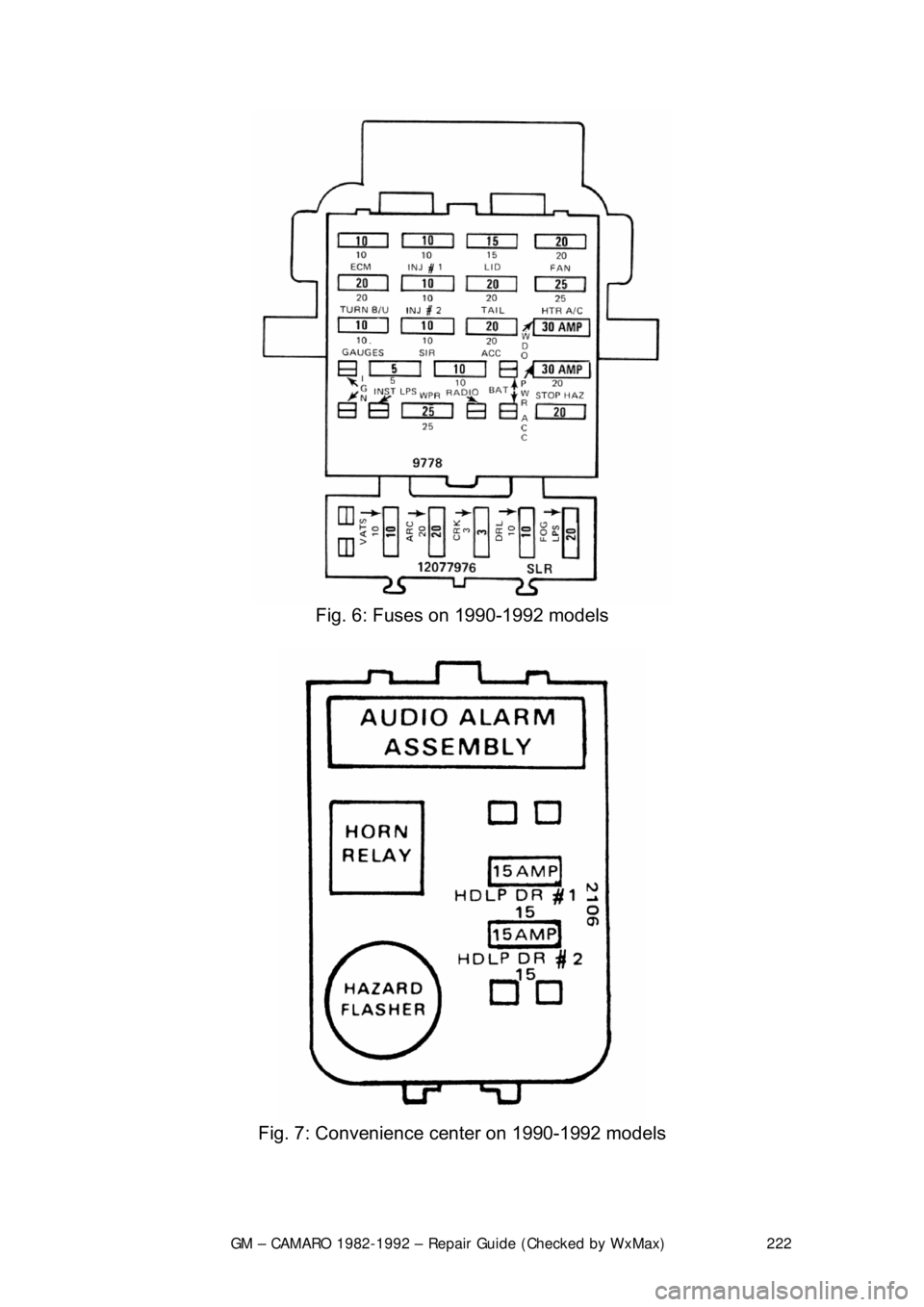
Fig. 6: Fuses on 1990-1992 models
Fig. 7: Convenience center on 1990-1992 models
Page 223 of 875

GM – CAMARO 1982-1992 – Repair Guide (Checked by WxMax) 223
FUSIBLE LINKS
In addition to circuit breakers and fuses,
the wiring harness incorporates fusible
links to protect the wiring. Links are used rather than a fuse, in wiring circuits
that are not normally fused, such as th e ignition circuit. The fusible links are
color coded red in the charging and load circuits to match the color coding of
the circuits they protect. Each link is four gauges smaller than the cable it
protects, and is marked on the insulation with the gauge size because the
insulation makes it appear heavier than it really is. The engine compartment
wiring harness has several fusible links. The same size wire with a special
Hypalon insulation must be used w hen replacing a fusible link.
For more details, see the information on fusible links at the beginning of this
section.
The links are located in the following areas:
1. A molded splice at the starter solenoid Bat terminal, a 14 gauge red wire.
2. A 16 gauge red fusible link at the j unction block to protect the unfused
wiring of 12 gauge or larger wire. This link stops at the bulkhead
connector.
3. The alternator warning light and fiel d circuitry is protected by a 20 gauge
red wire fusible link used in the batte ry feed-to-voltage regulator number
3 terminal. The link is installed as a molded splice in the circuit at the
junction block.
4. The ammeter circuit is protected by two 20 gauge fusible links installed
as molded splices in the circuit at t he junction block and battery to starter
circuit.
REPLACEMENT 1. Determine the circuit that is damaged.
2. Disconnect the negative battery terminal.
3. Cut the damaged fuse link from the harness and discard it.
4. Identify and procure the proper fuse link and butt connectors.
5. Strip the wire about
1/2 in. (13mm) on each end.
6. Connect the fusible link and crimp the butt connectors making sure that the wires are secure.
7. Solder each connection with resin core solder, and wrap the connections
with plastic electrical tape.
8. Reinstall the wir e in the harness.
9. Connect the negative battery terminal and test the system for proper
operation.
CIRCUIT BREAKERS
Various circuit breakers are located under the instrument panel. In order to gain
access to these components, it may be ne cessary to first remove the under
dash padding. Most of the circuit breakers are located in the convenience
center or the fuse panel.
Page 351 of 875

GM – CAMARO 1982-1992 – Repair Guide (Checked by WxMax) 351
alternating current developed
within the stator windings to a direct (DC) current
at the output (BAT) terminal. Three of these diodes are negative and are
mounted flush with the end frame while t he other three are positive and are
mounted into a strip called a heat sink. The positive diodes are easily identified
as the ones within small cavities or depressions.
The alternator charging system is a negative (-) ground system which consists
of an alternator, a regulat or, a charge indicator, a storage battery and wiring
connecting the components, and fuse link wire.
The alternator is belt-driven from t he engine. Energy is supplied from the
alternator/regulator system to the rotati ng field through two brushes to two slip-
rings. The slip-rings are mounted on the rotor shaft and are connected t\
o the
field coil. This energy supplied to the ro tating field from the battery is called
excitation current and is used to init ially energize the field to begin the
generation of electricity. Once the alter nator starts to generate electricity, the
excitation current comes from its ow n output rather than the battery.
The alternator produces power in the form of alternating current. The alternating
current is rectified by 6 diodes into dire ct current. The direct current is used to
charge the battery and power the rest of the electrical system.
When the ignition key is turned ON, current flows from the battery, through the
charging system indicator light on the in strument panel, to the voltage regulator,
and to the alternator. Since the alternat or is not producing any current, the
alternator warning light comes on. When the engine is started, the alternator
begins to produce current and turns the alte rnator light off. As the alternator
turns and produces current, the current is divided in two ways: part to the
battery(to charge the battery and power the electrical components of the
vehicle), and part is returned to the alte rnator (to enable it to increase its
output). In this situation, the alternator is receiving current from the battery and
from itself. A voltage regulat or is wired into the current supply to the alternator
to prevent it from receiving too much cu rrent which would cause it to put out too
much current. Conversely, if the voltage regulator does not allow the alternator
to receive enough current, the battery will not be fully charged and will
eventually go dead.
The battery is connected to the alternator at all times, whether the ignition key is
turned ON or not. If the battery were shorted to ground, the alternator would
also be shorted. This woul d damage the alternator. To prevent this, a fuse link
is installed in the wiring between the battery and the alternator. If the battery is
shorted, the fuse link melts, protecting the alternator.
An alternator is better that a convent ional, DC shunt generator because it is
lighter and more compact, because it is designed to supply the battery and
accessory circuits through a wide range of engine speeds, and because it
eliminates the necessary maintenance of replacing brushes and servicing
commutators.
PRECAUTIONS
Page 596 of 875

GM – CAMARO 1982-1992 – Repair Guide (Checked by WxMax) 596
recommended to have a qualified technici
an perform any further testing, if
needed.
FIELD SERVICE MODE
On fuel injected models, if the ALDL terminal B is grounded to terminal A with
the engine running, the system enters the Field Service Mode. In this mode, the
MIL will indicate whether the system is operating in open loop or closed loop.
If working in open loop, t he MIL will flash rapidly 2
1/2 times per second. In
closed loop, the flash rate slows to once per second. Additionally, if the system
is running lean in closed loop, the lamp will be off most of the cycle. A rich
condition in closed loop will cause the lamp to remain lit for most of the one
second cycle.
When operating in the Field Service M ode, additional codes cannot be stored
by the ECM. The closed loop timer is bypassed in this mode.
CLEARING CODES
Stored fault codes may be erased from me mory at any time by removing power
from the ECM for at least 30 seconds. It may be necessary to clear stored
codes during diagnosis to check for any re currence during a test drive, but the
stored should be written dow n when retrieved. The codes may still be required
for subsequent troubleshooting. Whenever a repair is complete, the stored
codes must be erased and the vehicle te st driven to confirm correct operation
and repair.
The ignition switch must be OFF any ti me power is disconnected or restored to
the ECM. Severe damage may result if this precaution is not observed.
Depending on the electric di stribution of the particular vehicle, power to the
ECM may be disconnected by removing the ECM fuse in the fusebox or
disconnecting the inline EC M power lead at the positive battery terminal.
Disconnecting the negative battery cable to clear codes will achieve the desired
result, but this will also clear other me mory data in the vehicle such as radio
presets or seat memory.
Page 638 of 875
GM – CAMARO 1982-1992 – Repair Guide (Checked by WxMax) 638
ELECTRONIC IGNITION SYSTEM
GENERAL INFORMATION
The High Energy Ignition (HEI) system
controls the fuel combustion by
providing a spark to ignite the compress ed air/fuel mixture at the correct time.
To provide improved engine performance, fuel economy, and control of exhaust
emissions, the engine contro l module (ECM) controls distributor spark advance
(timing) with an ignition control system.
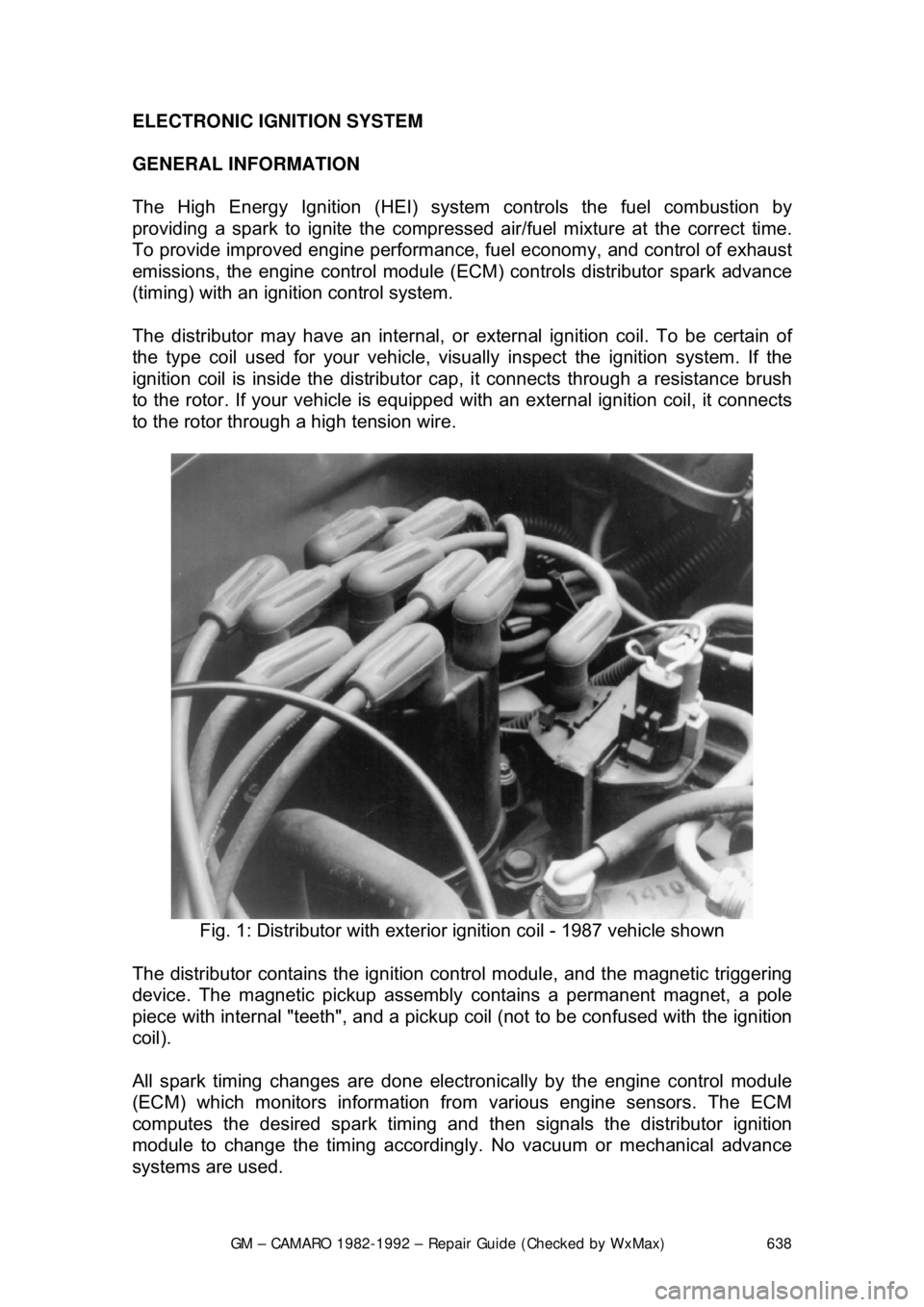
The distributor may have an internal, or ex ternal ignition coil. To be certain of
the type coil used for your vehicle, vis ually inspect the ignition system. If the
ignition coil is inside the distributor c ap, it connects through a resistance brush
to the rotor. If your vehicle is equipped with an external ignition coil, it connects
to the rotor through a high tension wire.
Fig. 1: Distributor with exterior ignition coil - 1987 vehicle shown
The distributor contains the ignition c ontrol module, and the magnetic triggering
device. The magnetic pickup assembly contains a permanent magnet, a pole
piece with internal "teeth", and a pickup co il (not to be confused with the ignition
coil).
All spark timing changes are done electr onically by the engine control module
(ECM) which monitors information from various engine sensors. The ECM
computes the desired spark timing and t hen signals the distributor ignition
module to change the timing accordingly. No vacuum or mechanical advance
systems are used.
Page 726 of 875

GM – CAMARO 1982-1992 – Repair Guide (Checked by WxMax) 726
RELIEVING FUEL SYSTEM PRESSURE
1. Remove the fuse marked "Fuel Pu mp" from the fuse block in the
passenger compartment.
2. Crank the engine. Th e engine will start and run until the fuel supply
remaining in the lines is exhauste d. When the engines stops, engage the
starter again for three seconds to a ssure dissipation of any remaining
pressure.
3. With the ignition OFF, disconnect the negative battery cable to prevent
fuel discharge if the key is accidentally turned to the ON position.
Replace the fuse with the ignition OFF.
When disconnecting fuel lines, there ma y still be a small amount of fuel
released. Cover the fuel line connection wi th a shop cloth to collect the fuel,
then place the cloth in an approved container.
ELECTRIC FUEL PUMP
REMOVAL & INSTALLATION
The removal and installation procedures fo r the Crossfire injection system fuel
pump is identical to the Throttle Body In jection (TBI) system. Please refer to the
TBI fuel pump procedures earlier in this repair guide.
TESTING
The testing procedures for the Crossfire in jection system fuel pump is identical
to the Throttle Body Injection (TBI) syst em. Please refer to the TBI fuel pump
procedures earlier in this repair guide.
THROTTLE BODY
REMOVAL & INSTALLATION
FRONT UNIT
1. Relieve the fuel system pressure.
2. Remove the air cleaner assembly, noting the connection points of the
vacuum lines.
3. Detach the electrical connectors at the injector and the idle air control
motor.
4. Disconnect the vacuum lines from the TBI unit, noting the connection
points. During installation, refer to the underhood emission control
information decal for vacuum line routing information.
5. Disconnect the transmission det ent cable from the TBI unit.
6. Disconnect the fuel inlet (feed) and fuel balance line connections at the
front TBI unit.
7. Remove and discard the throttle cont rol rod retaining clip from the front
TBI throttle lever stud. A new clip must be used during reassembly.
8. Unbolt and remove the TBI unit.
Page 847 of 875

GM – CAMARO 1982-1992 – Repair Guide (Checked by WxMax) 847
DISARMING
1. Turn the steering wheel to align the w heels in the straight-ahead position.
2. Turn the ignition switch to the LOCK position.
3. Remove the SIR air bag fuse from the fuse block.
4. Remove the left side trim panel and disconnect the yellow 2-way SIR
harness wire connector at the bas e of the steering column.
To enable system: 5. Turn the ignition switch to the LOCK position.
6. Reconnect the yello w 2-way connector at the base of the steering
column.
7. Reinstall the SIR fuse and the left side trim panel.
8. Turn the ignition switch to the RUN position.
9. Verify the SIR indicator light flashes 7-9 times, if not as specified, inspect
system for malfunction or c ontact the manufacturer.
For more details on the SIR system - including disarming instructions for
passenger bags - please refer to Chassis Electrical in this repair guide.
SUPPLEMENTAL INFLATABLE REST RAINT (SIR) COIL ASSEMBLY
After performing repairs on the inter nals of the steering column the coil
assembly must be centered in order to avoid damaging the coil or accidental
deployment of the air bag. There are 2 different styles of coils, one rotates
clockwise and the other rotates counterclockwise.
ADJUSTMENT (CENTERING THE COIL) 1. With the system properly disarmed, hold the coil assembly with the clear
bottom up to see the coil ribbon.
2. While holding the coil assembly, depr ess the lock spring and rotate the
hub in the direction of the arrow until it stops. The coil should now be
wound up snug against the center hub.
3. Rotate the coil assembly in the opposite direction approximately 2
1/2
turns and release the lock spring between the locking tabs in front of the
arrow.
4. Install the coil assembly onto the steering shaft.
STEERING WHEEL
WARNING - Before attempting any repairs involving the steering wheel or
disassembly of it, ensure that the Supple mental Inflatable Restraint (Air Bag)
system is properly disarmed.
REMOVAL & INSTALLATION
If the vehicle is equipped with a SIR (A ir Bag) system, ensure that the proper
disarming procedure is followed.