clock CHEVROLET CAMARO 1982 Repair Guide
[x] Cancel search | Manufacturer: CHEVROLET, Model Year: 1982, Model line: CAMARO, Model: CHEVROLET CAMARO 1982Pages: 875, PDF Size: 88.64 MB
Page 692 of 875

GM – CAMARO 1982-1992 – Repair Guide (Checked by WxMax) 692
IDLE AIR VALVE
A cover is in place over t
he idle air bleed valve. Also , the access holes to the
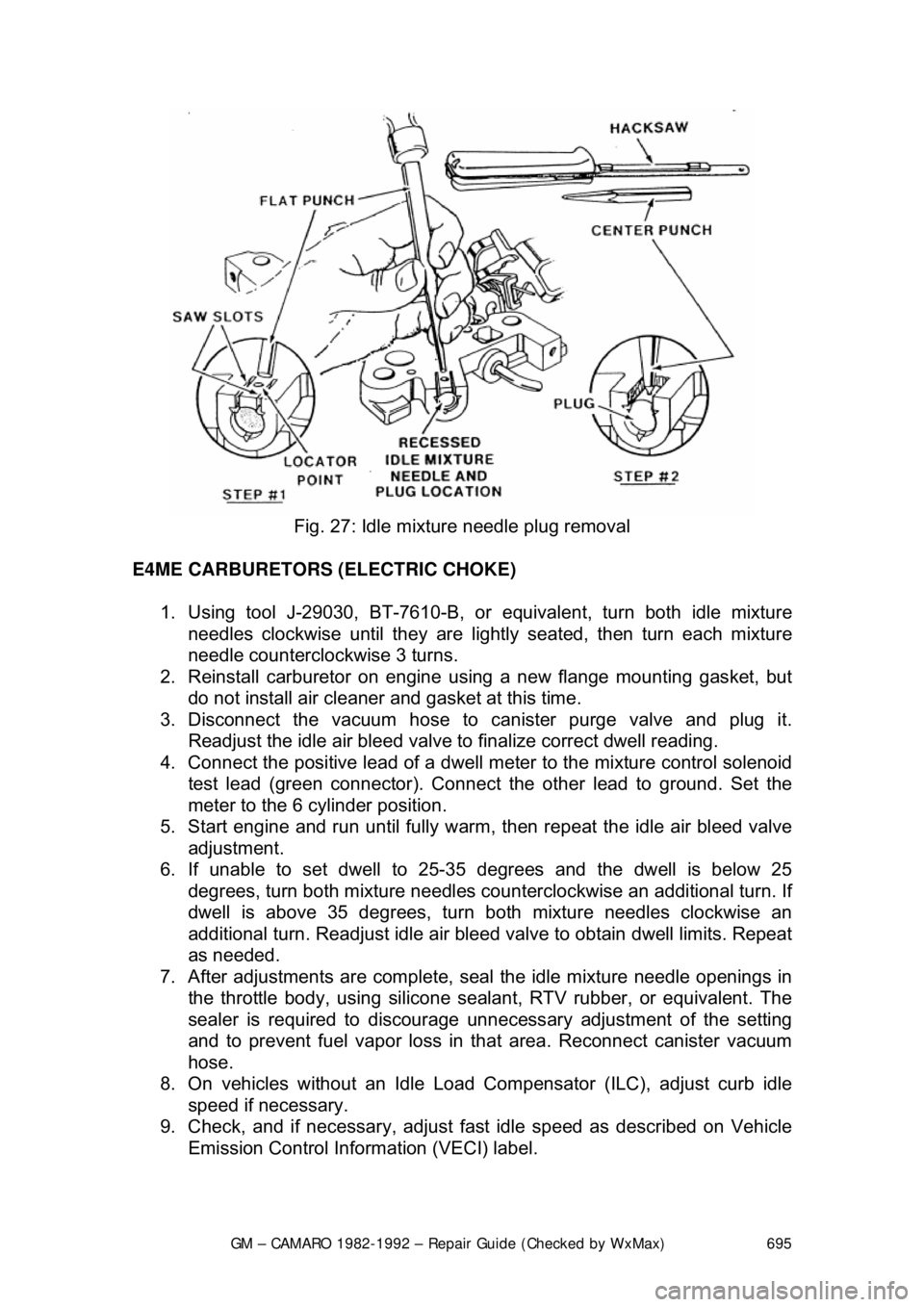
idle mixture needles are s ealed with hardened plugs. This is done to seal the
factory settings, during original equipment production. These items are NOT to
be removed unless required for cleaning, part replacement, improper dwell
readings or if the System Performance Check indicates the carburetor is the
cause of the trouble.
ROCHESTER E4ME AND E4MC
1. With engine OFF, cover the internal bowl vents and inlet to bleed valve
and the carburetor air intakes with maski ng tape. This is done to prevent
metal chips from entering.
2. Carefully drill rivet head of idle air bleed cover, with 0.110 in. (2.8mm) drill bit.
3. Remove rivet head and all pieces of rivet.
4. Lift cover off air bleed valve and bl ow out any metal shavings, or use a
magnet to remove excess metal.
CAUTION - Always wear eye protection when using compressed air.
5. Remove masking tape.
6. Start engine and allow it to reac h normal operating temperature.
7. Disconnect the vacuum hose from t he canister purge valve and plug it.
8. While idling in D for automatic transmission or N for manual
transmission, slowly turn the valve c ounterclockwise or clockwise, until
the dwell reading varies within the 25-35 degree range, attempting to be
as close to 30 degrees as possible.
Perform this step carefully. The air bleed valve is very sensitive and should be
turned in
1/8 turn increments only.
9. If the dwell reading d oes not vary and is not within the 25-35 degree
range, it will be necessary to remove the plugs and to adjust the idle
mixture needles.
Page 695 of 875
GM – CAMARO 1982-1992 – Repair Guide (Checked by WxMax) 695
Fig. 27: Idle mixture needle plug removal
E4ME CARBURETORS (ELECTRIC CHOKE) 1. Using tool J-29030, BT-7610-B, or equivalent, turn both idle mixture
needles clockwise until they are lightly seated, then turn each mixture
needle counterclockwise 3 turns.
2. Reinstall carburetor on engine using a new flange mounting gasket, but
do not install air cleaner and gasket at this time.
3. Disconnect the vacuum hose to canister purge valve and plug it.
Readjust the idle air bleed valve to finalize correct dwell reading.
4. Connect the positive lead of a dwell me ter to the mixture control solenoid
test lead (green connector). Connect the other lead to ground. Set the
meter to the 6 cylinder position.
5. Start engine and run unt il fully warm, then repeat the idle air bleed valve
adjustment.
6. If unable to set dwell to 25-35 degrees and the dwell is below 25
degrees, turn both mixture needles counter clockwise an additional turn. If
dwell is above 35 degrees, turn both mixture needles clockwise an
additional turn. Readjust idle air bleed valve to obtain dwell limits. Repeat
as needed.
7. After adjustments are complete, seal the idle mixture needle openings in
the throttle body, using silicone sealant, RTV rubber, or equivalent. The
sealer is required to discourage unnecessary adjus tment of the setting
and to prevent fuel vapor loss in that area. Reconnect canister vacuum
hose.
8. On vehicles without an Idle Load Co mpensator (ILC), adjust curb idle
speed if necessary.
9. Check, and if necessary, adjust fa st idle speed as described on Vehicle
Emission Control Information (VECI) label.
Page 696 of 875
GM – CAMARO 1982-1992 – Repair Guide (Checked by WxMax) 696
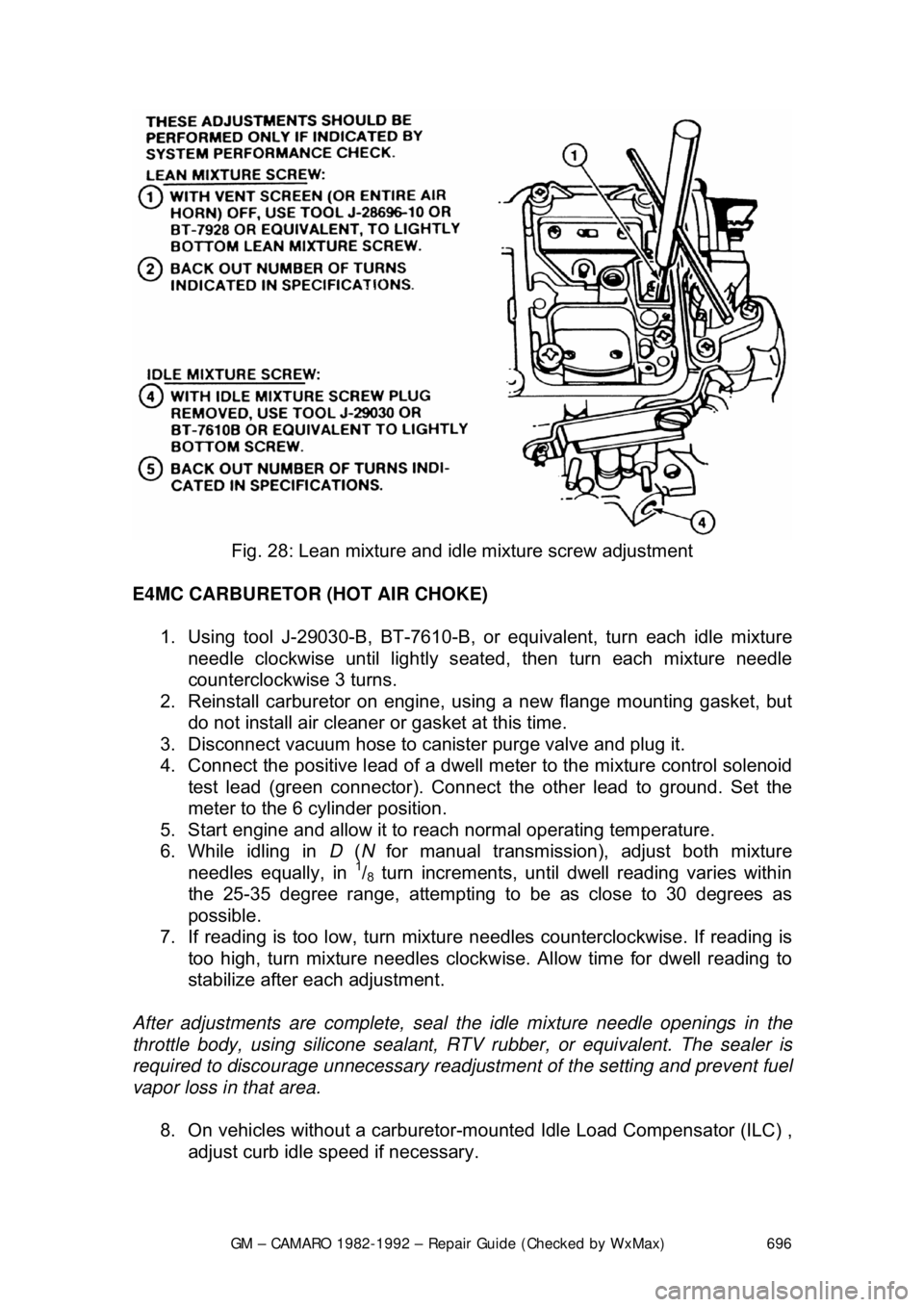
Fig. 28: Lean mixture and idle mixture screw adjustment
E4MC CARBURETOR (HOT AIR CHOKE) 1. Using tool J-29030-B, BT-7610-B, or equivalent, turn each idle mixture
needle clockwise until lightly seated, then turn each mixture needle
counterclockwise 3 turns.
2. Reinstall carburetor on engine, using a new flange mounting gasket, but
do not install air cleaner or gasket at this time.
3. Disconnect vacuum hose to c anister purge valve and plug it.
4. Connect the positive lead of a dwell me ter to the mixture control solenoid
test lead (green connector). Connect the other lead to ground. Set the
meter to the 6 cylinder position.
5. Start engine and allow it to reac h normal operating temperature.
6. While idling in D ( N for manual transmission), adjust both mixture
needles equally, in
1/8 turn increments, until dwell reading varies within
the 25-35 degree range, attempting to be as close to 30 degrees as
possible.
7. If reading is too low, turn mixtur e needles counterclockwise. If reading is
too high, turn mixture needl es clockwise. Allow time for dwell reading to
stabilize after each adjustment.
After adjustments are complete, seal t he idle mixture needle openings in the
throttle body, using silicone sealant, RTV rubber, or equivalent. The sealer is
required to discourage unnece ssary readjustment of the setting and prevent fuel
vapor loss in that area.
8. On vehicles without a carburetor -mounted Idle Load Compensator (ILC) ,
adjust curb idle speed if necessary.
Page 698 of 875

GM – CAMARO 1982-1992 – Repair Guide (Checked by WxMax) 698
5. Disconnect and plug hose to canister purge port.
6. Disconnect and plug hose to idle load compensator.
7. Back out idle stop screw
on carburetor 3 turns.
8. Turn air conditioning OFF.
9. Block drive wheels, set parki ng brake, place transmission in P, start and
warm engine to normal operating temperature. Make certain choke is
OPEN .
10. With engine RUNNING place transmission in D and idle load
compensator fully extended (no vacuum applied). Using tool J-29607, or
equivalent, adjust plunger to obtain 650-750 rpm. Locknut on plunger
must be held with a wrench to prevent damage to guide tabs.
11. Measure distance from the locknut to tip of the plunger. This distance
must not exceed 1 in. (25mm). If it does check for low idle condition.
12. Reconnect vacuum hose to idle load compensator and observe idle
speed.
13. Idle speed should be between 425-475 rpm in D.
14. If idle speed is correct no further adjustment is necessary, proceed to the
next step. If idle speed is still incorrect continue as follows:
It may be necessary to remove the idle load compensator from the engine
unless a hex key wrench is m odified to clear obstructions.
a. Stop engine, remove rubber cap from the center outlet tube.
b. Using a 0.90 in. (23mm) hex wrench, insert through open center tube to
engage idle speed adjusting screw.
c. If idle speed was low, turn t he adjusting screw counterclockwise
approximately 1 turn for every 85 rpm low. If idle speed was high turn
screw 1 turn for every 85 rpm high.
15. Disconnect and plug vacuum hose to the idle load compensator.
16. Using a hand pump, apply vacuum to the idle load compensator until fully
retracted.
17. Adjust the idle stop screw on carburetor float bowl to obtain 450 rpm in
D .
18. Place transmission in P and stop engine.
19. Reconnect the idle load compensator.
20. Reconnect all vacuum hoses.
21. Install air cleaner and gasket. Remove wheel blocks.
Page 724 of 875
GM – CAMARO 1982-1992 – Repair Guide (Checked by WxMax) 724
•
Type 2: Compress retaining spring from valve while turning valve
in with a clockwise motion. Return spring to original position with
straight portion of spring end aligned with flat surface of valve.
On IAC valves that have already been in service, do not push or pull on the
valve pintle. The force required to move the pintle may damage the threads on
the worm drive.
5. Use a new gasket or O-ring and install the IAC valve into the throttle body.
6. Allow the ECM to reset the idle air control valve using the procedure
described earlier in this section.
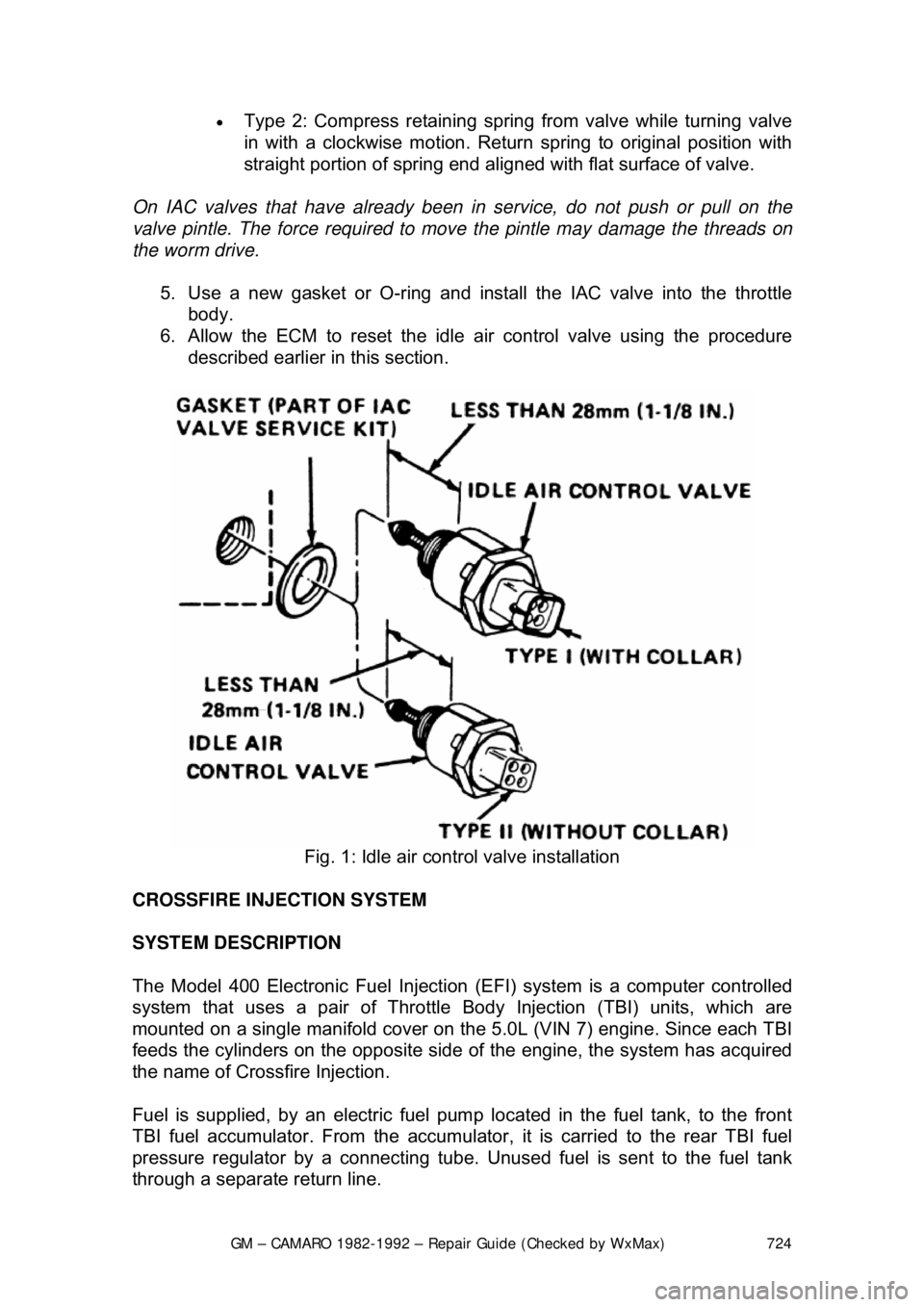
Fig. 1: Idle air control valve installation
CROSSFIRE INJECTION SYSTEM
SYSTEM DESCRIPTION
The Model 400 Electronic Fuel Injection (EFI) system is a computer controlled
system that uses a pair of Throttle Body Injection (TBI) units, which are
mounted on a single manifold cover on t he 5.0L (VIN 7) engine. Since each TBI
feeds the cylinders on the opposite side of the engine, the system has acquired
the name of Crossf ire Injection.
Fuel is supplied, by an electric fuel pum p located in the fuel tank, to the front
TBI fuel accumulator. From the accumulator, it is carried to the rear TBI fuel
pressure regulator by a c onnecting tube. Unused fuel is sent to the fuel tank
through a separate return line.
Page 729 of 875
GM – CAMARO 1982-1992 – Repair Guide (Checked by WxMax) 729
17. Check the throttle position sensor voltage and adjust if necessary.
18. Perform the Minimum Idle and Thro
ttle Valve Synchronization adjustment
procedures.
INJECTOR REPLACEMENT
The removal and installation procedures fo r the Crossfire injection system's fuel
injector is identical to the Throttle Bo dy Injection (TBI) system. Please refer to
the TBI fuel injector procedures earlier in this repair guide.
ADJUSTMENTS
PRELIMINARY ADJUSTMENTS
The preliminary adjustments are performed if tampering with the idle speed or
synchronization is evident and when either of the throttle bodies or the manifold
cover have been replaced. They must be performed BEFORE the Minimum Idle
and Throttle Valve Synchronizing procedure.
THROTTLE VALVE SYNCHRONIZING
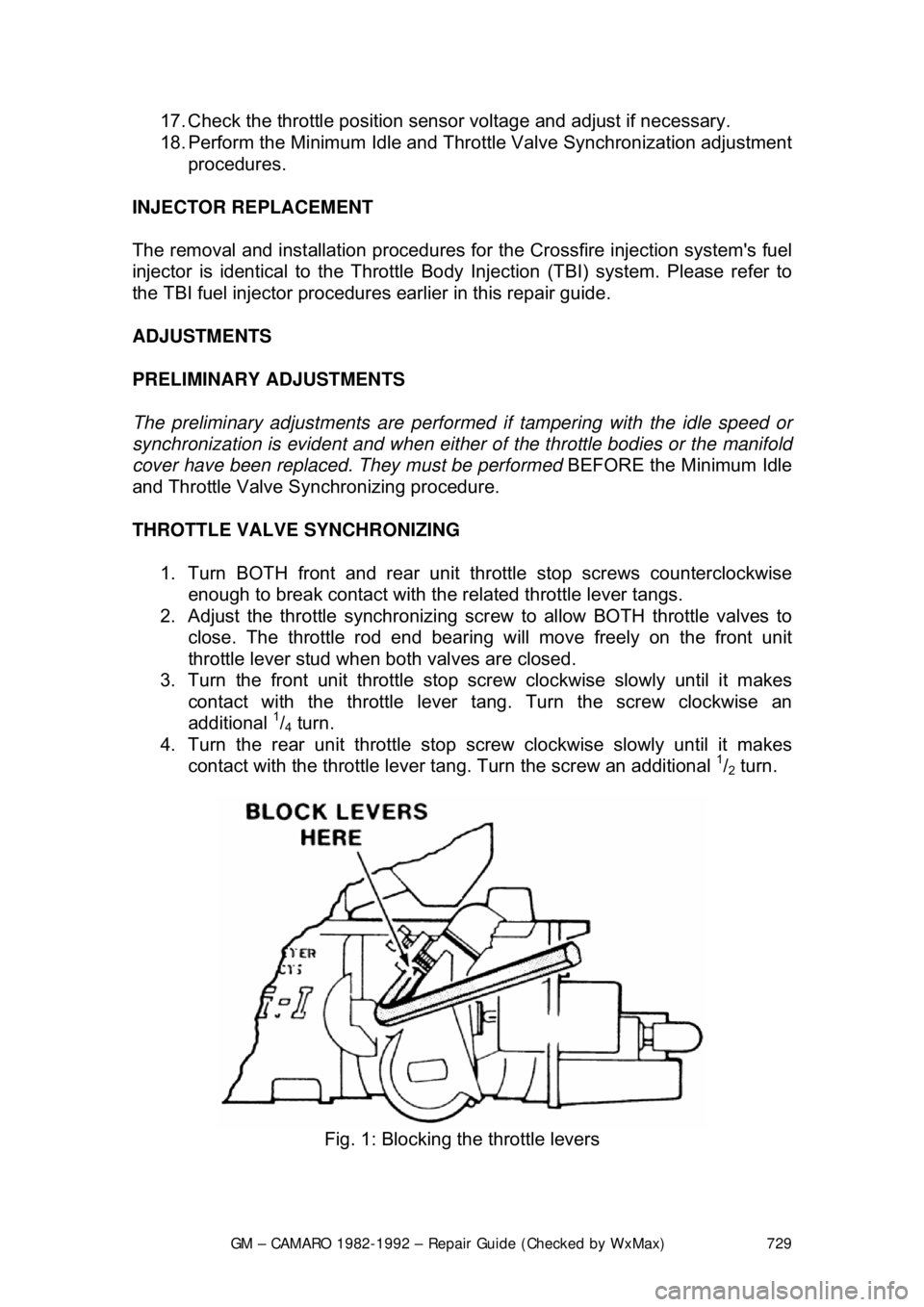
1. Turn BOTH front and rear unit throttle stop screws counterclockwise enough to break contact with the related throttle lever tangs.
2. Adjust the throttle synchronizing scr ew to allow BOTH throttle valves to
close. The throttle rod end bearing w ill move freely on the front unit
throttle lever stud when both valves are closed.
3. Turn the front unit th rottle stop screw clockwise slowly until it makes
contact with the throttle lever tang. Turn the screw clockwise an
additional
1/4 turn.
4. Turn the rear unit throttle stop screw clockwise slowly until it makes
contact with the throttle lever t ang. Turn the screw an additional
1/2 turn.
Fig. 1: Blocking the throttle levers
Page 751 of 875

GM – CAMARO 1982-1992 – Repair Guide (Checked by WxMax) 751
13. Lubricate a new outlet tube 0-ring and in
stall it on the end of the tube.
14. Connect the regulator base to the fuel outlet tube, then to the fuel rail.
15. Finger-tighten the base-to-rail screw.
16. Install the pressure regulator br acket. Finger-tighten the screws only.
17. Lubricate a new rear crossover tube O-ring and install it on the end of the
tube.
18. Install the rear crossover tube to the regulator base.
19. Install the crossover tube reta iner and finger-tighten the screw.
20. Tighten all attaching screws to 44 inch lbs. (5 Nm).
21. Install the fuel rail assembly.
22. Temporarily connect the negative battery cable. a. With the engine OFF and the igniti on ON, check for fuel leaks.
b. Disconnect the negative battery cable.
23. Install the intake plenum and runners.
24. Connect the negative battery cable.
IDLE AIR CONTROL VALVE
REMOVAL & INSTALLATION 1. Unplug the electrical connector from idle air control valve.
2. Remove the idle air control valve.
To install: 3. Before installing the idle air contro l valve, measure the distance that the
valve is extended. Measurement s hould be made from the motor housing
to the end of the cone. It should not exceed 28.5mm (1
1/8 in.), or damage
to the valve may occur when installed.
4. On 1985-1992 models, identify the replacement IAC valve as being
either Type 1 (with collar at electric terminal end) or Type 2 (without
collar). If measuring distance is great er than specified above, proceed as
follows:
• Type 1: Use finger pressure to slowly retract the pintle.
• Type 2: Compress retaining spring from valve while turning valve
in with a clockwise motion. Return spring to original position with
straight portion of spring end aligned with flat surface of valve.
On IAC valves that have already been in service, do not push or pull on the
valve pintle. The force required to move the pintle may damage the threads on
the worm drive.
5. Use a new gasket or O-ring and install the IAC valve into the throttle body.
6. Allow the ECM to reset the idle air control valve using the procedure
described earlier in this section.
Page 761 of 875

GM – CAMARO 1982-1992 – Repair Guide (Checked by WxMax) 761
MAINTENANCE OR REPAIR?
Maintenance includes routine inspecti
ons, adjustments, and replacement of
parts which show signs of normal wear . Maintenance compensates for wear or
deterioration. Repair implies that someth ing has broken or is not working. A
need for a repair is often caused by lack of maintenance. for example: draining
and refilling automatic transmission fl uid is maintenance recommended at
specific intervals. Failure to do this can shorten the life of the
transmission/transaxle, requiring very expen sive repairs. While no maintenance
program can prevent items from eventually breaking or wearing out, a general
rule is true: MAINTENANCE IS CHEAPER THAN REPAIR.
Two basic mechanic's rules should be mentioned here. First, whenever the left
side of the vehicle or engine is refe rred to, it means the driver's side.
Conversely, the right side of the vehi cle means the passenger's side. Second,
screws and bolts are removed by turn ing counterclockwise, and tightened by
turning clockwise unless specifically noted.
Safety is always the most important rule. Constantly be aware of the dangers
involved in working on an automobile and take the proper precautions. Please
refer to the information in this se ction regarding SERVICING YOUR VEHICLE
SAFELY and the SAFETY NOTICE on the acknowledgment page.
AVOIDING THE MOST COMMON MISTAKES
Pay attention to the instructions prov ided. There are 3 common mistakes in
mechanical work:
1. Incorrect order of assembly, di sassembly or adjustment. When taking
something apart or putting it toget her, performing steps in the wrong
order usually just costs you ex tra time; however, it CAN break
something. Read the entire proc edure before beginning. Perform
everything in the order in which the instructions say you should, even if
you can't see a reason for it. When you' re taking apart something that is
very intricate, you might want to draw a picture of how it looks when
assembled in order to make sure you get everything back in its proper
position. When making adjustments, per form them in the proper order.
One adjustment possibly will affect another.
2. Overtorquing (or undertorquing). While it is more common for overtorquing to cause damage, undertorquing may allow a fastener to
vibrate loose causing serious dam age. Especially when dealing with
aluminum parts, pay attention to tor que specifications and utilize a torque
wrench in assembly. If a torque figure is not available, remember that if
you are using the right tool to perfo rm the job, you will probably not have
to strain yourself to get a fast ener tight enough. The pitch of most
threads is so slight that the te nsion you put on the wrench will be
multiplied many times in actual fo rce on what you are tightening.
There are many commercial products avai lable for ensuring that fasteners won't
come loose, even if they are not torqued just right (a very common brand is
Page 791 of 875
GM – CAMARO 1982-1992 – Repair Guide (Checked by WxMax) 791
3. Clean all dirt from
the area around the cover. Re move the bolts retaining
the cover to the housing. Pry the co ver from the differential housing and
allow the fluid to drain into the catch pan.
To install: 4. With the cover and housing washed free of oil and gasket material, apply sealer to the mating surfaces.
5. Using a new gasket, install the cove r and torque the bolts to 20 ft. lbs.
(27 Nm) in a clockwise pattern to in sure uniform draw on the gasket. Fill
the differential with fluid through the fi ll plug and add limited slip additive,
as required.
6. Install the parking brake cable guides, if removed.
7. The fluid level shou ld reached a level within
3/8 in. (10mm) of the filler
plug hole. Replace the filler plug. Low er the car and inspect for leaks.
COOLING SYSTEM
CAUTION - When draining the c oolant, keep in mind that cats and dogs are
attracted by the ethylene gl ycol antifreeze, and are quite likely to drink any that
is left in an uncovered container or in puddles on the ground. This will prove
fatal in sufficient quantity. Always drai n the coolant into a sealable container.
Coolant should be reused unless it is c ontaminated or several years old (in
which case it should be taken to a recycli ng facility such as a service station).
FLUID RECOMMENDATIONS
When adding or changing the fluid in the system, create a 50/50 mixture of high
quality ethylene glycol antifreeze and water.
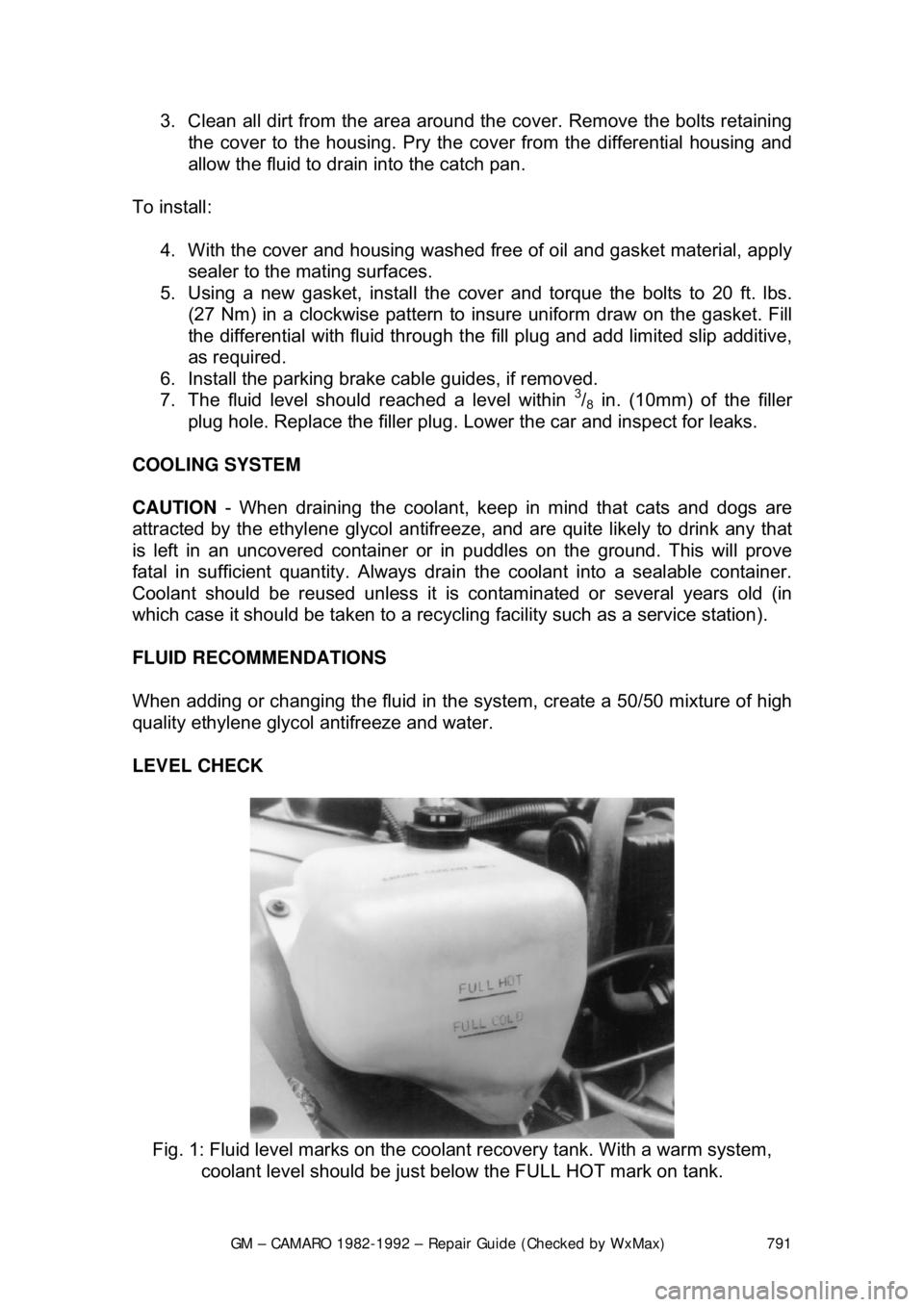
LEVEL CHECK
Fig. 1: Fluid level marks on the cool ant recovery tank. With a warm system,
coolant level should be just below the FULL HOT mark on tank.
Page 794 of 875
GM – CAMARO 1982-1992 – Repair Guide (Checked by WxMax) 794
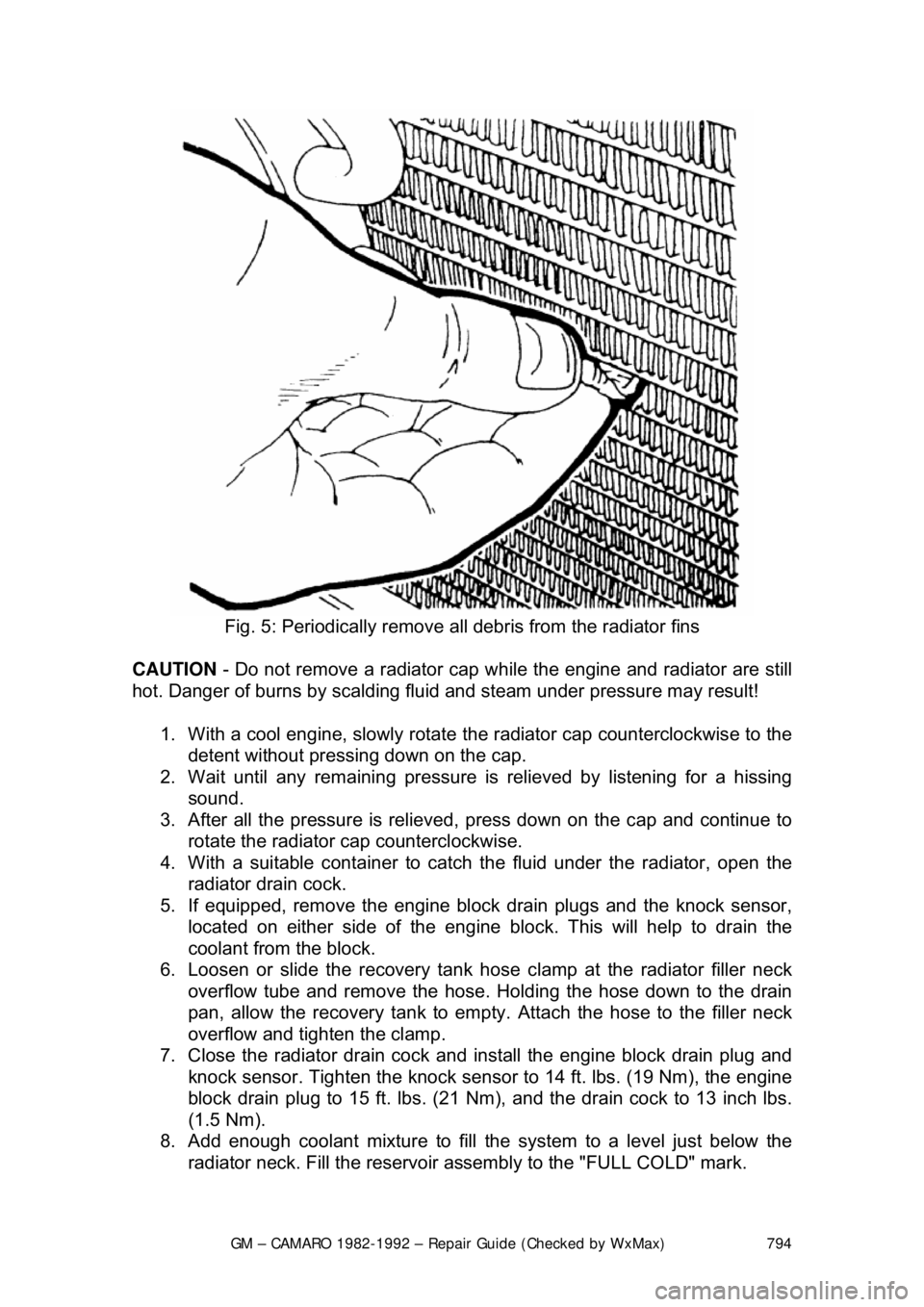
Fig. 5: Periodically remove all debris from the radiator fins
CAUTION - Do not remove a radiator cap wh ile the engine and radiator are still
hot. Danger of burns by scalding fluid and steam under pressure may result!
1. With a cool engine, slowly rotate t he radiator cap counterclockwise to the
detent without pressing down on the cap.
2. Wait until any remaini ng pressure is relieved by listening for a hissing
sound.
3. After all the pressure is relieved, press down on the cap and continue to
rotate the radiator cap counterclockwise.
4. With a suitable container to catc h the fluid under the radiator, open the
radiator drain cock.
5. If equipped, remove the engine blo ck drain plugs and the knock sensor,
located on either side of the engine block. This will help to drain the
coolant from the block.
6. Loosen or slide the recovery tank hos e clamp at the radiator filler neck
overflow tube and remove the hose. Holding the hose down to the drain
pan, allow the recovery tank to empty. Attach the hose to the filler neck
overflow and tighten the clamp.
7. Close the radiator drain cock and install the engine block drain plug and
knock sensor. Tighten the knock sensor to 14 ft. lbs. (19 Nm), the engine
block drain plug to 15 ft. lbs. (21 N m), and the drain cock to 13 inch lbs.
(1.5 Nm).
8. Add enough coolant mixture to fill the system to a level just below the
radiator neck. Fill the reservoir a ssembly to the "FULL COLD" mark.