ignition CHEVROLET CAMARO 1982 Repair Guide
[x] Cancel search | Manufacturer: CHEVROLET, Model Year: 1982, Model line: CAMARO, Model: CHEVROLET CAMARO 1982Pages: 875, PDF Size: 88.64 MB
Page 466 of 875
GM – CAMARO 1982-1992 – Repair Guide (Checked by WxMax) 466
wear. Worn piston rings, scored or wo
rn cylinder bores, blown head gaskets,
sticking or burnt valves, and worn valve seats are all possible culprits. A check
of each cylinder's compression will help locate the problem.
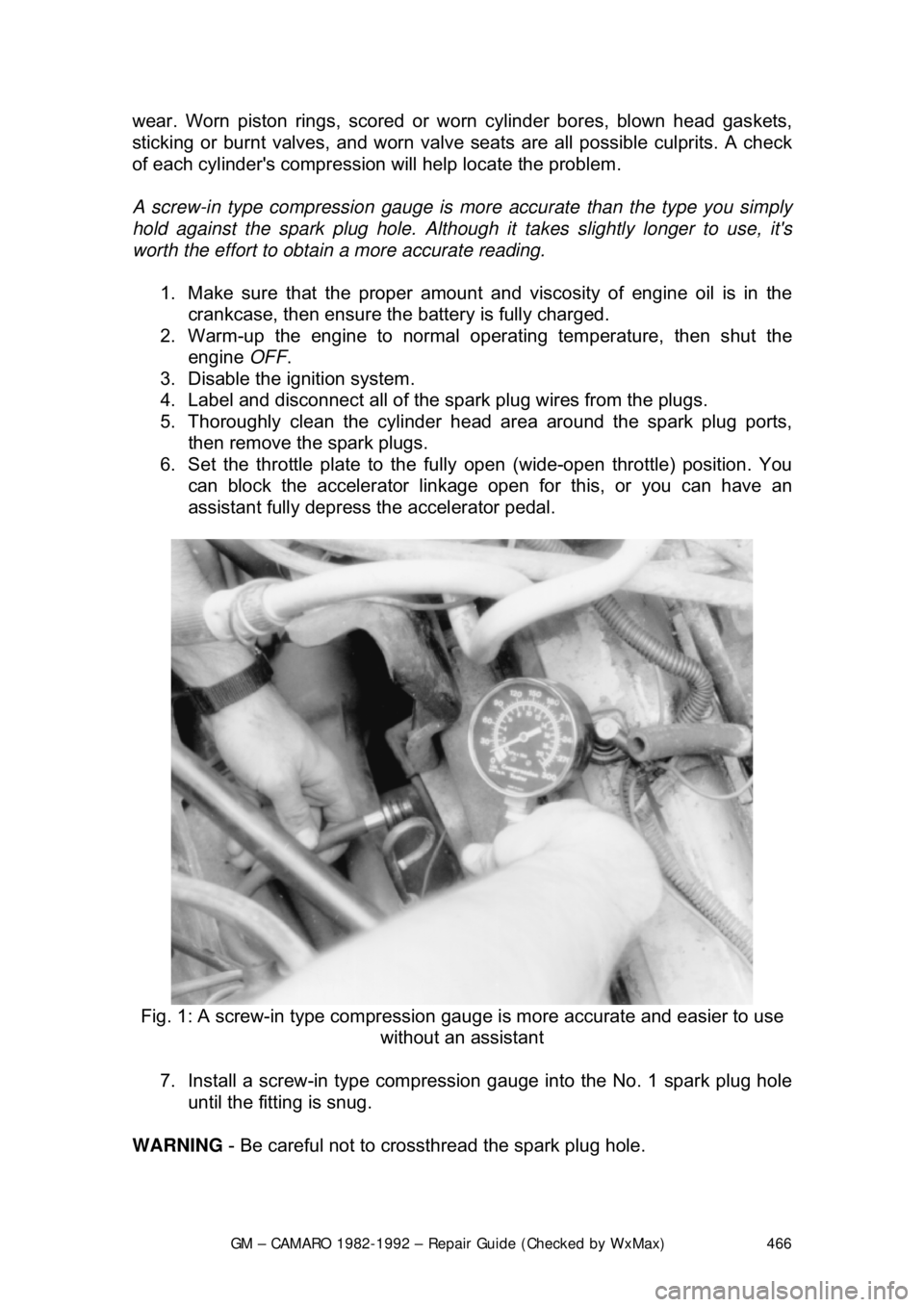
A screw-in type compression gauge is more accurate than the type you simply
hold against the spark plug hole. Although it takes slightly longer to use, it's
worth the effort to obtain a more accurate reading.
1. Make sure that the proper amount and viscosity of engine oil is in the
crankcase, then ensure the battery is fully charged.
2. Warm-up the engine to normal operat ing temperature, then shut the
engine OFF.
3. Disable the ignition system.
4. Label and disconnect all of the spark plug wires from the plugs.
5. Thoroughly clean the cylinder h ead area around the spark plug ports,
then remove the spark plugs.
6. Set the throttle plate to the fully open (wide-open throttle) position. You
can block the accelerator linkage open for this, or you can have an
assistant fully depress the accelerator pedal.
Fig. 1: A screw-in type compression gauge is more accurate and easier to use
without an assistant
7. Install a screw-in type compression gauge into the No. 1 spark plug hole
until the fitting is snug.
WARNING - Be careful not to crossthread the spark plug hole.
Page 467 of 875

GM – CAMARO 1982-1992 – Repair Guide (Checked by WxMax) 467
8. According to the tool manufacture
r's instructions, connect a remote
starting switch to the starting circuit.
9. With the ignition switch in the OFF position, use the remote starting
switch to crank the engine through at least five compression strokes
(approximately 5 seconds of cranking) and record the highest reading on
the gauge.
10. Repeat the test on each cylinder, cranking the engine approximately the
same number of compression stroke s and/or time as the first.
11. Compare the highest readi ngs from each cylinder to that of the others.
The indicated compression pre ssures are considered within
specifications if the lo west reading cylinder is within 75 percent of the
pressure recorded for the highest readi ng cylinder. For example, if your
highest reading cylinder pressure was 150 psi (1034 kPa), then 75
percent of that would be 113 psi (779 kPa). So the lowest reading
cylinder should be no less than 113 psi (779 kPa).
12. If a cylinder exhibits an unusually low compression reading, pour a
tablespoon of clean engine oil into the cylinder through the spark plug
hole and repeat the compression tes t. If the compression rises after
adding oil, it means that the cylinder's piston rings and/or cylinder bore
are damaged or worn. If the pressure re mains low, the valves may not be
seating properly (a valve job is needed), or the head gasket may be
blown near that cylinder. If compressi on in any two adjacent cylinders is
low, and if the addition of oil doesn' t help raise compression, there is
leakage past the head gasket. Oil and coolant in the combustion
chamber, combined with blue or const ant white smoke from the tail pipe,
are symptoms of this pr oblem. However, don't be alarmed by the normal
white smoke emitted from the tail pipe during engine warm-up or from
cold weather driving. There may be evidence of water droplets on the
engine dipstick and/or oil droplets in the cooling system if a head gasket
is blown.
OIL PRESSURE TEST
Check for proper oil pressu re at the sending unit passage with an externally
mounted mechanical oil pressure gauge (a s opposed to relying on a factory
installed dash-mounted gauge). A tachom eter may also be needed, as some
specifications may require running the engine at a specific rpm.
1. With the engine cold, locate and remo ve the oil pressure sending unit.
2. Following the manufacturer's inst ructions, connect a mechanical oil
pressure gauge and, if necessary, a tachometer to the engine.
3. Start the engine and allow it to idle.
4. Check the oil pressure reading when cold and record the number. You
may need to run the engine at a specified rpm, so check the
specifications chart located earlier in this section.
5. Run the engine until normal operati ng temperature is reached (upper
radiator hose will feel warm).
6. Check the oil pressure reading agai n with the engine hot and record the
number. Turn the engine OFF.
Page 513 of 875

GM – CAMARO 1982-1992 – Repair Guide (Checked by WxMax) 513
1. Connect the vehicle battery.
2. Start the engine. Keep y
our eye on your oil pressure indicator; if it does
not indicate oil pressure within 10 se conds of starting, turn the vehicle
off.
WARNING - Damage to the engine can result if it is allowed to run with no oil
pressure. Check the engine oil level to make sure that it is full. Check for any
leaks and if found, repair the leaks be fore continuing. If there is still no
indication of oil pressure, y ou may need to prime the system.
3. Confirm that there are no fluid leaks (oil or other).
4. Allow the engine to reach nor mal operating temperature (the upper
radiator hose will be hot to the touch).
5. If necessary, set the ignition timing.
6. Install any remaining components such as the air cleaner (if removed for
ignition timing) or body panels which were removed.
BREAKING IT IN
Make the first miles on the new engine , easy ones. Vary the speed but do not
accelerate hard. Most importantly, do not lug the engine, and avoid sustained
high speeds until at least 100 miles. Ch eck the engine oil and coolant levels
frequently. Expect the engine to use a littl e oil until the rings seat. Change the
oil and filter at 500 miles, 1500 mile s, then every 3000 miles past that.
KEEP IT MAINTAINED
Now that you have just gone through all of that hard work, keep yourself from
doing it all over again by thoroughly maintaining it. Not that you may not have
maintained it before, heck you c ould have had one to two hundred thousand
miles on it before doing this. However, you may have bought the vehicle used,
and the previous owner did not keep up on maintenance. Which is why you just
went through all of that hard work. See?
Page 570 of 875

GM – CAMARO 1982-1992 – Repair Guide (Checked by WxMax) 570
Switch (TVS). The electrical type, cons
ists of a ceramic grid located under the
base of the carburetor.
A check of the operation should be made at regular maintenance intervals.
TESTING
VACUUM SERVO TYPE 1. With the engine cold, observe the posit ion of the actuator arm. Start the
engine. The arm should move toward the diaphragm (closing the valve).
2. If the arm does not move, remove the hose and check for vacuum. If still
no vacuum, remove the top hose from the TVS switch and check for
vacuum.
3. If vacuum is present in the top hose, replace the TVS switch.
4. If vacuum is present at the actuator and it does not move, try to free the
valve. If the valve cannot be freed, it must be replaced.
ELECTRICAL TYPE 1. Turn the ignition ON with the engine co ld and probe both terminals of the
heater switch connector with a test light.
• If 1 wire has power, replace the heater switch.
• If neither wire has power, repai r the ignition circuit.
• If both wires have power, probe the pink wire at the heater
connector (if no power, repair the c onnector of the heater switch).
2. If power exists at the pink wire , disconnect the heater connector and
connect a tester across the harness terminal. If no power, repair the
ground wire; if power exists, check the resistance of the heater.
3. If heater is over 3 ohm s, replace the heater. If under 3 ohms, replace the
connector, start the engine (operate to normal temperature) and probe
the pink wire. If no power, the system is OK; if power exists, replace the
heater switch.
REMOVAL & INSTALLATION
VACUUM SERVO TYPE 1. Disconnect the vacuum hose at the EFE.
2. Remove exhaust pipe to manifold nuts.
3. Remove the crossover pipe. Complete removal is not always necessary.
4. Remove the EFE valve.
To install: 5. Position the EFE valve into place.
6. Install the crossover pipe.
7. Install the exhaust pi pe to manifold nuts.
8. Connect the vacuum hose at the EFE.
Page 577 of 875

GM – CAMARO 1982-1992 – Repair Guide (Checked by WxMax) 577
MALFUNCTION INDICATOR LAMP
The primary function of the MIL is to adv
ise the operator and the technician that
a fault is detected, and, in most cases, a code is stored. Under normal
conditions, the malfunction indicator la mp will illuminate when the ignition is
turned ON. Once the engine is started and running, the ECM will perform a
system check and extinguish the lamp if no fault is found.
Additionally, the lamp can be used to retrieve stored codes after the system is
placed in the Diagnostic Mode. Codes ar e transmitted as a series of flashes
with short or long pauses. When the syst em is placed in the Field Service
Mode, the dash lamp will indicate open loop or closed loop function to the
technician.
INTERMITTENTS
If a fault occurs intermittently, such as a loose connector pin breaking contact
as the vehicle hits a bump, the ECM will note the fault as it occurs and energize
the dash warning lamp. If the problem se lf-corrects, as with the terminal pin
again making contact, the dash lamp will extinguish after 10 seconds but\
a code
will remain stored in the ECM memory.
When an unexpected code appe ars during diagnostics, it may have been set
during an intermittent failure that self-c orrected; the codes are still useful in
diagnosis and should not be discounted.
OXYGEN SENSOR
OPERATION
An oxygen sensor is used on all models. The sensor protrudes into the exhaust
stream and monitors the oxygen content of the exhaust gases. The difference
between the oxygen content of the exhaust gases and that of the outside air
generates a voltage si gnal to the ECM. The ECM monitors this voltage and,
depending upon the value of the signal rece ived, issues a command to adjust
for a rich or a lean condition.
No attempt should ever be made to meas ure the voltage output of the sensor.
The current drain of any conventional vo ltmeter would be such that it would
permanently damage the sensor.
Page 582 of 875

GM – CAMARO 1982-1992 – Repair Guide (Checked by WxMax) 582
REMOVAL & INSTALLATION
On some models it may be necessary
to remove the air inlet assembly.
1. Disconnect the negative battery cable. Disconnect the IAC valve
electrical wiring.
2. Remove the IAC valve by performing the following: a. On thread-mounted units, use a 1
1/4 inch (32mm) wrench.
b. On flange-mounted units, remove the mounting screw assemblies.
3. Remove the IAC valve ga sket or O-ring and discard.
To install: 4. Clean the mounting surfaces by performing the following:
a. If servicing a thread-mounted valve, remove the old gasket material from the surf ace of the throttle body to ensure proper
sealing of the new gasket.
b. If servicing a flange-mounted valve, clean the IAC valve surfaces on the throttle body to assure pr oper seal of the new O-ring and
contact of the IAC valve flange.
5. If installing a new IAC valve, meas ure the distance between the tip of the
IAC valve pintle and the mounting flange. If the distance is greater than
1.102 inch (28mm), use finger pressure to slowly retract the pintle. The
force required to retract the pintle of a new valve will not cause damage
to the valve. If reinstalling the origin al IAC valve, do not attempt to adjust
the pintle in this manner.
6. Install the IAC valve into the thro ttle body by performing the following:
a. With thread-mounted valves, in stall with a new gasket. Using a
1
1/4 inch (32mm) wrench, tighten to 13 ft. lbs. (18 Nm).
b. With flange-mounted valves, lubricate a new O-ring with
transmission fluid and install on the IAC valve. Install the IAC
valve to the throttle body. Inst all the mounting screws using a
suitable thread locking compound. Tight en to 28 inch lbs. (3 Nm).
7. Connect the IAC valve electrical wiring.
8. Connect the negative battery cable.
9. No physical adjustment of the IAC valve assembly is required after installation. Reset the IAC valve pintle position by performing the
following:
a. Depress the accelerator pedal slightly.
b. Start the engine and run for 5 seconds.
c. Turn the ignition switch to the OFF position for 10 seconds.
d. Restart the engine and check for proper idle operation.
Page 585 of 875
GM – CAMARO 1982-1992 – Repair Guide (Checked by WxMax) 585
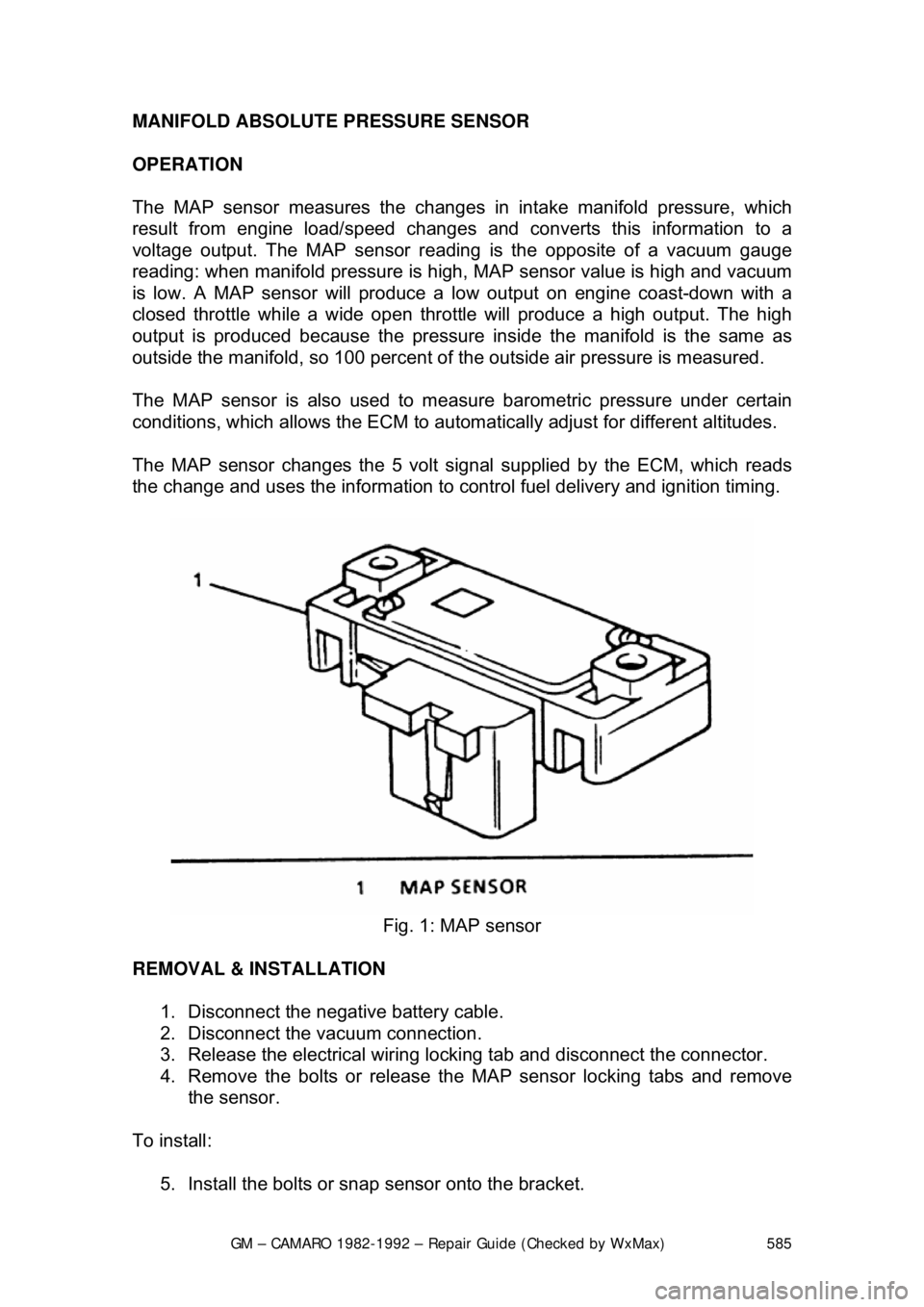
MANIFOLD ABSOLUTE PRESSURE SENSOR
OPERATION
The MAP sensor measures the changes in
intake manifold pressure, which
result from engine load/ speed changes and converts this information to a
voltage output. The MAP sensor reading is the opposite of a vacuum gauge
reading: when manifold pressu re is high, MAP sensor value is high and vacuum
is low. A MAP sensor will produce a low output on engine coast-down with a
closed throttle while a wide open throttle will produce a high output. The high
output is produced because the pressure inside the manifold is the same as
outside the manifold, so 100 percent of t he outside air pressure is measured.
The MAP sensor is also used to meas ure barometric pressure under certain
conditions, which allows the ECM to autom atically adjust for different altitudes.
The MAP sensor changes the 5 volt signal supplied by the ECM, which reads
the change and uses the information to cont rol fuel delivery and ignition timing.
Fig. 1: MAP sensor
REMOVAL & INSTALLATION 1. Disconnect the negative battery cable.
2. Disconnect the vacuum connection.
3. Release the electrical wiring lo cking tab and disconnect the connector.
4. Remove the bolts or release the MAP sensor locking tabs and remove
the sensor.
To install: 5. Install the bolts or snap sensor onto the bracket.
Page 592 of 875
GM – CAMARO 1982-1992 – Repair Guide (Checked by WxMax) 592
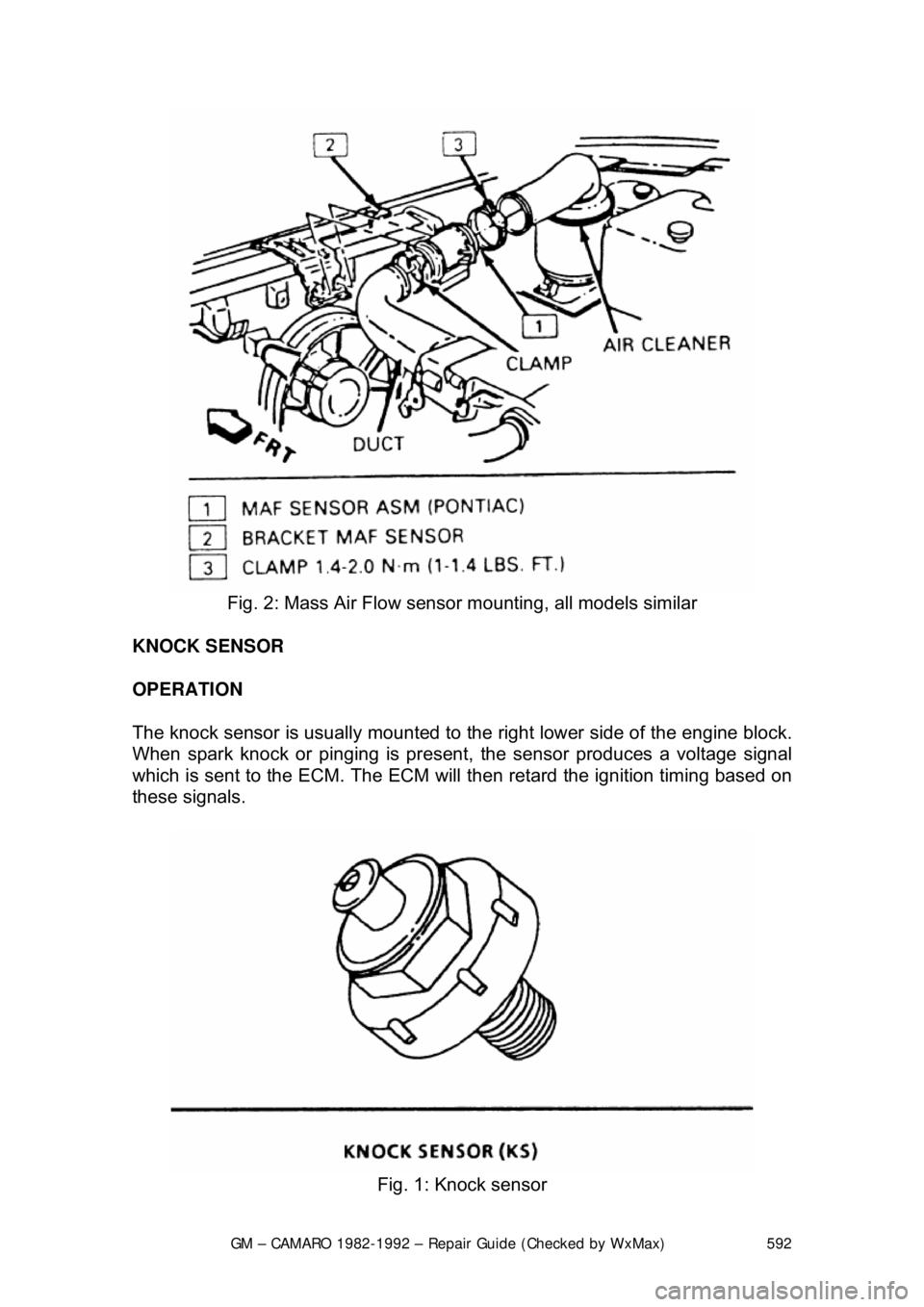
Fig. 2: Mass Air Flow sensor mounting, all models similar
KNOCK SENSOR
OPERATION
The knock sensor is usually mounted to the right lower side of the engine block.
When spark knock or pinging is present, the sensor produces a voltage signal
which is sent to the ECM. The ECM will then retard the ignition timing based on
these signals.
Fig. 1: Knock sensor
Page 594 of 875

GM – CAMARO 1982-1992 – Repair Guide (Checked by WxMax) 594
REMOVAL & INSTALLATION
1. Disconnect the negative battery cable.
2. Raise and safely support the vehicle.
3. Disconnect the VSS electrical wiring.
4. Remove the retaining bolt.
5. Have a clean container to catch the transmission fluid and remove the
VSS.
6. Remove and discard the O-ring.
To install: 7. Lubricate a new O-ring with a thin f ilm of transmission fluid. Install the O-
ring and VSS.
8. Install the retaining bolt.
9. Connect the electrical wiring.
10. Lower the vehicle.
11. Connect the negative battery cable.
12. Refill transmission to proper level.
TROUBLE CODES
SELF DIAGNOSTICS
READING CODES
The following procedure applies to mode ls with the 12 pin diagnostic connector
only.
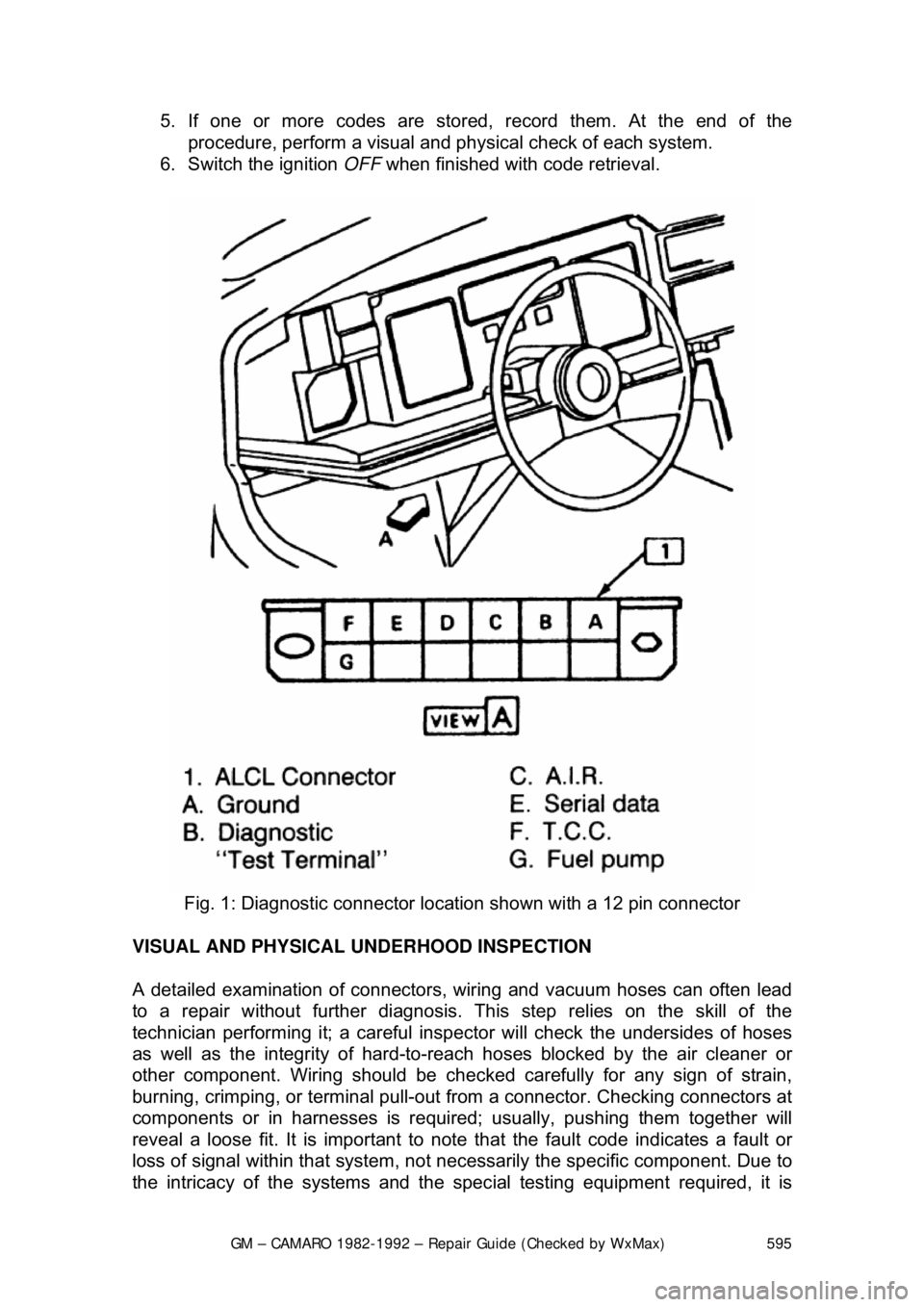
1. Turn the ignition switch OFF. Locate the Assembly Line Diagnostic Link
(ALDL), usually under the instrument panel. It may be within a plastic
cover or housing labeled DIAGNOSTIC CONNECTOR. This link is used
to communicate with the ECM.
2. Use a small jumper wire to connect Terminal B of the ALDL to Terminal
A. As the ALDL connector is viewed from the front, Terminal A is on the
extreme right of the upper row; Terminal B is second from the right on
the upper row.
3. After the terminals are connected, turn the ignition switch to the ON
position but do not start the engine. T he dash warning lamp should begin
to flash Code 12. The code will disp lay as one flash, a pause and two
flashes. Code 12 is not a fault code. It is used as a system
acknowledgment or handshake code; its presence indicates that the
ECM can communicate as requested. Code 12 is used to begin every
diagnostic sequence.
4. After Code 12 has been transmitted 3 times, the fault codes, if any, will
each be flashed in the same manner th ree times. The codes are stored
and transmitted in numeric order from lowest to highest.
The order of codes in the memory does not indicate the order of occurrence.
Page 595 of 875
GM – CAMARO 1982-1992 – Repair Guide (Checked by WxMax) 595
5. If one or more codes are stored,
record them. At the end of the
procedure, perform a visual and physical check of each system.
6. Switch the ignition OFF when finished with code retrieval.
Fig. 1: Diagnostic connector lo cation shown with a 12 pin connector
VISUAL AND PHYSICAL UNDERHOOD INSPECTION
A detailed examinatio n of connectors, wiring and va cuum hoses can often lead
to a repair without further diagnosis. This step relies on the skill of the
technician performing it; a careful inspec tor will check the undersides of hoses
as well as the integrity of hard-to-reac h hoses blocked by the air cleaner or
other component. Wiring should be check ed carefully for any sign of strain,
burning, crimping, or terminal pull-out from a connector. Checking connectors at
components or in harnesses is required; usually, pushing them together will
reveal a loose fit. It is important to note that the fault code indicates a fault or
loss of signal within that system, not necessarily the specific component. Due to
the intricacy of the systems and the spec ial testing equipment required, it is