sensor CHEVROLET CAMARO 1982 Repair Guide
[x] Cancel search | Manufacturer: CHEVROLET, Model Year: 1982, Model line: CAMARO, Model: CHEVROLET CAMARO 1982Pages: 875, PDF Size: 88.64 MB
Page 399 of 875
GM – CAMARO 1982-1992 – Repair Guide (Checked by WxMax) 399
3. Unplug the oxygen sensor and disconnect the exhaust pipe from the
exhaust manifold.
4. Remove the engine oil level dipstick and tube.
5. Remove the exhaust manifold atta ching bolts and remove the manifold.
To install: 6. Position the exhaust manifold onto the engine with a new gasket. Torque
the bolts, following the correct sequenc e, to 44 ft lbs. (60 Nm).
7. Install the engine oil level dipstick tube and dipstick.
8. Connect the exhaust pipe to the exhaust manifold.
9. Engage the oxygen sensor connector.
10. Install the air cleaner assembly and connecting hoses.
11. Connect the negative battery cable at the battery.
RADIATOR
REMOVAL & INSTALLATION
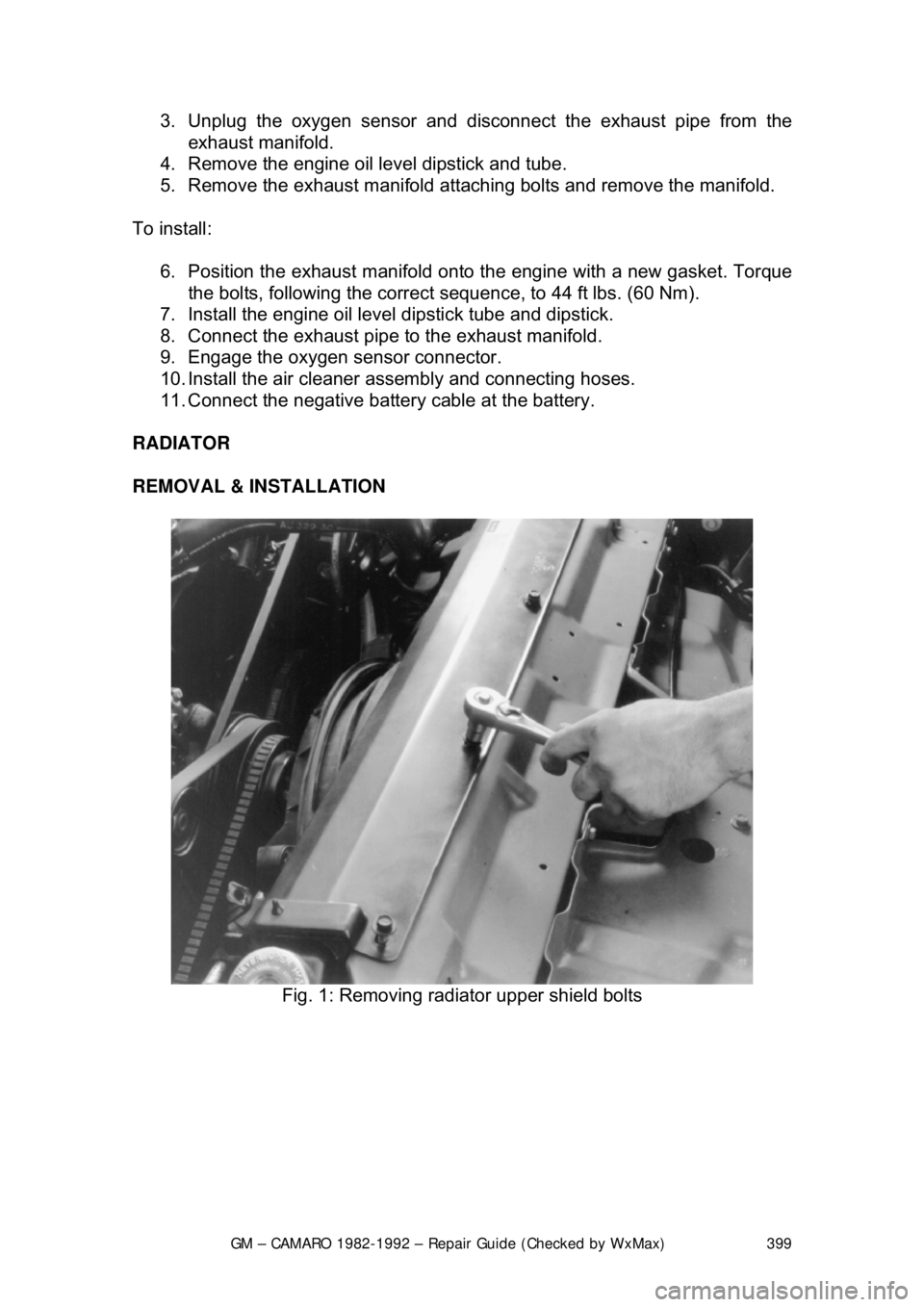
Fig. 1: Removing radiator upper shield bolts
Page 549 of 875
GM – CAMARO 1982-1992 – Repair Guide (Checked by WxMax) 549
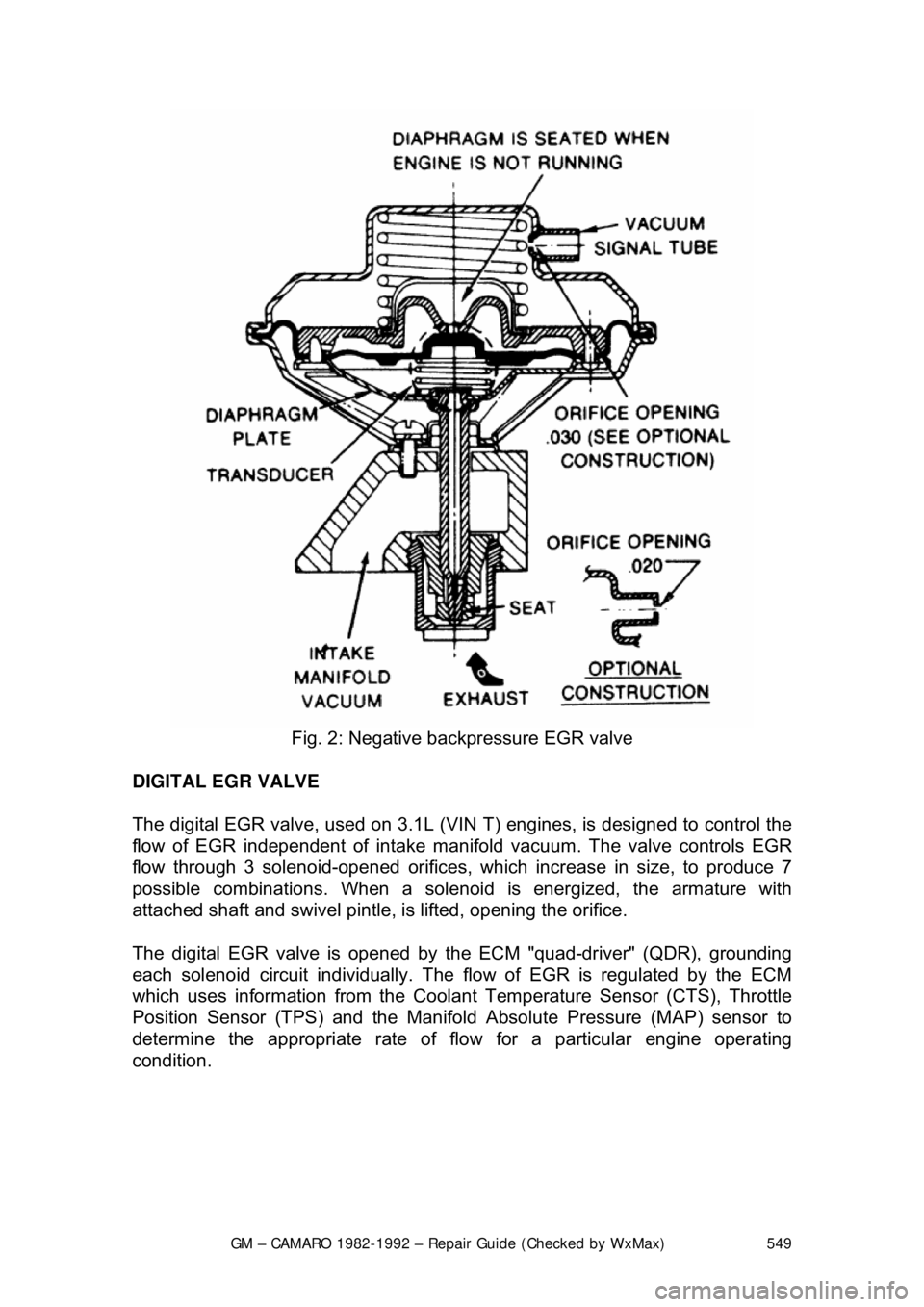
Fig. 2: Negative backpressure EGR valve
DIGITAL EGR VALVE
The digital EGR valve, used on 3.1L (VIN T) engines, is designed to control the
flow of EGR independent of intake mani fold vacuum. The valve controls EGR
flow through 3 solenoid- opened orifices, which increa se in size, to produce 7
possible combinations. When a solenoid is energized, the armature with
attached shaft and swivel pintle, is lifted, opening the orifice.
The digital EGR valve is opened by t he ECM "quad-driver" (QDR), grounding
each solenoid circuit individually. The fl ow of EGR is regulated by the ECM
which uses information from the Coolant Temperature Sensor (CTS), Throttle
Position Sensor (TPS) and the Manifold Absolute Pressure (MAP) sensor to
determine the appropriate rate of flow for a particular engine operating
condition.
Page 559 of 875
GM – CAMARO 1982-1992 – Repair Guide (Checked by WxMax) 559
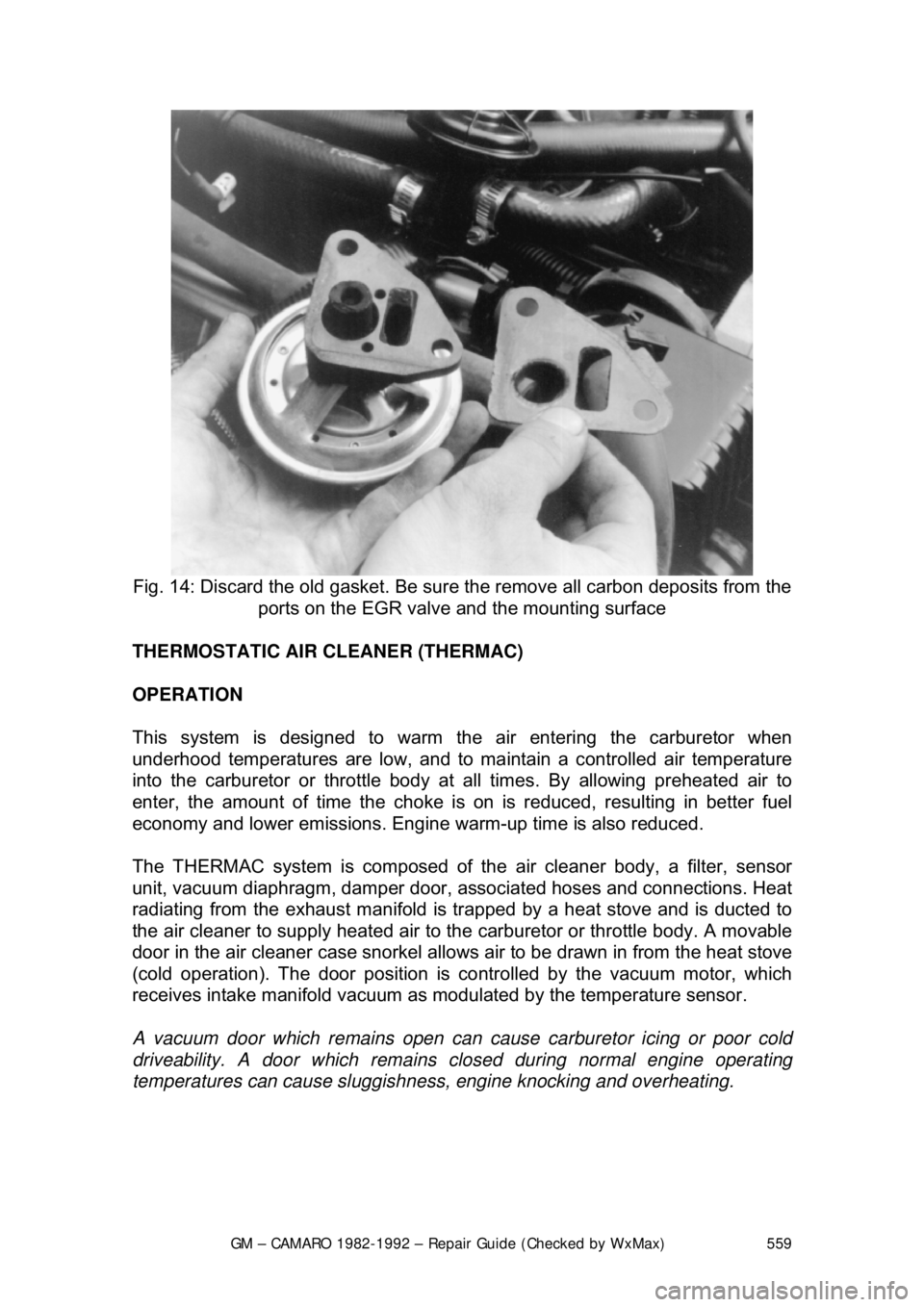
Fig. 14: Discard the old gasket. Be sure the remove all carbon deposits from the
ports on the EGR valve and the mounting surface
THERMOSTATIC AIR CLEANER (THERMAC)
OPERATION
This system is designed to warm the air entering the carburetor when
underhood temperatures are low, and to ma intain a controlled air temperature
into the carburetor or throttle body at all times. By allowing preheated air to
enter, the amount of time t he choke is on is reduced, resulting in better fuel
economy and lower emissions. Engine warm-up time is also reduced.
The THERMAC system is composed of th e air cleaner body, a filter, sensor
unit, vacuum diaphragm, damper door, a ssociated hoses and connections. Heat
radiating from the exhaust manifold is tr apped by a heat stove and is ducted to
the air cleaner to supply heated air to t he carburetor or throttle body. A movable
door in the air cleaner case snorkel allows air to be drawn in from the heat stove
(cold operation). The door position is co ntrolled by the vacuum motor, which
receives intake manifold vacuum as modulated by the temperature sensor.
A vacuum door which remain s open can cause carburetor icing or poor cold
driveability. A door which remains clos ed during normal engine operating
temperatures can cause sluggishne ss, engine knocking and overheating.
Page 561 of 875

GM – CAMARO 1982-1992 – Repair Guide (Checked by WxMax) 561
3. Apply at least 7 in. Hg of vacuum
to the damper diaphragm unit. The
door should close. If it doesn't, che ck the diaphragm linkage for binding
and correct hookup.
4. With the vacuum still applied and t he door closed, clamp the tube to trap
the vacuum. If the door doesn't remain closed, there is a leak in the
diaphragm assembly.
REMOVAL & INSTALLATION
VACUUM MOTOR 1. Remove the air cleaner.
2. Disconnect the vacuum hose from the motor.
3. Drill out the spot welds with a
1/8 inch (3mm) bit, then enlarge as
necessary to remove the retaining strap.
4. Remove the retaining strap.
5. Lift up the motor and cock it to o ne side to unhook the motor linkage at
the control damper assembly.
To install: 6. In order to install t he new vacuum motor, drill a
7/64 inch (2.8mm) hole in
the snorkel tube as the c enter of the vacuum motor retaining strap.
7. Insert the vacuum motor linkage into the control damper assembly.
8. Use the motor retaining strap and a sheet metal screw to secure the
retaining strap and motor to the snorkel tube.
Make sure the screw does not interf ere with the operation of the damper
assembly. Shorten the screw if necessary.
TEMPERATURE SENSOR 1. Remove the air cleaner.
2. Disconnect the hoses at the air cleaner.
3. Pry up the tabs on the sensor reta ining clip and remove the clip and
sensor from the air cleaner.
To install: 4. Position sensor into air cleaner.
5. Install retaining clip.
6. Connect the hoses to the air cleaner.
7. Install the air cleaner.
AIR INJECTION REACTION (AIR) SYSTEM
OPERATION
The AIR management system is used to prov ide additional oxygen to continue
the combustion process after the exhaus t gases leave the combustion chamber.
Page 573 of 875

GM – CAMARO 1982-1992 – Repair Guide (Checked by WxMax) 573
7. Install the retaining bracket.
8. Connect the negative battery cable.
ELECTRONIC ENGINE CONTROLS
COMPUTER COMMAND CO NTROL (CCC) SYSTEM
The Computer Command Control (CCC) Sy stem is an electronically controlled
exhaust emission system that can m onitor and control a large number of
interrelated emission cont rol systems. It can monitor various engine/vehicle
operating conditions and then use this in formation to control multiple engine
related systems. The CCC syst em is thereby making constant adjustments to
maintain optimum vehicle performance und er all normal driving conditions while
at the same time allowing the catalyti c converter to effectively control the
emissions of HC, CO and NO
x.
OPERATION
The Electronic Control Module (ECM) is required to maintain the exhaust
emissions at acceptable le vels. The module is a sma ll, solid state computer
which receives signals from many source s and sensors; it uses these data to
make judgements about operating conditions and then control output signals to
the fuel and emission systems to ma tch the current requirements.
Inputs are received from m any sources to form a complete picture of engine
operating conditions. Some inputs are simp ly Yes or No messages, such as that
from the Park/Neutral switch; the vehicle is either in gear or in Park/Neutral;
there are no other choices. Other data is sent in quantitative input, such as
engine rpm or coolant temperature. T he ECM is pre-programmed to recognize
acceptable ranges or combinations of si gnals and control the outputs to control
emissions while providing good driv eability and economy. The ECM also
monitors some output circuits, making sure that the components function as
commanded. For proper engine oper ation, it is essential that all input and output
components function properly and comm unicate properly with the ECM.
Since the control module is programmed to recognize the presence and value
of electrical inputs, it will also note the lack of a signal or a radical change in
values. It will, for example, react to the loss of signal from the vehicle speed
sensor or note that engine coolant temperature has risen beyond acceptable
(programmed) limits. Once a fault is recognized, a numeric code is assigned
and held in memory. The SERVICE ENGIN E SOON Malfunction Indicator Lamp
(MIL), will illuminate to advise the operator that the system has detected a fault.
More than one code may be stored. Although not every engine uses every
code, possible codes range from 12-999. Additionally, the same code may carry
different meanings relative to each engine or engine family. For example, on the
3.3L (VIN N) engine, code 46 indicates a fault found in the power steering
pressure switch circuit. The same code on the 5.7L (VIN F) engine indicates a
fault in the VATS anti-theft system.
Page 575 of 875
GM – CAMARO 1982-1992 – Repair Guide (Checked by WxMax) 575
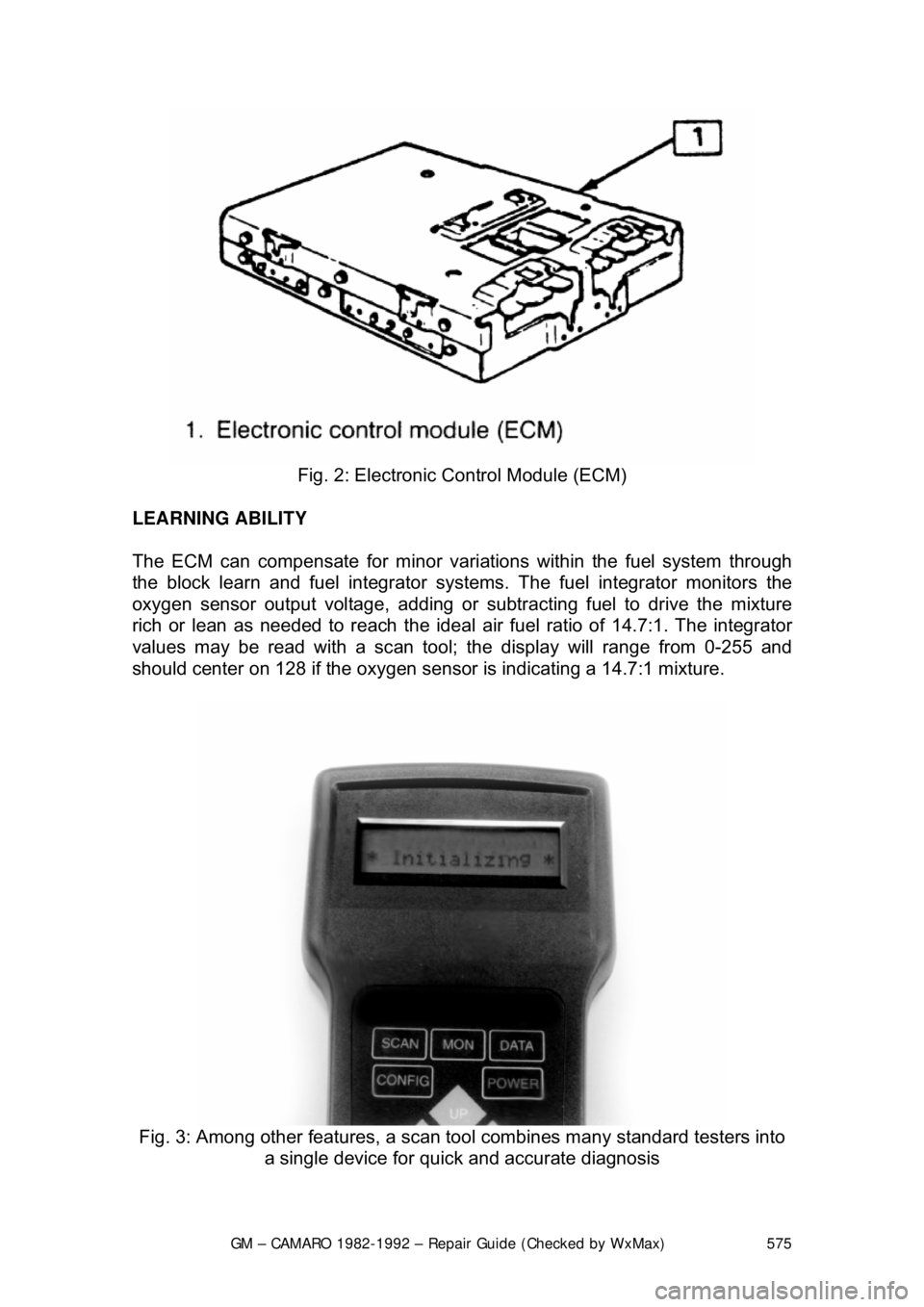
Fig. 2: Electronic Control Module (ECM)
LEARNING ABILITY
The ECM can compensate for minor variations within the fuel system through
the block learn and fuel in tegrator systems. The fuel integrator monitors the
oxygen sensor output voltage, adding or subtracting fuel to drive the mixture
rich or lean as needed to reach the ideal air fuel ratio of 14.7:1. The integrator
values may be read with a scan tool; the display will range from 0-255 and
should center on 128 if the oxygen sens or is indicating a 14.7:1 mixture.
Fig. 3: Among other features, a scan tool combines many standard testers into
a single device for quick and accurate diagnosis
Page 577 of 875

GM – CAMARO 1982-1992 – Repair Guide (Checked by WxMax) 577
MALFUNCTION INDICATOR LAMP
The primary function of the MIL is to adv
ise the operator and the technician that
a fault is detected, and, in most cases, a code is stored. Under normal
conditions, the malfunction indicator la mp will illuminate when the ignition is
turned ON. Once the engine is started and running, the ECM will perform a
system check and extinguish the lamp if no fault is found.
Additionally, the lamp can be used to retrieve stored codes after the system is
placed in the Diagnostic Mode. Codes ar e transmitted as a series of flashes
with short or long pauses. When the syst em is placed in the Field Service
Mode, the dash lamp will indicate open loop or closed loop function to the
technician.
INTERMITTENTS
If a fault occurs intermittently, such as a loose connector pin breaking contact
as the vehicle hits a bump, the ECM will note the fault as it occurs and energize
the dash warning lamp. If the problem se lf-corrects, as with the terminal pin
again making contact, the dash lamp will extinguish after 10 seconds but\
a code
will remain stored in the ECM memory.
When an unexpected code appe ars during diagnostics, it may have been set
during an intermittent failure that self-c orrected; the codes are still useful in
diagnosis and should not be discounted.
OXYGEN SENSOR
OPERATION
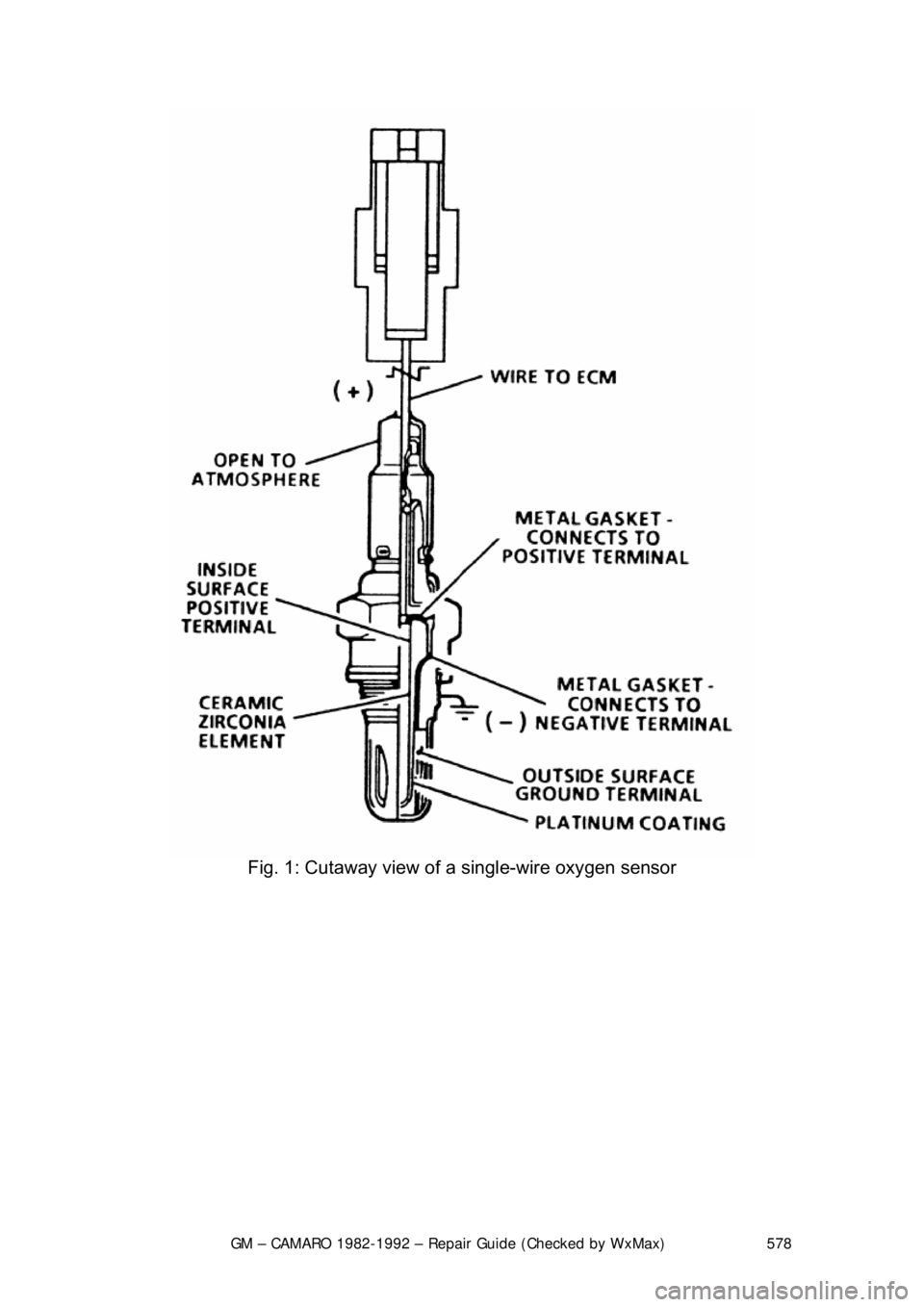
An oxygen sensor is used on all models. The sensor protrudes into the exhaust
stream and monitors the oxygen content of the exhaust gases. The difference
between the oxygen content of the exhaust gases and that of the outside air
generates a voltage si gnal to the ECM. The ECM monitors this voltage and,
depending upon the value of the signal rece ived, issues a command to adjust
for a rich or a lean condition.
No attempt should ever be made to meas ure the voltage output of the sensor.
The current drain of any conventional vo ltmeter would be such that it would
permanently damage the sensor.
Page 578 of 875
GM – CAMARO 1982-1992 – Repair Guide (Checked by WxMax) 578
Fig. 1: Cutaway view of a single-wire oxygen sensor
Page 579 of 875
GM – CAMARO 1982-1992 – Repair Guide (Checked by WxMax) 579
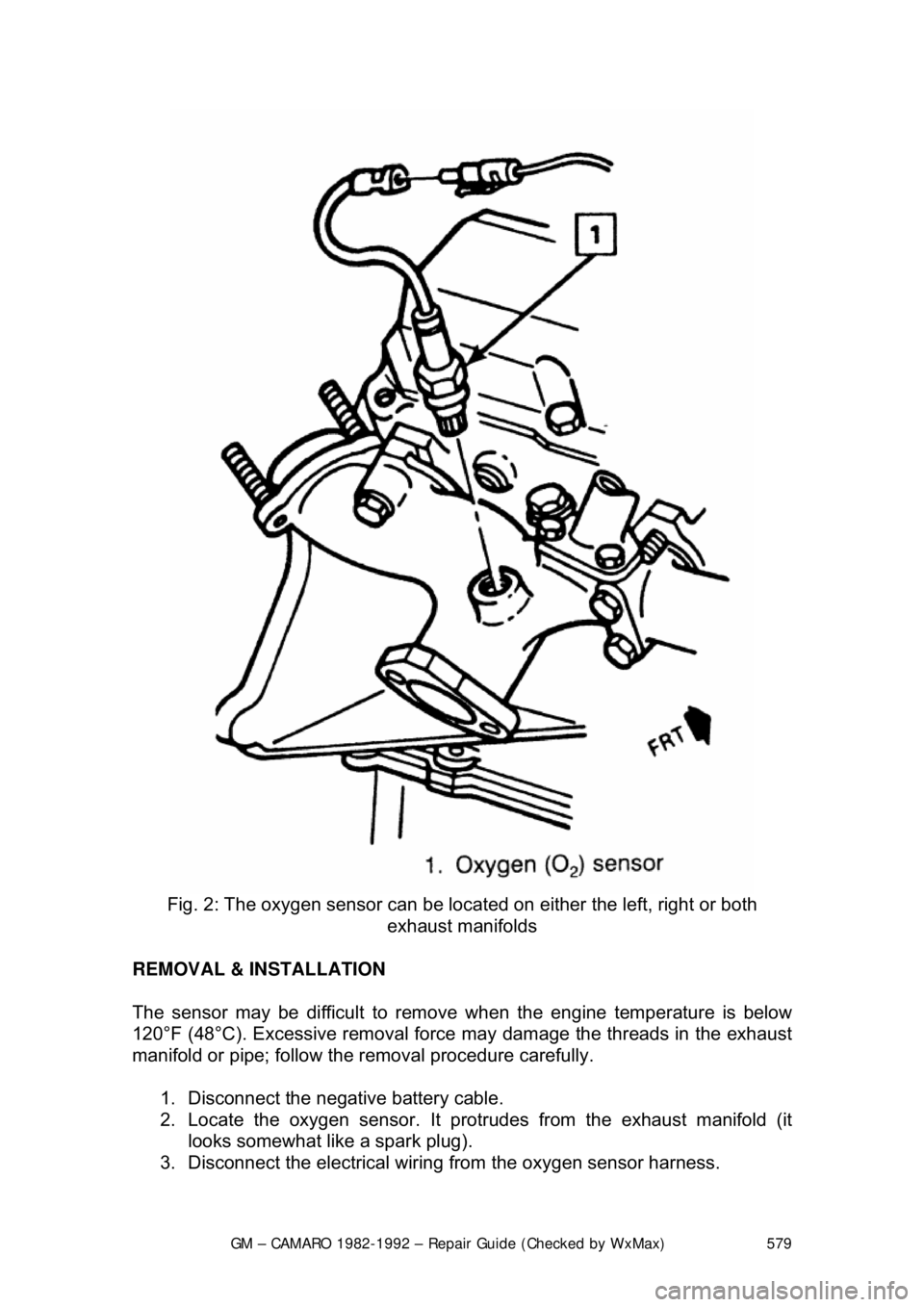
Fig. 2: The oxygen sensor can be locat ed on either the left, right or both
exhaust manifolds
REMOVAL & INSTALLATION
The sensor may be difficult to remove when the engine temperature is below
120°F (48°C). Excessive removal force may damage the threads in the exhaust
manifold or pipe; follow the removal procedure carefully.
1. Disconnect the negative battery cable.
2. Locate the oxygen sensor. It protr udes from the exhaust manifold (it
looks somewhat like a spark plug).
3. Disconnect the electrical wiring from the oxygen sensor harness.
Page 580 of 875

GM – CAMARO 1982-1992 – Repair Guide (Checked by WxMax) 580
4. Spray a commercial solvent onto the sensor threads and allow it to soak
in for at least five minutes.
5. Carefully remove the sensor wit h a special oxygen sensor socket.
To install: 6. First coat the new sensor's th reads with GM anti-seize compound No.
5613695 or the equivalent. This is not a conventional anti-seize paste.
The use of a regular compound may el ectrically insulate the sensor,
rendering it inoperative. Y ou must coat the threads with an electrically
conductive anti-seize compound. Installati on torque is 30 ft. lbs. (41 Nm).
Do not overtighten.
7. Reconnect the electric al wiring. Be careful not to damage the electrical
pigtail. Check the sensor boot fo r proper fit and installation.
8. Reconnect the negative battery cable.
COOLANT TEMPERATURE SENSOR
OPERATION
Most engine functions are affected by the coolant temperature. Determining
whether the engine is hot or cold is largely dependent on the temperature of the
coolant. An accurate temperature signal to the ECM is supplied by the coolant
temperature sensor. The coolant temperatur e sensor is a thermistor mounted in
the engine coolant stream. A thermistor is an electrical device that varies its
resistance in relation to changes in temperature. Low coolant temperature
produces a high resistance and high coolant temperature produces low
resistance. The ECM supplies a signal of 5 volts to the coolant temperature
sensor through a resistor in the ECM and measures the voltage. The voltage
will be high when the engine is cold and low when the engine is hot.
REMOVAL & INSTALLATION
1. Disconnect the negative battery cable.
2. Drain the cooling system to an appropr iate and clean container for reuse.
3. Disconnect the electrical wiring fr om the coolant temperature sensor.
4. Remove the coolant temperature sensor.
To install: 5. Install the coolant temperature sensor.
6. Connect the electrical wiring.
7. Fill the cooling system.
8. Connect the negative battery cable.
9. Start the engine and check for leaks.