check engine CHEVROLET CAMARO 1982 Repair Guide
[x] Cancel search | Manufacturer: CHEVROLET, Model Year: 1982, Model line: CAMARO, Model: CHEVROLET CAMARO 1982Pages: 875, PDF Size: 88.64 MB
Page 287 of 875

GM – CAMARO 1982-1992 – Repair Guide (Checked by WxMax) 287
DRIVE TRAIN
MANUAL TRANSMISSION
UNDERSTANDING THE MANUAL TRANSMISSION
Because of the way an internal combus tion engine breathes, it can produce
torque (or twisting force) only withi n a narrow speed range. Most overhead
valve pushrod engines must turn at about 2500 rpm to produce their peak
torque. Often by 4500 rpm, they are prod ucing so little torque that continued
increases in engine speed produce no power increases.
The torque peak on overhead camshaft engines is, generally, much higher, but
much narrower.
The manual transmission and clutch are employed to vary the relationship
between engine RPM and the speed of the w heels so that adequate power can
be produced under all circumst ances. The clutch allows engine torque to be
applied to the transmission input shaft gradually, due to mechanical slippage.
The vehicle can, consequently, be star ted smoothly from a full stop.
The transmission changes the ratio between the rotating speeds of the engine
and the wheels by the use of gears. 4-speed or 5-speed transmissions are most
common. The lower gears al low full engine power to be applied to the rear
wheels during acceleration at low speeds.
The clutch driveplate is a thin disc, the center of which is splined to the
transmission input shaft. Both sides of the disc are covered with a layer of
material which is similar to brake li ning and which is capable of allowing
slippage without roughness or excessive noise.
The clutch cover is bolted to the engine flywheel and incorporates a diaphragm
spring which provides the pressure to engage the clutch. The cover also houses
the pressure plate. When the clutch pe dal is released, the driven disc is
sandwiched between the pressu re plate and the smooth surface of the flywheel,
thus forcing the disc to turn at th e same speed as the engine crankshaft.
The transmission contains a mainshaft which passes all the way through the
transmission, from the clutch to the dr iveshaft. This shaft is separated at one
point, so that front and rear portions can turn at different speeds.
Power is transmitted by a countershaft in the lower gears and reverse. The
gears of the countershaft mesh with gear s on the mainshaft, allowing power to
be carried from one to the other. Countershaft gears are often integral with that
shaft, while several of the mainshaft gea rs can either rotate independently of
the shaft or be locked to it. Shifting from one gear to the next causes one of the
gears to be freed from rotating with the shaft and locks another to it. Gears are
locked and unlocked by internal dog clutc hes which slide between the center of
the gear and the shaft. The forward gears us ually employ synchronizers; friction
Page 294 of 875

GM – CAMARO 1982-1992 – Repair Guide (Checked by WxMax) 294
25. Connect the negative battery cable at the battery.
CLUTCH
UNDERSTANDING THE CLUTCH
The purpose of the clutch is to disconnect and connect engine power at the
transmission. A vehicle at rest requires a lot of engine torque to get all that
weight moving. An internal combustion engine does not develop a high starting
torque (unlike steam engines) so it must be allowed to operate without any load
until it builds up enough torque to move the vehicle. To a point, torque
increases with engine rpm. The clutch a llows the engine to build up torque by
physically disconnecting t he engine from the transmission, relieving the engine
of any load or resistance.
The transfer of engine power to the tr ansmission (the load) must be smooth and
gradual; if it weren't, driv e line components would wear out or break quickly.
This gradual power transfer is made possi ble by gradually releasing the clutch
pedal. The clutch disc and pressure plat e are the connecting link between the
engine and transmission. When the clutch pedal is released, the disc and plate
contact each other (the clutch is engag ed) physically joining the engine and
transmission. When the pedal is pushed in, the disc and plate separate (the
clutch is disengaged) disconnecting the engine from the transmission.
Most clutch assemblies consists of t he flywheel, the clutch disc, the clutch
pressure plate, the throw out bearing and fork, the actuating linkage and the
pedal. The flywheel and clutch pressure plate (driving members) are connected
to the engine crankshaft and rotate with it. The clutch disc is located between
the flywheel and pressure plate, and is splined to the transmission shaft. A
driving member is one that is attached to the engine and transfers engine power
to a driven member (clutch disc) on t he transmission shaft. A driving member
(pressure plate) rotates (drives) a driv en member (clutch disc) on contact and,
in so doing, turns the transmission shaft.
There is a circular di aphragm spring within th e pressure plate cover
(transmission side). In a relaxed state (w hen the clutch pedal is fully released)
this spring is convex; that is, it is dished outward toward the transmission.
Pushing in the clutch peda l actuates the attached linkage. Connected to the
other end of this is the throw out fork, which hold the throw out bearing. When
the clutch pedal is depre ssed, the clutch linkage pushes the fork and bearing
forward to contact the diaphragm spring of the pressure plate. The outer edges
of the spring are secured to the pressure plate and are pivoted on rings so that
when the center of the spring is compre ssed by the throw out bearing, the outer
edges bow outward and, by so doing, pu ll the pressure plate in the same
direction - away from the clutch disc. This action se parates the disc from the
plate, disengaging the clutch and allowing the transmission to be shifted into
another gear. A coil type clutch return sp ring attached to the clutch pedal arm
permits full release of the pedal. Releasing the pedal pulls the throw out bearing
away from the diaphragm spring resulting in a reversal of spring position. As
bearing pressure is gradually released from the spring center, the outer edges
Page 295 of 875

GM – CAMARO 1982-1992 – Repair Guide (Checked by WxMax) 295
of the spring bow outward, pushing the pre
ssure plate into closer contact with
the clutch disc. As the disc and plate mo ve closer together, friction between the
two increases and slippage is reduced until, when full spring pressure is applied
(by fully releasing the pedal) the speed of the disc and plate are the same. This
stops all slipping, creating a direct connection between the plate and disc which
results in the transfer of power from t he engine to the transmission. The clutch
disc is now rotating with the pressure plate at engine speed and, because it is
splined to the transmission shaft, the shaft now turns at the same engine speed.
The clutch is operating properly if: 1. It will stall the engine when released with the vehicle held stationary.
2. The shift lever can be moved freel y between 1st and reverse gears when
the vehicle is stationary and the clutch disengaged.
APPLICATION
All 1982-83 vehicles use a mechanical (non-hydraulic) clutch; 1984-92 models
use a hydraulic clutch. With the hydraulic clutch, no adjustment of the clutch
pedal or the linkage is required. On t he mechanical type, the only required
adjustment is to maintain the proper clutch pedal freeplay. The freeplay\
adjustment is very important, for it determines the engaging and disengaging
characteristics of the clutch assembly.
The clutch assembly consists of: a flywheel, a pressure plate, a throwout
bearing and fork, a clutch pedal, and an actuating lever (non-hydraulic) or a
master cylinder/slave cylinder (hydraulic).
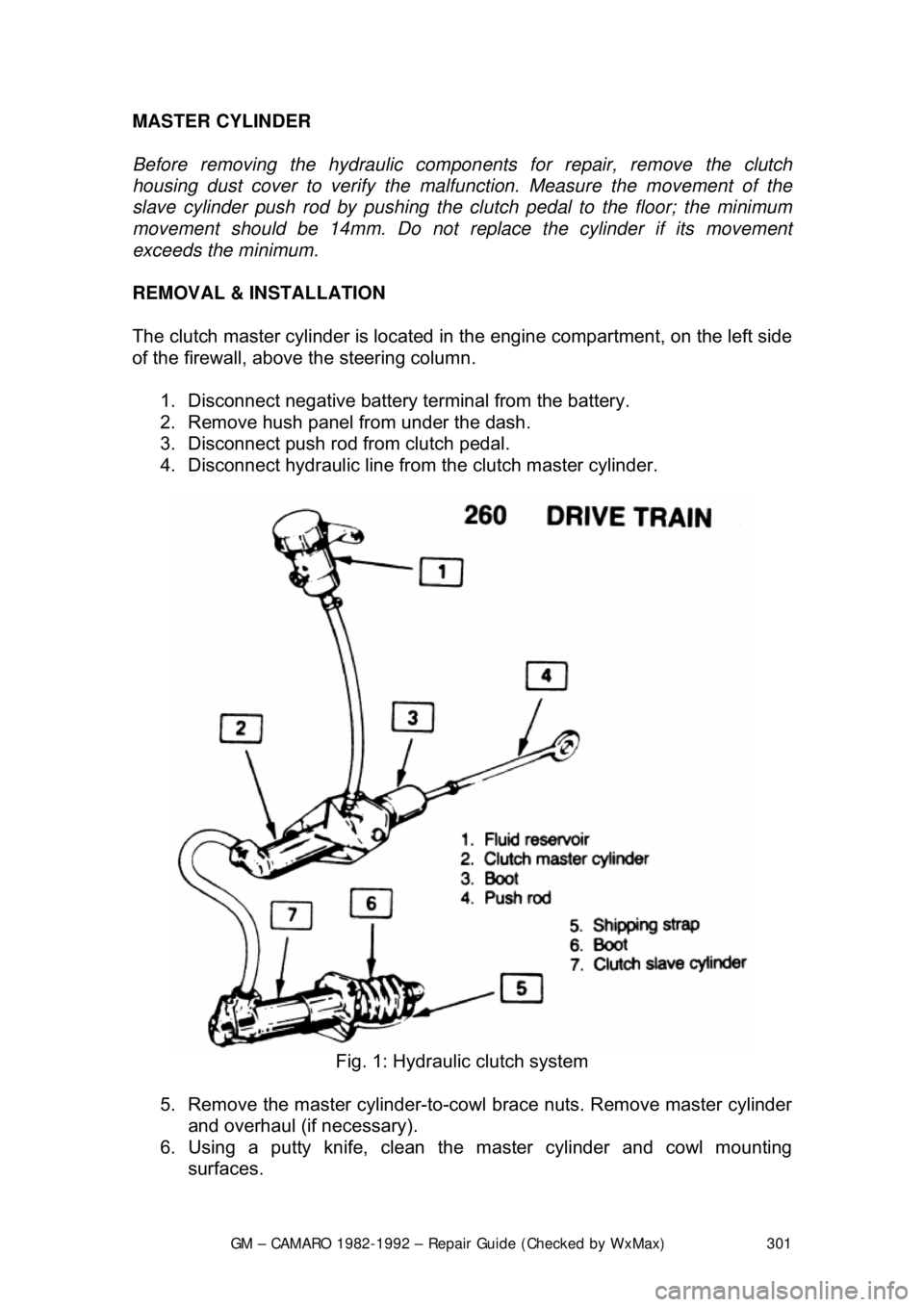
The hydraulic system utilizes a remote re servoir which is mounted to the power
brake booster, a master cy linder mounted to the cowl p anel and a slave cylinder
that is mounted to the bell housing. Th e system is operated directly by the
clutch pedal. When adding fl uid to the reservoir, always use a type which meets
DOT 3 specifications.
CAUTION - The clutch driven disc contains asbestos, which has been
determined to be a cancer causing agen t. Never clean clutch surfaces with
compressed air! Avoid inhaling any dus t from any clutch surface! When
cleaning clutch surfaces, use a commercia lly available brake cleaning fluid.
FREE-PLAY ADJUSTMENT
MECHANICAL LINKAGE 1. Disconnect the return sp ring at the clutch fork.
2. Hold the pedal against the rubber bumper on the dash brace.
3. Push the clutch fork so that th e throwout bearing lightly contacts the
pressure plate fingers.
Page 299 of 875
GM – CAMARO 1982-1992 – Repair Guide (Checked by WxMax) 299
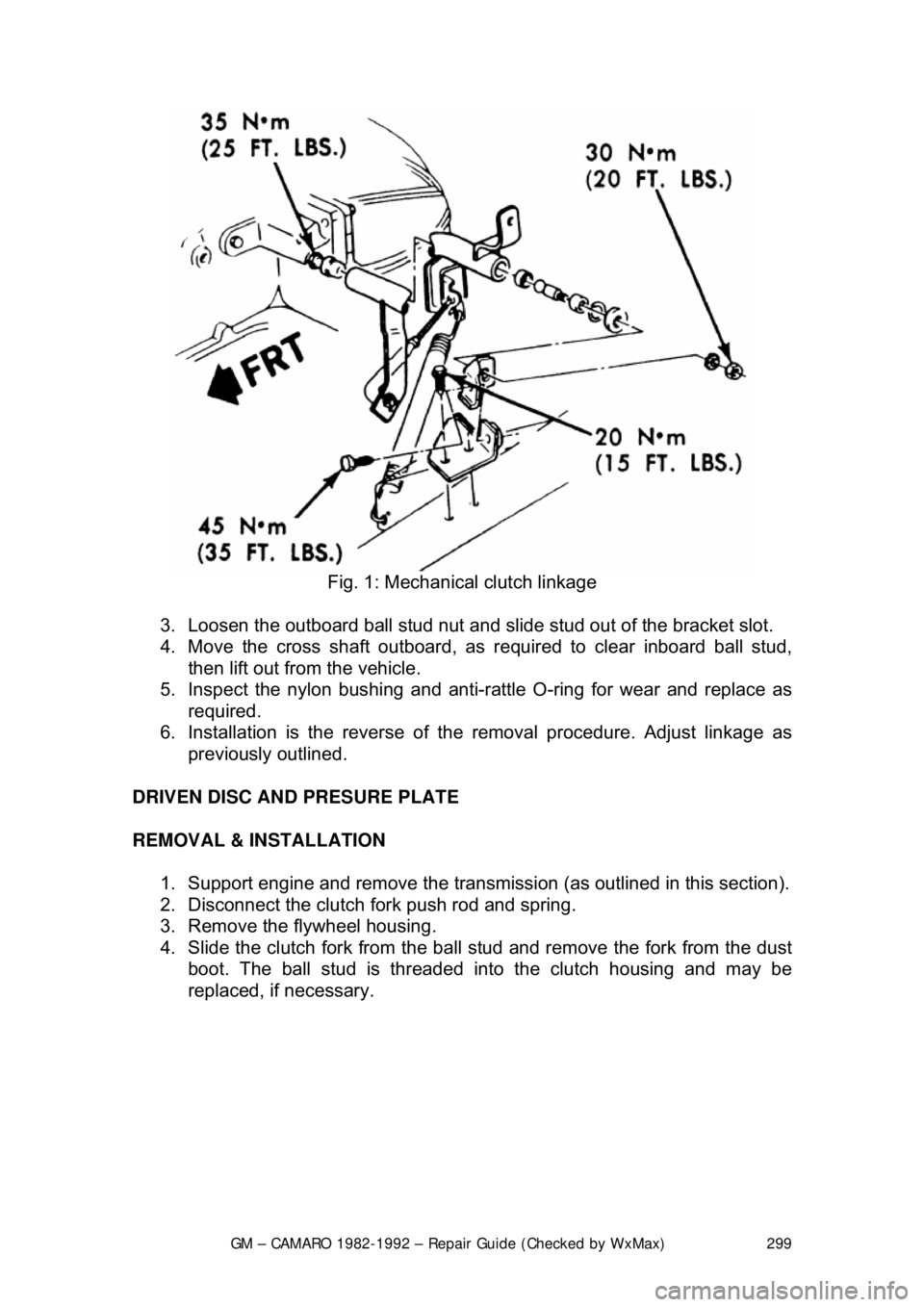
Fig. 1: Mechanical clutch linkage
3. Loosen the outboard ball stud nut and slid e stud out of the bracket slot.
4. Move the cross shaft outboard, as required to clear inboard ball stud,
then lift out from the vehicle.
5. Inspect the nylon bushing and anti-ra ttle O-ring for wear and replace as
required.
6. Installation is the reverse of th e removal procedure. Adjust linkage as
previously outlined.
DRIVEN DISC AND PRESURE PLATE
REMOVAL & INSTALLATION 1. Support engine and remove the transmissi on (as outlined in this section).
2. Disconnect the clutch fork push rod and spring.
3. Remove the flywheel housing.
4. Slide the clutch fork from the ball stud and remove the fork from the dust
boot. The ball stud is threaded into the clutch housing and may be
replaced, if necessary.
Page 301 of 875
GM – CAMARO 1982-1992 – Repair Guide (Checked by WxMax) 301
MASTER CYLINDER
Before removing the hydraulic compon
ents for repair, remove the clutch
housing dust cover to verify the malf unction. Measure the movement of the
slave cylinder push rod by pushing the cl utch pedal to the floor; the minimum
movement should be 14mm. Do not r eplace the cylinder if its movement
exceeds the minimum.
REMOVAL & INSTALLATION
The clutch master cylinder is located in the engine compartment, on the left side
of the firewall, above the steering column.
1. Disconnect negative battery terminal from the battery.
2. Remove hush panel from under the dash.
3. Disconnect push rod from clutch pedal.
4. Disconnect hydraulic line from the clutch master cylinder.
Fig. 1: Hydraulic clutch system
5. Remove the master cylinder-to-cowl brace nuts. Remove master cylinder
and overhaul (if necessary).
6. Using a putty knife, clean th e master cylinder and cowl mounting
surfaces.
Page 304 of 875

GM – CAMARO 1982-1992 – Repair Guide (Checked by WxMax) 304
Never release a depressed clutch pedal
with the bleeder screw open or air will
be drawn into the system.
AUTOMATIC TRANSMISSION
UNDERSTANDING AUTOMATIC TRANSMISSIONS
The automatic transmission allows eng ine torque and power to be transmitted
to the rear wheels within a narrow range of engine operating speeds. It will
allow the engine to turn fast enough to produce plenty of power and torque at
very low speeds, while keeping it at a s ensible rpm at high vehicle speeds (and
it does this job without driv er assistance). The transmission uses a light fluid as
the medium for the transmission of power. This fluid also works in the operation
of various hydraulic control circui ts and as a lubricant. Because the
transmission fluid performs all of thes e functions, trouble within the unit can
easily travel from one part to another. For this reason, and because of the
complexity and unusual oper ating principles of the transmission, a very sound
understanding of the basic principles of operation will simplify troubleshooting.
TORQUE CONVERTER
The torque converter replaces the convent ional clutch. It has three functions:
1. It allows the engine to idle with t he vehicle at a standstill, even with the
transmission in gear.
2. It allows the transmission to shi ft from range-to-range smoothly, without
requiring that the driver close the throttle during the shift.
3. It multiplies engine torque to an incr easing extent as vehicle speed drops
and throttle opening is increased. This has the effect of making the
transmission more responsive and redu ces the amount of shifting
required.
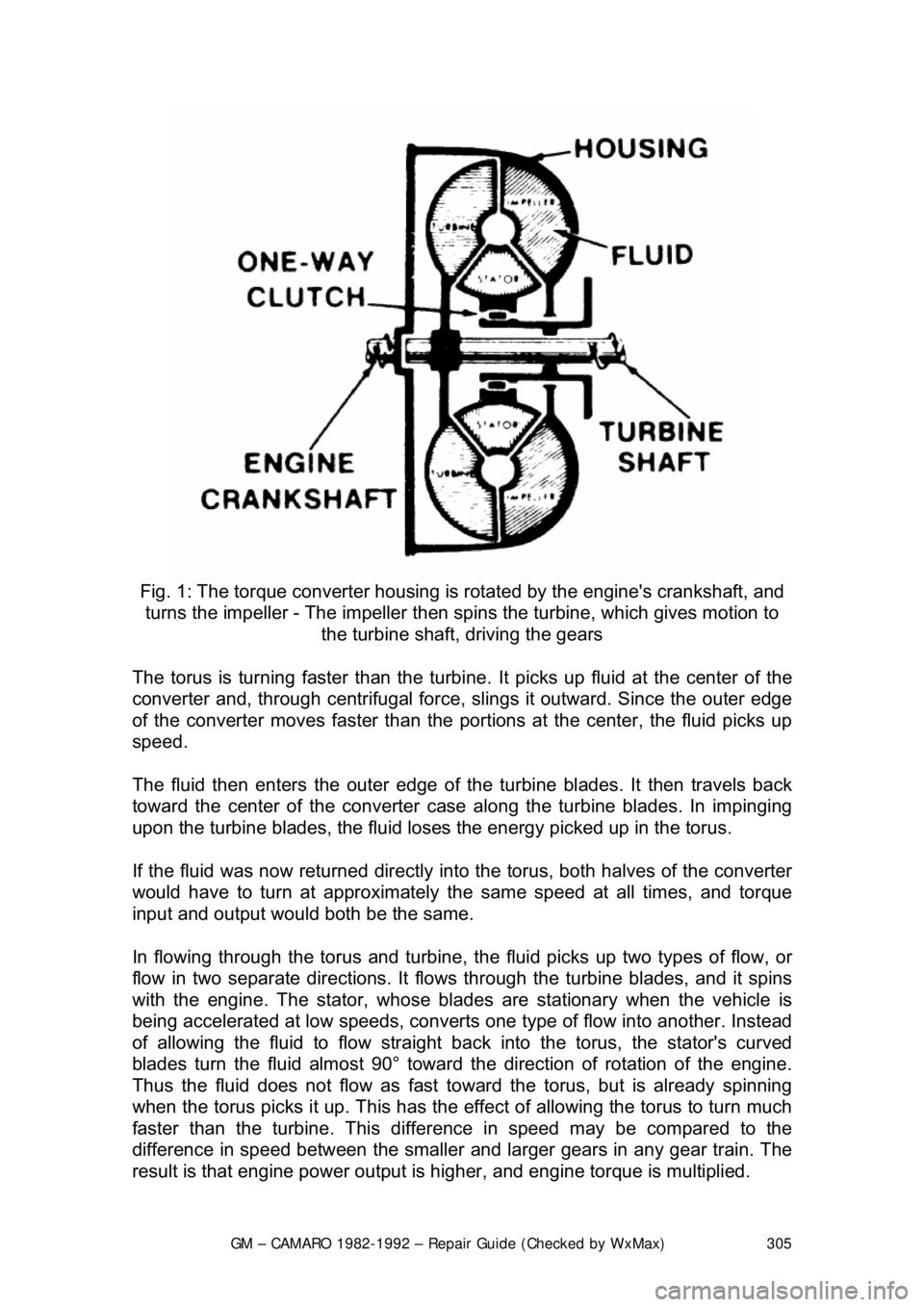
The torque converter is a metal case which is shaped like a sphere that
has been flattened on opposite sides. It is bolted to the rear end of the
engine's crankshaft. Generally, the ent ire metal case rotates at engine
speed and serves as the engine's flywheel.
The case contains three sets of bl ades. One set is attached directly to
the case. This set forms the torus or pump. Another set is directly
connected to the output shaft, and forms the turbine. The third set is
mounted on a hub which, in turn, is mounted on a stationary shaft
through a one-way clutch. This third set is known as the stator.
A pump, which is driven by the conv erter hub at engine speed, keeps the
torque converter full of transmission fluid at all times. Fluid flows
continuously through the unit to provide cooling.
Under low speed acceleration, the tor que converter functions as follows:
Page 305 of 875
GM – CAMARO 1982-1992 – Repair Guide (Checked by WxMax) 305
Fig. 1: The torque converter housing is rotated by the engine's crankshaft, and
turns the impeller - The impeller then spin s the turbine, which gives motion to
the turbine shaft, driving the gears
The torus is turning faster than the turbi ne. It picks up fluid at the center of the
converter and, through centrifugal force, slings it outward. Since the outer edge
of the converter moves faster than the portions at the center, the fluid picks up
speed.
The fluid then enters the outer edge of th e turbine blades. It then travels back
toward the center of the converter case along the turbine blades. In impinging
upon the turbine blades, the fluid loses the energy picked up in the torus.
If the fluid was now returned directly into the torus, both halves of the converter
would have to turn at approximately t he same speed at all times, and torque
input and output would both be the same.
In flowing through the torus and turbine, the fluid picks up two types of flow, or
flow in two separate directions. It flow s through the turbine blades, and it spins
with the engine. The stator, whose blades are stationary when the vehicle is
being accelerated at low speeds, converts one type of flow into another. Instead
of allowing the fluid to flow straight back into the torus, the stator's curved
blades turn the fluid almost 90° toward the direction of rotation of the engine.
Thus the fluid does not flow as fast to ward the torus, but is already spinning
when the torus picks it up. This has the effe ct of allowing the torus to turn much
faster than the turbine. This differ ence in speed may be compared to the
difference in speed between the smaller and larger gears in any gear train. The
result is that engine powe r output is higher, and engine torque is multiplied.
Page 306 of 875
GM – CAMARO 1982-1992 – Repair Guide (Checked by WxMax) 306
As the speed of the turbine increases, th
e fluid spins faster and faster in the
direction of engine rotation. As a result, t he ability of the stator to redirect the
fluid flow is reduced. Under cruising conditions, the stator is eventually forced to
rotate on its one-way clutch in the dire ction of engine rotation. Under these
conditions, the torque converter begins to behave almost like a solid shaft, with
the torus and turbine speeds being almost equal.
PLANETARY GEARBOX
The ability of the torque converter to mult iply engine torque is limited. Also, the
unit tends to be more efficient when the turbine is rotating at relatively high
speeds. Therefore, a planetar y gearbox is used to carry the power output of the
turbine to the driveshaft.
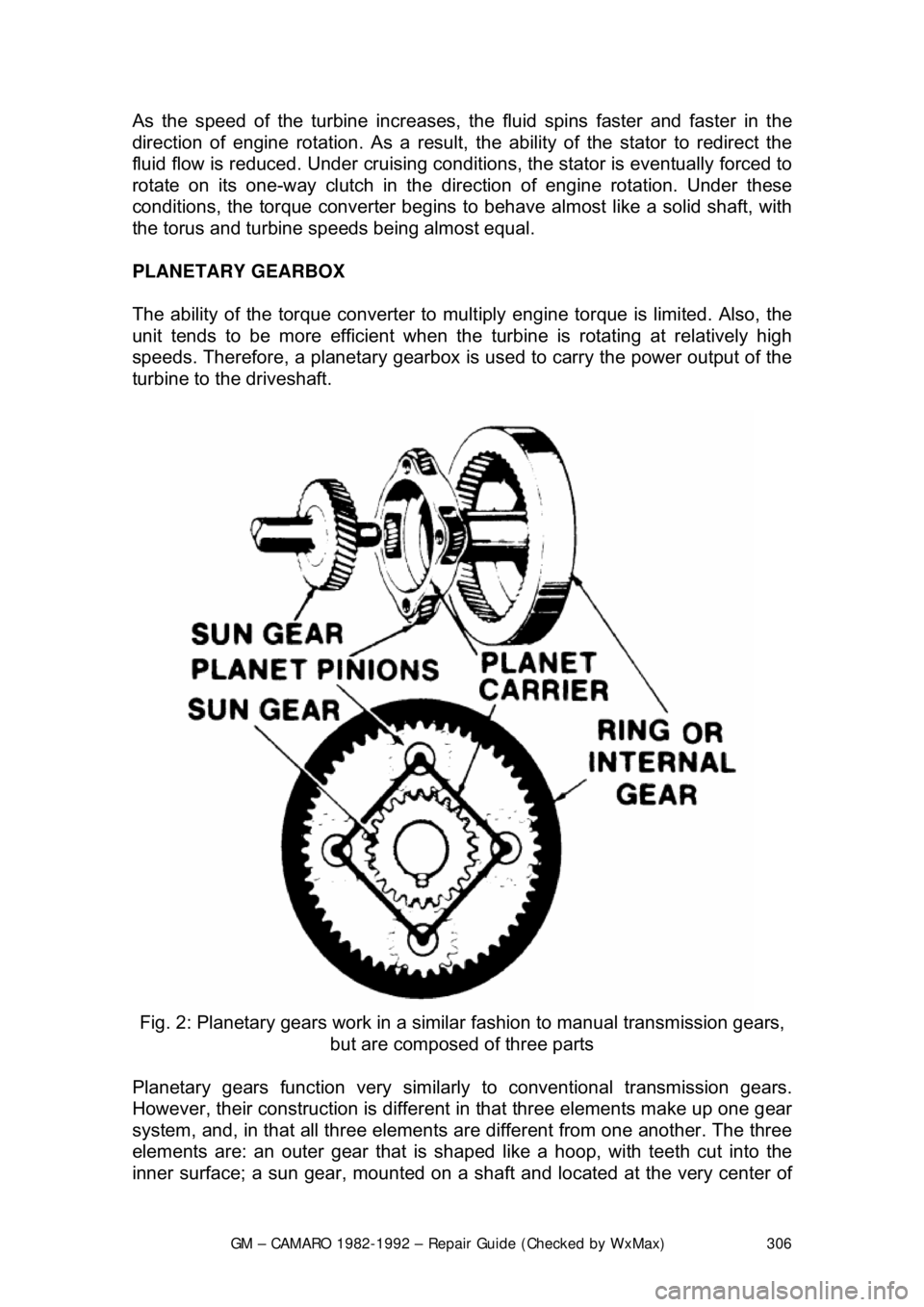
Fig. 2: Planetary gears work in a sim ilar fashion to manual transmission gears,
but are composed of three parts
Planetary gears function very similarly to conventional transmission gears.
However, their construction is different in that three elements make up one gear
system, and, in that all three elements ar e different from one another. The three
elements are: an outer gear that is shaped like a hoop, with teeth cut into the
inner surface; a sun gear, mounted on a sha ft and located at the very center of
Page 310 of 875

GM – CAMARO 1982-1992 – Repair Guide (Checked by WxMax) 310
modulator pressure rises as the thro
ttle is opened wider. By responding to these
two pressures, the shift valves caus e the upshift points to be delayed with
increased throttle opening to make the bes t use of the engine's power output.
Most transmissions also make use of an auxiliary circuit for downshifting. This
circuit may be actuated by the throttle linkage the vacuum line which actuates
the modulator, by a cable or by a solenoid. It applies pressure to a special
downshift surface on the shift valve or valves.
The transmission modulator also governs the line pressure, used to actuate the
servos. In this way, the clutches and bands will be actuated with a force
matching the torque output of the engine.
IDENTIFICATION
Two types of transmissions are used on th e vehicles; Turbo Hydra-Matic 200C
3-speed and Turbo Hydra-Matic 700-R4 4-speed. Beginning in 1991, the 700-
R4 was redesignated the 4L60.
FLUID PAN
REMOVAL, FLUID/FILTER CH ANGE, & INSTALLATION
Refer to General Information & Ma intenance for fluid pan procedures.
ADJUSTMENTS
BANDS
There are no band adjustments possible or required.
Page 312 of 875
GM – CAMARO 1982-1992 – Repair Guide (Checked by WxMax) 312
4. Rotate the shift lever clockwis
e to the park detent and then back to
neutral.
5. Tighten cable attachment to 11 ft. lbs. (15 Nm).
The lever must be held out of P when tightening the nut.
SHIFT LINKAGE 1. Place the manual shaft of the transmission in N. Place the console shift
lever in N.
2. Install the cable in the slot of the shift lever. Adjust the cable so that the
pin has free movement.
3. Install and tighten t he nut to the pin.
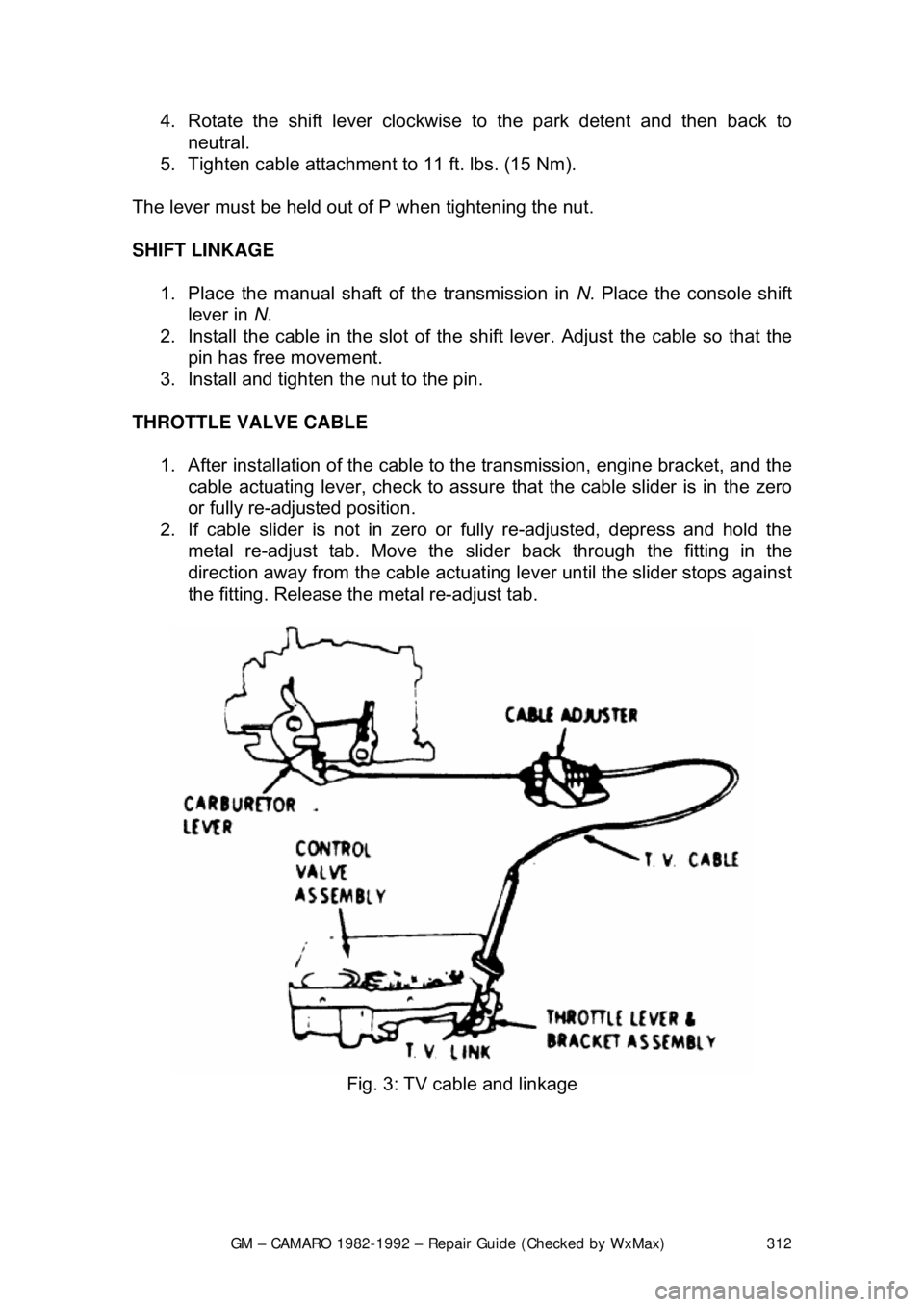
THROTTLE VALVE CABLE 1. After installation of the cable to the transmission, engine bracket, and the
cable actuating lever, check to assure that the cable slider is in the zero
or fully re-adjusted position.
2. If cable slider is not in zero or fully re-adjusted, depress and hold the
metal re-adjust tab. Move the sli der back through the fitting in the
direction away from the cable actuat ing lever until the slider stops against
the fitting. Release the metal re-adjust tab.
Fig. 3: TV cable and linkage