service CHEVROLET CAMARO 1993 User Guide
[x] Cancel search | Manufacturer: CHEVROLET, Model Year: 1993, Model line: CAMARO, Model: CHEVROLET CAMARO 1993Pages: 358, PDF Size: 15.6 MB
Page 107 of 358
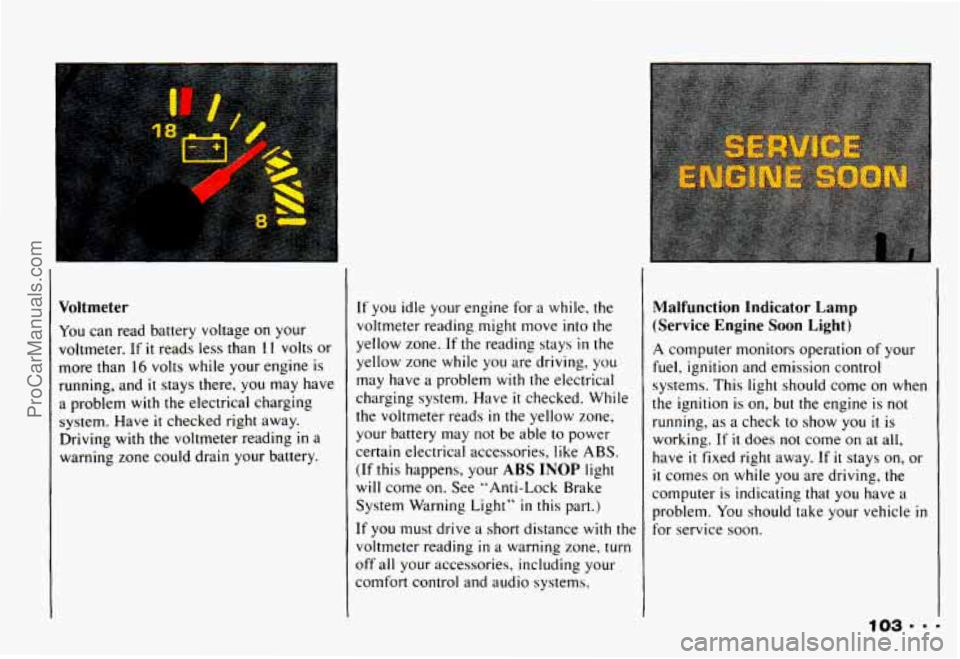
Voltmeter
You can read battery voltage on your
voltmeter. If
it reads less than 1 I volts or
more than
16 volts while your engine is
running, and
it stays there, you may have
a problem with the electrical charging
system. Have
it checked right away.
Driving with the voltmeter reading
in a
warning zone could drain your battery.
If you idle your engine for a while, the
voltmeter reading might move into the
yellow zone.
If the reading stays in the
yellow zone while you are driving, you
may have a problem with
the electrical
charging system. Have
it checked. While
the voltmeter reads
in the yellow zone,
your battery may
not be able to power
certain electrical accessories, like ABS.
(If this happens, your ABS INOP light
will come
on, See "Anti-Lock Brake
System Warning Light"
in this part.)
It' you must drive a short distance with the
voltmeter reading
in a warning zone. turn
off all your accessories, including your
comfort control and audio systems.
Malfunction Ind-kator Lamp
(Service Engine Soon Light)
A computer monitors operation of your
fuel, ignition and emission control
systems. This light should come on when
the ignition is
on, but the engine is not
running, as a check
to show you il is
working.
If it does not come on at all,
have
it fixed right away. If it stays on, or
it comes on while you are driving, the
computer is indicating that you have
a
problem. You should take your vehicle in
for service soon.
ProCarManuals.com
Page 108 of 358
Features & Controls
It you keep driving your vehicle
with this
fight on, after a while
emission controls won’t work
well, your fuel economy won’t be
good and your engine may
not rul
as smoothly. This could lead tc
costly repairs not covered by y
warranty.
... 104
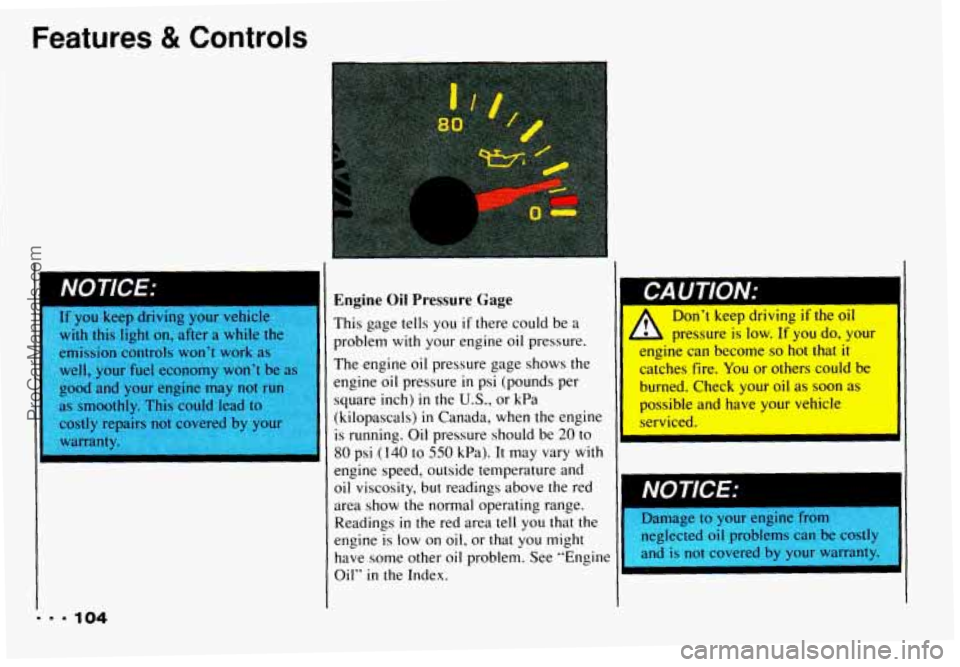
Engine Oil Pressure Gage
This gage tells you if there could be a
problem with your engine oil pressure.
The engine oil pressure gage shows the
engine oil pressure
in psi (pounds per
square inch)
in the U.S., or kPa
(kilopascals)
in Canada, when the engine
is running. Oil pressure should be 20 to
80 psi (140 to 550 kPa). It may vary with
engine speed, outside temperature and
oil viscosity, but readings above the red
area show the normal operating range.
Readings
in the red area tell you that the
engine is
low on oil, or that you might
have some other oil problem. See “Engine
Oil”
in the Index.
Don’t keep driving if the oil
h pressure is low. If you do, your
cllgine can become
so hot that it
I catches fire. You or others could be
burned. Check your
oil as soon as
possible and have your vehicle
serviced.
I NOTICE:
‘I
3
Damage your engine from
neglected oil problems can be costl)
ProCarManuals.com
Page 132 of 358
Comfort Controls & Audio Systems
AM Stereo
This means the Delco@ system can
receive C-QUAM@ stereo broadcasts.
Many AM stations around the country use
C-QUAM@
to produce stereo, though
some
do not. (C-QUAM@ is a registered
trademark
of Motorola, Inc.) If your
Delco@ system can get C-QUAM@, your
“STEREO” light will come on when
you’re receiving
it.
I
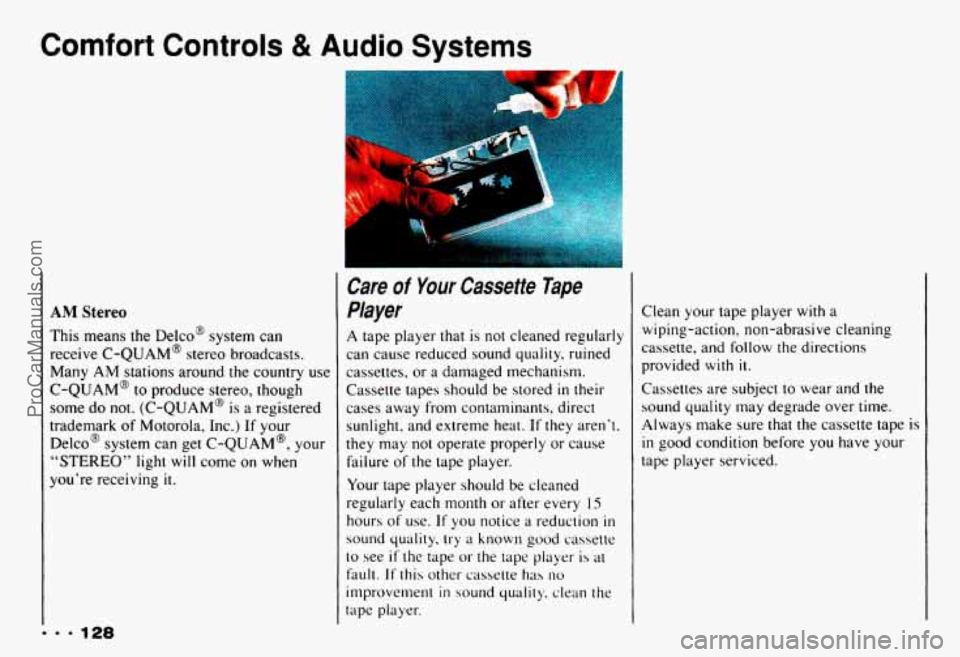
Care of Your Cassette Tape
Player
A tape player that is not cleaned regularly
can cause reduced sound quality, ruined
cassettes, or a damaged mechanism.
Cassette tapes should be stored
in their
cases away from contaminants, direct
sunlight, and extreme heat. If they aren’t.
they may not operate properly or cause
failure
of the tape player.
Your tape player should be cleaned
regularly each month or after every
IS
hours of use. If you notice a reduction in
sound quality. try a known good cassette
to see
if the tape or the tape player is a1
fault. If this other cassette has no
improvenlent in sound qualily. clean the
tape player. Clean
your tape player
with a
wiping-action, non-abrasive cleaning
cassette, and follow the directions
provided with it.
Cassettes are subject to wear and the
sound quality may degrade over time.
Always make sure that the cassette tape is
in good condition before you have your
tape player serviced.
ProCarManuals.com
Page 137 of 358
V
YIELD
ST0 PI1
E
HOS
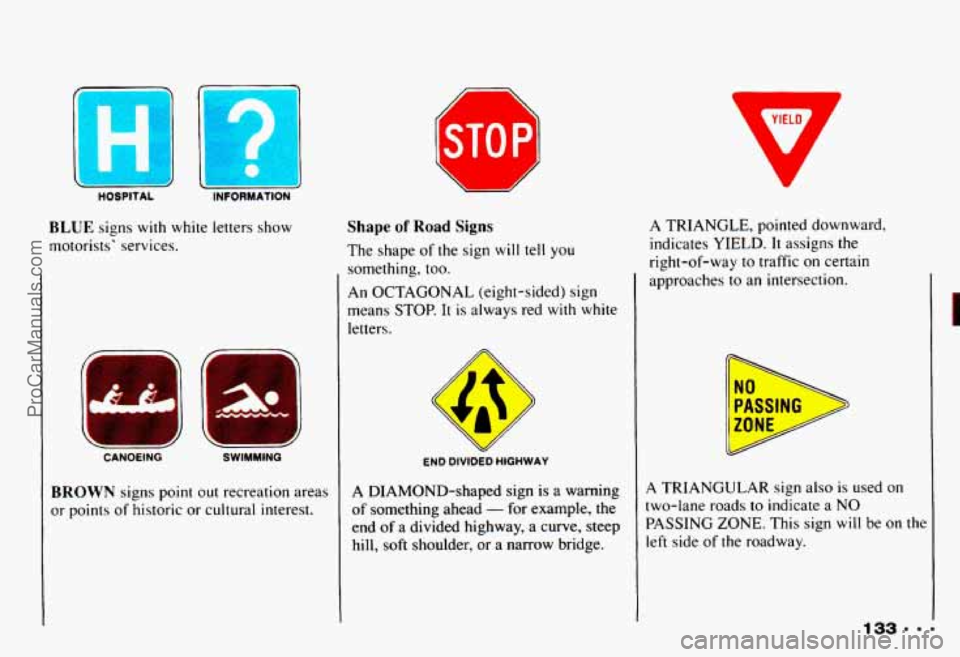
Shape of Road Signs
The shape of the sign will tell you
something,
too.
An OCTAGONAL (eight-sided) sign
means STOP.
It is always red with white
letters.
A TRIANGLE, pointed downward,
indicates YIELD.
It assigns the
right-of-way
to traffic on certain
approaches
to an intersection.
BLUE signs with white letters show
motorists’ services.
I
v CANOEING END DIVIDED HIGHWAY
A TRIANGULAR sign also is used on
two-lane roads to indicate a NO
PASSING ZONE. This sign
will be on the
left side
of the roadway.
BROWN signs point out recreation areas
or points of historic or cultural interest. A
DIAMOND-shaped sign is a warning
of something ahead - for example, the
end
of a divided highway, a curve, steep
hill,
soft shoulder, or a narrow bridge.
ProCarManuals.com
Page 149 of 358
Disc Brake Wear Indicators
Unless you have the four-wheel disc
brake option, your Chevrolet has front
disc brakes and rear drum brakes.
Disc brake pads have built-in wear
indicators that make a high-pitched
warning sound when the brake pads are
worn and new pads are needed. The
sound may come and go or be heard all
the time your vehicle is moving (except
when you are pushing on the brake peda
firmly). 1 The brake wear warning sound
- means that sooner or later your
brakes won’t work well. That could
lead to an accident. When you hear
the brake wear warning sound, have
your vehicle serviced.
I
I
.1 LullllllullIg 1u UIIVt: Wllll WUIII-UU
brake pads could result in rnctl\~
brake repair. Some driving conditions
or climates may
cause a brake squeal when the brakes are
first applied or lightly applied. This does
not mean something
is wrong with your
brakes.
Rear Drum Brakes
If you have rear drum brakes, they don’t
have wear indicators,
but if you ever hear
a rear brake rubbing noise, have the rear
brake linings inspected.
Also, the rear
brake drums should be removed and
inspected each time the tires are removed
for rotation or changing. When you have
the front brakes replaced, have the rear
brakes inspected, too.
Brake linings should always be replaced
as complete axle sets.
ProCarManuals.com
Page 158 of 358
Your Driving and the Road
But if you’re driving, don’t wear
sunglasses at night. They may cut down
on glare from headlights, but they also
make a lot
of things invisible that should
remain visible
- such as parked cars,
obstacles, pedestrians,
or even trains
blocking railway crossings. You may
want to put
on your sunglasses after you
have pulled into a brightly-lighted service
or refreshment area. Eyes shielded from
that glare may adjust more quickly to
darkness back on the road. But be sure to
remove your sunglasses before you leave
the service
area.-^-
You can be temporarily blinded by
approaching lights.
It can take a second or
two, or even several seconds, for your
eyes to readjust to the dark. When you are
faced with severe glare (as from a driver
who doesn’t lower the high beams, or a
vehicle
with misaimed headlights), slow
down a
little. Avoid staring directly into
the approaching lights. If there is a line of
opposing traffic, make occasional glances
over the line
of headlights to make certain
that one
of the vehicles isn’t starting to
move into
your lane. Once you are past
the bright lights, give your eyes time to
readjust before resuming speed.
High Beams
[f the vehicle approaching you has its
high beams on, signal
by flicking yours to
high and then back to low beam. This is
:he usual signal to lower the headlight
beams. If the other driver
still doesn’t
lower the beams, resist the temptation
to
put your high beams on. This only makes
two half-blinded drivers.
On a freeway, use your high beams only
in remote areas where you won’t impair
approaching drivers. In some places, like
Zities, using high beams is illegal.
ProCarManuals.com
Page 167 of 358
Driving a Long
Distance
Although most long trips today are made
on freeways, there are
still many made on
regular highways.
Long-distance driving on freeways and
regular highways
is the same in some
ways. The
trip has to be planned and the
vehicle prepared, you drive at
higher-than-city speeds, and there are
longer turns behind the wheel. You’ll
enjoy your trip more
if you and your
vehicle are
in good shape. Here are some
:ips for a successful long trip.
Before Leaving on a Long Trip
Make sure you’re ready. Try to be well
rested. If you must start when you’re not
fresh
- such as after a day’s work -
don’t plan to make too many miles that
first part of the journey. Wear comfortable
clothing and shoes you can easily drive
in.
Is your vehicle ready for a long trip? If
you keep
it serviced and maintained, it’s
ready to go. If
it needs service, have it
done before starting out. Of course, you’ll
find experienced and able service experts
in Chevrolet dealerships all across North
America. They’ll be ready and willing to
help
if you need it. Here
are some things you can check
before a trip:
0
0
0
0
0
Windshield Washer Fluid: Is the
reservoir
full? Are all windows clean
inside and outside?
Wiper Blades: Are they in good
shape?
Fuel, Engine Oil, Other Fluids:
Have you checked all levels?
Lights: Are they all working? Are the
lenses clean?
Tires: They are vitally important to a
safe, trouble-free trip.
Is the tread
good enough for long-distance
driving? Are the tires all inflated to
the recommended pressure?
163 -
ProCarManuals.com
Page 169 of 358
What can you do about highway
hypnosis'? First, be aware that
it can
happen.
Then here are some tips:
Make sure your vehicle is well
ventilated,
with a comfortably cool
interior.
Keep your eyes moving. Scan the road
ahead and
to the sides. Check your
rearview mirrors frequently and your
instruments from time
to time. This
can help you avoid a fixed stare. Wear
good sunglasses
in bright light.
Glare can cause drowsiness.
But don't
wear sunglasses
at night. They will
drastically reduce your overall vision
at
the very time you need all the
seeing power you have.
If you get sleepy,
pull off the road into
a rest, service, or parking area and
take a nap, get some exercise, or both.
For safety, treat drowsiness on the
highway as an emergency.
As in any driving situation. keep pace
with traffic and allow adequate following
distances.
Hill and Mountain
Roads
Driving on steep hills or mountains is
different from driving
in flat or rolling
terrain. If you drive regularly
in steep
country. or
if you're planning to visit
there, here are some tips that can make
your trips safer and more enjoyable.
0 Keep your vehicle in good shape.
Check all fluid levels and also the
brakes, tires, cooling system and
transmission. These parts can work
hard on mountain roads.
1659 *
ProCarManuals.com
Page 185 of 358
Maintenance When Trailer Towing
Your vehicle will need service more often
when you're pulling a trailer. See the
Maintenance Schedule for more on this.
Things that are especially important
in
trailer operation are automatic
transmission
fluid (don't overfill), engine
oil, axle lubricant. belts. cooling system,
and brake adjustment. Each of these is
covered
in this manual, and the Index will
help you find them quickly. If you're
trailering, it's
a good idea to review these
sections before
you start your trip.
Check periodically to see that all hitch
nuts
and bolts are tight.
ProCarManuals.com
Page 193 of 358
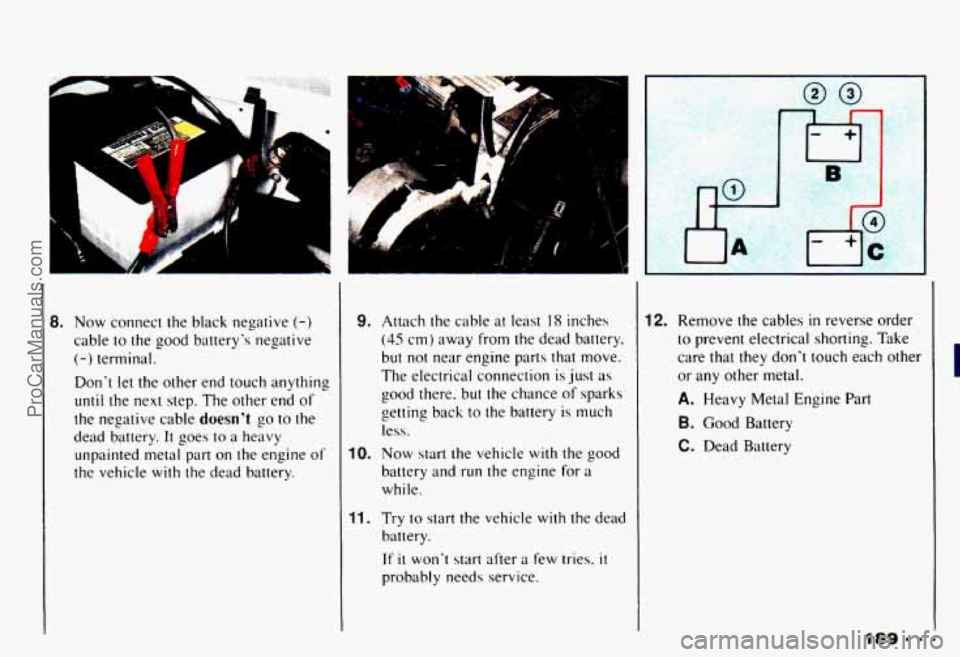
8. Now connect the black negative (-)
cable to the good battery's negative
(-) terminal.
Don't
let the other end touch anything
until the next step. The other end of
the negative cable doesn't go to the
dead battery. It goes to a heavy
unpainted metal part
on the engine of
the vehicle with the dead battery.
9.
10.
11.
Attach the cable at least 18 inches
(45 cm) away from the dead battery.
but
not near engine parts that move.
The electrical connection is just as
good there, but the chance of sparks
getting back to the battery is much
less.
Now start the vehicle with the good
battery and run the engine for a
while.
Try
to start the vehicle with the dead
battery.
If it won't start after a few tries, it
Probably needs service.
12. Remove the cables in reverse order
to prevent electrical shorting. Take
care that they don't touch each other
or any other metal.
A. Heavy Metal Engine Part
B. Good Battery
C. Dead Battery
ProCarManuals.com