service CHEVROLET CAMARO 1993 Workshop Manual
[x] Cancel search | Manufacturer: CHEVROLET, Model Year: 1993, Model line: CAMARO, Model: CHEVROLET CAMARO 1993Pages: 358, PDF Size: 15.6 MB
Page 262 of 358
Service & Appearance Care
9 9 9 258
When to Check: Check your tires once a
month
or more. Don’t forget your
compact spare tire. It should be at
60 psi
(420 kPa).
How to Check: Use a good quality
pocket-type gage to check tire pressure.
Simply looking at the tires will not tell
you the pressure, especially if you have
radial tires
- which may look properly
inflated even if they’re underinflated.
If your tires have valve caps, be sure to
put them back on. They help prevent
leaks by keeping out
dirt and moisture.
L
’
Tire Inspection and Rotation
To make your tires last longer, have them
inspected and rotated at the mileages
recommended
in the Maintenance
Schedule. See “Scheduled Maintenance
Services”
in the Index.
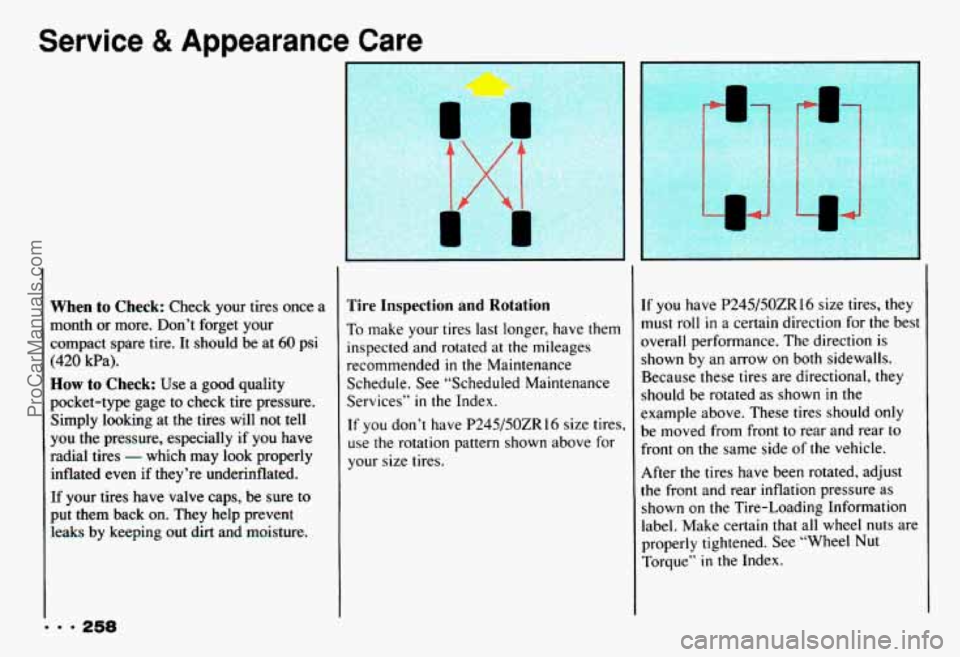
If you don’t have
P245/50ZR 16 size tires,
use the rotation pattern shown above for
your size tires. If
you have P245/50ZR16 size tires, they
must roll
in a certain direction for the best
overall performance. The direction is
shown by an arrow on both sidewalls.
Because these tires are directional, they
should
be rotated as shown in the
example above. These tires should only
be moved from front to rear and rear to
front on the same side of the vehicle.
After the tires have been rotated, adjust
the front and rear inflation pressure as
shown on the Tire-Loading Information
label. Make certain that all wheel nuts are
properly tightened. See “Wheel
Nut
Torque” in the Index.
ProCarManuals.com
Page 264 of 358
Service & Appearance Care
I
1
260
rating, traction, ride and other things during normal service on your vehicle. If
your tires have an all-season tread design,
&he
TPC number will be followed by a
“MS” (for mud and snow).
If you ever replace your tires with those
not having a TPC Spec number, make
sure they are the same size, load range, speed rating and construction type (bias,
bias-belted or radial) as your original
tires.
I bA u I /w/v.-
Mixing tires could cause you to
you mix tires of different sizes or
the vehicle may not handle properly,
and you could have a crash. Be sure
to use the same size and type tires
on all wheels,
It’s all right to drive with your
compact spare, though. It was
developed for limited use on your
vehicle.
typs
(radial ad bias-belted tires),
Uniform Tire Quality Grading
The following information relates to the
system developed
by the United States
National Highway Traffic Safety
Administration which grades tires by
treadwear, traction and temperature
performance.
(This applies only to
vehicles sold in the United States.)
ProCarManuals.com
Page 265 of 358
Treadwear
The treadwear grade is a comparative
rating based on the wear rate of the tire
when tested under controlled conditions
on a specified government test course. For
example, a tire graded
150 would wear
one and a half
(1 1/2) times as well on the
government course as a tire graded
100.
The relative performance of tires depends
upon the actual conditions of their use,
however, and may depart significantly
from the norm due
to variations in driving
habits, service practices and differences
in
road characteristics and climate.
Traction - A, B, C
The traction grades, from highest to
lowest are:
A, B, and C. They represent
the tire’s ability
to stop on wet pavement
as measured under controlled conditions
on specified government test surfaces of
asphalt and concrete.
A tire marked C
may have poor traction performance.
Warning: The traction grade assigned
to
this tire is based on braking
(straight-ahead) traction tests and does
no1 include cornering (turning) traction.
Temperature - A, B, C
The temperature grades are A (the
highest),
B, and C, representing the tire’s
resistance to the generation of heat and
its
ability to dissipate heat when tested under
controlled conditions on a specified
indoor laboratory test wheel. Sustained
high temperature can cause the material
of the tire to degenerate and reduce tire
life, and excessive temperature can lead to
sudden tire failure. The grade
C
corresponds to a level of performance
which all passenger car tires must meet
under the Federal Motor Vehicle Safety
Standard
No. 109. Grades B and A
261
ProCarManuals.com
Page 266 of 358
Service & Appearance Care
represent higher levels of performance on
the laboratory test wheel than the
minimum required by law.
Warning: The temperature grade for this
tire is established for a tire that is properly
inflated and not overloaded. Excessive
speed, underinflation, or excessive
loading, either separately or
in
combination, can cause heat buildup and
possible tire failure. Those grades
are molded on the sidewalls
of passenger car tires.
While the tires available as standard or
optional equipment on General Motors
vehicles may vary with respect to these
grades, all such tires meet General Motors
performance standards and have been
approved for use
on General Motors
vehicles.
All passenger type (P Metric)
tires must conform
to Federal safety
requirements
in addition to these grades.
Wheel Alignment and Tire Balance
The wheels on your vehicle were aligned
and balanced carefully at the factory to
give you the longest tire life and best
overall performance.
In most cases, you will not need to have
your wheels aligned again. However,
if
you notice unusual tire wear or your
vehicle pulling one way or the other, the
alignment may need to be reset.
If you
notice your vehicle vibrating when
driving on a smooth road, your wheels
may need to be rebalanced.
... 262
ProCarManuals.com
Page 268 of 358
Service & Appearance Care
Tire Chains
IL
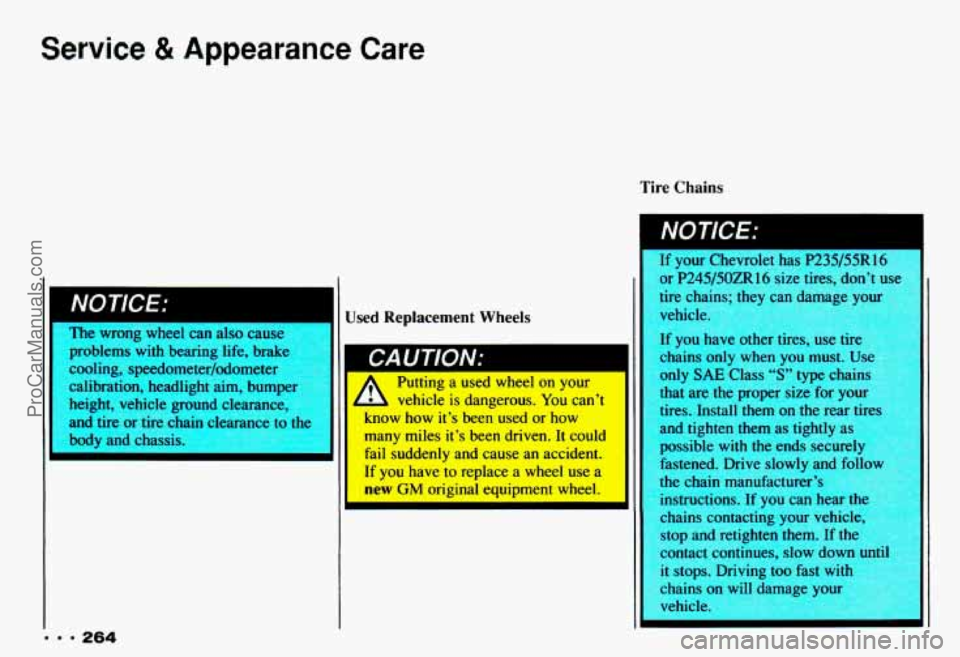
The wrong wheel can also cause
problems with bearing life, brake
cooling, speedometer/odometer
y!g@
calibration, headlight aim, bumper32
‘ i.i _. /8*
. .I )
height, vehicle ground clearance,
and tire or tire chain clearance to the
body and chassis. 1
... 264
Used Replacement Wheels
ruwllg it uscu WIIGGI UII yuul
vehicle is dangerous. You can’t
nnOW how it’s been used or how
many miles it’s been driven. It could
fail suddenly and cause an accident.
If you have to replace a wheel use a
new GM original equipment wheel.
Ib
If your Chevrolet has P235/55R16
or
P245/50ZRlf; cize tire. don’t 11c~ I
tire chains: the --In dm e vow I
I
vehicle.
If
you ,.-ve other tires, “st; LIIC
chains only when you must. Use
only
SAE Class “S” type chains
that are the proper size for
y
tires. Install them on the rear tires
and tighten them as tightly as
possible
with the ends securel)
fastened. Drive slowly and
folio
stop and retighten them. If the I
the chain manufacturer’s
instructions.
If you can hear th
chains contacting your vehicle
contact continues, slow down until
I
it stops. Driving too fast wit
chains on will damage yourg
vchicle.
I
ProCarManuals.com
Page 270 of 358
Service & Appearance Care
m.. 266
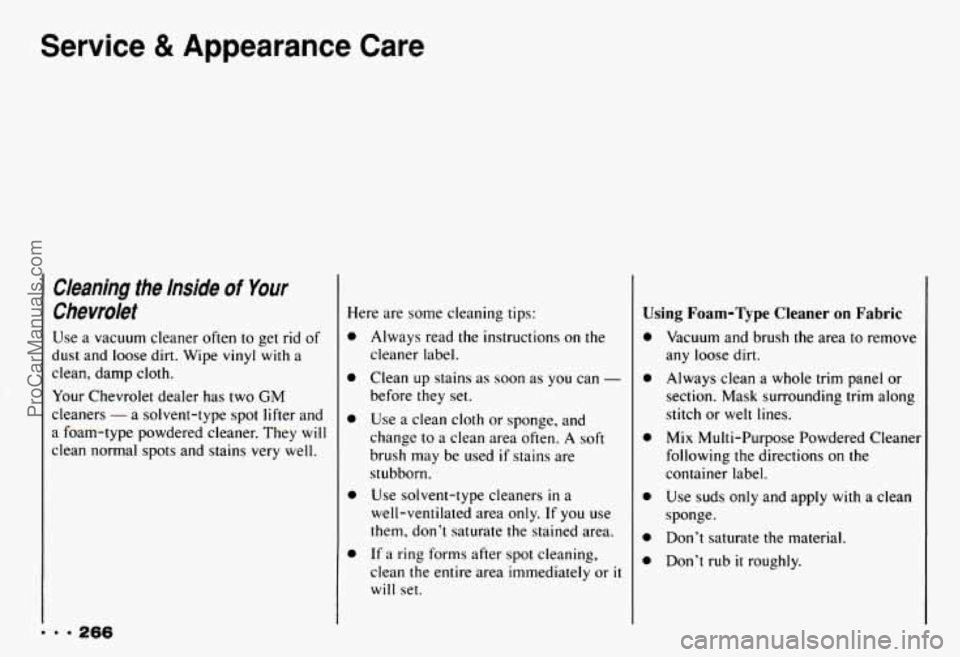
Cleaning the Inside of Your
Chevrolet
Use a vacuum cleaner often to get rid of
dust and loose dirt. Wipe
vinyl with a
clean, damp cloth.
Your Chevrolet dealer has two
GM
cleaners - a solvent-type spot lifter and
a foam-type powdered cleaner. They
will
clean normal spots and stains very well. Here are some cleaning tips:
0 Always read the instructions
on the
cleaner label.
Clean up stains
as soon as you can -
before they set.
Use a clean cloth or sponge, and
change to a clean area often.
A soft
brush
may be used if stains are
stubborn.
Use solvent-type cleaners
in a
well-ventilated area only. If you use
them, don’t saturate the stained area.
If
a ring forms after spot cleaning,
clean the entire area immediately or
it
will set.
Using Foam-Type Cleaner on Fabric
0
Vacuum and brush the area to remove
any loose
dirt.
Always clean a whole trim panel or
section. Mask surrounding trim along
stitch or welt lines.
Mix Multi-Purpose Powdered Cleaner
following the directions on the
container label.
Use suds only and apply
with a clean
sponge.
Don’t saturate the material.
Don’t rub
it roughly.
ProCarManuals.com
Page 272 of 358
Service & Appearance Care
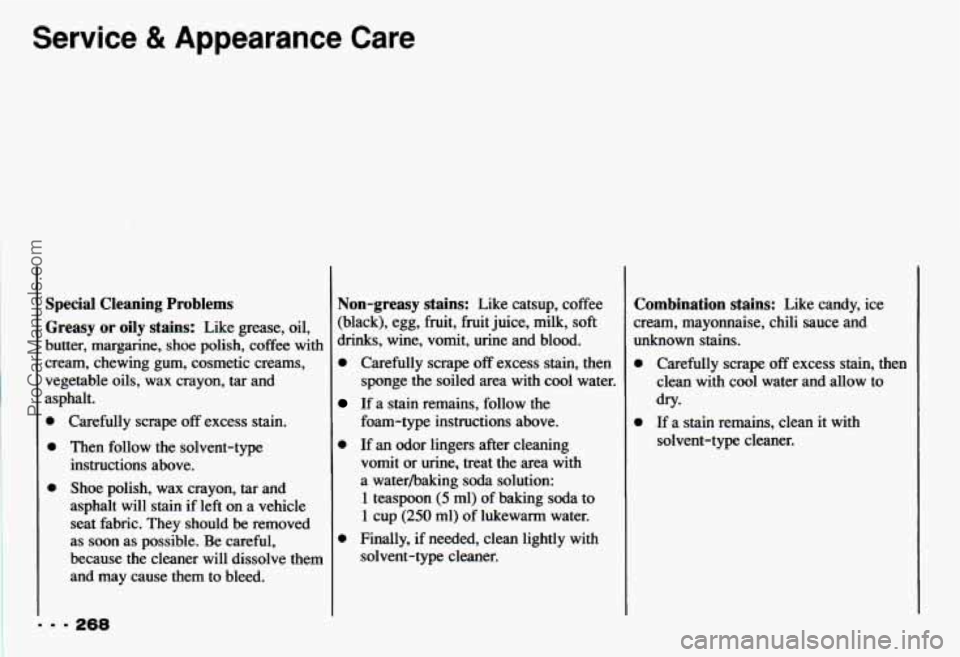
Special Cleaning Problems
Greasy
or oily stains: Like grease, oil,
butter, margarine, shoe polish, coffee with
cream, chewing gum, cosmetic creams,
vegetable oils, wax crayon,
tar and
asphalt.
0 Carefully scrape off excess stain.
0 Then follow the solvent-type
0 Shoe polish, wax crayon, tar and
instructions above.
asphalt will stain if left on a vehicle seat fabric. They should be removed
as soon as possible. Be careful,
because the cleaner will dissolve them
and may cause them to bleed.
Non-greasy stains: Like catsup, coffee
(black), egg, fruit, fruit juice, milk,
soft
drinks, wine, vomit, urine and blood.
0 Carefully scrape off excess stain, then
sponge the soiled area with cool water.
If a stain remains, follow the
foam-type instructions above.
0 If an odor lingers after cleaning
vomit or urine, treat the area with
a waterbaking soda solution:
1 teaspoon (5 ml) of baking soda to
1 cup (250 ml) of lukewarm water.
0 Finally, if needed, clean lightly with
solvent-type cleaner.
Combination stains: Like candy, ice
cream, mayonnaise, chili sauce and unknown stains.
0
0
Carefilly scrape off excess stain, then
clean with cool water and allow to
dry.
If a stain remains, clean it with
solvent-type cleaner.
... 268
ProCarManuals.com
Page 274 of 358
Service 8t Appearance Care
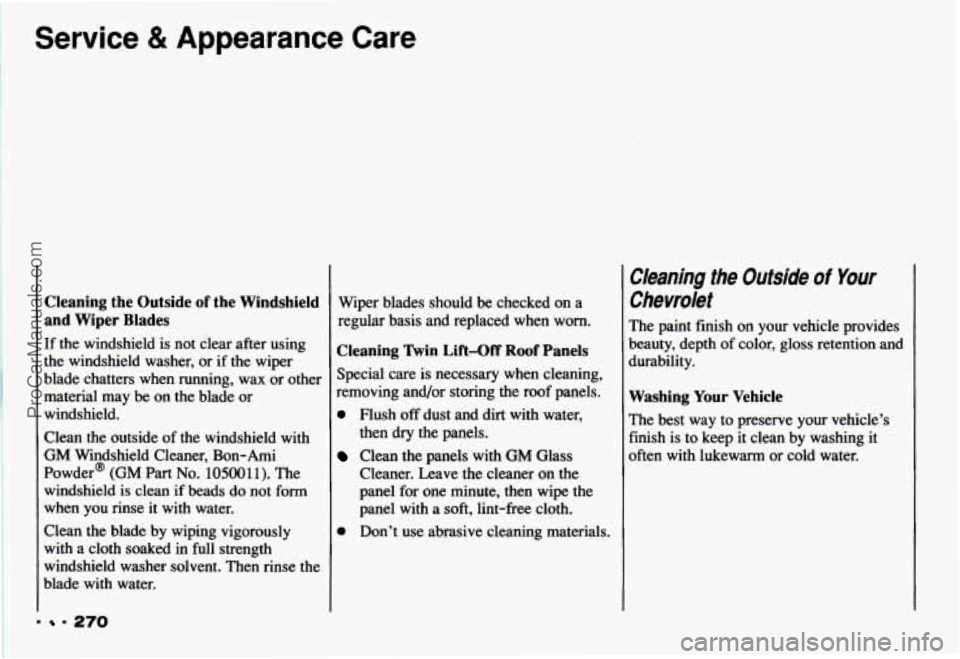
Cleaning the Outside of the Windshield
and Wiper Blades
If the windshield is not clear after using
the windshield washer, or if the wiper
blade chatters when running, wax or other material may be on the blade or
windshield,
Clean the outside
of the windshield with
GM Windshield Cleaner, Bon-Ami
Powder@ (GM Part
No. 1050011). The
windshield is clean if beads do not form
when
you rinse it with water.
Clean the blade by wiping vigorously
with a cloth
soaked in full strength
windshield washer solvent. Then rinse the
blade with water.
9 270
Wiper blades should be checked on a
regular basis and replaced when worn.
Cleaning Twin Lift-off Roof Panels
Special care is necessary when cleaning,
removing and/or storing the roof panels.
0 Flush off dust and dirt with water,
Clean the panels with GM Glass
then dry the panels.
Cleaner. Leave the cleaner on the
panel for one minute, then wipe
the
panel with a soft, lint-free cloth.
0 Don’t use abrasive cleaning materials.
Cieaning the Outside of Your
Chevrolet
The paint finish on your vehicle provides
beauty, depth of
color, gloss retention and
durability.
Washing Your Vehicle
The best way to preserve your vehicle’s
finish is to keep it clean by washing it
often with lukewarm
or cold water.
ProCarManuals.com
Page 276 of 358
Service & Appearance Care
999 272
I
White Sidewall Tires
Your Chevrolet dealer has a GM White
Sidewall Tire Cleaner.
You can use a stiff
brush
with it.
Weatherstrips
These are places where glass or metal
meets rubber. Silicone grease there
will
make them last longer, seal better, and not
stick or squeak. Apply silicone grease
with a clean cloth at least every six
months.
Sheet Metal Damage
If your vehicle is damaged and requires
sheet metal repair or replacement, make
sure the body repair shop applies
anti-corrosion material
to the parts
repaired or replaced to restore corrosion
protection.
Foreign Material
Calcium chloride and other salts, ice
melting agents, road
oil and tar, tree sap,
bird droppings, chemicals from industrial
chimneys, and other foreign matter can
damage your vehicle’s finish
if they
remain
on painted surfaces. Use cleaners
that are marked safe for painted surfaces
for these stains.
ProCarManuals.com
Page 277 of 358
Finish Damage
Any stone chips, fractures or deep
scratches
in the finish should be repaired
right away. Bare metal will corrode quickly and may develop into a major
repair expense.
Minor chips and scratches can be repaired
with touch-up materials available from
your dealer or other service outlets.
Larger areas
of finish damage can be
corrected in your dealer’s body and paint
shop.
Underbody Maintenance
Chemicals used for ice and snow remova
and dust control can collect
on the
underbody. If these are not removed,
accelerated corrosion (rust) can occur on
the underbody parts such as fuel lines,
frame, floor pan, and exhaust system even
though they have corrosion protection.
At least every spring, flush these
materials from the underbody with plain
water. Clean any areas where mud and
other debris can collect. Dirt packed in
closed areas of the frame should be loosened before being flushed. Your
dealer or an underbody vehicle washing system can do this for you.
Chemical Paint Spotting
Some weather and atmospheric conditions
can create a chemical fallout. Airborne
pollutants can fall upon and attack painted
surfaces on your vehicle.
This damage
can take two forms: blotchy,
ringlet-shaped discolorations, and small irregular dark spots etched into the paint surface.
Although no defect in
the paint job causes
this, Chevrolet will repair, at no charge
to
the owner, the surfaces of new vehicles
damaged by this fallout condition within
12 months or 12,000 miles (20 000 km)
of purchase, whichever comes first.
273 =
ProCarManuals.com