brake CHEVROLET CAMARO 1993 Owner's Manual
[x] Cancel search | Manufacturer: CHEVROLET, Model Year: 1993, Model line: CAMARO, Model: CHEVROLET CAMARO 1993Pages: 358, PDF Size: 15.6 MB
Page 90 of 358
Features & Controls
At dusk, the exterior lights will come on
automatically and the front turn signal
lights will go out.
At dawn, the exterior
lights will
go out and the front turn signal
lights will come on (if the headlight
switch is
off).
Of course, you may still turn on the
headlights any time you need to.
To idle your vehicle with the
DRL off, set
the parking brake while the ignition is
in
the Off or LOCK position. Then start the
vehicle. The
DRL will stay off until you
release the parking brake.
I
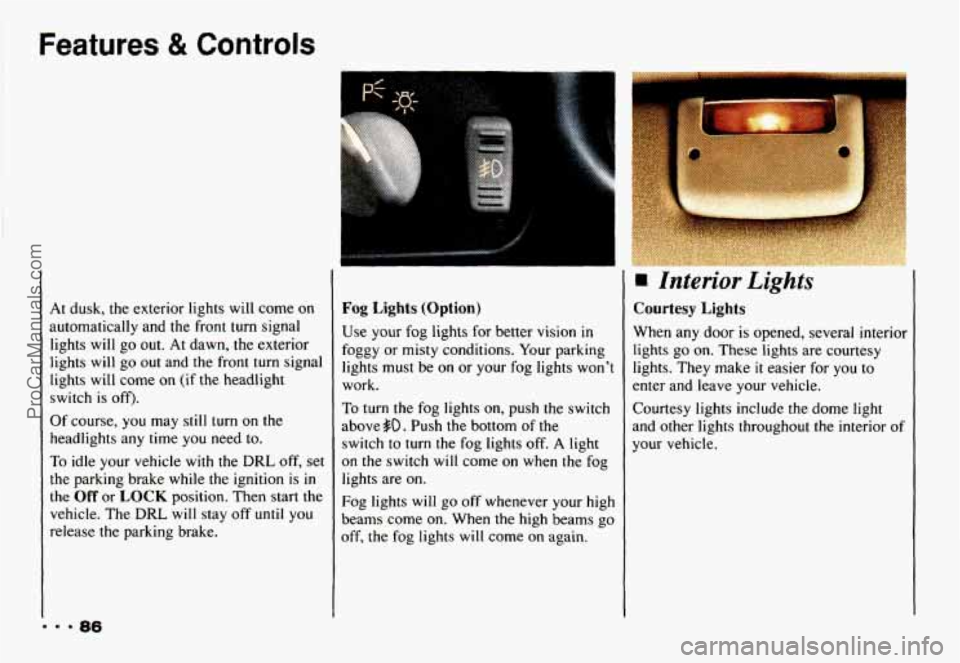
Fog Lights (Option)
Use your fog lights for better vision in
foggy or misty conditions. Your parking
lights must be on or your fog lights won't
work.
To turn the fog lights on, push the switch
abovego. Push the bottom of the
switch to
turn the fog lights off. A light
on the switch will come on when the fog
lights are on.
Fog lights will go off whenever your high
beams come on. When the high beams
go
off, the fog lights will come on again.
Interior Lights
Courtesy Lights
When any door is opened, several interior
lights
go on. These lights are courtesy
lights. They make
it easier for you to
mter and leave your vehicle.
Courtesy lights include the dome light
md other lights throughout the interior of
your vehicle.
ProCarManuals.com
Page 99 of 358
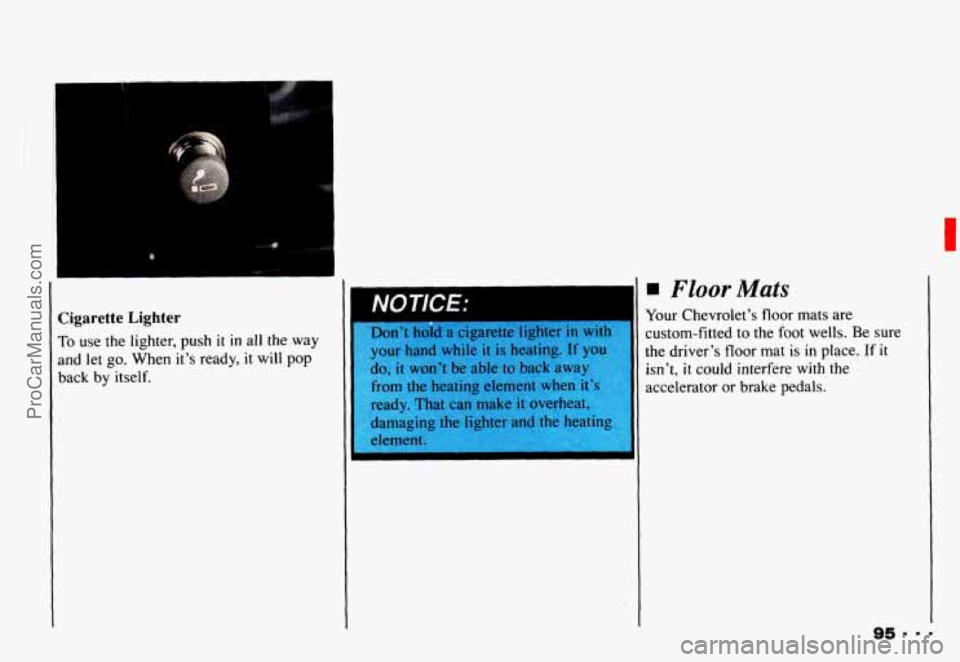
Cigarette Lighter
To use the lighter, push it in all the way
and let go. When it’s ready, it will pop
jack by itself.
f
Don’t hold a cigarette lighter in with
your hand while
it is heating. If you
lo, it won’t be able to back away
rom the heating element when it’!
ready. That can make
it overheat,
naging the lighter and the heating
.lement.
I
Floor Mats
Your Chevrolet’s floor mats are
custom-fitted to the foot wells. Be sure
the driver’s floor mat
is in place. If it
isn’t, it could interfere with the
accelerator
or brake pedals.
ProCarManuals.com
Page 101 of 358
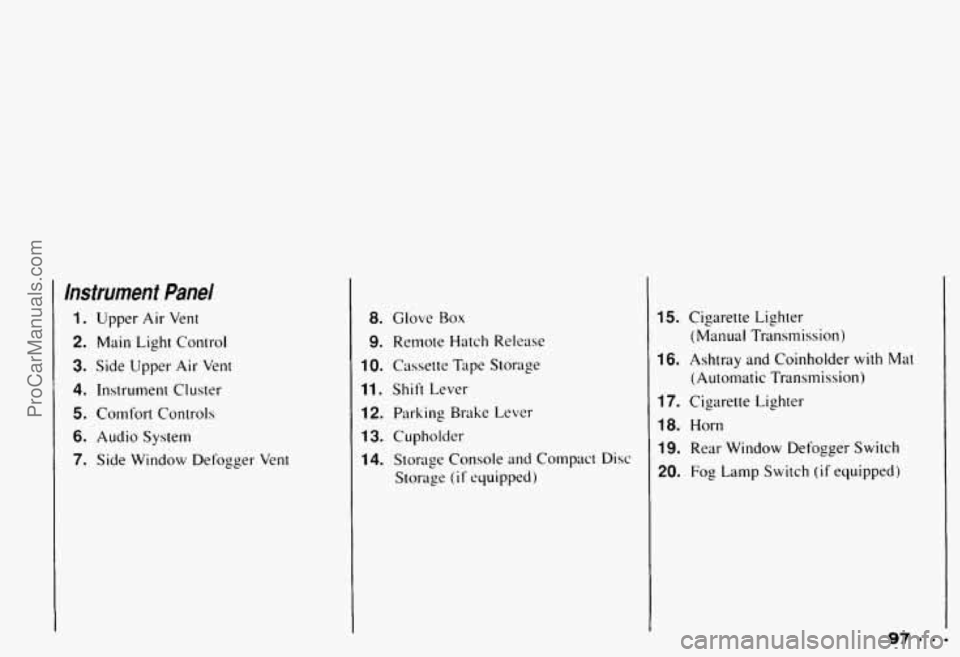
Instrument Panel
1. Upper Air Vent
2. Main Light Control
3. Side Upper Air Vent
4. Instrument Cluster
5. Comfort Controls
6. Audio System
7. Side Window Defogger Vent
8. Glove Box
9. Remote Hatch Release
10. Cassette Tape Storage
11. Shift Lever
12. Parking Brake Lever
13. Cupholder
14. Storage Console and Compact Disc
Storage
(if equipped)
15. Cigarette Lighter
16. Ashtray and Coinholder with Mat
17. Cigarette Lighter
18. Horn
19. Rear Window Defogger Switch
20. Fog Lamp Switch (if equipped)
(Manual Transmission)
(Automatic Transmission)
97.9- ProCarManuals.com
Page 104 of 358
Features & Controls
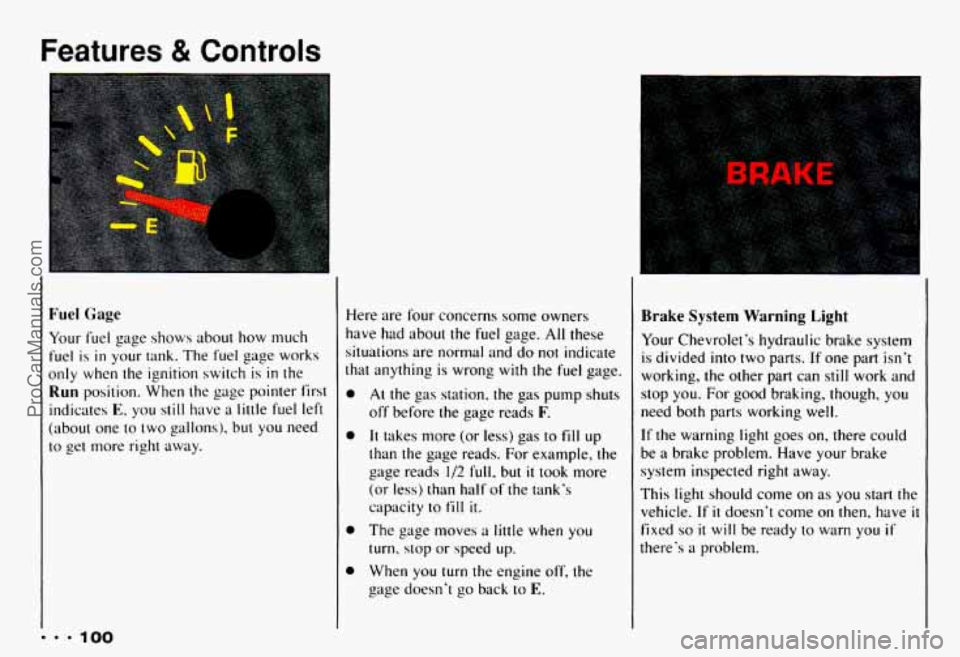
Fuel Gage
... 100
Your fuel page shows about how much
fuel
is in your tank. The fuel gage works
only when the ignition switch is
in the
Run position. When the gage pointer first
indicates
E, you still have a little fuel left
(about one to two gallons),
but you need
to get more right away. Here
are four concerns some owners
have had about the fuel gage.
All these
e
situations are normal and do not indicate
that anything
is wrong with the fuel gage.
e
0
0
At the gas station, the gas pump shuts
off before the gage reads
F.
It takes more (or less) gas to fill up
than the gage reads. For example, the
gage reads
1/2 full, but it took more
(or
less) than half of the tank's
capacity
to fill it.
The gage moves a little when you
turn, stop or speed up.
When you
turn the engine off, the
c gage doesn't go back to E.
Brake System Warning Light
Your Chevrolet's hydraulic brake system
is divided into two parts. If one part isn't
working, the other part can still work and
stop you. For good braking, though, you
need both parts working well.
If the warning light goes on, there could
be a brake problem. Have your brake
system inspected right away.
This light should come on as you start the
vehicle.
If it doesn't come on then, have it
fixed so it will be ready to warn you if
there's a problem.
ProCarManuals.com
Page 105 of 358
I
This light will also come on when you set
your parking brake, and will stay on
if
your parking brake doesn’t release fully.
If it stays on after your parking brake is
fully released, it means you have a brake
problem.
If the light comes on while driving, pull
off the road and stop carefully. You may
notice that the pedal is harder to push. Or,
the pedal may
go closer to the floor. It
may take longer to stop.
If the light is still
on, have the vehicle towed for service.
(See “Towing Your Vehicle”
in the
Index.)
I
CAUTION: II ____~
Your brake system may not be
working properly if the brake
warning light is on. Driving
with the
brake warning light on can lead to
an accident. If the light is still
on
after you’ve pulled off the road and
stopped carefully, have the vehicle
towed for service.
I
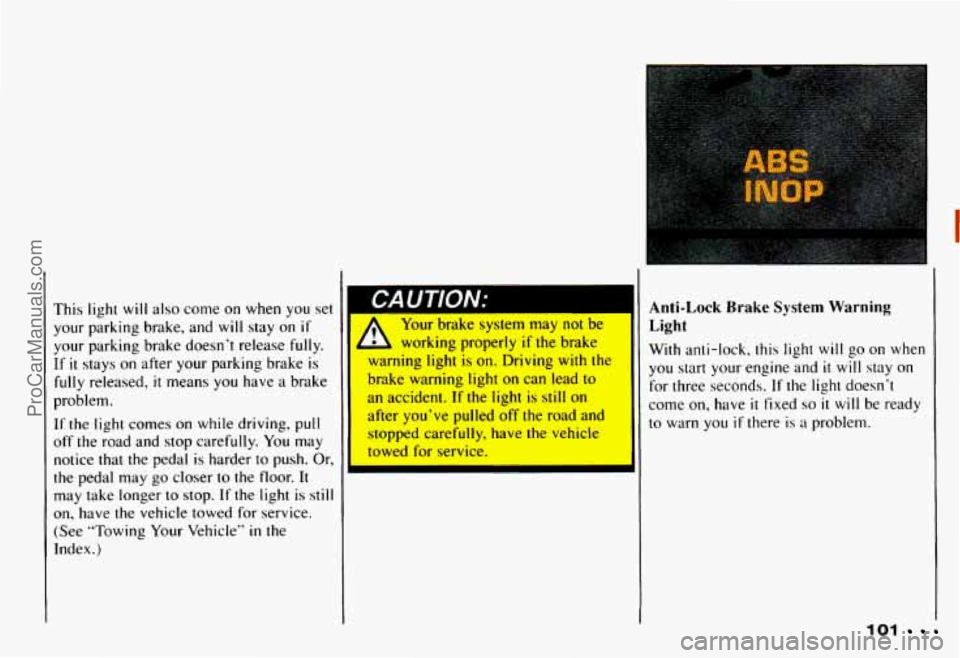
Anti-Lock Brake System Warning
Light
With anti-lock, this light will go on when
you start your engine and
it will stay on
for three seconds.
If the light doesn‘t
come
on, have it fixed so it will be ready
to warn
you if there is a problem.
101
ProCarManuals.com
Page 106 of 358
Features 8t Controls
f
I
I
. ’ 102
If the light stays on or comes on when
you’re driving, stop
as soon as possible
and turn the key off. Then start the engine
to reset the system. If the light still stays
on, or comes on again while you’re
driving, your Chevrolet needs service.
Unless the regular brake system warning
light is also on, you
will still have brakes,
but not anti-lock brakes. If the regular
brake system warning
light is also on, see
“Brake System Warning Light” earlier
in
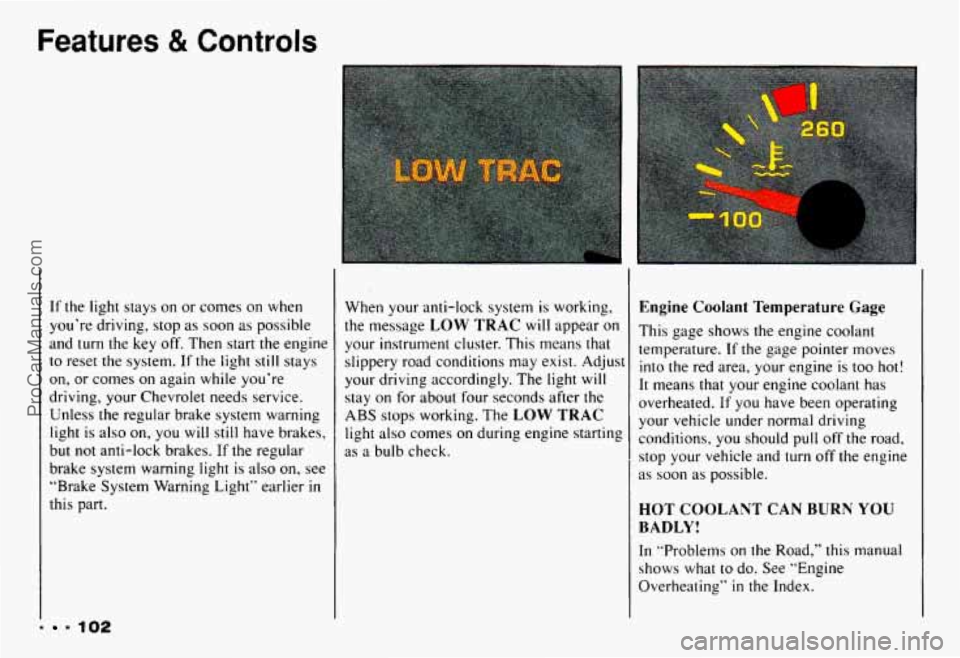
this part. When your anti-lock system is working,
the message
LOW TRAC will appear on
your instrument cluster. This means that
slippery road conditions may exist. Adjust
your driving accordingly. The light
will
stay on for about four seconds after the
ABS stops working. The
LOW TRAC
light also comes on during engine starting
as
a bulb check.
Engine Coolant Temperature Gage
This gage shows the engine coolant
temperature.
If the gage pointer moves
into the red area, your engine is
too hot!
It means that your engine coolant has
overheated. If you have been operating
your vehicle under normal driving
conditions, you should
pull off the road,
stop your vehicle and
turn off the engine
as soon as possible.
HOT COOLANT CAN BURN YOU
BADLY!
In ”Problerns on the Road,” this manual
shows
what to do. See “Engine
Overheating”
in the Index.
ProCarManuals.com
Page 107 of 358
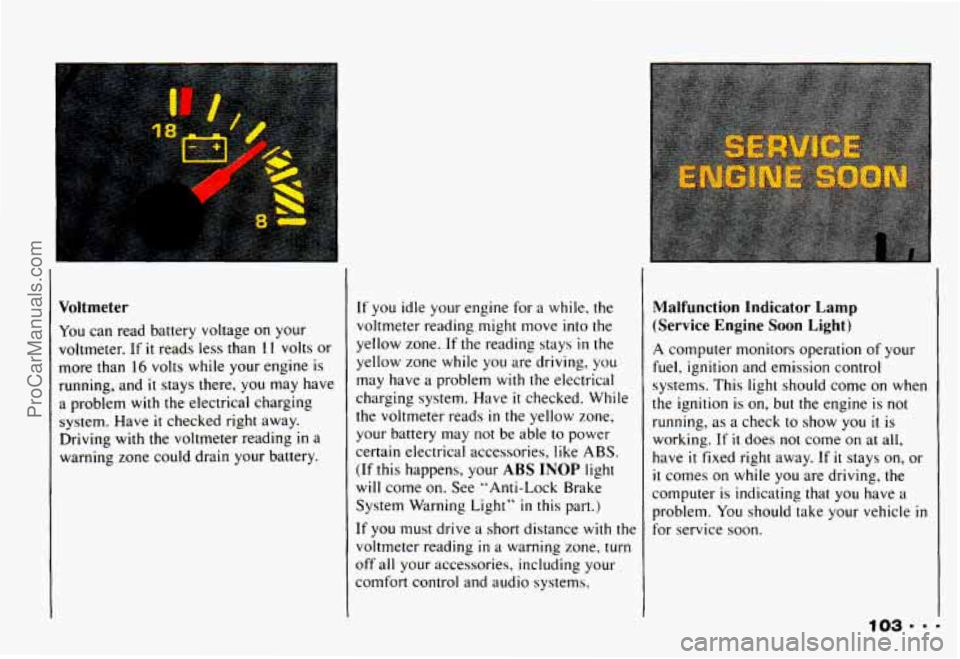
Voltmeter
You can read battery voltage on your
voltmeter. If
it reads less than 1 I volts or
more than
16 volts while your engine is
running, and
it stays there, you may have
a problem with the electrical charging
system. Have
it checked right away.
Driving with the voltmeter reading
in a
warning zone could drain your battery.
If you idle your engine for a while, the
voltmeter reading might move into the
yellow zone.
If the reading stays in the
yellow zone while you are driving, you
may have a problem with
the electrical
charging system. Have
it checked. While
the voltmeter reads
in the yellow zone,
your battery may
not be able to power
certain electrical accessories, like ABS.
(If this happens, your ABS INOP light
will come
on, See "Anti-Lock Brake
System Warning Light"
in this part.)
It' you must drive a short distance with the
voltmeter reading
in a warning zone. turn
off all your accessories, including your
comfort control and audio systems.
Malfunction Ind-kator Lamp
(Service Engine Soon Light)
A computer monitors operation of your
fuel, ignition and emission control
systems. This light should come on when
the ignition is
on, but the engine is not
running, as a check
to show you il is
working.
If it does not come on at all,
have
it fixed right away. If it stays on, or
it comes on while you are driving, the
computer is indicating that you have
a
problem. You should take your vehicle in
for service soon.
ProCarManuals.com
Page 140 of 358
Your Driving and the Road
136
Slowing down: If time allows, tap the
brake pedal once or twice
in advance of
slowing or stopping. This warns the driver
behind you.
Disabled: Your four-way flashers signal
that your vehicle
is disabled or is a
hazard. See “Hazard Warning Flashers”
in
the Index.
Traffic Officer
The traffic police officer is also a source
of important information. The officer’s
signals govern, no matter what the traffic
lights or other signs say.
The next section discusses some of the
road conditions you may encounter.
Defensive Driving
The best advice anyone can give about
driving
is: Drive defensively.
Please start
with a very important safety
device
in your Chevrolet: Buckle up. (See
“Safety Belts”
in the Index.)
Defensive driving really means “be ready for anything.“ On city streets,
rural roads,
or freeways, it means “always expect the
unexpected.”
Assume that pedestrians or other drivers
are going
to be careless and make
mistakes. Anticipate what they
might do.
Be ready for their mistakes.
Expect children
to dash out from behind
parked cars, often followed
by other
children. Expect occupants
in parked cars
to open doors into traffic. Watch for movement
in parked cars - someone
may be about
to open a door.
Expect other drivers
to run stop signs
when you are
on a through street. Be
ready
to brake if necessary as you go
:hrough intersections.
You may not have
:o use the brake, but if you do, you will be
-eady.
If you’re driving through a shopping
center parking
lot where there are
well-marked lanes, directional arrows,
and designated parking areas, expect
some drivers to ignore all these markings
and dash straight toward one part of the
lot.
ProCarManuals.com
Page 141 of 358
?edestrians can be careless. Watch for
hem.
In general, you must give way to
Jedestrians even if you know you have
.he right of way.
Xear-end collisions are about the most
xeventable
of accidents. Yet they are
:ommon.
Allow enough following
listance.
It’s the best defensive driving
maneuver,
in both city and rural driving.
You never know when the vehicle
in front
3f you is going to brake or turn suddenly. Here’s
a final bit of
information about
defensive driving. The most dangerous
time for driving
in the U.S. is very early
on Sunday morning.
In fact, GM
Research studies show that the most and
the least dangerous times for driving,
every week, fall on the same day. That
day
is Sunday. The most dangerous time
is Sunday from
3 a.m. to 4 a.m. The safest
time is Sunday from
10 a.m. to 11 a.m.
Driving the same distance on a Sunday at
3 a.m. isn’t just a little more dangerous
than
it is at 10 a.m. It‘s about 134 times
more dangerous!
That leads to the next section.
Drunken Driving
Death and injury associated with drinking
and driving is a national tragedy. It’s the
number one contributor to the highway
death toll, claiming thousands
of victims
every year. Alcohol takes away three
things that anyone needs to drive
a
vehicle:
0 Judgment
0 Muscular Coordination
Vision
Police records show that half of all motor
vehicle-related deaths involve alcohol
-
a driver, a passenger or someone else,
such as a pedestrian, had been drinking.
ProCarManuals.com
Page 144 of 358
Your Driving and the Road
I
,
I
... 140
There’s something else about drinking
and driving that many people don’t know.
Medical research shows that alcohol
in a
person’s system can make crash injuries
worse. That’s especially true for brain,
spinal cord and heart injuries. That means
that
if anyone who has been drinking -
driver or passenger - is in a crash, the
chance
of being killed or permanently
disabled
is higher than if that person had
not been drinking. And we’ve already
seen that the chance of a crash itself
is
higher for drinking drivers.
IU I I .
urrnKing ana men awing IS
very dangerous. Your reflexes,
perceptions, and judgment
will be
affected by even a small amount of
alcohol. You could have a serious
- or even fatal - accident if you
drive after drinking. Please don’t
drink
and drive or ride with a driver
who has been drinking. Ride home
in a cab; or if you’re with a group,
designate
a driver who will not
drink.
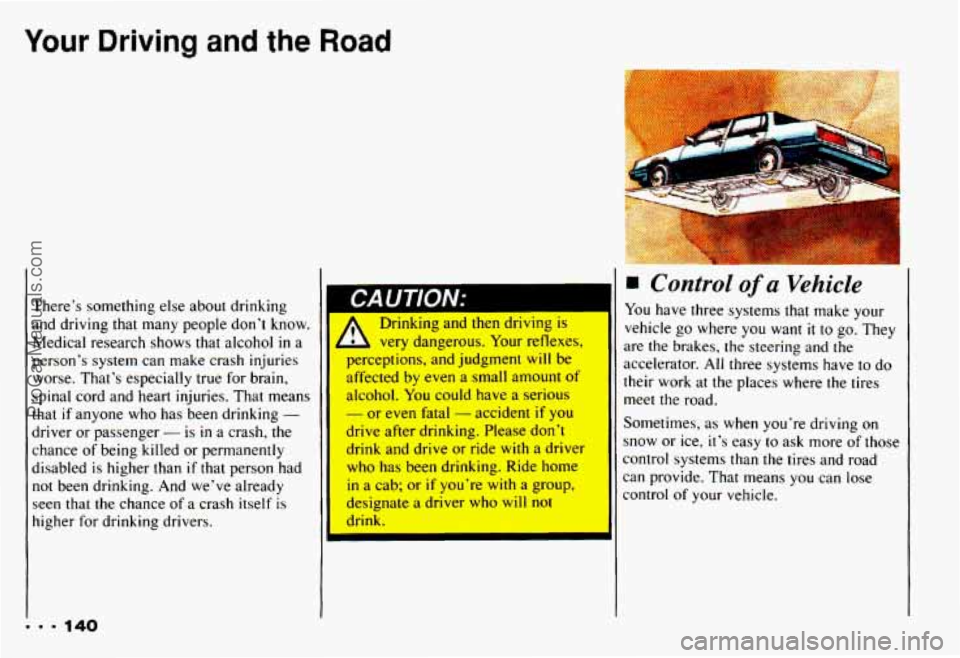
Control of a Vehicle
You have three systems that make your
vehicle
go where you want it lo go. They
are the brakes,
the steering and the
accelerator. All three systems have to do
their work
at the places where the tires
meet the road.
Sometimes, as when you’re driving on
snow or ice, it’s easy to ask more of those
control systems
than the tires and road
can provide. That means you can lose
control
of your vehicle.
ProCarManuals.com