warning CHEVROLET CAMARO 1993 Owner's Guide
[x] Cancel search | Manufacturer: CHEVROLET, Model Year: 1993, Model line: CAMARO, Model: CHEVROLET CAMARO 1993Pages: 358, PDF Size: 15.6 MB
Page 199 of 358
If you get the overheat warning with no
sign of steam,
try this for a minute or so:
1. If you have an air conditioner, turn it
2. Turn on your heater to full hot at the
off.
highest fan speed and open
the
window
as necessary.
3. Try to keep your engine under load (in
a drive gear where the engine runs
slower).
If you no longer have the overheat
warning, you can drive. Just
to be safe,
drive slower for about
ten minutes. If the
warning doesn’t come back on,
you can
drive normally. If
the warning
continues, pull over, stop,
and park your vehicle right away.
If there’s
still no sign of steam, you can
idle
the engine for two or three minutes
while you’re parked, to see
if the warning
stops.
But then, if you still have the
warning, TURN
OFF THE ENGINE
AND GET EVERYONE OUT
OF THE
VEHICLE
until it cools down.
You may decide not to
lift the hood but to
get service help right away.
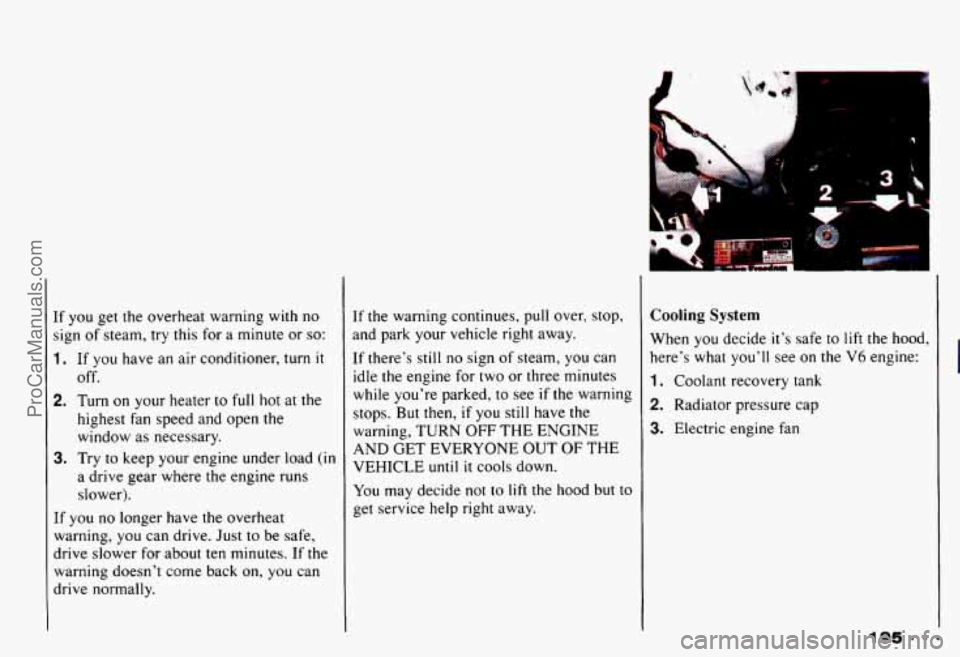
Cooling System
When you decide it’s safe to lift the hood,
here’s what you’ll see on the V6 engine:
1.
2.
3.
Coolant recovery tank
Radiator pressure cap
Electric engine
fan
ProCarManuals.com
Page 201 of 358
eng~ witho
r
u -.. .
tolar .-
[f there seems to be no leak, check to see
f the electric engine fan is running. If the
:ngine is overheating, the fan should be
-unning.
If it isn’t, your vehicle needs
iervice.
I I
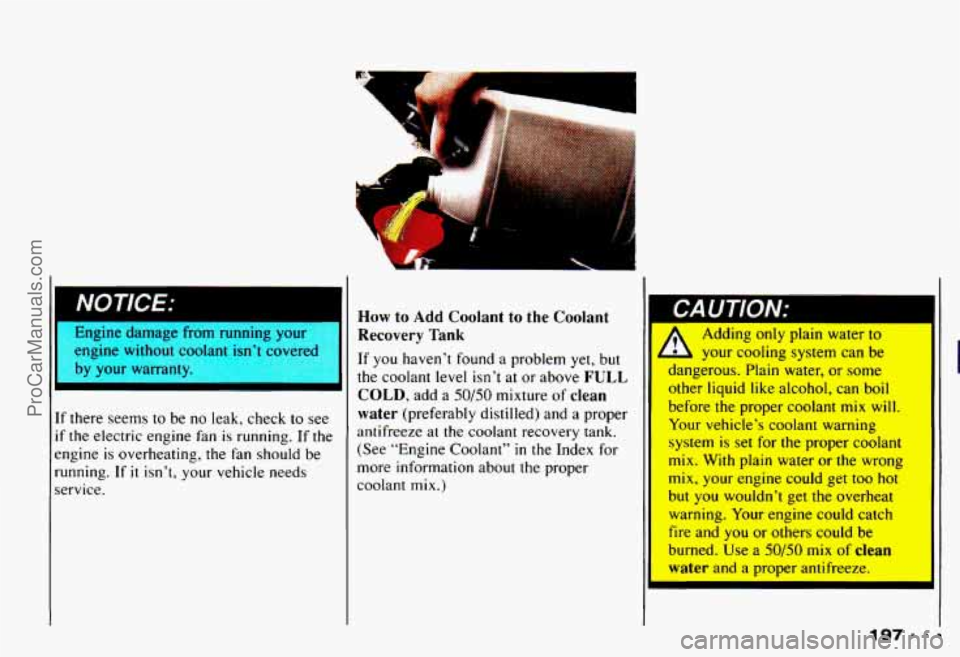
How to Add Coolant to the Coolant
Recovery Tank
If you haven’t found a problem yet, but
the coolant level isn’t
at or above FULL
COLD,
add a 50/50 mixture of clean
water
(preferably distilled) and a proper
antifreeze at the coolant recovery tank.
(See “Engine Coolant”
in the Index for
more information about the proper
coolant
mix.)
A Adding only plain water to
L your cooling system can be
dangerous. Plain water, or some
I
other liquid like alcohol, can boil
before the proper coolant
mix will.
Your vehicle’s coolant warning
system
is set for the proper coolant
mix. With plain water or the wrong
mix, your engine could get too hot
but you wouldn’t get the overheat
warning. Your engine could catch
fire and you or others could
be
burned. Use a 50/50 mix of clean
water
and a proper antifreeze.
197-
ProCarManuals.com
Page 202 of 358
Problems on the Road
and crack the engine, radiator,
heater core and other parts.
Use the
recommended coolant.
‘I
A You can be burne4 if you spill
- L coolant on hot engine parts.
Coolant contains ethylene glycol
and
it will burn if the engine parts
are hot enough. Don’t spill coolant
on
a hot engine.
9.198
When the coolant in the coolant recovery
tank is at or above
FULL COLD, start
your vehicle.
If the overheat warning continues, there’s
one more thing you can
try. You can add
the proper coolant
mix directly to the
radiator, but be sure the cooling system is
cool before you do
it.
I
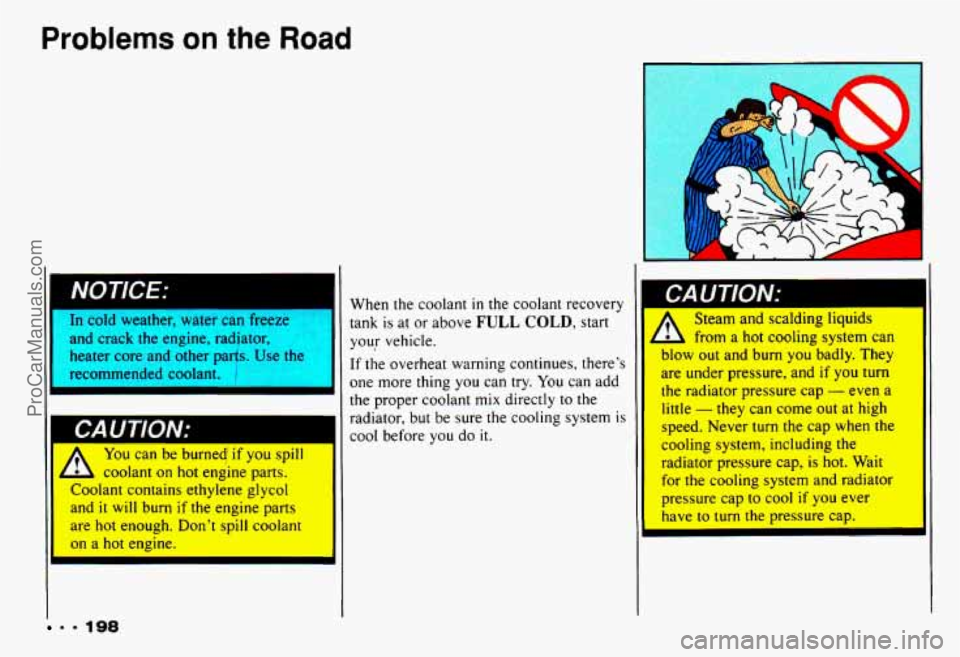
CAUTION:
Steam and scalding liquids
from a hot cooling system can
blow out and burn you badly. They
are under pressure, and
if you turn
the radiator pressure cap
- even a
little
- they can come out at high
speed. Never
turn the cap when the
cooling system, including the
radiator pressure cap,
is hot. Wait
for the cooling system and radiator
pressure cap to cool
if you ever
have to turn the pressure cap.
ProCarManuals.com
Page 209 of 358
I Changing a Flat lire
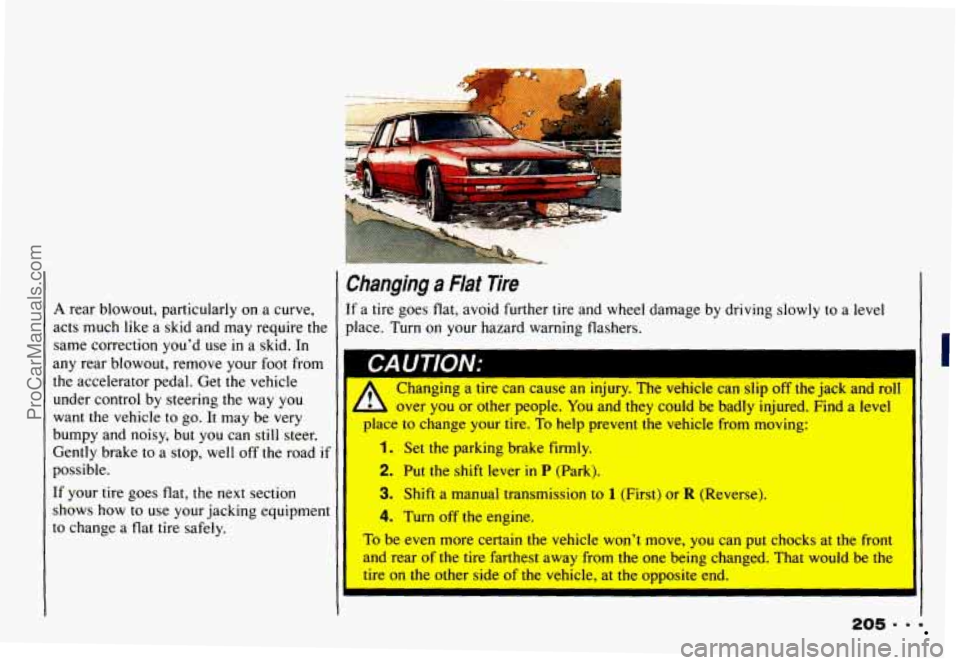
’ A rear blowout, particularly on a curve, If a tire goes flat, avoid further tire and wheel damage by driving slowly to a level
acts much like a skid and may require the place. Turn on your hazard warning flashers.
If your tire goes flat, the next section
shows how to use your jacking equipment
to change a flat tire safely.
1 CAUTION:
same correction you’d use in-a skid. In I -
any rear blowout, remove your foot from
the accelerator pedal. Get the vehicle
under control by steering
the way you
want
the vehicle to go. It may be very
bumpy and noisy, but you can still steer.
Gently brake to a stop, well off the road
if
possible. (I
A Changing a tire can cause an injury. The vehicle can slip off the jack and roll
over you or other people. You and
they could be badly injured. Find a level
I place to ccange your tire. To help prevent the vehicle from moving:
1. Set the parking brake firmly.
2. Put the shift lever in P (Park).
3. Shift a manual transmission to 1 (First) or R (Reverse). I
4. Turn off the engine.
To be even more certain the vehicle won’t move, you can put chocks at the front
and rear of the tire farthest away from the one being changed. That would be
tht
tire on the other side of the vehicle, at the opposite end.
L
I
205 - =
I
ProCarManuals.com
Page 242 of 358
Service & Appearance Care
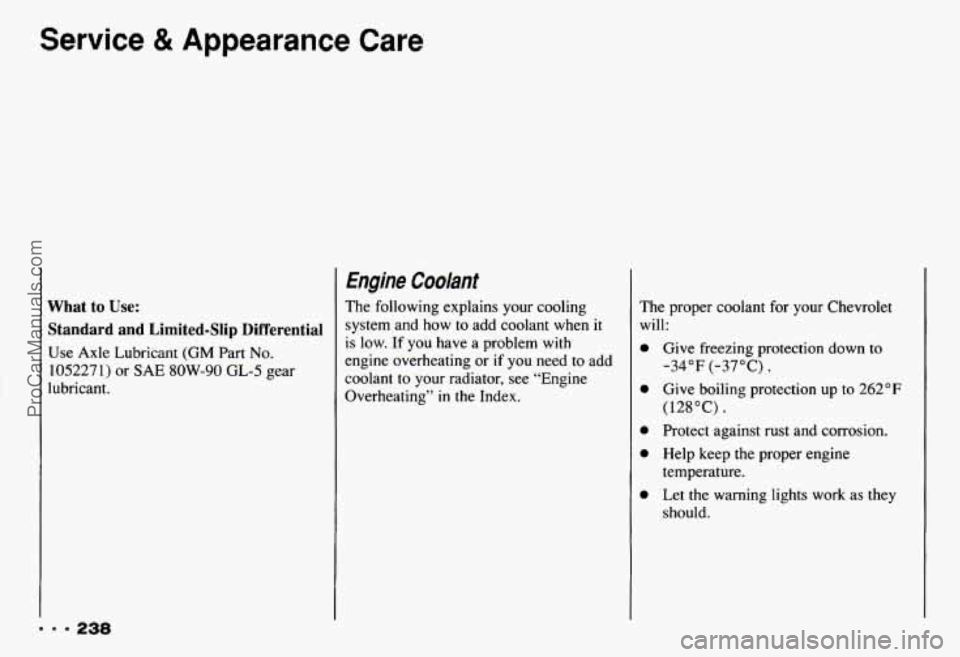
What to Use:
Standard and Limited-Slip Differential
Use Axle Lubricant (GM Part No.
1052271) or SAE 8OW-90 GL-5 gear
lubricant.
Engine Coolant
The following explains your cooling
system and how
to add coolant when it
is low. If
you have a problem with
engine overheating or if you need to add
coolant to your radiator, see “Engine
Overheating”
in the Index.
I
The proper coolant for your Chevrolet
will:
0
0
0
0
0
Give freezing protection down to
-34°F (-37°C).
Give boiling protection up to 262°F
(128°C).
Protect against rust and corrosion.
Help keep the proper engine
temperature.
Let
the warning lights work as they
should.
ProCarManuals.com
Page 243 of 358
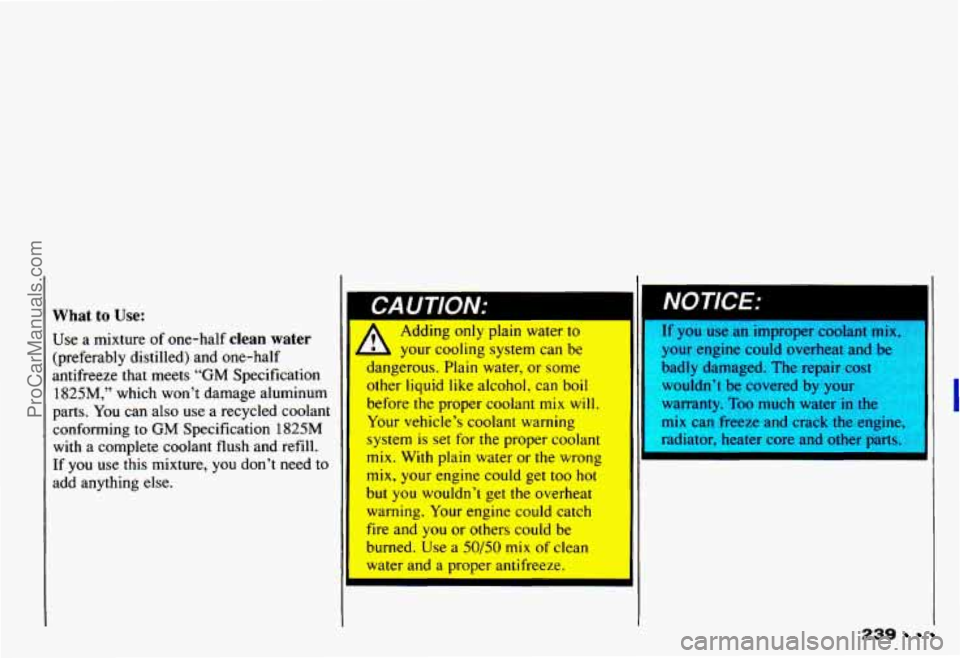
What to Use:
Use a mixture of one-half clean water
(preferably distilled) and one-half
antifreeze that meets
“GM Specification
1825M,” which won’t damage aluminum
parts. You can also use a recycled coolant
conforming to
GM Specification 1825M
with a complete coolant flush and refill.
If you use this mixture, you don’t need to
add anything else.
Adding only plain water to
- b your coding system can be
dangerous. Plain water, or some
other liquid like alcohol, can boil
before the proper coolant mix will.
Your vehicle’s coolant warning
system is set for the proper coolant I
mix. With plain water or the wrong
mix, your engine could get too hot
but you wouldn’t get the overheat
warning. Your
engine could catch
fire and YOU or others could be
burned. Use a 50/50 mix of clean
water and a proper antifreeze.
--
I If you use an improper coolant mix,
your engine could overheat and be
badly damaged. The repair cost
wouldn’t be covered by your
warranty.
Too much water in 1-
mix can freeze and crack the engine,
radiator, heater core and other parts.
239
ProCarManuals.com
Page 265 of 358
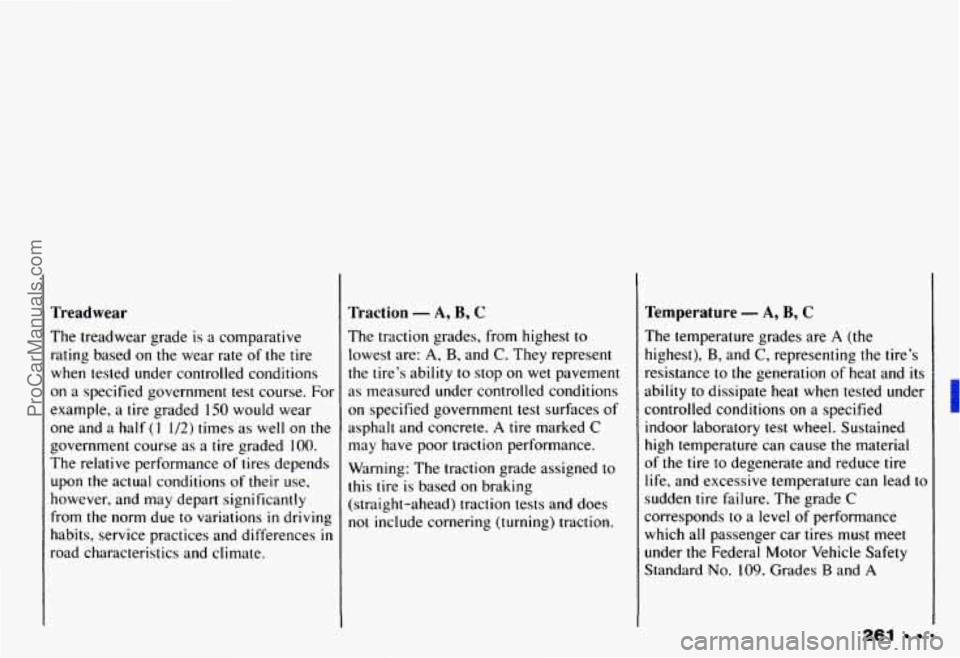
Treadwear
The treadwear grade is a comparative
rating based on the wear rate of the tire
when tested under controlled conditions
on a specified government test course. For
example, a tire graded
150 would wear
one and a half
(1 1/2) times as well on the
government course as a tire graded
100.
The relative performance of tires depends
upon the actual conditions of their use,
however, and may depart significantly
from the norm due
to variations in driving
habits, service practices and differences
in
road characteristics and climate.
Traction - A, B, C
The traction grades, from highest to
lowest are:
A, B, and C. They represent
the tire’s ability
to stop on wet pavement
as measured under controlled conditions
on specified government test surfaces of
asphalt and concrete.
A tire marked C
may have poor traction performance.
Warning: The traction grade assigned
to
this tire is based on braking
(straight-ahead) traction tests and does
no1 include cornering (turning) traction.
Temperature - A, B, C
The temperature grades are A (the
highest),
B, and C, representing the tire’s
resistance to the generation of heat and
its
ability to dissipate heat when tested under
controlled conditions on a specified
indoor laboratory test wheel. Sustained
high temperature can cause the material
of the tire to degenerate and reduce tire
life, and excessive temperature can lead to
sudden tire failure. The grade
C
corresponds to a level of performance
which all passenger car tires must meet
under the Federal Motor Vehicle Safety
Standard
No. 109. Grades B and A
261
ProCarManuals.com
Page 266 of 358
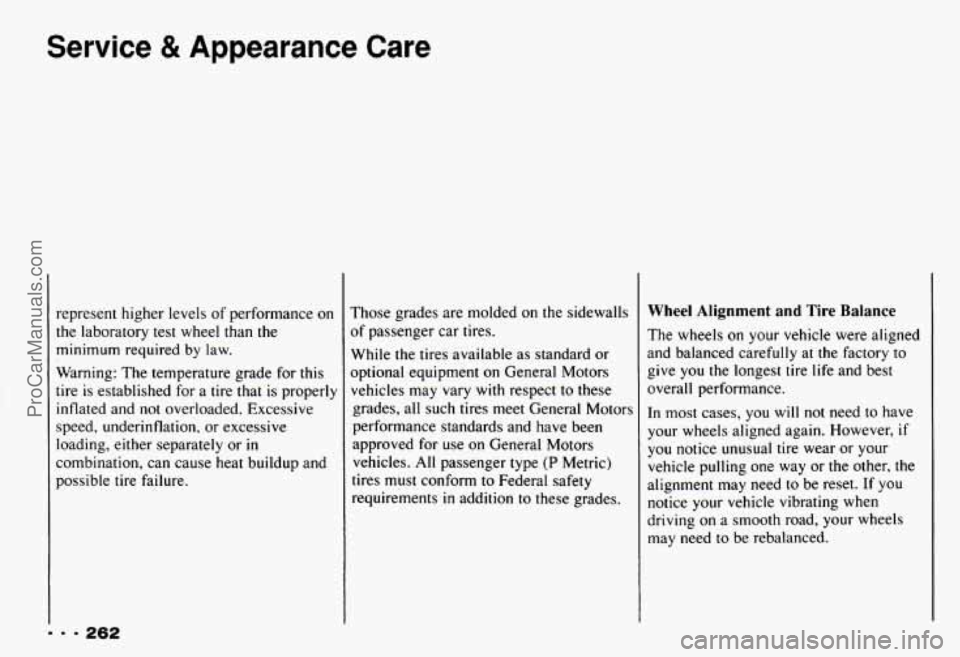
Service & Appearance Care
represent higher levels of performance on
the laboratory test wheel than the
minimum required by law.
Warning: The temperature grade for this
tire is established for a tire that is properly
inflated and not overloaded. Excessive
speed, underinflation, or excessive
loading, either separately or
in
combination, can cause heat buildup and
possible tire failure. Those grades
are molded on the sidewalls
of passenger car tires.
While the tires available as standard or
optional equipment on General Motors
vehicles may vary with respect to these
grades, all such tires meet General Motors
performance standards and have been
approved for use
on General Motors
vehicles.
All passenger type (P Metric)
tires must conform
to Federal safety
requirements
in addition to these grades.
Wheel Alignment and Tire Balance
The wheels on your vehicle were aligned
and balanced carefully at the factory to
give you the longest tire life and best
overall performance.
In most cases, you will not need to have
your wheels aligned again. However,
if
you notice unusual tire wear or your
vehicle pulling one way or the other, the
alignment may need to be reset.
If you
notice your vehicle vibrating when
driving on a smooth road, your wheels
may need to be rebalanced.
... 262
ProCarManuals.com
Page 308 of 358
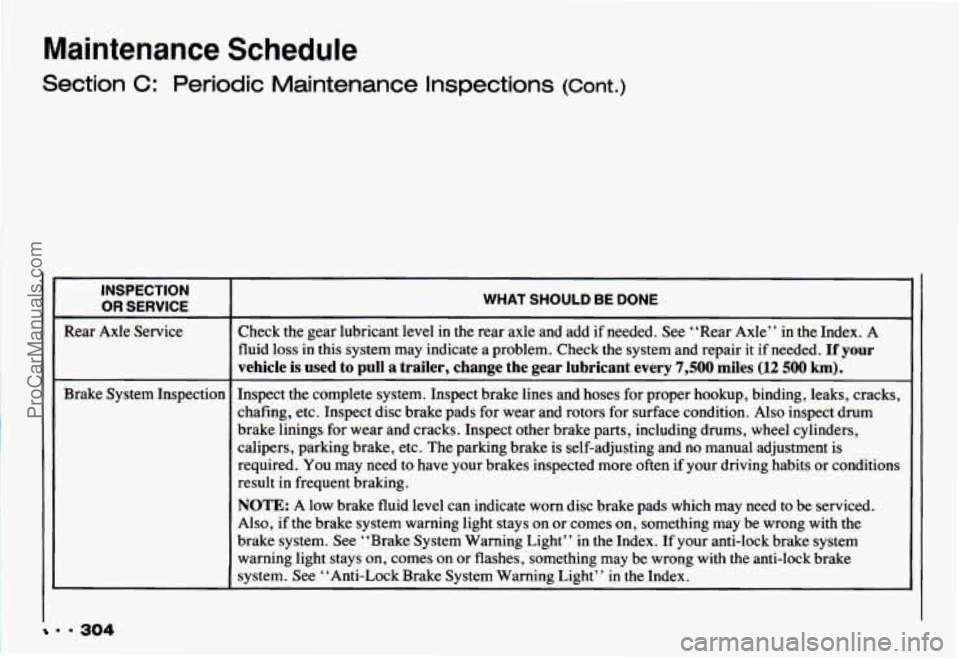
Maintenance Schedule
Section C: Periodic Maintenance Inspections (Cont.)
INSPECTION
OR SERVICE
Rear Axle Service
Brake System Inspection
WHAT SHOULD BE DONE
Check the gear lubricant level in the rear axle and add if needed. See “Rear Axle” in the Index. A
fluid
loss in this system may indicate a problem. Check the system and repair it if needed. If your
vehicle
is used to pull a trailer, change the gear lubricant every 7,500 miles (12 500 km).
Inspect the complete system. Inspect brake lines and hoses for proper hookup, binding, leaks, cracks,
chafing, etc. Inspect disc brake pads for wear and rotors for surface condition. Also inspect drum
brake linings for wear and cracks. Inspect other brake parts, including drums, wheel cylinders,
calipers, parking brake, etc. The parking brake is self-adjusting and no manual adjustment is
required. You may need to have your brakes inspected more often if your driving habits or conditions
result in frequent braking.
NOTE: A low brake fluid level can indicate worn disc brake pads which may need to be serviced.
Also, if the brake system warning light stays on
or comes on, something may be wrong with the
brake system. See “Brake System Warning Light” in
the Index. If your anti-lock brake system
warning light stays on, comes on or flashes, something may be wrong with the anti-lock brake
system. See “Anti-Lock Brake System Warning Light” in
the Index.
~~
. * 304
ProCarManuals.com
Page 333 of 358
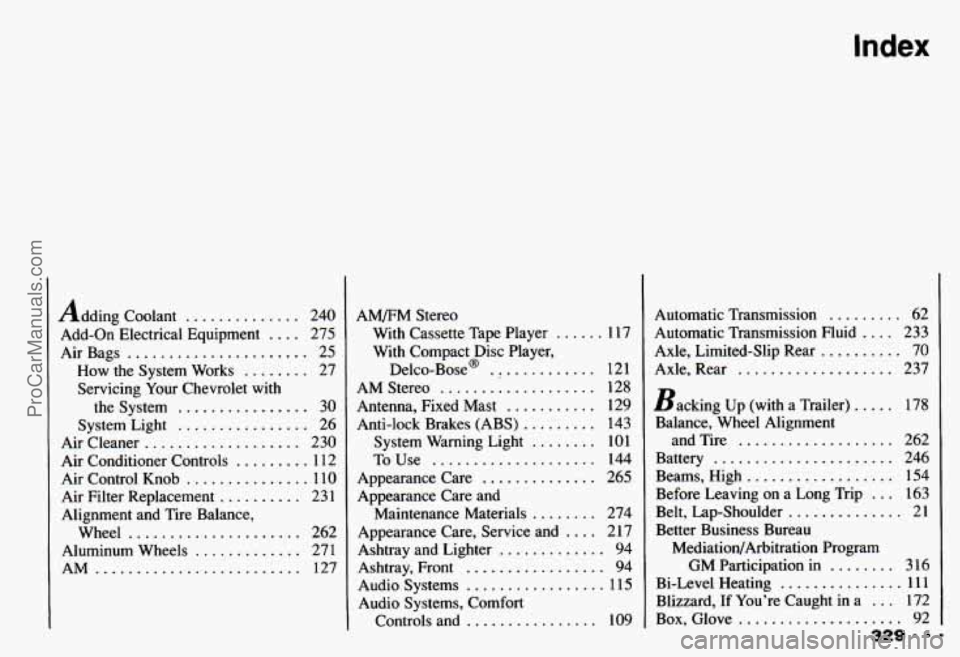
Index
Adding Coolant .............. 240
Add-on Electrical Equipment
.... 275
AirBags
...................... 25
How the System Works
........ 27
Servicing Your Chevrolet with
the System
................ 30
System Light
................ 26
Air Cleaner
................... 230
Air Conditioner Controls
......... 11 2
Air Control Knob
............... 110
Air Filter Replacement
.......... 231
Alignment and Tire Balance.
Wheel
..................... 262
Aluminum Wheels
............. 271
AM ......................... 127 AM/FM Stereo
With Cassette Tape Player
...... 1 17
With Compact Disc Player.
Delco-Base@ ............. 12 1
AM Stereo ................... 128
Antenna. Fixed Mast
........... 129
Anti-lock Brakes (ABS)
......... 143
System Warning Light
........ 101
To Use
.................... 144
Appearance Care
.............. 265
Appearance Care and Maintenance Materials
........ 274
Appearance Care. Service and
.... 217
Ashtray and Lighter
............. 94
Ashtray. Front
................. 94
Audio Systems
................. 11 5
Audio Systems. Comfort Controls and
................ 109 Automatic Transmission
......... 62
Automatic Transmission Fluid
.... 233
Axle. Limited-Slip Rear
.......... 70
Axle. Rear
................... 237
Backing Up (with a Trailer)
..... 178
Balance. Wheel Alignment
and Tire
................... 262
Battery
...................... 246
Beams. High
.................. 154
Before Leaving on a Long Trip
... 163
Belt. Lap-Shoulder
.............. 21
Better Business Bureau MediatiodArbitration Program
GM Participation
in ........ 316
Bi-Level Heating
............... 111
Blizzard. If You’re Caught in a ... 172
Box. Glove .................... 92
329 . .
ProCarManuals.com