fog light CHEVROLET CAMARO 1993 Owners Manual
[x] Cancel search | Manufacturer: CHEVROLET, Model Year: 1993, Model line: CAMARO, Model: CHEVROLET CAMARO 1993Pages: 358, PDF Size: 15.6 MB
Page 11 of 358
I
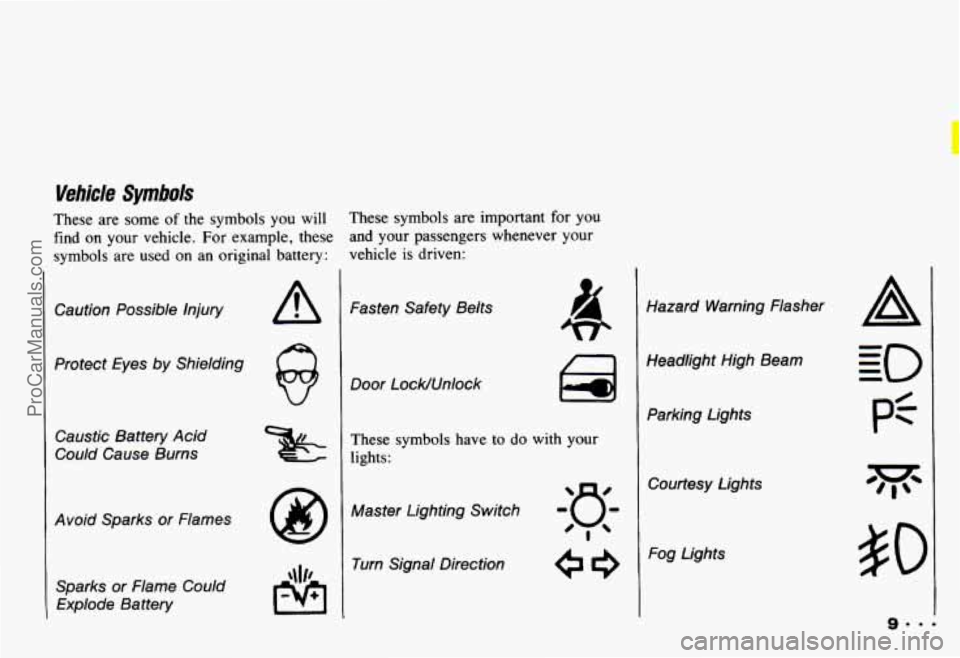
Vehicle Symbok
These are some of the symbols you will
find on your vehicle. For example, these
symbols are used on an original battery: These symbols are important for you
and your passengers whenever your
vehicle
is driven:
Caution Possible Injury
Protect Eyes by Shielding
Caustic Battery Acid
Could Cause Burns
Avoid Sparks or Flames
Sparks or Flame Could
Explode Battery Fasten Safety Belts
Door LocWUnlock
These symbols have to do with your
lights:
Master Lighting Switch
Turn Signal Direction Hazard
Warning Flasher
Headlight High Beam
Parking Lights
Courtesy Lights
Fog Lights
pf
%O
9.. .
ProCarManuals.com
Page 12 of 358
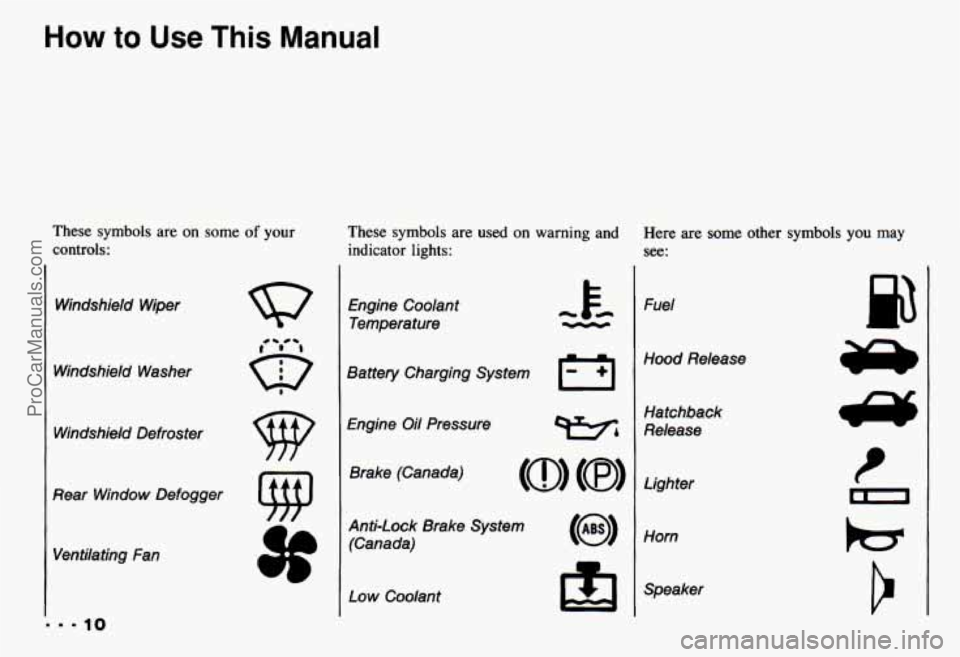
How to Use This Manual
These symbols are on some of your
controls: These symbols are used
on warning and
indicator lights:
Windshield Wiper
Windshield Washer Windshield Defroster
0
9
0-
I
Rear Window Defogger Ventilating Fan Engine Coolant
Temperature
Battery Charging System
El
Engine Oil Pressure Brake (Canada)
Anti-Lock Brake System (Canada)
Low Coolant h
Here are some other symbols you may
See:
Fuel
Hood Release
Hatchback
Release
Lighter
Horn
Speaker
p3
ProCarManuals.com
Page 14 of 358
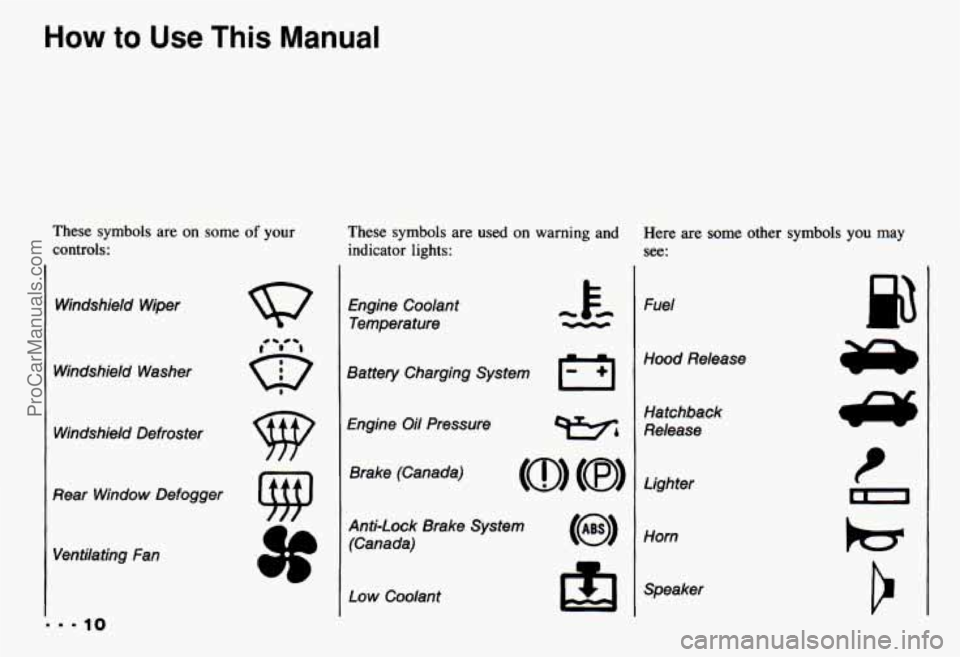
How to Use This Manual
These symbols are on some of your
controls: These symbols are used
on warning and
indicator lights:
Windshield Wiper
Windshield Washer Windshield Defroster
0
9
0-
I
Rear Window Defogger Ventilating Fan Engine Coolant
Temperature
Battery Charging System
El
Engine Oil Pressure Brake (Canada)
Anti-Lock Brake System (Canada)
Low Coolant h
Here are some other symbols you may
See:
Fuel
Hood Release
Hatchback
Release
Lighter
Horn
Speaker
p3
ProCarManuals.com
Page 88 of 358
Features & Controls
I
I
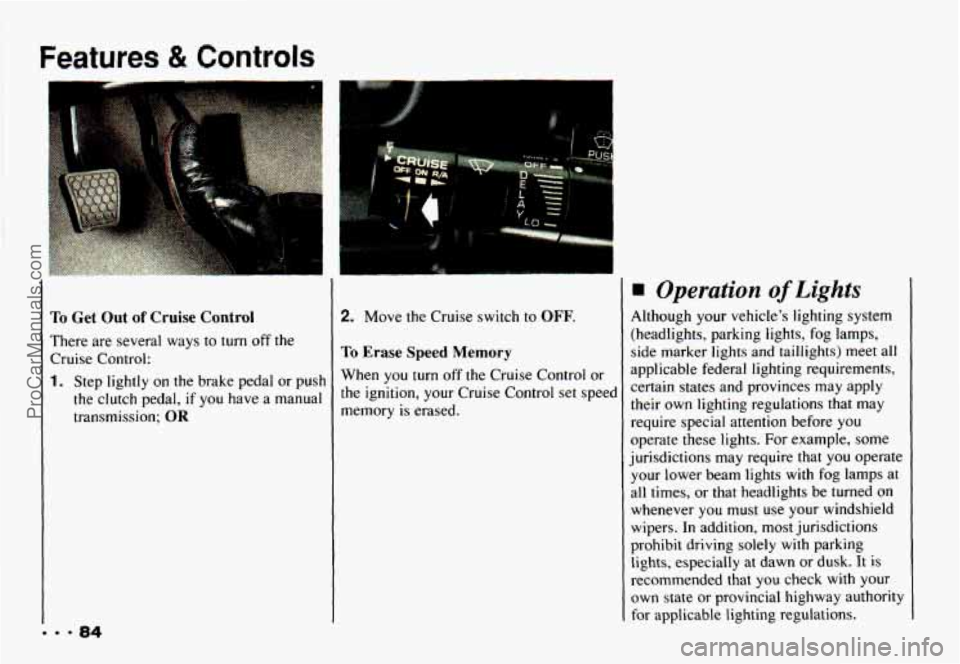
I'o Get Out of Cruise Control
There are several ways to turn off the
Cruise Control:.
1. Step lightly on the brake pedal or push
the clutch pedal,
if you have a manual
transmission:
OR
2. Move the Cruise switch to OFF.
To Erase Speed Memory
When you turn off the Cruise Control or
the ignition, your Cruise Control set speed
memory
is erased.
Operation of Lights
Although your vehicle's lighting system
(headlights, parking lights,
fog lamps,
side marker lights and taillights) meet all
applicable federal lighting requirements,
certain states and provinces may apply
their own lighting regulations that may
require special attention before you
operate these lights. For example, some
jurisdictions may require that
you operate
your lower beam lights with fog lamps at
all times, or that headlights be turned on
whenever you must use your windshield
wipers.
In addition, most jurisdictions
prohibit driving solely with parking
lights, especially at dawn or dusk. It is
recommended that you check with your
own state or provincial highway authority
for applicable lighting regulations.
ProCarManuals.com
Page 90 of 358
Features & Controls
At dusk, the exterior lights will come on
automatically and the front turn signal
lights will go out.
At dawn, the exterior
lights will
go out and the front turn signal
lights will come on (if the headlight
switch is
off).
Of course, you may still turn on the
headlights any time you need to.
To idle your vehicle with the
DRL off, set
the parking brake while the ignition is
in
the Off or LOCK position. Then start the
vehicle. The
DRL will stay off until you
release the parking brake.
I
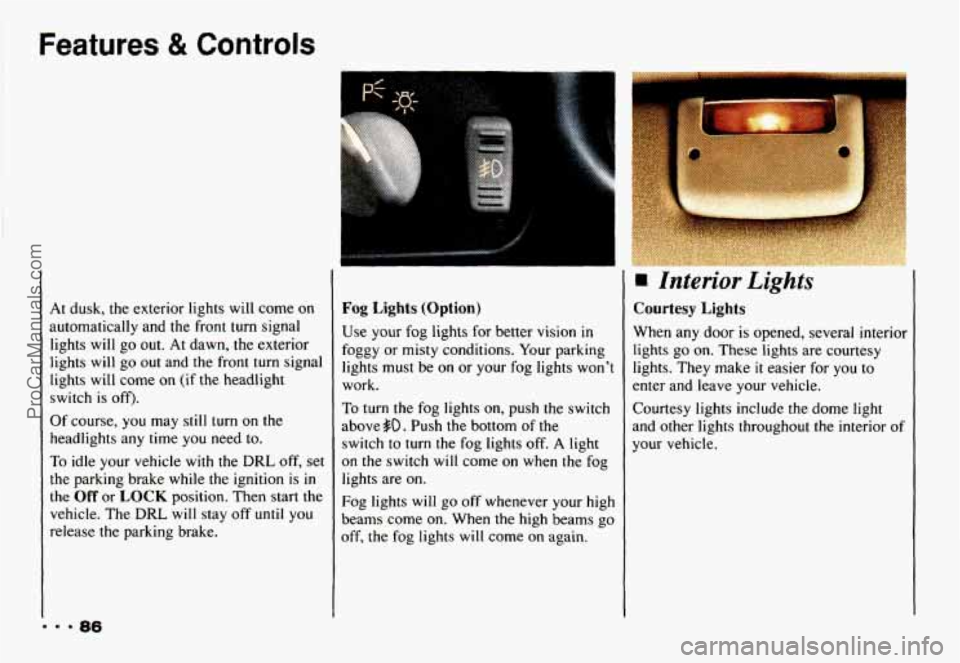
Fog Lights (Option)
Use your fog lights for better vision in
foggy or misty conditions. Your parking
lights must be on or your fog lights won't
work.
To turn the fog lights on, push the switch
abovego. Push the bottom of the
switch to
turn the fog lights off. A light
on the switch will come on when the fog
lights are on.
Fog lights will go off whenever your high
beams come on. When the high beams
go
off, the fog lights will come on again.
Interior Lights
Courtesy Lights
When any door is opened, several interior
lights
go on. These lights are courtesy
lights. They make
it easier for you to
mter and leave your vehicle.
Courtesy lights include the dome light
md other lights throughout the interior of
your vehicle.
ProCarManuals.com
Page 101 of 358
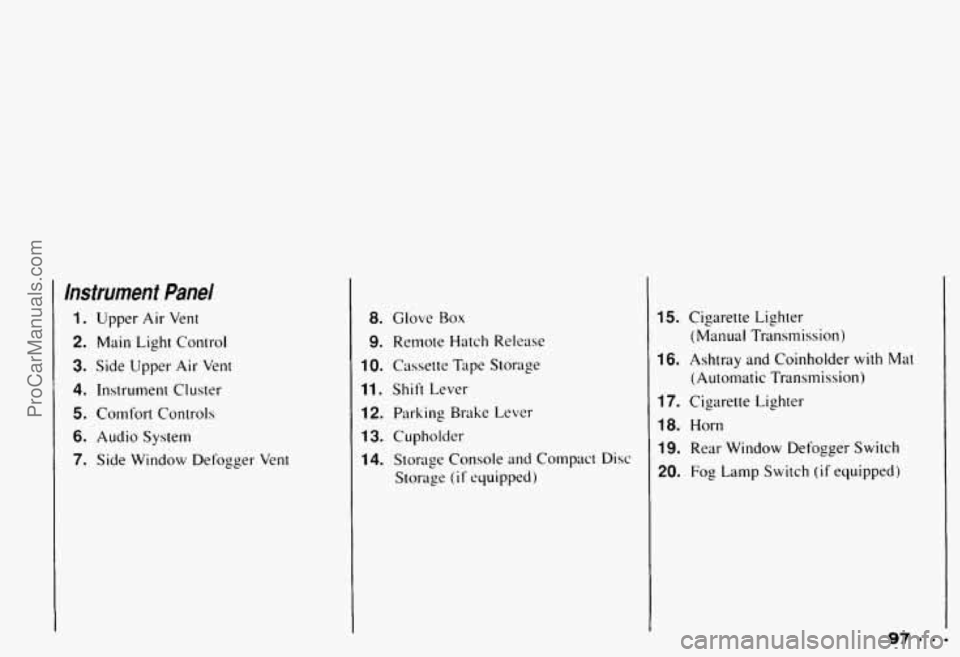
Instrument Panel
1. Upper Air Vent
2. Main Light Control
3. Side Upper Air Vent
4. Instrument Cluster
5. Comfort Controls
6. Audio System
7. Side Window Defogger Vent
8. Glove Box
9. Remote Hatch Release
10. Cassette Tape Storage
11. Shift Lever
12. Parking Brake Lever
13. Cupholder
14. Storage Console and Compact Disc
Storage
(if equipped)
15. Cigarette Lighter
16. Ashtray and Coinholder with Mat
17. Cigarette Lighter
18. Horn
19. Rear Window Defogger Switch
20. Fog Lamp Switch (if equipped)
(Manual Transmission)
(Automatic Transmission)
97.9- ProCarManuals.com
Page 118 of 358
Comfort Controls & Audio Systems
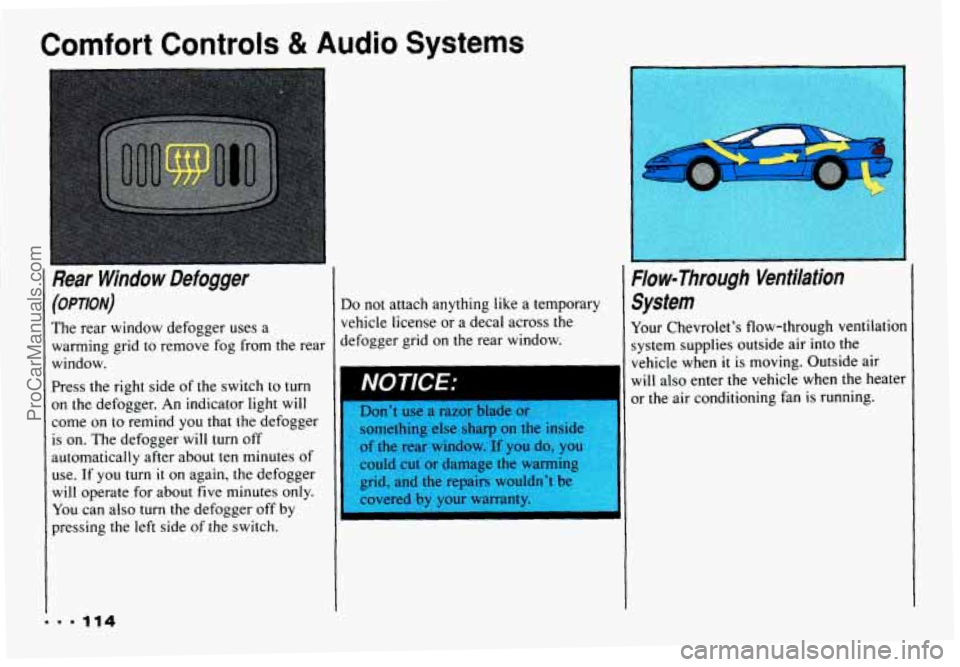
(OPTION)
The rear window defogger uses a
warming grid to remove fog from the rear
window.
Press the right side of the switch to turn
on the defogger. An indicator light will
come on to remind you that the defogger
is on. The defogger
will turn off
automatically after about ten minutes of
use. If you
turn it on again, the defogger
will operate for about five minutes only.
You can also turn the defogger off by
pressing the left side
of the switch.
Do not attach anything like a temporary
vehicle license or a decal across the
defogger grid on the rear window.
lsomething else sharp on the inside
of the rear window. ^If you do, you
could cut or damage the warming
grid, and the repairs wouldn't be
I
System
Your Chevrolet's flow-through ventilation
system supplies outside air into the
vehicle when
it is moving. Outside air
will also enter the vehicle when the heater
or the air conditioning fan is running.
ProCarManuals.com
Page 162 of 358
Your Driving and the Road
Besides slowing down, allow some
extra following distance. And be
especially careful when you pass
another vehicle. Allow yourself more
clear room ahead, and be prepared to
have your view restricted by road
spray. If the road spray is
so heavy
you are actually blinded, drop back.
Don’t pass
until conditions improve.
Going more slowly
is better than
having an accident.
Use your defogger
if it helps.
Have good tires
with proper tread
depth. (See “Tires”
in the Index.)
Driving in Fog, Mist
and Haze
Fog can occur with high humidity or
heavy frost. It can be
so mild that you can
see through
it for several hundred feet
(meters). Or
it might be so thick that you
can see only a few feet (meters) ahead.
It
may come suddenly to an otherwise clear
road.
And it can be a major hazard.
When you drive into
a fog patch, your
visibility will be reduced quickly. The
biggest dangers are striking the vehicle
ahead or being struck
by the one behind.
Try to “read” the fog density down the
road. If the vehicle ahead starts to become
less clear or, at night,
if the taillights are
harder to see, the fog is probably
thickening. Slow down to give traffic behind you
a chance to slow down.
Everybody then has a better chance
to
avoid hitting the vehicle ahead.
A patch of dense fog may extend only for
a few feet (meters) or for miles
(kilometers);
you can’t really tell while
you’re
in it. You can only treat the
situation with extreme care.
One common fog condition
- sometimes
called mist or ground fog
- can happen
in weather that seems perfect, especially
at
night or in the early morning in valley
and low, marshy areas.
You can be
suddenly enveloped
in thick, wet haze
that may even coat your windshield. You
can often spot these fog patches or mist
layers
with your headlights. But
.. 158
ProCarManuals.com
Page 163 of 358
sometimes they can be waiting for you as
you come over a hill or dip into a shallow
valley. Start your windshield wipers and
washer, to help clear accumulated road
dirt. Slow down carefully.
Tips on Driving in Fog
If you get caught in fog, turn your
headlights on low beam, even
in daytime.
You’ll see
- and be seen - better. Use
your fog lights
if your vehicle has them.
Don’t use your high beams. The light will
bounce off the water droplets that make
up fog and reflect back at you. Use
your defogger. In high humidity, even
a light buildup of moisture on the inside
of the glass will cut down on your already
limited visibility. Run your windshield
wipers and washer occasionally. Moisture
can build up on the outside glass, and
what seems to be fog may actually be
moisture on the outside of your
windshield.
Treat dense fog as an emergency. Try to
find a place to pull off the road. Of course
you want to respect another’s property,
but you might need to put something
between you and moving vehicles
-
space, trees, telephone poles, a private
driveway, anything that removes you
from other traffic.
[f visibility is near zero and you must stop
but are unsure whether you are away from
the road,
turn your lights on, start your
hazard warning flashers, and sound your
horn at intervals or when you hear
approaching traffic.
Pass other vehicles in fog only if you can
see far enough ahead to pass safely. Even
then, be prepared to delay your pass if
you suspect the fog is worse up ahead. If
other vehicles try to pass you, make
it
easy for them.
ProCarManuals.com
Page 196 of 358
Problems on the Road
I.. 192
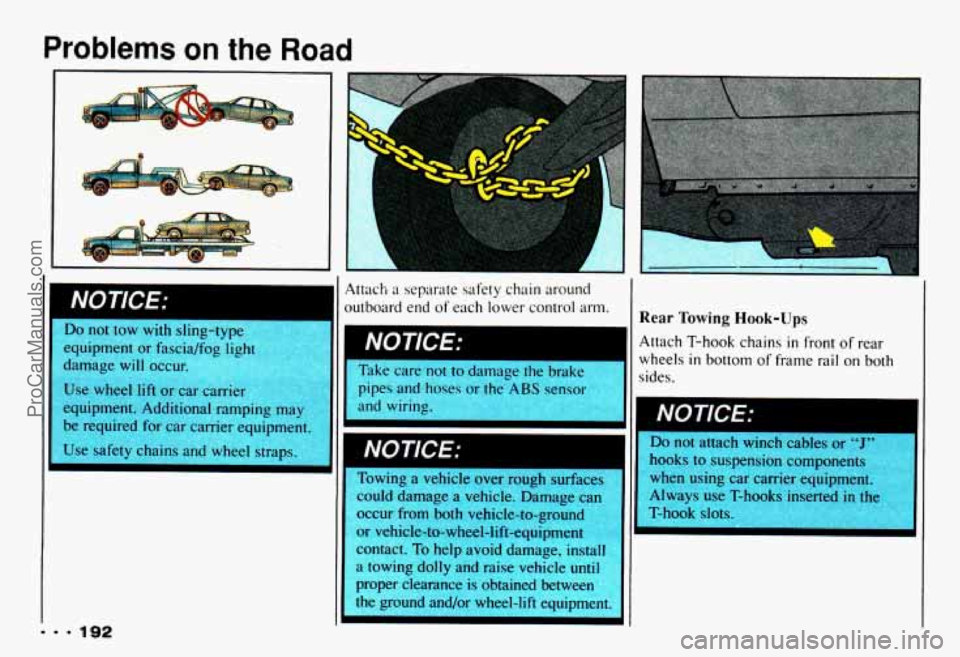
not tow with sling-typc
equipment or fascia/fog light
damage will occu
Use wheel lift or car carrier
equipment. Additional ramping may
be required for car carrier equipment.
Use safety chains and wheel straps. Attach
a separate safety chain around
outboard end
of each lower control arm.
I
contact. To help avoid damage, install
a towing
dolly and raise vehicle until
proper clearance
is obtained between *
the ground and/or wheel-lift equipment.
Rear Towing Hook-Ups
Attach T-hook chains in front of rear
wheels in bottom of frame rail on both
sides.
/I
I ~ to suspension compontllLa
using car carrier equipment.
ProCarManuals.com