maintenance schedule CHEVROLET CAMARO 1994 4.G User Guide
[x] Cancel search | Manufacturer: CHEVROLET, Model Year: 1994, Model line: CAMARO, Model: CHEVROLET CAMARO 1994 4.GPages: 292, PDF Size: 15.35 MB
Page 218 of 292
Downloaded from www.Manualslib.com manuals search engine Service and Appearance Care
When to Check: Check your tires once a
month or more. Don’t forget your
compact spare tire. It should be at
60 psi
(420 kPa).
How to Check: Use a good quality
pocket-type gage to check tire pressure.
Simply looking at the tires will not tell
you the pressure, especially if you have
radial tires
- which may look properly
inflated even
if they’re underinflated.
If your tires have valve caps, be sure to
put them back on. They help prevent
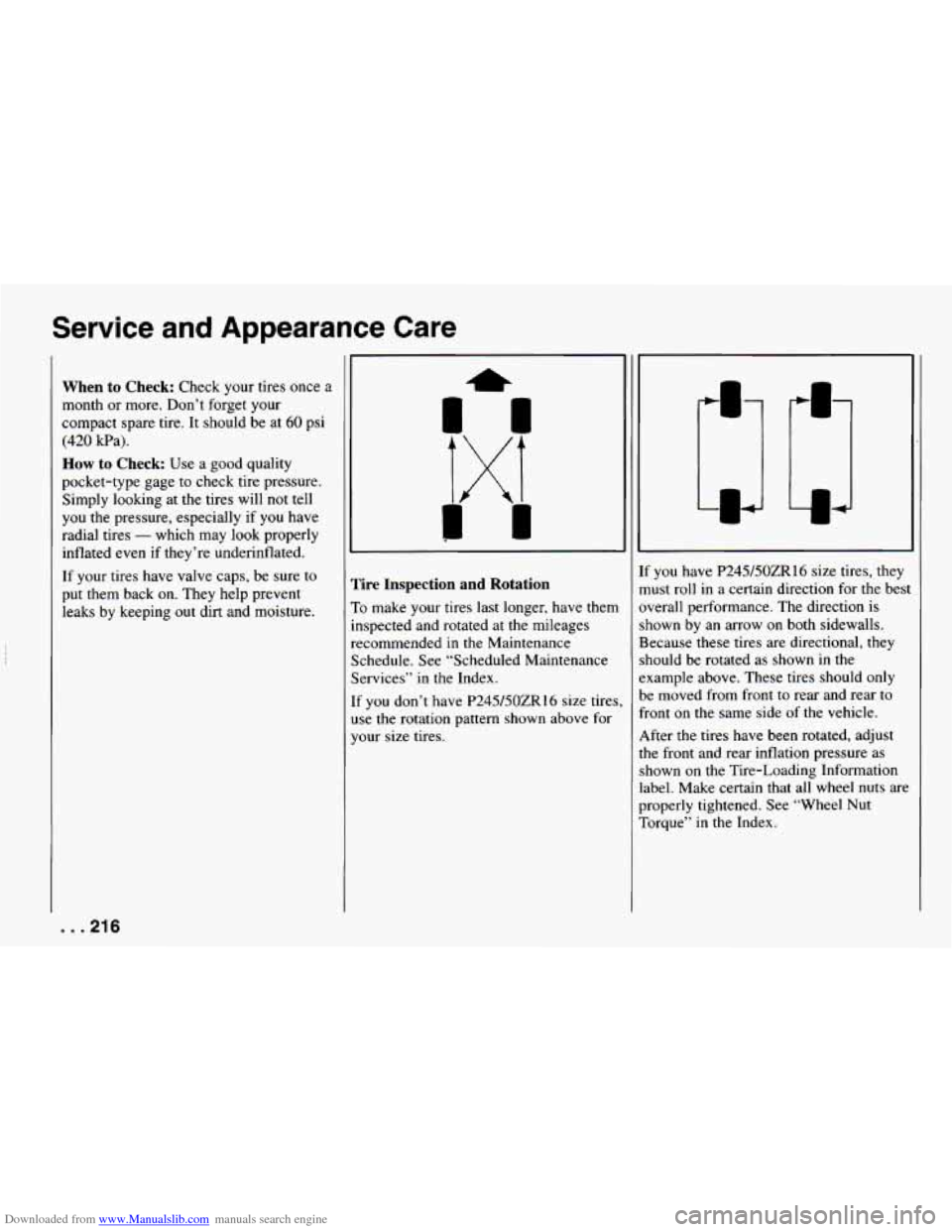
leaks by keeping out dirt and moisture. Tire Inspection and Rotation
To make your tires last longer, have them
inspected and rotated at the mileages
recommended
in the Maintenance
Schedule. See “Scheduled Maintenance
Services” in the Index.
[f you don’t have P245/50ZR16 size tires
use the rotation pattern shown above for
your size tires.
4-
f you have P245/50ZR16 size tires, they
nust roll in
a certain direction for the best
werall performance. The direction is
hown by an arrow on both sidewalls.
3ecause these tires are directional, they
hould be rotated as shown
in the
:xample above. These tires should only
,e moved from front to rear and rear to
ront on the same side of the vehicle.
ifter the tires have been rotated, adjust
he front and rear inflation pressure as
.hown on
the Tire-Loading Information
abel. Make certain that all wheel nuts are
u-operly tightened. See “Wheel Nut
rorque” in the Index.
. . .216
Page 239 of 292
Downloaded from www.Manualslib.com manuals search engine IMPORTANT: I
KEEP THE ENGINE OIL
AT THE PROPER
LEVEL AND CHANGE AS
RECOMMENDED
I
This part covers the
maintenance required for your
Chevrolet
. Your vehicle needs
these services
to retain its
safety. dependability and
emission control performance
.
Part l
Maintenance Schedule
Section
Introduction: A Word about Maintenance ........................ 238
A .
B .
C .
D .
E .
Your Vehicle and the Environment ......................... 238
How This Part Is Organized
............................... 238
Scheduled Maintenance Services ............................ 240
Using Your Maintenance Schedules ......................... 239
Selecting the Right Schedule
.............................. 239
Schedule1
............................................. 240
Schedule11
............................................ 242
Explanation
of Scheduled Maintenance Services .............. 244
Owner Checks and Services ................................ 246
AtEachFuelFill
....................................... 246
At Least Once a Month .................................. 246
AtLeastTwiceaYear
................................... 246
AtLeastOnceaYear
.................................... 247
Periodic Maintenance Inspections ........................... 249
Recommended Fluids and Lubricants ........................ 251
Maintenance Record ...................................... 253
lqq I
Have you purchased the GM Protection Plan? The Plan
supplements
your. new car warranties .
See your GM dealer for details .
237 ...
Page 240 of 292
Downloaded from www.Manualslib.com manuals search engine Maintenance Schedule
Introduction: A Word about Maintenance
We at General Motors want to help you
keep your vehicle in good working
Condition,
But we don’t how exactly
how you’ll drive it.
You may drive very
short distances only a few times a week.
Or you may drive long distances all the
time in very hot, dusty
weather. You may
use your vehicle in making deliveries. Or
you may drive it to work, to do errands,
or in many other ways.
Because of all the different ways people
use their GM vehicles, maintenance needs
vary. You may even need more frequent
checks
and replacements than you will
find in the schedules in this part. So
please read this part and note how you
drive.
If you have any questions on how
to keep your vehicle in
good condition,
see your Ghevrolet dealer, the place
many GM owners choose to have their
maintenance
work done. Your dealer can
be relied upon to use proper parts and
practices.
Your Vehicle and the
Environment
Proper vehicle maintenance not only
keeps your vehicle in good working
condition,
but it also helps the
environment. All recommended
maintenance procedures are important.
hproper vehicle maintenance or
the
removal of important components can
significantly affect the quality of the air
we breathe. Improper fluid levels or even
the wrong tire inflation can increase the
level of emissions from your vehicle. To
help protect our environment, and to help
keep your vehicle
in good condition,
please maintain your vehicle properly.
How This Part is Organized
The remainder of this part is divided into
five sections:
“Section
A: Scheduled Maintenance
Services” shows
what to have done, and
how often. Some of these services can
be
complex, so unless you are technically
qualified and have the necessary
equipment,
you should let your dealer’s service department
or another qualified
service center
do these jobs.
If you are skilled enough to do some work
on
your vehicle, you will probably want
to get the service information GM
publishes, You will find a list of
publications and how to get them later in
this manual. See “Service Publications”
in the
Index.
“Section B: Owner Checks and Services”
tells you what should be checked
whenever
you stop for fuel. It also
explains what you can easily
do to help
keep
your vehicle in good condition.
. . .238
Page 241 of 292
Downloaded from www.Manualslib.com manuals search engine “Section C: Periodic Maintenance
: Inspections” explains important
inspections that your Chevrolet dealer’s
service department or another qualified
service center should perform.
“Section
D: Recommended Fluids and
Lubricants” lists some products GM
recommends to help keep your vehicle
properly maintained. These products, or their equivalents, should be used whether
you do the work yourself or have it done.
“Section
E: Maintenance Record”
provides a place for you to record the
maintenance performed on your vehicle.
Whenever any maintenance is performed,
be sure to write it down in this section.
This will help you determine when your
next maintenance should be done. In
addition, it is a good idea
to keep your
maintenance receipts. They may be
needed to qualify your vehicle for
warranty repairs.
Using Your Maintenance
Schedules
This section tells you the maintenance
services you should have done and
when you should schedule them. Your
Chevrolet dealer knows your vehicle best
and wants you to be happy with it. If you
go to your dealer for your service needs,
you’ll know that GM-trained and
supported service people will perform
the work using genuine GM parts.
These schedules are for vehicles that:
carry passengers and cargo within
recommended limits.
You will find
these limits on your vehicle’s
Tire-Loading Information label. See
“Loading Your Vehicle” in the Index.
are driven on reasonable road pprfaces
within legal driving limits.
use
the recommended unleaded fuel.
See “Fuel” in the Index.
Selecting the Right Schedule
First you’ll need to decide which of the
two schedules is right for your vehicle.
Here’s how to decide which schedule to
follow:
Schedule
I
Is any one of these true for your vehicle?
Most trips are less than 4 miles (6 km).
Most trips are less than 10 miles (16
km) when outside temperatures are
below freezing.
The engine is at low speed most of the
time (as in door-to-door delivery, or in
stop-and-go traffic).
You operate your vehicle in dusty
You tow a trailer.
If any one (or more) of these is true for
your driving, follow Schedule
I.
Schedule 11
Follow Schedule I1 on& if none of the
above conditions is true.
areas.
239.. .
Page 242 of 292
Downloaded from www.Manualslib.com manuals search engine Maintenance Schedule
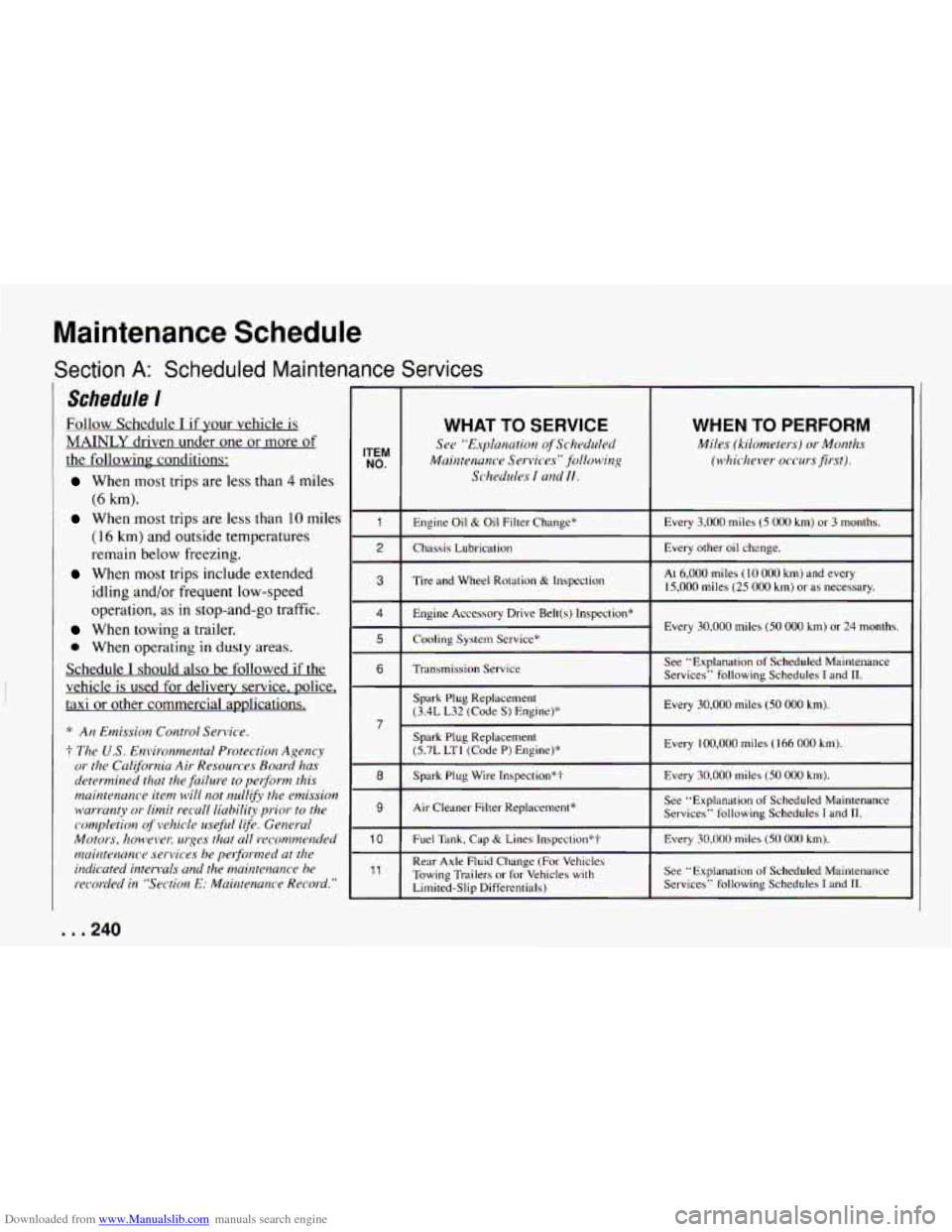
Section A: Scheduled Maintenance Services
Schedule 1
MAINLY driven under one or more of
the following conditions:
When most trips are less than 4 miles
(6 km).
When most trips are less than 10 miles
(16 km) and outside temperatures
remain below freezing.
When most trips include extended
idling and/or frequent low-speed
operation, as
in stop-and-go traffic.
When towing a trailer.
0 When operating in dusty areas.
Schedule
I should also be followed if the
vehicle is used for deliverv service, police,
taxi or other commercial applications.
* An Emission Control Service.
=t The U.S. En\sironmental Protection Agency
or the California Air Resources Board has
determined that the failure to pellform this
maintemnce item will not
nullifi. the emission
warranty
or limit recall liability prior to the
cvmpletion
cf vehicle usejul life. General
Motors, however, urges rhat all rec.*ornmended
maintenance services
he performed at the
indicated intervals and the maintenance be
recorded in “Section
E: Maintenance Record.”
ITEM NO.
-
1
2
3
4
5
6
7
8 -
9
10
11
WHAT TO SERVICE
See “E,rplanation of Scheduled
Maintenunce Servicae.s”
jullowing
Schedules I and 11.
Engine Oil & Oil Filter Change*
Chassis Lubrication
Tire and Wheel Rotation
& Inspection
Engine Accessory Drive Belt(s) Inspection*
Cooling System Service”
Transmission Service Spark Plug Replacement
(3.4L L32 (Code
S) Engine)*
Spark Plug Replacement
(5.7L LTI (Code P) Engine)*
Spark Plug Wire Inspection*+
Air Cleaner Filter Replacement*
Fuel Tank, Cap & Lines Inspection*?
Rear Axle Fluid Change
(For Vehicles
Towing Trailers
or for Vehicles with
Limited-Slip Differentials)
WHEN TO PERFORM
Miles (kilometers) or Months
(whichever occursfirst).
Every 3.000 miles (5 000 km) or 3 months.
Every other oil chenge.
At 6,000 miles (10 000 km) and every
15,000 miles (25 000 km) or as necessary.
Every 30,000 miles (50
000 km) or 24 months.
See “Explanation of Scheduled Maintenance
Services” following Schedules
I and 11.
Every 30,000 miles (50 000 km).
Every 100,000 miles ( 166 000 km).
Every 30,000 miles (50 000 km).
See “Explanation of Scheduled Maintenance
Services” following Schedules
I and II.
Every 30,000 miles (50 000 km).
See “Explanation of Scheduled Maintenance
Services” following Schedules
I and 11.
. . .240
Page 244 of 292
Downloaded from www.Manualslib.com manuals search engine Maintenance Schedule
Section A: Scheduled Maintenance Services (cont.)
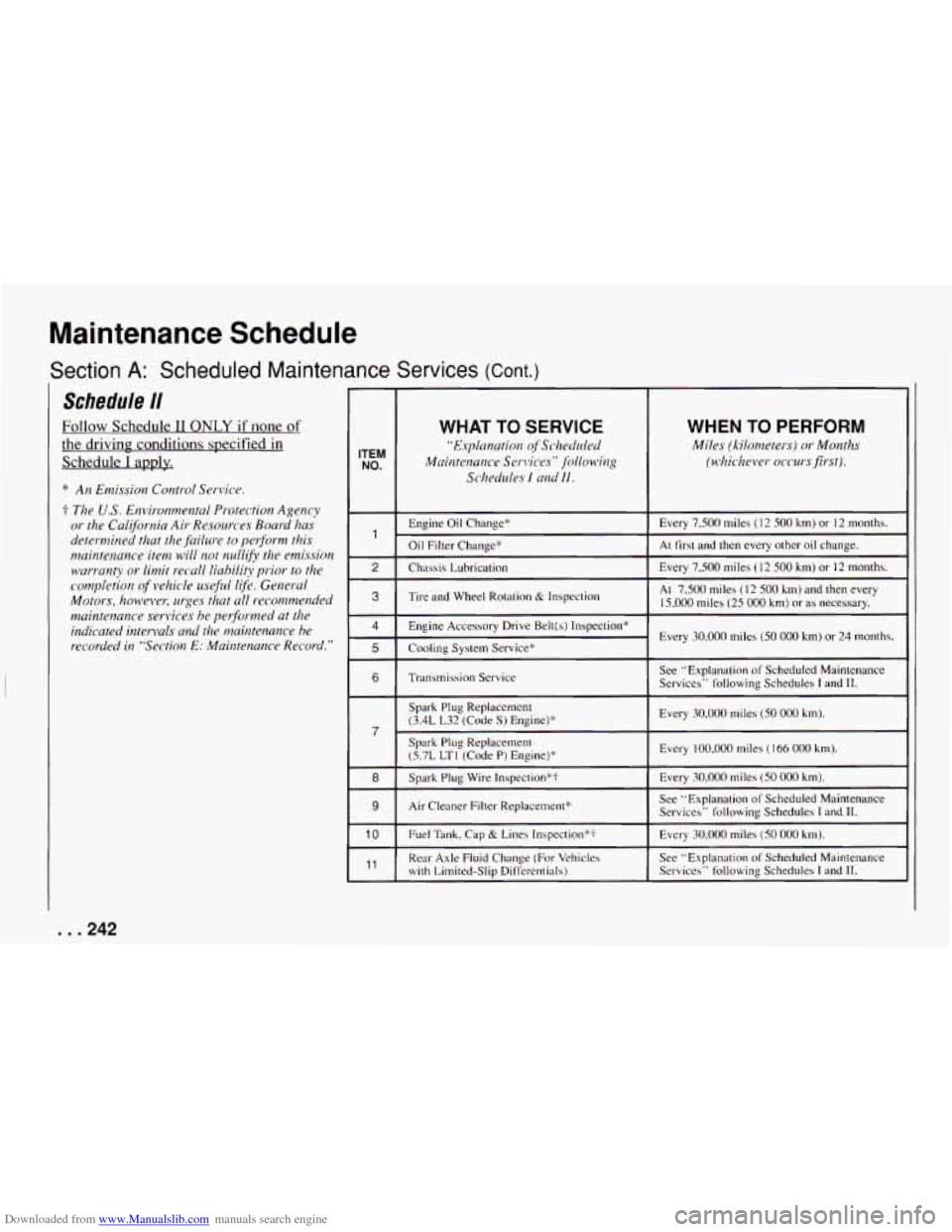
Schedule 11
Follow Schedule I1 ONLY if none of
Jhe driving: conditions specified in
Schedule I appl~
* An Emission Contsol Ses\:icc.
il- The US. Envisonmental Psotection Agency
os the Calijosrtia Ais Resousces Bousd has
detesmined that
the failuse to pesfosm this
maintenance item will not nullib the emissiott
warsanty
or limit secall liability psios to the
completion of whicle useful life. Genesal
Motoss, howews, urges that all sccommended
maintenance semices
be pesformed at the
indicated inten*als and
rhe maintenance he
secorded in “Section E: Maintenance Record.”
ITEM NO.
1
-
2
3
-
4
5
6
-
-
-
7
-
8
9
-
10
11
WHAT TO SERVICE
“E.vplanutiol? c?fSd~eduleci
Mairztetzuncx~ Ses\.ic*es‘’ fhllolz*itlg
Schedules I Ulld !I.
Engine Oil Change”
Oil Filter Change*
Chassis Lubrication
Tire and Wheel Rotation
& Inspection
Engine Accessory Drive Belt(s) Inspection”
Cooling System Service”
Transmission Service Spark Plug Replacement
(3.4L L32 (Code S) Engine)”
Spark Plug Replacement
(5.7L LTI (Code P) Engine)*
Spark
Plug Wire Inspection”?
Air Cleaner Filter Replacement”
Fuel Tank, Cap & Lines Inspection’k+
Rear Axle Fluid Change (For Vehicles
with Limited-Slip Differentials) Every
7,500 miles (1 2 500
km) or 12 months.
At first and then every other oil chqnge.
Every 7,500 miles
( 12 SO0 km) or 12 months.
At 7.500 miles (1 2 SO0 km) and then every
15.000 miles
(25 000 km) or as necessary.
Every 30.000 miles
(50 000 km) or 24 months.
See “Explanation of Scheduled Maintenance
Services“ following Schedules
I and 11.
Every 30,000 miles (SO 000 km).
Every IOO.OOO miles ( 166 000 km).
Every 30,000 miles (50 000 km).
See “Explanation of Scheduled Maintenance
Services” following Schedules
I and 11.
Every 30.000 miles (50 000 km).
See “Explanation of Scheduled Maintenance
Services” lollowing Schedules
I and 11.
. . .242
Page 246 of 292
Downloaded from www.Manualslib.com manuals search engine Maintenance Schedule
Section A: Scheduled Maintenance Services (cont.)
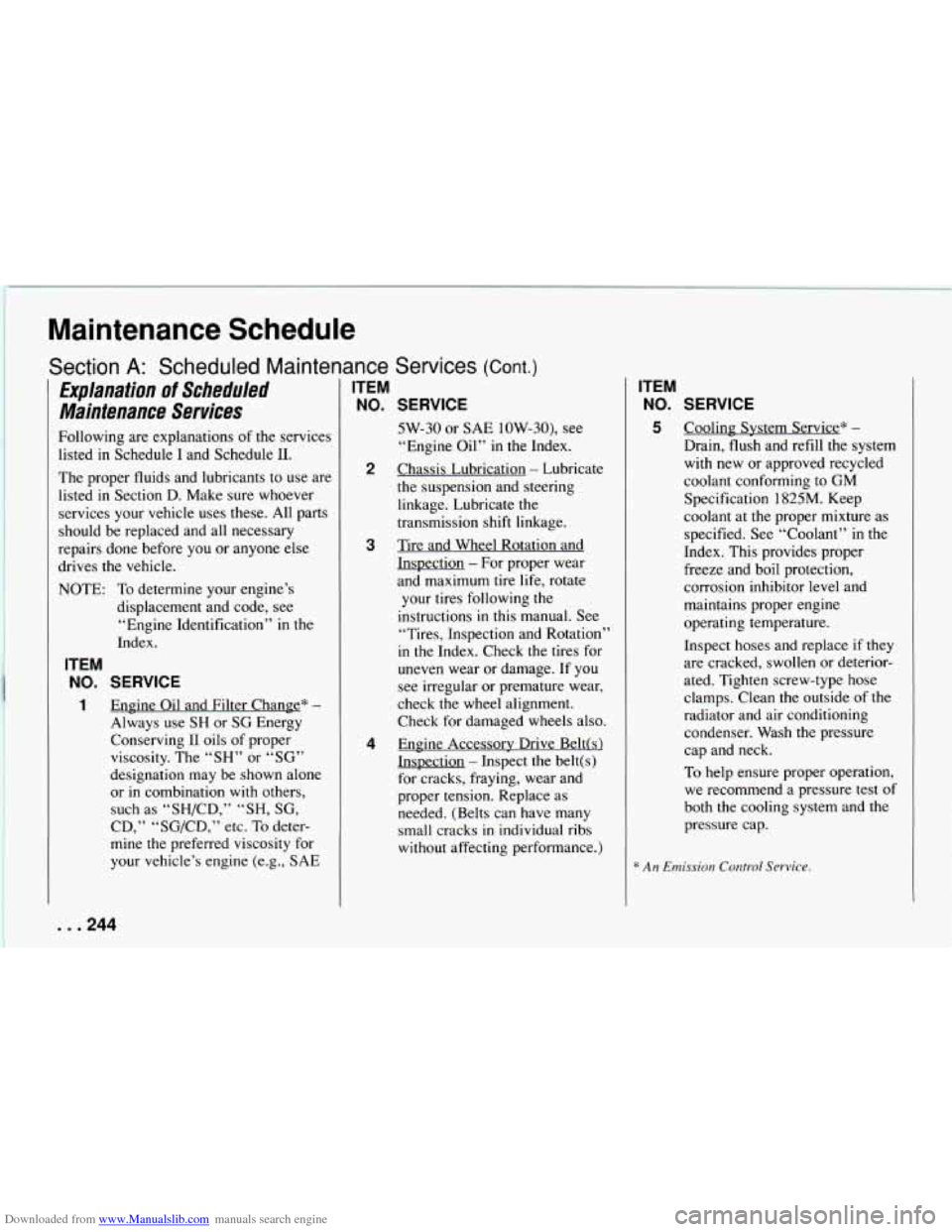
Explanation of Scheduled
Maintenance Services
Following are explanations of the services
listed in Schedule
I and Schedule 11.
The proper fluids and lubricants to use are
listed
in Section D. Make sure whoever
services your vehicle uses these. All parts
should be replaced and all necessary
repairs done before you or anyone else
drives the vehicle.
NOTE: To determine your engine’s
displacement and code, see
“Engine Identification”
in the
Index.
ITEM
NO. SERVICE
1 Engine Oil and Filter Change” -
Always use SH or SG Energy
Conserving I1 oils of proper
viscosity. The
“SH” or “SG”
designation may be shown alone
or
in combination with others,
such as “SH/CD,”
“SH, SG,
CD,” “SG/CD,” etc. To deter-
mine the preferred viscosity for
your vehicle’s engine (e.g., SAE
ITEM
NO.
2
3
4
SERVICE
5W-30 or SAE 1OW-30)’ see
“Engine Oil”
in the Index.
Chassis Lubrication
- Lubricate
the suspension and steering
linkage. Lubricate the
transmission shift linkage.
Tire and Wheel Rotation and
InsDection
- For proper wear
and maximum tire life, rotate
your tires following the
instructions
in this manual. See
“Tires, Inspection and Rotation”
in the Index. Check the tires for
uneven wear or damage. If you
see irregular or premature wear,
check the wheel alignment.
Check for damaged wheels also.
Engine Accessory Drive Belt(s)
Inspection
- Inspect the belt(s)
for cracks, fraying, wear and
proper tension. Replace as needed. (Belts can have many
small cracks
in individual ribs
without affecting performance.)
ITEM
NO. SERVICE
5 Cooling System Service* -
Drain, flush and refill the system
with new or approved recycled
coolant conforming to
GM
Specification 1825M. Keep
coolant at the proper mixture as
specified. See “Coolant”
in the
Index. This provides proper
freeze and boil protection,
corrosion inhibitor level and
maintains proper engine
operating temperature.
Inspect hoses and replace
if they
are cracked, swollen or deterior-
ated. Tighten screw-type hose
clamps. Clean the outside
of the
radiator and air conditioning
condenser. Wash the pressure
cap and neck.
To help ensure proper operation,
we recommend a pressure test of
both the cooling system and the
pressure cap.
* An Emission Control Service.
. . .244
Page 248 of 292
Downloaded from www.Manualslib.com manuals search engine Maintenance Schedule
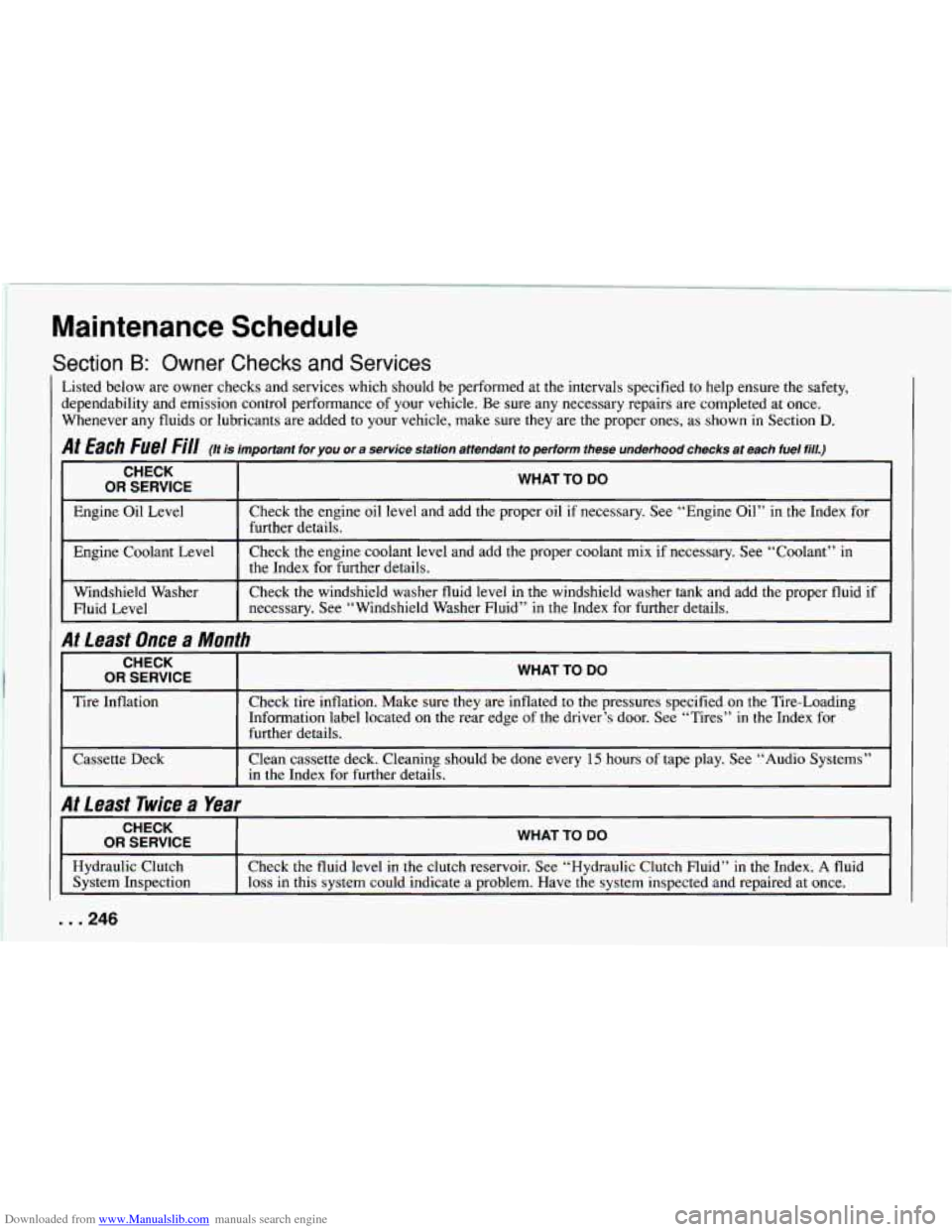
Section B: Owner Checks and Services
Listed below are owner checks and services which should be performed at the intervals specified to help ensure the safety,
dependability and emission control performance of your vehicle. Be sure any necessary repairs are completed at once.
Whenever any fluids or lubricants are added to your vehicle, make sure they are the proper ones, as shown in Section
D.
At Each Fuel Fill (It is important for you or a service station attendant to perform these underhood checks at each fuel fill.)
CHECK
OR SERVICE WHAT TO DO
Engine
Oil Level
Check the engine coolant level and add the proper coolant mix if necessary. See “Coolant” in
Engine Coolant Level Check the engine
oil level and add the proper oil if necessary. See “Engine Oil” in the Index for
Check the windshield washer fluid level
in the windshield washer tank and add the proper fluid if
Windshield Washer
Fluid Level necessary. See “Windshield
Washer Fluid”
in the Index for further details.
further details.
the Index for further details.
At Least Once
a Month
CHECK
OR SERVICE WHAT TO DO
Tire Inflation
Check tire inflation.
Make sure they are inflated to the pressures specified on the Tire-Loading
Information label located on the rear edge of the driver’s door. See “Tires” in the Index for
further details.
Cassette Deck Clean cassette deck. Cleaning should
be done every
15 hours of tape play. See “Audio Systems”
in the Index for further details.
At Least Twice a Year
CHECK
I OR SERVICE
I
Hydraulic Clutch
System Inspection
WHAT TO DO I
Check the fluid level in the clutch reservoir. See “Hydraulic Clutch Fluid” in the Index. A fluid
loss
in this system could indicate a problem. Have the system inspected and repaired at once.
. . .246
Page 250 of 292
Downloaded from www.Manualslib.com manuals search engine Maintenance Schedule
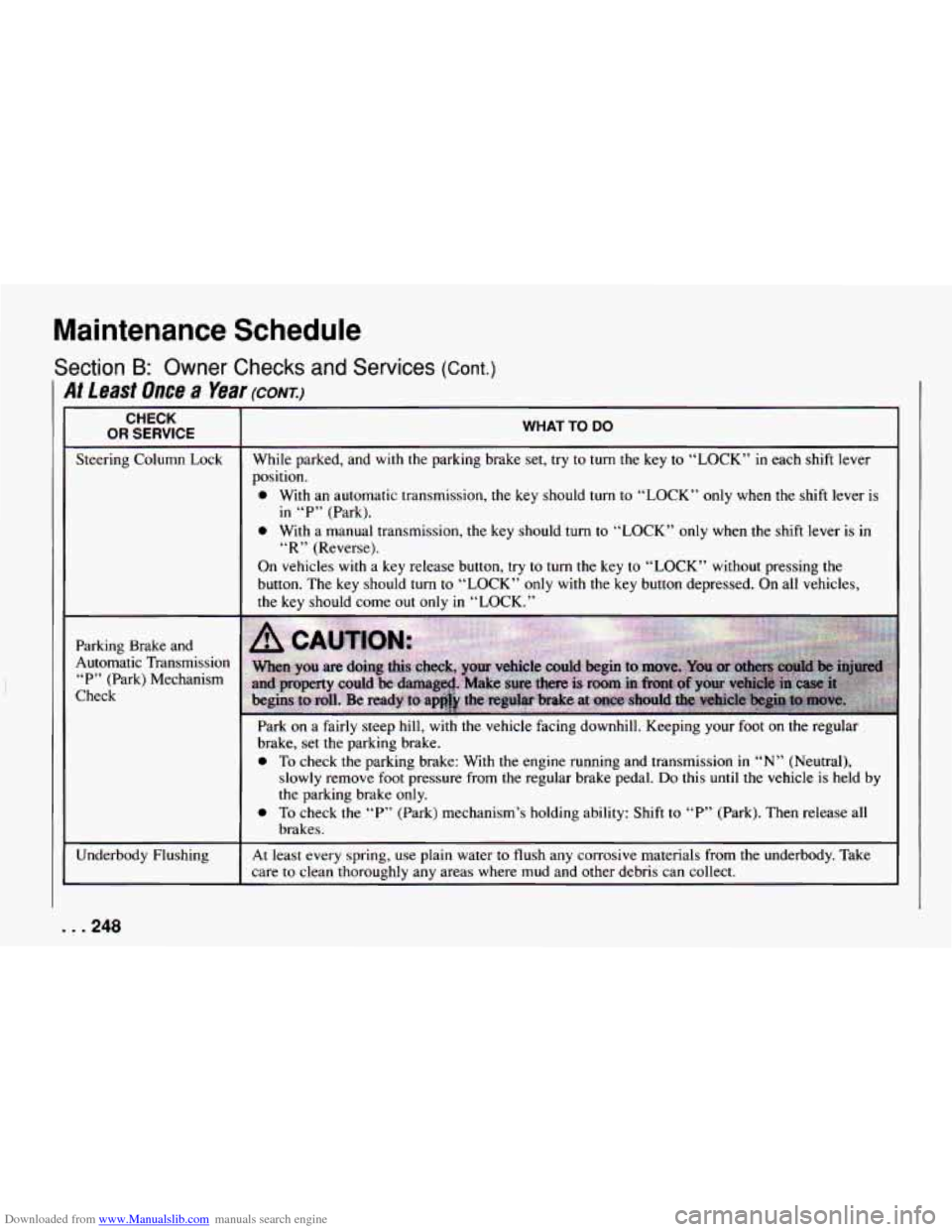
Section B: Owner Checks and Services (Cont.)
At Least Once a Year (CONT.)
CHECK
OR SERVICE
Steering Column Lock
Parking Brake and
Automatic Transmission “P” (Park) Mechanism
Check
Underbody Flushing
WHAT TO DO
While parked, and with the parking brake set, try to turn the key to “LOCK” in each shift lever
position.
0 With an automatic transmission, the key should turn to “LOCK” only when the shift lever is
0 With a manual transmission, the key should turn to “LOCK” only when the shift lever is in
On vehicles
with a key release button, try to turn the key to “LOCK” without pressing the
button. The key should turn to “LOCK” only with the key button depressed. On all vehicles,
the
key should come out only in “LOCK.”
in “P” (Park).
“R” (Reverse).
Park on a fairly steep hill, with the vehicle facing downhill. Keeping your foot on the regular
brake, set the parking brake.
0 To check the parking brake: With the engine running and transmission in “N” (Neutral),
slowly remove foot pressure from the regular brake pedal.
Do this until the vehicle is held by
the parking brake only.
brakes.
0 To check the “P” (Park) mechanism’s holding ability: Shift to “P” (Park). Then release all
At least every spring, use plain water to flush any corrosive materials from the underbody. Take
care to clean thoroughly any areas where mud and other debris can collect.
. . .248
Page 252 of 292
Downloaded from www.Manualslib.com manuals search engine Maintenance Schedule
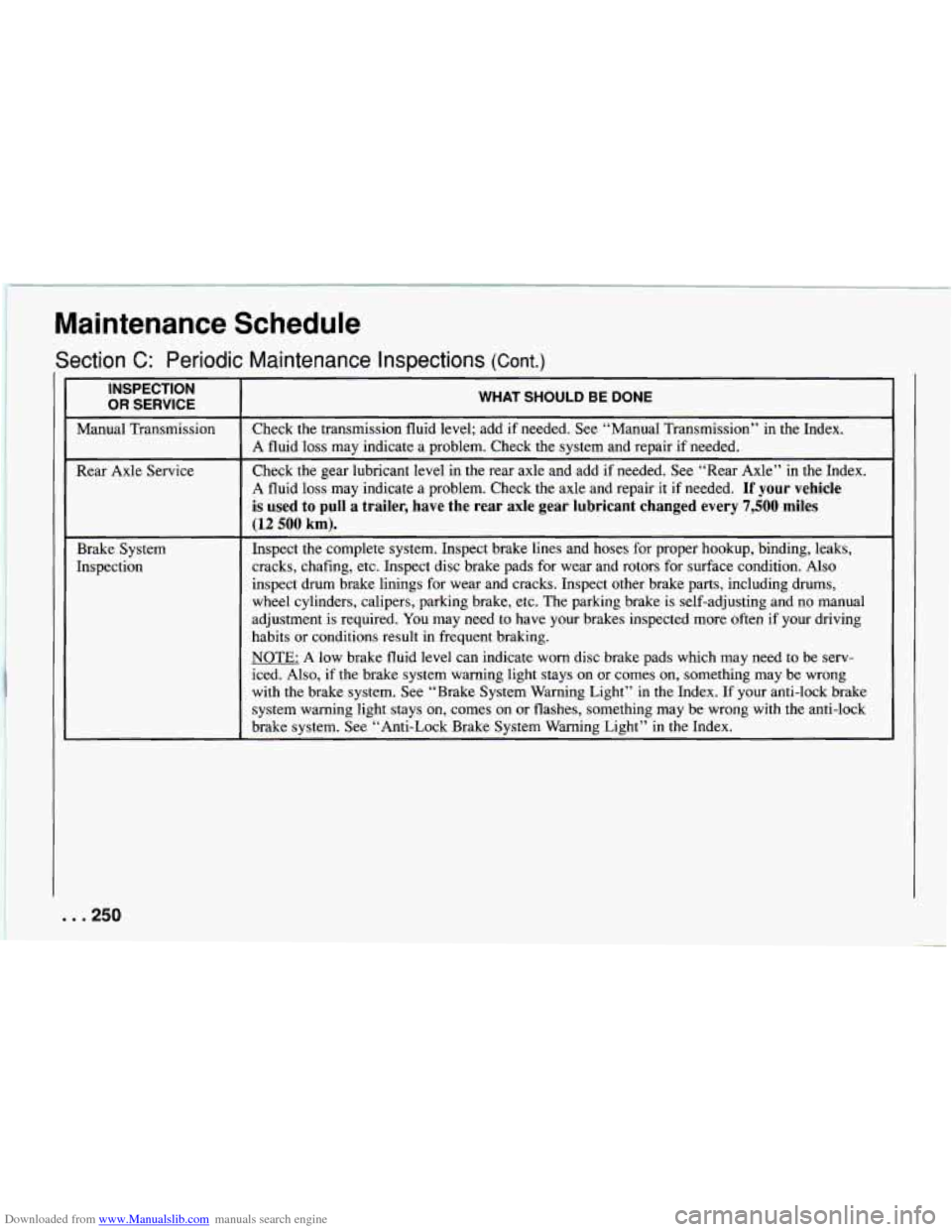
Section C: Periodic Maintenance Inspections (Cont.)
INSPECTION
OR SERVICE
Rear Axle Service
Brake System
Inspection
-
WHAT SHOULD BE DONE
Check the transmission fluid level; add if needed. See “Manual Transmission” in the Index.
A fluid loss may indicate a problem. Check the system and repair if needed.
Check the gear lubricant level in the rear axle and add if needed. See “Rear Axle” in the Index.
A fluid loss may indicate a problem. Check the axle and repair it
if needed. If your vehicle
is used to pull a trailer, have the rear axle gear lubricant changed every
7,500 miles
(12 500 km).
Inspect the complete system. Inspect brake lines and hoses for proper hookup, binding, leaks,
cracks, chafing, etc. Inspect disc brake pads for wear and rotors for surface condition. Also
inspect drum brake linings for wear and cracks. Inspect other brake parts, including drums,
wheel cylinders, calipers, parking brake, etc. The parking brake is self-adjusting and
no manual
adjustment is required. You may need to have your brakes inspected more often if your driving
habits or conditions result in frequent braking.
NOTE: A low brake fluid level can indicate worn disc brake pads which may need to be serv-
iced. Also, if the brake system warning light stays on or comes on, something may be wrong
with the brake system. See “Brake System Warning Light” in the Index.
If your anti-lock brake
system warning light stays on, comes on or flashes, something may be wrong with the anti-lock
brake system. See “Anti-Lock Brake System Warning Light” in the Index.
. . .250