engine coolant CHEVROLET CAMARO 1996 4.G User Guide
[x] Cancel search | Manufacturer: CHEVROLET, Model Year: 1996, Model line: CAMARO, Model: CHEVROLET CAMARO 1996 4.GPages: 402, PDF Size: 21.38 MB
Page 226 of 402
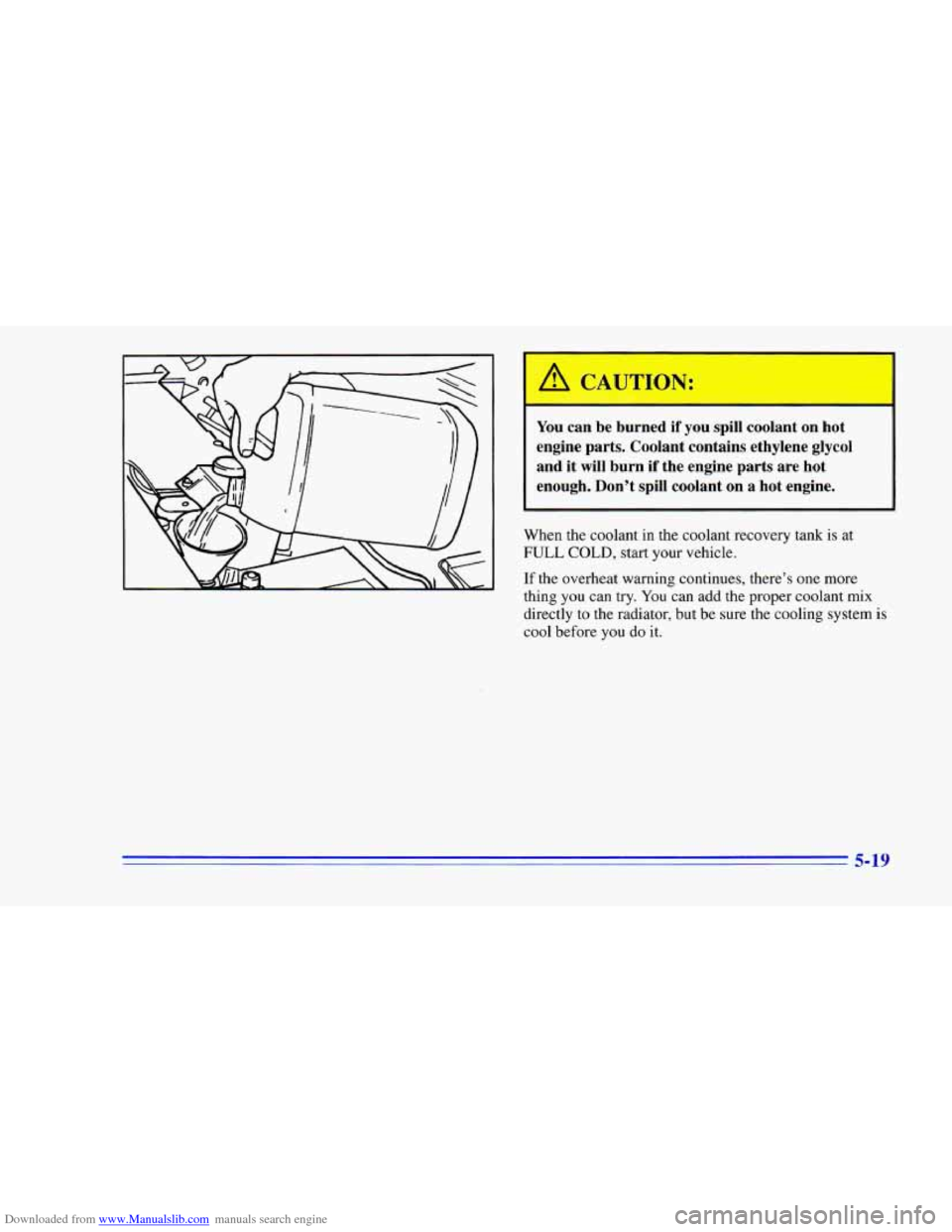
Downloaded from www.Manualslib.com manuals search engine YOU can be burned if you spill coolant on hot
engine parts. Coolant contains ethylene glycol
and it will burn if the engine parts are hot enough. Don’t spill coolant on a hot engine.
1
.
When the coolant in the coolant recovery tank is at
FULL COLD, start your vehicle.
If the overheat warning continues, there’s one more
thing
you can try. You can add the proper coolant mix
directly to the radiator, but
be sure the cooling system is
cool before
you do it.
5-19
Page 228 of 402
Downloaded from www.Manualslib.com manuals search engine How to Add Coolant to the Radiator
(V6 Engine) Only
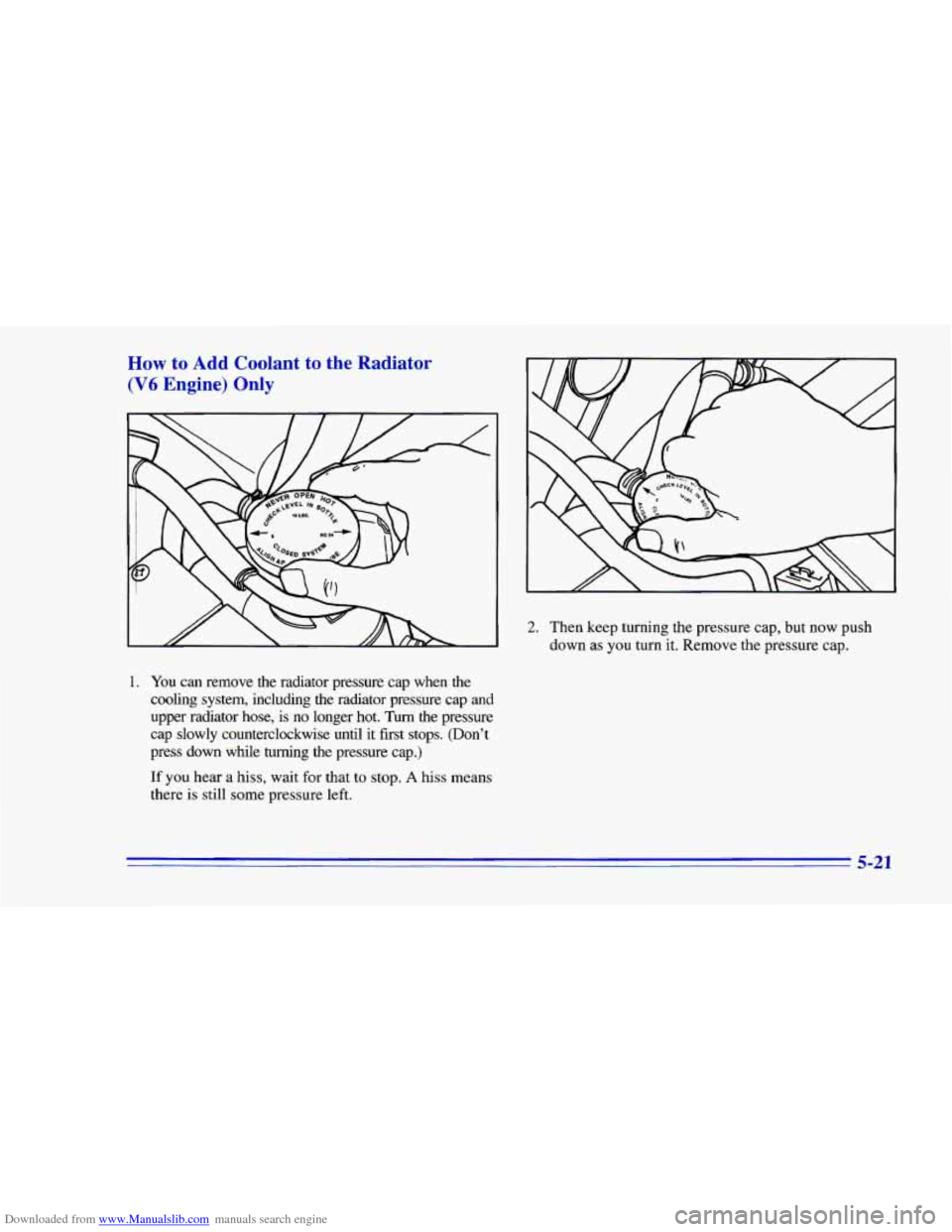
1. You can remove the radiator pressure cap when the
cooling system, including the radiator pressure cap
and
upper radiator hose, is no longer hot. Turn the pressure
cap slowly counterclockwise until it first stops. (Don’t
press down while turning the pressure cap.)
If you hear a hiss, wait for that to stop. A hiss means
there is still some pressure left.
2. Then keep turning the pressure cap, but now push
down as you turn
it. Remove the pressure cap.
5-21
Page 229 of 402
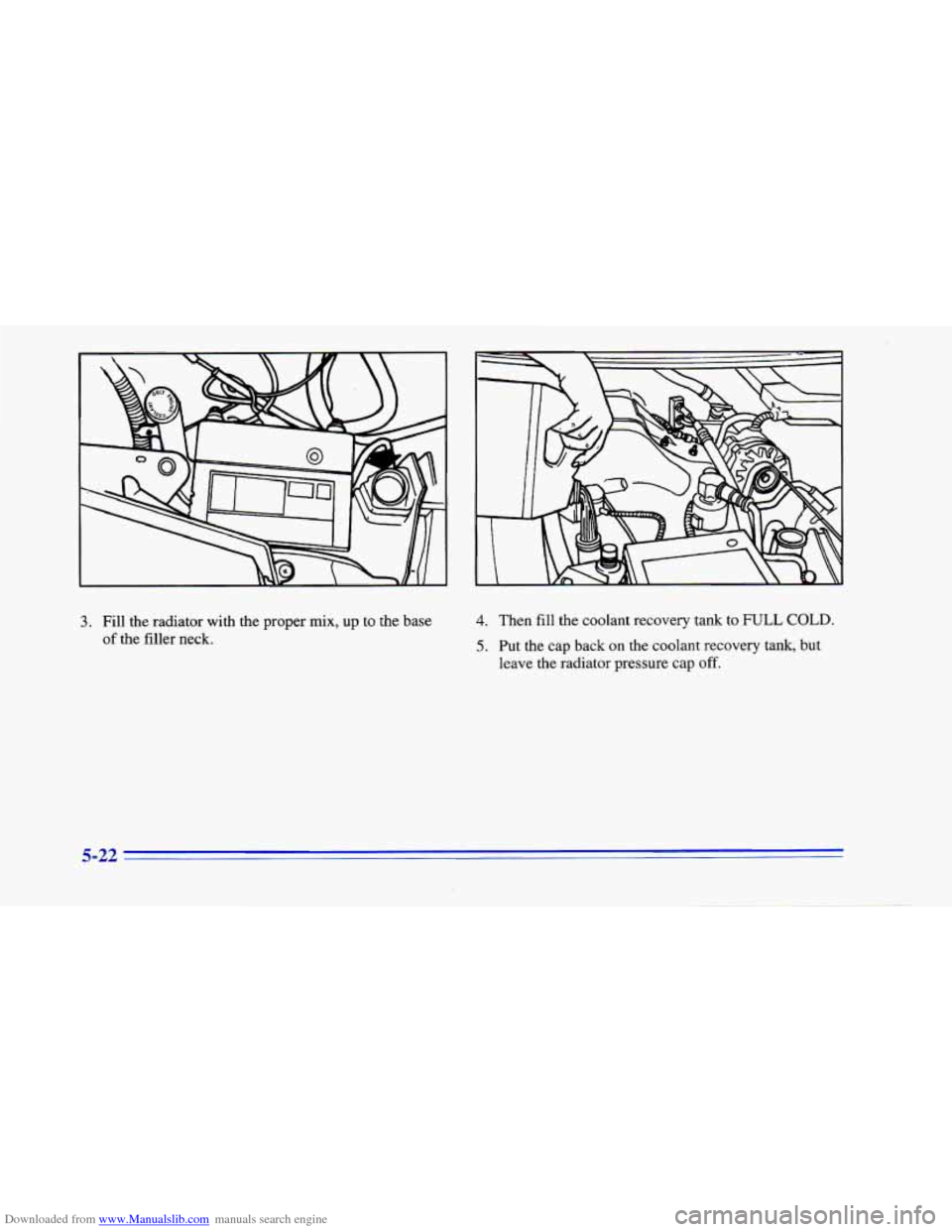
Downloaded from www.Manualslib.com manuals search engine 3. Fill the radiator with the proper mix, up to the base
of the filler neck.
4. Then fill the coolant recovery tank to FULL COLD.
5. Put the cap back on the coolant recovery tank, but
leave the radiator pressure cap
off.
5-22
Page 230 of 402
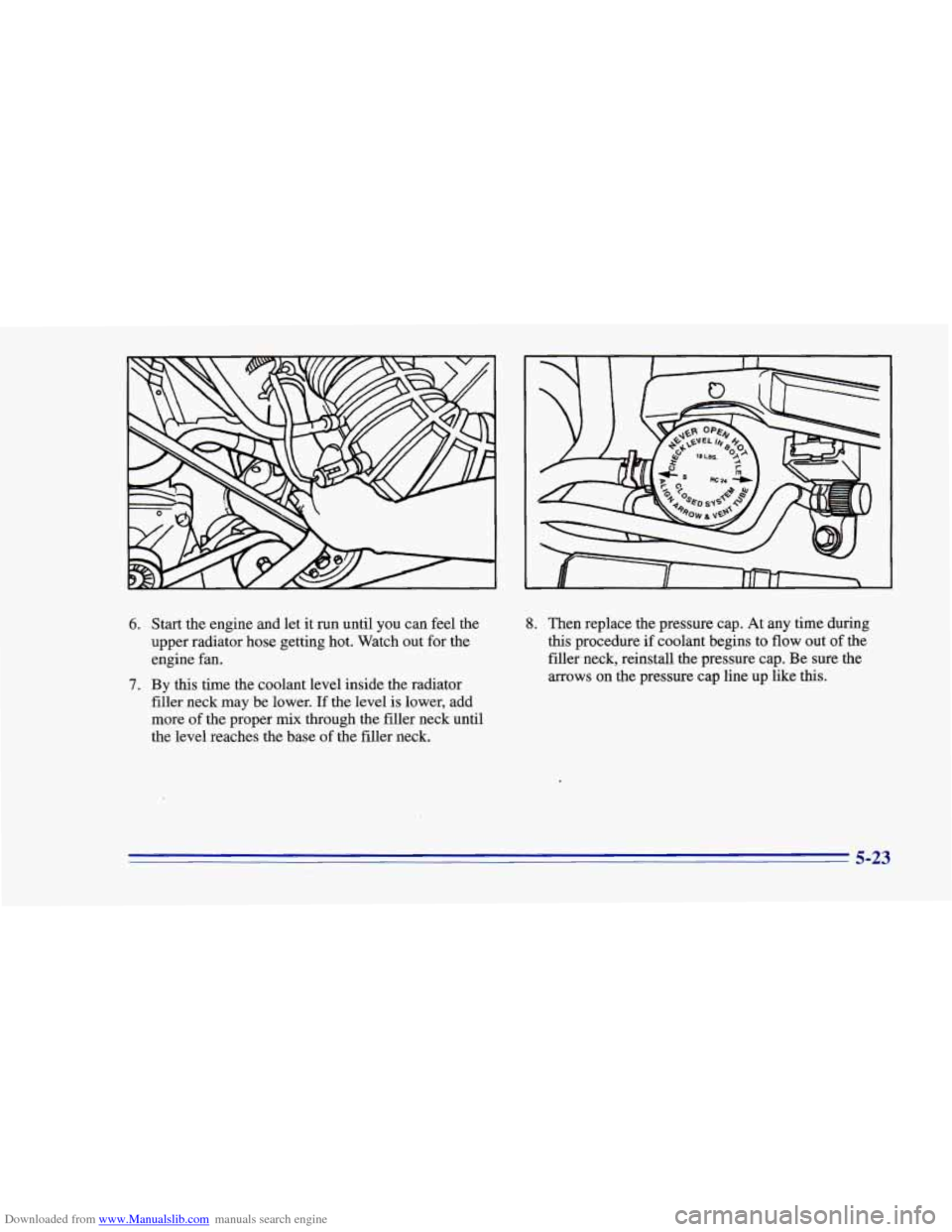
Downloaded from www.Manualslib.com manuals search engine 6.
7.
Start the engine and let it run until you can feel the
upper radiator hose getting hot. Watch out for the
engine fan.
By this time the coolant level inside the radiator
filler neck may be lower. If the level
is lower, add
more of the proper
mix through the filler neck until
the level reaches the base of the filler neck.
8. Then replace the pressure cap. At any time during
this procedure if coolant begins to
flow out of the
filler neck, reinstall the pressure cap. Be sure the
arrows on the pressure cap line up like this.
5-23
Page 231 of 402
Downloaded from www.Manualslib.com manuals search engine How to Add Coolant to the Radiator
(V8 Engine Only)
NOTICE:
The LTl Engine (Code P) has a specific radiator
fill procedure. Failure
to follow this procedure
could cause your engine
to overheat and be
severely damaged.
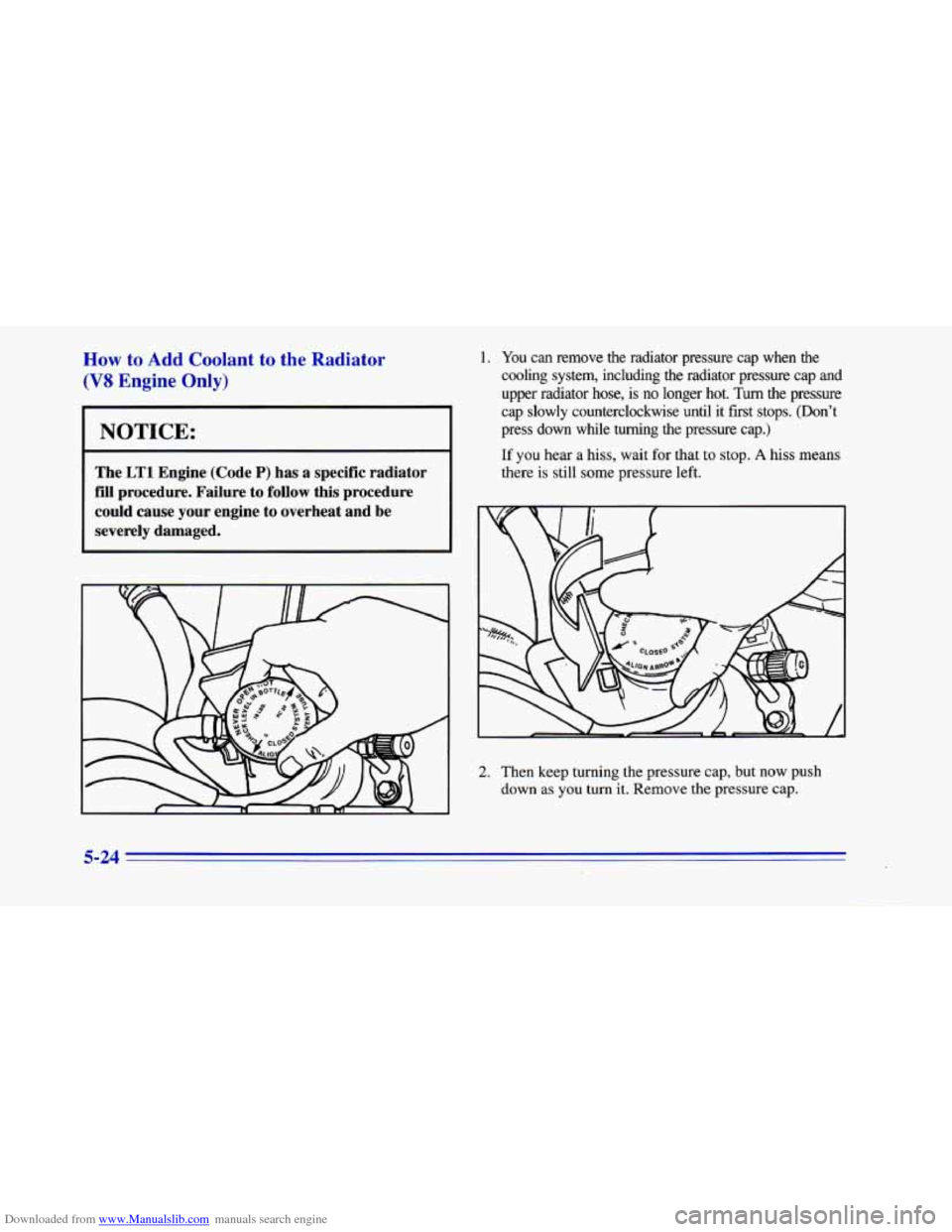
1. You can remove the radiator pressure cap when the
cooling system, including the radiator pressure cap
and
upper radiator hose, is no longer hot. Turn the pressure
cap slowly counterclockwise until it first stops. (Don’t
press down while turning the pressure cap.)
If you hear a hiss, wait for that to stop. A hiss means
there is still some pressure
left.
2. Then keep turning the pressure cap, but now push
down as you turn
it. Remove the pressure cap.
Page 232 of 402
Downloaded from www.Manualslib.com manuals search engine You can be burned if you spill coolant on hot
engine parts. Coolant contains ethylene glycol,
and
it will burn if the engine parts are hot
enough. Don’t spill coolant on a hot engine.
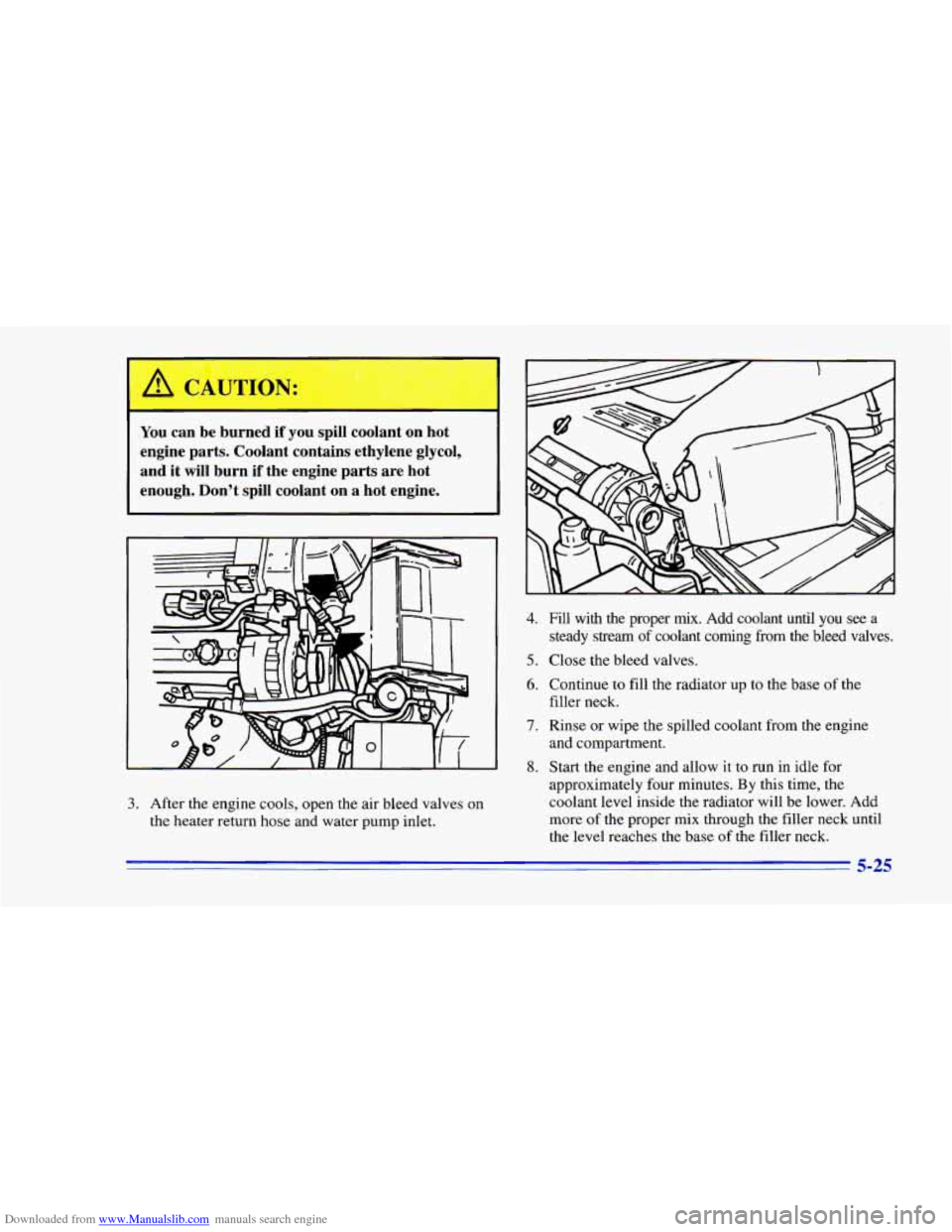
3. After the engine cools, open the air bleed valves on
the heater return hose and water pump inlet.
4. Fill with the proper mix. Add coolant until you see a
5. Close the bleed valves.
6. Continue to fill the radiator up to the base of the
7. Rinse or wipe the spilled coolant from the engine
and compartment.
8. Start the engine and allow it to run in idle for
approximately four minutes.
By this time, the
coolant level inside the radiator will be lower. Add
more
of the proper mix through the filler neck until
the level reaches the base of the filler neck.
steady stream
of coolant coming
from the bleed valves.
filler neck.
5-25
Page 233 of 402
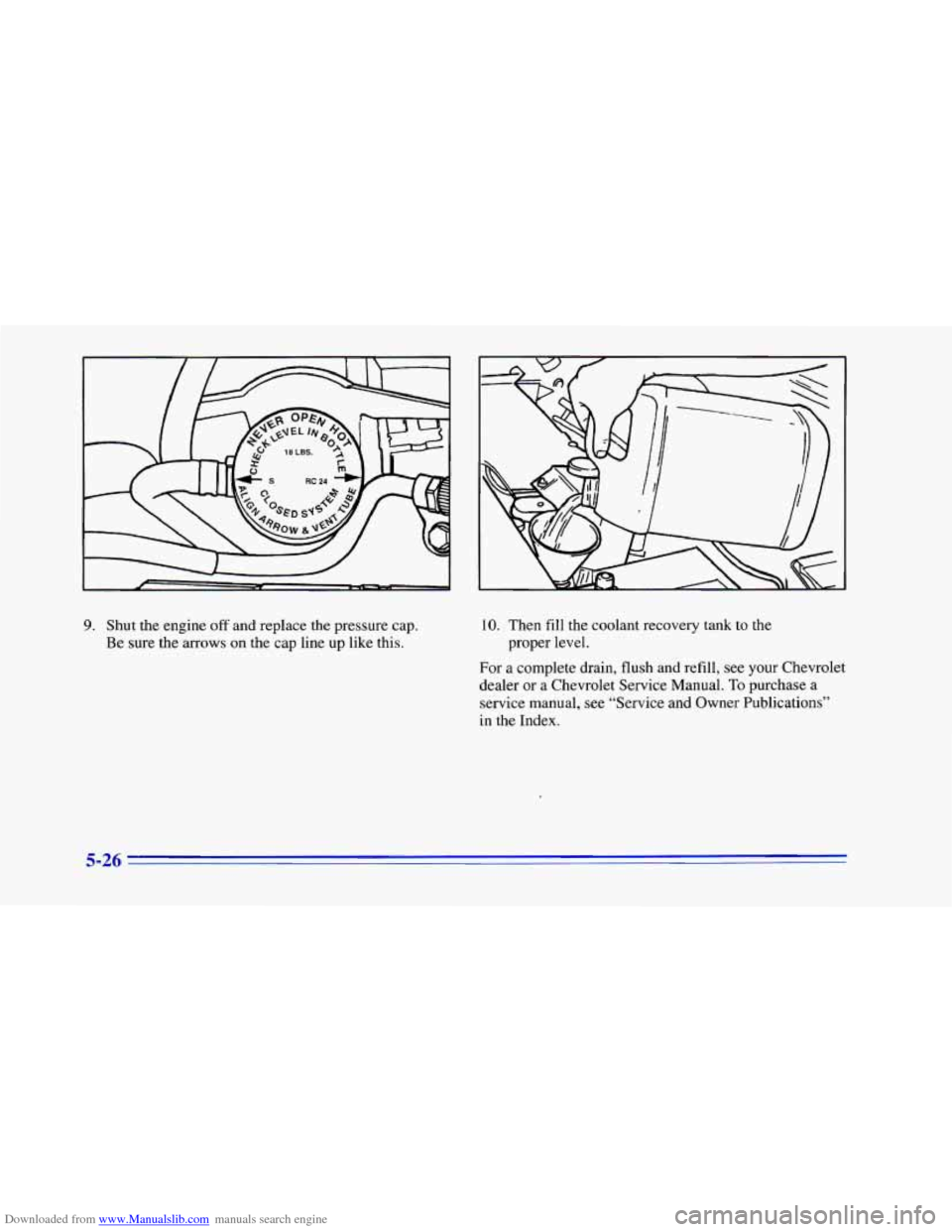
Downloaded from www.Manualslib.com manuals search engine 9. Shut the engine off and replace the pressure cap.
Be sure the arrows on the cap line up like this. 10. Then fill the coolant recovery tank to the
proper level.
For a complete drain,
flush and refill, see your Chevrolet
dealer or a Chevrolet Service Manual.
To purchase a
service manual, see “Service and Owner Publications”
in the Index.
5-26
Page 257 of 402
Downloaded from www.Manualslib.com manuals search engine Be careful not to spill gasoline. Clean gasoline from
painted surfaces as soon as possible. See “Cleaning the
Outside
of Your Chevrolet” in the Index.
When you
put the cap back on, turn it to the right until
you hear at least three clicks. Make sure you fully install
the cap. The diagnostic system can determine if the fuel
cap has been left off
or improperly installed. This would
allow fuel to evaporate into the atmosphere. See
“Malfunction Indicator Lamp” in the Index.
NOTICE:
If you need a new cap, be sure to get the right
type. Your dealer can get one for you.
If you get
the wrong type, it may not
fit and your fuel tank
and emissions system might be damaged.
Checking Things Under the Hood
I A CAUTIC 1: I
-
An electric fan under the hood can start up and
injure you even when the engine is not running.
Keep hands, clothing and tools away from any
underhood electric fan.
Things that burn can get on hot engine parts and
start
a fire. These include liquids like gasoline,
oil, coolant, brake fluid, windshield washer and
other fluids, and plastic or rubber. You or others
could be burned. Be careful not to drop or spill
things that will burn onto
a hot engine.
6-6
Page 259 of 402
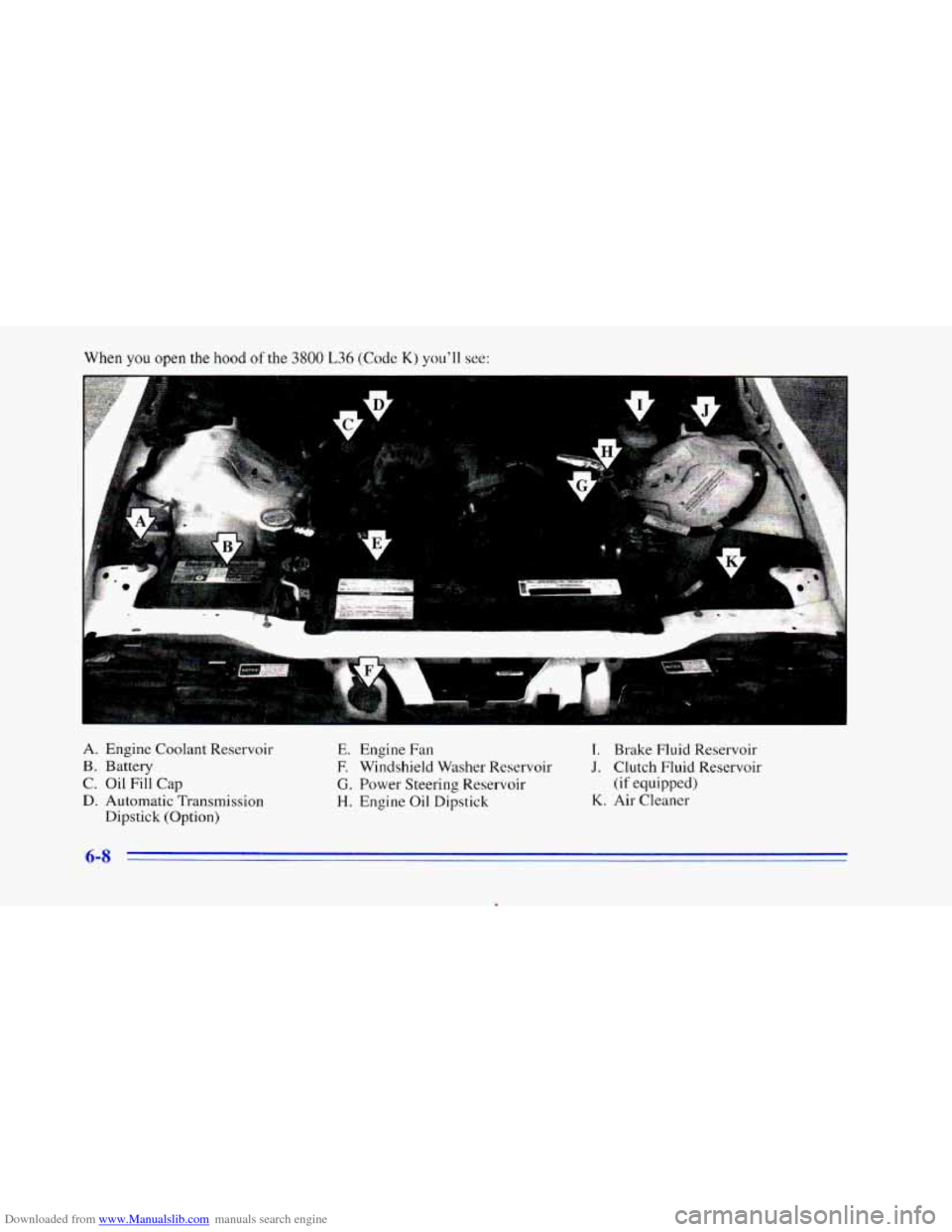
Downloaded from www.Manualslib.com manuals search engine When you open the hood of the 3800 L36 (Code K) you'll see:
A. Engine Coolant Reservoir
B. Battery
C. Oil Fill Cap
D. Automatic Transmission
Dipstick (Option)
E. Engine Fan
F. Windshield Washer Reservoir
G. Power Steering Reservoir
H. Engine Oil Dipstick
I. Brake Fluid Reservoir
J. Clutch Fluid Reservoir
K. Air Cleaner
(if equipped)
6-8
Page 260 of 402
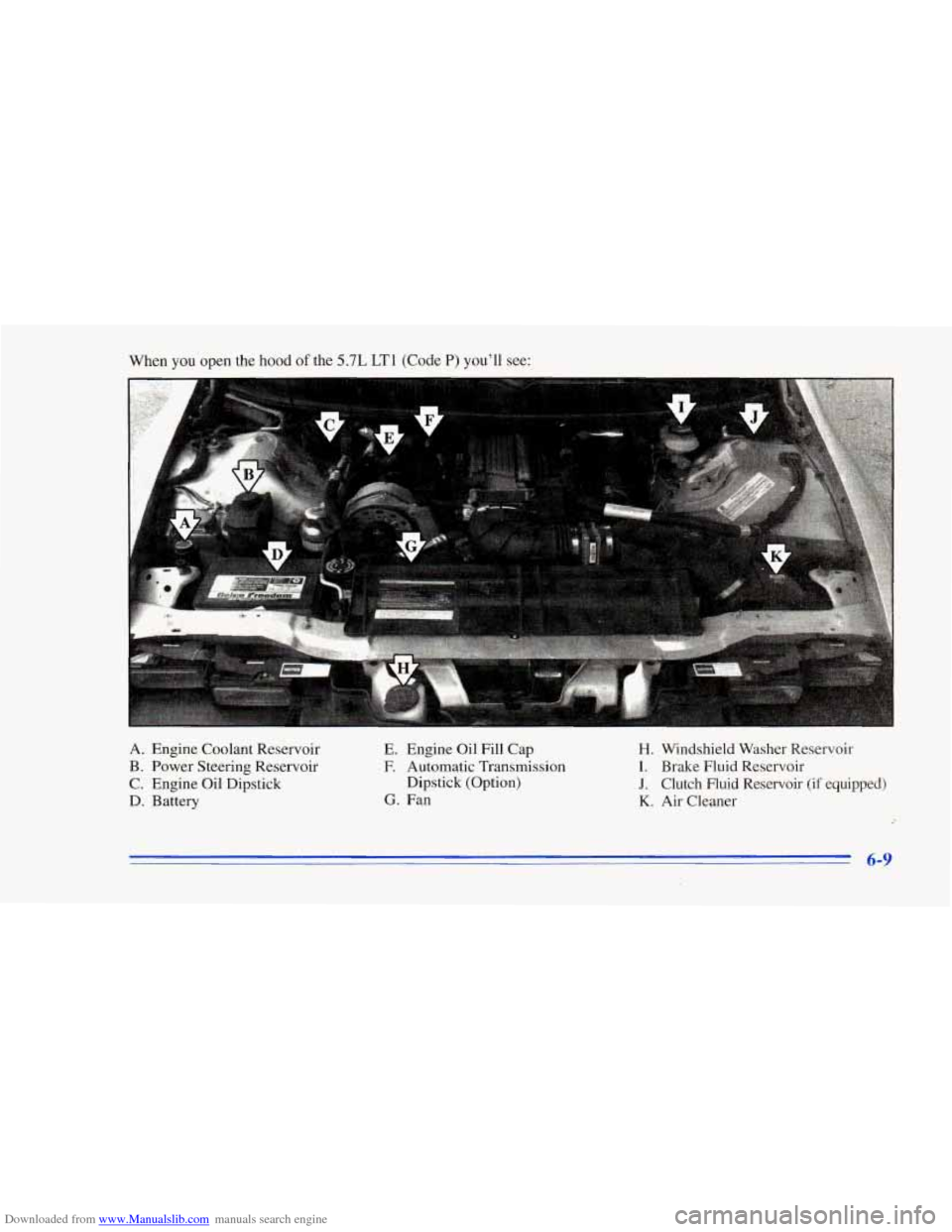
Downloaded from www.Manualslib.com manuals search engine When you open the hood of the 5.7L LT1 (Code P) you'll "ee:
A. Engine Coolant Reservoir
B. Power Steering Reservoir
C. Engine Oil Dipstick
D. Battery
.. .
E. Engine Oil Fill Cap
F. Automatic Transmission
Dipstick (Option)
G. Fan
H. Windshield Washer Reservoir
I. Brake Fluid Reservoir
J. Clutch Fluid Reservoir (if equipped)
K. Air Cleaner
6-9