lock CHEVROLET CAMARO 1996 4.G Manual PDF
[x] Cancel search | Manufacturer: CHEVROLET, Model Year: 1996, Model line: CAMARO, Model: CHEVROLET CAMARO 1996 4.GPages: 402, PDF Size: 21.38 MB
Page 231 of 402
Downloaded from www.Manualslib.com manuals search engine How to Add Coolant to the Radiator
(V8 Engine Only)
NOTICE:
The LTl Engine (Code P) has a specific radiator
fill procedure. Failure
to follow this procedure
could cause your engine
to overheat and be
severely damaged.
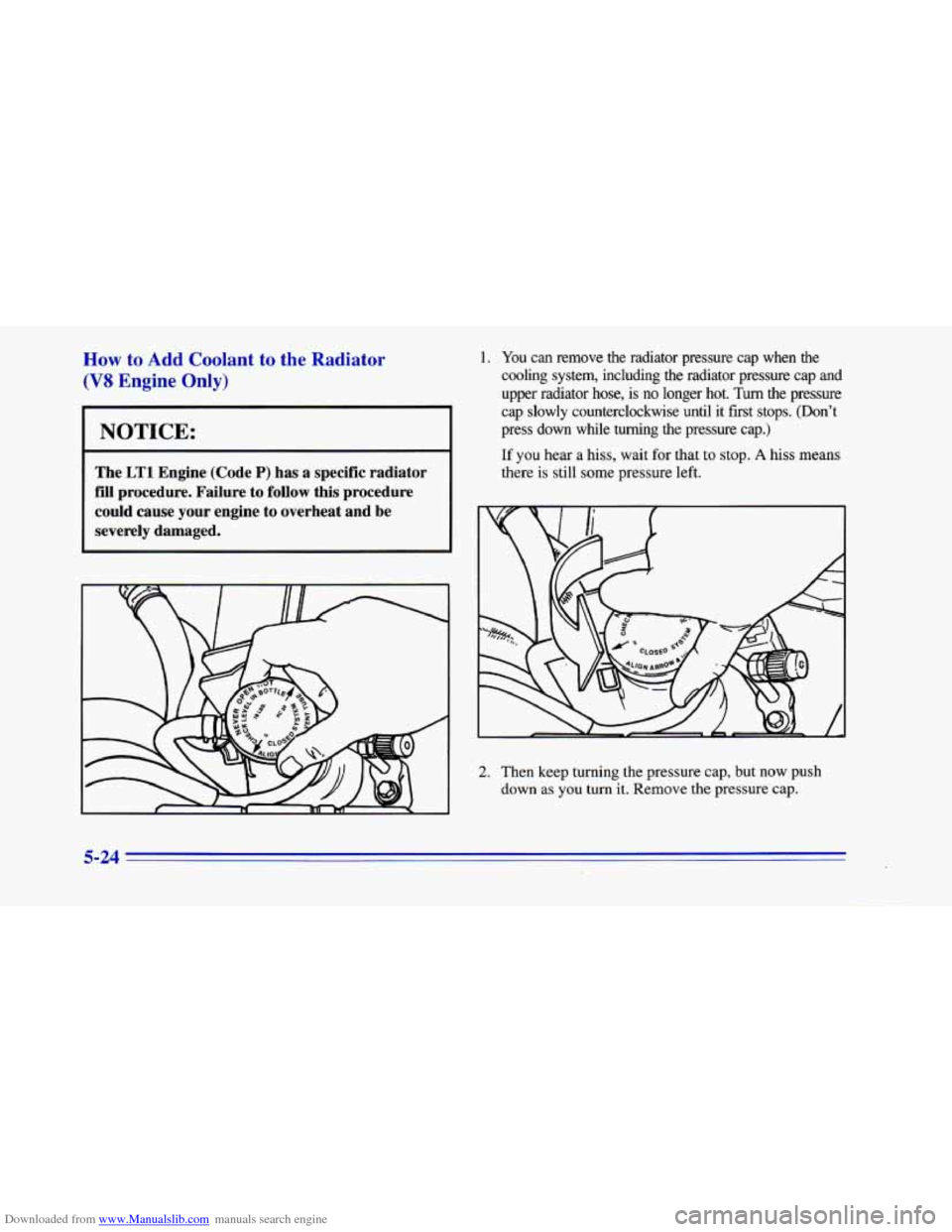
1. You can remove the radiator pressure cap when the
cooling system, including the radiator pressure cap
and
upper radiator hose, is no longer hot. Turn the pressure
cap slowly counterclockwise until it first stops. (Don’t
press down while turning the pressure cap.)
If you hear a hiss, wait for that to stop. A hiss means
there is still some pressure
left.
2. Then keep turning the pressure cap, but now push
down as you turn
it. Remove the pressure cap.
Page 234 of 402
Downloaded from www.Manualslib.com manuals search engine If a Tire Goes Flat
It’s unusual for a tire to “blow out” while you’re driving,
especially if you maintain your tires properly. If air goes
out of a tire, it’s much more likely
to leak out slowly.
But if you. should ever have a “blowout,” here are a few
tips about what
to expect and what to do:
If a front tire fails, the flat tire will create a drag that
pulls the vehicle toward that side. Take your foot
off the
accelerator pedal and grip the steering wheel firmly.
Steer to maintain lane position, and then gently brake to
a stop well
out of the traffic lane.
A rear blowout, particularly on a curve, acts much like a
skid and may require the same correction you’d use in a
skid. In any rear blowout, remove your foot from the
accelerator pedal. Get the vehicle under control by
steering the way you want the vehicle
to go. It may be
very bumpy and noisy, but you can still steer. Gently
brake to a stop
-- well off the road if possible.
If a tire goes flat, the next part shows how to use your
jacking equipment to change a flat tire safely.
Changing a Flat Tire
If a tire goes flat, avoid further tire and wheel damage
by driving slowly to a level place. Turn on your hazard
warning flashers.
A CAUTION:
Changing a tire can cause an injury. The vehicle
can slip off the jack and roll over you or other
people. You and they could be badly injured.
Find a level place to change your tire. To help
prevent the vehicle from moving:
1. Set the parking brake firmly.
2. Put an automatic transmission shift
lever in
PARK (P), or shift a manual
transmission to
FIRST (1) or
REVERSE (R).
3. Brn off the engine.
To be even more certain the vehicle won’t move,
you can put blocks at the front and rear
of the
tire farthest away from the one being changed.
That would be the tire on the other side of the
vehicle, at the opposite end.
5-27
Page 235 of 402
Downloaded from www.Manualslib.com manuals search engine The following steps will tell you how to use the jack and
change a tire.
Removing the Spare Tire and TG,,~~
The equipment you’ll need is in the right (passenger)
rear area behind the trim panel.
First you must remove the close-out panel. See
“Close-Out Panel” in the Index.
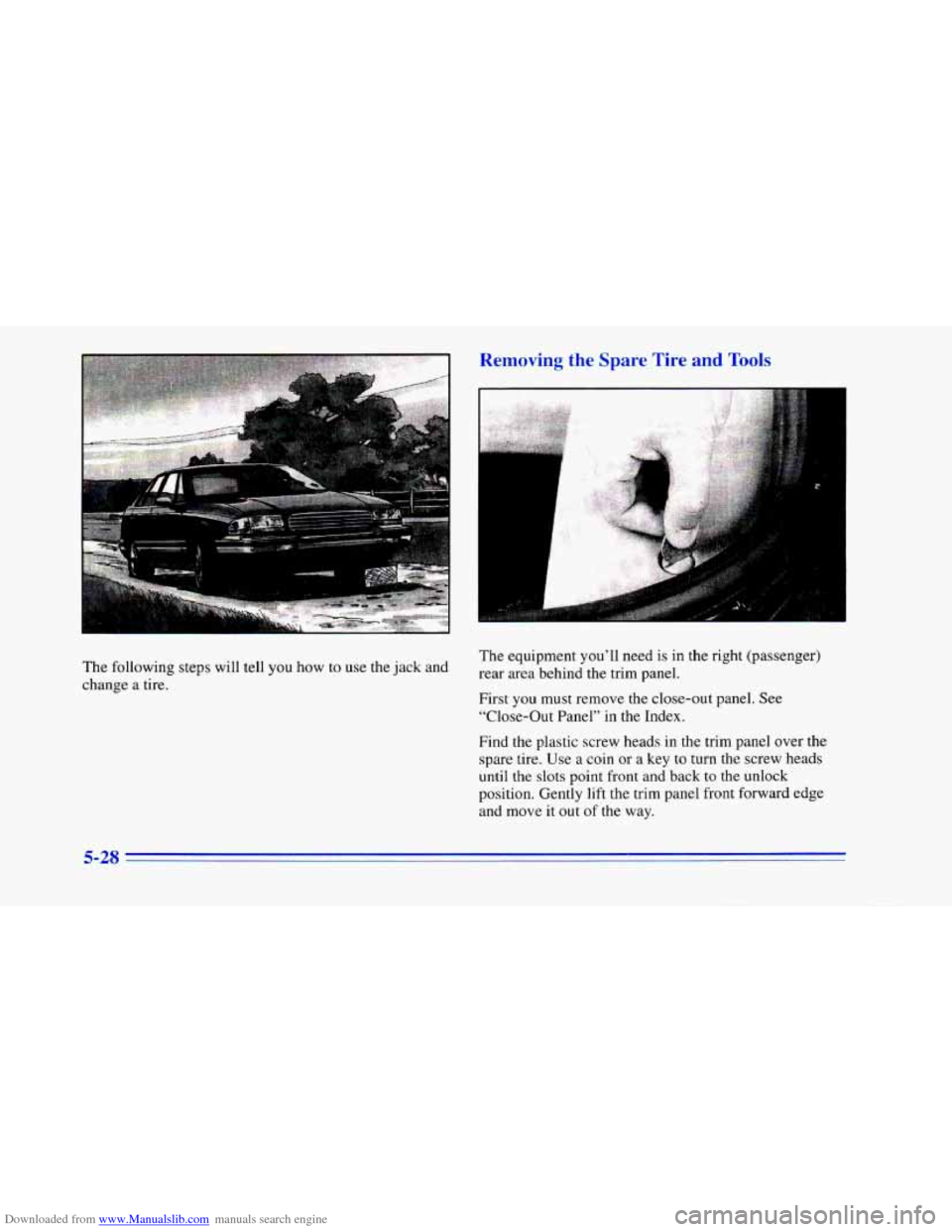
Find the plastic screw heads in the trim panel over the
spare tire. Use a coin or a key to turn the screw heads
until the slots point front and back to the unlock
position. Gently lift the trim panel front forward edge
and move it out
of the way.
5-28 -
Page 239 of 402
Downloaded from www.Manualslib.com manuals search engine If your vehicle has optional alloy wheels, each wheel
may have one locknut in place
of the standard wheel
nut.
A special wheel lock key (removal tool) and
instructions are located in the center console. Attach the
wheel lock key to the socket
of the wheel wrench.
Remove the locking wheel nut by turning
counterclockwise.
Removing the Flat Tire and Installing the
Spare Tire
1. Using the wheel wrench, loosen all the wheel nuts.
Don’t remove them yet.
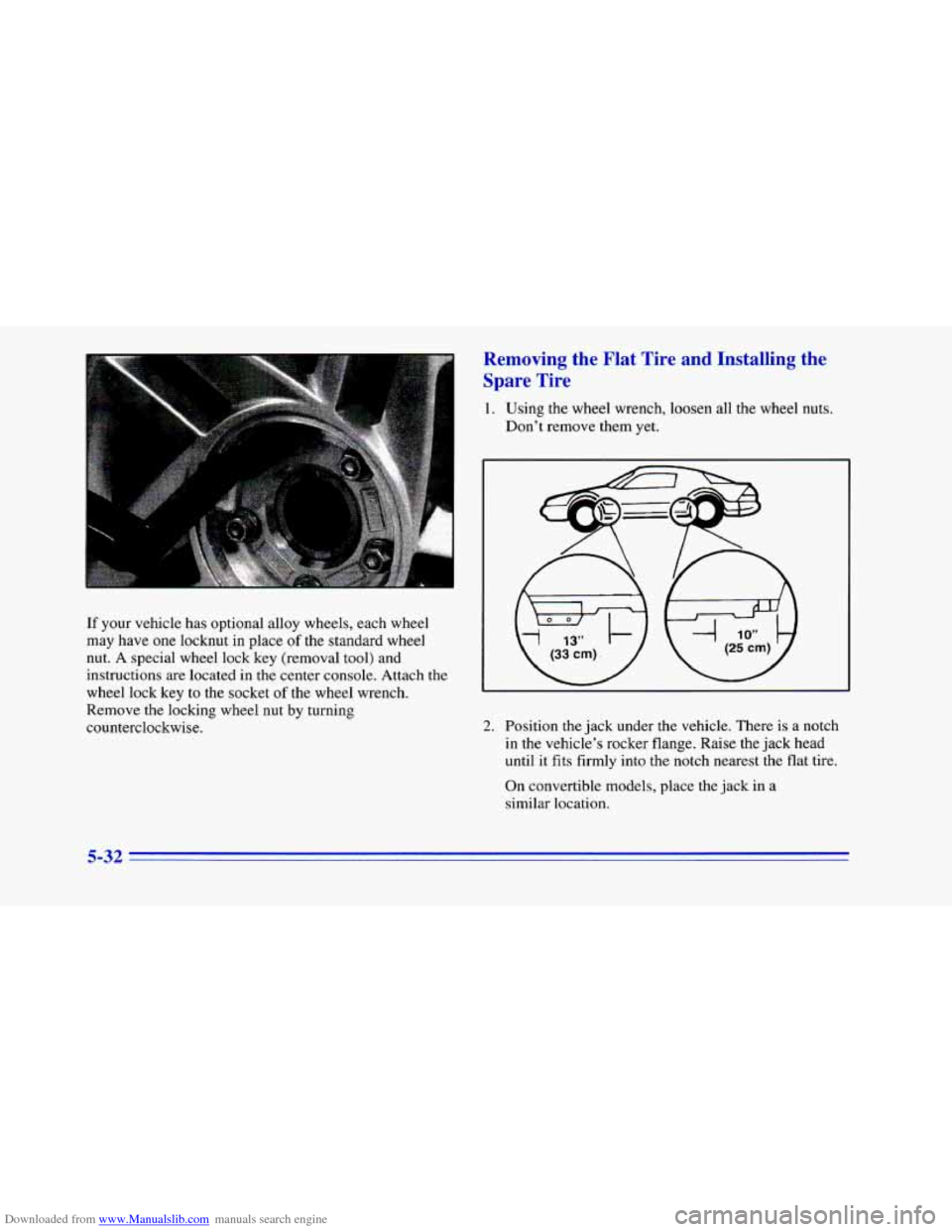
2. Position the jack under the vehicle. There is a notch
in the vehicle’s rocker flange. Raise the jack head
until
it fits firmly into the notch nearest the flat tire.
On convertible models, place the jack in a
similar location.
5-32
Page 241 of 402
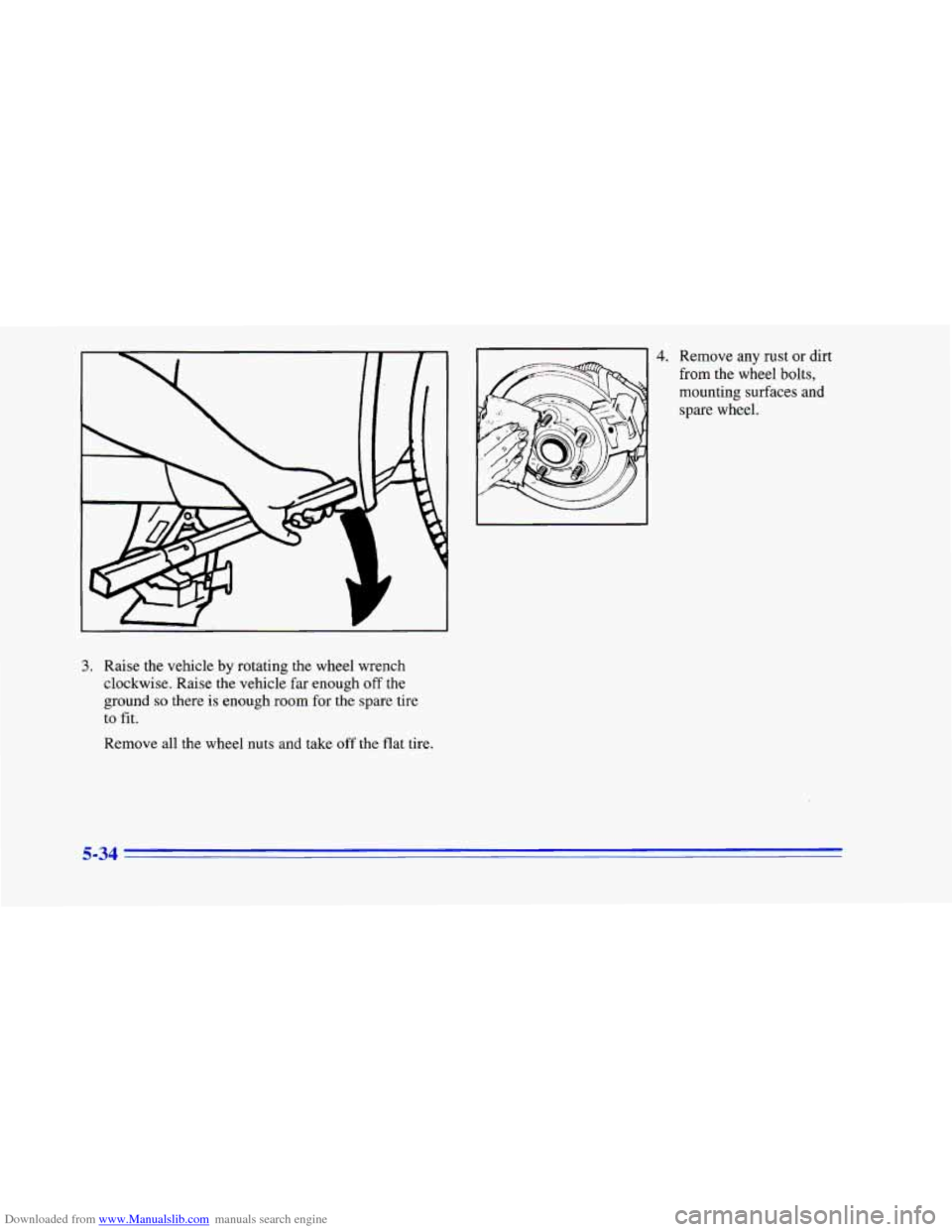
Downloaded from www.Manualslib.com manuals search engine 3. Raise the vehicle by rotating the wheel wrench
clockwise. Raise the vehicle far enough
off the
ground
so there is enough room for the spare tire
to fit.
Remove
all the wheel nuts and take off the flat tire.
4. Remove any rust or dirt
from the wheel bolts,
mounting surfaces and
spare wheel.
5-34
Page 243 of 402
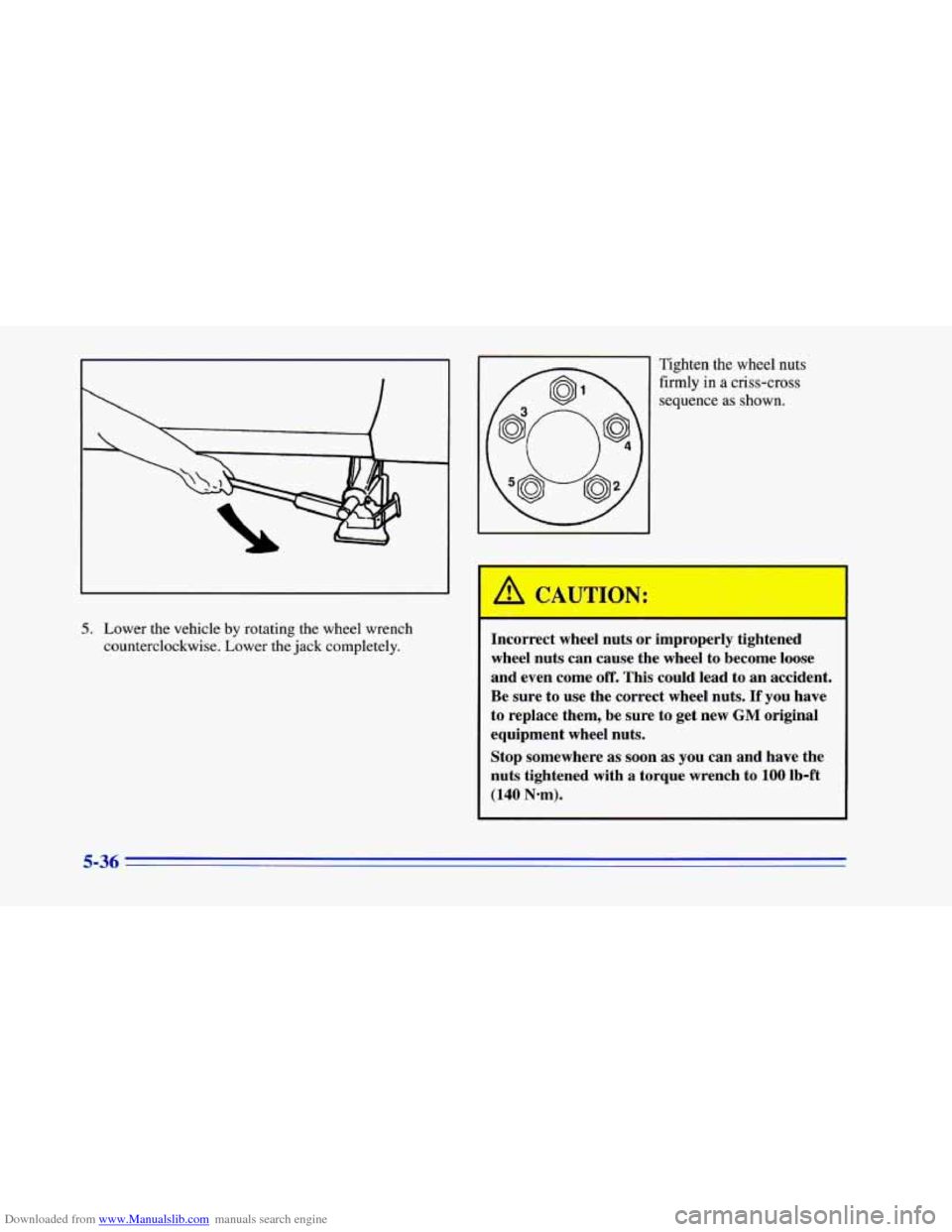
Downloaded from www.Manualslib.com manuals search engine 5. Lower the vehicle by rotating the wheel wrench
counterclockwise. Lower
the jack completely.
Tighten the wheel nuts
firmly in a criss-cross
sequence
as shown.
1 Incorrect wheel nuts or improperly tightened ~ wheel nuts can cause the wheel to become loose
and even come
off. This could lead to an accident.
Be sure to use the correct wheel nuts.
If you have
to replace them, be sure to get new
GM original
equipment wheel nuts.
Stop somewhere
as soon as you can and have the
nuts tightened with
a torque wrench to 100 lb-ft
(140 Nom).
5-36
Page 256 of 402
Downloaded from www.Manualslib.com manuals search engine Filling Your Tank
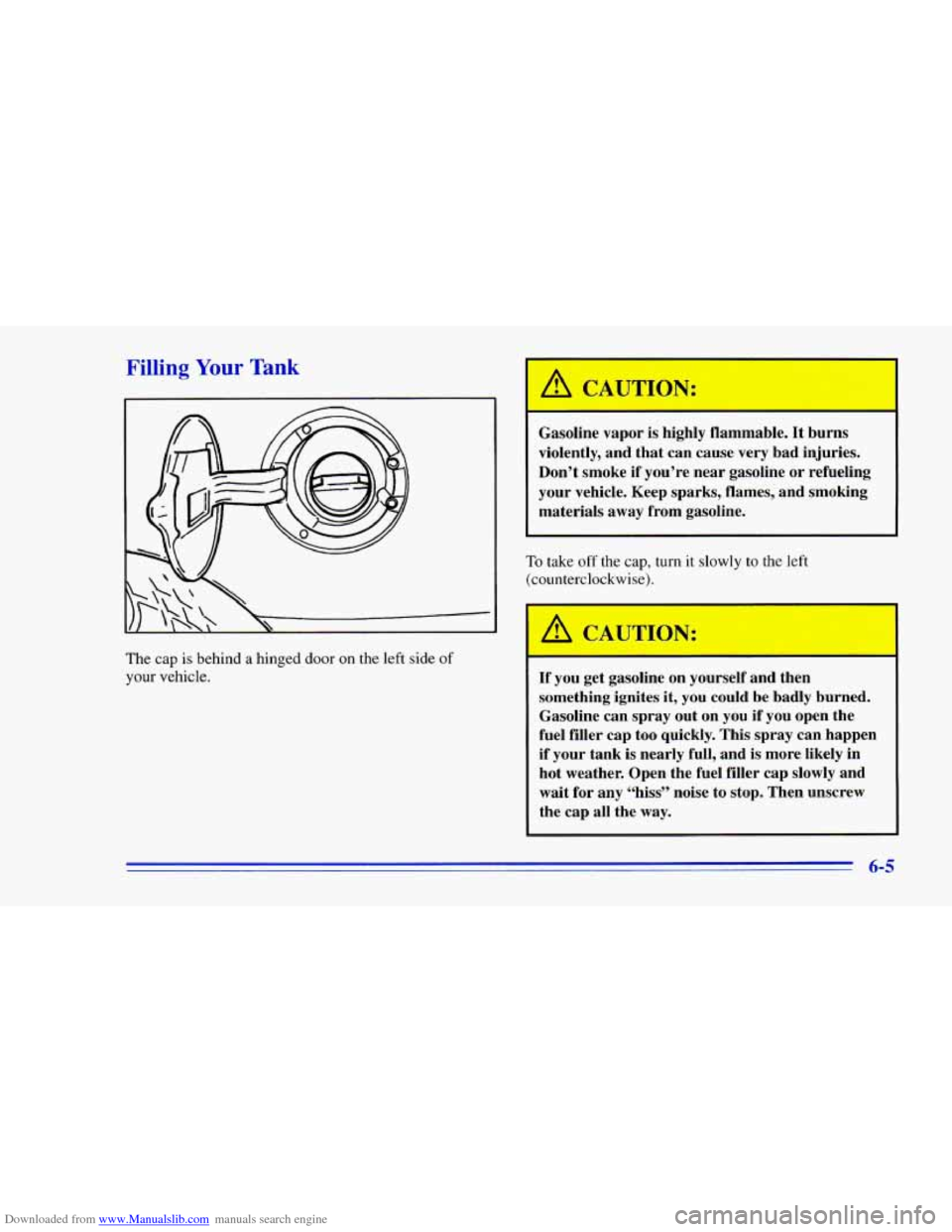
The cap is behind a hinged door on the left side of
your vehicle.
A CAUTION-
Gasoline vapor is highly flammable. It burns
violently, and that can cause very bad injuries.
Don’t smoke if you’re near gasoline or refueling
your vehicle. Keep sparks, flames, and smoking
materials away from gasoline.
To take off the cap, turn it slowly to the left
(counterclockwise).
IA ,-._____
N:
If you get gasoline on yourself and then
something ignites it, you could be badly burned.
Gasoline can spray out on you if you open the
fuel filler cap too quickly. This spray can happen
if your tank is nearly full, and
is more likely in
hot weather. Open the fuel filler cap slowly and
wait for any “hiss” noise to stop. Then unscrew
the cap
all the way.
I
6-5
Page 290 of 402
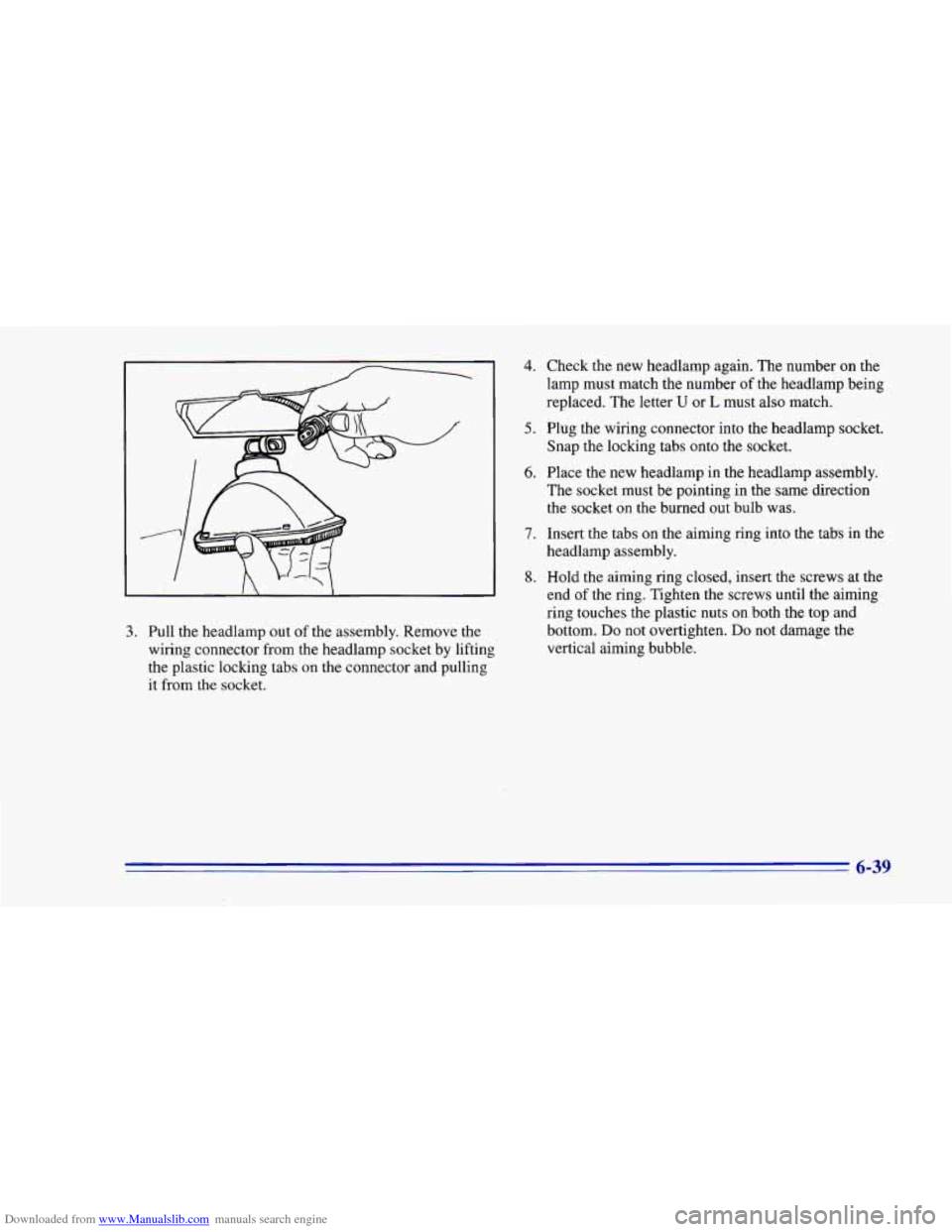
Downloaded from www.Manualslib.com manuals search engine 3. Pull the headlamp out of the assembly. Remove the
wiring connector from the headlamp socket by lifting
the plastic locking tabs on the connector and pulling
it from the socket.
4. Check the new headlamp again. The number on the
lamp must match the number
of the headlamp being
replaced. The letter
U or L must also match.
5. Plug the wiring connector into the headlamp socket.
Snap the locking tabs onto the socket.
6. Place the new headlamp in the headlamp assembly.
The socket must be pointing in the same direction
the socket
on the burned out bulb was.
7. Insert the tabs on the aiming ring into the tabs in the
headlamp assembly.
8. Hold the aiming ring closed, insert the screws at the
end
of the ring. Tighten the screws until the aiming
ring touches the plastic nuts on both the top and
bottom.
Do not overtighten. Do not damage the
vertical aiming bubble.
6-39
Page 295 of 402
Downloaded from www.Manualslib.com manuals search engine Rear Lamps
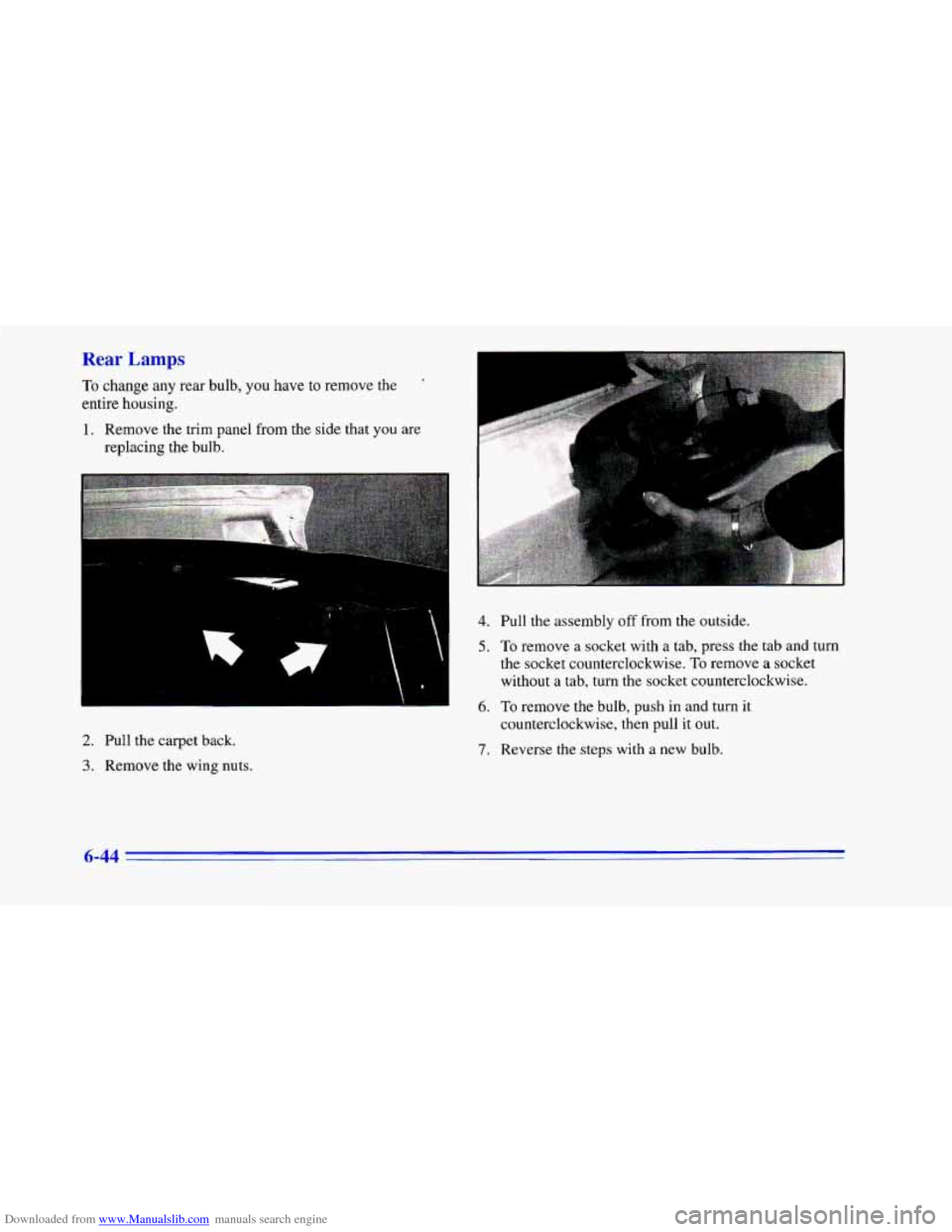
To change any rear bulb, you have to remove the
entire housing.
1. Remove the trim panel from the side that you are
replacing the bulb.
2. Pull the carpet back.
3. Remove the wing nuts.
4. Pull the assembly off from the outside.
5. To remove a socket with a tab, press the tab and turn
the socket counterclockwise.
To remove a socket
without
a tab, turn the socket counterclockwise.
6. To remove the bulb, push in and turn it
counterclockwise, then pull
it out.
7. Reverse the steps with a new bulb.
6-44
Page 296 of 402
Downloaded from www.Manualslib.com manuals search engine Rear Sidemarker
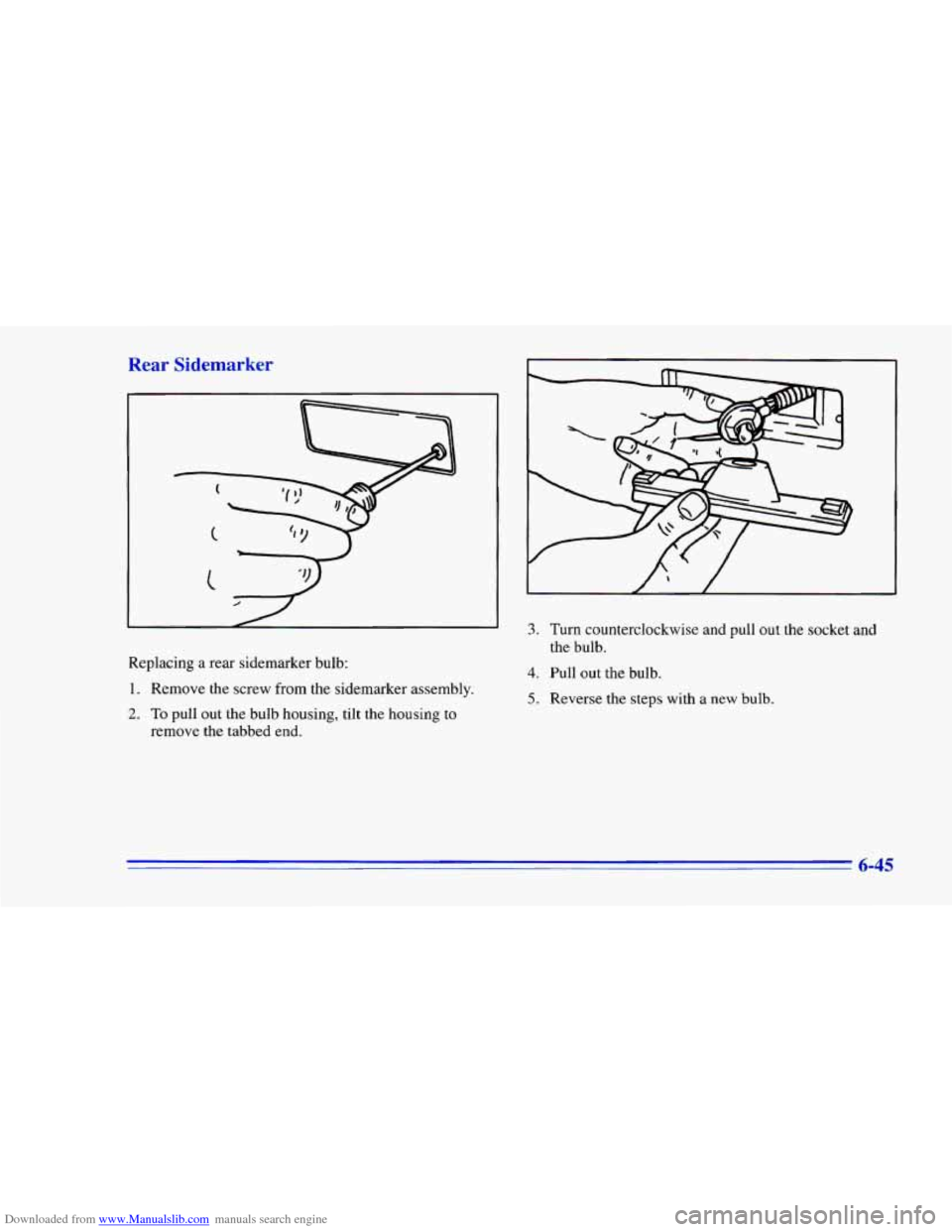
Replacing a rear sidemarker bulb:
1. Remove the screw from the sidemarker assembly.
2. To pull out the bulb housing, tilt the housing to
remove the tabbed end.
3. Turn counterclockwise and pull out the socket and
4. Pull out the bulb.
the bulb.
5. Reverse
the steps w ith a new bulb.
6-45