lock CHEVROLET CAMARO 1998 4.G Manual Online
[x] Cancel search | Manufacturer: CHEVROLET, Model Year: 1998, Model line: CAMARO, Model: CHEVROLET CAMARO 1998 4.GPages: 402, PDF Size: 21.2 MB
Page 296 of 402
Downloaded from www.Manualslib.com manuals search engine Headlamns
3.
Before replacing a headlamp that does not light, check
to make sure that the wiring connector
is securely
fastened to
it.
See "Replacement Bulbs" in the Index to check type of
headlamp you need to use before you begin to replace
the headlamp.
You must replace a headlamp with one
that is exactly the same.
1. Open the hood.
2. Locate the affected headlamp.
4.
5.
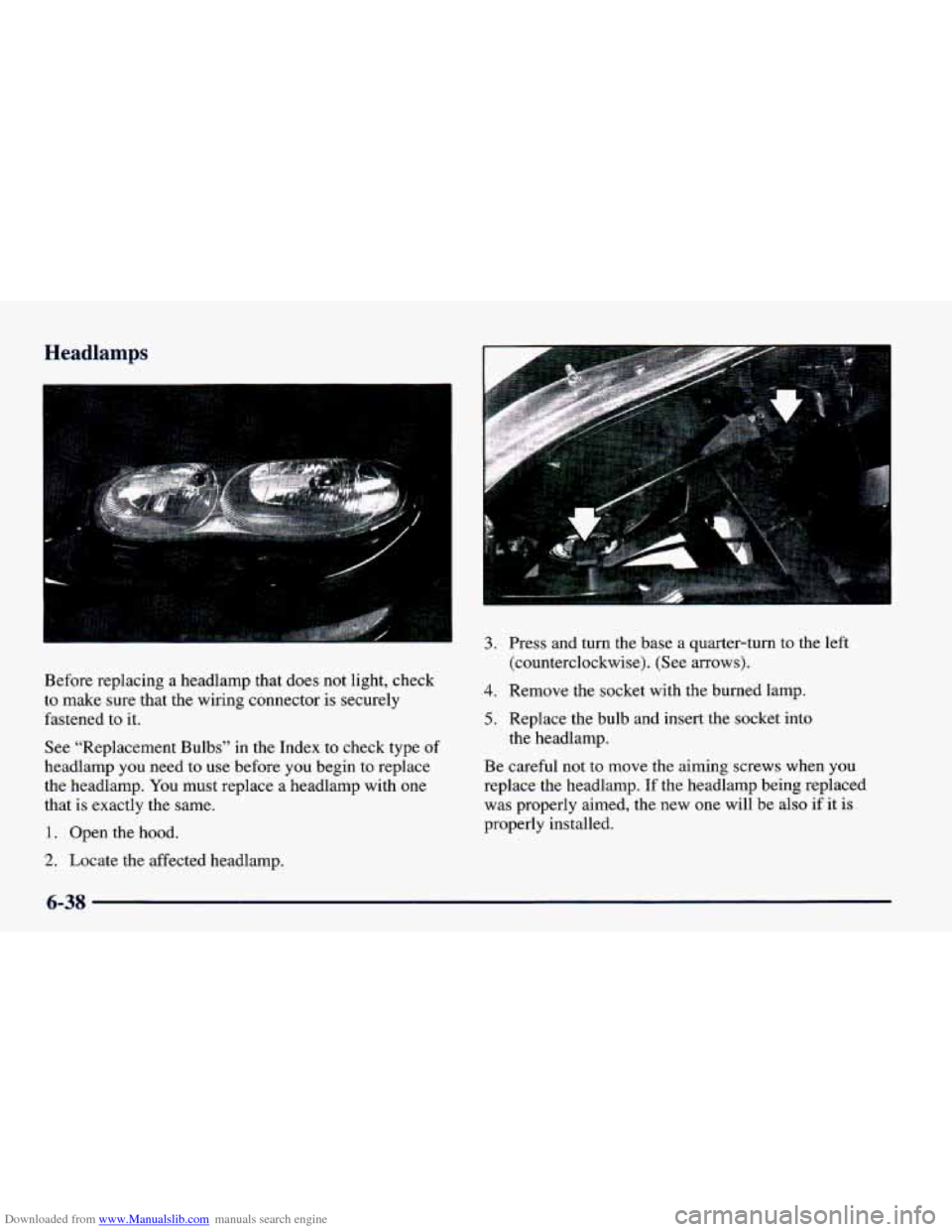
Press and turn the base a quarter-turn to the left
(counterclockwise). (See arrows).
Remove the socket with
the burned lamp.
Replace the bulb and insert the socket into
the headlamp.
Be careful
not to move the aiming screws when you
replace the headlamp. If the headlamp being replaced
was properly aimed, the new one will be also
if it is
properly installed.
6-38
Page 298 of 402
Downloaded from www.Manualslib.com manuals search engine Rear Lamps
To change any rear bulb, you have to remove the
entire housing.
1. Remove the trim panel from the side that you are
replacing the bulb.
2. Pull the carpet back.
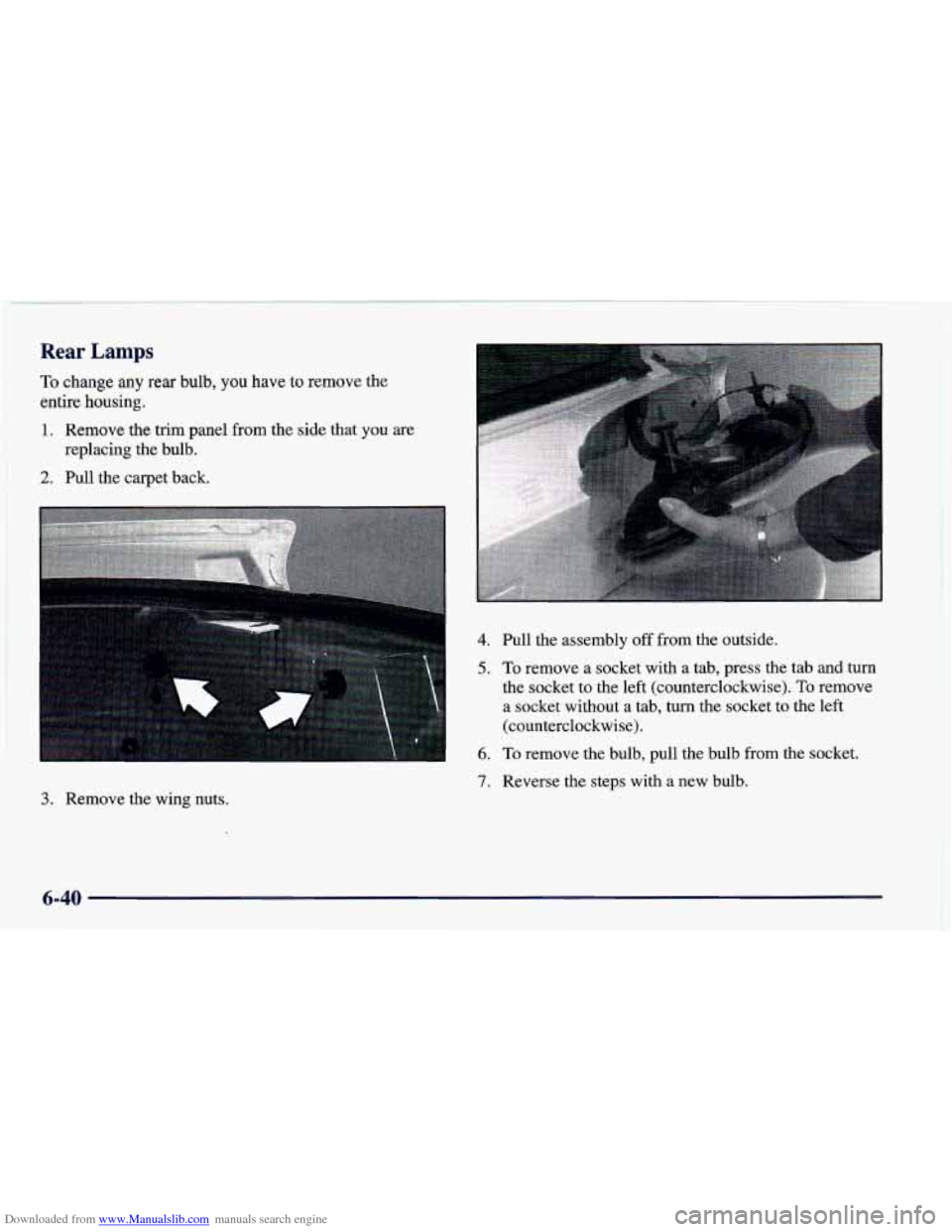
4. Pull the assembly off from the outside.
5. To remove a socket with a tab, press the tab and turn
the socket to the left (counterclockwise).
To remove
a socket without a tab, turn the socket to the left
(counterclockwise).
6. To remove the bulb, pull the bulb from the socket.
7. Reverse the steps with a new bulb.
3. Remove the wing nuts.
6-40
Page 299 of 402
Downloaded from www.Manualslib.com manuals search engine Rear Sid marker
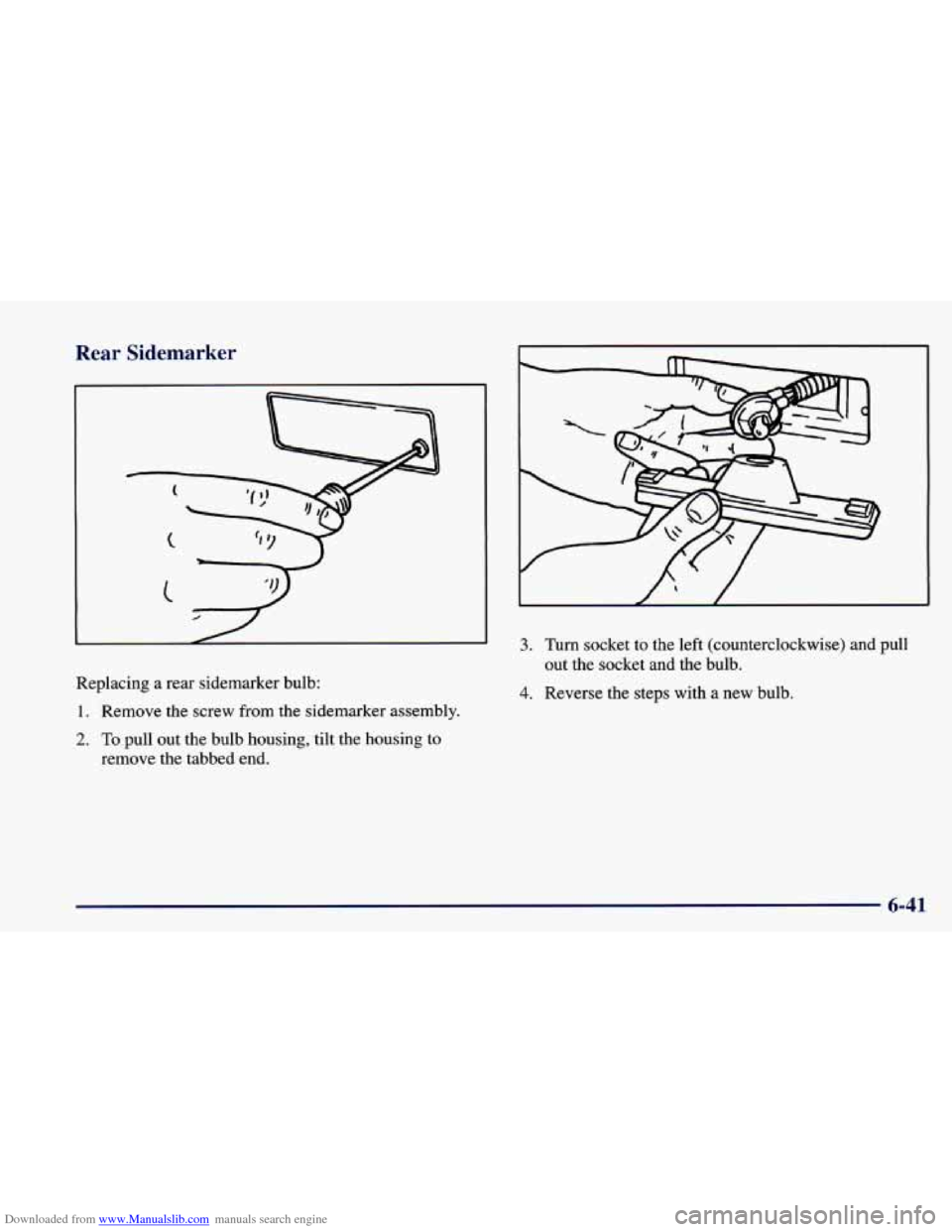
Replacing a rear sidemarker bulb:
1. Remove the screw from the sidemarker assembly.
2. To pull out the bulb housing, tilt the housing to
remove the tabbed
end.
I
3. Turn socket to the left (counterclockwise) and pull
out the socket
and the bulb.
4. Reverse the steps with a new bulb,
6-41
Page 300 of 402
Downloaded from www.Manualslib.com manuals search engine Wiper Blade Assembly Replacement
Replacement blades come in different types and are
removed in different ways.
To remove the wiper blade assembly:
1. Lift the wiper arm until it locks into an
2. Press the locking tab in while sliding the blade upright position.
assembly down.
Wiper Blade Element Replacement
To replace the wiper blade element, refer to the wiper
blade assembly replacement instructions. To replace
the element follow these steps:
1.
2.
3.
4.
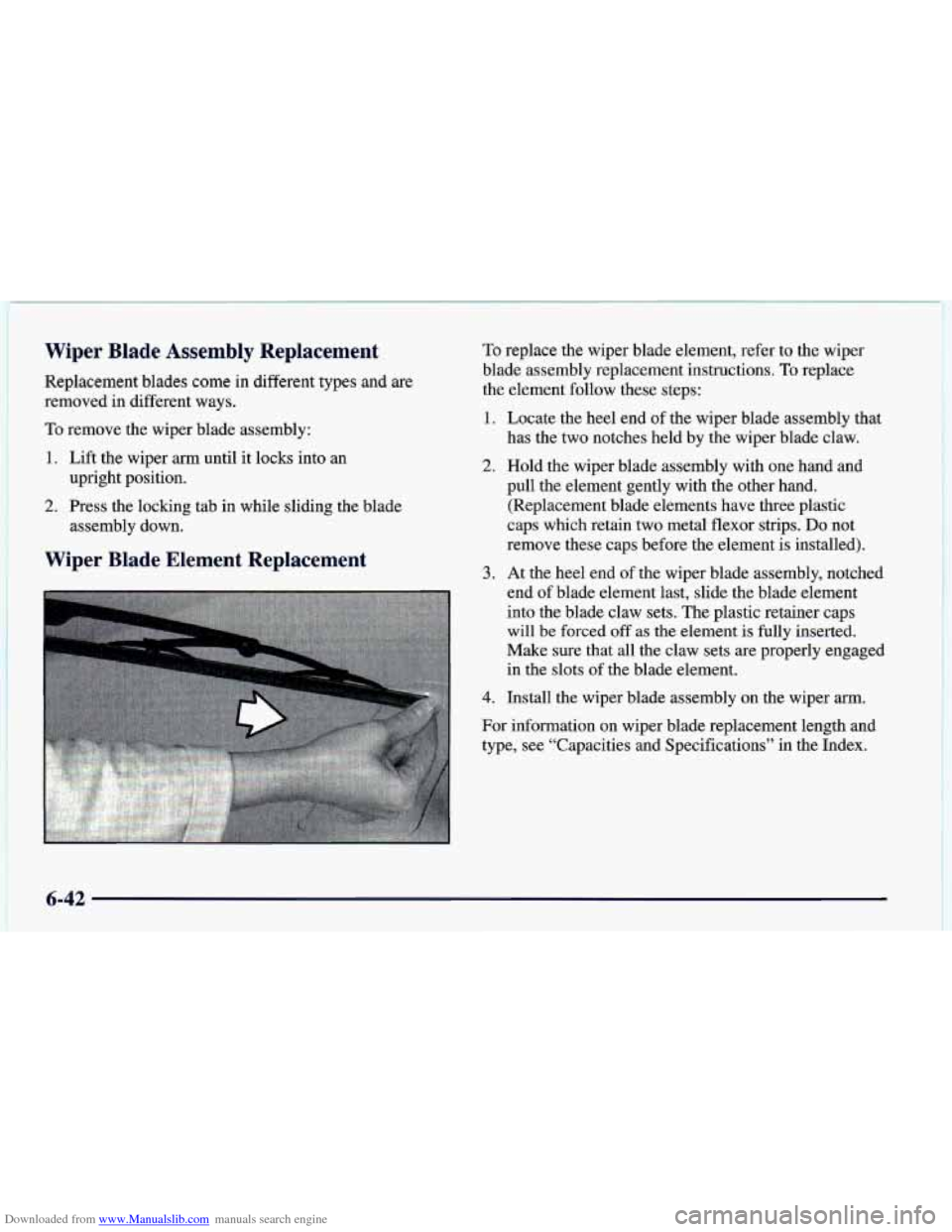
Locate the heel end of the wiper blade assembly that
has the two notches held by the wiper blade claw.
Hold the wiper blade assembly with one hand and
pull the element gently with the other hand. (Replacement blade elements have three plastic
caps which retain two metal flexor strips.
Do not
remove these caps before the element is installed).
At the heel end of the wiper blade assembly, notched
end of blade element last, slide the blade element
into the blade claw sets. The plastic retainer caps will be forced off
as the element is fully inserted.
Make sure that all the claw sets are properly engaged
in the slots of the blade element.
Install the wiper blade assembly on the wiper arm.
For information on wiper blade replacement length and
type, see “Capacities and Specifications’’ in the Index.\
6-42
Page 324 of 402
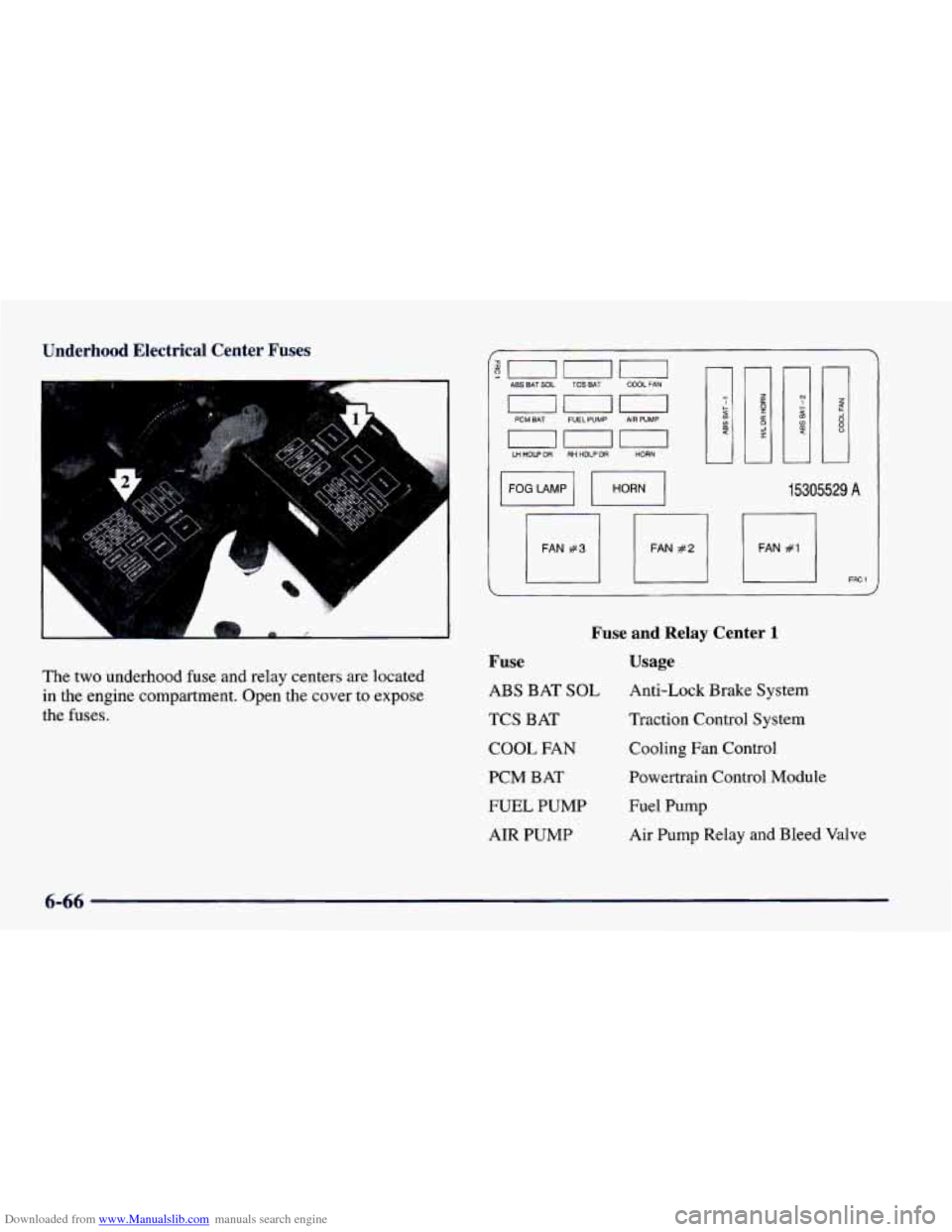
Downloaded from www.Manualslib.com manuals search engine Underhood Electrical Center Fuses
ABS BAT SOL TCS BAT COOL FAN
000
PCM BAT FUEL PUMP AIR PUMP
LH HOW OR RH HDLP DR HORN
r
FAN $43 1L
1
15305529 A
The two underhood fuse and relay centers are located
in the engine compartment. Open the cover to expose
the fuses.
Fuse
ABS BAT SOL
TCS BAT
COOL FAN
PCM BAT
FUEL PUMP
AIR PUMP
--- 1
-
Fuse and Relay Center 1
Usage
Anti-Lock Brake System
Traction Control System
Cooling Fan Control
Powertrain Control Module
Fuel Pump
Air Pump Relay and Bleed Valve
6-66
Page 325 of 402
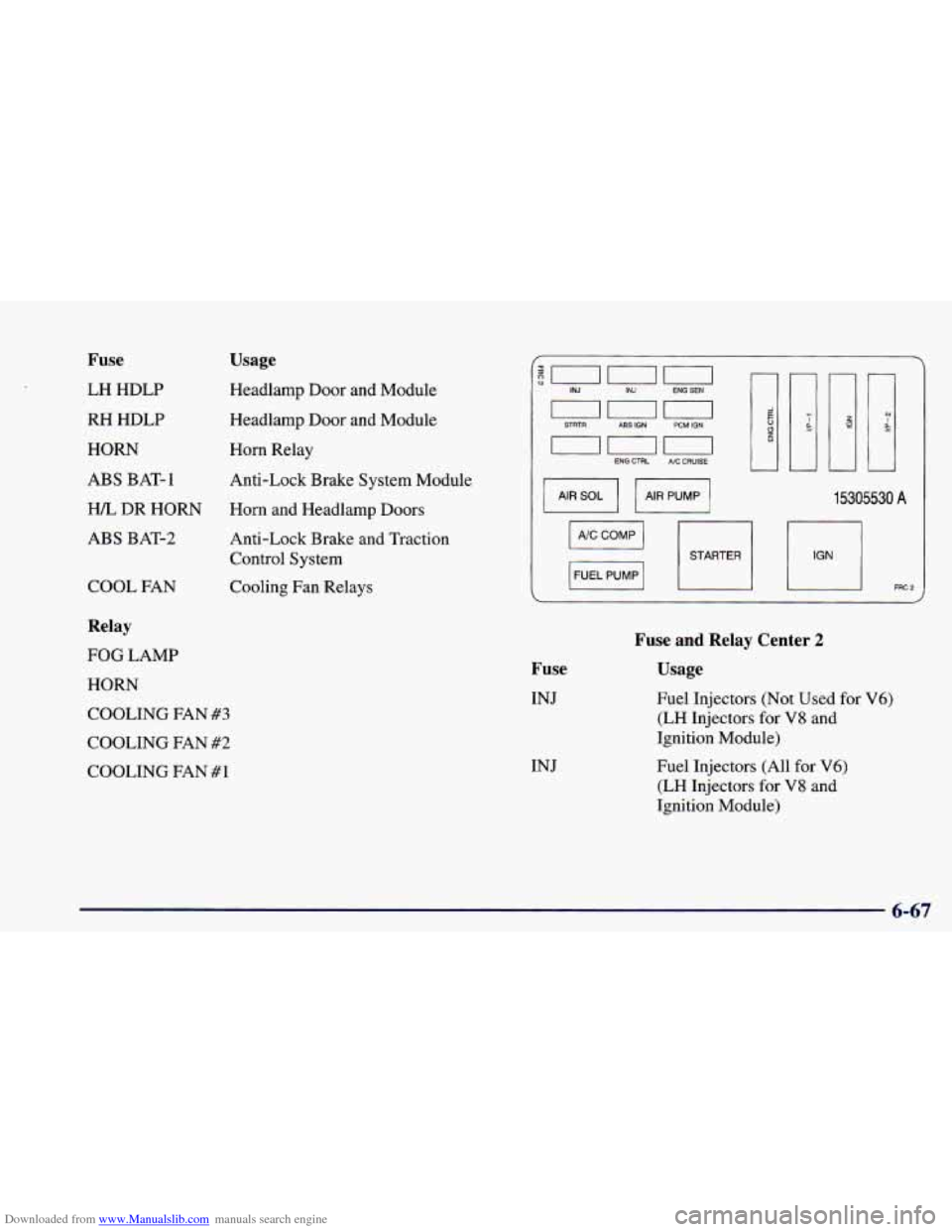
Downloaded from www.Manualslib.com manuals search engine Fuse
LH HDLP
RH HDLP
HORN
Usage
Headlamp Door and Module
Headlamp Door and Module
Horn Relay
ABS BAT-1 Anti-Lock Brake System Module
H/L DR HORN Horn and Headlamp Doors
ABS BAT-2 Anti-Lock Brake and Traction
Control System
Cooling Fan Relays
COOL
FAN
Relay
FOG LAMP
HORN COOLING FAN
#3
COOLING FAN #2
COOLING FAN #1
on0
on0
INJ INJ ENG SEN
STRTR ABS IGN PCM IGN
ENG CTRL A/C CRUISE
z
15305530 A
FRC 2
Fuse
INJ
INJ
Fuse and Relay Center 2
Usage
Fuel Injectors (Not Used for V6)
(LH Injectors for V8 and
Ignition Module)
Fuel Injectors (All for
V6)
(LH Injectors for V8 and
Ignition Module)
6-67
Page 326 of 402
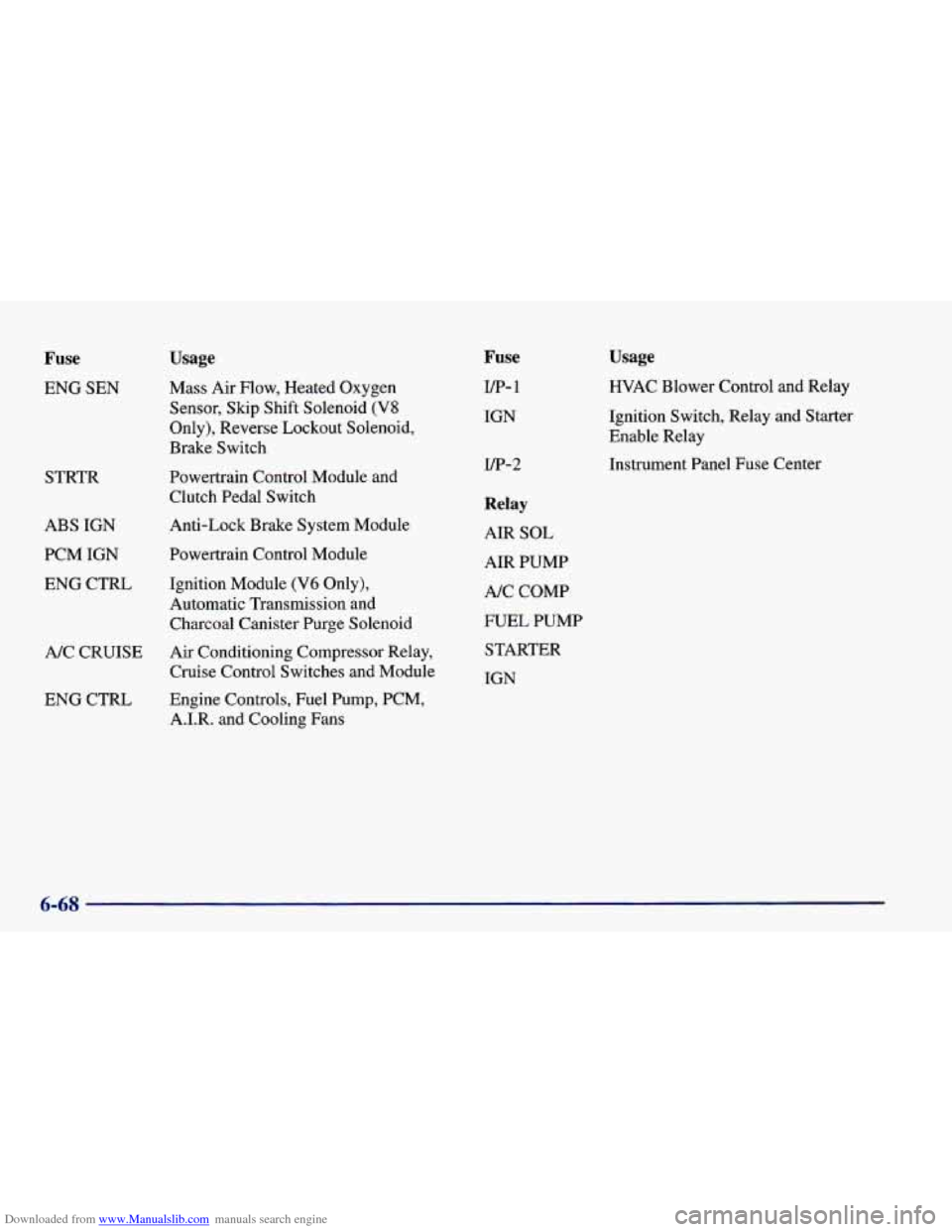
Downloaded from www.Manualslib.com manuals search engine Fuse
ENG SEN
STRTR
ABS IGN PCM IGN
ENG CTRL
Usage
Mass Air Flow, Heated Oxygen
Sensor, Skip Shift Solenoid
(V8
Only), Reverse Lockout Solenoid,
Brake Switch
Powertrain Control Module and
Clutch Pedal Switch
Anti-Lock Brake System Module
Powertrain Control Module
Ignition Module (V6 Only),
Automatic Transmission and
Charcoal Canister Purge Solenoid
A/C CRUISE Air Conditioning Compressor Relay,
Cruise Control Switches and Module
ENG CTRL Engine Controls, Fuel Pump, PCM,
A.I.R. and Cooling Fans
Fuse
I/P- 1
IGN
UP- 2
Relay
AIR SOL
AIR PUMP
A/C COMP
FUEL PUMP STARTER
IGN
Usage
HVAC Blower Control and Relay
Ignition Switch, Relay and Starter
Enable Relay
Instrument Panel Fuse Center
6-68
Page 363 of 402
Downloaded from www.Manualslib.com manuals search engine At Least Twice a Year
Restraint System Check
Make sure the safety belt reminder light and all your
belts, buckles, latch plates, retractors and anchorages are
working properly. Look for any other loose or damaged
safety belt system parts. If you see anything that might
keep a safety belt system from doing its job, have it
repaired. Have any torn or frayed safety belts replaced.
Also look for any opened or broken air bag coverings,
and have them repaired or replaced. (The air bag system
does not need regular maintenance.)
Wiper Blade Check
Inspect wiper blades for wear or cracking. Replace blade
inserts that appear worn or damaged or that streak or
miss areas of the windshield. Also see “Wiper Blades,
Cleaning” in the Index.
Manual Transmission Check
Check the transmission fluid level; add if needed. See
“Manual Transmission” in the Index. Check for leaks.
A fluid loss may indicate a problem. Have the system
inspected and repaired if needed.
Automatic Transmission Check
Check the transmission fluid level; add if needed. See
“Automatic Transmission” in the Index. A fluid loss
may indicate a problem. Check the system and repair if
needed.
Hydraulic Clutch System Check
Check the fluid level in the clutch reservoir. See
“Hydraulic Clutch Fluid” in the Index. A fluid loss
in this system could indicate a problem. Have the
system inspected and repaired at once.
At Least Once a Year
Key Lock Cylinders Service
Lubricate the key lock cylinders with the lubricant
specified in Part
D.
Body Lubrication Service
Lubricate all hinges and latches, including those for the
hood, rear compartment, console doors and any folding
seat hardware. Part
D tells you what to use. More
frequent lubrication may be required when exposed to
a corrosive environment.
7-33
Page 364 of 402
Downloaded from www.Manualslib.com manuals search engine Starter Switch Check When you are doing this check, the vehicle could
move suddenly.
If it does, you or others could be
injured. Follow the steps below.
1.
2.
3.
Before you start, be sure you have enough room
around the vehicle.
Firmly apply both the parking brake (see “Parking
Brake”
in the Index if necessary) and the regular brake.
NOTE:
Do not use the accelerator pedal, and be
ready to turn off the engine immediately if it starts.
On automatic transmission vehicles, try to start the
engine in each gear. The starter should work only in
PARK
(P) or NEUTRAL (N). If the starter works in
any other position, your vehicle needs service.
On manual transmission vehicles, put the shift lever
in NEUTRAL
(N), push the clutch down halfway
and try to start the engine. The starter should work
only when the clutch is pushed down all the way to
the floor. If the starter works when the clutch isn’t
pushed all the way down, your vehicle needs service.
Brake-Transmission Shift Interlock (BTSI) Check
(Automatic Transmission)
When you are doing this
( !ck, the vehicle could
move suddenly.
If it does, you or others could be
injured. Follow the steps below.
1.
2.
3.
Before you start, be sure you have enough room
around the vehicle. It should be parked on
a
level surface.
Firmly apply the parking brake (see “Parking Brake”
in the Index if necessary).
NOTE: Be ready
to apply the regular brake
immediately if the vehicle begins to move.
With the engine off, turn the key to the RUN
position, but don’t start the engine. Without applying
the regular brake, try to move the shift lever out of
PARK
(P) with normal effort. If the shift lever
moves out of PARK (P), your vehicle’s BTSI
needs service.
7-34
Page 365 of 402
Downloaded from www.Manualslib.com manuals search engine Ignition Transmission Lock Check
While parked, and with the parking brake set, try to turn
the ignition key
to LOCK in each shift lever position.
With an automatic transmission, the key should turn
to LOCK only when the shift lever is in PARK (P).
With a manual transmission, the key should turn to
LOCK only when the
shift lever is in REVERSE (R).
On vehicles with a key release button, try to turn the key
to LOCK without pressing the button. The key should
turn to LOCK only when you press the key button.
On all vehicles, the key should come out only in LOCK.
Parking Brake and Automatic Transmission
PARK
(P) Mechanism Check
A CAT JTION:
When you are doing this checkyour vehicle
could begin to move. You or others could be
injured and property could be damaged. Make
sure there
is room in front of your vehicle in case
it begins to roll. Be ready to apply the regular
brake at once should the vehicle begin to move.
Park on a fairly steep hill, with the vehicle facing
downhill. Keeping your foot on the regular brake,
set the parlung brake.
To check the parking brake’s holding ability:
With the engine running and transmission in
NEUTRAL (N), slowly remove foot pressure
from the regular brake pedal.
Do this until the
vehicle is held by the parking brake only.
To check the PARK (P) mechanism’s holding ability:
With the engine running, shift to PARK (P). Then
release all brakes.
Underbody Flushing Service
At least every spring, use plain water to flush any
corrosive materials from the underbody. Take care to
clean thoroughly any areas where mud and other debris
can collect.
7-35