lock CHEVROLET CAMARO 1998 4.G Manual PDF
[x] Cancel search | Manufacturer: CHEVROLET, Model Year: 1998, Model line: CAMARO, Model: CHEVROLET CAMARO 1998 4.GPages: 402, PDF Size: 21.2 MB
Page 208 of 402
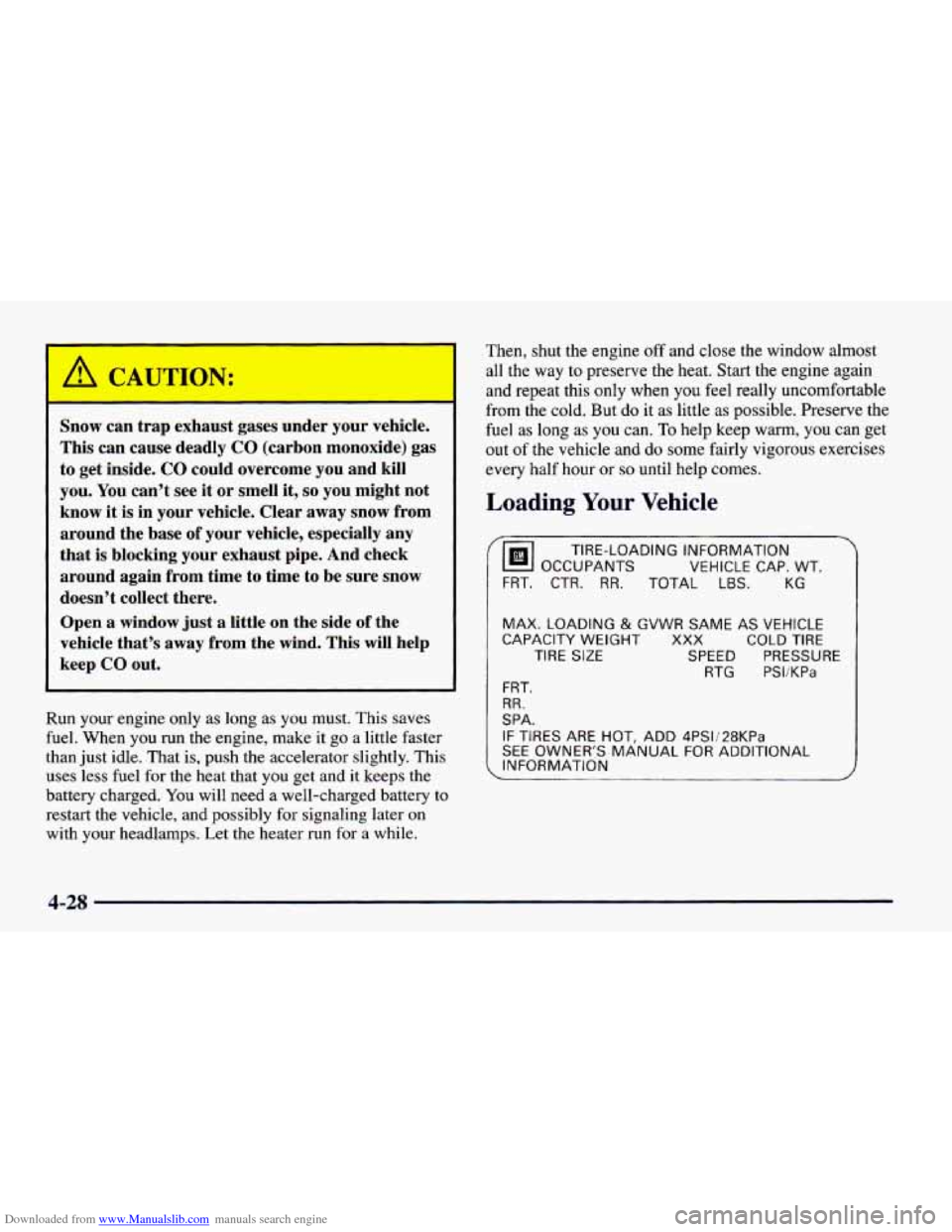
Downloaded from www.Manualslib.com manuals search engine a CAUTION:
Snow can trap exhaust gases under your vehicle.
This can cause deadly
CO (carbon monoxide) gas
to get inside. CO could overcome you and kill
you.
You can’t see it or smell it, so you might not
know it is in your vehicle. Clear away snow from
around the base of your vehicle, especially any
that
is blocking your exhaust pipe. And check
around again from time
to time to be sure snow
doesn’t collect there.
Open
a window just a little on the side of the
vehicle that’s away from the wind. This will help
keep
CO out.
Run your engine only as long as you must. This saves
fuel. When you run the engine, make it go a little faster
than just idle. That is, push the accelerator slightly. This
uses less fuel for the heat that
you get and it keeps the
battery charged.
You will need a well-charged battery to
restart the vehicle, and possibly for signaling later on
with your headlamps. Let the heater run for a while. Then,
shut the engine
off and close the window almost
all the way to preserve the heat. Start the engine again
and repeat this
only when you feel really uncomfortable
from the cold. But do it as little as possible. Preserve the
fuel as long as you can.
To help keep warm, you can get
out of the vehicle and do some fairly vigorous exercises
every half hour or
so until help comes.
Loading Your Ve’ kle
OCCUPANTS
VEHICLE CAP. WT.
.
TIRE-LOADING INFORMATION
FRT, CTR. RR. TOTAL LBS. KG
MAX. LOADING & GVWR SAME AS VEHICLE
CAPACITY WEIGHT XXX COLD TIRE
TIRE
SIZE SPEED PRESSURE
RTG PSPKPa
FRT.
RR.
SPA.
IF TIRES ARE HOT, ADD 4PSli28KPa
SEE OWNER’S MANUAL FOR ADDITIONAL
INFORMATION
4-28
Page 214 of 402
Downloaded from www.Manualslib.com manuals search engine Safety Chains Driving with a Trailer
You should always attach chains between your vehicle
and your trailer. Cross the safety chains under the tongue
of the trailer
so that the tongue will not drop to the road
if it becomes separated from the hitch. Instructions
about safety chains may be provided by the hitch
manufacturer or by the trailer manufacturer. Follow the
manufacturer’s recommendation for attaching safety
chains and do not attach them to the bumper. Always
leave just enough slack
so you can turn with your rig.
And, never allow safety chains to drag on the ground.
Trailer Brakes
If your trailer weighs more than 1,000 lbs. (450 kg)
loaded, then it needs its own brakes
-- and they must be
adequate. Be sure to read and follow the instructions for
the trailer brakes
so you’ll be able to install, adjust and
maintain them properly. Because you have anti-lock
brakes, do not try to tap into your vehicle’s brake
system. If you do, both brake systems won’t work well,
or at all. Towing a trailer requires a certain amount of experience.
Before setting out for the open road, you’ll want to get
to know your rig. Acquaint yourself with
the feel of
handling and braking with the added weight of the
trailer. And always keep in mind that the vehicle you
are
driving is now a good deal longer and not nearly as
responsive as your vehicle is by itself.
Before you start, check the trailer hitch and platform
(and attachments), safety chains, electrical connector,
lamps, tires and mirror adjustment.
If the trailer has
electric brakes, start your vehicle and trailer moving and
then apply the trailer brake controller by hand to be sure
the brakes are working. This lets you check your
electrical connection at the same time.
During your trip, check occasionally to be sure that the
load is secure, and that the lamps and any trailer brakes
are still working.
Following Distance
Stay at least twice as far behind the vehicle ahead as you
would when driving your vehicle without a trailer. This
can help you avoid situations that require heavy braking
and sudden turns.
4-34
Page 223 of 402
Downloaded from www.Manualslib.com manuals search engine 6. Check that the jumper cables don’t have loose or
missing insulation.
If they do, you could get a shock.
The vehicles could be damaged, too.
Before you connect the cables, here are some basic
things you should know. Positive
(+) will go to
positive
(+) and negative (-) will go to negative (-)
or a metal engine part. Don’t connect positive (+) to
negative
(-) or you’ll get a short that would damage
the battery and maybe other parts, too.
I
Fans or other moving engine parts can injure you
badly. Keep your hands away from moving parts
once the engine
is running.
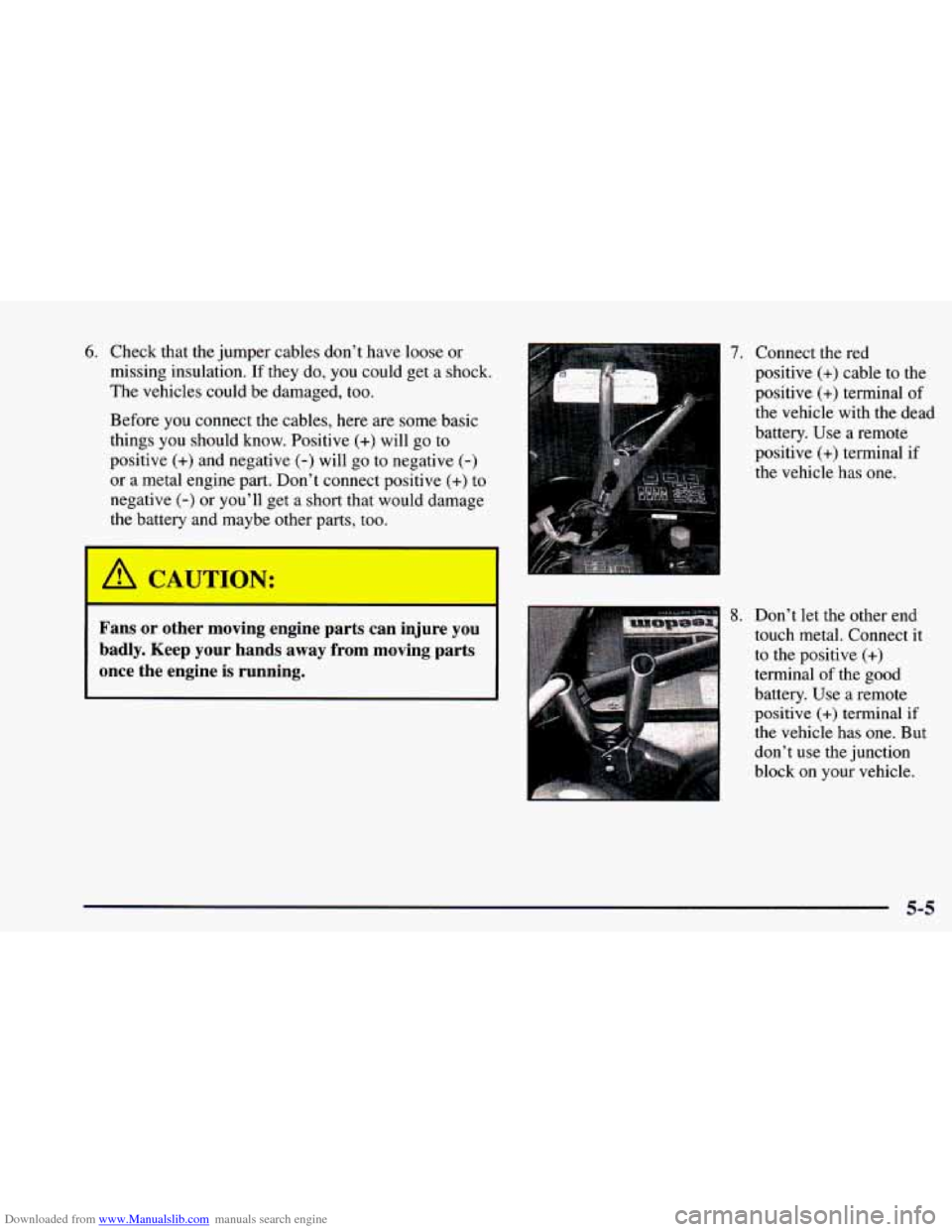
7. Connect the red
positive
(+) cable to the
positive
(+) terminal of
the vehicle with the dead
battery. Use
a remote
positive
(+) terminal if
the vehicle has one.
8. Don’t let the other end
touch metal. Connect
it
to the positive (+)
terminal of the good
battery. Use a remote
positive
(+> terminal if
the vehicle has one. But
don’t use the junction
block on
your vehicle.
5-5
Page 226 of 402
Downloaded from www.Manualslib.com manuals search engine I - CAUTIOI.:
A vehicle can fall from a car carrier if it isn’t
adequately secured. This can cause
a collision,
serious personal injury and vehicle damage. The
vehicle should be tightly secured with chains or
steel cables before it is transported.
Don’t use substitutes (ropes, leather straps,
canvas webbing, etc.) that can be cut by sharp
edges underneath the towed vehicle. Always use
T-hooks inserted in the T-hook slots. Never use
J-hooks. They will damage drivetrain and
suspension components.
When your vehicle is being towed, have the ignition key
turned to the
OFF position. The steering wheel should
be clamped in a straight-ahead position, with a clamping
device designed for towing service.
Do not use the
vehicle’s steering column lock for this. The transmission
should be in
NEUTRAL (N) and the parking
brake released.
Don’t have your vehicle towed on the drive wheels,
unless
you must. If the vehicle must be towed on the
drive wheels, be sure to follow the speed and distance
restrictions later in this section or your transmission will
be damaged.
If these limitations must be exceeded, then
the drive wheels have to be supported on a dolly.
5-8
Page 238 of 402
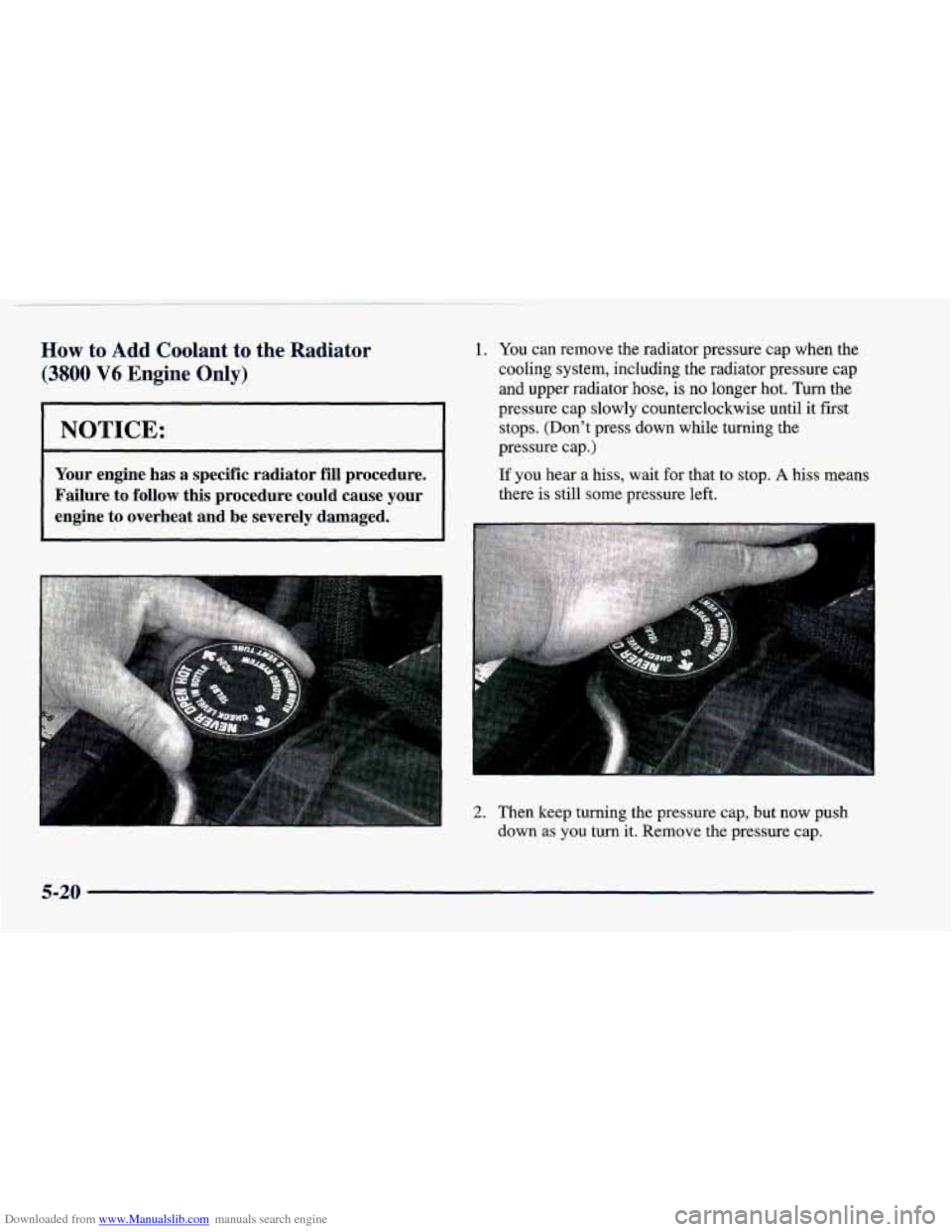
Downloaded from www.Manualslib.com manuals search engine How to Add Coolant to the Radiator
(3800 V6 Engine Only)
I NOTICE:
Your engine has a specific radiator fill procedure.
Failure to follow this procedure could cause your
engine to overheat and be severely damaged.
1. You can remove the radiator pressure cap when the
cooling system, including the radiator pressure cap
and upper radiator
hose, is no longer hot. Turn the
pressure cap slowly counterclockwise until it first
stops. (Don't press down while turning the
pressure cap.)
If you hear a hiss, wait for that to stop. A hiss means
there
is still some pressure left.
2. Then keep turning the pressure cap, but now push down
as you turn it. Remove the pressure cap.
5-20
Page 242 of 402
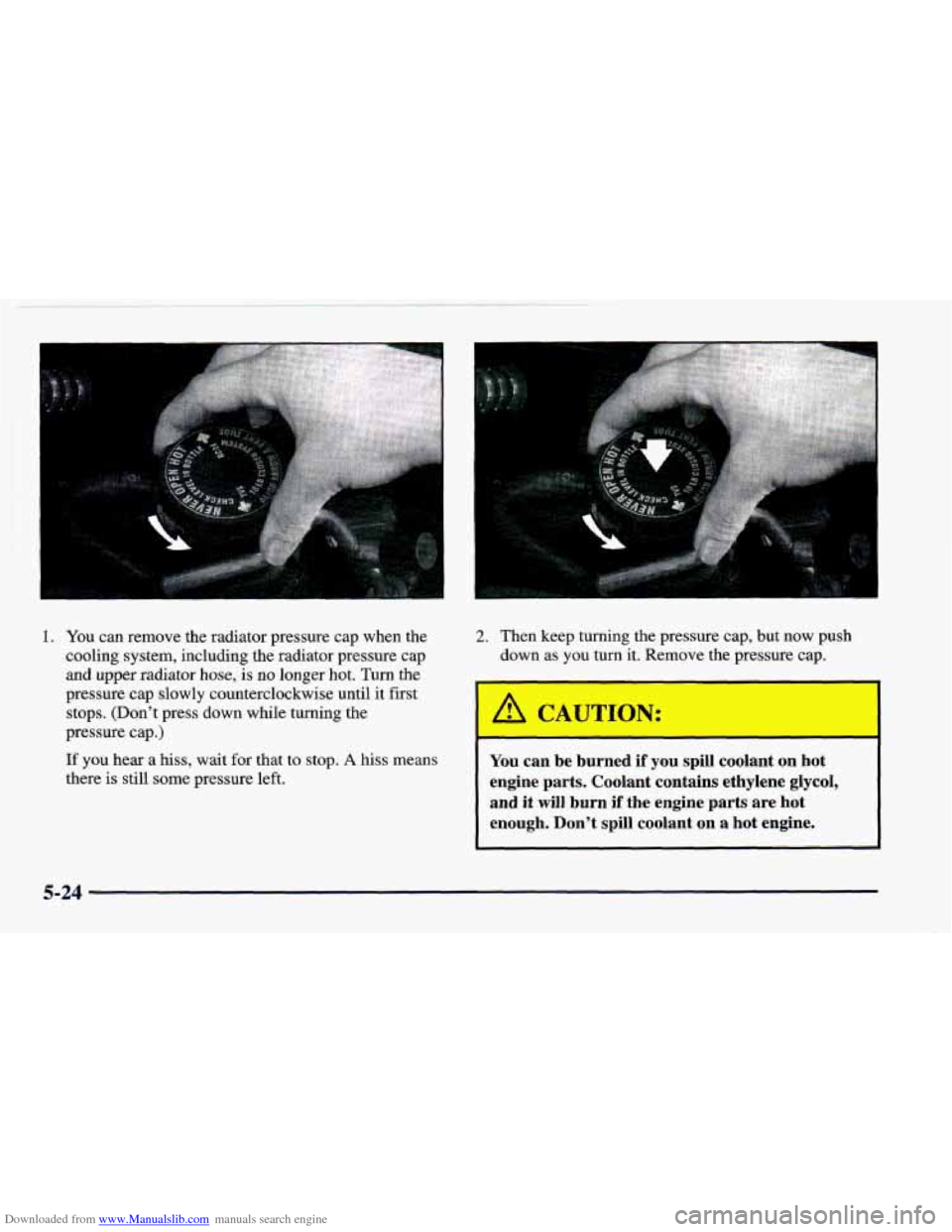
Downloaded from www.Manualslib.com manuals search engine 1. You can remove the radiator pressure cap when the
cooling system, including the radiator pressure cap
and upper radiator hose, is no longer hot. Turn the
pressure cap slowly counterclockwise until it first
stops. (Don’t press down while turning
the
pressure cap.)
If you hear a hiss, wait for that to stop. A hiss means
there is still some pressure left.
2. Then keep turning the pressure cap, but now push
down as you turn it. Remove the pressure cap.
A CAUTION:
You can be burned if you spill coolant on hot
engine parts. Coolant contains ethylene glycol,
and it will burn
if the engine parts are hot
enough. Don’t spill coolant on
a hot engine.
5-24
Page 245 of 402
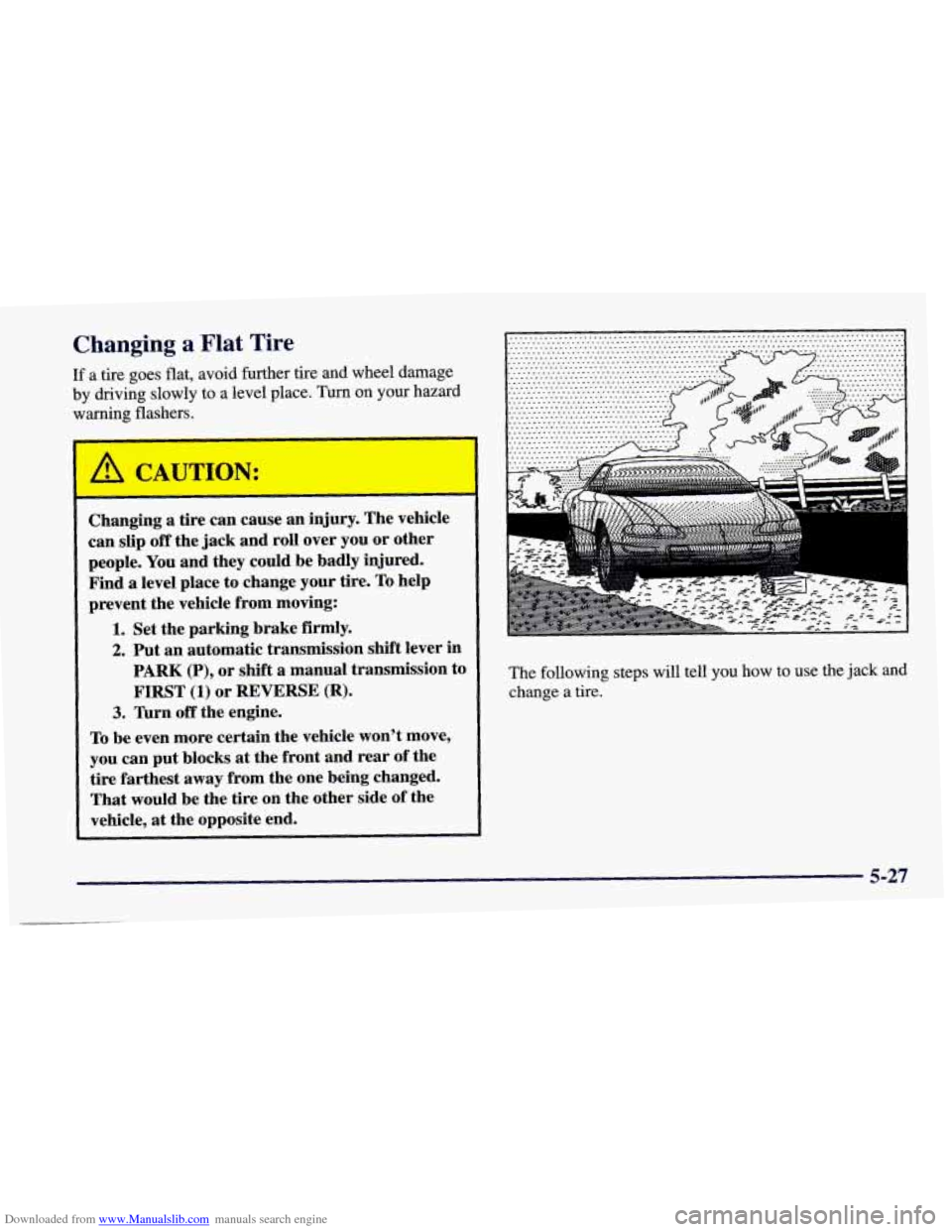
Downloaded from www.Manualslib.com manuals search engine Changing a Flat Tire
If a tire goes flat, avoid further tire and wheel damage
by driving slowly to a level place. Turn on your hazard
warning flashers.
Changing a tire can cause an injury. The vehicle
can slip
off the jack and roll over you or other
people. You and they could be badly injured.
Find
a level place to change your tire. To help
prevent the vehicle from moving:
1. Set the parking brake firmly.
2. Put an automatic transmission shift lever in
PARK (P), or shift a manual transmission to
FIRST
(1) or REVERSE (R).
3. lhrn off the engine.
To be even more certain the vehicle won’t move,
you can put blocks at the front and rear of the
tire farthest
away from the one being changed.
That would be the tire on the other side of the
vehicle, at the opposite end.
The following steps will tell you how to use the jack and
change a tire.
5-27
Page 246 of 402
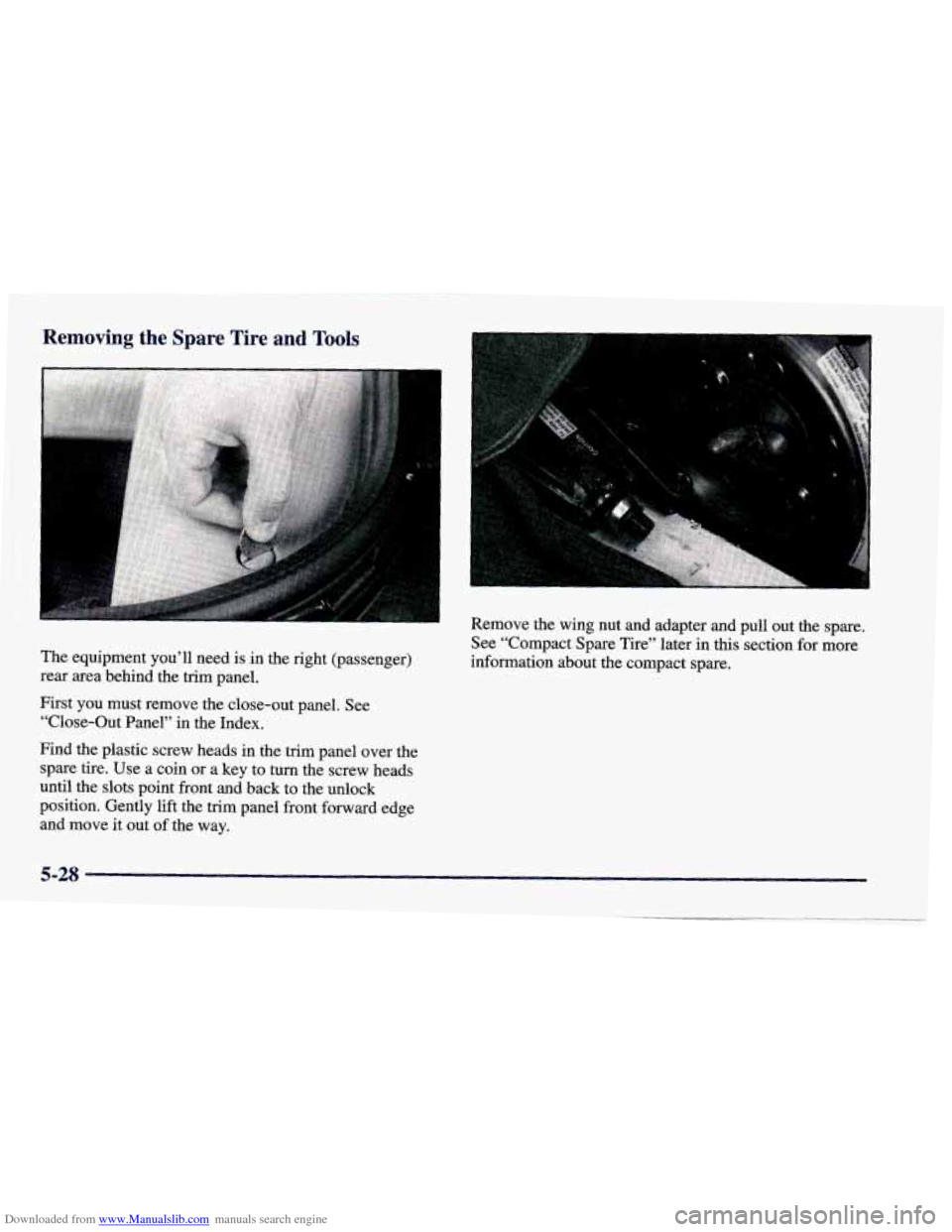
Downloaded from www.Manualslib.com manuals search engine Removing the Spare Tire and Tools
The equipment you’ll need is in the right (passenger)
rear area behind the trim panel.
First
you must remove the close-out panel. See
“Close-Out Panel” in the Index.
Find the plastic screw heads in the trim panel over the
spare tire. Use
a coin or a key to turn the screw heads
until the slots point front and back to the unlock
position. Gently lift the trim panel front forward edge
and move
it out of the way.
Remove the wing nut and adapter and pull out the spare.
See “Compact Spare Tire’’ later in
this section for more
information about the compact spare.
5-28
Page 249 of 402
Downloaded from www.Manualslib.com manuals search engine I
Removing the Flat Tire and Installing the Spare Tire
1. Using the wheel wrench, loosen all the wheel nuts.
Don’t remove them yet.
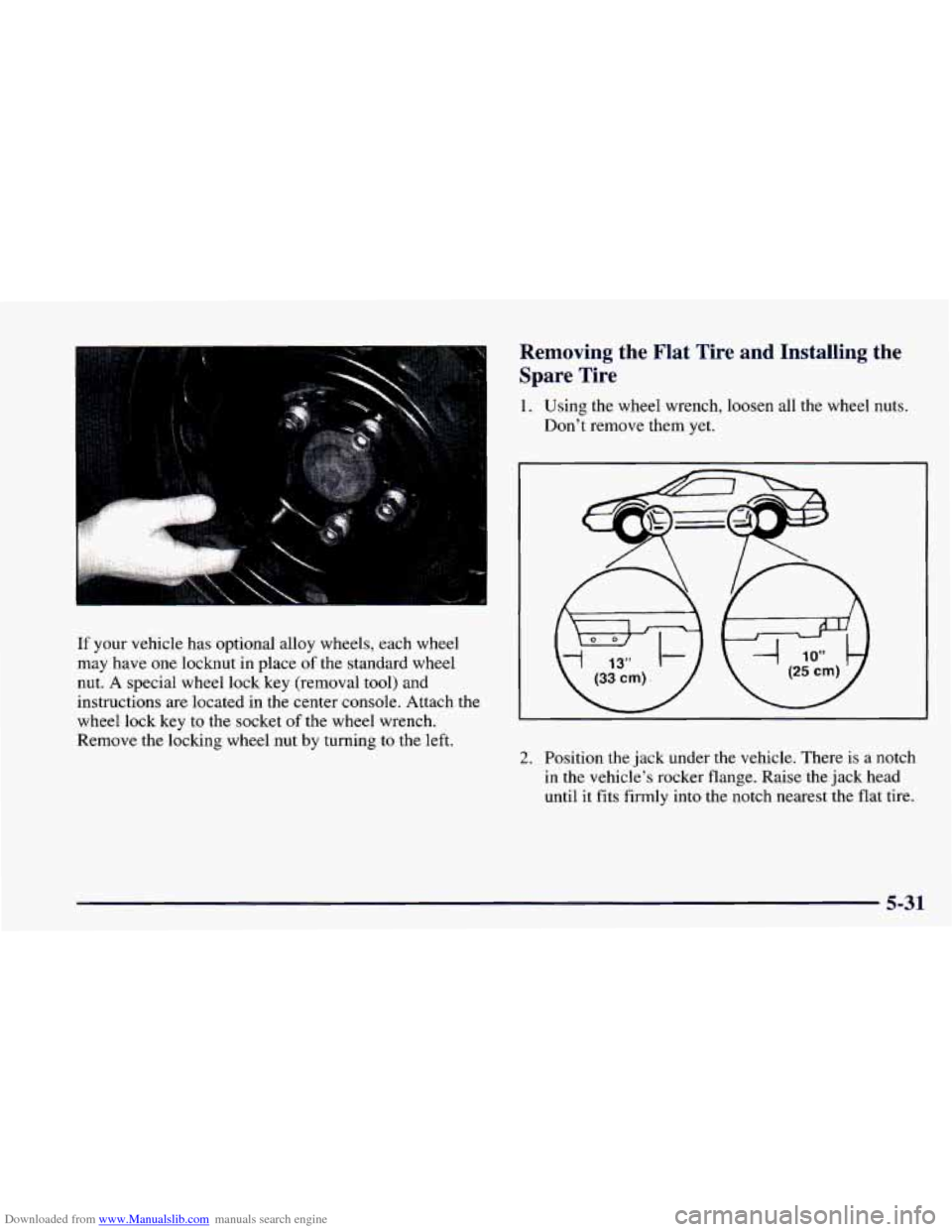
If your vehicle has optional alloy wheels, each wheel
may have one locknut in place of the standard wheel
nut. A special wheel lock key (removal
tool) and
instructions are located in the center console. Attach the
wheel lock key
to the socket of the wheel wrench.
Remove the locking wheel nut by turning to the left.
2. Position the jack under the vehicle. There is a notch
in the vehicle’s rocker flange. Raise the jack head
until it fits firmly into the notch nearest the flat tire.
5-31
Page 265 of 402
Downloaded from www.Manualslib.com manuals search engine To remove the cap, turn it slowly to the left
(counterclockwise). The cap has a spring in it;
if you let
go of the cap too soon, it will spring back to the right.
BN:
If you get gasoline on yourself and then
something ignites
it, you could be badly burned.
Gasoline can spray out on you if you open the
fuel filler cap too quickly. This spray can happen
if your
tank is nearly full, and is more likely in
hot weather. Open the fuel filler cap slowly and
wait for any “hiss” noise to stop. Then unscrew
the cap all the
way.
Be careful not to spill gasoline. Clean gasoline from
painted surfaces
as soon as possible. See “Cleaning the
Outside of Your Vehicle” in the Index. When you put
the cap
back on, turn it to the right
(clockwise) until you hear a clicking sound.
Make
sure you fully install the cap. The diagnostic system
can determine if the fuel cap has been left off
or
improperly installed. This would allow fuel to
evaporate into the atmosphere. See “Malfunction
Indicator Lamp” in the Index.
NOTICE:
If you need a new cap, be sure to get the right
type. Your dealer can get one for
you. If you get
the wrong type,
it may not fit properly. This may
cause your malfunction indicator lamp to light
and your fuel tank and emissions system may be
damaged. See “Malfunction Indicator Lamp” in
the Index.
6-7