tow CHEVROLET CAMARO 2011 5.G Service Manual
[x] Cancel search | Manufacturer: CHEVROLET, Model Year: 2011, Model line: CAMARO, Model: CHEVROLET CAMARO 2011 5.GPages: 414, PDF Size: 6.24 MB
Page 273 of 414
Black plate (11,1)Chevrolet Camaro Owner Manual - 2011
Vehicle Care 10-11
Obtaining an accurate oil level
reading is essential:
1. If the engine has been runningrecently, turn off the engine and
allow several minutes for the
oil to drain back into the oil pan.
Checking the oil level too soon
after engine shutoff will not
provide an accurate oil level
reading.
2. Pull out the dipstick and clean it with a paper towel or cloth,
then push it back in all the way.
Remove it again, keeping the
tip down, and check the level.When to Add Engine Oil
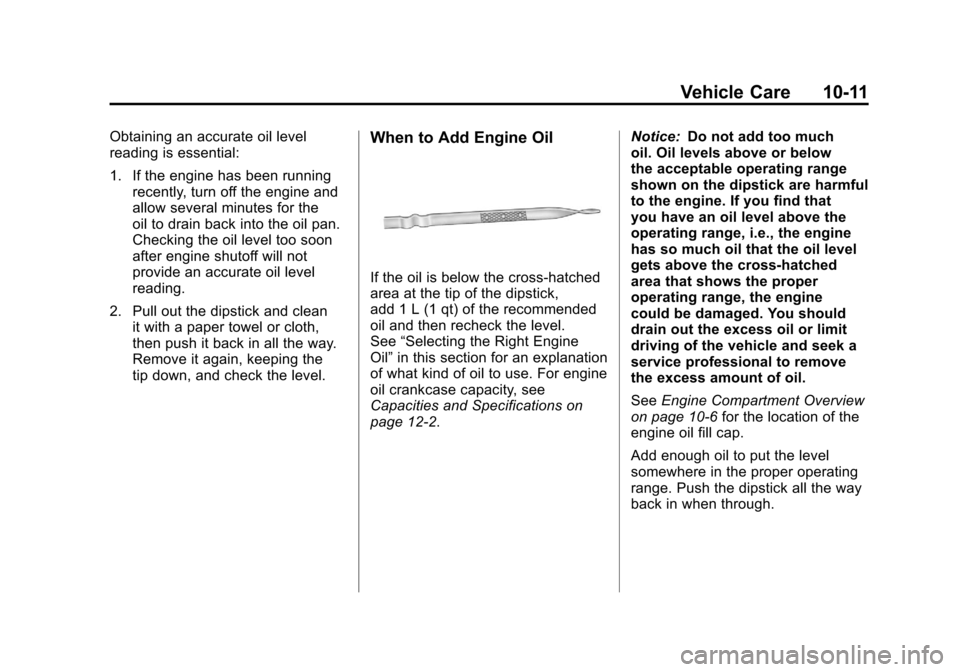
If the oil is below the cross-hatched
area at the tip of the dipstick,
add 1 L (1 qt) of the recommended
oil and then recheck the level.
See “Selecting the Right Engine
Oil” in this section for an explanation
of what kind of oil to use. For engine
oil crankcase capacity, see
Capacities and Specifications on
page 12‑2. Notice:
Do not add too much
oil. Oil levels above or below
the acceptable operating range
shown on the dipstick are harmful
to the engine. If you find that
you have an oil level above the
operating range, i.e., the engine
has so much oil that the oil level
gets above the cross-hatched
area that shows the proper
operating range, the engine
could be damaged. You should
drain out the excess oil or limit
driving of the vehicle and seek a
service professional to remove
the excess amount of oil.
See Engine Compartment Overview
on page 10‑6 for the location of the
engine oil fill cap.
Add enough oil to put the level
somewhere in the proper operating
range. Push the dipstick all the way
back in when through.
Page 288 of 414
Black plate (26,1)Chevrolet Camaro Owner Manual - 2011
10-26 Vehicle Care
Then check to see if the engine
cooling fans are running. If the
engine is overheating, both fans
should be running. If they are not,
do not continue to run the engine
and have the vehicle serviced.
Notice:Engine damage from
running the engine without
coolant is not covered by the
warranty.
Notice: If the engine catches fire
because of being driven with no
coolant, the vehicle can be badly
damaged. The costly repairs
would not be covered by the
vehicle warranty.If Steam Is Coming From The
Engine Compartment
{WARNING
Steam from an overheated engine
can burn you badly, even if you
just open the hood. Stay away
from the engine if you see or hear
steam coming from it. Just turn it
off and get everyone away from
the vehicle until it cools down.
Wait until there is no sign of
steam or coolant before you
open the hood.
If you keep driving when the
engine is overheated, the liquids
in it can catch fire. You or others
could be badly burned. Stop the
engine if it overheats, and get out
of the vehicle until the engine
is cool.
If No Steam Is Coming From
The Engine Compartment
If an engine overheat warning is
displayed but no steam can be seen
or heard, the problem may not be
too serious. Sometimes the engine
can get a little too hot when the
vehicle:
.Climbs a long hill on a hot day.
.Stops after high-speed driving.
.Idles for long periods in traffic.
.Tows a trailer.
If the overheat warning is displayed
with no sign of steam:
1. Turn the air off.
2. Turn the heater on to the highest temperature and to the highest
fan speed. Open the windows as
necessary.
3. In heavy traffic, let the engine idle in N (Neutral) while stopped.
If it is safe to do so, pull off
the road, shift to P (Park) or
N (Neutral) and let the
engine idle.
Page 289 of 414
Black plate (27,1)Chevrolet Camaro Owner Manual - 2011
Vehicle Care 10-27
If the temperature overheat gauge
is no longer in the overheat zone
or an overheat warning no longer
displays, the vehicle can be driven.
Continue to drive the vehicle slow
for about 10 minutes. Keep a safe
vehicle distance from the car in front
of you. If the warning does not come
back on, continue to drive normally.
If the warning continues, pull over,
stop, and park the vehicle
right away.
If there is no sign of steam,
idle the engine for three minutes
while parked. If the warning is still
displayed, turn off the engine until it
cools down.Power Steering Fluid
The power steering fluid reservoir
is located under the engine cover
on the driver side toward the
front of the engine compartment.
SeeEngine Compartment Overview
on page 10‑6.
When to Check Power Steering
Fluid
It is not necessary to regularly
check power steering fluid unless
you suspect there is a leak in the
system or an unusual noise is
heard. A fluid loss in this system
could indicate a problem. Have
the system inspected and repaired.
How to Check Power Steering
Fluid
Check the level after the vehicle
has been driven for at least
twenty minutes so the fluid is warm.
To check the power steering fluid:
1. Turn the ignition key to LOCK/OFF and let the engine
compartment cool down.
2. Remove the engine cover. Refer toEngine Cover on page 10‑9.
3. Wipe the cap and the top of the reservoir clean.
4. Turn the cap counterclockwise and pull it straight up.
5. Wipe the dipstick with a clean rag.
Page 297 of 414
Black plate (35,1)Chevrolet Camaro Owner Manual - 2011
Vehicle Care 10-35
To replace the windshield wiper
blade:
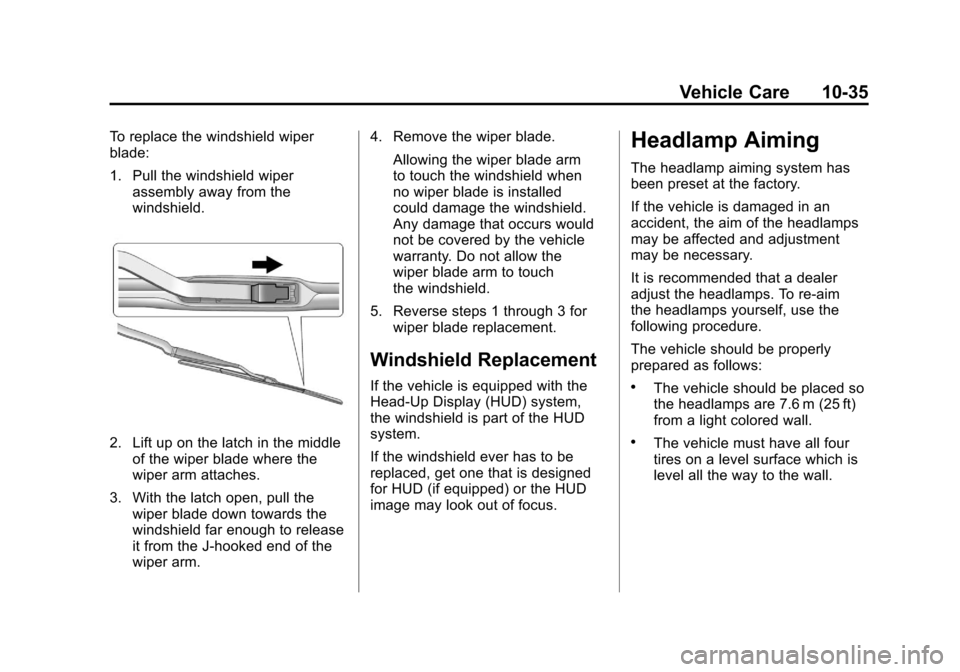
1. Pull the windshield wiperassembly away from the
windshield.
2. Lift up on the latch in the middleof the wiper blade where the
wiper arm attaches.
3. With the latch open, pull the wiper blade down towards the
windshield far enough to release
it from the J-hooked end of the
wiper arm. 4. Remove the wiper blade.
Allowing the wiper blade arm
to touch the windshield when
no wiper blade is installed
could damage the windshield.
Any damage that occurs would
not be covered by the vehicle
warranty. Do not allow the
wiper blade arm to touch
the windshield.
5. Reverse steps 1 through 3 for wiper blade replacement.
Windshield Replacement
If the vehicle is equipped with the
Head-Up Display (HUD) system,
the windshield is part of the HUD
system.
If the windshield ever has to be
replaced, get one that is designed
for HUD (if equipped) or the HUD
image may look out of focus.
Headlamp Aiming
The headlamp aiming system has
been preset at the factory.
If the vehicle is damaged in an
accident, the aim of the headlamps
may be affected and adjustment
may be necessary.
It is recommended that a dealer
adjust the headlamps. To re-aim
the headlamps yourself, use the
following procedure.
The vehicle should be properly
prepared as follows:
.The vehicle should be placed so
the headlamps are 7.6 m (25 ft)
from a light colored wall.
.The vehicle must have all four
tires on a level surface which is
level all the way to the wall.
Page 329 of 414
Black plate (67,1)Chevrolet Camaro Owner Manual - 2011
Vehicle Care 10-67
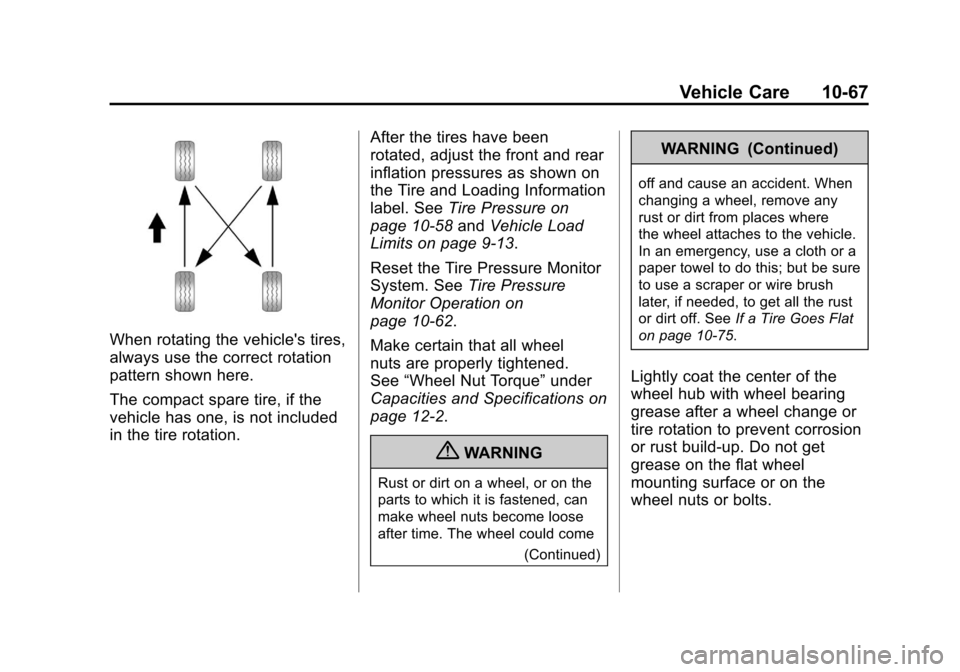
When rotating the vehicle's tires,
always use the correct rotation
pattern shown here.
The compact spare tire, if the
vehicle has one, is not included
in the tire rotation.After the tires have been
rotated, adjust the front and rear
inflation pressures as shown on
the Tire and Loading Information
label. See
Tire Pressure on
page 10‑58 andVehicle Load
Limits on page 9‑13.
Reset the Tire Pressure Monitor
System. See Tire Pressure
Monitor Operation on
page 10‑62.
Make certain that all wheel
nuts are properly tightened.
See “Wheel Nut Torque” under
Capacities and Specifications on
page 12‑2.
{WARNING
Rust or dirt on a wheel, or on the
parts to which it is fastened, can
make wheel nuts become loose
after time. The wheel could come
(Continued)
WARNING (Continued)
off and cause an accident. When
changing a wheel, remove any
rust or dirt from places where
the wheel attaches to the vehicle.
In an emergency, use a cloth or a
paper towel to do this; but be sure
to use a scraper or wire brush
later, if needed, to get all the rust
or dirt off. SeeIf a Tire Goes Flat
on page 10‑75.
Lightly coat the center of the
wheel hub with wheel bearing
grease after a wheel change or
tire rotation to prevent corrosion
or rust build-up. Do not get
grease on the flat wheel
mounting surface or on the
wheel nuts or bolts.
Page 337 of 414
Black plate (75,1)Chevrolet Camaro Owner Manual - 2011
Vehicle Care 10-75
Tire Chains
{WARNING
Do not use tire chains. There is
not enough clearance. Tire chains
used on a vehicle without the
proper amount of clearance can
cause damage to the brakes,
suspension, or other vehicle
parts. The area damaged by the
tire chains could cause you to
lose control of the vehicle and
you or others may be injured
in a crash. Use another type
of traction device only if its
manufacturer recommends it for(Continued)
WARNING (Continued)
use on the vehicle and tire size
combination and road conditions.
Follow that manufacturer's
instructions. To help avoid
damage to the vehicle, drive
slowly, re‐adjust or remove the
device if it is contacting the
vehicle, and do not spin the
wheels. If you do find traction
devices that will fit, install them
on the rear tires.
If a Tire Goes Flat
It is unusual for a tire to blowout
while you are driving, especially if
you maintain your vehicle's tires
properly. If air goes out of a tire,
it is much more likely to leak out
slowly. But if you should ever have
a blowout, here are a few tips about
what to expect and what to do:
If a front tire fails, the flat tire
creates a drag that pulls the vehicle
toward that side. Take your foot
off the accelerator pedal and grip
the steering wheel firmly. Steer to
maintain lane position, and then
gently brake to a stop, well off the
road, if possible.
Page 350 of 414
Black plate (88,1)Chevrolet Camaro Owner Manual - 2011
10-88 Vehicle Care
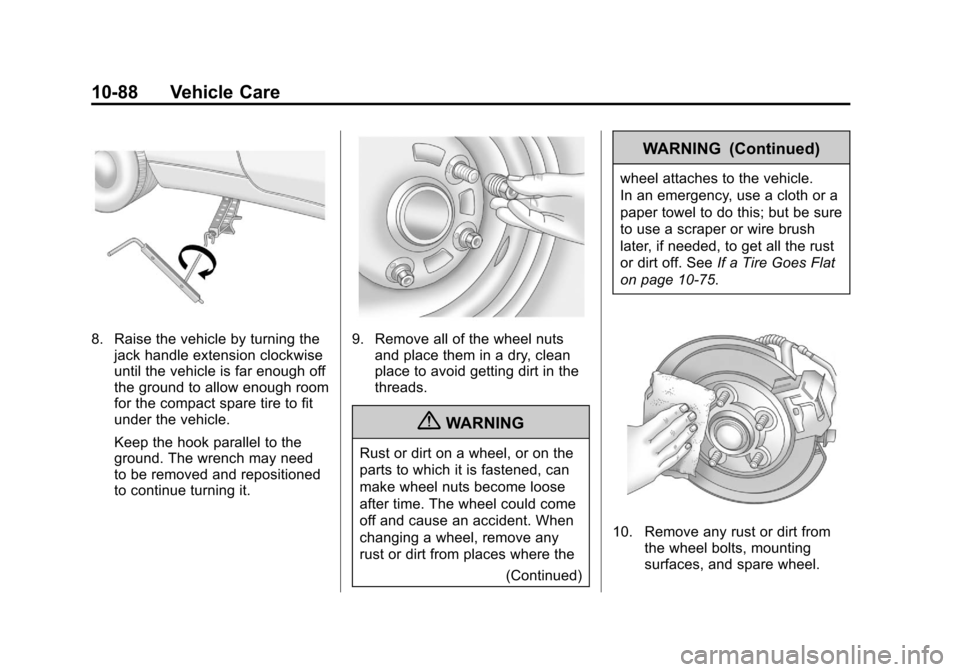
8. Raise the vehicle by turning thejack handle extension clockwise
until the vehicle is far enough off
the ground to allow enough room
for the compact spare tire to fit
under the vehicle.
Keep the hook parallel to the
ground. The wrench may need
to be removed and repositioned
to continue turning it.9. Remove all of the wheel nutsand place them in a dry, clean
place to avoid getting dirt in the
threads.
{WARNING
Rust or dirt on a wheel, or on the
parts to which it is fastened, can
make wheel nuts become loose
after time. The wheel could come
off and cause an accident. When
changing a wheel, remove any
rust or dirt from places where the
(Continued)
WARNING (Continued)
wheel attaches to the vehicle.
In an emergency, use a cloth or a
paper towel to do this; but be sure
to use a scraper or wire brush
later, if needed, to get all the rust
or dirt off. SeeIf a Tire Goes Flat
on page 10‑75.
10. Remove any rust or dirt from the wheel bolts, mounting
surfaces, and spare wheel.
Page 351 of 414
Black plate (89,1)Chevrolet Camaro Owner Manual - 2011
Vehicle Care 10-89
11. Place the compact spare tireon the wheel-mounting surface.
{WARNING
Never use oil or grease on bolts
or nuts because the nuts might
come loose. The vehicle's wheel
could fall off, causing a crash.
12. Reinstall the wheel nuts with the rounded end of the nuts
toward the wheel. Tighten each
nut as much as possible using
the wheel wrench until the
wheel is held firmly against
the hub.
Use your free hand to prevent
the wheel from turning while
you are tightening.
13. Lower the vehicle by turning the jack handle
counterclockwise. Lower
the jack completely.
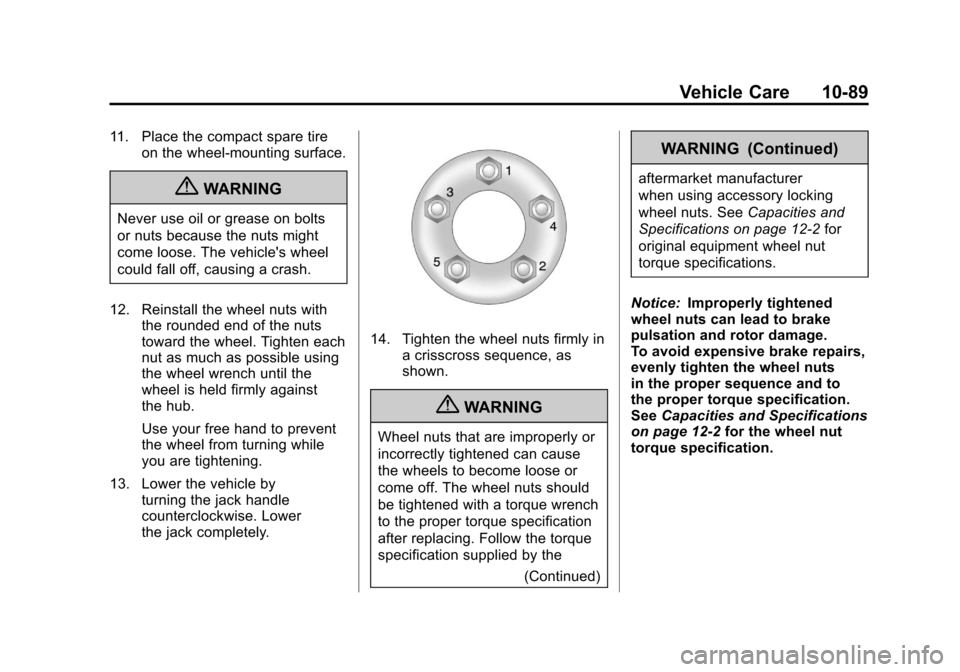
14. Tighten the wheel nuts firmly ina crisscross sequence, as
shown.
{WARNING
Wheel nuts that are improperly or
incorrectly tightened can cause
the wheels to become loose or
come off. The wheel nuts should
be tightened with a torque wrench
to the proper torque specification
after replacing. Follow the torque
specification supplied by the
(Continued)
WARNING (Continued)
aftermarket manufacturer
when using accessory locking
wheel nuts. SeeCapacities and
Specifications on page 12‑2 for
original equipment wheel nut
torque specifications.
Notice: Improperly tightened
wheel nuts can lead to brake
pulsation and rotor damage.
To avoid expensive brake repairs,
evenly tighten the wheel nuts
in the proper sequence and to
the proper torque specification.
See Capacities and Specifications
on page 12‑2 for the wheel nut
torque specification.
Page 357 of 414
Black plate (95,1)Chevrolet Camaro Owner Manual - 2011
Vehicle Care 10-95
Towing
Towing the Vehicle
Notice:To avoid damage,
the disabled vehicle should be
towed with all four wheels off
the ground. Care must be taken
with vehicles that have low
ground clearance and/or special
equipment. Always flatbed on a
car carrier.
Consult your dealer or a
professional towing service if the
disabled vehicle must be towed.
See Roadside Assistance Program
(U.S. and Canada) on page 13‑7
or Roadside Assistance Program
(Mexico) on page 13‑10. To tow the vehicle behind another
vehicle for recreational purposes,
such as behind a motor home, see
“Recreational Vehicle Towing”
in this
section.
Recreational Vehicle
Towing
Notice: Dolly towing or dinghy
towing the vehicle may cause
damage because of reduced
ground clearance. Always put
the vehicle on a flatbed truck or
trailer.
The vehicle was neither designed
nor intended to be towed with any
of its wheels on the ground. If the
vehicle must be towed, see “Towing
the Vehicle” earlier in this section.
Appearance Care
Exterior Care
Cleaning Exterior
Lamps/Lenses
Use only lukewarm or cold water, a
soft cloth and a car washing soap
to clean exterior lamps and lenses.
Follow instructions under “Washing
the Vehicle” later in this section.
Finish Care
Occasional waxing or mild polishing
of the vehicle by hand may be
necessary to remove residue from
the paint finish. Approved cleaning
products can be obtained from your
dealer.
Page 359 of 414
Black plate (97,1)Chevrolet Camaro Owner Manual - 2011
Vehicle Care 10-97
Washing the Vehicle
To preserve the vehicle's finish,
keep it clean by washing it often.
Do not wash the vehicle in
direct sunlight and use a car
washing soap.
Notice:Certain cleaners contain
chemicals that can damage the
emblems or nameplates on the
vehicle. Check the cleaning
product label. If it states that it
should not be used on plastic
parts, do not use it on the vehicle
or damage may occur and it
would not be covered by the
warranty.
Do not use cleaning agents
that are petroleum based or
that contain acid or abrasives,
as they can damage the paint,
metal or plastic on the vehicle.
Approved cleaning products can
be obtained from your dealer. Follow all manufacturer directions
regarding correct product usage,
necessary safety precautions and
appropriate disposal of any vehicle
care product.
Rinse the vehicle well, before
washing and after to remove all
cleaning agents completely. If they
are allowed to dry on the surface,
they could stain.
Dry the finish with a soft, clean
chamois or an all-cotton towel to
avoid surface scratches and water
spotting.
High pressure car washes could
cause water to enter the vehicle.
Avoid using high pressure washes
closer than 30 cm (12 in) to the
surface of the vehicle. Use of power
washers exceeding 8,274 kPa
(1,200 psi) can result in damage
or removal of paint and decals.
Notice:
Conveyor systems on
some automatic car washes could
damage the vehicle. There may
not be enough clearance for the
undercarriage. Check with the car
wash manager before using the
automatic car wash.
Weatherstrips
Silicone grease on weatherstrips
will make them last longer, seal
better, and not stick or squeak.
Apply silicone grease with a clean
cloth. During very cold, damp
weather frequent application may be
required. See Recommended Fluids
and Lubricants on page 11‑7.