steering CHEVROLET CAMARO 2021 Workshop Manual
[x] Cancel search | Manufacturer: CHEVROLET, Model Year: 2021, Model line: CAMARO, Model: CHEVROLET CAMARO 2021Pages: 354, PDF Size: 8.86 MB
Page 217 of 354

Chevrolet Camaro Owner Manual (GMNA-Localizing-U.S./Canada/Mexico-
14583589) - 2021 - CRC - 10/1/20
216 Driving and Operating
To turn TCS on again, pressY. The traction
off light
idisplayed in the instrument
cluster will turn off.
If TCS is limiting wheel spin when
Yis
pressed, the system will not turn off until
the wheels stop spinning.
To turn off both TCS and StabiliTrak/ESC,
press and hold
Yuntil the traction off
light
iand StabiliTrak/ESC OFF lightg
come on and stay on in the instrument
cluster.
To turn TCS and StabiliTrak/ESC on again,
press
Y. The traction off lightiand
StabiliTrak/ESC OFF light
gin the
instrument cluster turn off.
Adding accessories can affect the vehicle
performance. See Accessories and
Modifications 0236.
Engine Drag Control (EDC)
EDC improves vehicle stability by sensing if
there is a difference in speed between the
free rolling front wheels and the rear drive
wheels that often occurs when the driver
takes their foot off the accelerator pedal on
slippery surfaces (snow, ice, etc.). When this
is detected, EDC sends more torque to the rear wheels to make sure all four wheels are
spinning at similar speeds, making the
vehicle more stable.
Driver Mode Control
Driver Mode Control adds a sportier feel,
provides a more comfortable ride, or assists
in different weather conditions or terrain.
This system simultaneously changes the
software calibration of various sub-systems
to optimize driving performance. Depending
on the option package, available features,
and mode selected, the exhaust, suspension,
steering, and powertrain will change
calibrations to achieve the desired mode
characteristics. If the vehicle is equipped
with Magnetic Ride Control, selecting the
various Driver Modes adjusts the ride of the
vehicle to enhance the ride performance for
the road conditions and the selected mode.
While in the Sport and/or Track Modes, the
vehicle monitors driving behavior and
automatically enables Performance Shift
Features in the automatic transmission
when spirited driving is detected. These
features maintain lower transmission gears
to increase available engine braking and
improve acceleration response. The vehicle
will exit these features and return to normal
operation after a short period when no
spirited driving is detected.
Driver Mode Control Switch
The Driver Mode Control has three or four
modes: Tour, Sport, Snow/Ice, and Track.
Press
yorzon the MODE switch on the
center console to make a mode selection.
Pressing the switch will display the moding
menu in the instrument cluster with all
available ride modes. Every switch press will
select and activate the next available mode.
When Sport, Snow/Ice, or Track Mode is
selected, a unique and persistent indicator
will be displayed in the instrument cluster.
Page 218 of 354

Chevrolet Camaro Owner Manual (GMNA-Localizing-U.S./Canada/Mexico-
14583589) - 2021 - CRC - 10/1/20
Driving and Operating 217
Tour Mode
Use for normal city and highway driving to
provide a smooth, soft ride. This setting
provides a balanced setting between comfort
and handling. This is the standard mode.
Sport Mode
Use where road conditions or personal
preference demand a more controlled
response.
When Sport Mode is selected, the
transmission may downshift to a lower gear
for better performance. The transmission
will continue to shift automatically but can
hold a lower gear longer than it would in
the Tour Mode based on braking, throttle
input, and vehicle lateral acceleration. See
Automatic Transmission0206. The steering
will change to provide more precise control.
If the vehicle has Magnetic Ride Control, the
suspension will change to provide better
cornering performance. If the vehicle is
equipped with Active Exhaust, the exhaust
valves will open earlier and more often.
Competitive Driving Mode can be accessed
through this mode by pressing
Yon the
console twice. This Competitive Driving Mode is only on SS,
1LE, and ZL1 vehicles. For example, a vehicle
with a V6 engine and automatic
transmission will have Sport Mode, but will
not be able to access Competitive
Driving Mode.
Snow/Ice Mode
If equipped, use when more traction is
needed during slippery conditions. The
automatic transmission will upshift normally
when the vehicle is moving. The acceleration
will adjust to help provide a smoother
launch. The automatic transmission will also
shift differently to assist in maintaining
traction.
This feature is not intended for use when
the vehicle is stuck in sand, mud, ice, snow,
or gravel. If the vehicle becomes stuck, see
If
the Vehicle Is Stuck 0195.
Track Mode
If equipped, use when maximum vehicle
handling is desired.
When Track Mode is selected, the
transmission may downshift to a lower gear
for better performance. The automatic
transmission and steering will function
similar to Sport Mode.
The accelerator pedal is adjusted to give
maximum control during the highest level of
spirited driving. The Magnetic Ride Control
will be set to the optimum level for vehicle
responsiveness. If the vehicle is equipped
with Active Exhaust, the exhaust valves will
open. Performance Traction Management
(PTM) can be accessed through this mode by
pressing
Yon the console twice.
There are attributes that vary by mode
shown below. Not all vehicles have all
features, depending on the vehicle options.
Page 219 of 354

Chevrolet Camaro Owner Manual (GMNA-Localizing-U.S./Canada/Mexico-
14583589) - 2021 - CRC - 10/1/20
218 Driving and Operating
Modes:SNOW/ICETOUR
Default SPORT
TRACK
Throttle Progression WeatherNormalNormal Track
Transmission Shift Mode (Automatic Only) NormalNormal Normal or Sport
depending on trimlevel Track
Engine Sound Management (if equipped) TourTourSport Track
Steering TourTourSport Track
StabiliTrak/Electronic Stability Control (ESC) -
Competitive Driving Mode/PTM (if equipped) N/A
N/A Competitive Driving
Mode Available PTM Available
Magnetic Ride Control (if equipped) TourTourSport Track
Launch Control (when in Competitive Driving Mode) N/A N/AAvailable Available
Throttle Progression
Adjusts throttle sensitivity by selecting how
quickly or slowly the throttle reacts to
input.
Automatic Transmission Shift Mode (if
equipped)
Adjusts from normal operation to Sport or
Track shifting features. Engine Sound Management (if equipped)
Changes when variable exhaust valves open
or close.
Engine Sound Enhancement (turbo 4)
Allows the ability to turn Engine Sound
Enhancement off.
Steering
Adjusts from a lighter steering feel in Tour
Mode to reduced assist for more
steering feel.StabiliTrak/ESC - Competitive Driving Mode
(if equipped)
Available in Sport and Track Modes.
Magnetic Ride Control (if equipped)
Adjusts the shock damping firmness based
on driving conditions to improve comfort
and performance.
Page 221 of 354

Chevrolet Camaro Owner Manual (GMNA-Localizing-U.S./Canada/Mexico-
14583589) - 2021 - CRC - 10/1/20
220 Driving and Operating
When the TCS/StabiliTrak/ESC button is
pressed again, the TCS and StabiliTrak/ESC
systems are on. The appropriate message
displays briefly in the DIC.
Launch Control
If the vehicle has the LT1 10 speed
transmission, seeTrack Events and
Competitive Driving 0185 for custom launch
control information.
A Launch Control feature is available, within
Competitive Driving Mode, to allow the
driver to achieve high levels of vehicle
acceleration in a straight line. Launch
Control is a form of traction control that
manages tire spin while launching the
vehicle. This feature is intended for use
during closed course race events where
consistent zero to sixty and quarter mile
times are desirable.
Launch Control is only available when the
following criteria are met:
.Competitive Driving Mode is selected.
.The vehicle is not moving.
.The steering wheel is pointing straight.
Manual Transmissions
.The clutch is pressed to floor and the
vehicle is in 1 (First) gear.
.The accelerator pedal is rapidly applied to
wide open throttle.
The Launch Control feature will initially limit
engine speed as the driver rapidly applies
the accelerator pedal to wide open throttle.
Allow the engine rpm to stabilize. A smooth,
quick release of the clutch, while
maintaining the fully pressed accelerator
pedal, will manage wheel slip. Complete
shifts are described in Manual Transmission
0 209.
Automatic Transmissions
.The brake pedal must be firmly pressed
to the floor, equivalent to a panic brake
event.
.The accelerator pedal is rapidly applied to
wide open throttle. (If the vehicle rolls
due to wide open throttle, release the
throttle, press the brake pedal more
firmly, and re-apply the accelerator to
wide open throttle.)
After the vehicle is launched, the system
continues in Competitive Driving Mode.
Competitive Driving Mode and Launch
Control are systems designed for a closed
course race track and not intended for use on public roads. The systems are not
intended to compensate for lack of driver
experience or familiarity with the race track.
Limited-Slip Rear Axle
Vehicles with a limited-slip rear axle can
give more traction on snow, mud, ice, sand,
or gravel. When traction is low, this feature
allows the drive wheel with the most
traction to move the vehicle. The limited-slip
rear axle also gives the driver enhanced
control when cornering hard or completing a
maneuver, such as a lane change. For
vehicles with limited-slip differential, driven
under severe conditions, the rear axle fluid
should be changed. See
Competitive Driving
Mode (SS, ZL1 and 1LE Models Only) 0219
and
Maintenance Schedule 0304.
Cruise Control
When using cruise control, the vehicle can
maintain a speed of about 40 km/h (25 mph)
or more without keeping your foot on the
accelerator. Cruise control does not work at
speeds below 40 km/h (25 mph).
Page 227 of 354
Chevrolet Camaro Owner Manual (GMNA-Localizing-U.S./Canada/Mexico-
14583589) - 2021 - CRC - 10/1/20
226 Driving and Operating
detected, three beeps sound from the left or
right, depending on the direction of the
detected vehicle.
SeeRadio Frequency Statement 0331.
Turning the Features On or Off
RPA and RCTA can be turned on or off. See
“Collision/Detection Systems” underVehicle
Personalization 0104.
To turn the rear Park Assist symbols or
guidance lines on or off, see “Rear Camera”
under Vehicle Personalization 0104.
Forward Collision Alert (FCA)
System
If equipped, the FCA system may help to
avoid or reduce the harm caused by
front-end crashes. When approaching a
vehicle ahead too quickly, FCA provides a
red flashing alert on the windshield and
rapidly beeps. FCA also lights an amber
visual alert if following another vehicle too
closely.
FCA detects vehicles within a distance of
approximately 60 m (197 ft) and operates at
speeds above 8 km/h (5 mph).
{Warning
FCA is a warning system and does not
apply the brakes. When approaching a
slower-moving or stopped vehicle ahead
too rapidly, or when following a vehicle
too closely, FCA may not provide a
warning with enough time to help avoid
a crash. It also may not provide any
warning at all. FCA does not warn of
pedestrians, animals, signs, guardrails,
bridges, construction barrels, or other
objects. Be ready to take action and
apply the brakes. See Defensive Driving
0 182.
FCA can be disabled with the FCA steering
wheel control.
Detecting the Vehicle Ahead
FCA warnings will not occur unless the FCA
system detects a vehicle ahead. When a
vehicle is detected, the vehicle ahead indicator will display green. Vehicles may
not be detected on curves, highway exit
ramps, or hills, due to poor visibility; or if a
vehicle ahead is partially blocked by
pedestrians or other objects. FCA will not
detect another vehicle ahead until it is
completely in the driving lane.
{Warning
FCA does not provide a warning to help
avoid a crash, unless it detects a vehicle.
FCA may not detect a vehicle ahead if
the FCA sensor is blocked by dirt, snow,
or ice, or if the windshield is damaged.
It may also not detect a vehicle on
winding or hilly roads, or in conditions
that can limit visibility such as fog, rain,
or snow, or if the headlamps or
windshield are not cleaned or in proper
condition. Keep the windshield,
headlamps, and FCA sensors clean and in
good repair.
Page 228 of 354
Chevrolet Camaro Owner Manual (GMNA-Localizing-U.S./Canada/Mexico-
14583589) - 2021 - CRC - 10/1/20
Driving and Operating 227
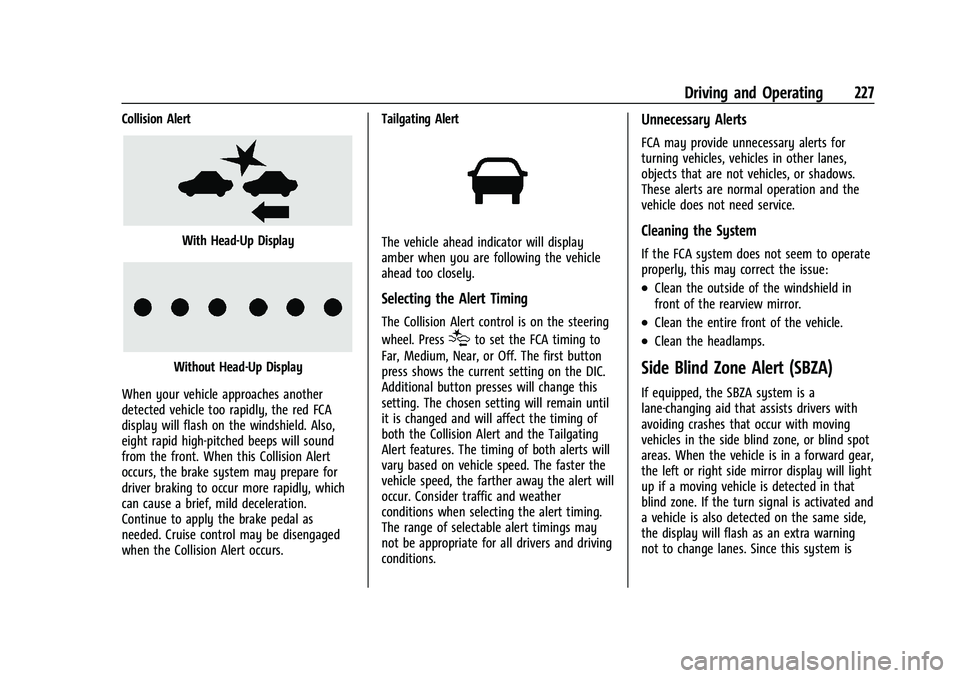
Collision Alert
With Head-Up Display
Without Head-Up Display
When your vehicle approaches another
detected vehicle too rapidly, the red FCA
display will flash on the windshield. Also,
eight rapid high-pitched beeps will sound
from the front. When this Collision Alert
occurs, the brake system may prepare for
driver braking to occur more rapidly, which
can cause a brief, mild deceleration.
Continue to apply the brake pedal as
needed. Cruise control may be disengaged
when the Collision Alert occurs. Tailgating Alert
The vehicle ahead indicator will display
amber when you are following the vehicle
ahead too closely.
Selecting the Alert Timing
The Collision Alert control is on the steering
wheel. Press
[to set the FCA timing to
Far, Medium, Near, or Off. The first button
press shows the current setting on the DIC.
Additional button presses will change this
setting. The chosen setting will remain until
it is changed and will affect the timing of
both the Collision Alert and the Tailgating
Alert features. The timing of both alerts will
vary based on vehicle speed. The faster the
vehicle speed, the farther away the alert will
occur. Consider traffic and weather
conditions when selecting the alert timing.
The range of selectable alert timings may
not be appropriate for all drivers and driving
conditions.
Unnecessary Alerts
FCA may provide unnecessary alerts for
turning vehicles, vehicles in other lanes,
objects that are not vehicles, or shadows.
These alerts are normal operation and the
vehicle does not need service.
Cleaning the System
If the FCA system does not seem to operate
properly, this may correct the issue:
.Clean the outside of the windshield in
front of the rearview mirror.
.Clean the entire front of the vehicle.
.Clean the headlamps.
Side Blind Zone Alert (SBZA)
If equipped, the SBZA system is a
lane-changing aid that assists drivers with
avoiding crashes that occur with moving
vehicles in the side blind zone, or blind spot
areas. When the vehicle is in a forward gear,
the left or right side mirror display will light
up if a moving vehicle is detected in that
blind zone. If the turn signal is activated and
a vehicle is also detected on the same side,
the display will flash as an extra warning
not to change lanes. Since this system is
Page 264 of 354

Chevrolet Camaro Owner Manual (GMNA-Localizing-U.S./Canada/Mexico-
14583589) - 2021 - CRC - 10/1/20
Vehicle Care 263
Fuses UsageF4 Cooling fanF5 Passenger power seat
F6 –
F7 –
F8 –
F9 –
F10 –
F11 AUX DRL
F12 Front wiper
F13 Starter
F14 Brake vacuum pump
F15 Automatic headlamp leveling
module
F16 Front heated seat F17 Passenger window
F18 Body control module 4
F19 SDM/AOS Fuses Usage
F20 OnStar/NavigationF21 Body control module 6
F22 ABS valve
F23 –
F24 –
F25 Electric steering column lock
F26 Body control module 2
F27 –
F28 Body control module 3
F29 Body control module 8
F30 Windshield wiper F31 Right HID headlamp
F32 Left HID headlamp
F33 –
F34 Horn Fuses Usage
F35 Automatic headlamp leveling
motor
F36 Left high-beam headlamp
F37 Right high-beam headlamp
F38 –
F39 –
F40 Rear electrical center/Ignition
F41 Malfunction indicator lamp/
Ignition
F42 HVAC/ISRVM/ OSRVM
F43 Front exhaust valve active fuel
management
F44 –
F45 Sunroof
F46 Body control module 7
Page 265 of 354

Chevrolet Camaro Owner Manual (GMNA-Localizing-U.S./Canada/Mexico-
14583589) - 2021 - CRC - 10/1/20
264 Vehicle Care
Fuses UsageF47 CGM
F48 A/C clutch
F49 Heated steering wheel
F50 Fuel system control module/
Ignition
F51 Rear exhaust valve PTSQ
F52 –
F53 –
F54 Engine coolant pump
F55 Fuel prime
F56 –
F57 Engine control module/Ignition
F58 Transmission control module/
Ignition
F59 – Fuses Usage
F60 Transmission control module
battery
F61 Non-walk/Vehicle
F62 Ignition coils –odd
F63 Non-walk/O2 sensor
F64 Ignition coils –even
F65 –
F66 Engine control module 1
F67 Engine control module 2
F68 Spare
F69 Spare F70 Spare F71 Spare
F72 Spare
F73 Spare
F74 Spare Fuses Usage
F75 Spare
F76 Spare F77 Spare
Relays Usage K1 –
K2 Run/Crank
K3 –
K4 Vacuum pump K5 A/C control
K6 Coolant pump K7 Engine control module
K8 Fuel prime
K9 –
K10 Starter
Page 267 of 354

Chevrolet Camaro Owner Manual (GMNA-Localizing-U.S./Canada/Mexico-
14583589) - 2021 - CRC - 10/1/20
266 Vehicle Care
Fuses UsageF2 Front blower
F3 Electric parking brake
F4 –
F5 –
F6 Rear drive control module
F7 Right window
F8 –
F9 Left window
F10 Heated mirror F11 –
F12 Heated steering wheel
F13 –
F14 HVAC control F15 Spare
F16 Display F17 Spare
F18 – Fuses Usage
F19 Front ventilated seat
F20 Spare F21 –
F22 –
F23 Body control module
F24 –
F25 –
F26 –
F27 RGB lights
F28 Passive entry/ Passive start
battery
F29 Data link connector
F30 Canister vent F31 Power fold top
F32 Memory seat module
F33 Wireless charger Fuses Usage
F34 Engine control module battery
F35 Fuel system control module V6
F36 –
F37 Electric steering column lock
F38 Outside rear view mirror/Power
window
F39 Rear closure
F40 –
F41 Battery regulated voltage control
F42 SADS
F43 Rear drive control module/ICCM
F44 Folding top solenoid
F45 Amplifier
F46 Fuel system control module V8
F47 Shunt
Page 268 of 354

Chevrolet Camaro Owner Manual (GMNA-Localizing-U.S./Canada/Mexico-
14583589) - 2021 - CRC - 10/1/20
Vehicle Care 267
Fuses UsageF48 –
F49 Steering wheel F50 Front camera module
F51 Camera module
F52 Ultrasonic park aid
F53 –
F54 Side blind zone alert
F55 Radio
F56 –
F57 –
Relays Usage K1 Rear window defogger
K2 Fuel system control module
Circuit
Breakers Usage
CB1 – Circuit
Breakers Usage
CB2 Retained accessory power
CB3 –
Wheels and Tires
Tires
Every new GM vehicle has high-quality
tires made by a leading tire
manufacturer. See the warranty manual
for information regarding the tire
warranty and where to get service. For
additional information refer to the tire
manufacturer.
{Warning
.Poorly maintained and improperly
used tires are dangerous.
.Overloading the tires can cause
overheating as a result of too
much flexing. There could be a
blowout and a serious crash. See
Vehicle Load Limits 0196.
(Continued)
Warning (Continued)
.Underinflated tires pose the same
danger as overloaded tires. The
resulting crash could cause serious
injury. Check all tires frequently to
maintain the recommended
pressure. Tire pressure should be
checked when the tires are cold.
.Overinflated tires are more likely
to be cut, punctured, or broken by
a sudden impact —such as when
hitting a pothole. Keep tires at the
recommended pressure.
.Worn or old tires can cause a
crash. If the tread is badly worn,
replace them.
.Replace any tires that have been
damaged by impacts with
potholes, curbs, etc.
.Improperly repaired tires can cause
a crash. Only the dealer or an
authorized tire service center
should repair, replace, dismount,
and mount the tires.
(Continued)