warning CHEVROLET CAMARO SS 2010 Owners Manual
[x] Cancel search | Manufacturer: CHEVROLET, Model Year: 2010, Model line: CAMARO SS, Model: CHEVROLET CAMARO SS 2010Pages: 372, PDF Size: 1.91 MB
Page 316 of 372
Jump Starting
If the battery has run down, try
to use another vehicle and some
jumper cables to start your vehicle.
Be sure to use the following steps
to do it safely.
{WARNING
Batteries can hurt you. They can
be dangerous because:
•They contain acid that can
burn you.
•They contain gas that can
explode or ignite.
•They contain enough
electricity to burn you.
If you do not follow these steps
exactly, some or all of these
things can hurt you.
Notice: Ignoring these steps
could result in costly damage to
the vehicle that would not be
covered by the warranty. Trying to start the vehicle by
pushing or pulling it will not work,
and it could damage the vehicle.
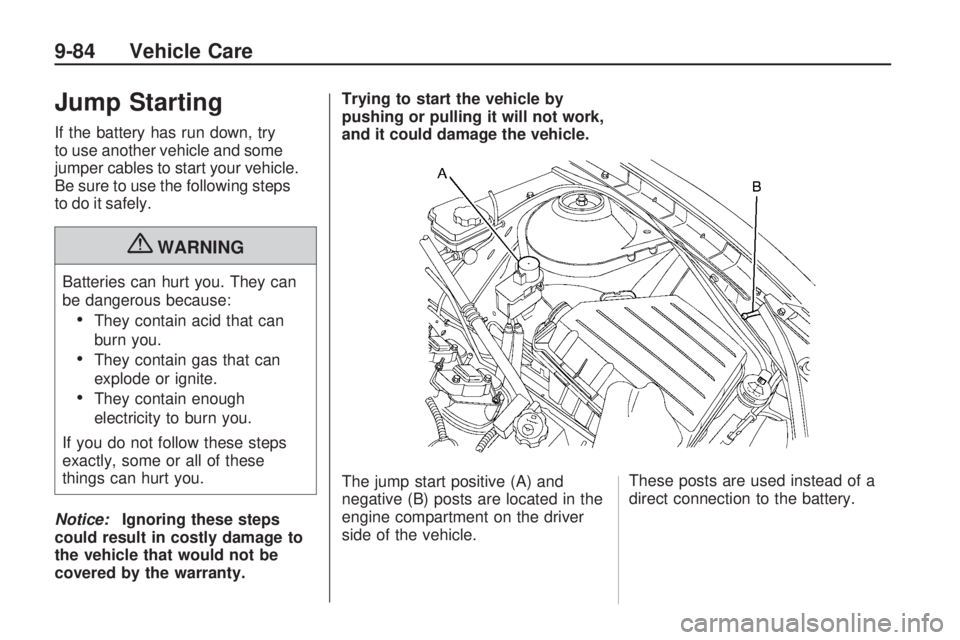
The jump start positive (A) and
negative (B) posts are located in the
engine compartment on the driver
side of the vehicle.
These posts are used instead of a
direct connection to the battery.
9-84 Vehicle Care
Page 317 of 372
The positive jump start connection
is covered by a red cap. Remove to
expose the terminal.
1. Check the other vehicle. It must
have a 12-volt battery with a
negative ground system.
Notice:If the other vehicle’s
system is not a 12-volt system
with a negative ground, both
vehicles can be damaged. Only
use vehicles with 12-volt systems
with negative grounds to jump
start your vehicle.
2. Position the two vehicles so that
they are not touching.
3. Set the parking brake firmly and
put the shift lever in P (Park).
SeeShifting Into Park on
page 8-21.Notice:If you leave the radio or
other accessories on during the
jump starting procedure, they
could be damaged. The repairs
would not be covered by the
warranty. Always turn off the
radio and other accessories
when jump starting the vehicle.
4. Turn the ignition to LOCK/OFF
and switch off all lights and
accessories in both vehicles,
except the hazard warning
flashers if needed.
{WARNING
An electric fan can start up even
when the engine is not running
and can injure you. Keep hands,
clothing and tools away from any
underhood electric fan.
{WARNING
Using a match near a battery can
cause battery gas to explode.
People have been hurt doing this,
and some have been blinded. Use
a flashlight if you need more light.
Be sure the battery has enough
water. You do not need to add
water to the battery installed in
your new vehicle. But if a battery
has filler caps, be sure the right
amount of fluid is there. If it is
low, add water to take care of
that first. If you don’t, explosive
gas could be present.
Battery fluid contains acid that
can burn you. Do not get it on
you. If you accidentally get it in
your eyes or on your skin, flush
the place with water and get
medical help immediately.
Vehicle Care 9-85
Page 318 of 372
{WARNING
Fans or other moving engine
parts can injure you badly. Keep
your hands away from moving
parts once the engine is running.
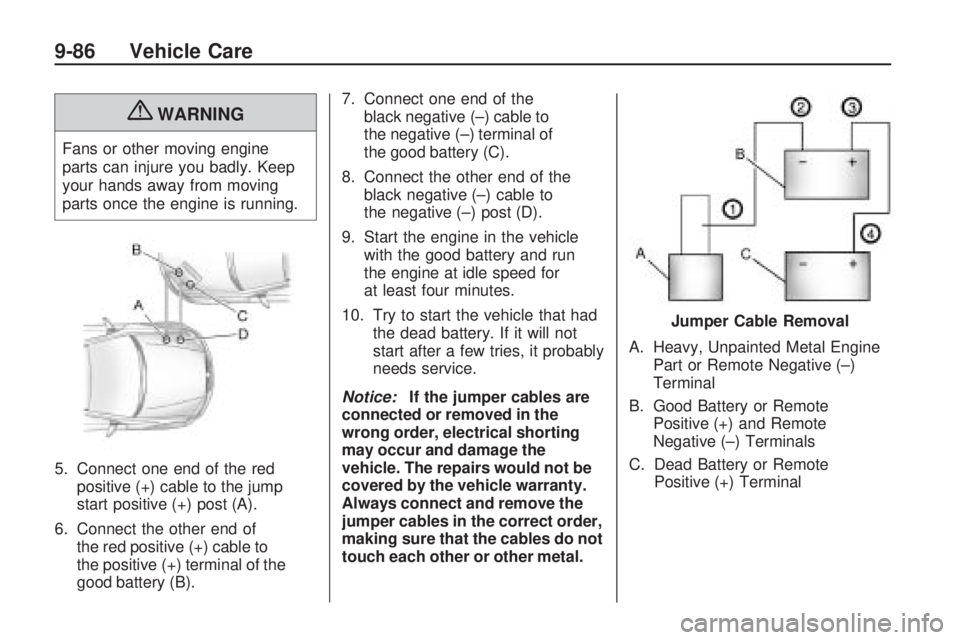
5. Connect one end of the red
positive (+) cable to the jump
start positive (+) post (A).
6. Connect the other end of
the red positive (+) cable to
the positive (+) terminal of the
good battery (B).7. Connect one end of the
black negative (–) cable to
the negative (–) terminal of
the good battery (C).
8. Connect the other end of the
black negative (–) cable to
the negative (–) post (D).
9. Start the engine in the vehicle
with the good battery and run
the engine at idle speed for
at least four minutes.
10. Try to start the vehicle that had
the dead battery. If it will not
start after a few tries, it probably
needs service.
Notice:If the jumper cables are
connected or removed in the
wrong order, electrical shorting
may occur and damage the
vehicle. The repairs would not be
covered by the vehicle warranty.
Always connect and remove the
jumper cables in the correct order,
making sure that the cables do not
touch each other or other metal.A. Heavy, Unpainted Metal Engine
Part or Remote Negative (–)
Terminal
B. Good Battery or Remote
Positive (+) and Remote
Negative (–) Terminals
C. Dead Battery or Remote
Positive (+) Terminal
Jumper Cable Removal
9-86 Vehicle Care
Page 327 of 372
Instrument Panel, Vinyl, and
Other Plastic Surfaces
To remove dust, a soft cloth
dampened with water can be used.
If a more thorough cleaning is
necessary, a clean soft cloth
dampened with a mild soap solution
can be used to gently remove
dust and dirt. Never use spot lifters
or removers on plastic surfaces.
Many commercial cleaners
and coatings that are sold to
preserve and protect soft plastic
surfaces may permanently change
the appearance and feel of the
interior and are not recommended.
Do not use silicone or wax-based
products, or those containing
organic solvents to clean the
vehicle’s interior because they can
alter the appearance by increasing
the gloss in a non-uniform manner.Some commercial products may
increase gloss on the instrument
panel. The increase in gloss may
cause annoying reflections in the
windshield and even make it difficult
to see through the windshield under
certain conditions.
Care of Safety Belts
Keep belts clean and dry.
{WARNING
Do not bleach or dye safety belts.
It may severely weaken them.
In a crash, they might not be able
to provide adequate protection.
Clean safety belts only with mild
soap and lukewarm water.
Vehicle Care 9-95
Page 329 of 372

Service and
Maintenance
General InformationGeneral Information.............10-1
Scheduled MaintenanceScheduled Maintenance........10-2
Recommended Fluids,
Lubricants, and Parts
Recommended Fluids and
Lubricants.........................10-7
Maintenance Replacement
Parts................................10-9
Maintenance RecordsMaintenance Records.........10-10
General Information
Notice:Maintenance
intervals, checks, inspections,
recommended uids, and
lubricants are necessary to
keep this vehicle in good
working condition. Damage
caused by failure to follow
scheduled maintenance might
not be covered by the vehicle
warranty.
Proper vehicle maintenance helps to
keep the vehicle in good working
condition, improves fuel economy,
and reduces vehicle emissions
for better air quality.
Because of all the different ways
people use vehicles, maintenance
needs vary. The vehicle might need
more frequent checks and services.
Please read the information under
Scheduled Maintenance. To keep
the vehicle in good condition, see
your dealer/retailer.The maintenance schedule is for
vehicles that:•carry passengers and cargo
within recommended limits on
the Tire and Loading Information
label. SeeVehicle Load Limits
on page 8-12.
•are driven on reasonable road
surfaces within legal driving
limits.
•use the recommended fuel.
SeeRecommended Fuel
on page 8-44.
{WARNING
Performing maintenance work can
be dangerous. Some jobs can
cause serious injury. Perform
maintenance work only if you
have the required know-how and
the proper tools and equipment.
If in doubt, see your dealer/retailer
to have a qualified technician do
the work. SeeDoing Your Own
Service Work on page 9-4.
Service and Maintenance 10-1
Page 361 of 372
A
Accessories and
Modifications...................... 9-3
Accessory Power.................8-19
Active Fuel Management™....8-25
Adding Equipment to the
Airbag-Equipped Vehicle....2-33
Add-On Electrical
Equipment.......................8-55
Air Cleaner/Filter, Engine.......9-16
Air Vents.............................. 7-3
Airbag System
Check.............................2-34
How Does an Airbag
Restrain?.....................2-27
Passenger Sensing
System........................2-28
What Makes an Airbag
Inflate?........................2-26
What Will You See After
an Airbag Inflates?........2-27
When Should an Airbag
Inflate?........................2-25
Where Are the Airbags?.....2-23Airbag System (cont.)
Airbags
Adding Equipment to the
Vehicle........................2-33
Passenger Status
Indicator.......................4-18
Readiness Light................4-17
Servicing Airbag-Equipped
Vehicles.......................2-32
System Check..................2-21
Alarm System
Anti-Theft........................1-10
AM-FM Radio........................ 6-8
Antenna
Satellite Radio..................6-14
Antilock Brake
System (ABS)..................8-31
Warning Light...................4-23
Anti-Theft
Alarm System..................1-10
Alarm System Messages....4-35
Appearance Care
Exterior...........................9-88
Interior............................9-92
Assistance Program,
Roadside.........................12-6Audio Players......................6-14
CD .................................6-14
Audio System
Backglass Antenna............6-13
Radio Reception...............6-13
Theft-Deterrent Feature....... 6-2
Automatic
Dimming Mirrors...............1-12
Headlamp System.............. 5-3
Automatic Transmission.........8-26
Fluid...............................9-14
Manual Mode...................8-29
Shiftlock Control System
Check..........................9-32
Auxiliary Devices..................6-16
Axle, Rear..........................9-30
B
Battery...............................9-29
Jump Starting...................9-84
Load Management.............. 5-6
Power Protection................ 5-7
Voltage and Charging
Messages....................4-30
Blade Replacement, Wiper....9-33
INDEX i-1
Page 362 of 372
Bluetooth............6-22, 6-23, 6-26
Brakes...............................9-27
Antilock...........................8-31
Assist.............................8-33
Fluid...............................9-28
Parking...........................8-32
System Messages.............4-31
Braking................................ 8-4
Break-In, New Vehicle..........8-16
Bulb Replacement................9-41
Fog Lamps ......................9-40
Halogen Bulbs..................9-37
Headlamp Aiming..............9-34
Headlamps......................9-37
Headlamps, Front Turn
Signal and Parking
Lamps .................9-37, 9-38
High Intensity Discharge
(HID) Lighting...............9-37
License Plate Lamps.........9-40
Taillamps, Turn Signal and
Stoplamps....................9-40
Buying New Tires.................9-63C
Calibration............................ 4-8
California
Fuel Requirements............8-45
Perchlorate Materials
Requirements................. 9-3
Warning............................ 9-2
Canadian Vehicle Owners......... iii
Capacities and
Specifications...................11-2
Carbon Monoxide
Engine Exhaust................8-25
Trunk................................ 1-8
Winter Driving..................8-10
Cautions, Danger, and
Warnings............................. iv
CD Player...........................6-14
Center Console Storage......... 3-1
Chains, Tire........................9-68
Charging System Light..........4-19
Check
Engine Lamp...................4-19
Ignition
Transmission Lock.........9-32Check (cont.)
Child Restraints
Infants and Young
Children.......................2-37
Lower Anchors and Tethers
for Children..................2-43
Older Children..................2-35
Securing..................2-48, 2-50
Systems..........................2-39
Where to Put the
Restraint......................2-41
Circuit Breakers...................9-42
Cleaning
Exterior Care...................9-88
Interior Care....................9-92
Climate Control Systems......... 7-1
Clock................................... 4-8
Cluster, IP...........................4-10
Clutch, Hydraulic..................9-15
Collision Damage Repair.......12-9
Compact Spare Tire.............9-83
Compass.............................. 4-8
Compass Messages.............
4-31
Competitive Driving................ 8-7
Competitive Driving Mode......8-37
i-2 INDEX
Page 363 of 372
Compressor Kit, Tire
Sealant...........................9-71
Control of a Vehicle............... 8-3
Convenience Net................... 3-1
Convex Mirrors....................1-12
Coolant
Engine............................9-19
Engine Temperature Gage . . . 4-14
Cooling System...................9-17
Engine Messages.............4-32
Courtesy Transportation
Program..........................12-8
Covers
Engine.............................. 9-9
Cruise Control.....................8-38
Light...............................4-26
Messages........................4-31
Customer Assistance............12-4
Offices............................12-3
Text Telephone (TTY)
Users..........................12-4
Customer Information
Service Publications
Ordering Information.....12-12
Customer Satisfaction
Procedure........................12-1D
Damage Repair, Collision......12-9
Danger, Warnings, and
Cautions............................. iv
Data Recorders, Event........12-14
Daytime Running
Lamps (DRL) .............5-3, 9-39
Defensive Driving................... 8-2
Devices, Auxiliary.................6-16
Dome Lamps ........................ 5-6
Door
Ajar Messages.................4-31
Locks............................... 1-6
Power Locks...................... 1-7
Driver Information
Center (DIC)....................4-27
Driving
Better Fuel Economy.......... 8-2
Characteristics and
Towing Tips ..................8-49
Competitive...............8-7, 8-37
Defensive.......................... 8-2
Drunk............................... 8-3
Highway Hypnosis.............. 8-9
Hill and Mountain Roads..... 8-9
If the Vehicle is Stuck.......8-11Driving (cont.)
Loss of Control.................. 8-6
Off-Road Recovery............. 8-6
Vehicle Load Limits...........8-12
Winter.............................8-10
E
Electrical Equipment,
Add-On...........................8-55
Electrical System
Engine Compartment
Fuse Block...................9-42
Fuses and Circuit
Breakers......................9-42
Instrument Panel Fuse
Block...........................9-45
Overload.........................9-41
Rear Compartment
Fuse Block...................9-46
Engine
Air Cleaner/Filter...............9-16
Check and Service Engine
Soon Lamp..................4-19
Compartment Overview....... 9-6
Coolant...........................9-19
INDEX i-3
Page 364 of 372
Engine (cont.)
Coolant
Temperature Gage.........4-14
Cooling System................9-17
Cooling System
Messages....................4-32
Cover............................... 9-9
Drive Belt Routing.............11-4
Exhaust...........................8-25
Oil Pressure Gage............4-12
Overheating.....................9-24
Power Messages..............4-33
Pressure Light..................4-25
Running While Parked.......8-26
Starting...........................8-19
Engine Oil
Life System.....................9-13
Messages........................4-32
Temperature Gage............4-13
Entry Lighting........................ 5-6
Equipment, Towing...............8-55
Event Data Recorders.........12-14
Extender, Safety Belt............2-20
Exterior Lamp Controls........... 5-1F
Filter
Engine Air Cleaner............9-16
Flashers, Hazard Warning....... 5-4
Flash-to-Pass........................ 5-3
Flat Tire..............................9-69
Flat Tire, Changing...............9-77
Fluid
Automatic Transmission.....9-14
Brakes............................9-28
Power Steering.................9-25
Washer...........................9-26
Fog Lamps
Bulb Replacement.............9-40
Front................................ 5-5
Light...............................4-26
Front Seats
Adjustment........................ 2-3
Heated............................. 2-6
Fuel...................................8-43
Additives.........................8-45
Economy Driving................ 8-2
Filling a Portable Fuel
Container.....................8-48Fuel (cont.)
Filling the Tank.................8-46
Fuels in Foreign
Countries.....................8-45
Gage ..............................4-11
Gasoline Specifications......8-44
Management, Active..........8-25
Recommended.................8-44
Requirements, California....8-45
System Messages.............4-33
Fuses
Engine Compartment
Fuse Block...................9-42
Fuses and Circuit
Breakers......................9-42
Instrument Panel Fuse
Block...........................9-45
Rear Compartment
Fuse Block...................9-46
G
Gages
Engine Coolant
Temperature.................4-14
Engine Oil Pressure..........4-12
Engine Oil Temperature.....4-13
i-4 INDEX
Page 365 of 372
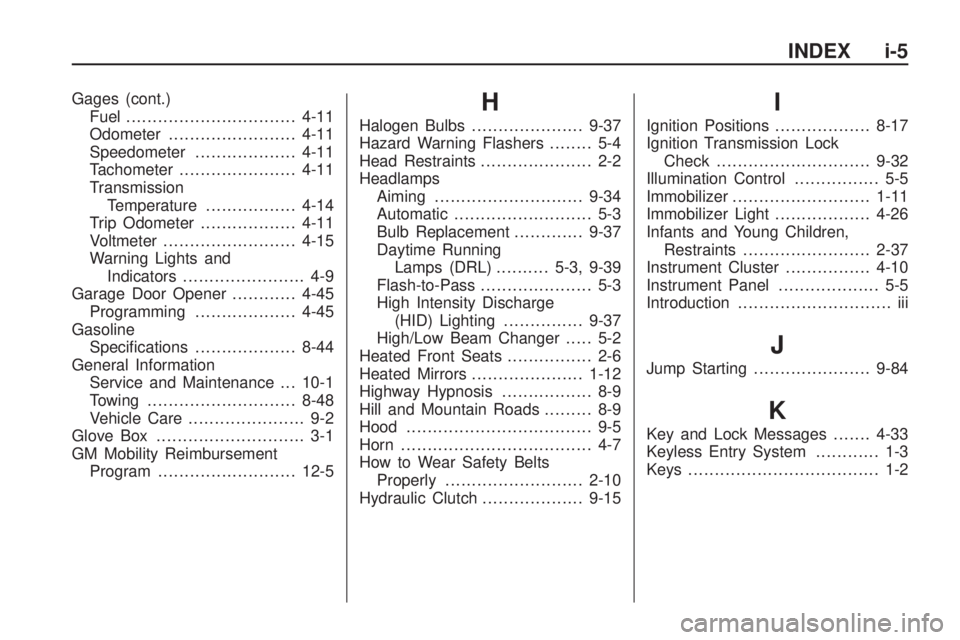
Gages (cont.)
Fuel................................4-11
Odometer........................4-11
Speedometer...................4-11
Tachometer......................4-11
Transmission
Temperature.................4-14
Trip Odometer..................4-11
Voltmeter.........................4-15
Warning Lights and
Indicators....................... 4-9
Garage Door Opener............4-45
Programming...................4-45
Gasoline
Specifications...................8-44
General Information
Service and Maintenance . . . 10-1
Towing ............................8-48
Vehicle Care...................... 9-2
Glove Box............................ 3-1
GM Mobility Reimbursement
Program..........................12-5H
Halogen Bulbs.....................9-37
Hazard Warning Flashers........ 5-4
Head Restraints..................... 2-2
Headlamps
Aiming ............................9-34
Automatic.......................... 5-3
Bulb Replacement.............9-37
Daytime Running
Lamps (DRL) ..........5-3, 9-39
Flash-to-Pass..................... 5-3
High Intensity Discharge
(HID) Lighting...............9-37
High/Low Beam Changer..... 5-2
Heated Front Seats................ 2-6
Heated Mirrors.....................1-12
Highway Hypnosis................. 8-9
Hill and Mountain Roads......... 8-9
Hood ................................... 9-5
Horn .................................... 4-7
How to Wear Safety Belts
Properly..........................2-10
Hydraulic Clutch...................9-15
I
Ignition Positions..................8-17
Ignition Transmission Lock
Check.............................9-32
Illumination Control................ 5-5
Immobilizer..........................1-11
Immobilizer Light..................4-26
Infants and Young Children,
Restraints........................2-37
Instrument Cluster................4-10
Instrument Panel................... 5-5
Introduction............................. iii
J
Jump Starting......................9-84
K
Key and Lock Messages.......4-33
Keyless Entry System............ 1-3
Keys.................................... 1-2
INDEX i-5