warning CHEVROLET CAMARO SS 2010 Owners Manual
[x] Cancel search | Manufacturer: CHEVROLET, Model Year: 2010, Model line: CAMARO SS, Model: CHEVROLET CAMARO SS 2010Pages: 372, PDF Size: 1.91 MB
Page 261 of 372
What to Add
Use only new DOT 3 brake
fluid from a sealed container.
SeeRecommended Fluids and
Lubricants on page 10-7.
Always clean the brake/clutch
fluid reservoir cap and the area
around the cap before removing it.
This helps keep dirt from entering
the reservoir.
{WARNING
With the wrong kind of fluid in the
brake/clutch hydraulic system,
the brakes might not work well.
This could cause a crash. Always
use the proper brake/clutch fluid.Notice:
Using the wrong uid can
badly damage brake/clutch
hydraulic system parts.
For example, just a few drops
of mineral-based oil, such
as engine oil, in the brake
hydraulic system can damage
brake hydraulic system parts so
badly that they will have to be
replaced. Do not let someone
put in the wrong kind of uid.
If brake uid is spilled on the
vehicle’s painted surfaces, the
paint nish can be damaged.
Be careful not to spill brake
uid on the vehicle. If you do,
wash it off immediately.
Battery
This vehicle has a maintenance
free battery. When it is time for a
new battery, see your dealer/retailer
for one that has the replacement
number shown on the original
battery’s label. SeeEngine
Compartment Overview on
page 9-6for battery location.
{WARNING
Battery posts, terminals, and
related accessories contain lead
and lead compounds, chemicals
known to the State of California
to cause cancer and reproductive
harm. Wash hands after handling.
Vehicle Care 9-29
Page 262 of 372
Vehicle Storage
{WARNING
Batteries have acid that can burn
you and gas that can explode.
You can be badly hurt if you are
not careful. SeeJump Starting
on page 9-84for tips on working
around a battery without
getting hurt.
Infrequent Usage: If the vehicle
is driven infrequently, remove
the black, negative (−) cable
from the battery. This helps keep
the battery from running down.Extended Storage: For extended
storage of the vehicle, remove the
black, negative (−) cable from the
battery or use a battery trickle
charger. This helps maintain the
charge of the battery over an
extended period of time.
Rear Axle
When to Check Lubricant
It is not necessary to regularly
check rear axle fluid unless you
suspect there is a leak or you hear
an unusual noise. A fluid loss could
indicate a problem. Have it inspected
and repaired.
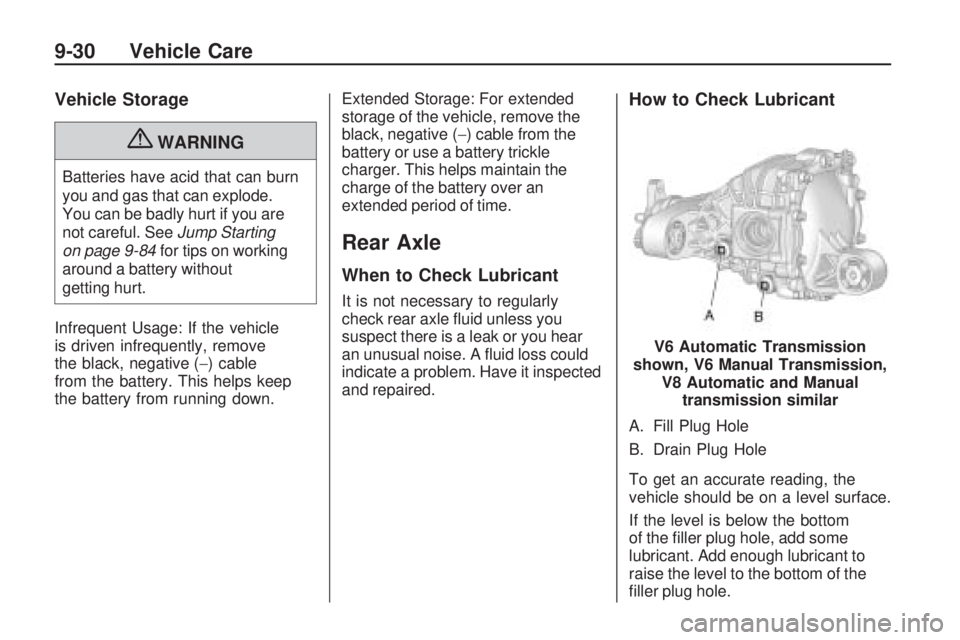
How to Check Lubricant
A. Fill Plug Hole
B. Drain Plug Hole
To get an accurate reading, the
vehicle should be on a level surface.
If the level is below the bottom
of the filler plug hole, add some
lubricant. Add enough lubricant to
raise the level to the bottom of the
filler plug hole.V6 Automatic Transmission
shown, V6 Manual Transmission,
V8 Automatic and Manual
transmission similar
9-30 Vehicle Care
Page 263 of 372

What to Use
For 218 mm rear drive module
(RDM) V6 manual, V8 automatic
and V8 manual:
To add lubricant when the level
is low, use 75W-90 LS gear oil
(GM Part No. US 89021677
and 1052358, in Canada
Part No. 89021678 and 992694)
meeting GM Specification 9986226.
To completely refill after draining,
seeRecommended Fluids and
Lubricants on page 10-7. Then fill
to the bottom of the filler plug hole
with the Synthetic Gear Lubricant.
For 195 mm RDM V6 automatic:
To add lubricant when the level
is low, use 75W-90 gear Oil
(GM Part No. US 89021677,
in Canada Part No. 89021678)
meeting GM Specification 9986115.
To completely refill after draining,
seeRecommended Fluids and
Lubricants on page 10-7. Then fill
to the bottom of the filler plug hole
with the Synthetic Gear Lubricant.
Starter Switch Check
{WARNING
When you are doing this
inspection, the vehicle could move
suddenly. If the vehicle moves,
you or others could be injured.
1. Before starting this check,
be sure there is enough
room around the vehicle.
2. Firmly apply both the parking
brake and the regular brake.
SeeParking Brake on page 8-32.
Do not use the accelerator
pedal, and be ready to turn off
the engine immediately if it starts.3. For automatic transmission
vehicles, try to start the engine
in each gear. The vehicle
should start only in P (Park) or
N (Neutral). If the vehicle starts
in any other position, contact your
dealer/retailer for service.
For manual transmission
vehicles, put the shift lever in
Neutral, push the clutch pedal
down halfway, and try to start the
engine. The vehicle should start
only when the clutch pedal is
pushed down all the way to the
floor. If the vehicle starts when
the clutch pedal is not pushed
all the way down, contact your
dealer/retailer for service.
Vehicle Care 9-31
Page 264 of 372
Automatic Transmission
Shift Lock Control
System Check
{WARNING
When you are doing this
inspection, the vehicle could move
suddenly. If the vehicle moves,
you or others could be injured.
1. Before starting this check, be
sure there is enough room
around the vehicle. It should
be parked on a level surface.
2. Firmly apply the parking brake.
SeeParking Brake on page 8-32.
Be ready to apply the regular
brake immediately if the vehicle
begins to move.3. With the engine off, turn the
ignition to ON/RUN, but do
not start the engine. Without
applying the regular brake,
try to move the shift lever out
of P (Park) with normal effort.
If the shift lever moves out
of P (Park), contact your
dealer/retailer for service.
Ignition Transmission
Lock Check
While parked, and with the parking
brake set, try to turn the ignition
to LOCK/OFF in each shift lever
position.
•The ignition should turn to
LOCK/OFF only when the
shift lever is in P (Park).
•The ignition key should come out
only in LOCK/OFF.
Contact your dealer/retailer if
service is required.
Park Brake and P (Park)
Mechanism Check
{WARNING
When you are doing this check,
the vehicle could begin to move.
You or others could be injured
and property could be damaged.
Make sure there is room in front
of the vehicle in case it begins to
roll. Be ready to apply the regular
brake at once should the vehicle
begin to move.
9-32 Vehicle Care
Page 269 of 372
Bulb Replacement
For the proper type of replacement
bulbs, seeReplacement Bulbs
on page 9-41.
For any bulb changing procedure
not listed in this section, contact
your dealer/retailer.
Halogen Bulbs
{WARNING
Halogen bulbs have pressurized
gas inside and can burst if you
drop or scratch the bulb. You or
others could be injured. Be sure
to read and follow the instructions
on the bulb package.
High Intensity Discharge
(HID) Lighting
{WARNING
The low beam high intensity
discharge lighting system
operates at a very high voltage.
If you try to service any of the
system components, you could
be seriously injured. Have your
dealer/retailer or a qualified
technician service them.
The up–level vehicle is equipped
with HID headlamps. The park lamp
function is also a function of the HID
headlamp. After an HID headlamp
bulb has been replaced, you may
notice that the beam is a slightly
different shade than it was originally.
This is normal.
Headlamps, Front Turn
Signal and Parking
Lamps (Base Vehicle)
The base model vehicle has a
halogen headlamp and a turn
signal/parking lamp on the
headlamp assembly.
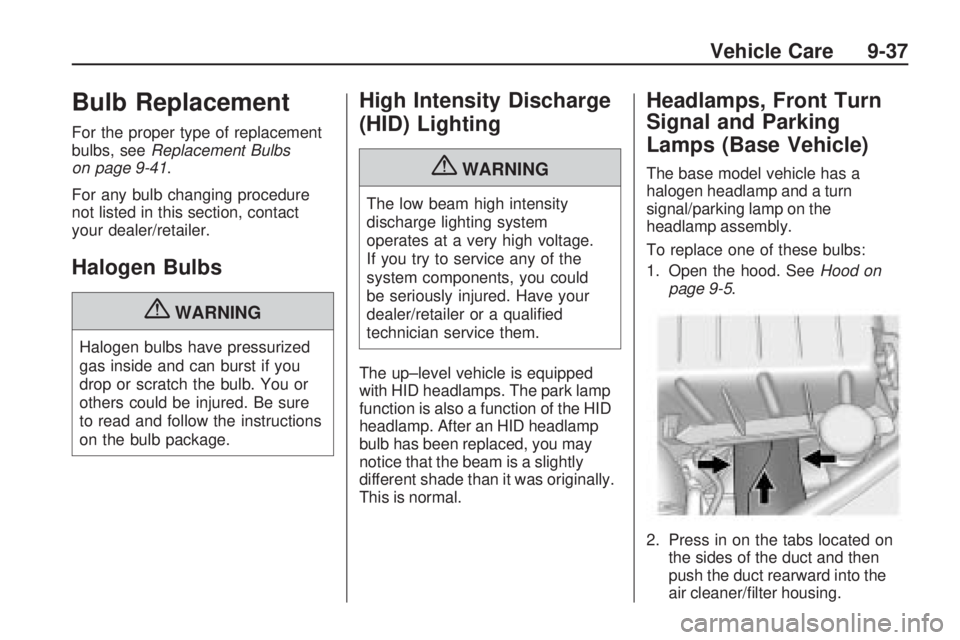
To replace one of these bulbs:
1. Open the hood. SeeHood on
page 9-5.
2. Press in on the tabs located on
the sides of the duct and then
push the duct rearward into the
air cleaner/filter housing.
Vehicle Care 9-37
Page 280 of 372
Wheels and Tires
Tires
Your new vehicle comes
with high-quality tires made
by a leading tire manufacturer.
If you ever have questions about
your tire warranty and where to
obtain service, see your vehicle
Warranty booklet for details.
For additional information refer
to the tire manufacturer.
{WARNING
Poorly maintained and improperly
used tires are dangerous.
•Overloading your tires can
cause overheating as a result
of too much flexing. You could
have an air-out and a serious
accident. SeeVehicle Load
Limits on page 8-12.
(Continued)
WARNING (Continued)
•Underinflated tires pose the
same danger as overloaded
tires. The resulting accident
could cause serious injury.
Check all tires frequently to
maintain the recommended
pressure. Tire pressure
should be checked when
your tires are cold. SeeTire
Pressure on page 9-54.
•Overinflated tires are more
likely to be cut, punctured
or broken by a sudden
impact — such as when you
hit a pothole. Keep tires at
the recommended pressure.
•Worn, old tires can cause
accidents. If your tread is
badly worn, or if your tires
have been damaged,
replace them.
Winter Tires
If you expect to drive on snow or ice
covered roads often, you may want
to get winter tires for your vehicle.
All season tires provide good overall
performance on most surfaces but
they may not offer the traction you
would like or the same level of
performance as winter tires on
snow or ice covered roads.
Winter tires, in general, are
designed for increased traction
on snow and ice covered roads.
With winter tires, there may be
decreased dry road traction,
increased road noise, and shorter
tread life. After switching to winter
tires, be alert for changes in vehicle
handling and braking.
See your dealer/retailer for details
regarding winter tire availability
and proper tire selection. Also, see
Buying New Tires on page 9-63.
9-48 Vehicle Care
Page 288 of 372
Tire Pressure for
High-Speed Operation
{WARNING
Driving at high speeds, 100 mph
(160 km/h) or higher, puts an
additional strain on tires. Sustained
high-speed driving causes
excessive heat build up and
can cause sudden tire failure.
You could have a crash and you
or others could be killed. Some
high-speed rated tires require
inflation pressure adjustment for
high speed operation. When speed
limits and road conditions are such
that a vehicle can be driven at high
speeds, make sure the tires are
rated for high speed operation, in
excellent condition, and set to the
correct cold tire inflation pressure
for the vehicle load.Vehicles with 245/45ZR20 103Y,
P245/50ZR19 104W and
275/40ZR20 106Y size tires,
have tires capable of high speed
use. Make sure the tires are inflated
to the recommended cold inflation
pressures before operating the
vehicle at speeds over 100 mph
(160 km/h). SeeVehicle Load Limits
on page 8-12andTire Pressure on
page 9-54.
Tire Pressure Monitor
System
The Tire Pressure Monitor System
(TPMS) uses radio and sensor
technology to check tire pressure
levels. The TPMS sensors monitor
the air pressure in your vehicle’s tires
and transmit tire pressure readings
to a receiver located in the vehicle.
Each tire, including the spare
(if provided), should be checked
monthly when cold and inflated to
the inflation pressure recommended
by the vehicle manufacturer on thevehicle placard or tire inflation
pressure label. (If your vehicle has
tires of a different size than the size
indicated on the vehicle placard or
tire inflation pressure label, you
should determine the proper tire
inflation pressure for those tires.)
As an added safety feature, your
vehicle has been equipped with a
tire pressure monitoring system
(TPMS) that illuminates a low tire
pressure telltale when one or
more of your tires is significantly
under-inflated.
Accordingly, when the low tire
pressure telltale illuminates, you
should stop and check your tires as
soon as possible, and inflate them
to the proper pressure. Driving on
a significantly under-inflated tire
causes the tire to overheat and can
lead to tire failure. Under-inflation
also reduces fuel efficiency and
tire tread life, and may affect the
vehicle’s handling and stopping
ability.
9-56 Vehicle Care
Page 290 of 372
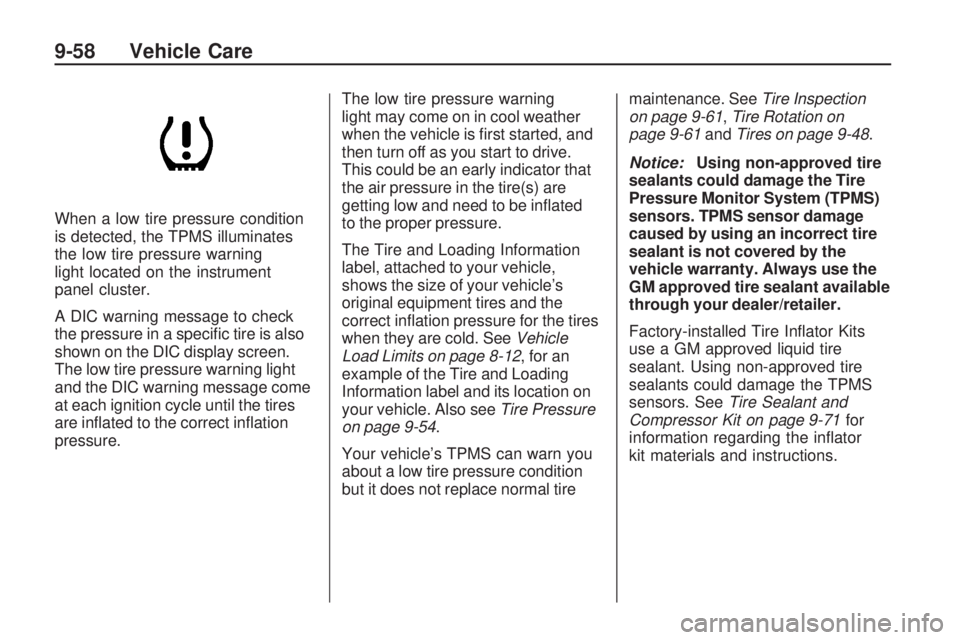
When a low tire pressure condition
is detected, the TPMS illuminates
the low tire pressure warning
light located on the instrument
panel cluster.
A DIC warning message to check
the pressure in a specific tire is also
shown on the DIC display screen.
The low tire pressure warning light
and the DIC warning message come
at each ignition cycle until the tires
are inflated to the correct inflation
pressure.The low tire pressure warning
light may come on in cool weather
when the vehicle is first started, and
then turn off as you start to drive.
This could be an early indicator that
the air pressure in the tire(s) are
getting low and need to be inflated
to the proper pressure.
The Tire and Loading Information
label, attached to your vehicle,
shows the size of your vehicle’s
original equipment tires and the
correct inflation pressure for the tires
when they are cold. SeeVehicle
Load Limits on page 8-12, for an
example of the Tire and Loading
Information label and its location on
your vehicle. Also seeTire Pressure
on page 9-54.
Your vehicle’s TPMS can warn you
about a low tire pressure condition
but it does not replace normal tiremaintenance. SeeTire Inspection
on page 9-61,Tire Rotation on
page 9-61andTires on page 9-48.
Notice:Using non-approved tire
sealants could damage the Tire
Pressure Monitor System (TPMS)
sensors. TPMS sensor damage
caused by using an incorrect tire
sealant is not covered by the
vehicle warranty. Always use the
GM approved tire sealant available
through your dealer/retailer.
Factory-installed Tire Inflator Kits
use a GM approved liquid tire
sealant. Using non-approved tire
sealants could damage the TPMS
sensors. SeeTire Sealant and
Compressor Kit on page 9-71for
information regarding the inflator
kit materials and instructions.
9-58 Vehicle Care
Page 291 of 372
TPMS Malfunction Light and
Message
The TPMS will not function properly
if one or more of the TPMS sensors
are missing or inoperable. When the
system detects a malfunction, the
low tire warning light flashes for
about one minute and then stays
on for the remainder of the ignition
cycle. A DIC warning message is
also displayed. The low tire warning
light and DIC warning message
come on at each ignition cycle until
the problem is corrected. Some of
the conditions that can cause the
malfunction light and DIC message
to come on are:
•One of the road tires has been
replaced with the spare tire, if the
vehicle has one. The spare tire
does not have a TPMS sensor.
The DIC message should go off
once you re-install the road tire
containing the TPMS sensor.
•The TPMS sensor matching
process was not done or not
completed successfully after
rotating the vehicle’s tires.
The DIC message should go
off after successfully completing
the sensor matching process.
See “TPMS Sensor Matching
Process” later in this section.
•One or more TPMS sensors
are missing or damaged.
The DIC message and the
TPMS malfunction light should
go off when the TPMS sensors
are installed and the sensor
matching process is performed
successfully. See your dealer/
retailer for service.
•Replacement tires or wheels do
not match your vehicle’s original
equipment tires or wheels. Tires
and wheels other than those
recommended for your vehicle
could prevent the TPMS from
functioning properly. SeeBuying
New Tires on page 9-63.
•Operating electronic devices or
being near facilities using radio
wave frequencies similar to the
TPMS could cause the TPMS
sensors to malfunction.
If the TPMS is not functioning it
cannot detect or signal a low tire
condition. See your dealer/retailer for
service if the TPMS malfunction light
and DIC message comes on and
stays on.
Vehicle Care 9-59
Page 294 of 372
The compact spare tire, if the
vehicle has one, is not included
in the tire rotation.
After the tires have been rotated,
adjust the front and rear inflation
pressures as shown on the Tire
and Loading Information label.
SeeTire Pressure on page 9-54
andVehicle Load Limits on
page 8-12.
Reset the Tire Pressure Monitor
System. SeeTire Pressure
Monitor Operation on page 9-57.
Make certain that all wheel
nuts are properly tightened.
See “Wheel Nut Torque” under
Capacities and Specications on
page 11-2.{WARNING
Rust or dirt on a wheel, or on the
parts to which it is fastened, can
make wheel nuts become loose
after time. The wheel could come
off and cause an accident. When
changing a wheel, remove any
rust or dirt from places where the
wheel attaches to the vehicle.
In an emergency, use a cloth or
a paper towel to do this; but be
sure to use a scraper or wire
brush later, if needed, to get all
the rust or dirt off. SeeIf a Tire
Goes Flat on page 9-69.
When It Is Time for
New Tires
Various factors, such as
maintenance, temperatures,
driving speeds, vehicle loading,
and road conditions influence
when you need new tires.
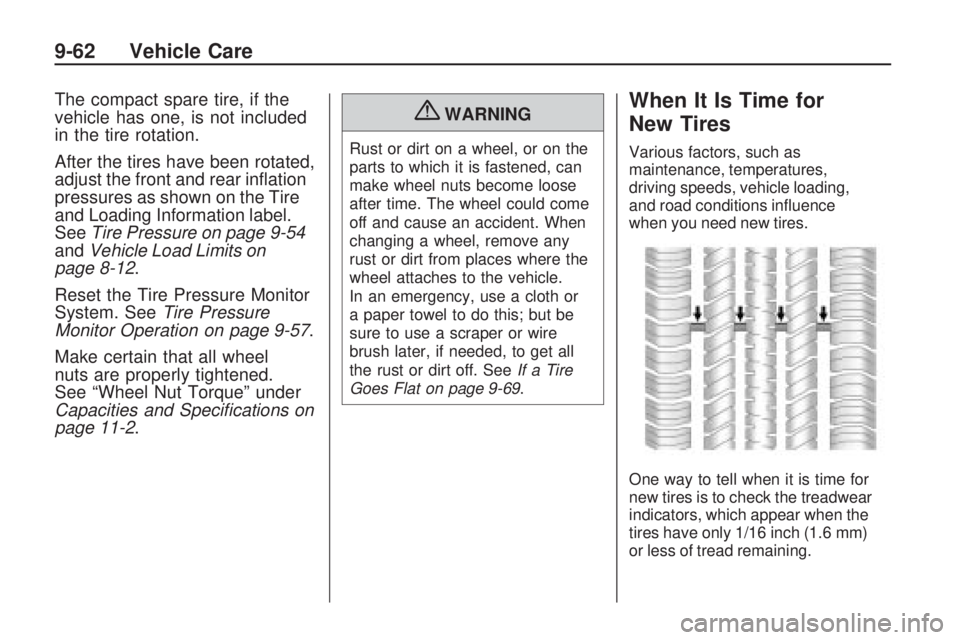
One way to tell when it is time for
new tires is to check the treadwear
indicators, which appear when the
tires have only 1/16 inch (1.6 mm)
or less of tread remaining.
9-62 Vehicle Care