window CHEVROLET CAMARO SS 2010 Owner's Manual
[x] Cancel search | Manufacturer: CHEVROLET, Model Year: 2010, Model line: CAMARO SS, Model: CHEVROLET CAMARO SS 2010Pages: 372, PDF Size: 1.91 MB
Page 48 of 372

The right front passenger frontal
airbag is in the instrument panel on
the passenger side.
The seat-mounted side impact
airbags for the driver and right front
passenger are in the side of the
seatbacks closest to the door.If the vehicle has roof-rail airbags for
the driver, right front passenger, and
second row outboard passengers,
they are in the ceiling above the side
windows.Driver Side shown,
Passenger Side similarDriver Side shown,
Passenger Side similar
2-24 Seats and Restraints
Page 49 of 372
{WARNING
If something is between an
occupant and an airbag, the airbag
might not inflate properly or it might
force the object into that person
causing severe injury or even
death. The path of an inflating
airbag must be kept clear. Do not
put anything between an occupant
and an airbag, and do not attach or
put anything on the steering wheel
hub or on or near any other airbag
covering.
Do not use seat accessories
that block the inflation path of a
seat-mounted side impact airbag.
Never secure anything to the roof
of a vehicle with roof-rail airbags
by routing a rope or tie down
through any door or window
opening. If you do, the path of
an inflating roof-rail airbag will
be blocked.
When Should an Airbag
Inate?
Frontal airbags are designed to
inflate in moderate to severe frontal
or near-frontal crashes to help
reduce the potential for severe
injuries mainly to the driver’s or right
front passenger’s head and chest.
However, they are only designed
to inflate if the impact exceeds
a predetermined deployment
threshold. Deployment thresholds
are used to predict how severe a
crash is likely to be in time for the
airbags to inflate and help restrain
the occupants.
Whether the frontal airbags will
or should deploy is not based on
how fast your vehicle is traveling.
It depends largely on what you hit,
the direction of the impact, and how
quickly your vehicle slows down.Frontal airbags may inflate at
different crash speeds. For example:•If the vehicle hits a stationary
object, the airbags could inflate at
a different crash speed than if the
vehicle hits a moving object.
•If the vehicle hits an object that
deforms, the airbags could inflate
at a different crash speed than if
the vehicle hits an object that
does not deform.
•If the vehicle hits a narrow object
(like a pole), the airbags could
inflate at a different crash speed
than if the vehicle hits a wide
object (like a wall).
•If the vehicle goes into an object
at an angle, the airbags could
inflate at a different crash speed
than if the vehicle goes straight
into the object.
Thresholds can also vary with
specific vehicle design.
Frontal airbags are not intended to
inflate during vehicle rollovers, rear
impacts, or in many side impacts.
Seats and Restraints 2-25
Page 50 of 372
In addition, the vehicle has
dual-stage frontal airbags.
Dual-stage airbags adjust the
restraint according to crash severity.
Your vehicle has electronic frontal
sensors, which help the sensing
system distinguish between a
moderate frontal impact and a
more severe frontal impact.
For moderate frontal impacts,
dual-stage airbags inflate at a
level less than full deployment.
For more severe frontal impacts,
full deployment occurs.
Your vehicle has seat-mounted side
impact airbags. Your vehicle may
or may not have roof-rail airbags.
SeeAirbag System on page 2-21.
Seat-mounted side impact and
roof-rail airbags are intended to
inflate in moderate to severe side
crashes. In addition, these roof-rail
airbags are intended to inflate in a
severe frontal impact. Seat-mounted
side impact and roof-rail airbags will
inflate if the crash severity is abovethe system’s designed threshold
level. The threshold level can vary
with specific vehicle design.
Seat-mounted side impact
airbags are not intended to inflate
in frontal impacts, near-frontal
impacts, rollovers, or rear impacts.
A seat-mounted side impact airbag
is intended to deploy on the side of
the vehicle that is struck. Roof-rail
airbags are intended to deploy on
both sides in some high threshold
frontal impacts.
In any particular crash, no one
can say whether an airbag should
have inflated simply because of
the damage to a vehicle or because
of what the repair costs were.
For frontal airbags, inflation is
determined by what the vehicle hits,
the angle of the impact, and how
quickly the vehicle slows down.
For seat-mounted side impact and
roof-rail airbags, deployment is
determined by the location and
severity of the side impact.What Makes an Airbag
Inate?
In a deployment event, the sensing
system sends an electrical signal
triggering a release of gas from the
inflator. Gas from the inflator fills the
airbag causing the bag to break out
of the cover and deploy. The inflator,
the airbag, and related hardware are
all part of the airbag module.
Frontal airbag modules are located
inside the steering wheel and
instrument panel. For vehicles with
seat-mounted side impact airbags,
there are airbag modules in the side
of the front seatbacks closest to
the door. For vehicles with roof-rail
airbags, there are airbag modules
in the ceiling of the vehicle, near the
side windows that have occupant
seating positions.
2-26 Seats and Restraints
Page 51 of 372
How Does an Airbag
Restrain?
In moderate to severe frontal or
near frontal collisions, even belted
occupants can contact the steering
wheel or the instrument panel. In
moderate to severe side collisions,
even belted occupants can contact
the inside of the vehicle.
Airbags supplement the protection
provided by safety belts. Frontal
airbags distribute the force of the
impact more evenly over the
occupant’s upper body, stopping
the occupant more gradually.
Seat-mounted side impact and
roof-rail airbags distribute the force
of the impact more evenly over the
occupant’s upper body.
But airbags would not help in many
types of collisions, primarily because
the occupant’s motion is not toward
those airbags. SeeWhen Should
an Airbag Inate? on page 2-25
for more information.
Airbags should never be regarded
as anything more than a supplement
to safety belts.
What Will You See After
an Airbag Inates?
After the frontal airbags and
seat-mounted side impact airbags
inflate, they quickly deflate, so
quickly that some people may not
even realize an airbag inflated.
Roof-rail airbags may still be at least
partially inflated for some time after
they deploy. Some components of
the airbag module may be hot for
several minutes. For location of the
airbag modules, seeWhat Makes
an Airbag Inate? on page 2-26.
The parts of the airbag that come
into contact with you may be warm,
but not too hot to touch. There may
be some smoke and dust coming
from the vents in the deflated
airbags. Airbag inflation does not
prevent the driver from seeing out
of the windshield or being able to
steer the vehicle, nor does it prevent
people from leaving the vehicle.
{WARNING
When an airbag inflates, there
may be dust in the air. This dust
could cause breathing problems
for people with a history of asthma
or other breathing trouble.
To avoid this, everyone in the
vehicle should get out as soon
as it is safe to do so. If you have
breathing problems but cannot get
out of the vehicle after an airbag
inflates, then get fresh air by
opening a window or a door. If you
experience breathing problems
following an airbag deployment,
you should seek medical attention.
The vehicle has a feature that may
automatically unlock the doors, turn
the interior lamps on, and turn the
hazard warning flashers on when
the airbags inflate. You can lock the
doors, turn the interior lamps off,
and turn the hazard warning flashers
off by using the controls for those
features.
Seats and Restraints 2-27
Page 64 of 372
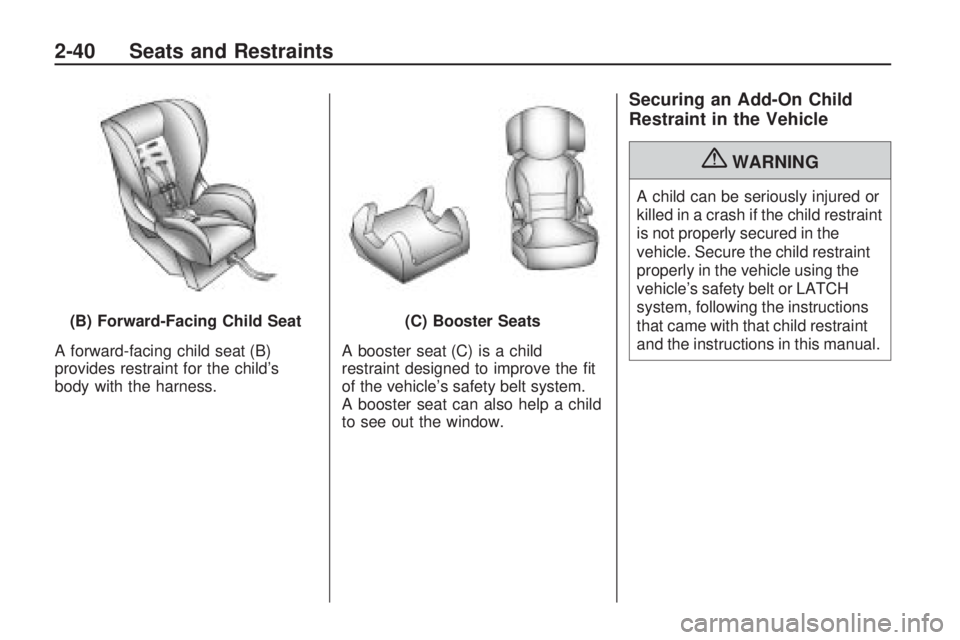
A forward-facing child seat (B)
provides restraint for the child’s
body with the harness.A booster seat (C) is a child
restraint designed to improve the fit
of the vehicle’s safety belt system.
A booster seat can also help a child
to see out the window.
Securing an Add-On Child
Restraint in the Vehicle
{WARNING
A child can be seriously injured or
killed in a crash if the child restraint
is not properly secured in the
vehicle. Secure the child restraint
properly in the vehicle using the
vehicle’s safety belt or LATCH
system, following the instructions
that came with that child restraint
and the instructions in this manual. (B) Forward-Facing Child Seat
(C) Booster Seats
2-40 Seats and Restraints
Page 82 of 372

Vehicle Speed Messages......4-37
Vehicle Messages................4-37
Window Messages...............4-37
Vehicle PersonalizationVehicle Personalization.........4-38
OnStar SystemOnStar®System..................4-42
Universal Remote SystemUniversal Remote System.....4-45
Universal Remote System
Programming.....................4-45
Universal Remote System
Operation..........................4-48
4-2 Instruments and Controls
Page 117 of 372
Vehicle Reminder
Messages
Ice Possible Drive With Care
This message is displayed when ice
conditions are possible.
Turn Wiper Control to
Intermittent First
This message is displayed when
attempting to adjust the intermittent
wiper speed without intermittent
selected on the wiper control.
SeeWindshield Wiper/Washer on
page 4-7.
Vehicle Speed Messages
Driver Selected Speed Limit
Exceeded
This message is displayed when the
vehicle speed is greater than the
set speed. See “Speed Warning”
underDriver Information Center
(DIC) on page 4-27.
Vehicle Messages
Messages are displayed on the DIC
to notify the driver that the status
of the vehicle has changed and that
some action may be needed by
the driver to correct the condition.
Multiple messages may appear
one after another.
Some messages may not require
immediate action. For those you can
press SET to acknowledge that
you received the messages and to
clear them. Some messages
cannot be cleared because they are
more urgent. These messages
require action. You should take
any messages that appear on the
display seriously and remember that
clearing the messages will only
make the messages disappear,
not correct the problem. Possible
messages that can be displayed
and some information about them,
grouped by subject, are in the
following information.
Window Messages
Open, Then Close Driver
Window
This message is displayed when the
window needs to be reprogrammed.
If the vehicle’s battery has been
recharged or disconnected, you will
need to reprogram each front
window for the express up feature
to work. SeePower Windows
on page 1-14for more information.
Open, Then Close Passenger
Window
This message is displayed when the
window needs to be reprogrammed.
If the vehicle’s battery has been
recharged or disconnected, you will
need to reprogram each front
window for the express up feature
to work. SeePower Windows
on page 1-14for more information.
Instruments and Controls 4-37
Page 137 of 372

A high electrical load occurs when
several of the following are on, such
as: headlamps, high beams, fog
lamps, rear window defogger,
climate control fan at high speed,
heated seats, engine cooling fans,
trailer loads, and loads plugged into
accessory power outlets.
EPM works to prevent excessive
discharge of the battery. It does
this by balancing the generator’s
output and the vehicle’s electrical
needs. It can increase engine
idle speed to generate more power,
whenever needed. It can temporarily
reduce the power demands of
some accessories.
Normally, these actions occur in
steps or levels, without being
noticeable. In rare cases at thehighest levels of corrective action,
this action may be noticeable to the
driver. If so, a Driver Information
Center (DIC) message might be
displayed, such as BATTERY
SAVER ACTIVE, BATTERY
VOLTAGE LOW, or LOW BATTERY.
If one of these messages display, it
is recommended that the driver
reduce the electrical loads as much
as possible. SeeDriver Information
Center (DIC) on page 4-27.
Battery Power Protection
This feature shuts off the dome
lamps if they are left on for more than
10 minutes when the ignition is in
LOCK/OFF. This helps to prevent the
battery from running down.
Lighting 5-7
Page 151 of 372
Radio Reception
Frequency interference and static
can occur during normal radio
reception if items such as cell phone
chargers, vehicle convenience
accessories, and external electronic
devices are plugged into the
accessory power outlet. If there is
interference or static, unplug the item
from the accessory power outlet.
FM
FM signals only reach about
16 to 65 km (10 to 40 miles).
Although the radio has a built-in
electronic circuit that automatically
works to reduce interference,
some static can occur, especially
around tall buildings or hills, causing
the sound to fade in and out.
AM
The range for most AM stations is
greater than for FM, especially at
night. The longer range can cause
station frequencies to interfere with
each other. For better radio
reception, most AM radio stations
boost the power levels during the
day, and then reduce these levels
during the night. Static can also
occur when things like storms and
power lines interfere with radio
reception. When this happens, try
reducing the treble on the radio.
XM™ Satellite Radio Service
XM Satellite Radio Service gives
digital radio reception from
coast-to-coast in the 48 contiguous
United States, and in Canada.
Just as with FM, tall buildings or hills
can interfere with satellite radio
signals, causing the sound to fade
in and out. In addition, traveling
or standing under heavy foliage,
bridges, garages, or tunnels may
cause loss of the XM signal for
a period of time.
Cellular Phone Usage
Cellular phone usage may cause
interference with the vehicle’s radio.
This interference may occur when
making or receiving phone calls,
charging the phone’s battery,
or simply having the phone on.
This interference can cause
an increased level of static while
listening to the radio. If static
is received while listening to the
radio, unplug the cellular phone and
turn it off.
Backglass Antenna
The AM-FM antenna is integrated
with the rear window defogger,
located in the rear window. Make
sure that the inside surface of
the rear window is not scratched
and that the lines on the glass are
not damaged. If the inside surface
is damaged, it could interfere
with radio reception. For proper
radio reception, the antenna
connector needs to be properly
attached to the post on the glass.
Infotainment System 6-13
Page 152 of 372
If a cellular telephone antenna
needs to be attached to the glass,
make sure that the grid lines for
the AM-FM antenna are not
damaged. There is enough space
between the grid lines to attach
a cellular telephone antenna without
interfering with radio reception.
Notice:Using a razor blade or
sharp object to clear the inside
rear window can damage the rear
window antenna and/or the rear
window defogger. Repairs would
not be covered by the vehicle
warranty. Do not clear the inside
rear window with sharp objects.Notice:Do not apply aftermarket
glass tinting with metallic lm.
The metallic lm in some tinting
materials will interfere with or
distort the incoming radio
reception. Any damage caused to
your backglass antenna due to
metallic tinting materials will
not be covered by the vehicle
warranty.
Satellite Radio Antenna
For vehicles with XM™ Satellite
Radio Service, the antenna is
located on the decklid of the vehicle.
Keep the antenna clear of
obstructions for clear radio
reception.
Audio Players
CD Player
The CD player can play audio CDs
and MP3 CDs.
The CD player will not play
8 cm (3 inches) CDs.
Care of CDs
Sound quality can be reduced due to
disc quality, recording method,
quality of the music recorded, and
how the disc has been handled.
Handle discs carefully and store
them in their original cases or other
protective cases away from direct
sunlight and dust. If the bottom
surface of a disc is damaged, the
disc may not play properly or at all.
Do not touch the bottom surface of a
disc while handling it; this could
damage the surface. Pick up discs by
grasping the outer edges or the edge
of the hole and the outer edge.
6-14 Infotainment System