instrument panel CHEVROLET CAMARO SS 2010 Owner's Guide
[x] Cancel search | Manufacturer: CHEVROLET, Model Year: 2010, Model line: CAMARO SS, Model: CHEVROLET CAMARO SS 2010Pages: 372, PDF Size: 1.91 MB
Page 227 of 372
Backing Up
Hold the bottom of the steering
wheel with one hand. Then, to move
the trailer to the left, move that
hand to the left. To move the trailer
to the right, move your hand to
the right. Always back up slowly
and, if possible, have someone
guide you.
Making Turns
Notice:Making very sharp turns
while trailering could cause the
trailer to come in contact with the
vehicle. The vehicle could be
damaged. Avoid making very
sharp turns while trailering.
When turning with a trailer, make
wider turns than normal. Do this so
the trailer won’t strike soft shoulders,
curbs, road signs, trees or other
objects. Avoid jerky or sudden
maneuvers. Signal well in advance.
Turn Signals When Towing a
Trailer
The arrows on the instrument panel
flash whenever signaling a turn
or lane change. Properly hooked up,
the trailer lamps also flash, telling
other drivers the vehicle is turning,
changing lanes or stopping.
When towing a trailer, the arrows on
the instrument panel flash for turns
even if the bulbs on the trailer are
burned out. For this reason you
may think other drivers are seeing
the signal when they are not. It is
important to check occasionally to be
sure the trailer bulbs are still working.
Driving On Grades
Reduce speed and shift to a lower
gear before starting down a long or
steep downgrade. If the transmission
is not shifted down, the brakes might
have to be used so much that they
would get hot and no longer
work well.Vehicles with an automatic
transmission can tow in D (Drive).
Shift the transmission to a lower
gear if the transmission shifts
too often under heavy loads and/or
hilly conditions. For vehicles with
a manual transmission, it is
better not to use the highest gear.
When towing at high altitude on
steep uphill grades, consider the
following: Engine coolant will boil at
a lower temperature than at normal
altitudes. If the engine is turned off
immediately after towing at high
altitude on steep uphill grades,
the vehicle may show signs similar
to engine overheating. To avoid
this, let the engine run while
parked, preferably on level ground,
with the automatic transmission
in P (Park) for a few minutes
before turning the engine off.
Driving and Operating 8-51
Page 233 of 372
Vehicle Care
General InformationGeneral Information...............9-2
California Proposition 65
Warning.............................9-2
California Perchlorate
Materials Requirements........9-3
Accessories and
Modifications.......................9-3
Vehicle ChecksDoing Your Own
Service Work......................9-4
Hood...................................9-5
Engine Compartment
Overview............................9-6
Engine Cover.......................9-9
Engine Oil..........................9-10
Engine Oil Life System.........9-13
Automatic Transmission
Fluid................................9-14
Manual Transmission Fluid. . . .9-15
Hydraulic Clutch..................9-15
Engine Air Cleaner/Filter.......9-16
Cooling System...................9-17
Engine Coolant...................9-19
Engine Overheating.............9-24
Power Steering Fluid............9-25Washer Fluid......................9-26
Brakes...............................9-27
Brake Fluid.........................9-28
Battery...............................9-29
Rear Axle...........................9-30
Starter Switch Check............9-31
Automatic Transmission
Shift Lock Control
System Check...................9-32
Ignition Transmission
Lock Check.......................9-32
Park Brake and P (Park)
Mechanism Check..............9-32
Wiper Blade Replacement......9-33Headlamp AimingHeadlamp Aiming................9-34
Bulb ReplacementBulb Replacement...............9-37
Halogen Bulbs....................9-37
High Intensity Discharge
(HID) Lighting....................9-37
Headlamps, Front Turn
Signal and Parking Lamps
(Base Vehicle)...................9-37
Headlamps, Front Turn
Signal and Parking Lamps
(Up-Level Vehicle)..............9-38
Daytime Running
Lamps (DRL)....................9-39
Fog Lamps.........................9-40Taillamps, Turn Signal, and
Stoplamps.........................9-40
License Plate Lamp.............9-40
Replacement Bulbs..............9-41
Electrical SystemElectrical System
Overload...........................9-41
Fuses and Circuit
Breakers...........................9-42
Engine Compartment
Fuse Block.......................9-42
Instrument Panel
Fuse Block.......................9-45
Rear Compartment
Fuse Block.......................9-46
Wheels and TiresTires..................................9-48
Winter Tires........................9-48
Tire Sidewall Labeling..........9-49
Tire Designations.................9-51
Tire Terminology and
Definitions.........................9-52
Tire Pressure......................9-54
Tire Pressure for
High-Speed Operation........9-56
Tire Pressure Monitor
System.............................9-56
Tire Pressure Monitor
Operation..........................9-57
Tire Inspection....................9-61
Vehicle Care 9-1
Page 237 of 372
Hood
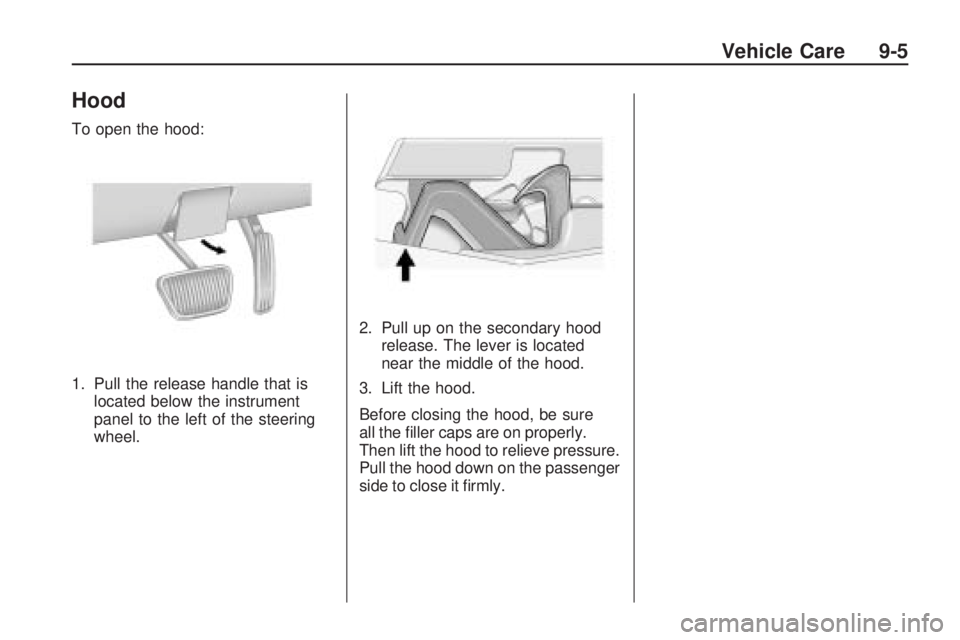
To open the hood:
1. Pull the release handle that is
located below the instrument
panel to the left of the steering
wheel.2. Pull up on the secondary hood
release. The lever is located
near the middle of the hood.
3. Lift the hood.
Before closing the hood, be sure
all the filler caps are on properly.
Then lift the hood to relieve pressure.
Pull the hood down on the passenger
side to close it firmly.
Vehicle Care 9-5
Page 256 of 372

Engine Overheating
The vehicle has an indicator to warn
of engine overheating.
There is an engine coolant
temperature warning light on
your vehicle’s instrument panel.
SeeEngine Coolant Temperature
Gage on page 4-14.
You may decide not to lift the hood
when this warning appears, but
instead get service help right away.
SeeRoadside Assistance Program
on page 12-6.
If you do decide to lift the hood,
make sure the vehicle is parked
on a level surface.Then check to see if the engine
cooling fans are running. If the
engine is overheating, both fans
should be running. If they are
not, do not continue to run the
engine and have the vehicle
serviced.
Notice:Engine damage from
running the engine without
coolant is not covered by the
warranty.
Notice:If the engine catches
re because of being driven with
no coolant, your vehicle can be
badly damaged. The costly repairs
would not be covered by the
vehicle warranty.
If Steam Is Coming From The
Engine Compartment
{WARNING
Steam from an overheated engine
can burn you badly, even if you
just open the hood. Stay away
from the engine if you see or hear
steam coming from it. Just turn it
off and get everyone away from
the vehicle until it cools down. Wait
until there is no sign of steam or
coolant before you open the hood.
If you keep driving when your
engine is overheated, the liquids
in it can catch fire. You or others
could be badly burned. Stop your
engine if it overheats, and get out
of the vehicle until the engine
is cool.
9-24 Vehicle Care
Page 274 of 372

Headlamp Wiring
An electrical overload may cause
the lamps to go on and off, or in
some cases to remain off. Have
the headlamp wiring checked right
away if the lamps go on and off or
remain off.
Windshield Wipers
If the wiper motor overheats due to
heavy snow or ice, the windshield
wipers will stop until the motor cools
and will then restart.
Although the circuit is protected
from electrical overload, overload
due to heavy snow or ice, may
cause wiper linkage damage.
Always clear ice and heavy snow
from the windshield before using
the windshield wipers.
If the overload is caused by an
electrical problem and not snow
or ice, be sure to get it fixed.
Fuses and Circuit
Breakers
The wiring circuits in the vehicle
are protected from short circuits by
a combination of fuses and circuit
breakers. This greatly reduces the
chance of damage caused by
electrical problems.
To check a fuse, look at the
silver-colored band inside the fuse.
If the band is broken or melted,
replace the fuse. Be sure to replace
a bad fuse with a new one of the
identical size and rating.
Fuses of the same amperage
can be temporarily borrowed from
another fuse location, if a fuse goes
out. Replace the fuse as soon as
possible.
To identify and check fuses, circuit
breakers, and relays, seeEngine
Compartment Fuse Block on
page 9-42,Instrument Panel Fuse
Block on page 9-45, andRear
Compartment Fuse Block on
page 9-46.
Engine Compartment
Fuse Block
To remove the hinged fuse block
cover, press the clip at the front of
the cover, and swing it up.
Notice:Spilling liquid on any
electrical components on the
vehicle may damage it. Always
keep the covers on any electrical
component.
9-42 Vehicle Care
Page 277 of 372
Instrument Panel Fuse
Block
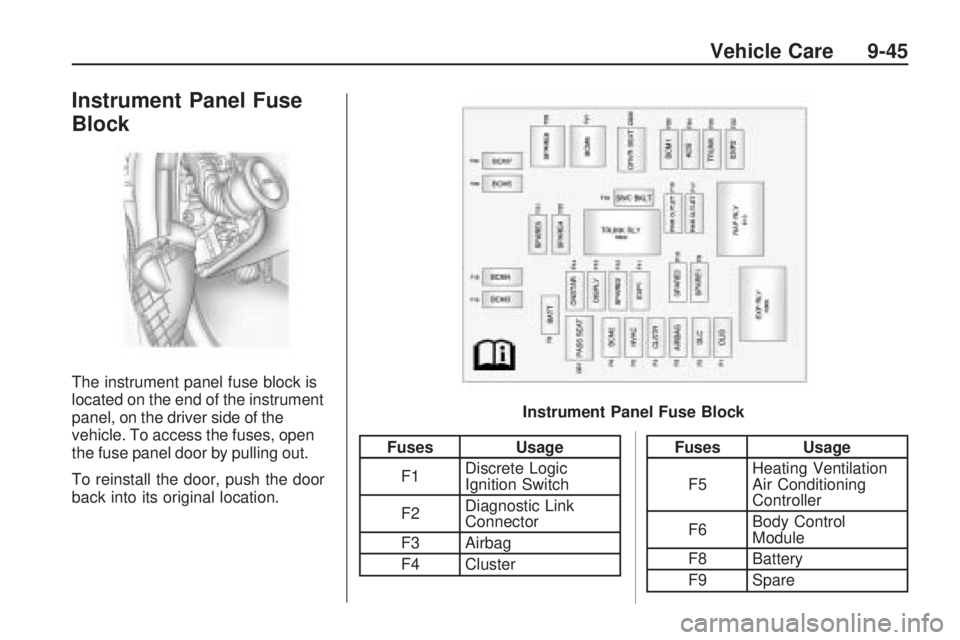
The instrument panel fuse block is
located on the end of the instrument
panel, on the driver side of the
vehicle. To access the fuses, open
the fuse panel door by pulling out.
To reinstall the door, push the door
back into its original location.
FusesUsage
F1 Discrete Logic
Ignition Switch
F2 Diagnostic Link
Connector
F3 Airbag
F4 ClusterFuses Usage
F5 Heating Ventilation
Air Conditioning
Controller
F6 Body Control
Module
F8 Battery
F9 Spare
Instrument Panel Fuse Block
Vehicle Care 9-45
Page 290 of 372
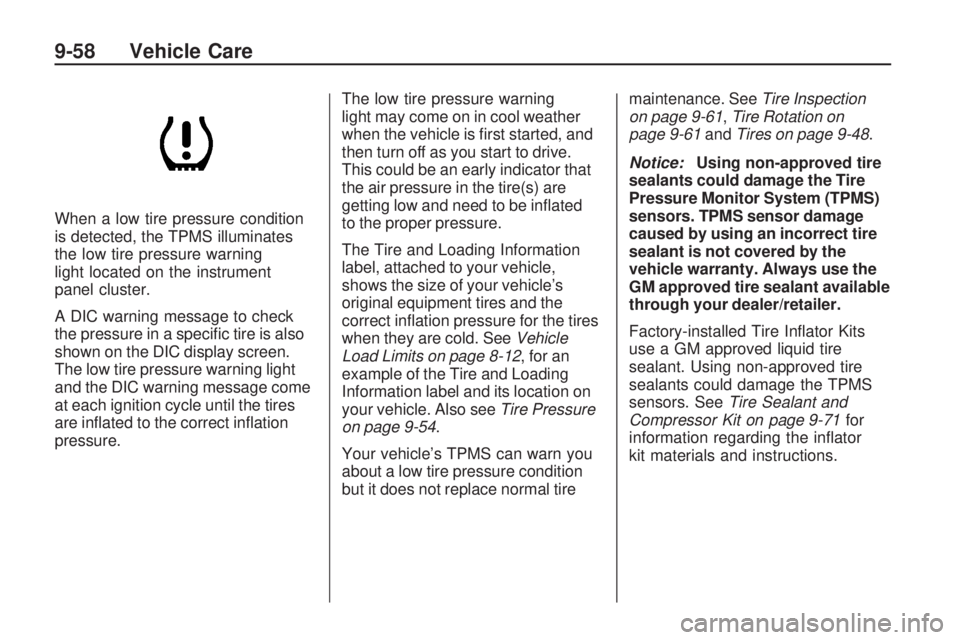
When a low tire pressure condition
is detected, the TPMS illuminates
the low tire pressure warning
light located on the instrument
panel cluster.
A DIC warning message to check
the pressure in a specific tire is also
shown on the DIC display screen.
The low tire pressure warning light
and the DIC warning message come
at each ignition cycle until the tires
are inflated to the correct inflation
pressure.The low tire pressure warning
light may come on in cool weather
when the vehicle is first started, and
then turn off as you start to drive.
This could be an early indicator that
the air pressure in the tire(s) are
getting low and need to be inflated
to the proper pressure.
The Tire and Loading Information
label, attached to your vehicle,
shows the size of your vehicle’s
original equipment tires and the
correct inflation pressure for the tires
when they are cold. SeeVehicle
Load Limits on page 8-12, for an
example of the Tire and Loading
Information label and its location on
your vehicle. Also seeTire Pressure
on page 9-54.
Your vehicle’s TPMS can warn you
about a low tire pressure condition
but it does not replace normal tiremaintenance. SeeTire Inspection
on page 9-61,Tire Rotation on
page 9-61andTires on page 9-48.
Notice:Using non-approved tire
sealants could damage the Tire
Pressure Monitor System (TPMS)
sensors. TPMS sensor damage
caused by using an incorrect tire
sealant is not covered by the
vehicle warranty. Always use the
GM approved tire sealant available
through your dealer/retailer.
Factory-installed Tire Inflator Kits
use a GM approved liquid tire
sealant. Using non-approved tire
sealants could damage the TPMS
sensors. SeeTire Sealant and
Compressor Kit on page 9-71for
information regarding the inflator
kit materials and instructions.
9-58 Vehicle Care
Page 327 of 372
Instrument Panel, Vinyl, and
Other Plastic Surfaces
To remove dust, a soft cloth
dampened with water can be used.
If a more thorough cleaning is
necessary, a clean soft cloth
dampened with a mild soap solution
can be used to gently remove
dust and dirt. Never use spot lifters
or removers on plastic surfaces.
Many commercial cleaners
and coatings that are sold to
preserve and protect soft plastic
surfaces may permanently change
the appearance and feel of the
interior and are not recommended.
Do not use silicone or wax-based
products, or those containing
organic solvents to clean the
vehicle’s interior because they can
alter the appearance by increasing
the gloss in a non-uniform manner.Some commercial products may
increase gloss on the instrument
panel. The increase in gloss may
cause annoying reflections in the
windshield and even make it difficult
to see through the windshield under
certain conditions.
Care of Safety Belts
Keep belts clean and dry.
{WARNING
Do not bleach or dye safety belts.
It may severely weaken them.
In a crash, they might not be able
to provide adequate protection.
Clean safety belts only with mild
soap and lukewarm water.
Vehicle Care 9-95
Page 341 of 372

Technical Data
Vehicle IdenticationVehicle Identification
Number (VIN)....................11-1
Service Parts
Identification Label.............11-1
Vehicle DataCapacities and
Specifications....................11-2
Engine Drive Belt Routing.....11-4
Vehicle Identication
Vehicle Identication
Number (VIN)
This is the legal identifier for the
vehicle. It appears on a plate in the
front corner of the instrument panel,
on the left side of the vehicle. It can
be seen through the windshield from
outside the vehicle. The VIN also
appears on the Vehicle Certification
and Service Parts labels and the
certificates of title and registration.
Engine Identication
The eighth character in the VIN
is the engine code. This code
helps identify the vehicle’s engine,
specifications, and replacement
parts. See “Engine Specifications”
underCapacities and Specications
on page 11-2for the vehicle’s
engine code.
Service Parts
Identication Label
This label is in the trunk. It is very
helpful if parts need to be ordered.
The label has the following
information:
•Vehicle Identification
Number (VIN)
•Model designation
•Paint information
•Production options and special
equipment
Do not remove this label from the
vehicle.
Technical Data 11-1
Page 346 of 372
STEP TWO:If after contacting a
member of dealership management,
it appears your concern cannot
be resolved by the dealership
without further help, in the U.S., call
the Chevrolet Customer Assistance
Center at 1-800-222-1020. In
Canada, call General Motors of
Canada Customer Communication
Centre at 1-800-263-3777
(English), or 1-800-263-7854
(French).
We encourage you to call the
toll-free number in order to give your
inquiry prompt attention. Have the
following information available
to give the Customer Assistance
Representative:
•Vehicle Identification Number
(VIN). This is available from
the vehicle registration or title, or
the plate at the top left of the
instrument panel and visible
through the windshield.
•Dealership name and location.
•Vehicle delivery date and present
mileage.When contacting Chevrolet,
remember that your concern will
likely be resolved at a dealer’s
facility. That is why we suggest
following Step One first.
STEP THREE — U.S. Owners:
Both General Motors and your
dealer are committed to making sure
you are completely satisfied with
your new vehicle. However, if
you continue to remain unsatisfied
after following the procedure
outlined in Steps One and Two, you
can file with the Better Business
Bureau (BBB) Auto Line Program to
enforce your rights.
The BBB Auto Line Program is an
out of court program administered
by the Council of Better Business
Bureaus to settle automotive
disputes regarding vehicle repairs or
the interpretation of the New
Vehicle Limited Warranty. Although
you may be required to resort to
this informal dispute resolution
program prior to filing a court action,
use of the program is free ofcharge and your case will generally
be heard within 40 days. If you
do not agree with the decision given
in your case, you may reject it
and proceed with any other venue
for relief available to you.
You may contact the BBB Auto
Line Program using the toll-free
telephone number or write them at
the following address:
BBB Auto Line Program
Council of Better Business
Bureaus, Inc.
4200 Wilson Boulevard
Suite 800
Arlington, VA 22203-1838
Telephone: 1-800-955-5100
www.dr.bbb.org/goauto
This program is available in all
50 states and the District of
Columbia. Eligibility is limited by
vehicle age, mileage, and other
factors. General Motors reserves the
right to change eligibility limitations
and/or discontinue its participation
in this program.
12-2 Customer Information