ignition CHEVROLET CAMARO SS 2010 Workshop Manual
[x] Cancel search | Manufacturer: CHEVROLET, Model Year: 2010, Model line: CAMARO SS, Model: CHEVROLET CAMARO SS 2010Pages: 372, PDF Size: 1.91 MB
Page 291 of 372
TPMS Malfunction Light and
Message
The TPMS will not function properly
if one or more of the TPMS sensors
are missing or inoperable. When the
system detects a malfunction, the
low tire warning light flashes for
about one minute and then stays
on for the remainder of the ignition
cycle. A DIC warning message is
also displayed. The low tire warning
light and DIC warning message
come on at each ignition cycle until
the problem is corrected. Some of
the conditions that can cause the
malfunction light and DIC message
to come on are:
•One of the road tires has been
replaced with the spare tire, if the
vehicle has one. The spare tire
does not have a TPMS sensor.
The DIC message should go off
once you re-install the road tire
containing the TPMS sensor.
•The TPMS sensor matching
process was not done or not
completed successfully after
rotating the vehicle’s tires.
The DIC message should go
off after successfully completing
the sensor matching process.
See “TPMS Sensor Matching
Process” later in this section.
•One or more TPMS sensors
are missing or damaged.
The DIC message and the
TPMS malfunction light should
go off when the TPMS sensors
are installed and the sensor
matching process is performed
successfully. See your dealer/
retailer for service.
•Replacement tires or wheels do
not match your vehicle’s original
equipment tires or wheels. Tires
and wheels other than those
recommended for your vehicle
could prevent the TPMS from
functioning properly. SeeBuying
New Tires on page 9-63.
•Operating electronic devices or
being near facilities using radio
wave frequencies similar to the
TPMS could cause the TPMS
sensors to malfunction.
If the TPMS is not functioning it
cannot detect or signal a low tire
condition. See your dealer/retailer for
service if the TPMS malfunction light
and DIC message comes on and
stays on.
Vehicle Care 9-59
Page 292 of 372

TPMS Sensor Matching
Process
Each TPMS sensor has a unique
identification code. Any time you
replace one or more of the TPMS
sensors or rotate your vehicle’s tires,
the identification codes need to be
matched to the new tire/wheel
position. The sensors are matched
to the tire/wheel positions in the
following order: driver side front tire,
passenger side front tire, passenger
side rear tire, and driver side rear
tire using a TPMS diagnostic tool.
See your dealer/retailer for service.
The TPMS sensors can also be
matched to each tire/wheel position
by increasing or decreasing the
tire’s air pressure. If increasing the
tire’s air pressure, do not exceed
the maximum inflation pressure
indicated on the tire’s sidewall.
To decrease the tire’s air-pressure
use the pointed end of the valve
cap, a pencil-style air pressure
gage, or a key.You have two minutes to match
the first tire/wheel position, and
five minutes overall, to match all
four tire/wheel positions. If it takes
longer than two minutes, to match
the first tire and wheel, or more than
five minutes to match all four tire
and wheel positions, the matching
process stops and you need to
start over.
The TPMS matching process is
outlined below:
1. Set the parking brake.
2. Turn the ignition switch to
ON/RUN with the engine off.
3. Go to the TPM vehicle
information screen on the DIC.
SeeDriver Information Center
(DIC) on page 4-27. Press set to
relearn the sensors. The horn
sounds twice to signal the
receiver is in relearn mode and
Tire Learning Active message
displays on the DIC screen.
4. Start with the driver side
front tire.5. Remove the valve cap from
the valve stem. Activate the
TPMS sensor by increasing or
decreasing the tire’s air pressure
for 10 seconds, or until a horn
chirp sounds. The horn chirp,
which can take up to 30 seconds
to sound, confirms that the TPMS
sensor identification code has
been matched to this tire position.
6. Proceed to the passenger
side front tire, and repeat
the procedure in Step 5.
7. Proceed to the passenger
side rear tire, and repeat
the procedure in Step 5.
8. Proceed to the driver side rear
tire, and repeat the procedure
in Step 5.
9. After hearing the confirming horn
chirp, for the driver side rear tire,
the horn sounds two more times
to signal the tire learning mode is
no longer active. Turn the ignition
switch to LOCK/OFF.
9-60 Vehicle Care
Page 317 of 372
The positive jump start connection
is covered by a red cap. Remove to
expose the terminal.
1. Check the other vehicle. It must
have a 12-volt battery with a
negative ground system.
Notice:If the other vehicle’s
system is not a 12-volt system
with a negative ground, both
vehicles can be damaged. Only
use vehicles with 12-volt systems
with negative grounds to jump
start your vehicle.
2. Position the two vehicles so that
they are not touching.
3. Set the parking brake firmly and
put the shift lever in P (Park).
SeeShifting Into Park on
page 8-21.Notice:If you leave the radio or
other accessories on during the
jump starting procedure, they
could be damaged. The repairs
would not be covered by the
warranty. Always turn off the
radio and other accessories
when jump starting the vehicle.
4. Turn the ignition to LOCK/OFF
and switch off all lights and
accessories in both vehicles,
except the hazard warning
flashers if needed.
{WARNING
An electric fan can start up even
when the engine is not running
and can injure you. Keep hands,
clothing and tools away from any
underhood electric fan.
{WARNING
Using a match near a battery can
cause battery gas to explode.
People have been hurt doing this,
and some have been blinded. Use
a flashlight if you need more light.
Be sure the battery has enough
water. You do not need to add
water to the battery installed in
your new vehicle. But if a battery
has filler caps, be sure the right
amount of fluid is there. If it is
low, add water to take care of
that first. If you don’t, explosive
gas could be present.
Battery fluid contains acid that
can burn you. Do not get it on
you. If you accidentally get it in
your eyes or on your skin, flush
the place with water and get
medical help immediately.
Vehicle Care 9-85
Page 332 of 372
•Restraint system component
check. SeeSafety System Check
on page 2-20.
•Automatic transmission fluid level
check and adding fluid, if needed.
SeeAutomatic Transmission
Fluid on page 9-14.
•Rear axle fluid level check and
adding fluid, if needed. SeeRear
Axle on page 9-30.
•Engine air cleaner filter
inspection. SeeEngine Air
Cleaner/Filter on page 9-16.
•Passenger compartment air filter
replacement (or every 12 months,
whichever occurs first). More
frequent replacement may be
required if vehicle is driven
regularly under dusty conditions.
Additional Required Services
At Each Fuel Stop
•Engine oil level check.
SeeEngine Oil on page 9-10.
•Engine coolant level check.
SeeEngine Coolant on
page 9-19.
•Windshield washer fluid level
check. SeeWasher Fluid on
page 9-26.
Once a Month
•Tire inflation check. SeeTire
Pressure on page 9-54.
•Tire wear inspection. SeeTire
Inspection on page 9-61.Once a Year
•SeeStarter Switch Check on
page 9-31.
•SeeAutomatic Transmission
Shift Lock Control System
Check on page 9-32.
•SeeIgnition Transmission Lock
Check on page 9-32.
•SeePark Brake and P (Park)
Mechanism Check on page 9-32.
•Engine cooling system and
pressure cap pressure check.
Radiator and air conditioning
condenser outside cleaning.
SeeCooling System on
page 9-17.
•If the vehicle has a Tire Sealant
and Compressor Kit, check the
sealant expiration date printed
on the instruction label of the
kit. SeeTire Sealant and
Compressor Kit on page 9-71.
10-4 Service and Maintenance
Page 359 of 372

GM will not access this data or
share it with others except: with the
consent of the vehicle owner or,
if the vehicle is leased, with
the consent of the lessee; in
response to an official request of
police or similar government office;
as part of GM’s defense of
litigation through the discovery
process; or, as required by law.
Data that GM collects or receives
may also be used for GM research
needs or may be made available
to others for research purposes,
where a need is shown and the data
is not tied to a specific vehicle or
vehicle owner.OnStar®
If your vehicle has OnStar and you
subscribe to the OnStar services,
please refer to the OnStar
Terms and Conditions for
information on data collection and
use. See alsoOnStar
®System
on page 4-42in this manual
for more information.
Radio Frequency
Identication (RFID)
RFID technology is used in some
vehicles for functions such as
tire pressure monitoring and ignition
system security, as well as in
connection with conveniences such
as key fobs for remote door
locking/unlocking and starting, and
in-vehicle transmitters for garage
door openers. RFID technology in
GM vehicles does not use or record
personal information or link with
any other GM system containing
personal information.
Radio Frequency
Statement (US, Can)
This vehicle has systems that
operate on a radio frequency that
comply with Part 15 of the Federal
Communications Commission
(FCC) Rules and with RSS-210/211
of Industry and Science Canada.
Operation is subject to the following
two conditions:
1. The device may not cause
interference.
2. The device must accept any
interference received, including
interference that may cause
undesired operation of the
device.
Changes or modifications to any of
these systems by other than an
authorized service facility could void
authorization to use this equipment.
Customer Information 12-15
Page 362 of 372
Bluetooth............6-22, 6-23, 6-26
Brakes...............................9-27
Antilock...........................8-31
Assist.............................8-33
Fluid...............................9-28
Parking...........................8-32
System Messages.............4-31
Braking................................ 8-4
Break-In, New Vehicle..........8-16
Bulb Replacement................9-41
Fog Lamps ......................9-40
Halogen Bulbs..................9-37
Headlamp Aiming..............9-34
Headlamps......................9-37
Headlamps, Front Turn
Signal and Parking
Lamps .................9-37, 9-38
High Intensity Discharge
(HID) Lighting...............9-37
License Plate Lamps.........9-40
Taillamps, Turn Signal and
Stoplamps....................9-40
Buying New Tires.................9-63C
Calibration............................ 4-8
California
Fuel Requirements............8-45
Perchlorate Materials
Requirements................. 9-3
Warning............................ 9-2
Canadian Vehicle Owners......... iii
Capacities and
Specifications...................11-2
Carbon Monoxide
Engine Exhaust................8-25
Trunk................................ 1-8
Winter Driving..................8-10
Cautions, Danger, and
Warnings............................. iv
CD Player...........................6-14
Center Console Storage......... 3-1
Chains, Tire........................9-68
Charging System Light..........4-19
Check
Engine Lamp...................4-19
Ignition
Transmission Lock.........9-32Check (cont.)
Child Restraints
Infants and Young
Children.......................2-37
Lower Anchors and Tethers
for Children..................2-43
Older Children..................2-35
Securing..................2-48, 2-50
Systems..........................2-39
Where to Put the
Restraint......................2-41
Circuit Breakers...................9-42
Cleaning
Exterior Care...................9-88
Interior Care....................9-92
Climate Control Systems......... 7-1
Clock................................... 4-8
Cluster, IP...........................4-10
Clutch, Hydraulic..................9-15
Collision Damage Repair.......12-9
Compact Spare Tire.............9-83
Compass.............................. 4-8
Compass Messages.............
4-31
Competitive Driving................ 8-7
Competitive Driving Mode......8-37
i-2 INDEX
Page 365 of 372
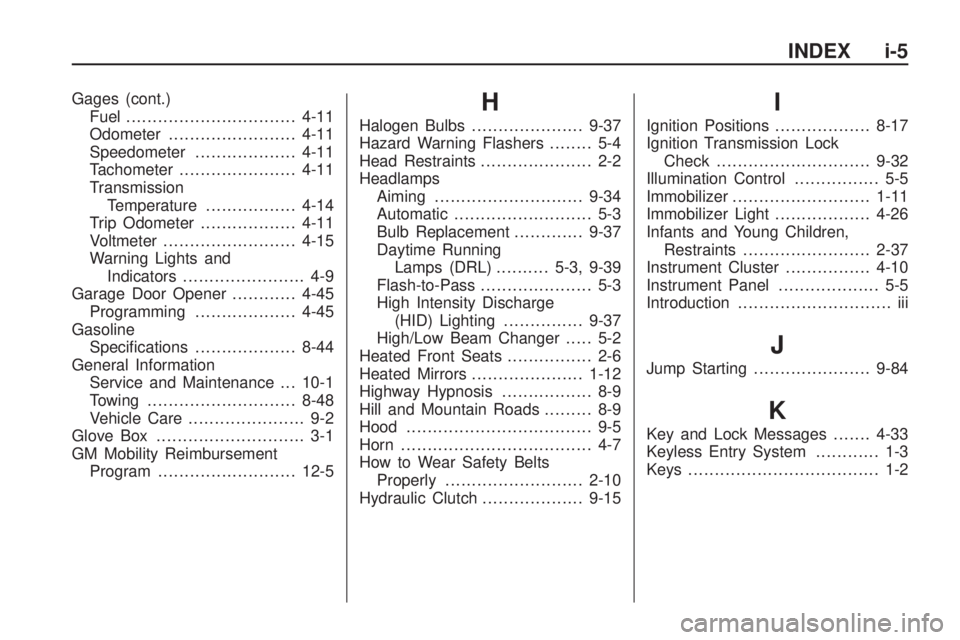
Gages (cont.)
Fuel................................4-11
Odometer........................4-11
Speedometer...................4-11
Tachometer......................4-11
Transmission
Temperature.................4-14
Trip Odometer..................4-11
Voltmeter.........................4-15
Warning Lights and
Indicators....................... 4-9
Garage Door Opener............4-45
Programming...................4-45
Gasoline
Specifications...................8-44
General Information
Service and Maintenance . . . 10-1
Towing ............................8-48
Vehicle Care...................... 9-2
Glove Box............................ 3-1
GM Mobility Reimbursement
Program..........................12-5H
Halogen Bulbs.....................9-37
Hazard Warning Flashers........ 5-4
Head Restraints..................... 2-2
Headlamps
Aiming ............................9-34
Automatic.......................... 5-3
Bulb Replacement.............9-37
Daytime Running
Lamps (DRL) ..........5-3, 9-39
Flash-to-Pass..................... 5-3
High Intensity Discharge
(HID) Lighting...............9-37
High/Low Beam Changer..... 5-2
Heated Front Seats................ 2-6
Heated Mirrors.....................1-12
Highway Hypnosis................. 8-9
Hill and Mountain Roads......... 8-9
Hood ................................... 9-5
Horn .................................... 4-7
How to Wear Safety Belts
Properly..........................2-10
Hydraulic Clutch...................9-15
I
Ignition Positions..................8-17
Ignition Transmission Lock
Check.............................9-32
Illumination Control................ 5-5
Immobilizer..........................1-11
Immobilizer Light..................4-26
Infants and Young Children,
Restraints........................2-37
Instrument Cluster................4-10
Instrument Panel................... 5-5
Introduction............................. iii
J
Jump Starting......................9-84
K
Key and Lock Messages.......4-33
Keyless Entry System............ 1-3
Keys.................................... 1-2
INDEX i-5