ignition CHEVROLET CAMARO SS 2010 Service Manual
[x] Cancel search | Manufacturer: CHEVROLET, Model Year: 2010, Model line: CAMARO SS, Model: CHEVROLET CAMARO SS 2010Pages: 372, PDF Size: 1.91 MB
Page 208 of 372
Let us say the road is wet and you
are driving safely. Suddenly, an
animal jumps out in front of you.
You slam on the brakes and
continue braking. Here is what
happens with ABS:
A computer senses that the wheels
are slowing down. If one of the
wheels is about to stop rolling,
the computer will separately work
the brakes at each wheel.
ABS can change the brake pressure
to each wheel, as required, faster
than any driver could. This can
help the driver steer around
the obstacle while braking hard.
As the brakes are applied, the
computer keeps receiving updates
on wheel speed and controls braking
pressure accordingly.Remember: ABS does not change
the time needed to get a foot up to
the brake pedal or always decrease
stopping distance. If you get too
close to the vehicle in front of you,
there will not be enough time to
apply the brakes if that vehicle
suddenly slows or stops. Always
leave enough room up ahead to
stop, even with ABS.
Using ABS
Do not pump the brakes. Just hold
the brake pedal down firmly and let
antilock work. The antilock pump
or motor might be heard operating,
and the brake pedal might be felt to
pulsate, but this is normal.
Braking in Emergencies
ABS allows the driver to steer and
brake at the same time. In many
emergencies, steering can help
more than even the very best
braking.
Parking Brake
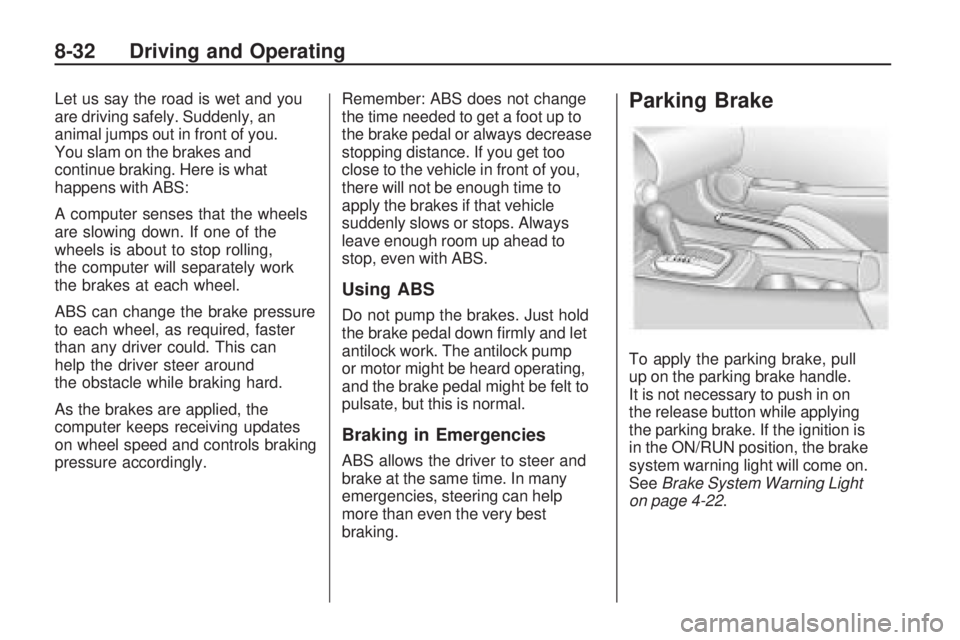
To apply the parking brake, pull
up on the parking brake handle.
It is not necessary to push in on
the release button while applying
the parking brake. If the ignition is
in the ON/RUN position, the brake
system warning light will come on.
SeeBrake System Warning Light
on page 4-22.
8-32 Driving and Operating
Page 216 of 372
Increasing Speed While Using
Cruise Control
There are two ways to go to a
higher speed.
•Disengage the cruise control,
but do not turn it off.
•If the cruise control system is
already engaged, press the
thumbwheel up toward RES/+
and hold it until the vehicle
accelerates to the desired speed,
and then release the switch.
To increase the speed in small
amounts, press the thumbwheel
up toward RES/+ briefly and then
release it. Each time this is done,
the vehicle goes about 1.6 km/h
(1 mph) faster.
Reducing Speed While Using
Cruise Control
If the cruise control system is
already engaged,
•Push the thumbwheel toward
SET/−and hold until the desired
lower speed is reached, then
release it.
•To slow down in very small
amounts, push the thumbwheel
toward SET/−briefly. Each time
this is done, the vehicle goes
about 1.6 km/h (1 mph) slower.
Passing Another Vehicle While
Using Cruise Control
Use the accelerator pedal to
increase the vehicle’s speed.
When you take your foot off the
pedal, the vehicle will slow down
to the previously set cruise control
speed.
Using Cruise Control on Hills
How well the cruise control works
on hills depends upon the vehicle’s
speed, load, and the steepness of
the hills. When going up steep hills,
you might have to step on the
accelerator pedal to maintain the
vehicle’s speed. When going
downhill, you might have to brake
or shift to a lower gear to maintain
the vehicle’s speed. When the
brakes are applied the cruise
control shuts off.Ending Cruise Control
There are three ways to end the
cruise control:
•Step lightly on the brake pedal
or clutch; when cruise control
disengages, the indicator light
on the instrument panel cluster
goes out.
•Press5to turn off the cruise
control system.
•Press\to disengage the cruise
control.
Erasing Speed Memory
The cruise control set speed
memory is erased when the cruise
control or the ignition is turned off.
8-40 Driving and Operating
Page 233 of 372
Vehicle Care
General InformationGeneral Information...............9-2
California Proposition 65
Warning.............................9-2
California Perchlorate
Materials Requirements........9-3
Accessories and
Modifications.......................9-3
Vehicle ChecksDoing Your Own
Service Work......................9-4
Hood...................................9-5
Engine Compartment
Overview............................9-6
Engine Cover.......................9-9
Engine Oil..........................9-10
Engine Oil Life System.........9-13
Automatic Transmission
Fluid................................9-14
Manual Transmission Fluid. . . .9-15
Hydraulic Clutch..................9-15
Engine Air Cleaner/Filter.......9-16
Cooling System...................9-17
Engine Coolant...................9-19
Engine Overheating.............9-24
Power Steering Fluid............9-25Washer Fluid......................9-26
Brakes...............................9-27
Brake Fluid.........................9-28
Battery...............................9-29
Rear Axle...........................9-30
Starter Switch Check............9-31
Automatic Transmission
Shift Lock Control
System Check...................9-32
Ignition Transmission
Lock Check.......................9-32
Park Brake and P (Park)
Mechanism Check..............9-32
Wiper Blade Replacement......9-33Headlamp AimingHeadlamp Aiming................9-34
Bulb ReplacementBulb Replacement...............9-37
Halogen Bulbs....................9-37
High Intensity Discharge
(HID) Lighting....................9-37
Headlamps, Front Turn
Signal and Parking Lamps
(Base Vehicle)...................9-37
Headlamps, Front Turn
Signal and Parking Lamps
(Up-Level Vehicle)..............9-38
Daytime Running
Lamps (DRL)....................9-39
Fog Lamps.........................9-40Taillamps, Turn Signal, and
Stoplamps.........................9-40
License Plate Lamp.............9-40
Replacement Bulbs..............9-41
Electrical SystemElectrical System
Overload...........................9-41
Fuses and Circuit
Breakers...........................9-42
Engine Compartment
Fuse Block.......................9-42
Instrument Panel
Fuse Block.......................9-45
Rear Compartment
Fuse Block.......................9-46
Wheels and TiresTires..................................9-48
Winter Tires........................9-48
Tire Sidewall Labeling..........9-49
Tire Designations.................9-51
Tire Terminology and
Definitions.........................9-52
Tire Pressure......................9-54
Tire Pressure for
High-Speed Operation........9-56
Tire Pressure Monitor
System.............................9-56
Tire Pressure Monitor
Operation..........................9-57
Tire Inspection....................9-61
Vehicle Care 9-1
Page 245 of 372
Engine Oil Additives / Engine
Oil Flushes
Do not add anything to the oil.
The recommended oils with
the starburst symbol that meet
GM Standard GM6094M are all
that is needed for good performance
and engine protection.
Engine oil system flushes are not
recommended and could cause
engine damage not covered by
the vehicle warranty.
Engine Oil Life System
When to Change Engine Oil
This vehicle has a computer system
that indicates when to change the
engine oil and filter. This is based
on engine revolutions and engine
temperature, and not on mileage.
Based on driving conditions, the
mileage at which an oil change is
indicated can vary considerably.
For the oil life system to work
properly, the system must be reset
every time the oil is changed.When the system has calculated
that oil life has been diminished,
it indicates that an oil change is
necessary. A CHANGE ENGINE
OIL SOON message comes on.
SeeEngine Oil Messages on
page 4-32. Change the oil as soon
as possible within the next 1 000 km
(600 miles). It is possible that, if
driving under the best conditions,
the oil life system might not indicate
that an oil change is necessary for
over a year. However, the engine oil
and filter must be changed at least
once a year and at this time the
system must be reset. Your dealer/
retailer has trained service people
who will perform this work using
genuine parts and reset the system.
It is also important to check the oil
regularly and keep it at the proper
level.
If the system is ever reset
accidentally, the oil must be changed
at 5 000 km (3,000 miles) since the
last oil change. Remember to reset
the oil life system whenever the oil is
changed.
How to Reset the Engine Oil
Life System
The Engine Oil Life System
calculates when to change the
engine oil and filter based on vehicle
use. Whenever the oil is changed,
reset the system so it can calculate
when the next oil change is required.
If a situation occurs where the oil is
changed prior to a change engine oil
message being turned on, reset the
system.
After changing the engine oil, reset
the system:
1. Turn the ignition key to ON/RUN
with the engine off.
2. Fully press and release the
accelerator pedal three times
within five seconds.
If the CHANGE ENGINE OIL
SOON message is not on,
the system is reset.
If the CHANGE ENGINE OIL SOON
message comes on again and stays
on for 30 seconds at the next ignition
cycle, it did not reset. The system
needs to be reset again.
Vehicle Care 9-13
Page 252 of 372
Checking Coolant
The vehicle must be on a level
surface when checking the coolant
level.
Check coolant as follows:
1. Turn the ignition OFF.
2. Locate the coolant recovery
bottle. SeeEngine Compartment
Overview on page 9-6.
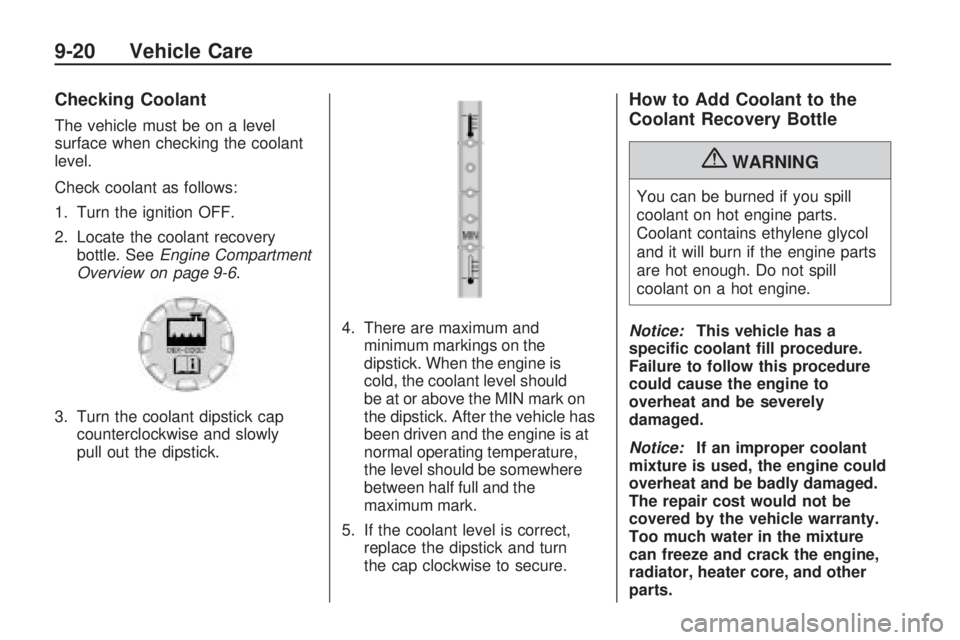
3. Turn the coolant dipstick cap
counterclockwise and slowly
pull out the dipstick.4. There are maximum and
minimum markings on the
dipstick. When the engine is
cold, the coolant level should
be at or above the MIN mark on
the dipstick. After the vehicle has
been driven and the engine is at
normal operating temperature,
the level should be somewhere
between half full and the
maximum mark.
5. If the coolant level is correct,
replace the dipstick and turn
the cap clockwise to secure.
How to Add Coolant to the
Coolant Recovery Bottle
{WARNING
You can be burned if you spill
coolant on hot engine parts.
Coolant contains ethylene glycol
and it will burn if the engine parts
are hot enough. Do not spill
coolant on a hot engine.
Notice:This vehicle has a
specic coolant ll procedure.
Failure to follow this procedure
could cause the engine to
overheat and be severely
damaged.
Notice:If an improper coolant
mixture is used, the engine could
overheat and be badly damaged.
The repair cost would not be
covered by the vehicle warranty.
Too much water in the mixture
can freeze and crack the engine,
radiator, heater core, and other
parts.
9-20 Vehicle Care
Page 258 of 372
How to Check Power Steering
Fluid
Check the level after the vehicle
has been driven for at least
twenty minutes so the fluid
is warm.
To check the power steering fluid:
1. Turn the ignition key to
LOCK/OFF and let the engine
compartment cool down.
2. Remove the engine cover. Refer
toEngine Cover on page 9-9.
3. Wipe the cap and the top of the
reservoir clean.
4. Turn the cap counterclockwise
and pull it straight up.
5. Wipe the dipstick with a
clean rag.6. Replace the cap and completely
tighten it.
7. Remove the cap again and look
at the fluid level on the dipstick.
When the engine is hot, the
level should be at the hot MAX
level. When the engine is
cold, the fluid level should be
between MIN and MAX on
the dipstick.
What to Use
To determine what kind of fluid to
use, seeRecommended Fluids and
Lubricants on page 10-7. Always
use the proper fluid.
Washer Fluid
What to Use
When windshield washer fluid
is needed, be sure to read the
manufacturer’s instructions before
use. If operating vehicle in an area
where the temperature can fall
below freezing, use a fluid that has
sufficient protection against freezing.
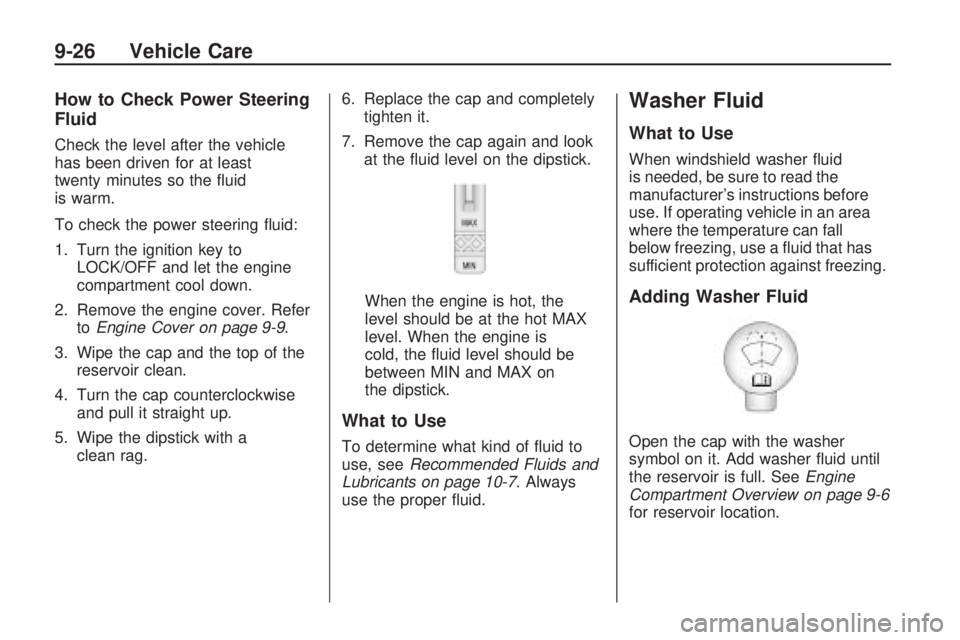
Adding Washer Fluid
Open the cap with the washer
symbol on it. Add washer fluid until
the reservoir is full. SeeEngine
Compartment Overview on page 9-6
for reservoir location.
9-26 Vehicle Care
Page 264 of 372
Automatic Transmission
Shift Lock Control
System Check
{WARNING
When you are doing this
inspection, the vehicle could move
suddenly. If the vehicle moves,
you or others could be injured.
1. Before starting this check, be
sure there is enough room
around the vehicle. It should
be parked on a level surface.
2. Firmly apply the parking brake.
SeeParking Brake on page 8-32.
Be ready to apply the regular
brake immediately if the vehicle
begins to move.3. With the engine off, turn the
ignition to ON/RUN, but do
not start the engine. Without
applying the regular brake,
try to move the shift lever out
of P (Park) with normal effort.
If the shift lever moves out
of P (Park), contact your
dealer/retailer for service.
Ignition Transmission
Lock Check
While parked, and with the parking
brake set, try to turn the ignition
to LOCK/OFF in each shift lever
position.
•The ignition should turn to
LOCK/OFF only when the
shift lever is in P (Park).
•The ignition key should come out
only in LOCK/OFF.
Contact your dealer/retailer if
service is required.
Park Brake and P (Park)
Mechanism Check
{WARNING
When you are doing this check,
the vehicle could begin to move.
You or others could be injured
and property could be damaged.
Make sure there is room in front
of the vehicle in case it begins to
roll. Be ready to apply the regular
brake at once should the vehicle
begin to move.
9-32 Vehicle Care
Page 276 of 372

Mini Fuses Usage
11 Cooling Fan Relay
14Manifold Air
Flow/Chassis
Control
15 Ignition
16 Run/Crank IP
17Sensing Diagnostic
Module/Ignition
18 Run/Crank Body
19Transmission
Control Module/
Ignition
20Engine Control
Module/Ignition
31Outside Rear
View Mirror
32Canister Vent
Solenoid
33Body Control
Module #6Mini Fuses Usage
34 Sunroof
35 Front Heated Seats
38 Washer Pump Front
40Antilock Brake
System Valves
46HID Headlamp –
Left Front
47HID Headlamp –
Right Front
50 Fog Lamps
51 Horn
52 Spare
55High Beam
Headlamp – Right
Front
56High Beam
Headlamp – Left
Front
61 Heated MirrorMini
RelaysUsage
K26 Powertrain
K50 Run / Crank
K55 Rear Defog
K612 Cooling Fan High
K614 Cooling Fan Control
Micro
RelaysUsage
K61 Starter
K69 Wiper Control
K613 Cooling Fan Low
K617Air Conditioning
Compressor Clutch
K619 Wiper Speed
K627High Intensity
Discharge
Headlamps
K632Brake
Vacuum Pump
9-44 Vehicle Care
Page 277 of 372
Instrument Panel Fuse
Block
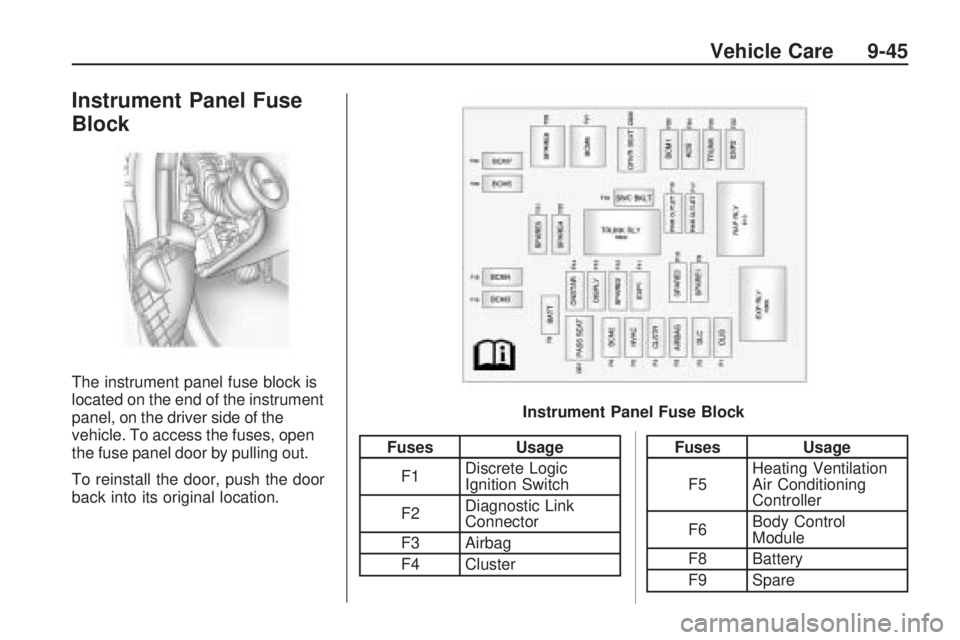
The instrument panel fuse block is
located on the end of the instrument
panel, on the driver side of the
vehicle. To access the fuses, open
the fuse panel door by pulling out.
To reinstall the door, push the door
back into its original location.
FusesUsage
F1 Discrete Logic
Ignition Switch
F2 Diagnostic Link
Connector
F3 Airbag
F4 ClusterFuses Usage
F5 Heating Ventilation
Air Conditioning
Controller
F6 Body Control
Module
F8 Battery
F9 Spare
Instrument Panel Fuse Block
Vehicle Care 9-45
Page 290 of 372
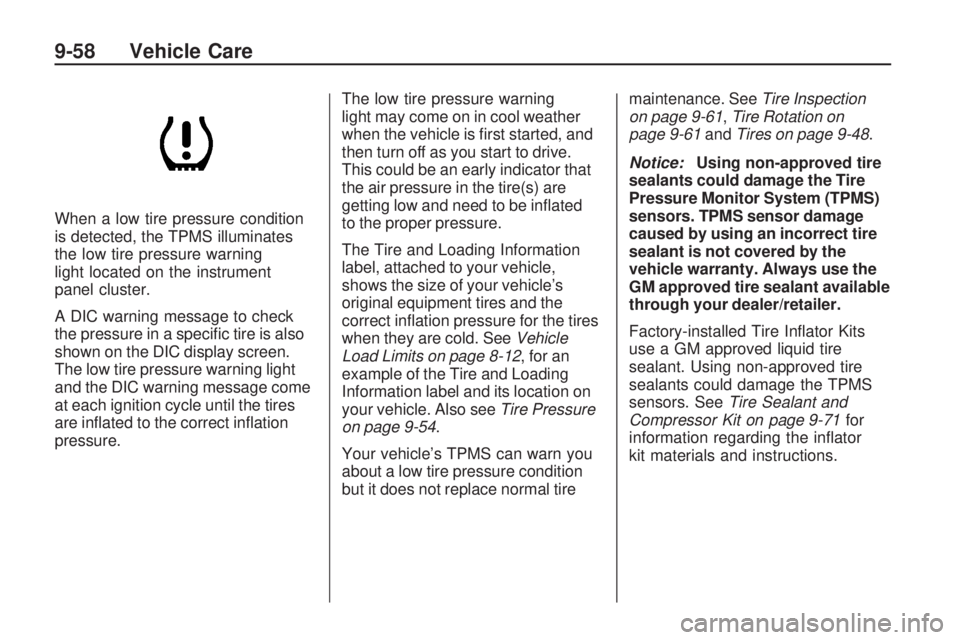
When a low tire pressure condition
is detected, the TPMS illuminates
the low tire pressure warning
light located on the instrument
panel cluster.
A DIC warning message to check
the pressure in a specific tire is also
shown on the DIC display screen.
The low tire pressure warning light
and the DIC warning message come
at each ignition cycle until the tires
are inflated to the correct inflation
pressure.The low tire pressure warning
light may come on in cool weather
when the vehicle is first started, and
then turn off as you start to drive.
This could be an early indicator that
the air pressure in the tire(s) are
getting low and need to be inflated
to the proper pressure.
The Tire and Loading Information
label, attached to your vehicle,
shows the size of your vehicle’s
original equipment tires and the
correct inflation pressure for the tires
when they are cold. SeeVehicle
Load Limits on page 8-12, for an
example of the Tire and Loading
Information label and its location on
your vehicle. Also seeTire Pressure
on page 9-54.
Your vehicle’s TPMS can warn you
about a low tire pressure condition
but it does not replace normal tiremaintenance. SeeTire Inspection
on page 9-61,Tire Rotation on
page 9-61andTires on page 9-48.
Notice:Using non-approved tire
sealants could damage the Tire
Pressure Monitor System (TPMS)
sensors. TPMS sensor damage
caused by using an incorrect tire
sealant is not covered by the
vehicle warranty. Always use the
GM approved tire sealant available
through your dealer/retailer.
Factory-installed Tire Inflator Kits
use a GM approved liquid tire
sealant. Using non-approved tire
sealants could damage the TPMS
sensors. SeeTire Sealant and
Compressor Kit on page 9-71for
information regarding the inflator
kit materials and instructions.
9-58 Vehicle Care