service CHEVROLET CAMARO SS 2010 Workshop Manual
[x] Cancel search | Manufacturer: CHEVROLET, Model Year: 2010, Model line: CAMARO SS, Model: CHEVROLET CAMARO SS 2010Pages: 372, PDF Size: 1.91 MB
Page 245 of 372
Engine Oil Additives / Engine
Oil Flushes
Do not add anything to the oil.
The recommended oils with
the starburst symbol that meet
GM Standard GM6094M are all
that is needed for good performance
and engine protection.
Engine oil system flushes are not
recommended and could cause
engine damage not covered by
the vehicle warranty.
Engine Oil Life System
When to Change Engine Oil
This vehicle has a computer system
that indicates when to change the
engine oil and filter. This is based
on engine revolutions and engine
temperature, and not on mileage.
Based on driving conditions, the
mileage at which an oil change is
indicated can vary considerably.
For the oil life system to work
properly, the system must be reset
every time the oil is changed.When the system has calculated
that oil life has been diminished,
it indicates that an oil change is
necessary. A CHANGE ENGINE
OIL SOON message comes on.
SeeEngine Oil Messages on
page 4-32. Change the oil as soon
as possible within the next 1 000 km
(600 miles). It is possible that, if
driving under the best conditions,
the oil life system might not indicate
that an oil change is necessary for
over a year. However, the engine oil
and filter must be changed at least
once a year and at this time the
system must be reset. Your dealer/
retailer has trained service people
who will perform this work using
genuine parts and reset the system.
It is also important to check the oil
regularly and keep it at the proper
level.
If the system is ever reset
accidentally, the oil must be changed
at 5 000 km (3,000 miles) since the
last oil change. Remember to reset
the oil life system whenever the oil is
changed.
How to Reset the Engine Oil
Life System
The Engine Oil Life System
calculates when to change the
engine oil and filter based on vehicle
use. Whenever the oil is changed,
reset the system so it can calculate
when the next oil change is required.
If a situation occurs where the oil is
changed prior to a change engine oil
message being turned on, reset the
system.
After changing the engine oil, reset
the system:
1. Turn the ignition key to ON/RUN
with the engine off.
2. Fully press and release the
accelerator pedal three times
within five seconds.
If the CHANGE ENGINE OIL
SOON message is not on,
the system is reset.
If the CHANGE ENGINE OIL SOON
message comes on again and stays
on for 30 seconds at the next ignition
cycle, it did not reset. The system
needs to be reset again.
Vehicle Care 9-13
Page 246 of 372
What to Do with Used Oil
Used engine oil contains certain
elements that can be unhealthy for
your skin and could even cause
cancer. Do not let used oil stay on
your skin for very long. Clean your
skin and nails with soap and water,
or a good hand cleaner. Wash or
properly dispose of clothing or rags
containing used engine oil. See the
manufacturer’s warnings about the
use and disposal of oil products.
Used oil can be a threat to the
environment. If you change your own
oil, be sure to drain all the oil from the
filter before disposal. Never dispose
of oil by putting it in the trash, pouring
it on the ground, into sewers, or into
streams or bodies of water. Recycle
it by taking it to a place that collects
used oil.
Automatic Transmission
Fluid
How to Check Automatic
Transmission Fluid
It is not necessary to check
the transmission fluid level.
A transmission fluid leak is the
only reason for fluid loss. If a leak
occurs, take the vehicle to your
dealer/retailer service department
and have it repaired as soon as
possible.
There is a special procedure
for checking and changing the
transmission fluid. Because this
procedure is difficult, you should
have this done at your dealer/
retailer service department.Contact your dealer/retailer for
additional information or the
procedure can be found in the
service manual. To purchase a
service manual, seeService
Publications Ordering Information
on page 12-12.
Change the fluid and filter at the
intervals listed inScheduled
Maintenance on page 10-2, and
be sure to use the fluid listed
inRecommended Fluids and
Lubricants on page 10-7.
9-14 Vehicle Care
Page 247 of 372
Manual Transmission
Fluid
It is not necessary to check the
manual transmission fluid level.
A transmission fluid leak is the only
reason for fluid loss. If a leak occurs,
take the vehicle to your dealer/
retailer service department and
have it repaired as soon as possible.
SeeRecommended Fluids and
Lubricants on page 10-7for the
proper fluid to use.
Hydraulic Clutch
It is not necessary to regularly
check brake/clutch fluid unless
you suspect there is a leak in the
system. Adding fluid will not correct
a leak. A fluid loss in this system
could indicate a problem. Have the
system inspected and repaired.
When to Check and What
to Use
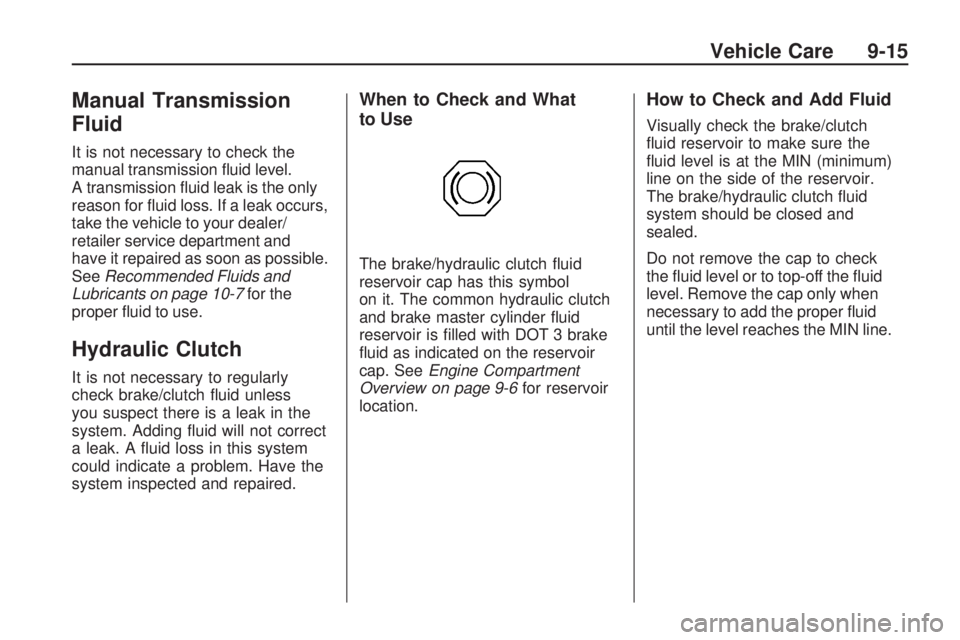
The brake/hydraulic clutch fluid
reservoir cap has this symbol
on it. The common hydraulic clutch
and brake master cylinder fluid
reservoir is filled with DOT 3 brake
fluid as indicated on the reservoir
cap. SeeEngine Compartment
Overview on page 9-6for reservoir
location.
How to Check and Add Fluid
Visually check the brake/clutch
fluid reservoir to make sure the
fluid level is at the MIN (minimum)
line on the side of the reservoir.
The brake/hydraulic clutch fluid
system should be closed and
sealed.
Do not remove the cap to check
the fluid level or to top-off the fluid
level. Remove the cap only when
necessary to add the proper fluid
until the level reaches the MIN line.
Vehicle Care 9-15
Page 248 of 372

Engine Air Cleaner/Filter
SeeEngine Compartment
Overview on page 9-6for the
location of the engine air
cleaner/filter.
When to Inspect the Engine
Air Cleaner/Filter
Inspect the air cleaner/filter at the
MaintenanceIIintervals and replace
it at the first oil change after each
50,000 mile (80 000 km) interval.
See “Schedule Maintenance” in
Service and Maintenance for more
information. If driving in dusty/dirty
conditions, inspect the filter at each
engine oil change.
How to Inspect the Engine Air
Cleaner/Filter
To inspect the air cleaner/filter,
remove the filter from the vehicle
and lightly shake the filter to release
loose dust and dirt. If the filter
remains caked with dirt, a new
filter is required.
To inspect or replace the engine air
cleaner/filter:
1. Open the hood. SeeHood on
page 9-5.
2. Locate the air filter housing
on the front of the driver
side of the engine compartment.
SeeEngine Compartment
Overview on page 9-6.
3.6 L V6 Engine Air Cleaner/
Filter Housing shown
(6.2 L V8 Engines similar)
9-16 Vehicle Care
Page 250 of 372
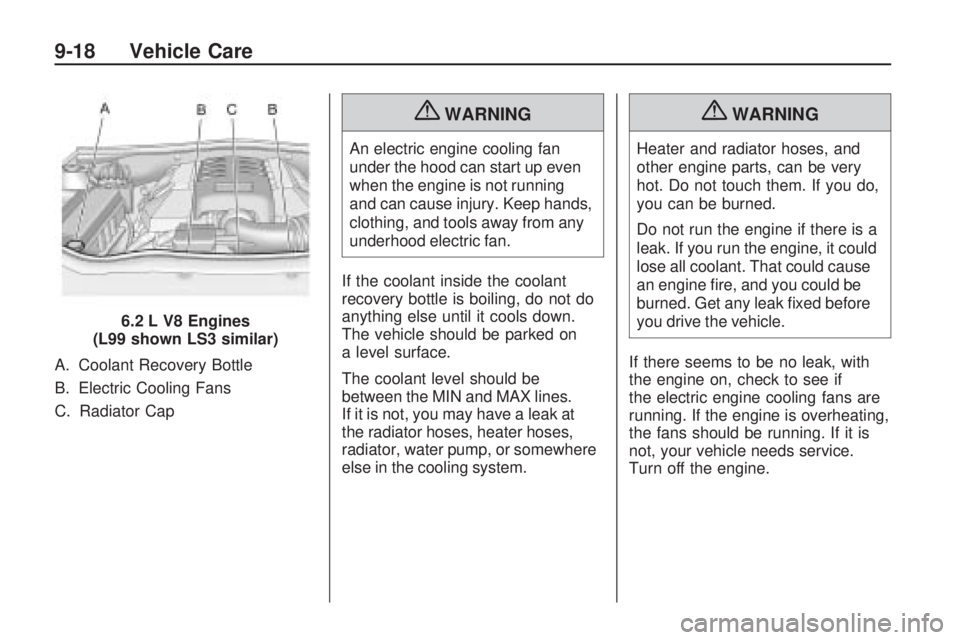
A. Coolant Recovery Bottle
B. Electric Cooling Fans
C. Radiator Cap
{WARNING
An electric engine cooling fan
under the hood can start up even
when the engine is not running
and can cause injury. Keep hands,
clothing, and tools away from any
underhood electric fan.
If the coolant inside the coolant
recovery bottle is boiling, do not do
anything else until it cools down.
The vehicle should be parked on
a level surface.
The coolant level should be
between the MIN and MAX lines.
If it is not, you may have a leak at
the radiator hoses, heater hoses,
radiator, water pump, or somewhere
else in the cooling system.
{WARNING
Heater and radiator hoses, and
other engine parts, can be very
hot. Do not touch them. If you do,
you can be burned.
Do not run the engine if there is a
leak. If you run the engine, it could
lose all coolant. That could cause
an engine fire, and you could be
burned. Get any leak fixed before
you drive the vehicle.
If there seems to be no leak, with
the engine on, check to see if
the electric engine cooling fans are
running. If the engine is overheating,
the fans should be running. If it is
not, your vehicle needs service.
Turn off the engine. 6.2 L V8 Engines
(L99 shown LS3 similar)
9-18 Vehicle Care
Page 256 of 372

Engine Overheating
The vehicle has an indicator to warn
of engine overheating.
There is an engine coolant
temperature warning light on
your vehicle’s instrument panel.
SeeEngine Coolant Temperature
Gage on page 4-14.
You may decide not to lift the hood
when this warning appears, but
instead get service help right away.
SeeRoadside Assistance Program
on page 12-6.
If you do decide to lift the hood,
make sure the vehicle is parked
on a level surface.Then check to see if the engine
cooling fans are running. If the
engine is overheating, both fans
should be running. If they are
not, do not continue to run the
engine and have the vehicle
serviced.
Notice:Engine damage from
running the engine without
coolant is not covered by the
warranty.
Notice:If the engine catches
re because of being driven with
no coolant, your vehicle can be
badly damaged. The costly repairs
would not be covered by the
vehicle warranty.
If Steam Is Coming From The
Engine Compartment
{WARNING
Steam from an overheated engine
can burn you badly, even if you
just open the hood. Stay away
from the engine if you see or hear
steam coming from it. Just turn it
off and get everyone away from
the vehicle until it cools down. Wait
until there is no sign of steam or
coolant before you open the hood.
If you keep driving when your
engine is overheated, the liquids
in it can catch fire. You or others
could be badly burned. Stop your
engine if it overheats, and get out
of the vehicle until the engine
is cool.
9-24 Vehicle Care
Page 259 of 372

Notice:
When using concentrated
washer uid, follow the
manufacturer’s instructions
for adding water.
Do not mix water with
ready-to-use washer uid.
Water can cause the solution
to freeze and damage your
washer uid tank and other
parts of the washer system.
Also, water does not clean
as well as washer uid.
Fill the washer uid tank only
three-quarters full when it is
very cold. This allows for uid
expansion if freezing occurs,
which could damage the tank
if it is completely full.
Do not use engine coolant
(antifreeze) in your windshield
washer. It can damage the
vehicle’s windshield washer
system and paint.
Brakes
This vehicle has disc brakes.
Disc brake pads have built-in wear
indicators that make a high-pitched
warning sound when the brake pads
are worn and new pads are needed.
The sound can come and go or be
heard all the time the vehicle is
moving, except when applying
the brake pedal firmly.
{WARNING
The brake wear warning sound
means that soon the brakes will
not work well. That could lead to
an accident. When the brake wear
warning sound is heard, have the
vehicle serviced.
Notice:Continuing to drive with
worn-out brake pads could result
in costly brake repair.Some driving conditions or climates
can cause a brake squeal when
the brakes are first applied or lightly
applied. This does not mean
something is wrong with the brakes.
Properly torqued wheel nuts are
necessary to help prevent brake
pulsation. When tires are rotated,
inspect brake pads for wear and
evenly tighten wheel nuts in the
proper sequence to torque
specifications inCapacities and
Specications on page 11-2.
Brake linings should always be
replaced as complete axle sets.
Brake Pedal Travel
See your dealer/retailer if the brake
pedal does not return to normal
height, or if there is a rapid increase
in pedal travel. This could be a sign
that brake service might be required.
Vehicle Care 9-27
Page 263 of 372

What to Use
For 218 mm rear drive module
(RDM) V6 manual, V8 automatic
and V8 manual:
To add lubricant when the level
is low, use 75W-90 LS gear oil
(GM Part No. US 89021677
and 1052358, in Canada
Part No. 89021678 and 992694)
meeting GM Specification 9986226.
To completely refill after draining,
seeRecommended Fluids and
Lubricants on page 10-7. Then fill
to the bottom of the filler plug hole
with the Synthetic Gear Lubricant.
For 195 mm RDM V6 automatic:
To add lubricant when the level
is low, use 75W-90 gear Oil
(GM Part No. US 89021677,
in Canada Part No. 89021678)
meeting GM Specification 9986115.
To completely refill after draining,
seeRecommended Fluids and
Lubricants on page 10-7. Then fill
to the bottom of the filler plug hole
with the Synthetic Gear Lubricant.
Starter Switch Check
{WARNING
When you are doing this
inspection, the vehicle could move
suddenly. If the vehicle moves,
you or others could be injured.
1. Before starting this check,
be sure there is enough
room around the vehicle.
2. Firmly apply both the parking
brake and the regular brake.
SeeParking Brake on page 8-32.
Do not use the accelerator
pedal, and be ready to turn off
the engine immediately if it starts.3. For automatic transmission
vehicles, try to start the engine
in each gear. The vehicle
should start only in P (Park) or
N (Neutral). If the vehicle starts
in any other position, contact your
dealer/retailer for service.
For manual transmission
vehicles, put the shift lever in
Neutral, push the clutch pedal
down halfway, and try to start the
engine. The vehicle should start
only when the clutch pedal is
pushed down all the way to the
floor. If the vehicle starts when
the clutch pedal is not pushed
all the way down, contact your
dealer/retailer for service.
Vehicle Care 9-31
Page 264 of 372
Automatic Transmission
Shift Lock Control
System Check
{WARNING
When you are doing this
inspection, the vehicle could move
suddenly. If the vehicle moves,
you or others could be injured.
1. Before starting this check, be
sure there is enough room
around the vehicle. It should
be parked on a level surface.
2. Firmly apply the parking brake.
SeeParking Brake on page 8-32.
Be ready to apply the regular
brake immediately if the vehicle
begins to move.3. With the engine off, turn the
ignition to ON/RUN, but do
not start the engine. Without
applying the regular brake,
try to move the shift lever out
of P (Park) with normal effort.
If the shift lever moves out
of P (Park), contact your
dealer/retailer for service.
Ignition Transmission
Lock Check
While parked, and with the parking
brake set, try to turn the ignition
to LOCK/OFF in each shift lever
position.
•The ignition should turn to
LOCK/OFF only when the
shift lever is in P (Park).
•The ignition key should come out
only in LOCK/OFF.
Contact your dealer/retailer if
service is required.
Park Brake and P (Park)
Mechanism Check
{WARNING
When you are doing this check,
the vehicle could begin to move.
You or others could be injured
and property could be damaged.
Make sure there is room in front
of the vehicle in case it begins to
roll. Be ready to apply the regular
brake at once should the vehicle
begin to move.
9-32 Vehicle Care
Page 265 of 372
Park on a fairly steep hill, with the
vehicle facing downhill. Keeping
your foot on the regular brake,
set the parking brake.
•To check the parking brake’s
holding ability: With the engine
running and the transmission
in N (Neutral), slowly remove
foot pressure from the regular
brake pedal. Do this until
the vehicle is held by the
parking brake only.
•To check the P (Park)
mechanism’s holding ability:
With the engine running, shift
to P (Park). Then release the
parking brake followed by the
regular brake.
Contact your dealer/retailer if
service is required.
Wiper Blade
Replacement
Windshield wiper blades should be
inspected for wear and cracking.
SeeScheduled Maintenance on
page 10-2for more information.
Replacement blades come in
different types and are removed
in different ways. For proper type
and length, seeMaintenance
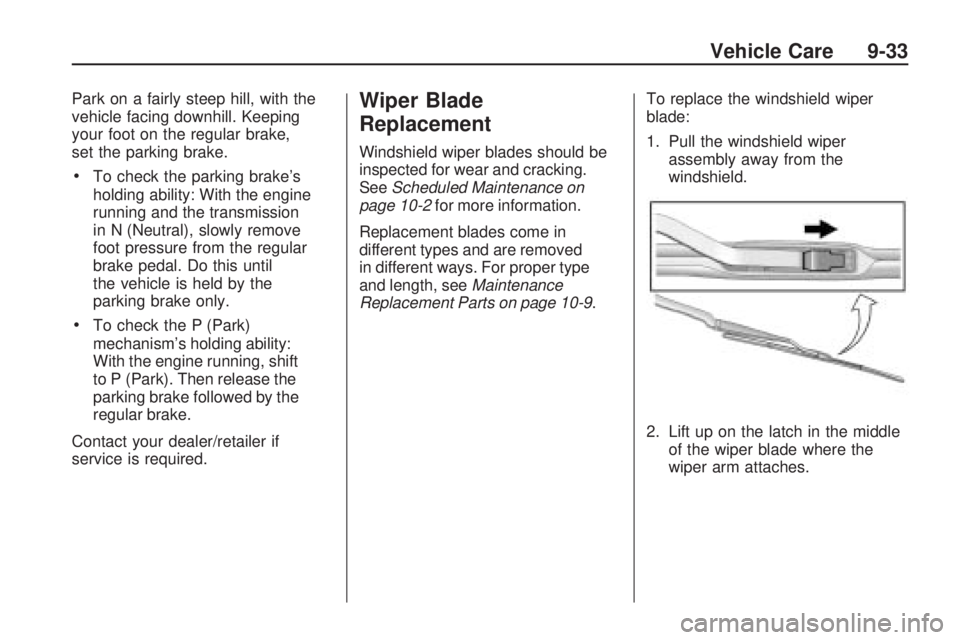
Replacement Parts on page 10-9.To replace the windshield wiper
blade:
1. Pull the windshield wiper
assembly away from the
windshield.
2. Lift up on the latch in the middle
of the wiper blade where the
wiper arm attaches.
Vehicle Care 9-33