service CHEVROLET CAMARO SS 2010 Repair Manual
[x] Cancel search | Manufacturer: CHEVROLET, Model Year: 2010, Model line: CAMARO SS, Model: CHEVROLET CAMARO SS 2010Pages: 372, PDF Size: 1.91 MB
Page 269 of 372
Bulb Replacement
For the proper type of replacement
bulbs, seeReplacement Bulbs
on page 9-41.
For any bulb changing procedure
not listed in this section, contact
your dealer/retailer.
Halogen Bulbs
{WARNING
Halogen bulbs have pressurized
gas inside and can burst if you
drop or scratch the bulb. You or
others could be injured. Be sure
to read and follow the instructions
on the bulb package.
High Intensity Discharge
(HID) Lighting
{WARNING
The low beam high intensity
discharge lighting system
operates at a very high voltage.
If you try to service any of the
system components, you could
be seriously injured. Have your
dealer/retailer or a qualified
technician service them.
The up–level vehicle is equipped
with HID headlamps. The park lamp
function is also a function of the HID
headlamp. After an HID headlamp
bulb has been replaced, you may
notice that the beam is a slightly
different shade than it was originally.
This is normal.
Headlamps, Front Turn
Signal and Parking
Lamps (Base Vehicle)
The base model vehicle has a
halogen headlamp and a turn
signal/parking lamp on the
headlamp assembly.
To replace one of these bulbs:
1. Open the hood. SeeHood on
page 9-5.
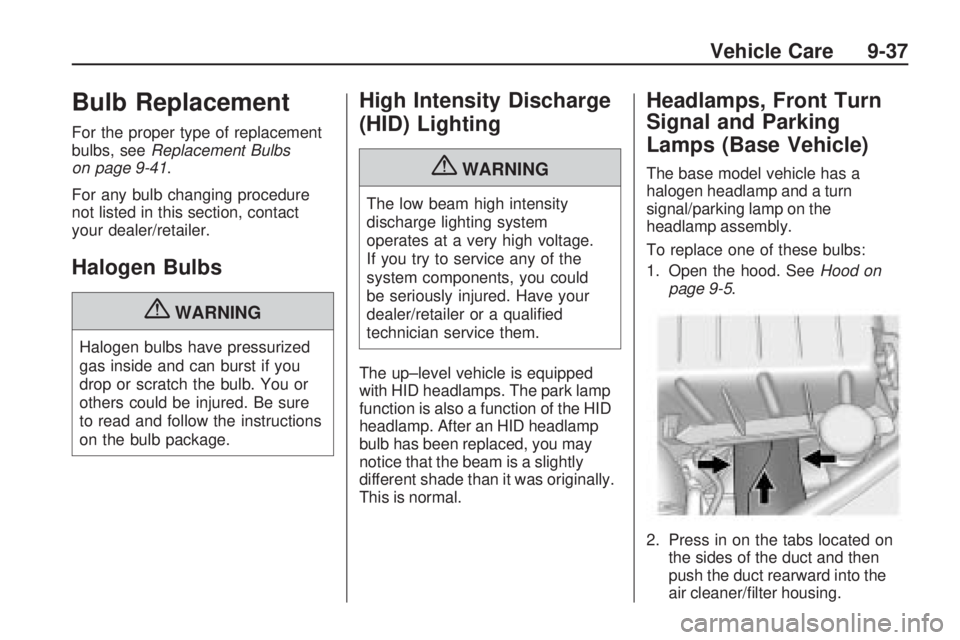
2. Press in on the tabs located on
the sides of the duct and then
push the duct rearward into the
air cleaner/filter housing.
Vehicle Care 9-37
Page 280 of 372
Wheels and Tires
Tires
Your new vehicle comes
with high-quality tires made
by a leading tire manufacturer.
If you ever have questions about
your tire warranty and where to
obtain service, see your vehicle
Warranty booklet for details.
For additional information refer
to the tire manufacturer.
{WARNING
Poorly maintained and improperly
used tires are dangerous.
•Overloading your tires can
cause overheating as a result
of too much flexing. You could
have an air-out and a serious
accident. SeeVehicle Load
Limits on page 8-12.
(Continued)
WARNING (Continued)
•Underinflated tires pose the
same danger as overloaded
tires. The resulting accident
could cause serious injury.
Check all tires frequently to
maintain the recommended
pressure. Tire pressure
should be checked when
your tires are cold. SeeTire
Pressure on page 9-54.
•Overinflated tires are more
likely to be cut, punctured
or broken by a sudden
impact — such as when you
hit a pothole. Keep tires at
the recommended pressure.
•Worn, old tires can cause
accidents. If your tread is
badly worn, or if your tires
have been damaged,
replace them.
Winter Tires
If you expect to drive on snow or ice
covered roads often, you may want
to get winter tires for your vehicle.
All season tires provide good overall
performance on most surfaces but
they may not offer the traction you
would like or the same level of
performance as winter tires on
snow or ice covered roads.
Winter tires, in general, are
designed for increased traction
on snow and ice covered roads.
With winter tires, there may be
decreased dry road traction,
increased road noise, and shorter
tread life. After switching to winter
tires, be alert for changes in vehicle
handling and braking.
See your dealer/retailer for details
regarding winter tire availability
and proper tire selection. Also, see
Buying New Tires on page 9-63.
9-48 Vehicle Care
Page 281 of 372
If you choose to use winter tires:
•Use tires of the same brand and
tread type on all four wheel
positions.
•Use only radial ply tires of the
same size, load range, and
speed rating as the original
equipment tires.
Winter tires with the same speed
rating as your original equipment
tires may not be available for H, V,
W, Y, and ZR speed rated tires.
If you choose winter tires with a lower
speed rating, never exceed the tire’s
maximum speed capability.
Tire Sidewall Labeling
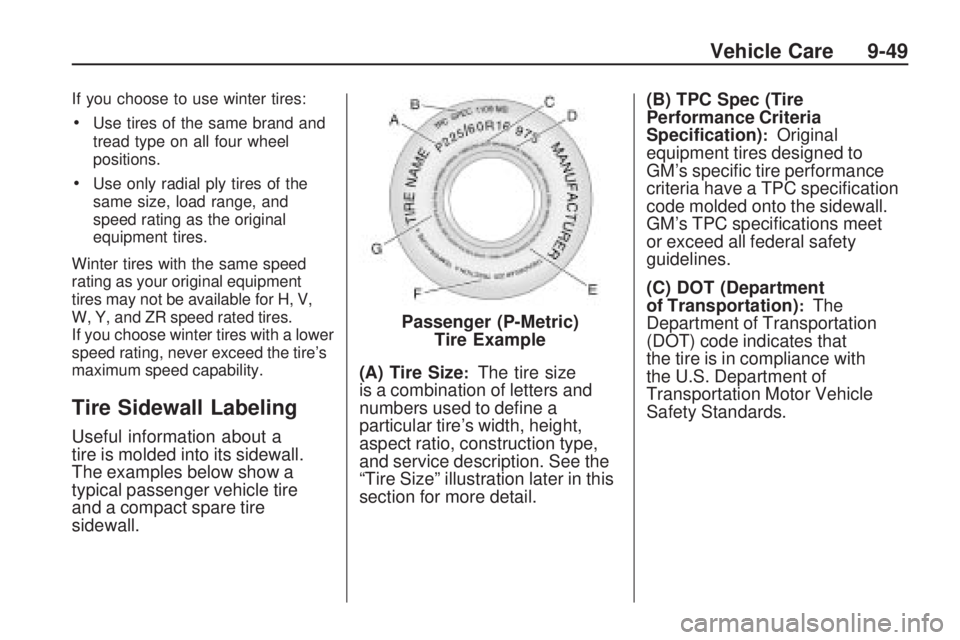
Useful information about a
tire is molded into its sidewall.
The examples below show a
typical passenger vehicle tire
and a compact spare tire
sidewall.(A) Tire Size
:The tire size
is a combination of letters and
numbers used to define a
particular tire’s width, height,
aspect ratio, construction type,
and service description. See the
“Tire Size” illustration later in this
section for more detail.(B) TPC Spec (Tire
Performance Criteria
Specication)
:Original
equipment tires designed to
GM’s specific tire performance
criteria have a TPC specification
code molded onto the sidewall.
GM’s TPC specifications meet
or exceed all federal safety
guidelines.
(C) DOT (Department
of Transportation)
:The
Department of Transportation
(DOT) code indicates that
the tire is in compliance with
the U.S. Department of
Transportation Motor Vehicle
Safety Standards. Passenger (P-Metric)
Tire Example
Vehicle Care 9-49
Page 283 of 372

(E) Tire Ination:The
temporary use tire or compact
spare tire should be inflated
to 60 psi (420 kPa). For more
information on tire pressure
and inflation seeTire Pressure
on page 9-54.
(F) Tire Size
:A combination
of letters and numbers define a
tire’s width, height, aspect ratio,
construction type, and service
description. The letter T as the
first character in the tire size
means the tire is for temporary
use only.
(G) TPC Spec (Tire
Performance Criteria
Specication)
:Original
equipment tires designed to
GM’s specific tire performance
criteria have a TPC specification
code molded onto the sidewall.
GM’s TPC specifications meet
or exceed all federal safety
guidelines.
Tire Designations
Tire Size
The following illustration
shows an example of a typical
passenger vehicle tire size.
(A) Passenger (P-Metric) Tire
:The United States version of
a metric tire sizing system. The
letter P as the first character in
the tire size means a passenger
vehicle tire engineered to
standards set by the U.S.
Tire and Rim Association.
(B) Tire Width
:The three-digit
number indicates the tire section
width in millimeters from sidewall
to sidewall.(C) Aspect Ratio
:A two-digit
number that indicates the tire
height-to-width measurements.
For example, if the tire size
aspect ratio is 60, as shown in
item C of the illustration, it would
mean that the tire’s sidewall is
60 percent as high as it is wide.
(D) Construction Code
:A
letter code is used to indicate the
type of ply construction in the tire.
The letter R means radial ply
construction; the letter D means
diagonal or bias ply construction;
and the letter B means
belted-bias ply construction.
(E) Rim Diameter
:Diameter of
the wheel in inches.
(F) Service Description
:These
characters represent the load
index and speed rating of the tire.
The load index represents the
load carry capacity a tire is
certified to carry. The speed
rating is the maximum speed a
tire is certified to carry a load.
Vehicle Care 9-51
Page 291 of 372
TPMS Malfunction Light and
Message
The TPMS will not function properly
if one or more of the TPMS sensors
are missing or inoperable. When the
system detects a malfunction, the
low tire warning light flashes for
about one minute and then stays
on for the remainder of the ignition
cycle. A DIC warning message is
also displayed. The low tire warning
light and DIC warning message
come on at each ignition cycle until
the problem is corrected. Some of
the conditions that can cause the
malfunction light and DIC message
to come on are:
•One of the road tires has been
replaced with the spare tire, if the
vehicle has one. The spare tire
does not have a TPMS sensor.
The DIC message should go off
once you re-install the road tire
containing the TPMS sensor.
•The TPMS sensor matching
process was not done or not
completed successfully after
rotating the vehicle’s tires.
The DIC message should go
off after successfully completing
the sensor matching process.
See “TPMS Sensor Matching
Process” later in this section.
•One or more TPMS sensors
are missing or damaged.
The DIC message and the
TPMS malfunction light should
go off when the TPMS sensors
are installed and the sensor
matching process is performed
successfully. See your dealer/
retailer for service.
•Replacement tires or wheels do
not match your vehicle’s original
equipment tires or wheels. Tires
and wheels other than those
recommended for your vehicle
could prevent the TPMS from
functioning properly. SeeBuying
New Tires on page 9-63.
•Operating electronic devices or
being near facilities using radio
wave frequencies similar to the
TPMS could cause the TPMS
sensors to malfunction.
If the TPMS is not functioning it
cannot detect or signal a low tire
condition. See your dealer/retailer for
service if the TPMS malfunction light
and DIC message comes on and
stays on.
Vehicle Care 9-59
Page 292 of 372

TPMS Sensor Matching
Process
Each TPMS sensor has a unique
identification code. Any time you
replace one or more of the TPMS
sensors or rotate your vehicle’s tires,
the identification codes need to be
matched to the new tire/wheel
position. The sensors are matched
to the tire/wheel positions in the
following order: driver side front tire,
passenger side front tire, passenger
side rear tire, and driver side rear
tire using a TPMS diagnostic tool.
See your dealer/retailer for service.
The TPMS sensors can also be
matched to each tire/wheel position
by increasing or decreasing the
tire’s air pressure. If increasing the
tire’s air pressure, do not exceed
the maximum inflation pressure
indicated on the tire’s sidewall.
To decrease the tire’s air-pressure
use the pointed end of the valve
cap, a pencil-style air pressure
gage, or a key.You have two minutes to match
the first tire/wheel position, and
five minutes overall, to match all
four tire/wheel positions. If it takes
longer than two minutes, to match
the first tire and wheel, or more than
five minutes to match all four tire
and wheel positions, the matching
process stops and you need to
start over.
The TPMS matching process is
outlined below:
1. Set the parking brake.
2. Turn the ignition switch to
ON/RUN with the engine off.
3. Go to the TPM vehicle
information screen on the DIC.
SeeDriver Information Center
(DIC) on page 4-27. Press set to
relearn the sensors. The horn
sounds twice to signal the
receiver is in relearn mode and
Tire Learning Active message
displays on the DIC screen.
4. Start with the driver side
front tire.5. Remove the valve cap from
the valve stem. Activate the
TPMS sensor by increasing or
decreasing the tire’s air pressure
for 10 seconds, or until a horn
chirp sounds. The horn chirp,
which can take up to 30 seconds
to sound, confirms that the TPMS
sensor identification code has
been matched to this tire position.
6. Proceed to the passenger
side front tire, and repeat
the procedure in Step 5.
7. Proceed to the passenger
side rear tire, and repeat
the procedure in Step 5.
8. Proceed to the driver side rear
tire, and repeat the procedure
in Step 5.
9. After hearing the confirming horn
chirp, for the driver side rear tire,
the horn sounds two more times
to signal the tire learning mode is
no longer active. Turn the ignition
switch to LOCK/OFF.
9-60 Vehicle Care
Page 298 of 372
The Uniform Tire Quality Grading
(UTQG) system does not apply
to deep tread, winter-type snow
tires, space-saver, or temporary
use spare tires, tires with nominal
rim diameters of 10 to 12 inches
(25 to 30 cm), or to some
limited-production tires.
While the tires available on
General Motors passenger cars
and light trucks may vary with
respect to these grades, they
must also conform to federal
safety requirements and
additional General Motors Tire
Performance Criteria (TPC)
standards.Treadwear
The treadwear grade is a
comparative rating based
on the wear rate of the tire
when tested under controlled
conditions on a specified
government test course. For
example, a tire graded 150
would wear one and a half (1.5)
times as well on the government
course as a tire graded 100.
The relative performance of
tires depends upon the actual
conditions of their use, however,
and may depart significantly from
the norm due to variations in
driving habits, service practices,
and differences in road
characteristics and climate.Traction – AA, A, B, C
The traction grades, from
highest to lowest, are AA, A, B,
and C. Those grades represent
the tire’s ability to stop on wet
pavement as measured under
controlled conditions on specified
government test surfaces of
asphalt and concrete. A tire
marked C may have poor traction
performance.
Temperature – A, B, C
The temperature grades
are A (the highest), B, and C,
representing the tire’s resistance
to the generation of heat and
its ability to dissipate heat
when tested under controlled
conditions on a specified
indoor laboratory test wheel.
9-66 Vehicle Care
Page 318 of 372
{WARNING
Fans or other moving engine
parts can injure you badly. Keep
your hands away from moving
parts once the engine is running.
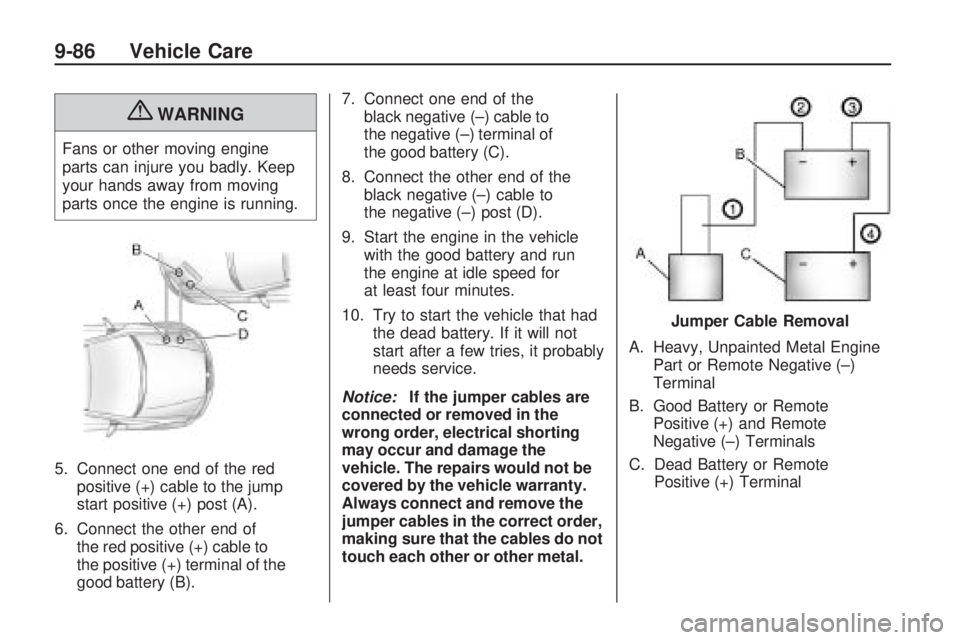
5. Connect one end of the red
positive (+) cable to the jump
start positive (+) post (A).
6. Connect the other end of
the red positive (+) cable to
the positive (+) terminal of the
good battery (B).7. Connect one end of the
black negative (–) cable to
the negative (–) terminal of
the good battery (C).
8. Connect the other end of the
black negative (–) cable to
the negative (–) post (D).
9. Start the engine in the vehicle
with the good battery and run
the engine at idle speed for
at least four minutes.
10. Try to start the vehicle that had
the dead battery. If it will not
start after a few tries, it probably
needs service.
Notice:If the jumper cables are
connected or removed in the
wrong order, electrical shorting
may occur and damage the
vehicle. The repairs would not be
covered by the vehicle warranty.
Always connect and remove the
jumper cables in the correct order,
making sure that the cables do not
touch each other or other metal.A. Heavy, Unpainted Metal Engine
Part or Remote Negative (–)
Terminal
B. Good Battery or Remote
Positive (+) and Remote
Negative (–) Terminals
C. Dead Battery or Remote
Positive (+) Terminal
Jumper Cable Removal
9-86 Vehicle Care
Page 319 of 372
To disconnect the jumper cables
from both vehicles:
1. Disconnect the black negative (−)
cable from the vehicle that had
the dead battery.
2. Disconnect the black negative (−)
cable from the vehicle with the
good battery.
3. Disconnect the red positive (+)
cable from the vehicle with the
good battery.
4. Disconnect the red positive (+)
cable from the other vehicle.
5. Return the caps over the
positive (+) and negative (–)
terminals to their original
positions.Towing
Towing the Vehicle
To avoid damage, the disabled
vehicle should be towed with all four
wheels off the ground. Consult your
dealer/retailer or a professional
towing service if the disabled vehicle
needs to be towed. SeeRoadside
Assistance Program on page 12-6.
If the vehicle has lost battery power,
the shift lever needs to be manually
released to neutral for towing.
See “Shift Lock Manual Release”
underShifting Out of Park on
page 8-22.
To tow the vehicle behind
another vehicle for recreational
purposes — such as behind
a motorhome, see Recreational
Vehicle Towing following.
Recreational Vehicle
Towing
Notice:Dolly towing or dinghy
towing the vehicle may cause
damage because of reduced
ground clearance. Always put
the vehicle on a atbed truck or
trailer.
The vehicle was neither designed
nor intended to be towed with any
of its wheels on the ground. If the
vehicle must be towed, see “Towing
the Vehicle” earlier in this section.
Vehicle Care 9-87
Page 329 of 372

Service and
Maintenance
General InformationGeneral Information.............10-1
Scheduled MaintenanceScheduled Maintenance........10-2
Recommended Fluids,
Lubricants, and Parts
Recommended Fluids and
Lubricants.........................10-7
Maintenance Replacement
Parts................................10-9
Maintenance RecordsMaintenance Records.........10-10
General Information
Notice:Maintenance
intervals, checks, inspections,
recommended uids, and
lubricants are necessary to
keep this vehicle in good
working condition. Damage
caused by failure to follow
scheduled maintenance might
not be covered by the vehicle
warranty.
Proper vehicle maintenance helps to
keep the vehicle in good working
condition, improves fuel economy,
and reduces vehicle emissions
for better air quality.
Because of all the different ways
people use vehicles, maintenance
needs vary. The vehicle might need
more frequent checks and services.
Please read the information under
Scheduled Maintenance. To keep
the vehicle in good condition, see
your dealer/retailer.The maintenance schedule is for
vehicles that:•carry passengers and cargo
within recommended limits on
the Tire and Loading Information
label. SeeVehicle Load Limits
on page 8-12.
•are driven on reasonable road
surfaces within legal driving
limits.
•use the recommended fuel.
SeeRecommended Fuel
on page 8-44.
{WARNING
Performing maintenance work can
be dangerous. Some jobs can
cause serious injury. Perform
maintenance work only if you
have the required know-how and
the proper tools and equipment.
If in doubt, see your dealer/retailer
to have a qualified technician do
the work. SeeDoing Your Own
Service Work on page 9-4.
Service and Maintenance 10-1