cooling CHEVROLET CAPTIVA SPORT 2013 User Guide
[x] Cancel search | Manufacturer: CHEVROLET, Model Year: 2013, Model line: CAPTIVA SPORT, Model: CHEVROLET CAPTIVA SPORT 2013Pages: 374, PDF Size: 6.66 MB
Page 239 of 374
Black plate (5,1)Chevrolet Captiva Sport Owner Manual - 2013 - crc - 11/12/12
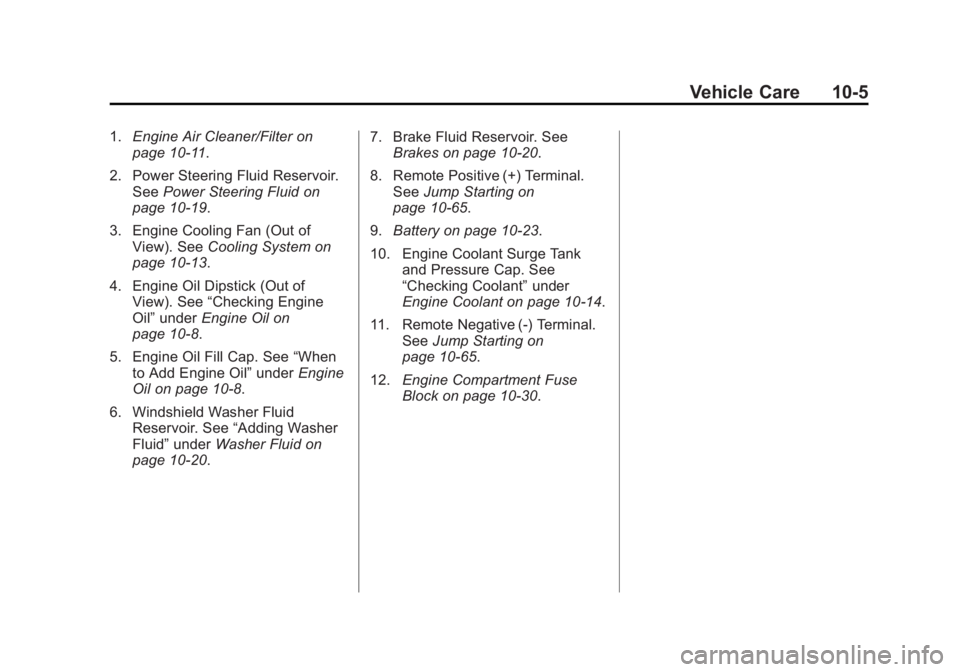
Vehicle Care 10-51. Engine Air Cleaner/Filter on
page 10 ‑ 11 .
2. Power Steering Fluid Reservoir.
See Power Steering Fluid on
page 10 ‑ 19 .
3. Engine Cooling Fan (Out of
View). See Cooling System on
page 10 ‑ 13 .
4. Engine Oil Dipstick (Out of
View). See “ Checking Engine
Oil ” under Engine Oil on
page 10 ‑ 8 .
5. Engine Oil Fill Cap. See “ When
to Add Engine Oil ” under Engine
Oil on page 10 ‑ 8 .
6. Windshield Washer Fluid
Reservoir. See “ Adding Washer
Fluid ” under Washer Fluid on
page 10 ‑ 20 . 7. Brake Fluid Reservoir. See
Brakes on page 10 ‑ 20 .
8. Remote Positive (+) Terminal.
See Jump Starting on
page 10 ‑ 65 .
9. Battery on page 10 ‑ 23 .
10. Engine Coolant Surge Tank
and Pressure Cap. See
“ Checking Coolant ” under
Engine Coolant on page 10 ‑ 14 .
11. Remote Negative (-) Terminal.
See Jump Starting on
page 10 ‑ 65 .
12. Engine Compartment Fuse
Block on page 10 ‑ 30 .
Page 241 of 374
Black plate (7,1)Chevrolet Captiva Sport Owner Manual - 2013 - crc - 11/12/12
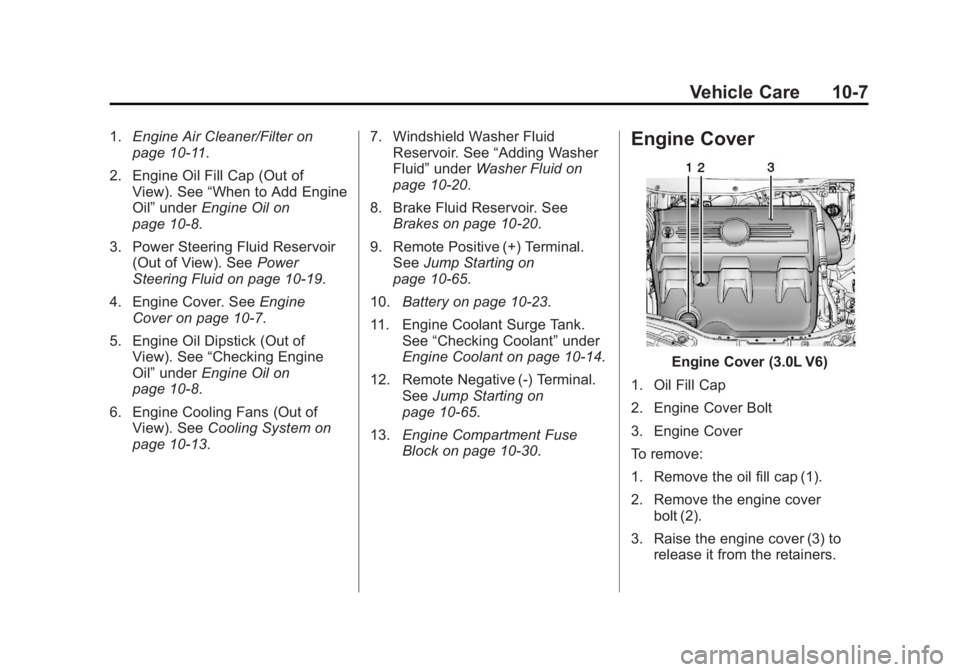
Vehicle Care 10-71. Engine Air Cleaner/Filter on
page 10 ‑ 11 .
2. Engine Oil Fill Cap (Out of
View). See “ When to Add Engine
Oil ” under Engine Oil on
page 10 ‑ 8 .
3. Power Steering Fluid Reservoir
(Out of View). See Power
Steering Fluid on page 10 ‑ 19 .
4. Engine Cover. See Engine
Cover on page 10 ‑ 7 .
5. Engine Oil Dipstick (Out of
View). See “ Checking Engine
Oil ” under Engine Oil on
page 10 ‑ 8 .
6. Engine Cooling Fans (Out of
View). See Cooling System on
page 10 ‑ 13 . 7. Windshield Washer Fluid
Reservoir. See “ Adding Washer
Fluid ” under Washer Fluid on
page 10 ‑ 20 .
8. Brake Fluid Reservoir. See
Brakes on page 10 ‑ 20 .
9. Remote Positive (+) Terminal.
See Jump Starting on
page 10 ‑ 65 .
10. Battery on page 10 ‑ 23 .
11. Engine Coolant Surge Tank.
See “ Checking Coolant ” under
Engine Coolant on page 10 ‑ 14 .
12. Remote Negative (-) Terminal.
See Jump Starting on
page 10 ‑ 65 .
13. Engine Compartment Fuse
Block on page 10 ‑ 30 .Engine Cover
Engine Cover (3.0L V6)
1. Oil Fill Cap
2. Engine Cover Bolt
3. Engine Cover
To remove:
1. Remove the oil fill cap (1).
2. Remove the engine cover
bolt (2).
3. Raise the engine cover (3) to
release it from the retainers.
Page 247 of 374
Black plate (13,1)Chevrolet Captiva Sport Owner Manual - 2013 - crc - 11/12/12
Vehicle Care 10-13
{ WARNINGOperating the engine with the air
cleaner/filter off can cause you or
others to be burned. The air
cleaner not only cleans the air; it
helps to stop flames if the engine
backfires. Use caution when
working on the engine and do not
drive with the air cleaner/filter off.
Notice: If the air cleaner/filter is
off, dirt can easily get into the
engine, which could damage it.
Always have the air cleaner/filter
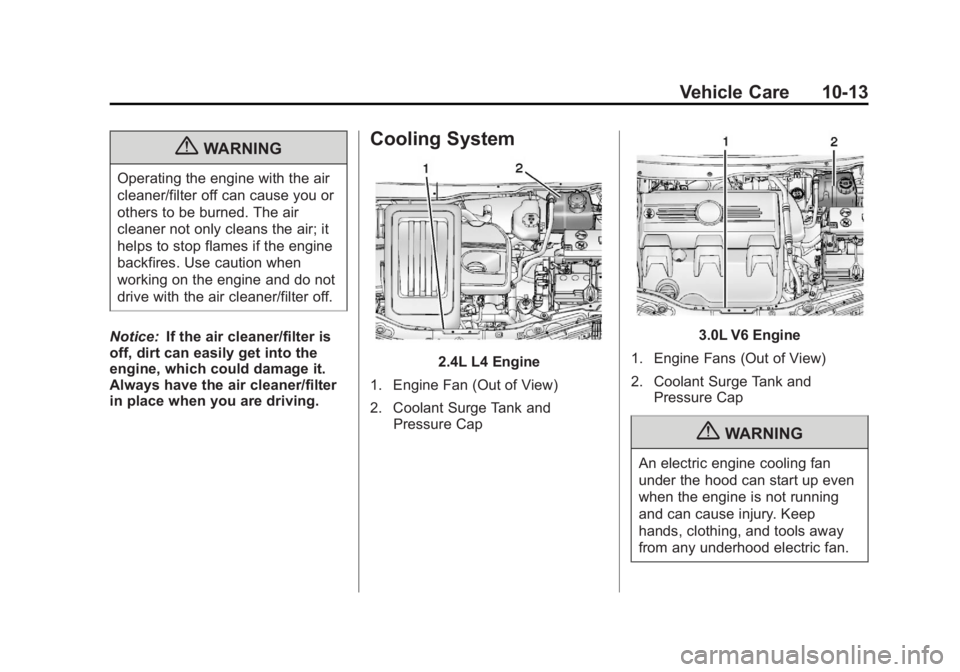
in place when you are driving. Cooling System
2.4L L4 Engine
1. Engine Fan (Out of View)
2. Coolant Surge Tank and
Pressure Cap 3.0L V6 Engine
1. Engine Fans (Out of View)
2. Coolant Surge Tank and
Pressure Cap
{ WARNING
An electric engine cooling fan
under the hood can start up even
when the engine is not running
and can cause injury. Keep
hands, clothing, and tools away
from any underhood electric fan.
Page 248 of 374
Black plate (14,1)Chevrolet Captiva Sport Owner Manual - 2013 - crc - 11/12/12
10-14 Vehicle Care If the coolant inside the coolant
surge tank is hot, do not do anything
else until it cools down. The vehicle
should be parked on a level surface.
The coolant level should be
between the MIN and MAX lines.
If it is not, you may have a leak at
the radiator hoses, heater hoses,
radiator, water pump, or somewhere
else in the cooling system.
{ WARNINGHeater and radiator hoses, and
other engine parts, can be very
hot. Do not touch them. If you do,
you can be burned.
Do not run the engine if there is a
leak. If you run the engine, it
could lose all coolant. That could
cause an engine fire, and you
could be burned. Get any leak
fixed before you drive the vehicle.
If there seems to be no leak, with
the engine on, check to see if the
engine cooling fan(s) is running. If the engine is overheating, the fan
should be running. If it is not, the
vehicle needs service. Turn off the
engine.
Notice: Engine damage from
running the engine without
coolant is not covered by the
warranty.
Notice: Using coolant other than
DEX-COOL ®
can cause premature
engine, heater core, or radiator
corrosion. In addition, the engine
coolant could require changing
sooner, at 50 000 km (30,000 mi)
or 24 months, whichever occurs
first. Any repairs would not be
covered by the vehicle warranty.
Always use DEX-COOL
(silicate-free) coolant in the
vehicle.
Engine Coolant The cooling system in the vehicle is
filled with DEX-COOL ®
engine
coolant. This coolant is designed to
remain in the vehicle for 5 years or 240 000 km (150,000 mi), whichever
occurs first, if only DEX-COOL
extended life coolant is added.
The following explains the cooling
system and how to add coolant
when it is low. If there is a problem
with engine overheating, see Engine
Overheating on page 10 ‑ 18 .
A 50/50 mixture of clean, drinkable
water and DEX-COOL coolant will: .
Give freezing protection down to
− 37°C ( − 34°F). .
Give boiling protection up to
129°C (265°F). .
Protect against rust and
corrosion. .
Help keep the proper engine
temperature. .
Let the warning lights and
gauges work as they should.
Notice: Using coolant other than
DEX-COOL ®
can cause premature
engine, heater core, or radiator
corrosion. In addition, the engine
coolant could require changing
Page 249 of 374
Black plate (15,1)Chevrolet Captiva Sport Owner Manual - 2013 - crc - 11/12/12
Vehicle Care 10-15sooner than DEX-COOL. Any
repairs would not be covered by
the vehicle warranty. Always use
DEX-COOL (silicate-free) coolant
in the vehicle.
What to Use Use a mixture of one-half clean,
drinkable water and one-half
DEX-COOL coolant which will not
damage aluminum parts. If you use
this coolant mixture, you do not
need to add anything else.
{ WARNINGAdding only plain water or some
other liquid to the cooling system
can be dangerous. Plain water
and other liquids, can boil before
the proper coolant mixture will.
The coolant warning system is set
for the proper coolant mixture.
(Continued) WARNING (Continued) With plain water or the wrong
mixture, the engine could get too
hot but you would not get the
overheat warning. The engine
could catch fire and you or
others could be burned. Use a
50/50 mixture of clean, drinkable
water and DEX-COOL coolant.
Notice: If an improper coolant
mixture is used, the engine could
overheat and be badly damaged.
The repair cost would not be
covered by the vehicle warranty.
Too much water in the mixture
can freeze and crack the engine,
radiator, heater core, and other
parts.
If coolant has to be added more
than four times a year, have the
dealer check the vehicle cooling
system. Notice: If extra inhibitors and/or
additives are used in the vehicle's
cooling system, the vehicle could
be damaged. Use only the proper
mixture of the engine coolant
listed in this manual for the
cooling system. See
Recommended Fluids and
Lubricants on page 11 ‑ 12 for
more information.
Never dispose of engine coolant by
putting it in the trash, pouring it on
the ground, or into sewers, streams,
or bodies of water. Have the coolant
changed by an authorized service
center, familiar with legal
requirements regarding used
coolant disposal. This will help
protect the environment and your
health.
Checking Coolant
The coolant surge tank is located on
the driver side of the engine
compartment. See Engine
Compartment Overview on
page 10 ‑ 4 for more information on
location.
Page 250 of 374
Black plate (16,1)Chevrolet Captiva Sport Owner Manual - 2013 - crc - 11/12/12
10-16 Vehicle Care
{ WARNINGTurning the surge tank pressure
cap when the engine and radiator
are hot can allow steam and
scalding liquids to blow out and
burn you badly. Never turn the
surge tank pressure cap — even a
little — when the engine and
radiator are hot.
The vehicle must be on a level
surface. When the engine is cold,
the coolant level should be between
the MIN and MAX lines.
Adding Coolant
If more coolant is needed, add the
proper DEX-COOL coolant mixture
at the coolant surge tank, but only
when the engine is cool. See below
for instructions on “ How to Add
Coolant to the Coolant Surge Tank. ”{ WARNINGYou can be burned if you spill
coolant on hot engine parts.
Coolant contains ethylene glycol,
and it will burn if the engine parts
are hot enough. Do not spill
coolant on a hot engine.
When replacing the pressure cap,
make sure it is hand-tight and fully
seated.
How to Add Coolant to the
Coolant Surge Tank Notice: This vehicle has a
specific coolant fill procedure.
Failure to follow this procedure
could cause the engine to
overheat and be severely
damaged.
If a problem yet has not been found,
check to see if coolant is visible in
the coolant surge tank. If coolant is
visible but the coolant level is not at
between the MIN and MAX lines,
add a 50/50 mixture of clean, drinkable water and DEX-COOL
coolant at the coolant surge tank,
but be sure the cooling system,
including the coolant surge tank
pressure cap, is cool before doing it.
See Engine Overheating on
page 10 ‑ 18 for more information.
{ WARNINGSteam and scalding liquids from a
hot cooling system can blow out
and burn you badly. They are
under pressure, and if you turn
the coolant surge tank pressure
cap — even a little — they can
come out at high speed. Never
turn the cap when the cooling
system, including the coolant
surge tank pressure cap, is hot.
Wait for the cooling system and
coolant surge tank pressure cap
to cool if you ever have to turn
the pressure cap.
Page 251 of 374
Black plate (17,1)Chevrolet Captiva Sport Owner Manual - 2013 - crc - 11/12/12
Vehicle Care 10-17
{ WARNINGAdding only plain water or some
other liquid to the cooling system
can be dangerous. Plain water
and other liquids, can boil before
the proper coolant mixture will.
The coolant warning system is set
for the proper coolant mixture.
With plain water or the wrong
mixture, the engine could get too
hot but you would not get the
overheat warning. The engine
could catch fire and you or
others could be burned. Use a
50/50 mixture of clean, drinkable
water and DEX-COOL coolant.
Notice: In cold weather, water
can freeze and crack the engine,
radiator, heater core and other
parts. Use the recommended
coolant and the proper coolant
mixture. { WARNINGYou can be burned if you spill
coolant on hot engine parts.
Coolant contains ethylene glycol
and it will burn if the engine parts
are hot enough. Do not spill
coolant on a hot engine.
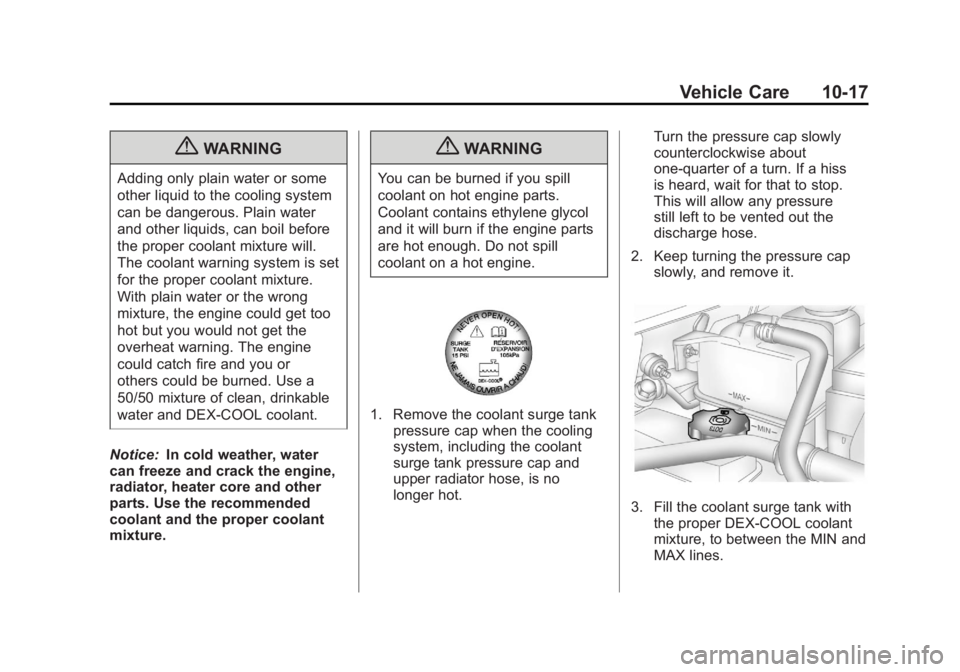
1. Remove the coolant surge tank
pressure cap when the cooling
system, including the coolant
surge tank pressure cap and
upper radiator hose, is no
longer hot. Turn the pressure cap slowly
counterclockwise about
one-quarter of a turn. If a hiss
is heard, wait for that to stop.
This will allow any pressure
still left to be vented out the
discharge hose.
2. Keep turning the pressure cap
slowly, and remove it.
3. Fill the coolant surge tank with
the proper DEX-COOL coolant
mixture, to between the MIN and
MAX lines.
Page 252 of 374
Black plate (18,1)Chevrolet Captiva Sport Owner Manual - 2013 - crc - 11/12/12
10-18 Vehicle Care 4. With the coolant surge tank
pressure cap off, start the
engine and let it run until the
upper radiator hose can be felt
getting hot. Watch out for the
engine cooling fan.
By this time, the coolant level
inside the coolant surge tank
may be lower. If the level is
lower, add more of the proper
DEX-COOL coolant mixture to
the coolant surge tank until the
level reaches between the MIN
and MAX lines.
5. Replace the pressure cap. Be
sure the pressure cap is
hand-tight.
Check the level in the surge tank
when the cooling system has cooled
down. If the coolant is not at the
proper level, repeat Steps 1 – 3 and
reinstall the pressure cap. If the
coolant still is not at the proper level
when the system cools down again,
see the dealer. Engine Overheating There is a coolant temperature
warning light on the instrument
panel. See Engine Coolant
Temperature Warning Light on
page 5 ‑ 20 .
If Steam is Coming from the
Engine
{ WARNINGSteam from an overheated engine
can cause serious injury, even if
the hood is opened just a little.
Stay away from the engine if
steam is seen or heard coming
from it. Just turn it off and get
everyone away from the vehicle
until it cools down. Wait until there
is no sign of steam or coolant
before opening the hood.
If driving continues when the
engine is overheated, the liquids
in it can catch fire. Someone
(Continued) WARNING (Continued) could get badly burned. Stop the
engine if it overheats, and get out
of the vehicle until the engine has
cooled.
Notice: Driving the vehicle when
there is no coolant in the coolant
overflow recovery bottle, can
badly damage the engine. The
costly repairs would not be
covered by the vehicle warranty.
If No Steam is Coming from
the Engine If there is an engine overheat
warning, but no steam can be seen
or heard, the problem may not be
too serious. Sometimes the engine
can get a little too hot when the
vehicle: .
Climbs a long hill on a hot day. .
Stops after high-speed driving.
Page 265 of 374
Black plate (31,1)Chevrolet Captiva Sport Owner Manual - 2013 - crc - 11/12/12
Vehicle Care 10-31
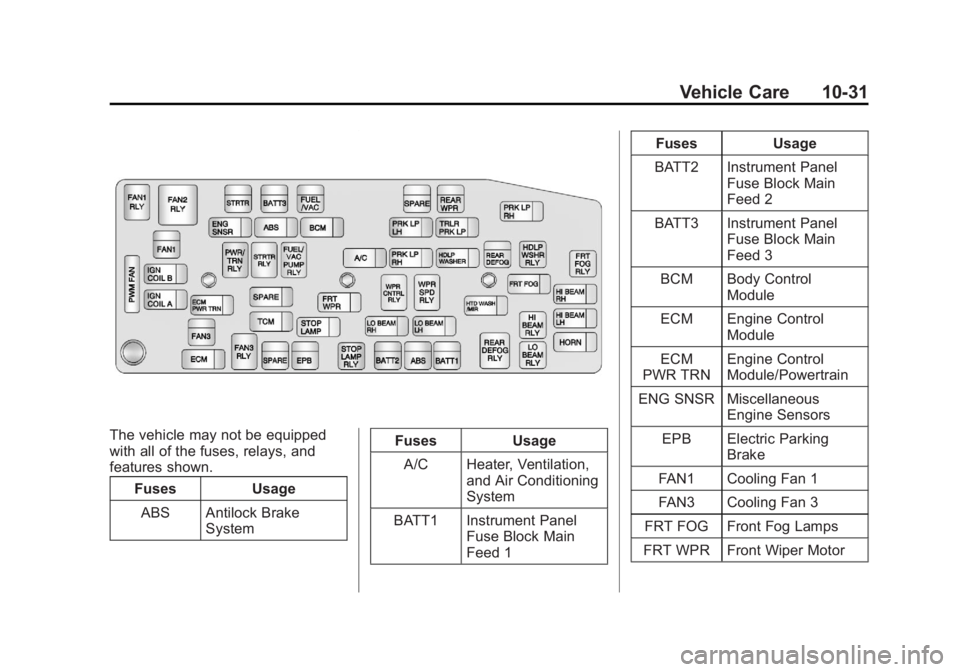
The vehicle may not be equipped
with all of the fuses, relays, and
features shown.
Fuses Usage
ABS Antilock Brake
System Fuses Usage
A/C Heater, Ventilation,
and Air Conditioning
System
BATT1 Instrument Panel
Fuse Block Main
Feed 1 Fuses Usage
BATT2 Instrument Panel
Fuse Block Main
Feed 2
BATT3 Instrument Panel
Fuse Block Main
Feed 3
BCM Body Control
Module
ECM Engine Control
Module
ECM
PWR TRN Engine Control
Module/Powertrain
ENG SNSR Miscellaneous
Engine Sensors
EPB Electric Parking
Brake
FAN1 Cooling Fan 1
FAN3 Cooling Fan 3
FRT FOG Front Fog Lamps
FRT WPR Front Wiper Motor
Page 266 of 374
Black plate (32,1)Chevrolet Captiva Sport Owner Manual - 2013 - crc - 11/12/12
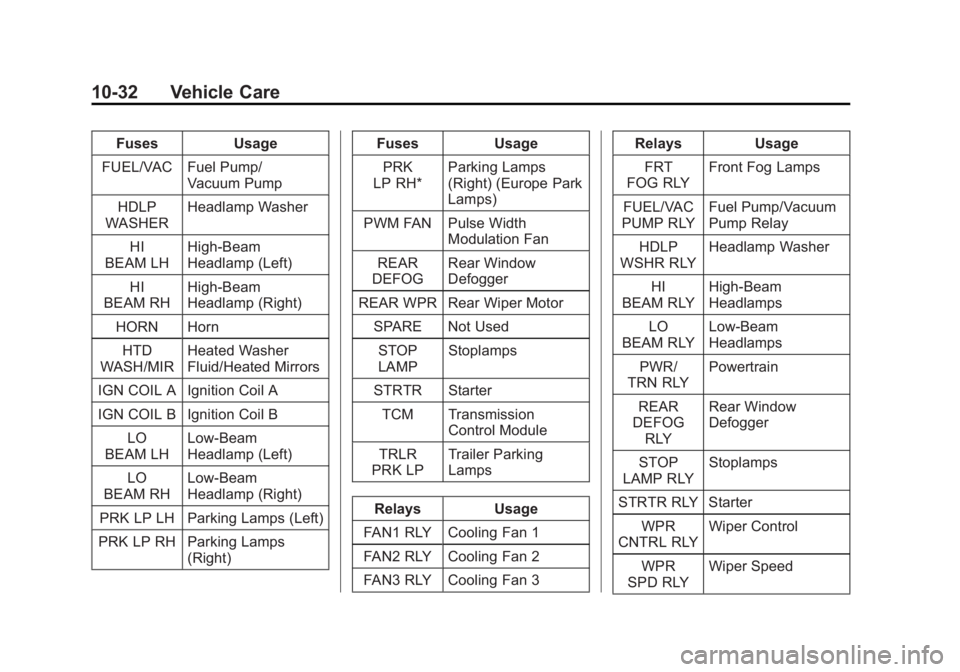
10-32 Vehicle Care Fuses Usage
FUEL/VAC Fuel Pump/
Vacuum Pump
HDLP
WASHER Headlamp Washer
HI
BEAM LH High-Beam
Headlamp (Left)
HI
BEAM RH High-Beam
Headlamp (Right)
HORN Horn
HTD
WASH/MIR Heated Washer
Fluid/Heated Mirrors
IGN COIL A Ignition Coil A
IGN COIL B Ignition Coil B
LO
BEAM LH Low-Beam
Headlamp (Left)
LO
BEAM RH Low-Beam
Headlamp (Right)
PRK LP LH Parking Lamps (Left)
PRK LP RH Parking Lamps
(Right) Fuses Usage
PRK
LP RH* Parking Lamps
(Right) (Europe Park
Lamps)
PWM FAN Pulse Width
Modulation Fan
REAR
DEFOG Rear Window
Defogger
REAR WPR Rear Wiper Motor
SPARE Not Used
STOP
LAMP Stoplamps
STRTR Starter
TCM Transmission
Control Module
TRLR
PRK LP Trailer Parking
Lamps
Relays Usage
FAN1 RLY Cooling Fan 1
FAN2 RLY Cooling Fan 2
FAN3 RLY Cooling Fan 3 Relays Usage
FRT
FOG RLY Front Fog Lamps
FUEL/VAC
PUMP RLY Fuel Pump/Vacuum
Pump Relay
HDLP
WSHR RLY Headlamp Washer
HI
BEAM RLY High-Beam
Headlamps
LO
BEAM RLY Low-Beam
Headlamps
PWR/
TRN RLY Powertrain
REAR
DEFOG
RLY Rear Window
Defogger
STOP
LAMP RLY Stoplamps
STRTR RLY Starter
WPR
CNTRL RLY Wiper Control
WPR
SPD RLY Wiper Speed