display CHEVROLET CAPTIVA SPORT 2013 Workshop Manual
[x] Cancel search | Manufacturer: CHEVROLET, Model Year: 2013, Model line: CAPTIVA SPORT, Model: CHEVROLET CAPTIVA SPORT 2013Pages: 374, PDF Size: 6.66 MB
Page 167 of 374
Black plate (19,1)Chevrolet Captiva Sport Owner Manual - 2013 - crc - 11/12/12
Infotainment System 7-19
Auxiliary Devices Using the Auxiliary Input Jack Radios with an auxiliary input jack
on the lower right side of the
faceplate can connect to an external
audio device such as an iPod ®
,
MP3 player, or CD player, for use as
another source for audio listening.
This input jack is not an audio
output; do not plug headphones into
the front auxiliary input jack.
To use a portable audio player,
connect a 3.5 mm (1/8 in) cable to
the radio's front auxiliary input jack.
When a device is connected, press
the radio CD/AUX button to begin
playing audio from the device over
the vehicle speakers.
For optimal sound quality, increase
the portable audio device's volume
to the loudest level.
It is always best to power the
portable audio device through its
own battery while playing. O (Power/Volume): Turn clockwise
or counterclockwise to increase or
decrease the volume of the portable
player. Additional volume
adjustments might have to be made
from the portable device if the
volume is not loud or soft enough.
BAND: Press to listen to the radio
when a portable audio device is
playing. The portable audio device
continues playing.
CD/AUX (CD/Auxiliary): Press to
play a CD when a portable audio
device is playing. Press again and
the system begins playing audio
from the connected portable audio
player. If a portable audio player is
not connected, No Input Device
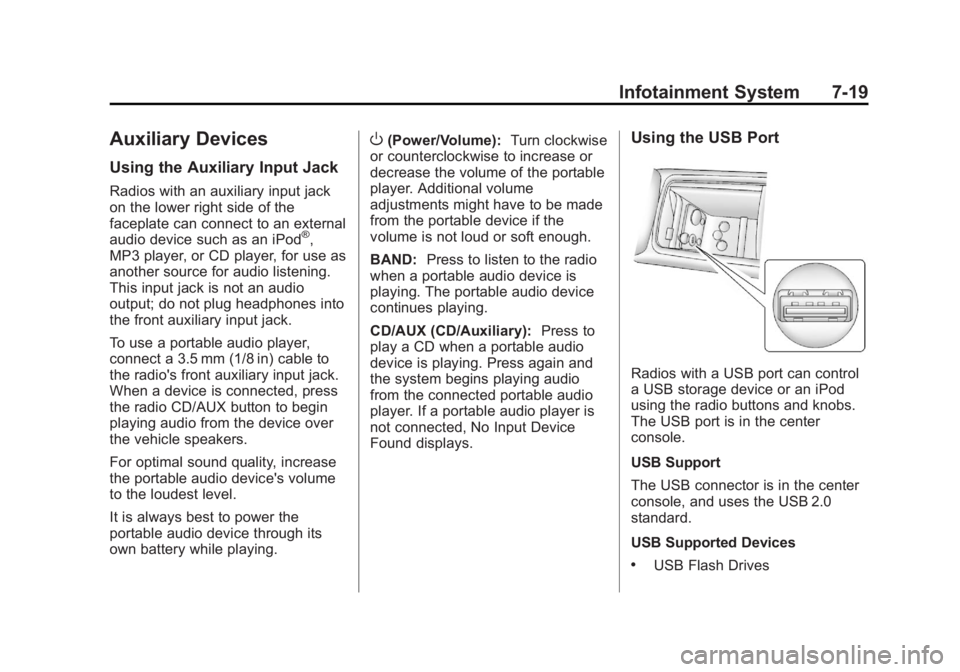
Found displays. Using the USB Port
Radios with a USB port can control
a USB storage device or an iPod
using the radio buttons and knobs.
The USB port is in the center
console.
USB Support
The USB connector is in the center
console, and uses the USB 2.0
standard.
USB Supported Devices .
USB Flash Drives
Page 168 of 374
Black plate (20,1)Chevrolet Captiva Sport Owner Manual - 2013 - crc - 11/12/12
7-20 Infotainment System .
Portable USB Hard Drives .
Fifth generation or later iPod .
iPod nano ®
.
iPod touch ®
.
iPod classic ®
Not all iPods and USB drives are
compatible with the USB port.
Make sure the iPod has the latest
firmware from Apple ®
for proper
operation. iPod firmware can be
updated using the latest iTunes ®
application. See www.apple.com/
itunes.
For help with identifying your iPod,
go to www.apple.com/support.
Radios that have a USB port can
play .mp3 and .wma files stored on a
USB storage device as well as AAC
files stored on an iPod.
USB Supported File and Folder
Structure
The radio supports: .
Up to 700 folders. .
Up to eight folders in depth. .
Up to 65,535 files. .
Folder and file names up to
64 bytes. .
Files with an .mp3 or .wma file
extension. .
AAC files stored on an iPod. .
FAT16. .
FAT32.
Connecting a USB Storage
Device or iPod The USB port can be used to
control an iPod or a USB storage
device.
To connect a USB storage device,
connect the device to the USB port
in the center console or on the
instrument panel.
To connect an iPod, connect one
end of the USB cable that came
with the iPod to the iPod ’ s dock
connector and connect the other
end to the USB port in the center
console. If the vehicle is on and the
USB connection works, OK to
disconnect and a GM logo may appear on the iPod and iPod
appears on the radio display. The
iPod music appears on the radio ’ s
display and begins playing.
The iPod charges while it is
connected to the vehicle if the
vehicle is in the ACC/ACCESSORY
or ON/RUN position. When the
vehicle is turned off, the iPod
automatically powers off and will not
charge or draw power from the
vehicle's battery.
If you have an older iPod model that
is not supported, it can still be used
by connecting it to the auxiliary
input jack using a standard 3.5 mm
(1/8 in) stereo cable. See “ Using the
Auxiliary Input Jack ” earlier for more
information.
Using the Radio to Control a
USB Storage Device or iPod
The radio can control a USB
storage device or an iPod using the
radio buttons and knobs, and
display song information on the
radio ’ s display.
Page 169 of 374
Black plate (21,1)Chevrolet Captiva Sport Owner Manual - 2013 - crc - 11/12/12
Infotainment System 7-21
f (Tune): Turn to select files.
© SEEK: Press to go to the start of
the track, if more than 10 seconds
have played. Press and hold or
press multiple times to continue
moving backward through tracks.
¨ SEEK: Press to go to the next
track. Press and hold or press
multiple times to continue moving
forward through tracks.
s REV (Reverse): Press and hold
to reverse playback quickly. Sound
is heard at a reduced volume.
Release
s REV to resume playing.
The elapsed time of the file
displays.
\ FWD (Fast Forward): Press
and hold to advance playback
quickly. Sound is heard at a reduced
volume. Release
\ FWD to
resume playing. The elapsed time of
the file displays.
4 (Information): Press to display
additional information about the
selected track. Using Softkeys to Control a
USB Storage Device or iPod The six softkeys below the radio
display are used to control the
functions listed below.
To use the softkeys:
1. Press the first or fifth softkey
below the radio display to
display the functions listed
below, or press the softkey
below the function if it is
currently displayed.
2. Press the softkey below the tab
with the function on it to use that
function.
j (Pause): Press the softkey
below
j to pause the track. The tab
appears raised when pause is being
used. Press the softkey below
jagain to resume playback.
Back: Press the softkey below the
radio display to go back to the main
display screen on an iPod, or the
root directory on a USB storage
device. c (Folder View): Press the
softkey below
c to view the
contents of the current folder on the
USB drive. To browse and select
files:
1. Press the softkey below
c .
2. Turn
f to scroll through the list
of folders.
3. Press
f to select the desired
folder. If there is more then one
folder, repeat Steps 1 and 2 until
the desired folder is reached.
4. Turn
f to scroll through the files
in the selected folder.
5. Press
f to select the desired file
to be played.
To skip through large lists, the five
softkeys can be used to navigate in
the following order: .
First softkey, first item in the list. .
Second softkey, 1% through the
list each time the softkey is
pressed.
Page 204 of 374
Black plate (16,1)Chevrolet Captiva Sport Owner Manual - 2013 - crc - 11/12/12
9-16 Driving and Operating ACC (ACC/ACCESSORY): This is
the position in which you can
operate some electrical accessories
or items plugged into the accessory
power outlets.
Use this position if the vehicle must
be pushed or towed.
ON (ON/RUN): This position can
be used to operate the electrical
accessories and to display some
instrument cluster warning and
indicator lights. This position can
also be used for service and
diagnostics, and to verify the proper
operation of the malfunction
indicator lamp as may be required
for emission inspection purposes.
The switch stays in this position
when the engine is running. The
transmission is also unlocked in this
position. If you leave the key in the
ACC/ACCESSORY or ON/RUN
positions with the engine off, the
battery could be drained. You may
not be able to start the vehicle if the
battery is allowed to drain for an
extended period of time. START: This is the position that
starts the engine. When the engine
starts, release the key. The ignition
switch returns to ON/RUN for
driving.
A warning tone will sound when the
driver door is opened, the ignition is
in ACC/ACCESSORY or LOCK/
OFF, and the key is in the ignition.
Starting the Engine Move the shift lever to P (Park) or
N (Neutral). The engine will not start
in any other position. To restart the
engine when the vehicle is already
moving, use N (Neutral) only.
Notice: Do not try to shift to
P (Park) if the vehicle is moving.
If you do, you could damage the
transmission. Shift to P (Park)
only when the vehicle is stopped. Starting Procedure
1. With your foot off the accelerator
pedal, turn the ignition to START.
When the engine starts, let go of
the key. The idle speed will slow
down as the engine warms. Do
not race the engine immediately
after starting it. Operate the
engine and transmission gently
to allow the oil to warm up and
lubricate all moving parts.
The vehicle has a
Computer-Controlled Cranking
System. This feature assists in
starting the engine and protects
components. If the ignition key is
turned to the START position,
and then released when the
engine begins cranking, the
engine will continue cranking for
a few seconds or until the
vehicle starts. If the engine does
not start and the key is held in
START, cranking will be stopped
after 15 seconds to prevent
cranking motor damage. To
prevent gear damage, this
system also prevents cranking if
Page 210 of 374
Black plate (22,1)Chevrolet Captiva Sport Owner Manual - 2013 - crc - 11/12/12
9-22 Driving and Operating D (Drive): This position is for
normal driving with the automatic
transmission. It provides the best
fuel economy. If you need more
power for passing, and you are: .
Going less than about 55 km/h
(35 mph), push the accelerator
pedal about halfway down. .
Going about 55 km/h (35 mph),
push the accelerator all the
way down.
Downshifting the transmission in
slippery road conditions could result
in skidding, see “ Skidding ” under
Loss of Control on page 9 ‑ 5 .
M (Manual): This position allows
you to change gears similar to a
manual transmission. If the vehicle
has this feature, see Manual Mode
on page 9 ‑ 22 . Notice: Spinning the tires or
holding the vehicle in one place
on a hill using only the
accelerator pedal may damage
the transmission. The repair will
not be covered by the vehicle
warranty. If you are stuck, do not
spin the tires. When stopping on
a hill, use the brakes to hold the
vehicle in place.
Manual Mode Electronic Range Select
(ERS) Mode ERS mode allows you to choose the
top-gear limit of the transmission
and the vehicle's speed while
driving downhill or towing a trailer.
The vehicle has an electronic shift
position indicator within the
instrument panel cluster. When
using the ERS mode a number will
display in place of the D (Drive),
indicating the current gear range
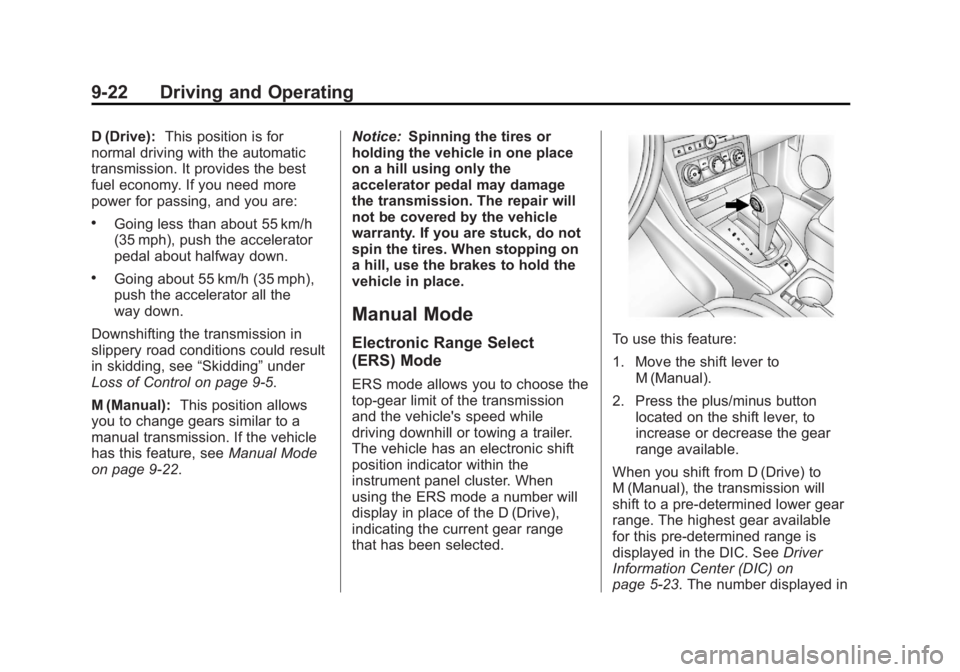
that has been selected. To use this feature:
1. Move the shift lever to
M (Manual).
2. Press the plus/minus button
located on the shift lever, to
increase or decrease the gear
range available.
When you shift from D (Drive) to
M (Manual), the transmission will
shift to a pre-determined lower gear
range. The highest gear available
for this pre-determined range is
displayed in the DIC. See Driver
Information Center (DIC) on
page 5 ‑ 23 . The number displayed in
Page 213 of 374
Black plate (25,1)Chevrolet Captiva Sport Owner Manual - 2013 - crc - 11/12/12
Driving and Operating 9-25Remember: ABS does not change
the time needed to get a foot up to
the brake pedal or always decrease
stopping distance. If you get too
close to the vehicle in front of you,
there will not be enough time to
apply the brakes if that vehicle
suddenly slows or stops. Always
leave enough room up ahead to
stop, even with ABS.
Using ABS Do not pump the brakes. Just hold
the brake pedal down firmly and let
ABS work. You might hear the ABS
pump or motor operating and feel
the brake pedal pulsate, but this is
normal.
Braking in Emergencies
ABS allows you to steer and brake
at the same time. In many
emergencies, steering can help
more than even the very best
braking. Parking Brake
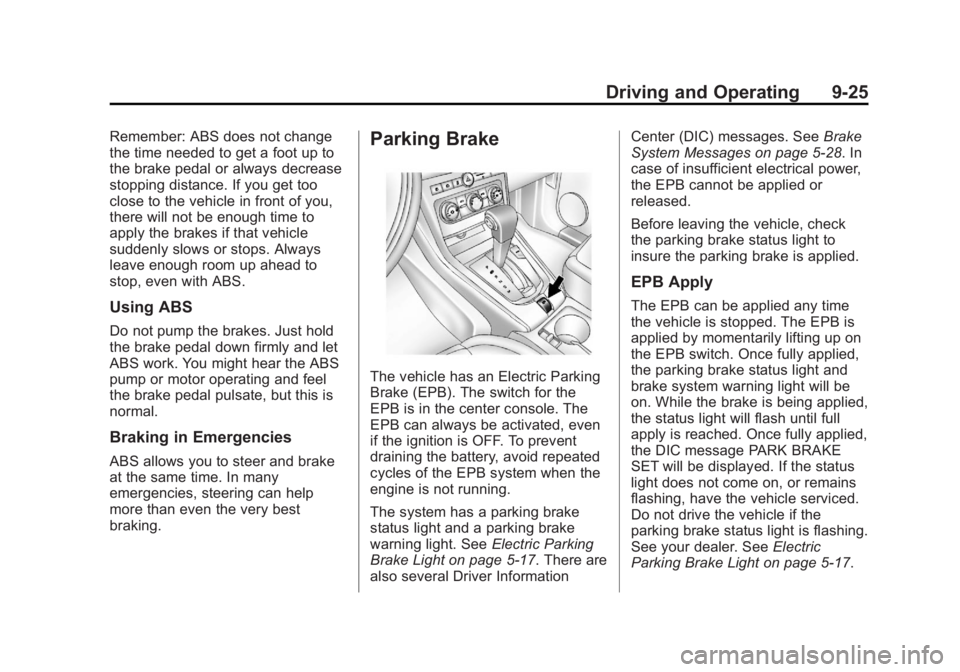
The vehicle has an Electric Parking
Brake (EPB). The switch for the
EPB is in the center console. The
EPB can always be activated, even
if the ignition is OFF. To prevent
draining the battery, avoid repeated
cycles of the EPB system when the
engine is not running.
The system has a parking brake
status light and a parking brake
warning light. See Electric Parking
Brake Light on page 5 ‑ 17 . There are
also several Driver Information Center (DIC) messages. See Brake
System Messages on page 5 ‑ 28 . In
case of insufficient electrical power,
the EPB cannot be applied or
released.
Before leaving the vehicle, check
the parking brake status light to
insure the parking brake is applied.
EPB Apply The EPB can be applied any time
the vehicle is stopped. The EPB is
applied by momentarily lifting up on
the EPB switch. Once fully applied,
the parking brake status light and
brake system warning light will be
on. While the brake is being applied,
the status light will flash until full
apply is reached. Once fully applied,
the DIC message PARK BRAKE
SET will be displayed. If the status
light does not come on, or remains
flashing, have the vehicle serviced.
Do not drive the vehicle if the
parking brake status light is flashing.
See your dealer. See Electric
Parking Brake Light on page 5 ‑ 17 .
Page 214 of 374
Black plate (26,1)Chevrolet Captiva Sport Owner Manual - 2013 - crc - 11/12/12
9-26 Driving and Operating If the EPB is applied while the
vehicle is in motion, a chime will
sound, and the DIC message
RELEASE PARK BRAKE SWITCH
will be displayed. The vehicle will
decelerate as long as the switch is
held in the up position. Releasing
the EPB switch during deceleration
will release the parking brake. If the
switch is held in the up position until
the vehicle comes to a stop, the
EPB will remain applied.
If the parking brake status light
flashes continuously, the EPB is
only partially applied or released,
or there is a problem with the EPB.
The DIC message SERVICE
PARKING BRAKE will be displayed.
If this light flashes continuously,
release the EPB, and attempt to
apply it again. If this light continues
to flash, do not drive the vehicle.
See your dealer.
If the parking brake warning light is
on, the EPB has detected an error
in another system and is operating
with reduced functionality. To apply
the EPB when this light is on, lift up on the EPB switch and hold it in the
up position. Full application of the
parking brake by the EPB system
may take a longer period of time
than normal when this light is on.
Continue to hold the switch until the
parking brake status light remains
on. If the parking brake warning light
is on, see your dealer.
If the EPB fails to apply, the rear
wheels should be blocked to
prevent vehicle movement.
EPB Release To release the EPB, place the
ignition in the ACC/ACCESSORY or
ON/RUN position, apply and hold
the brake pedal, and push down
momentarily on the EPB switch.
If you attempt to release the EPB
without the brake pedal applied, a
chime will sound, and the DIC
message STEP ON BRAKE TO
RELEASE PARK BRAKE will be
displayed. The EPB is released
when the parking brake status light
is off. If the parking brake warning light is
on, the EPB has detected an error
in another system and is operating
with reduced functionality. To
release the EPB when this light is
on, push down on the EPB switch
and hold it in the down position.
EPB release may take a longer
period of time than normal when this
light is on. Continue to hold the
switch until the parking brake status
light is off. If the light is on, see your
dealer.
Notice: Driving with the parking
brake on can overheat the brake
system and cause premature
wear or damage to brake system
parts. Make sure that the parking
brake is fully released and the
brake warning light is off before
driving.
Page 215 of 374
Black plate (27,1)Chevrolet Captiva Sport Owner Manual - 2013 - crc - 11/12/12
Driving and Operating 9-27Automatic EPB Release The EPB will automatically release if
the vehicle is running, placed into
gear and an attempt is made to
drive away. Avoid rapid acceleration
when the EPB is applied, to
preserve parking brake lining life.
For maximum EPB force when
towing a trailer or parking on a hill,
pull the EPB switch twice. If you are
towing a trailer and parking on a hill,
see Driving Characteristics and
Towing Tips on page 9 ‑ 39 .Ride Control Systems Traction Control
System (TCS) The vehicle has a Traction Control
System (TCS) that limits wheel spin.
This is useful in slippery road
conditions. The system operates
only if it senses that any of the drive
wheels are spinning or beginning to
lose traction. When this happens,
TCS applies the brakes to limit
wheel spin and also reduces engine
power. The system may be heard or
felt while it is working, but this is
normal.
This light will flash when TCS is
limiting wheel spin. It is recommended to leave the
system on for normal driving
conditions, but it may be necessary
to turn the system off if the vehicle
is stuck in sand, mud, ice, or snow.
See If the Vehicle Is Stuck on
page 9 ‑ 9 .
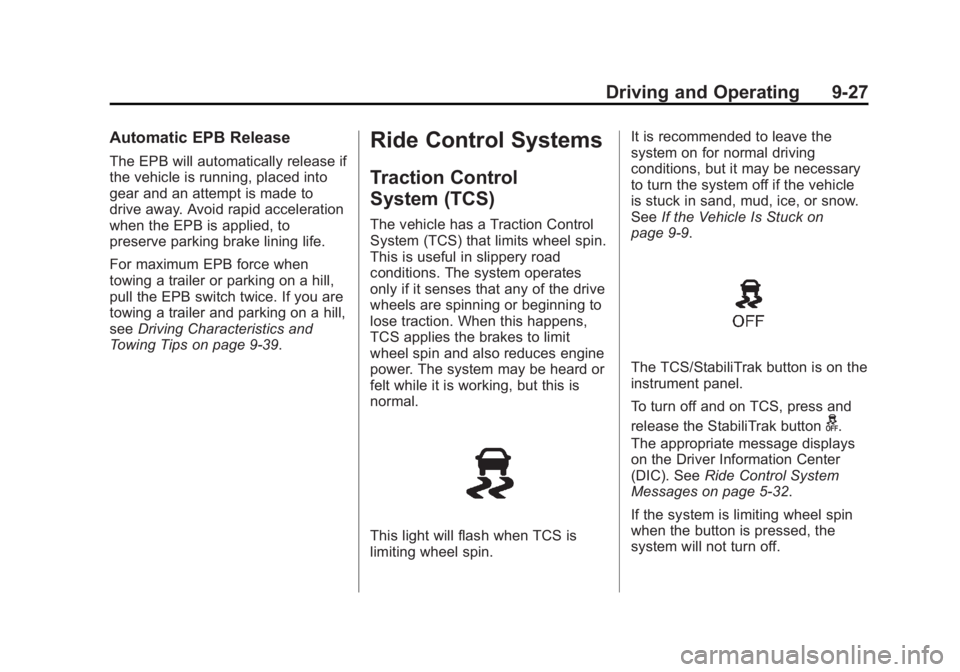
The TCS/StabiliTrak button is on the
instrument panel.
To turn off and on TCS, press and
release the StabiliTrak button
g .
The appropriate message displays
on the Driver Information Center
(DIC). See Ride Control System
Messages on page 5 ‑ 32 .
If the system is limiting wheel spin
when the button is pressed, the
system will not turn off.
Page 216 of 374
Black plate (28,1)Chevrolet Captiva Sport Owner Manual - 2013 - crc - 11/12/12
9-28 Driving and Operating Adding non-dealer accessories can
affect the vehicle's performance.
See Accessories and Modifications
on page 10 ‑ 2 .
Brake Pedal Override This vehicle has this feature that
limits engine torque when the brake
pedal is applied. If there is one foot
on the brake pedal and the other
foot on the accelerator, the engine
rpm will only climb to slightly more
than idle speed.
This feature is enabled at vehicle
start. Press and release the TCS/
StabiliTrak button
g to disable or
enable this feature and TCS. The
appropriate message will display on
the DIC. See Ride Control System
Messages on page 5 ‑ 32 .
StabiliTrak ®
SystemThe vehicle has a stability control
system called StabiliTrak which
combines antilock brake, traction,
and stability control systems and helps the driver maintain directional
control of the vehicle in most driving
conditions.
StabiliTrak activates when the
computer senses a difference
between the intended path and the
direction the vehicle is actually
traveling. StabiliTrak selectively
applies braking pressure at any one
of the vehicle's brakes to assist the
driver with keeping the vehicle on
the intended path.
When the vehicle is started and
begins to move, the system
performs several diagnostic checks
to ensure that there are no
problems. The system may be
heard or felt while it is working. This
is normal and does not mean there
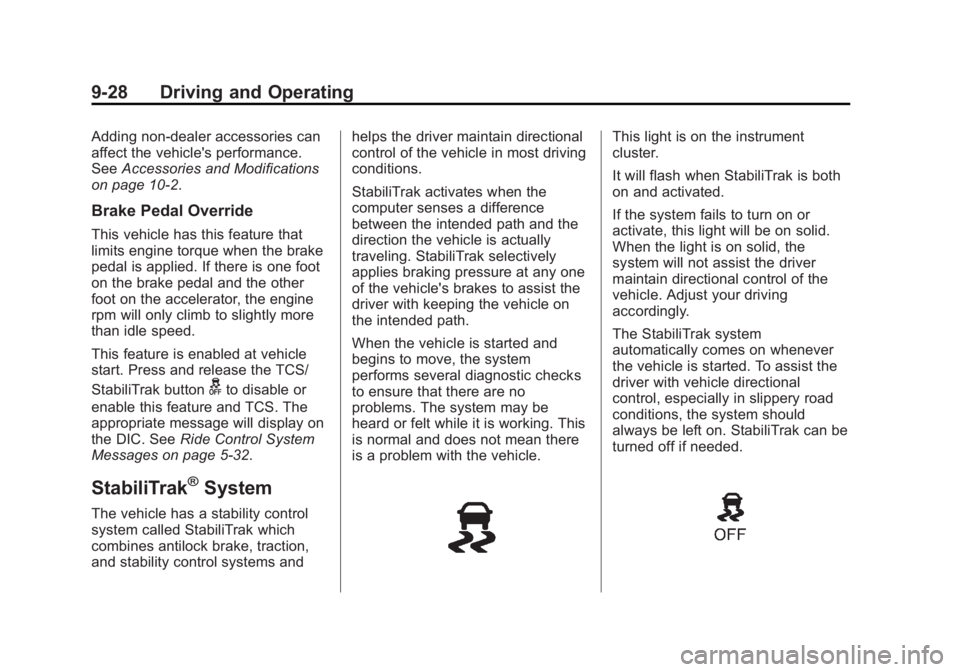
is a problem with the vehicle. This light is on the instrument
cluster.
It will flash when StabiliTrak is both
on and activated.
If the system fails to turn on or
activate, this light will be on solid.
When the light is on solid, the
system will not assist the driver
maintain directional control of the
vehicle. Adjust your driving
accordingly.
The StabiliTrak system
automatically comes on whenever
the vehicle is started. To assist the
driver with vehicle directional
control, especially in slippery road
conditions, the system should
always be left on. StabiliTrak can be
turned off if needed.
Page 217 of 374
Black plate (29,1)Chevrolet Captiva Sport Owner Manual - 2013 - crc - 11/12/12
Driving and Operating 9-29The Traction Control System (TCS)/
StabiliTrak button is on the
instrument panel.
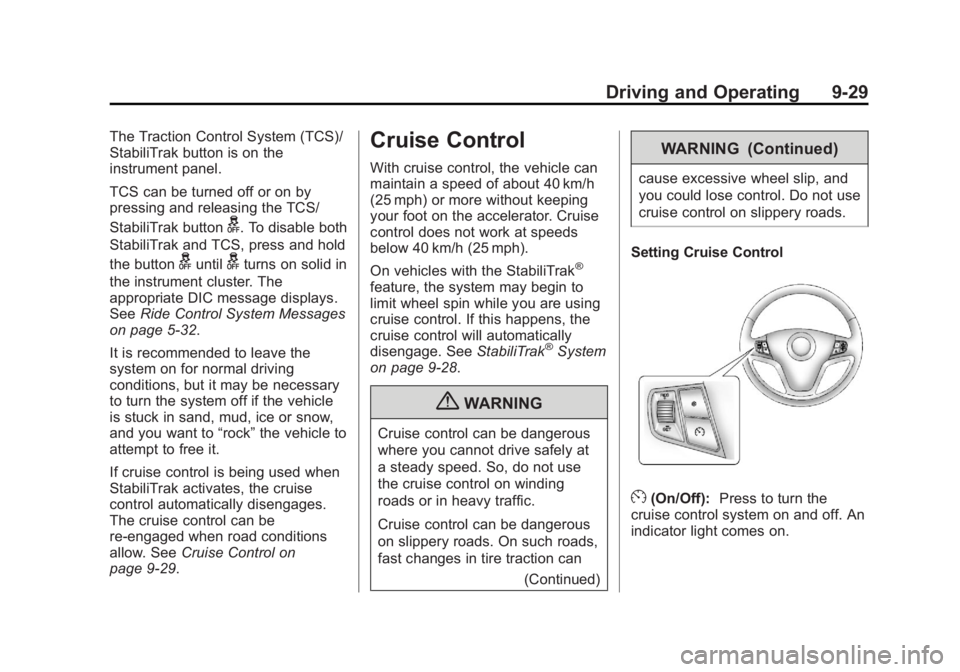
TCS can be turned off or on by
pressing and releasing the TCS/
StabiliTrak button
g . To disable both
StabiliTrak and TCS, press and hold
the button
g until
g turns on solid in
the instrument cluster. The
appropriate DIC message displays.
See Ride Control System Messages
on page 5 ‑ 32 .
It is recommended to leave the
system on for normal driving
conditions, but it may be necessary
to turn the system off if the vehicle
is stuck in sand, mud, ice or snow,
and you want to “ rock ” the vehicle to
attempt to free it.
If cruise control is being used when
StabiliTrak activates, the cruise
control automatically disengages.
The cruise control can be
re-engaged when road conditions
allow. See Cruise Control on
page 9 ‑ 29 . Cruise Control With cruise control, the vehicle can
maintain a speed of about 40 km/h
(25 mph) or more without keeping
your foot on the accelerator. Cruise
control does not work at speeds
below 40 km/h (25 mph).
On vehicles with the StabiliTrak ®
feature, the system may begin to
limit wheel spin while you are using
cruise control. If this happens, the
cruise control will automatically
disengage. See StabiliTrak ®
System
on page 9 ‑ 28 .
{ WARNING
Cruise control can be dangerous
where you cannot drive safely at
a steady speed. So, do not use
the cruise control on winding
roads or in heavy traffic.
Cruise control can be dangerous
on slippery roads. On such roads,
fast changes in tire traction can
(Continued) WARNING (Continued) cause excessive wheel slip, and
you could lose control. Do not use
cruise control on slippery roads.
Setting Cruise Control
E (On/Off): Press to turn the
cruise control system on and off. An
indicator light comes on.