torque CHEVROLET CAPTIVA SPORT 2013 Owners Manual
[x] Cancel search | Manufacturer: CHEVROLET, Model Year: 2013, Model line: CAPTIVA SPORT, Model: CHEVROLET CAPTIVA SPORT 2013Pages: 374, PDF Size: 6.66 MB
Page 23 of 374
Black plate (19,1)Chevrolet Captiva Sport Owner Manual - 2013 - crc - 11/12/12
In Brief 1-19Keep the sensors on the vehicle's
rear bumper clean to ensure proper
operation.
See Ultrasonic Parking Assist on
page 9 ‑ 31 .
Power Outlets The accessory power outlets can be
used to plug in electrical equipment,
such as a cell phone or MP3 player.
The power outlets are located inside
the center floor console, on the rear
of the center floor console, and in
the rear cargo compartment.
Remove the cover to access and
replace when not in use.
See Power Outlets on page 5 ‑ 7 .Universal Remote System
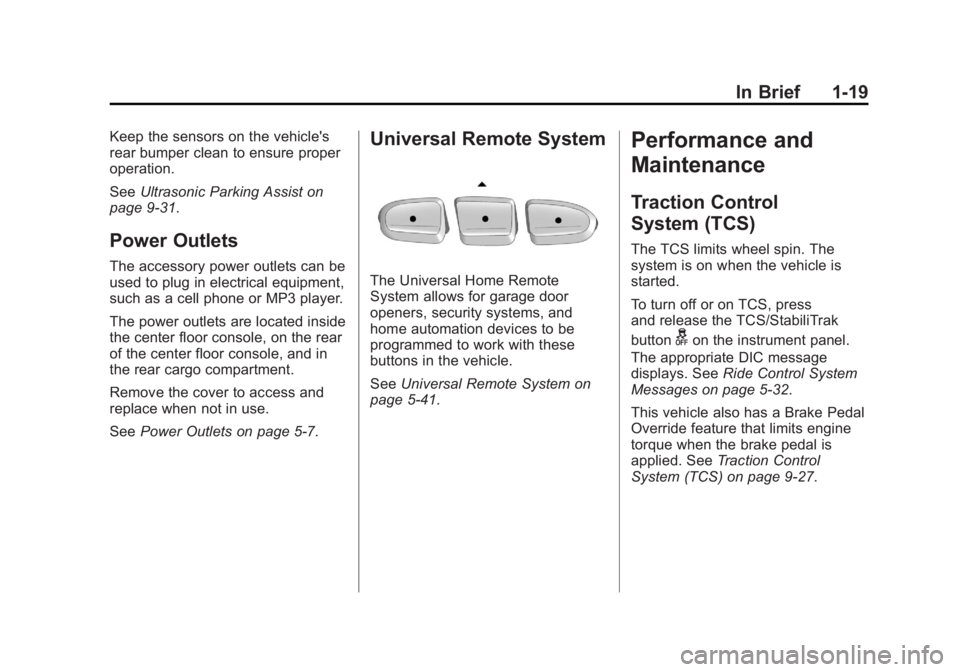
The Universal Home Remote
System allows for garage door
openers, security systems, and
home automation devices to be
programmed to work with these
buttons in the vehicle.
See Universal Remote System on
page 5 ‑ 41 .Performance and
Maintenance Traction Control
System (TCS) The TCS limits wheel spin. The
system is on when the vehicle is
started.
To turn off or on TCS, press
and release the TCS/StabiliTrak
button
g on the instrument panel.
The appropriate DIC message
displays. See Ride Control System
Messages on page 5 ‑ 32 .
This vehicle also has a Brake Pedal
Override feature that limits engine
torque when the brake pedal is
applied. See Traction Control
System (TCS) on page 9 ‑ 27 .
Page 206 of 374
Black plate (18,1)Chevrolet Captiva Sport Owner Manual - 2013 - crc - 11/12/12
9-18 Driving and Operating Leaving the Vehicle With the
Engine Running
{ WARNINGIt can be dangerous to leave the
vehicle with the engine running.
It could overheat and catch fire.
It is dangerous to get out of the
vehicle if the shift lever is not fully
in P (Park) with the parking brake
firmly set. The vehicle can roll.
Do not leave the vehicle when the
engine is running. If you have left
the engine running, the vehicle
can move suddenly. You or others
could be injured. To be sure the
vehicle will not move, even when
you are on fairly level ground,
always set the parking brake and
move the shift lever to P (Park).
See Shifting Into Park on
page 9 ‑ 17 . If you are towing a
trailer, see Driving Characteristics
and Towing Tips on page 9 ‑ 39 . If you have to leave an automatic
transmission vehicle with the engine
running, be sure the vehicle is in
P (Park) and the parking brake is
firmly set before you leave it. After
you have moved the shift lever into
P (Park), hold the brake pedal down.
Then, see if you can move the shift
lever away from P (Park) without
first pushing the button. If you can, it
means that the shift lever was not
fully locked into P (Park).
Torque Lock If you are parking on a hill and you
do not shift into P (Park) properly,
the weight of the vehicle may put
too much force on the parking pawl
in the transmission. You may find it
difficult to pull the shift lever out of
P (Park). This is called “ torque lock. ”
To prevent torque lock, set the
parking brake and then shift into
P (Park) properly before you leave
the driver seat. To find out how, see
Shifting Into Park on page 9 ‑ 17 . Move the shift lever out of P (Park)
before you release the parking
brake.
If torque lock does occur, you may
need to have another vehicle push
yours a little uphill to take some of
the pressure from the parking pawl
in the transmission, so you can pull
the shift lever out of P (Park).
Shifting out of Park The vehicle has an electronic shift
lock release system. The shift lock
release is designed to: .
Prevent ignition key removal
unless the shift lever is in
P (Park) with the shift lever
button fully released. .
Prevent movement of the shift
lever out of P (Park), unless the
ignition is in ON/RUN or ACC/
ACCESSORY and the regular
brake pedal is applied.
Page 211 of 374
Black plate (23,1)Chevrolet Captiva Sport Owner Manual - 2013 - crc - 11/12/12
Driving and Operating 9-23the DIC is the highest gear that the
transmission will be allowed to
operate in. This means that all
gears below that number are
available. For example, when
4 (Fourth) is shown, 1 (First) through
4 (Fourth) gears are automatically
shifted by the vehicle. The
transmission will not shift into
5 (Fifth) until the + (Plus) button is
used or you shift back into D (Drive).
While in M (Manual), the
transmission will prevent shifting to
a lower gear range if the engine
speed is too high. You have a brief
period of time to slow the vehicle.
If vehicle speed is not reduced
within the time allowed, the lower
gear range shift will not be
completed. You must further slow
the vehicle, then press the − (Minus)
button to the desired lower gear
range.
Automatic Engine Grade Braking is
not available when the ERS is
active. It is available in D (Drive).
While using the ERS, cruise control
can be used. Fuel Economy Mode The vehicle may have a fuel
economy mode. When engaged,
fuel economy mode can improve the
vehicle's fuel economy.
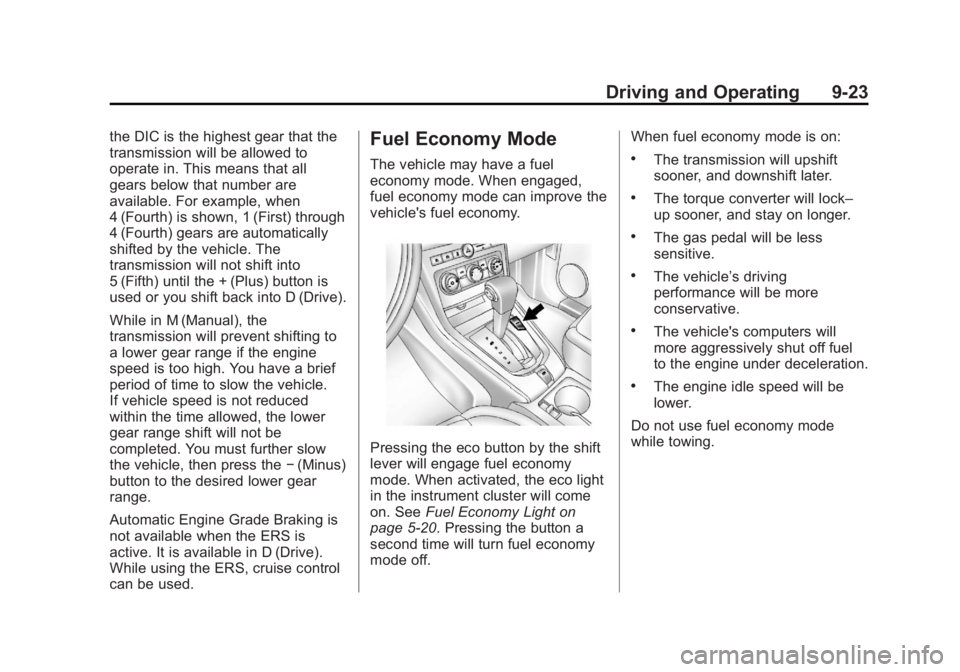
Pressing the eco button by the shift
lever will engage fuel economy
mode. When activated, the eco light
in the instrument cluster will come
on. See Fuel Economy Light on
page 5 ‑ 20 . Pressing the button a
second time will turn fuel economy
mode off. When fuel economy mode is on: .
The transmission will upshift
sooner, and downshift later. .
The torque converter will lock –
up sooner, and stay on longer. .
The gas pedal will be less
sensitive. .
The vehicle ’ s driving
performance will be more
conservative. .
The vehicle's computers will
more aggressively shut off fuel
to the engine under deceleration. .
The engine idle speed will be
lower.
Do not use fuel economy mode
while towing.
Page 216 of 374
Black plate (28,1)Chevrolet Captiva Sport Owner Manual - 2013 - crc - 11/12/12
9-28 Driving and Operating Adding non-dealer accessories can
affect the vehicle's performance.
See Accessories and Modifications
on page 10 ‑ 2 .
Brake Pedal Override This vehicle has this feature that
limits engine torque when the brake
pedal is applied. If there is one foot
on the brake pedal and the other
foot on the accelerator, the engine
rpm will only climb to slightly more
than idle speed.
This feature is enabled at vehicle
start. Press and release the TCS/
StabiliTrak button
g to disable or
enable this feature and TCS. The
appropriate message will display on
the DIC. See Ride Control System
Messages on page 5 ‑ 32 .
StabiliTrak ®
SystemThe vehicle has a stability control
system called StabiliTrak which
combines antilock brake, traction,
and stability control systems and helps the driver maintain directional
control of the vehicle in most driving
conditions.
StabiliTrak activates when the
computer senses a difference
between the intended path and the
direction the vehicle is actually
traveling. StabiliTrak selectively
applies braking pressure at any one
of the vehicle's brakes to assist the
driver with keeping the vehicle on
the intended path.
When the vehicle is started and
begins to move, the system
performs several diagnostic checks
to ensure that there are no
problems. The system may be
heard or felt while it is working. This
is normal and does not mean there
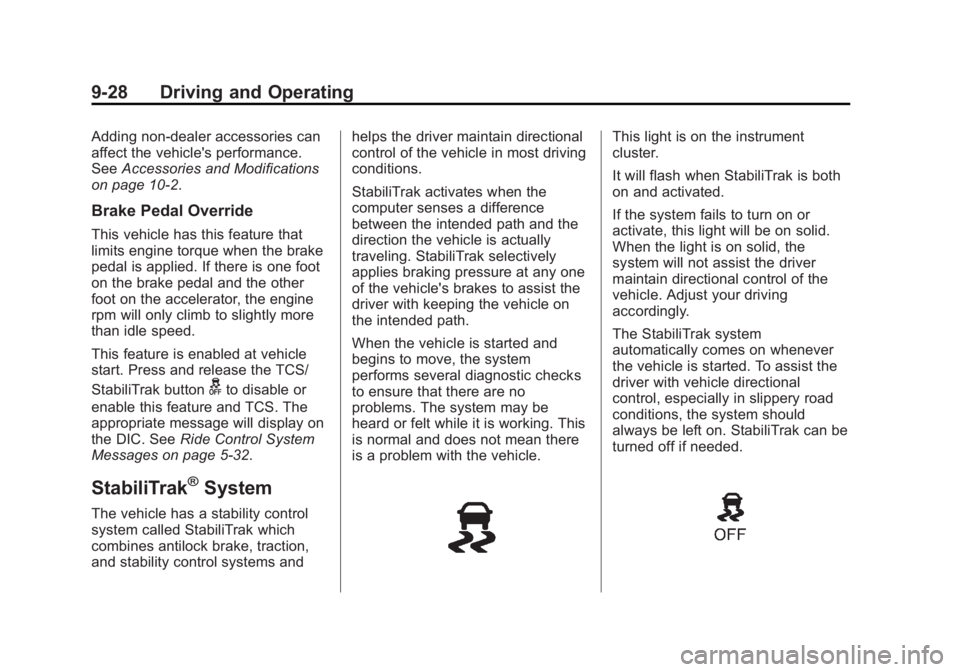
is a problem with the vehicle. This light is on the instrument
cluster.
It will flash when StabiliTrak is both
on and activated.
If the system fails to turn on or
activate, this light will be on solid.
When the light is on solid, the
system will not assist the driver
maintain directional control of the
vehicle. Adjust your driving
accordingly.
The StabiliTrak system
automatically comes on whenever
the vehicle is started. To assist the
driver with vehicle directional
control, especially in slippery road
conditions, the system should
always be left on. StabiliTrak can be
turned off if needed.
Page 255 of 374
Black plate (21,1)Chevrolet Captiva Sport Owner Manual - 2013 - crc - 11/12/12
Vehicle Care 10-21
{ WARNINGThe brake wear warning sound
means that soon the brakes will
not work well. That could lead to
a crash. When the brake wear
warning sound is heard, have the
vehicle serviced.
Notice: Continuing to drive with
worn-out brake pads could result
in costly brake repair.
Some driving conditions or climates
can cause a brake squeal when the
brakes are first applied or lightly
applied. This does not mean
something is wrong with the brakes.
Properly torqued wheel nuts are
necessary to help prevent brake
pulsation. When tires are rotated,
inspect brake pads for wear and
evenly tighten wheel nuts in the
proper sequence to torque
specifications in Capacities and
Specifications on page 12 ‑ 2 . Brake linings should always be
replaced as complete axle sets.
Brake Pedal Travel See your dealer if the brake pedal
does not return to normal height,
or if there is a rapid increase in
pedal travel. This could be a sign
that brake service might be
required.
Brake Adjustment Every time the brakes are applied,
with or without the vehicle moving,
the brakes adjust for wear.
Replacing Brake System Parts The braking system on a vehicle is
complex. Its many parts have to be
of top quality and work well together
if the vehicle is to have really good
braking. The vehicle was designed
and tested with top-quality brake
parts. When parts of the braking
system are replaced, be sure to get
new, approved replacement parts. If this is not done, the brakes might
not work properly. For example,
installing disc brake pads that are
wrong for the vehicle, can change
the balance between the front and
rear brakes — for the worse. The
braking performance expected can
change in many other ways if the
wrong replacement brake parts are
installed.
Brake Fluid
The brake master cylinder reservoir
is filled with DOT 3 brake fluid as
indicated on the reservoir cap. See
Engine Compartment Overview on
page 10 ‑ 4 for the location of the
reservoir.
Page 284 of 374
Black plate (50,1)Chevrolet Captiva Sport Owner Manual - 2013 - crc - 11/12/12
10-50 Vehicle Care Loading Information label after
the tires have been rotated. See
Tire Pressure on page 10 ‑ 43
and Vehicle Load Limits on
page 9 ‑ 10 .
Reset the Tire Pressure Monitor
System. See Tire Pressure
Monitor Operation on
page 10 ‑ 46 .
Check that all wheel nuts are
properly tightened. See “ Wheel
Nut Torque ” under Capacities
and Specifications on
page 12 ‑ 2 .
{ WARNING
Rust or dirt on a wheel, or on the
parts to which it is fastened, can
make wheel nuts become loose
after time. The wheel could come
off and cause an accident. When
changing a wheel, remove any
rust or dirt from places where the
(Continued) WARNING (Continued) wheel attaches to the vehicle. In
an emergency, a cloth or a paper
towel can be used; however, use
a scraper or wire brush later to
remove all rust or dirt.
Lightly coat the center of the
wheel hub with wheel bearing
grease after a wheel change or
tire rotation to prevent corrosion
or rust build-up. Do not get
grease on the flat wheel
mounting surface or on the
wheel nuts or bolts.
When It Is Time for New
Tires Factors such as maintenance,
temperatures, driving speeds,
vehicle loading, and road conditions
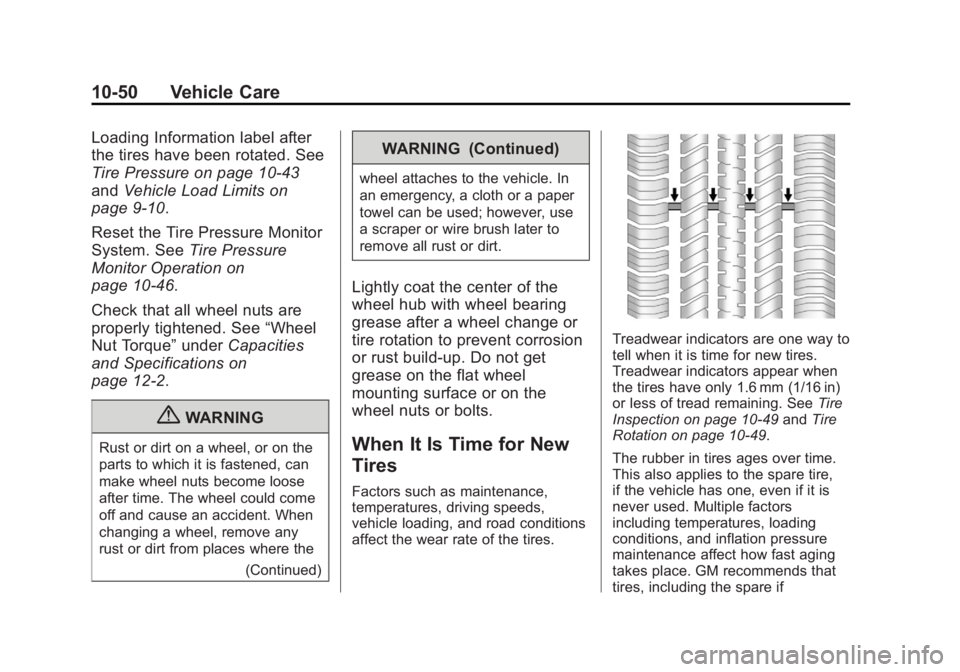
affect the wear rate of the tires. Treadwear indicators are one way to
tell when it is time for new tires.
Treadwear indicators appear when
the tires have only 1.6 mm (1/16 in)
or less of tread remaining. See Tire
Inspection on page 10 ‑ 49 and Tire
Rotation on page 10 ‑ 49 .
The rubber in tires ages over time.
This also applies to the spare tire,
if the vehicle has one, even if it is
never used. Multiple factors
including temperatures, loading
conditions, and inflation pressure
maintenance affect how fast aging
takes place. GM recommends that
tires, including the spare if
Page 296 of 374
Black plate (62,1)Chevrolet Captiva Sport Owner Manual - 2013 - crc - 11/12/12
10-62 Vehicle Care
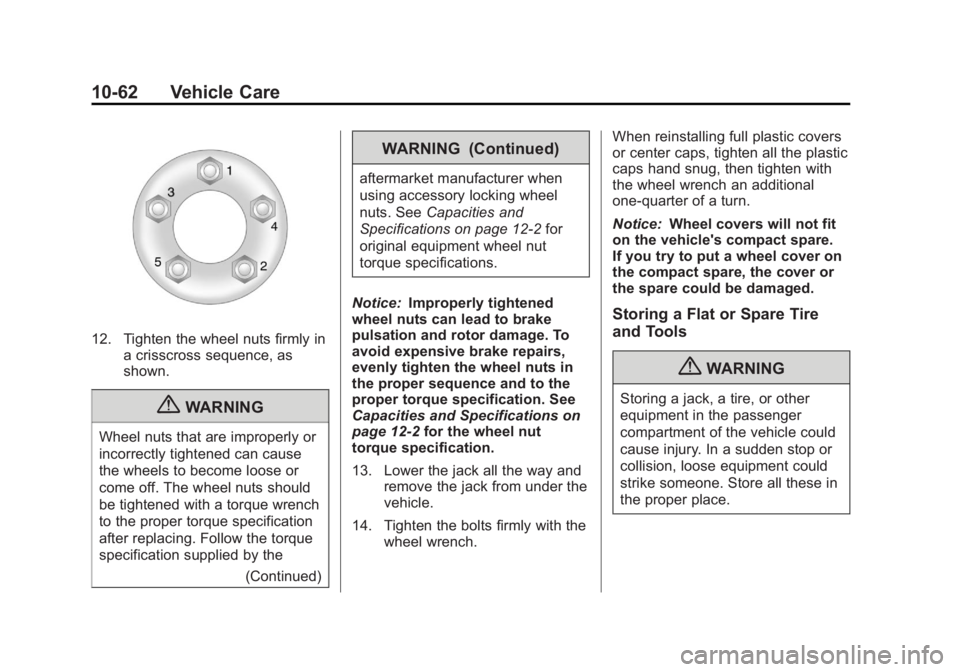
12. Tighten the wheel nuts firmly in
a crisscross sequence, as
shown.
{ WARNING
Wheel nuts that are improperly or
incorrectly tightened can cause
the wheels to become loose or
come off. The wheel nuts should
be tightened with a torque wrench
to the proper torque specification
after replacing. Follow the torque
specification supplied by the
(Continued) WARNING (Continued) aftermarket manufacturer when
using accessory locking wheel
nuts. See Capacities and
Specifications on page 12 ‑ 2 for
original equipment wheel nut
torque specifications.
Notice: Improperly tightened
wheel nuts can lead to brake
pulsation and rotor damage. To
avoid expensive brake repairs,
evenly tighten the wheel nuts in
the proper sequence and to the
proper torque specification. See
Capacities and Specifications on
page 12 ‑ 2 for the wheel nut
torque specification.
13. Lower the jack all the way and
remove the jack from under the
vehicle.
14. Tighten the bolts firmly with the
wheel wrench. When reinstalling full plastic covers
or center caps, tighten all the plastic
caps hand snug, then tighten with
the wheel wrench an additional
one-quarter of a turn.
Notice: Wheel covers will not fit
on the vehicle's compact spare.
If you try to put a wheel cover on
the compact spare, the cover or
the spare could be damaged.
Storing a Flat or Spare Tire
and Tools
{ WARNINGStoring a jack, a tire, or other
equipment in the passenger
compartment of the vehicle could
cause injury. In a sudden stop or
collision, loose equipment could
strike someone. Store all these in
the proper place.
Page 333 of 374
Black plate (3,1)Chevrolet Captiva Sport Owner Manual - 2013 - crc - 11/12/12
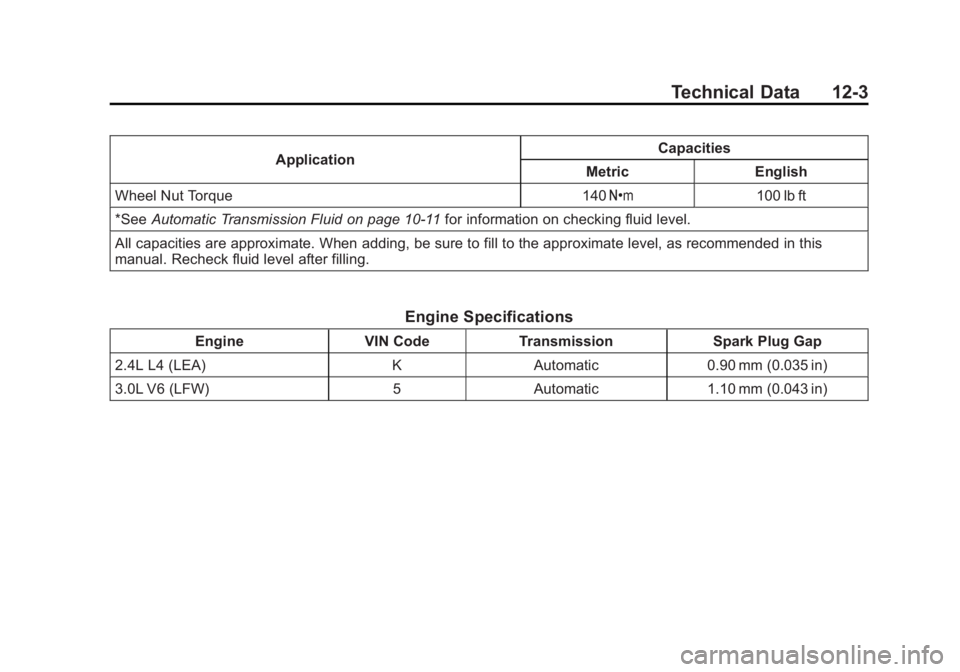
Technical Data 12-3Application Capacities
Metric English
Wheel Nut Torque 140 Y 100 lb ft
*See Automatic Transmission Fluid on page 10 ‑ 11 for information on checking fluid level.
All capacities are approximate. When adding, be sure to fill to the approximate level, as recommended in this
manual. Recheck fluid level after filling.
Engine SpecificationsEngine VIN Code Transmission Spark Plug Gap
2.4L L4 (LEA) K Automatic 0.90 mm (0.035 in)
3.0L V6 (LFW) 5 Automatic 1.10 mm (0.043 in)