cooling CHEVROLET CAVALIER 1984 1.G User Guide
[x] Cancel search | Manufacturer: CHEVROLET, Model Year: 1984, Model line: CAVALIER, Model: CHEVROLET CAVALIER 1984 1.GPages: 105, PDF Size: 24.23 MB
Page 80 of 105
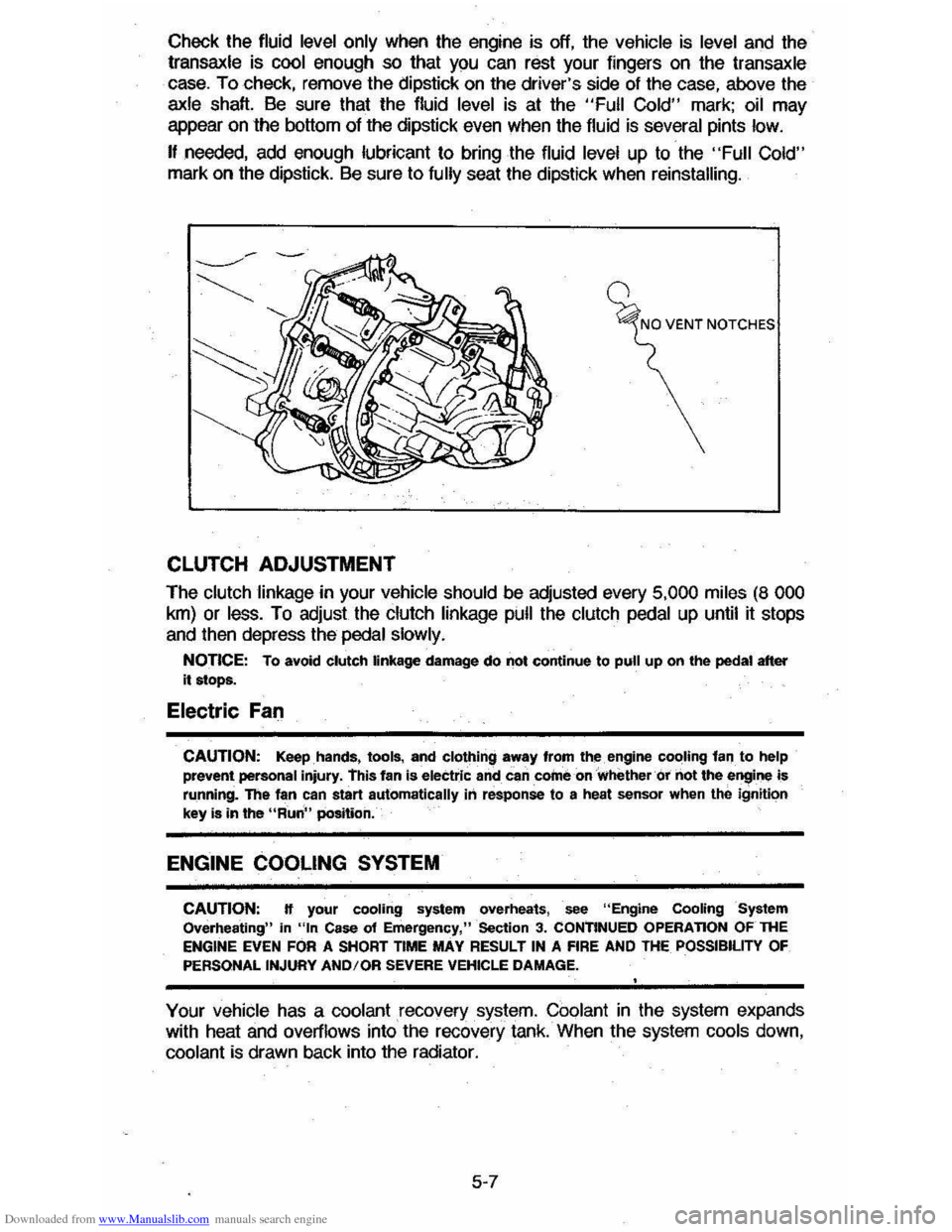
Downloaded from www.Manualslib.com manuals search engine Check the fluid level only when the engine is off, the vehicle is level and the transaxle is cool enough so that you can rest your fingers on the transaxle
case. To check, remove the dipstick on the driver's side of the case, above the
axle shaft, Be sure that the fluid level is at the "Full Cold" mark; oil may
appear on the bottom of the dipstick even when the fluid is several pints low.
I! needed, add enough lubricant to bring the fluid level up to the "Full Cold" mark on the dipstick. Be sure to fully seat the dipstick when reinstalling.
CLUTCH ADJUSTMENT
The clutch linkage in your vehicle should be adjusted every 5,000 miles (8 000
km) or less. To adjust the clutch linkage pull the clutch pedal up until it stops
and then depress the
pedal slowly.
NOTICE: To avoid clutch linkage damage do not continue to pull up on the pedal after
it stops.
Electric Fan
CAUTION: Keep hands, tools, and clothing away fr,om th~engine cooUng lanto help prevent personal injury. this fan is electric and can corne on whether or not the engine is
running. The fan can start automatically in response to a heat sensor when the ignition
key is in the "Run" position.
ENGINE COOLING SYSTEM
CAUTION: H your cooling system overheats, see "Engine Cooling System Overheating" in "In Case of Emergency," Section 3. CONTINUED OPERATION OFTHE ENGINE EVEN FOR A SHORT TIME MAY RESULT IN A FIRE AND THE POSSIBILITY OF
PERSONAL INJURY ANDIOR SEVERE VEHICLE DAMAGE.
Your vehicle has a coolant recovery.system. Coolant in the system expands with heat and overflows into the recovery tank. When the system cools down,
coolant is drawn back into the radiator.
5-7
Page 81 of 105
Downloaded from www.Manualslib.com manuals search engine The cooting system was filled at the factory with a quality coolant that meets
GM Specifications.
~ is important to use proper coolant to prevent damage to
cooling system components . Coolants meeting GM Specification 1825-M or
those specially formulated for aluminum co"1JOflent protection should be used.
The cooling system is designed to use coolant (a mixture of ethylene glycol ,
corrosion inhibitors and water) rather than plain water. The coolant solution
must be used year round
to provide:
• freezing protection down to -37'C (-34'F),
• boiling protection up to 128 'C (262'F),
• protection against rust and corrosion in the cooling system,
• the proper engine temperature for efficient operation and emission control,
and
• proper operation of the coolant temperature light or gage .
See the Maintenance Schedule folder to find out when the coolant must be
replaced . Note that changing the coolant is needed
to make certain that all
parts
of the cooling system work well.
.-~~~~--~-.
CooUng System Care
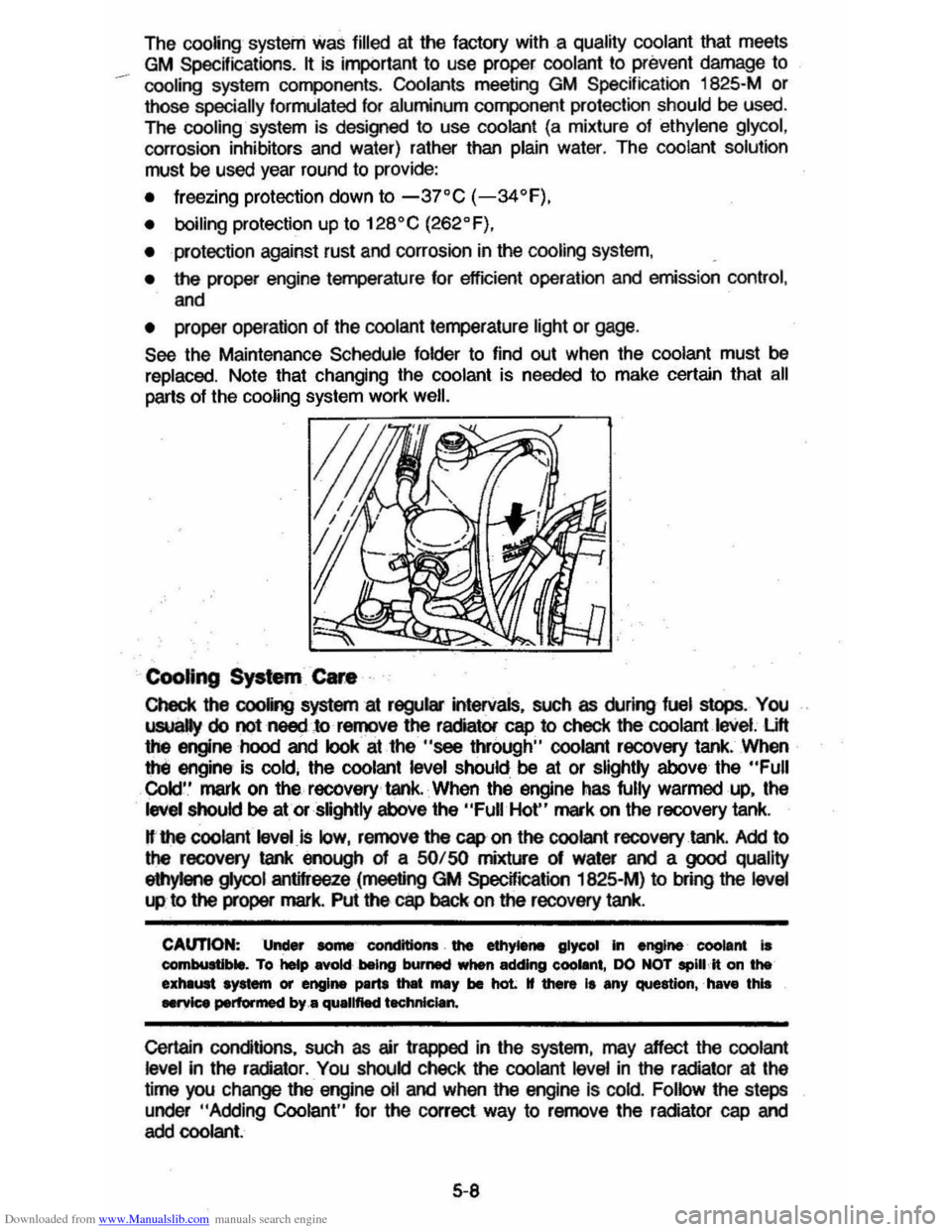
Check the cooling system at regular intervals, such as during fuel sI
Cold' .' mark on the recovery ' tank. When the engine has fully warmed up, the
level should be at or slightly above the "Full Hot" mark on the recovery tank.
H·the coolant level is low, remove the cap on the coolant recovery tank. Add to the recovery tank enough of a SO/ SO mixture 01 water and a good quality
eIIlyIene gIyool antifreeze (meeting GM SpecWication 1825-M) to bfing the level
"" to the proper mark. Pui the cap back on the recovery tank.
CAUTION: Under some' condttlons . the ethytene glycol In engine' coolant is combultlble. To help Rold being burMCf when adding eoollnt, DO NOT spill It on the exhliUlt system or engine ~rtI tMt mIIy be haL tf there It any question,' have this .....,ice performed by .• quallftecl t.chnlclan.
Certain conditions, such as air trapped in the system, may effect the coolant level in the radiator . You should check the coolant level in the radiator at the
time you change the engine 011 and when the engine Is cold. Follow the steps
under
"Adding Coolant" for the correct way to remove the radiator cap and add coolant.
5-8
Page 82 of 105
Downloaded from www.Manualslib.com manuals search engine If you have to add coolant more than four times a year (either to the recovery
tank or to the radiator), or if
coolant is dirty or discolored, see your dealer for a cooling system check.
NOTICE: rr you use the proper quality antifreeze, there is no need to add extra inhibitors or additives which claim to improve the system. They may be harmful to the proper operation of the system.
Adding Coolant
CAUTION: To help avoid the danger of being burned, do not remove the radiator cap while the engine and radiator are stili hot. Scalding fluid and steam can be blown out under pressure if the cap is taken off too soon.
1. When the engine is cool, remove the radiator cap.
• Turn the cap slowly to the left until it reaches a "stop." Do not press
down
while turning the cap.
• Wait until any remaining pressure (indicated by a hissing sound) is relieved, then press down on the cap and continue turning it to the left.
2. Add enough water and ethylene glycol anmreeze (meeting GM Specification 1825-M) to provide the required cooling, freezing and
corrosion protection. Use a solution that is at least 50 percent antifreeze
but no more than 70 percent antHreeze. Fill the radiator to the base of the
filler neck and fill the coolahUocave,y lank to at or above the "Full Hot" mark. Put the recovery tank cap back on.
3. Run the engine, with the radiator cap removed, until the upper radiator
hose is
hot. With the engine idling, add coolant to the radiator until it
reaches
the bottom of the filler neck. Install the radiator cap, making sure
the arrows on the cap line up with the overflow tube on the radiator filler
neck.
II is Ihe owner's responsibility 10:
• Maintain cooling system freeze protection at -37°G (-34°F) to ensUre
protection against corrosion and loss of coolant from boiling. (A SO/SO mixture of water and ethylene glycol antifreeze will provide freeze
protection to -37°G or -34°F.) You should do this even if you don't
expect freezing temperatures. Periodic
replacement of coolant is needed to replace the anti-corrosion additives that wear out with use. Coolant that
has become dark in color shows that it needs to be changed for this reason.
• Add ethylene glycol base antifreeze that meets GM SpecHication 1825-M
when antifreeze has to be added because of coolant loss or for more
protection against freezing at temperatures less than stated.
NOTICE: Do not use methanol-base antifreeze, or alcohol, . or plain water alone, in your vehicle at anytime. They will boil ata lower point than that at which the "TEMP" light (or temperature gage) will warn of overheating, and they do not provide proper protection against corrosion.
Thermostat
The engine coolant temperature is controlled by a thermostat. It stops coolant
flow through the radiator until a preset temperature is reached. This thermostat
is installed in the engine coolant oullet on the engine block. The same
thermostat is used in both winter and summer. When a replacement is needed, AG-Oelco paris are recommended.
5-9
Page 84 of 105
Downloaded from www.Manualslib.com manuals search engine • If the fluid is warmed up (about 66"C or 150"F -- hot to the touch), the
fluid level should be between the "HOT" and "Cold" marks on the power steering reservoir.
• If cool (about 21"C or 70"F), the fluid level should be between the "Add" and "Cold" marks.
This fluid does not need periodic changing.
FRONT SUSPENSION AND STEERING LINKAGE
Lubricate fillings at the interval shown in the Maintenance Schedule with water
resistant
EP Chassis Lubricant which meets GM Specification 6031M.
NOTICE: Ball joints should not be lubricated unless their temperature is -12"C (10"F), or-higher. During cold weather, they should be allowed to warm up as necessary before
being lubricated or damage to the ball jOint could occur.
FREEDOM BATTERY
Your new vehicle has a Delco FREEDOM battery. It needs no periodic
maintenance.
Its top is permanently sealed (except for two small vent holes) and has no filler caps. ,You will never have to add water.
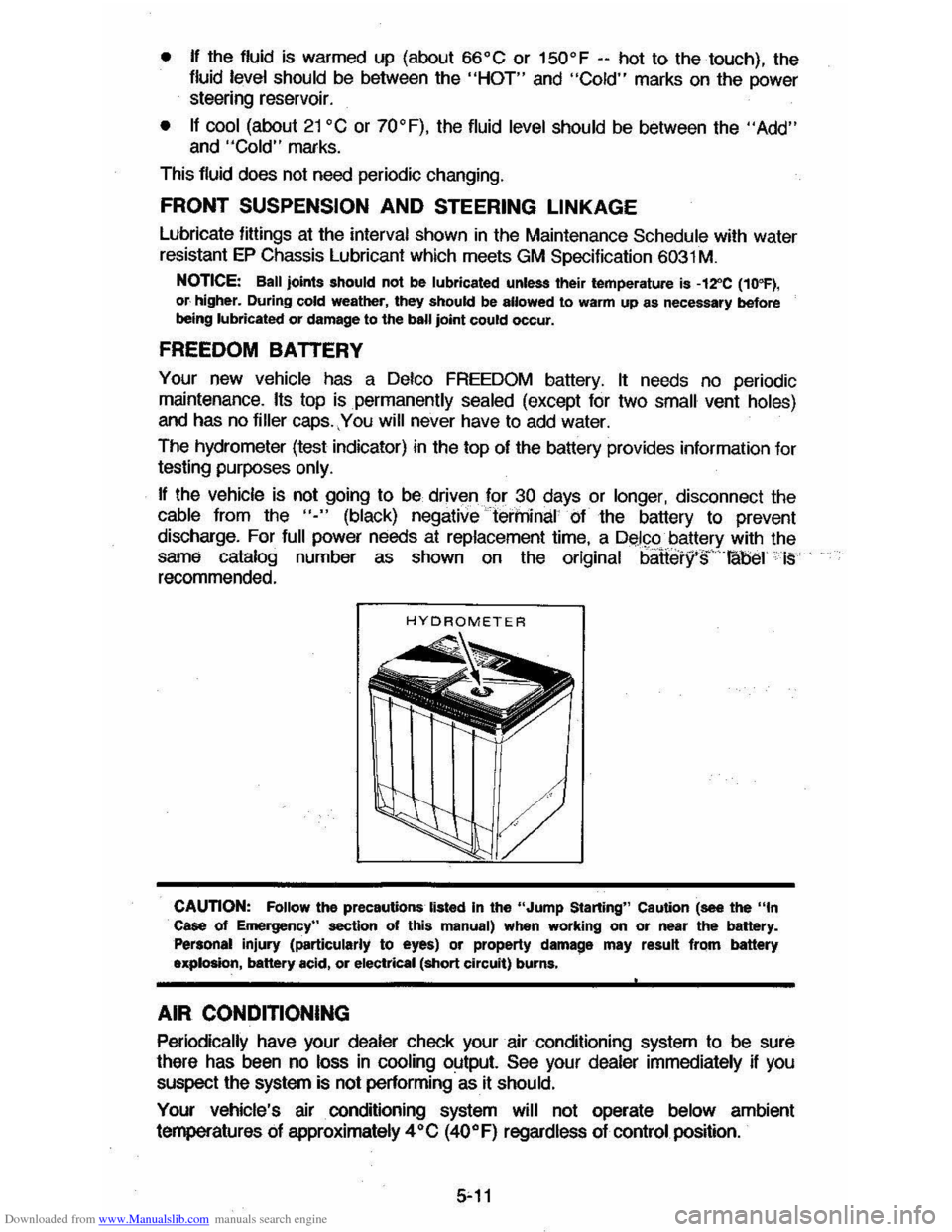
The hydrometer (test indicator) in the top of the battery provides information for
testing purposes only.
If the vehicle is not going to be driven .f?r 30 days or longer, disconnect the cable from the "-" (black) negative terminal of the battery to prevent
discharge. For
full power needs at replacement time, a Del~o battery with the sarne catalog number as shown on the original battery'if . !abel " is recommended.
CAUTION: Follow the precautions listed in the "Jump Starting" Caution (see the "In Case of Emergency" section of this manual) when working on or near the battery. Personal injury (particularly to eyes) or property damage may result from battery explosion, battery acid, or electrical (Short circuit) burns.
AIR CONDITIONING
Periodically have your dealer check your air conditioning system to be sure
there has been no loss in cooling output. See your dealer immediately if you
suspect the system is not performing"as it should.
Your vehicle's air conditioning system will not operate below ambient
temperatures of approximately
4·C (40·F) regardless of control position.
Page 91 of 105
Downloaded from www.Manualslib.com manuals search engine Wheel Replacement
Damaged wheels must be replaced. For example, replace wheels if they are
bent,
cracked,or heavily rusted, or if wheel nuts often become loose. Also
replace wheels which leak air (except some aluminum wheels which can be repaired-- see your authorized dealer). See the Caution under "Inspection and
Rotation"
in this section regarding the importance of obtaining good metal-tometal contact when replacing or changing wheels.
Do not use bent wheels which have been straightened, and do not use inner
tubes in leaking wheels designed for tubeless tires. Such wheels may have
structural damage and could fail without warning. When replacing wheels for
any reason, the new wheels should be equal in load limit. diameter, width,
offset, and mounting configurations to those originally installed on your vehicle.
A wheel of the wrong size or type may adversely affect such things
as wheel
and bearing life, brake cooling, speedometer I odometer calibration, stopping
ability, headlight
aim, bumper height, vehicle ground clearance, and tire or tire
chain clearance to the body and chassis. Replacement with used wheels is not advised; they may have been treated harshly or have very high mileage, and
could fail without warning.
You can get wheels from your dealer.
Warranty
Tires are warranted by the tire manufa9turers. Warranty information is included
in the manufacturer's Warranty folder furnished With your vehicle.
5-18
Page 92 of 105
Downloaded from www.Manualslib.com manuals search engine SECTION 6
SPECIFICATIONS
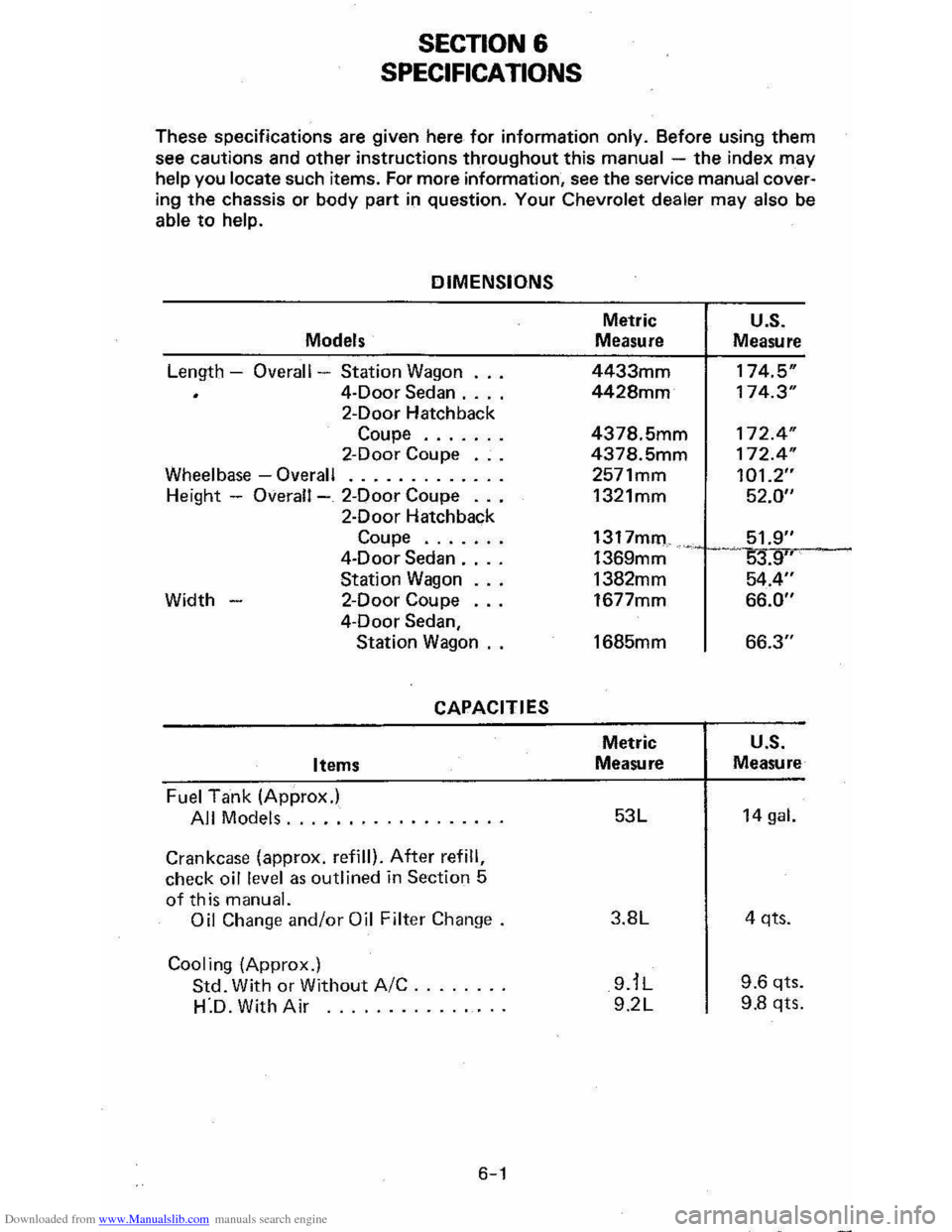
These specifications are given here for information only. Before using them
see cautions and other instructions throughout this manual -the index may help you locate such items. For more information, see the service manual cover·
lng the chassis or body part in question. Your Chevrolet dealer may also be
able to help.
DIMENSIONS
Models
Length -Overall -Station Wagon
4-Door Sedan .... 2-Door Hatchback
Coupe ...... . 2-Door Coupe .. .
Wheelbase -Overall ............ . Height -Overall-_ 2-Door Coupe .. .
2·Door Hatchback
Coupe ...... .
4-Door
Sedan ... .
Station
Wagon Width - 2-Door Coupe ...
4·Door Sedan,
Station Wagon ..
CAPACITIES
Items
Fuel Tank (Approx.)
All Models ................. .
Crankcase (approx, refill). After refill, check oil level as outlined in Section 5
of this manual. Oil Change and/or Oil Filter Change.
Cooling (Approx.)
Std. With or Without AIC ...••... H·D. With Air ...........•...
6-1
Metric
Measure
4433mm
4428mm
4378.5mm
4378.5mm
2571mm
1321mm
1317mm 1369mm
1382mm
1677mm
1685mm
Metric
Measure
53L
3.8L
9.iL 9.2L
-
U.S. Measure
174.5"
174.3"
172.4 "
172.4"
101.2" 52.0"
51.9" 53.9" 54.4"
66.0"
66.3"
U.S. Measure
14 gal.
4 qts.
9.6 qts.
9.8 qts.
Page 99 of 105
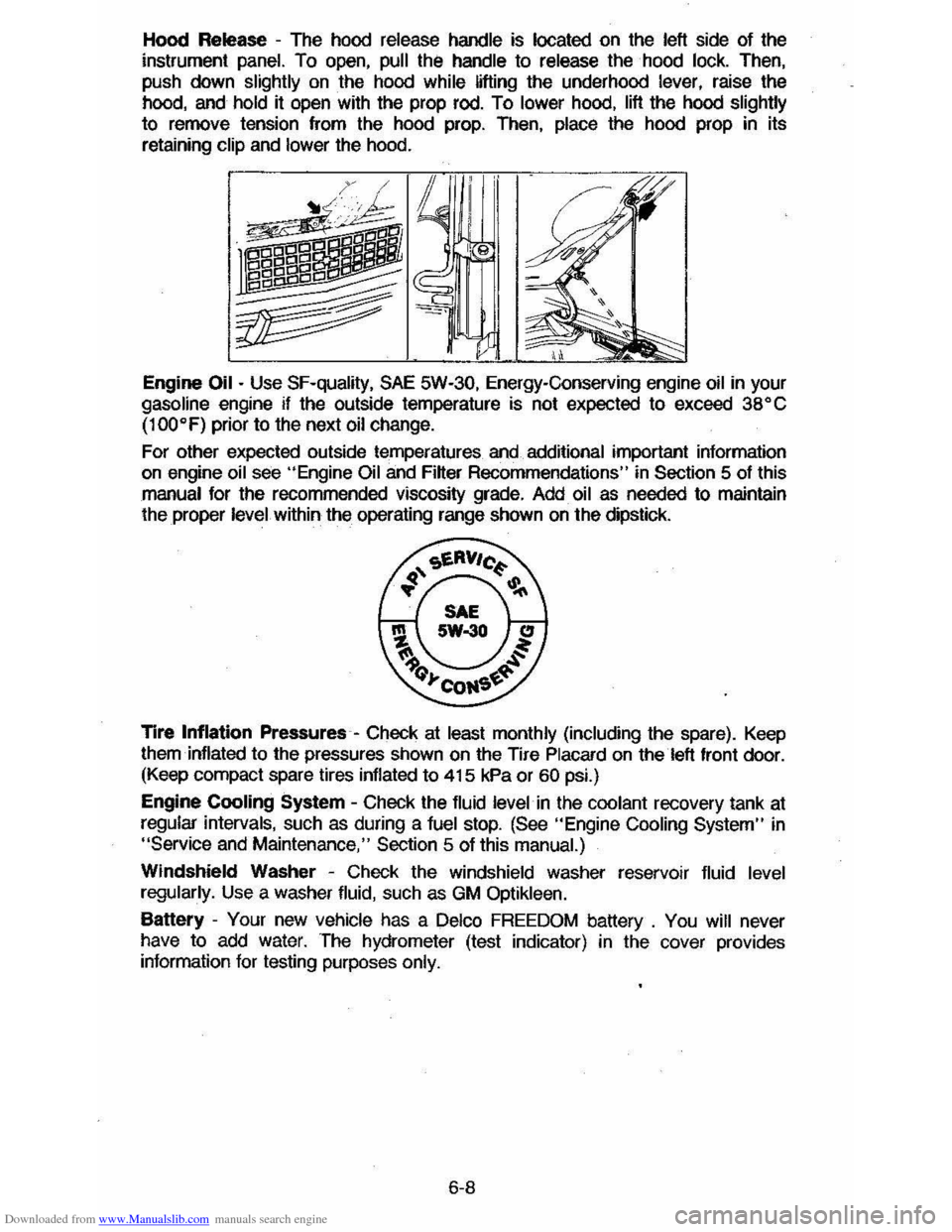
Downloaded from www.Manualslib.com manuals search engine Hood Release -The hood release handle is located on the left side of the
instrument panel. To open, pull the handle to release the hood lock. Then,
push down
slightly on the hood while lifting the underhood lever, raise the
hood, and hold it open with the prop rod. To lower hood, lift the hood slightly
to remove tension from the hood prop. Then, place the hood prop in its
retaining
clip and lower the hood.
Engine
Oil - Use SF-quality, SAE 5W-30, Energy-Conserving engine oil in your gasoline engine if the outside temperature is not expected to exceed 38" C
(100"F)
prior to the next oil change.
For other expected outside temperatures
and additional important information on engine oil see "Engine Oil and Filter Recommendations" in Section 5 of this
manual for the recommended viscosity grade. Add oil as needed to maintain
the proper level within the operating range shown on the dipstick.
Tire
Inflation Pressures -Check at least monthly (including the spare). Keep
them inflated to the pressures shown on the Tire Placard on the left front door. (Keep compact spare tires inflated to 415 kPa or 60 psi.)
Engine
Cooling System -Check the fluid level in the coolant recovery tank at
regular intervals, such as during a fuel stop. (See "Engine Cooling System" in "Service and Maintenance," Section 5 of this manual.)
Windshield Washer -Check the windshield washer reservoir fluid level
regularly. Use a washer fluid, such as GM Optikleen.
Battery -Your new vehicle has a Delco FREEDOM battery . You will never
have to add water. The hydrometer (test indicator) in the cover provides information for testing purposes only.
6-8
Page 103 of 105
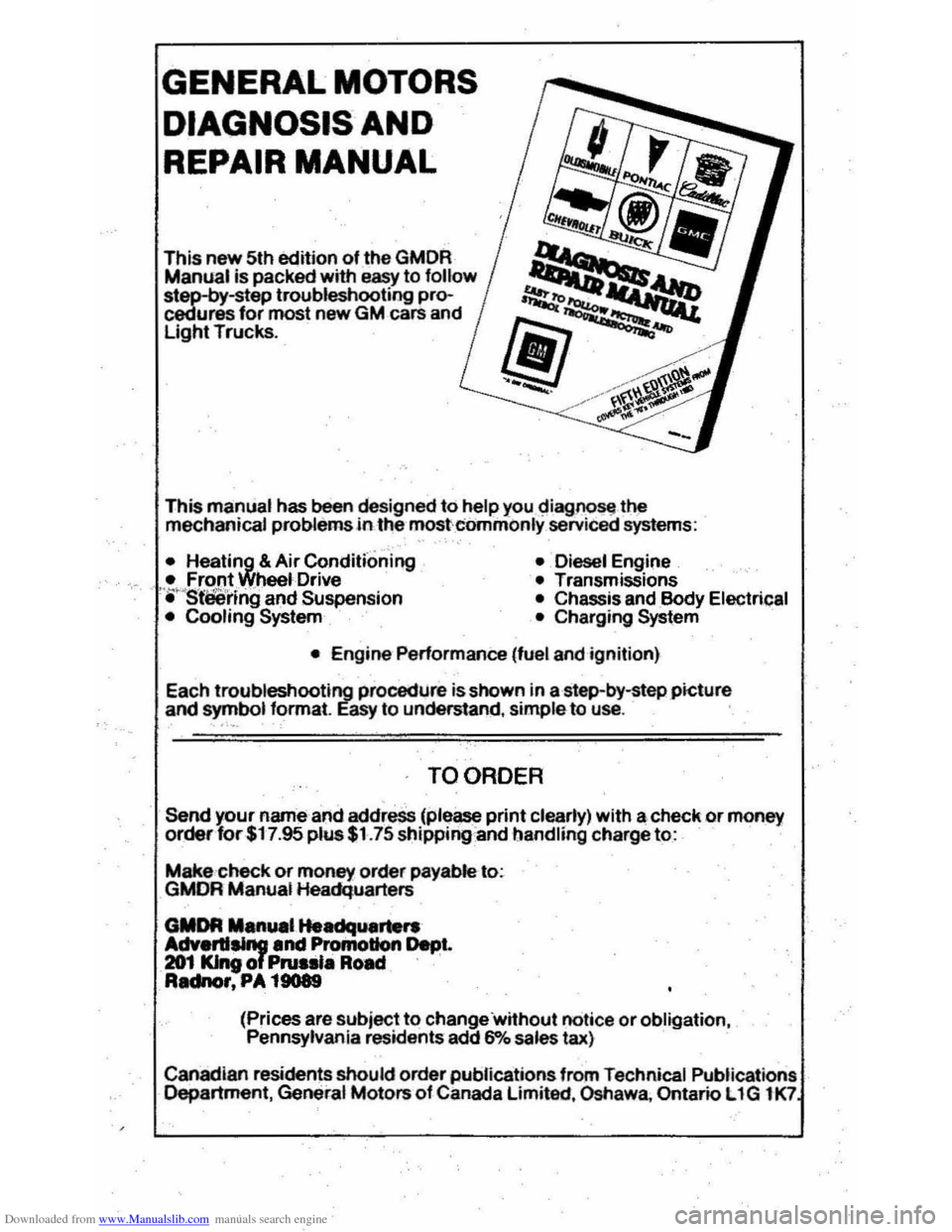
Downloaded from www.Manualslib.com manuals search engine GENERAL MOTORS
DIAGNOSIS
AND
REPAIR MANUAL
This new 5th edition of the GMDR Manual is packed with easy to follow
step-by-step troubleshooliog procedures for most new GM cars and Light Trucks.
This
manual has been designed to help you <;liagnoS4j t~ mechanical problems.;n the most-cOmmonly serviced systems:
• , H , ea, t, i, ng & Air Condition 'ing
• Front Wheel Drive " " ·Sfeeririg and Suspension • Cooling System
• Diesel Engine • Transmissions • Chassis and Body Electrical • Charging System
• Engine Performance (fuel and ignition)
Each troubleshooting procedure is
Sho" wn in a step-by-step pi<:ture and symbol formal. Easy to understand, simple to use . '
rOORDER
Send your name and address (pl"ase print clearly) with a check or money order for $17.95 plus$I.75shippingand bandling cha'geto:
Make·check or money order payable to: GMOR Manual Headquarters
GMDR M.nual Helldqu ....... Advertising .nd Promotion Dept_ 201 King of Prussia Road ' ' R.dnor, PA 19089
(Prices are subject to change without notice or obligation,
Pennsylvania residents add 60/. sales tax)
Canadian residents
should order publications from Technical Publications Department, General Motors of Canada Limited, Oshawa , Ontario LIG lK7