seats CHEVROLET CAVALIER 1993 1.G User Guide
[x] Cancel search | Manufacturer: CHEVROLET, Model Year: 1993, Model line: CAVALIER, Model: CHEVROLET CAVALIER 1993 1.GPages: 308, PDF Size: 15.62 MB
Page 30 of 308
Downloaded from www.Manualslib.com manuals search engine Seats & Safety Belts
Rear Seat Passengers
It’s very important for rear seat
passengers to buckle up! Accident
statistics show that unbelted people in
the rear seat are hurt more often in
crashes than those who are wearing
safety belts.
Rear passengers who aren’t safety belted
can be thrown out of the vehicle in a
crash. And they can strike others in the
vehicle who are wearing safety belts.
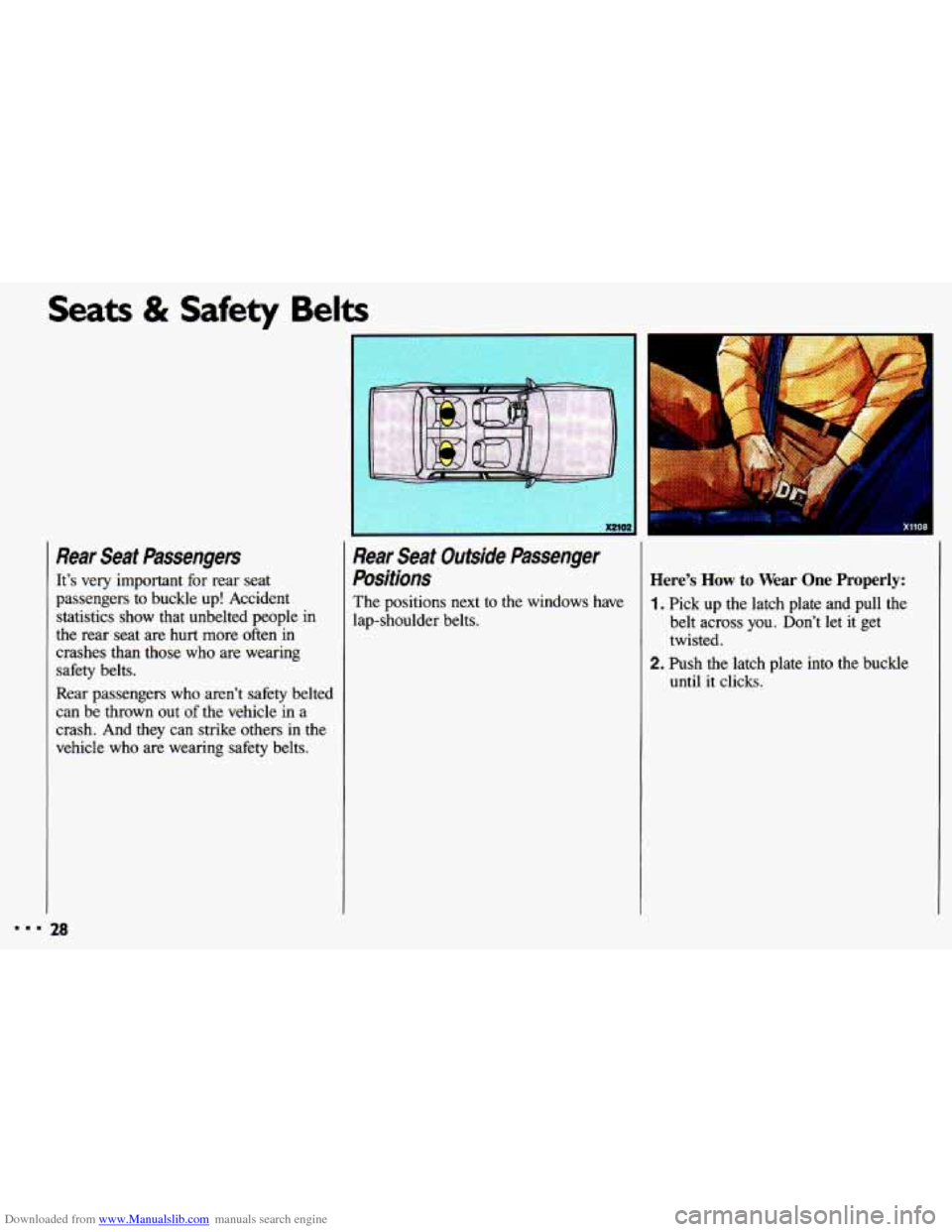
Rear Seat Outside Passenger
Positions
The positions next to the windows have
lap-shoulder belts.
Here’s How to Wear One Properly:
1 . Pick up the latch plate and pull the
belt across
you. Don’t let it get
twisted.
2. Push the latch plate into the buckle
until it clicks.
Page 32 of 308
Downloaded from www.Manualslib.com manuals search engine ..I
Seats & Safety Belts
?ear Seat Outside Passenger
Dositions
(CONT.)
The safety belt locks if there's a sudden
'top or a crash.
CAUTION I
A
You can be seriously hurt if
your shoulder belt
is too
loose. In
a crash you would move
forward too much, which could
increase injury. The shoulder belt
should fit against
your body.
D
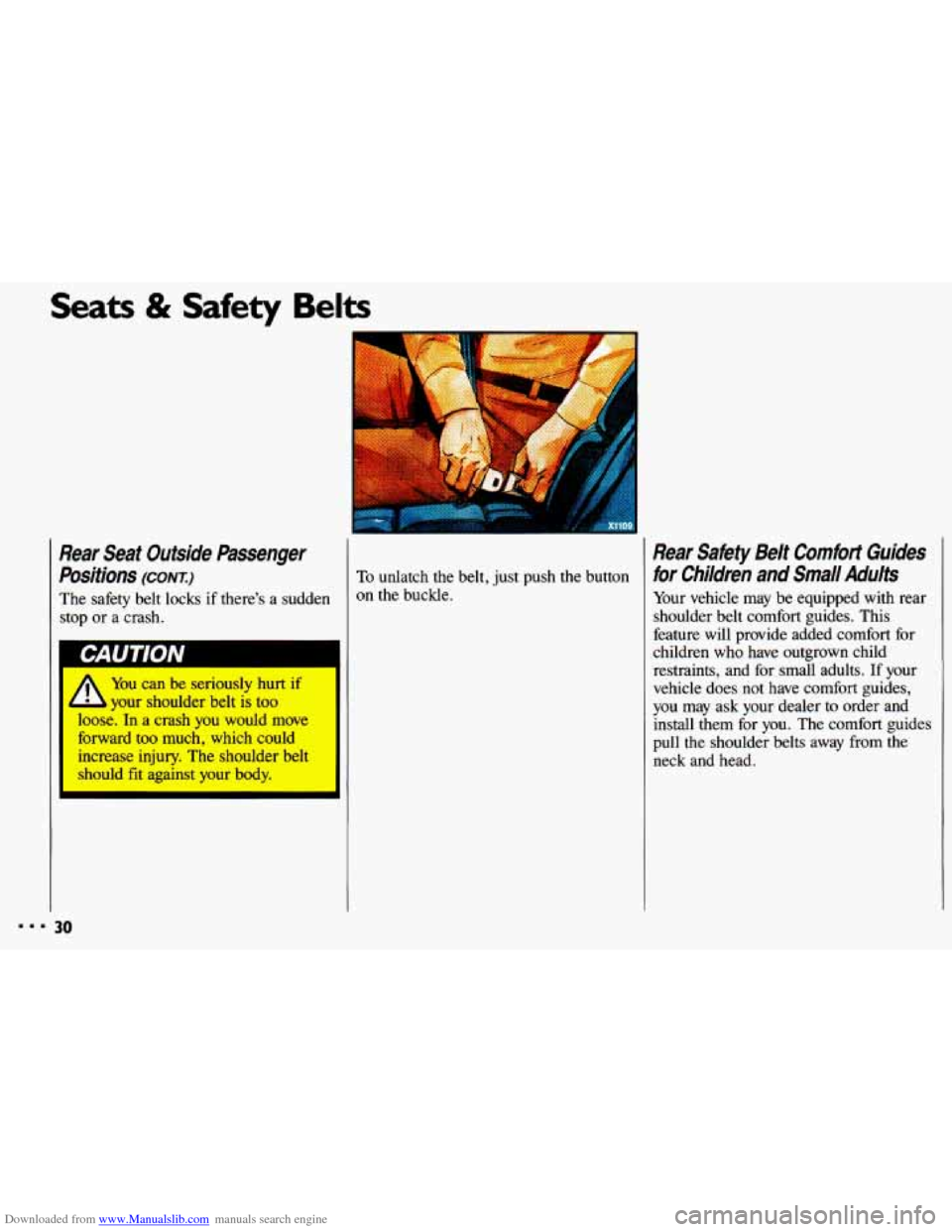
To unlatch the belt, just push the button
on the buckle.
Rear Safety Belt Comfort Guides
for Children and Small Adults
Your vehicle may be equipped with rear
shoulder belt comfort guides. This
feature will provide added comfort for
children who have outgrown child
restraints, and for small adults. If your
vehicle does not have comfort guides,
you may ask your dealer
to order and
install them for you. The comfort guides
pull the shoulder belts away from the
neck and head.
Page 34 of 308
Downloaded from www.Manualslib.com manuals search engine Seats & Safety Belts
f-
Rear Safety Belt Comfort Guides
for Children and Small Aduits
(CONr.)
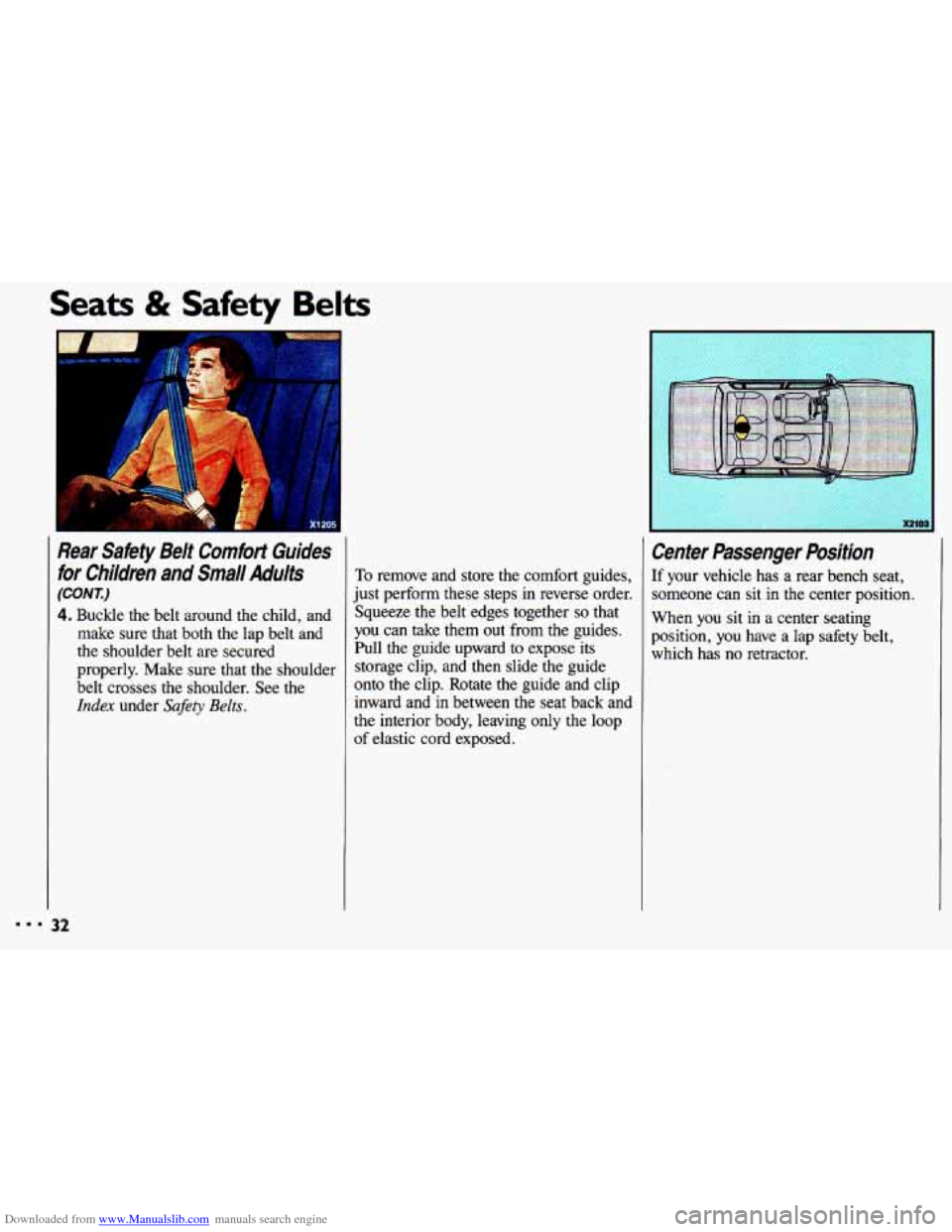
4. Buckle the belt around the child, and
make sure that both the lap belt and
the shoulder belt are secured
properly. Make sure that the shoulder
belt crosses the shoulder. See the
Index under Safety Belts.
To remove and store the comfort guides,
just perform these steps in reverse order.
Squeeze the belt edges together
so that
you can take them out from the guides.
Pull the guide upward to expose its
storage clip, and then slide the guide
onto the clip. Rotate the guide and clip
inward and
in between the seat back and
the interior body, leaving
only the loop
of elastic cord exposed.
Center Passenger Position
If your vehicle has a rear bench seat,
someone can sit in the center position.
When you sit
in a center seating
position, you have a lap safety belt,
which has
no retractor.
Page 36 of 308
Downloaded from www.Manualslib.com manuals search engine Seats & Safety Belts
r
A
i
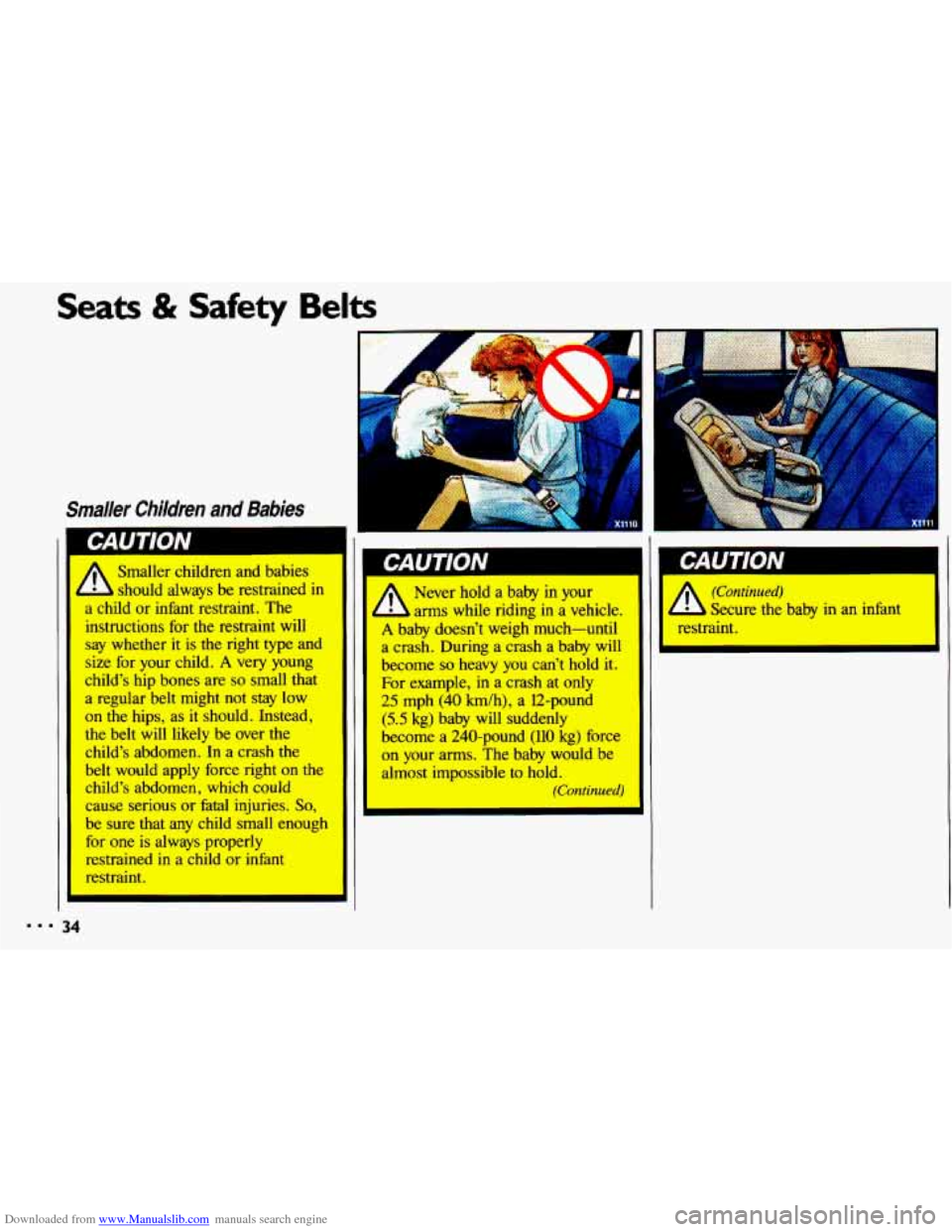
Smaller children and babies
should always be restrained in
a child or infint restraint. The
instructions for the restraint will
say whether it is the right type and
size for your child. A very young
child's hip bones are so smalI that
a regular belt might not stay low
on the hips, as it should. Instead,
the belt will likely be over the
child's abdomen. In a crash the
belt would apply
force right on the
child's abdomen, which could
cause serious or fatal injuries. So,
be sure that any child small enough
for one is always properly
restrained in a child or infant
restraint.
1
,.. -- :a -"
x
(Continued)
Secure the baby in an infant
restraint.
Page 38 of 308
Downloaded from www.Manualslib.com manuals search engine Seats & Safety Belts
..I
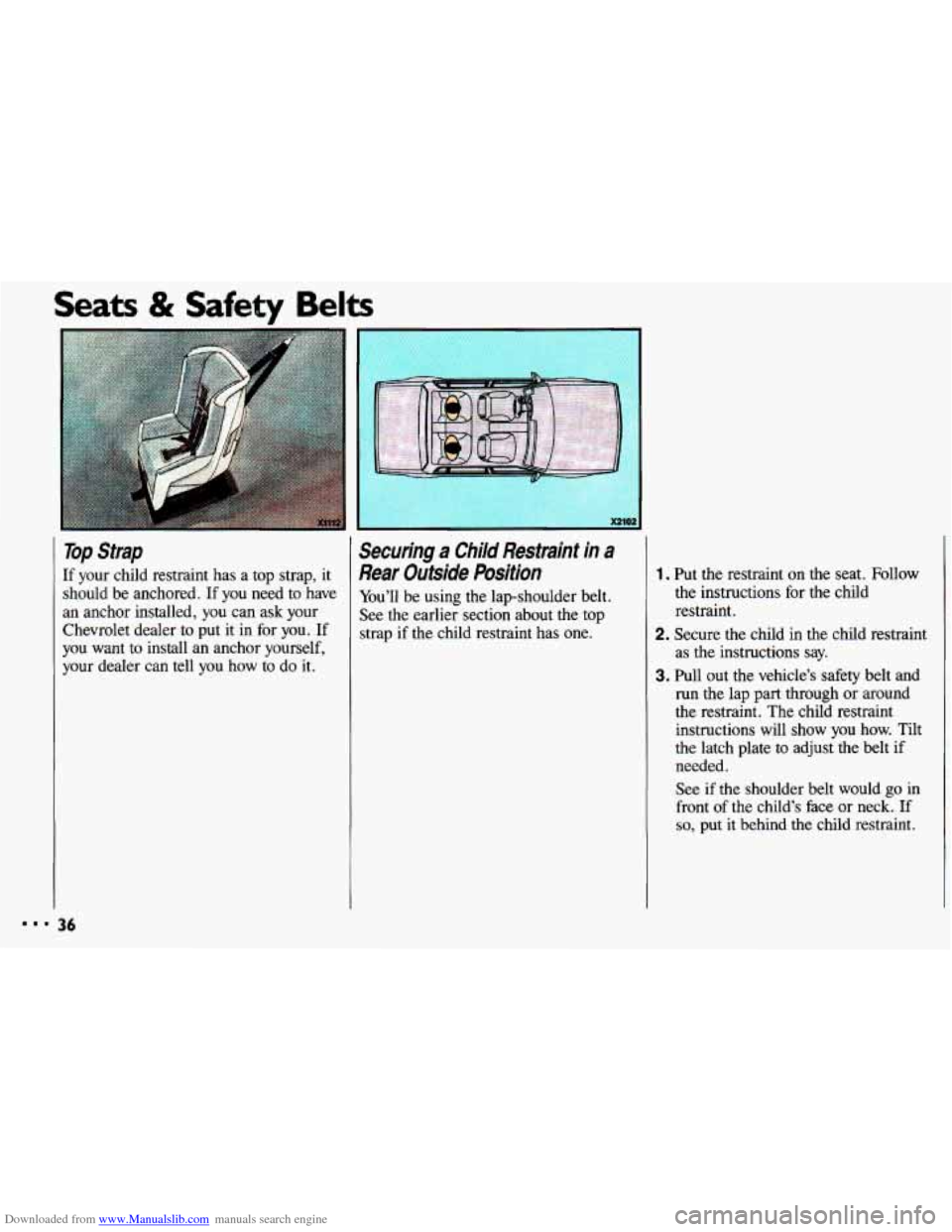
Top Strap
If your child restraint has a top strap, it
should be anchored.
If you need to have
an anchor installed, you can ask your
Chevrolet dealer to put
it in for you. If
you want to install an anchor yourself,
your dealer can tell you how to do
it.
36
Securing a Child Restraint in a
Rear Outside Position
You’ll be using the lap-shoulder belt.
See the earlier section about the top
strap if the child restraint has one.
1 . Put the restraint on the seat. Follow
the instructions for the child
restraint.
2. Secure the child in the child restraint
as the instructions say.
3. Pull out the vehicle’s safety belt and
run the lap part through or around
the restraint. The child restraint
instructions will show you how. Tilt
the latch plate
to adjust the belt if
needed.
See if the shoulder
belt would go in
front
of the child’s face or neck. If
so, put it behind the child restraint.
Page 40 of 308
Downloaded from www.Manualslib.com manuals search engine Seats & Safety Belts
..I I
I
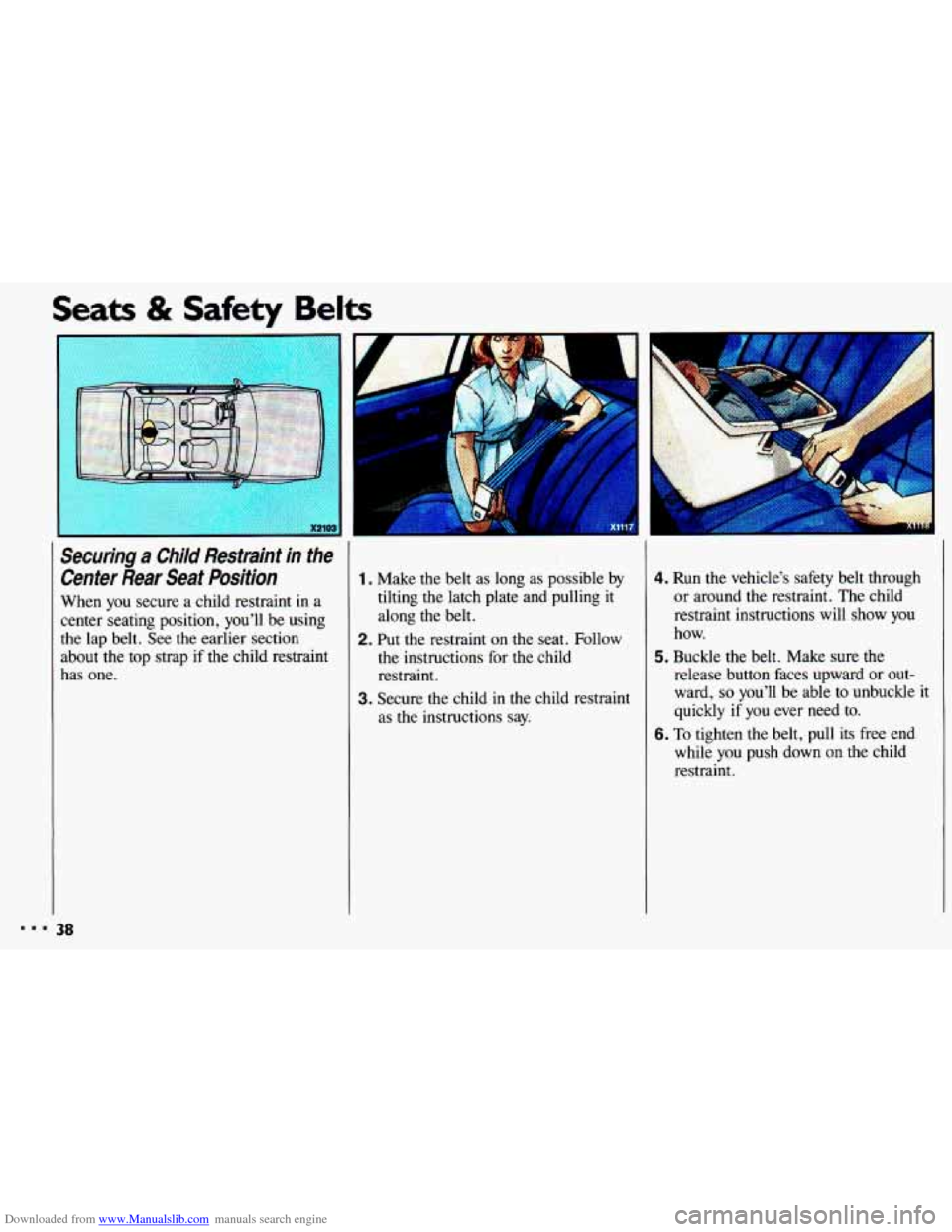
Securing a Child Restraint in the
Center Rear Seat Position
When you secure a child restraint in a
center seating position, you’ll be using
the lap belt. See
the earlier section
about the top strap if the child restraint
has one.
38
1. Make the belt as long as possible by
tilting the latch plate and pulling
it
along the belt.
2. Put the restraint on the seat. Follow
the instructions for the child
restraint.
as the instructions say.
3. Secure the child in the child restraint
4. Run the vehicle’s safety belt through
or around the restraint. The child
restraint instructions will show you
how.
release button faces upward or out-
ward,
so you’ll be able to unbuckle it
quickly if you ever need to.
6. To tighten the belt, pull its free end
while you push down on the child
restraint.
5. Buckle the belt. Make sure the
Page 42 of 308
Downloaded from www.Manualslib.com manuals search engine Seats & Safety Belts
Securing a Child Restraint in the
Right Front Seat (CONT.)
yr/ infantkhild seat attaching
hardware in another vehicle.
If you
do, it may not work well and the
child may not be protected
I
properly in a crash. The special
hardware is for your vehicle only.
Also, don’t use the special belt for
anything but securing a child
restraint in the right front seat.
If
an adult or older child uses it, the
belt won’t provide protection and
may even increase injury in a
crash.
I
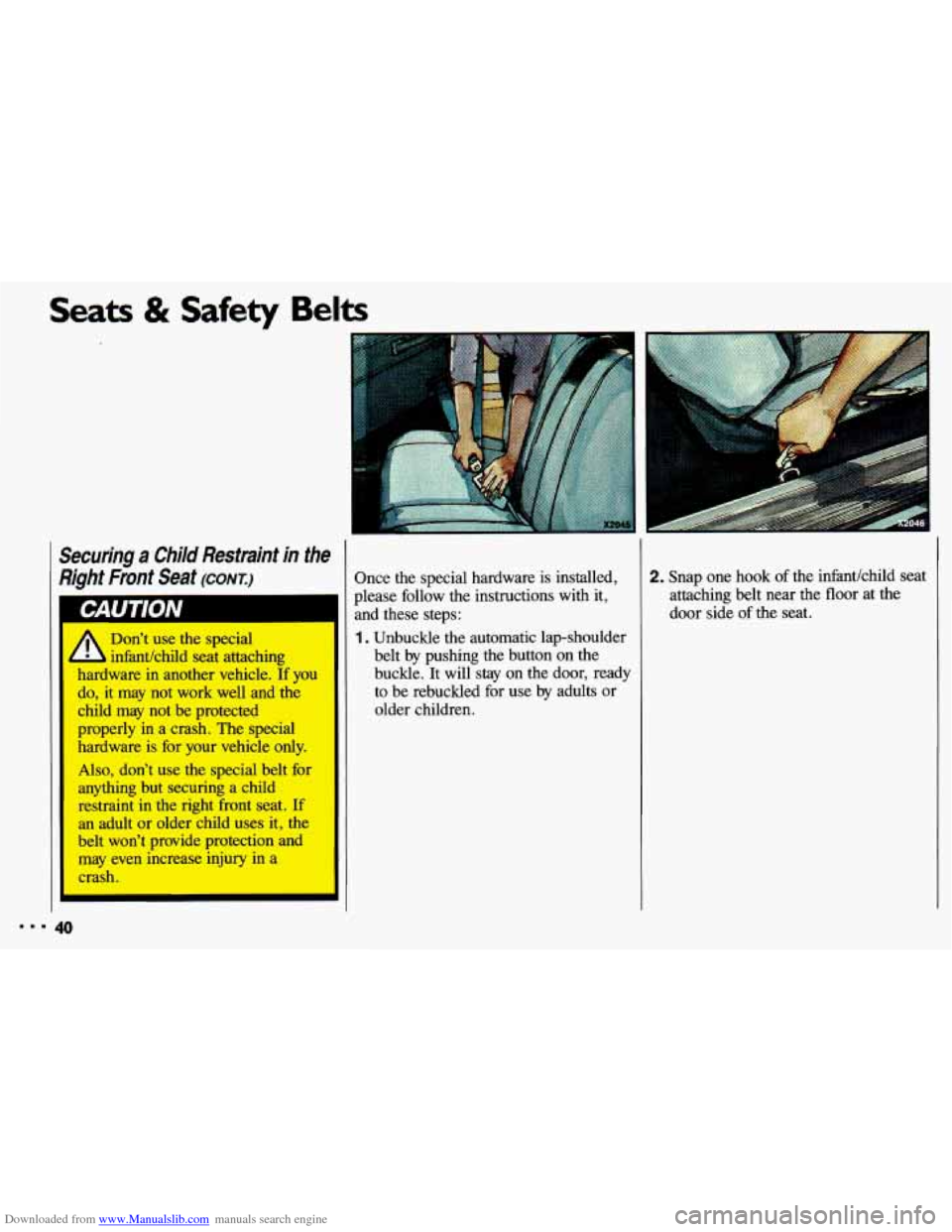
Once the special hardware is installed,
please follow the instructions with it,
and these steps:
1 . Unbuckle the automatic lap-shoulder
belt by pushing the button on the
buckle. It
will stay on the door, ready
to be rebuckled for use by adults or
older children.
2. Snap one hook of the infmtkhild seat
attaching belt near the
floor at the
door side
of the seat.
Page 44 of 308
Downloaded from www.Manualslib.com manuals search engine Seats & Safety Belts
Securing a Child Restraint in the
7ight Front Seat
(CONX:)
9. To make it tight, pull the belt while
you push down on the child
restraint.
If the belt won’t stay tight,
switch
it end for end.
IO. Push and pull the child restraint in
different directions
to be sure it is
secure.
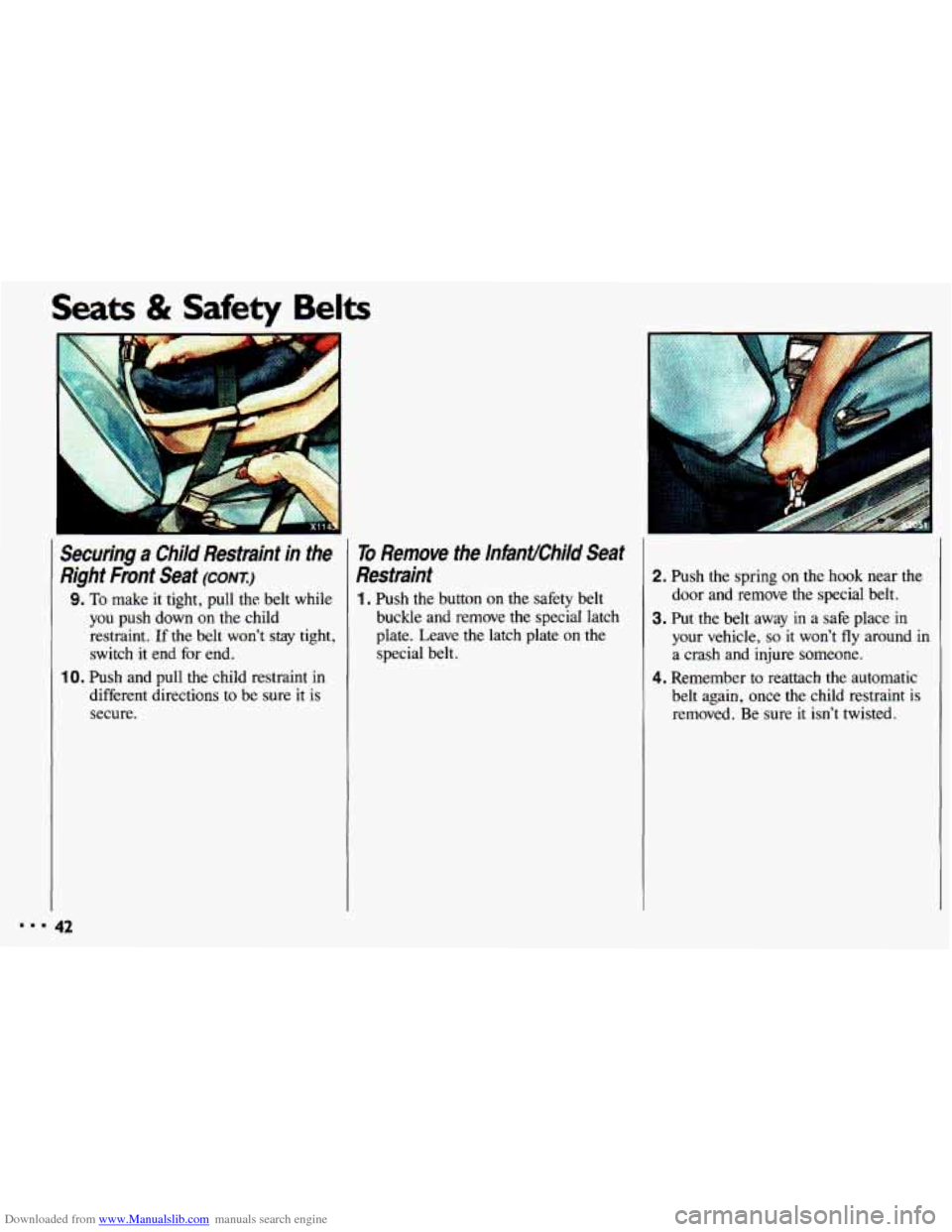
To Remove the InfanUChiId Seat
Restraint
1. Push the button on the safety belt
buckle and remove the special latch
plate. Leave the latch plate on the special belt.
2. Push the spring on the hook near the
door and remove the special belt.
3. Put the belt away in a safe place in
your vehicle, so it won’t fly around in
a crash and injure someone.
4. Remember to reattach the automatic
belt again, once the child restraint is
removed. Be sure it isn’t twisted.
Page 46 of 308
Downloaded from www.Manualslib.com manuals search engine Seats & Safety Belts
larger Children (CONT.)
Q: What if a child is wearing a lap-
shoulder belt, but the child is
so
small that the shoulder belt is very
close to the child’s face or
neck?
A: Move the child toward the center of
the vehicle, but be sure that the shoulder belt still is on the child’s
shoulder,
so that in a crash the
child‘s upper body would have the
restraint that belts provide.
If the child is
so small that the
shoulder belt is still very close to the
child’s face or neck, you might want
to place the child in the center seat
position, the one that has only a lap
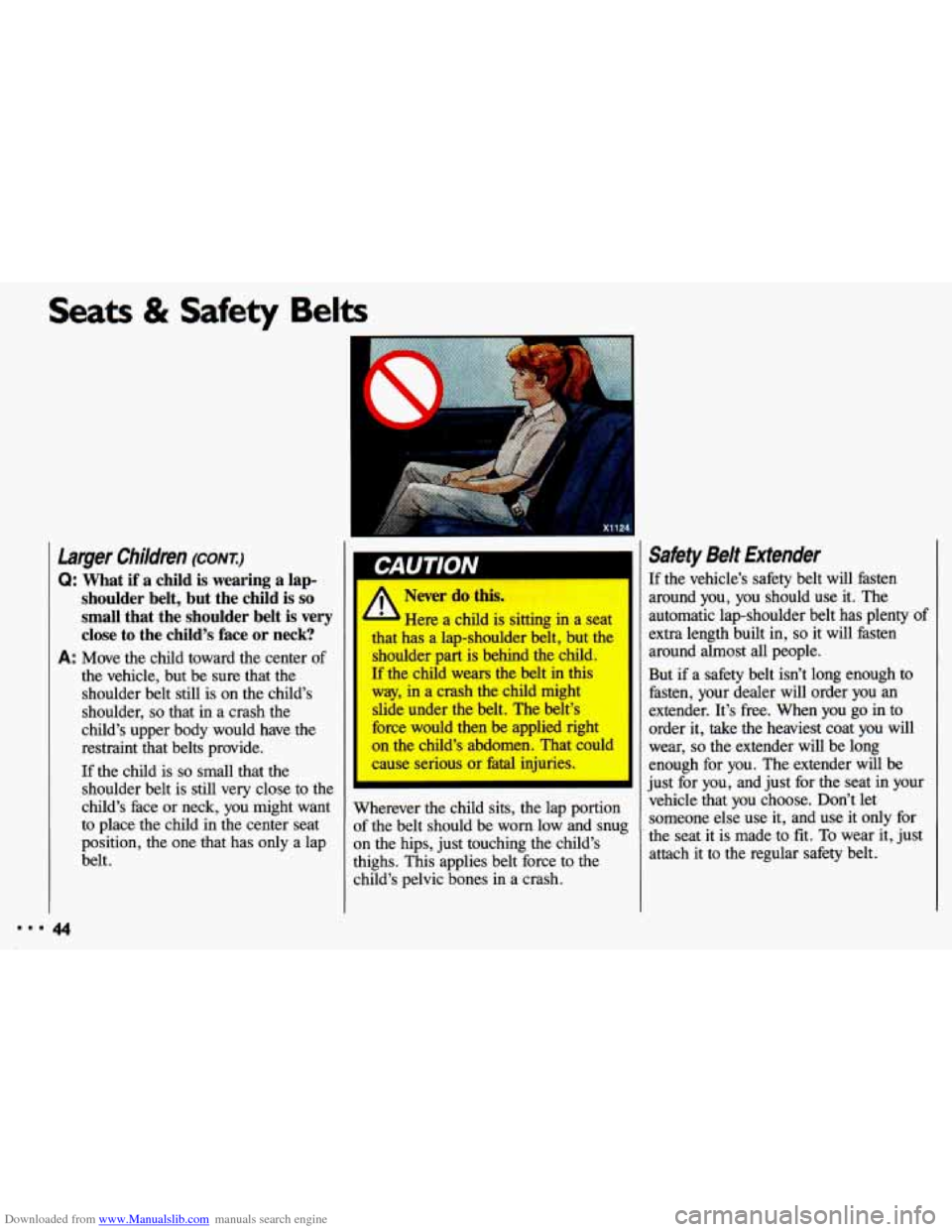
belt. Here
a child is sitting in a seat
that has a lap-shoulder belt, but the
shoulder part is behind the child.
If the child wears the belt in this
way, in a crash the child might
slide under the belt. The belt’s
force would then be applied right
on the child’s abdomen. That could
cause serious or fatal injuries.
Wherever the child sits, the lap portion
of the belt should be worn low and snug
on the hips, just touching the child’s
thighs. This applies belt force to the child’s pelvic bones in a crash.
Safety Belt Extender
If the vehicle’s safety belt will fasten
around you, you should use it. The
automatic lap-shoulder belt has plenty of
extra length built in,
so it will fasten
around almost all people.
But if a safety belt isn’t long enough to
fasten, your dealer will order you
an
extender. It’s free. When you go in to
order it, take the heaviest coat you will
wear,
so the extender will be long
enough for you. The extender will be
just for you, and just for the seat in your
vehicle that you choose. Don’t let
someone else use it, and use it only for
the seat it is made to fit. To wear it, just
attach it to the regular safety belt.
Page 56 of 308
Downloaded from www.Manualslib.com manuals search engine Features & Controls
. . ,. .
. ... .
Convenience Net (OPTION)
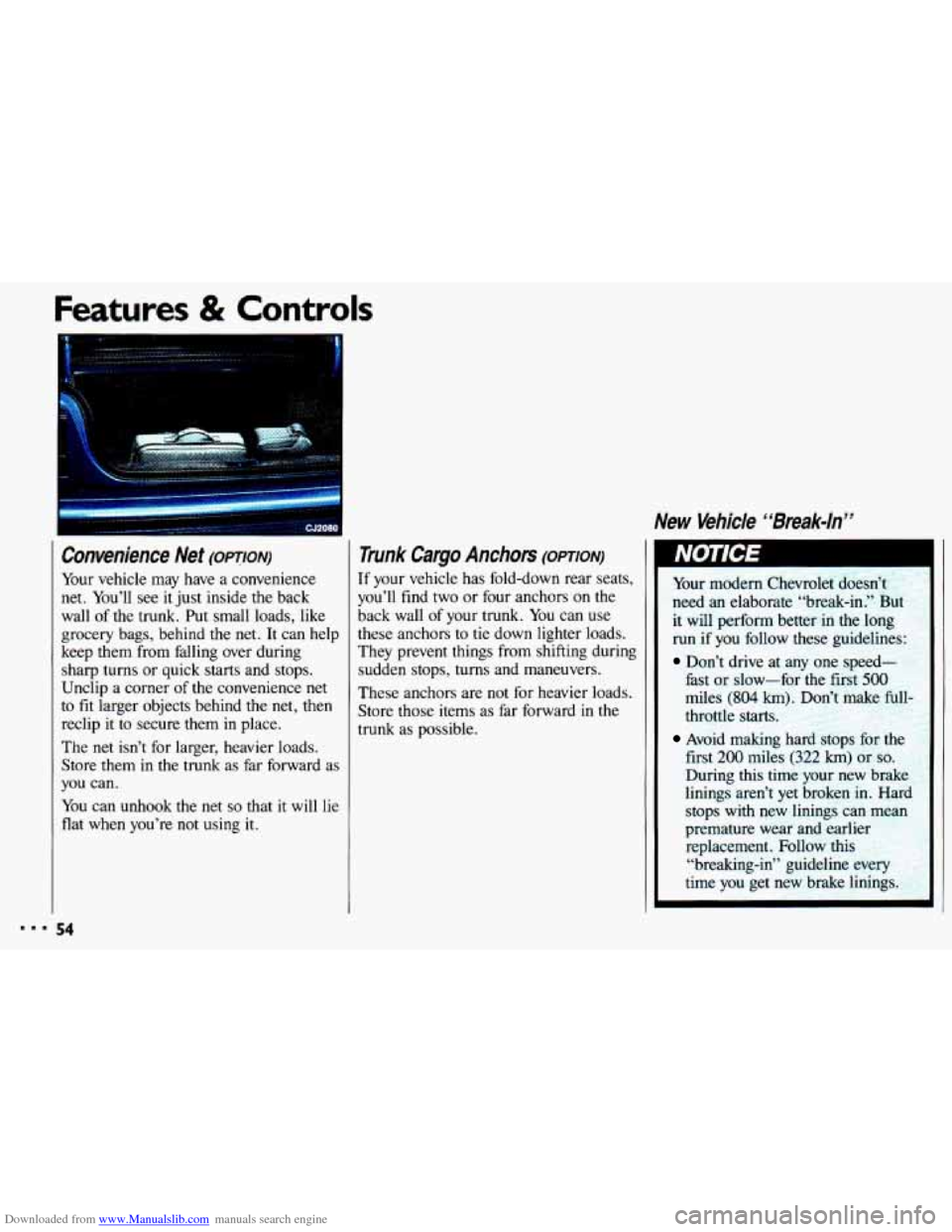
Your vehicle may have a convenience
net. You’ll see it just inside
the back
wall of the trunk. Put small loads, like
grocery bags, behind the net. It can help
keep them from falling over during
sharp turns or quick
starts and stops.
Unclip a corner of the convenience net
to
fit larger objects behind the net, then
reclip it to secure them in place.
The
net isn’t for larger, heavier loads.
Store them in the trunk as far forward
as
you can.
You can unhook the net
so that it will lie
flat when you’re not using it.
Trunk Cargo Anchors (omoN)
If your vehicle has fold-down rear seats,
you’ll find two or four anchors on the
back wall of your trunk. You can use
these anchors to tie down lighter loads.
They prevent things from shifting during sudden stops, turns and maneuvers.
These anchors are not for heavier loads.
Store those items as far forward in
the
trunk as possible.
New Vehicle “Break-ln”
Your modern Chevrolet doesn’t
need an elaborate “break-in.” But
it will perform better in the long run
if you follow these guidelines:
Don’t drive at any one speed-
fast or slow-for the first
500
miles (804 km 3on’t make full
throttle starts.
first 200 miles (322 km) or so.
During this time your new brake
linings aren’t yet broken in.
Harc
stops with new linings can mean
premature wear and earlier replacement. Follow this
“breaking-in” guideline eveq
time
you get new brake linings.
Avoid making hard stops for 1