service CHEVROLET CAVALIER 1993 1.G Owner's Guide
[x] Cancel search | Manufacturer: CHEVROLET, Model Year: 1993, Model line: CAVALIER, Model: CHEVROLET CAVALIER 1993 1.GPages: 308, PDF Size: 15.62 MB
Page 208 of 308
Downloaded from www.Manualslib.com manuals search engine Service & Appearance Care
Engine Oil (CONT.)
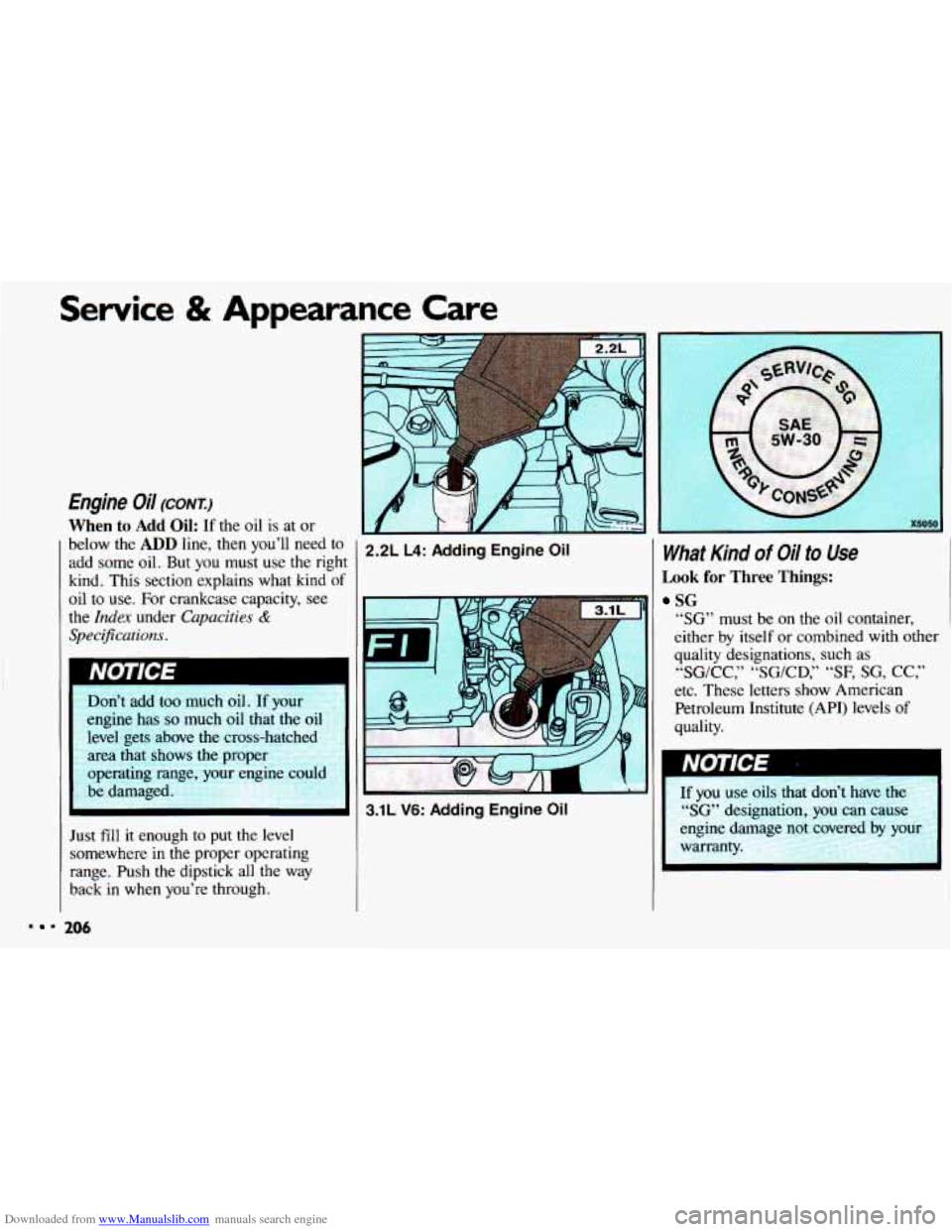
When to Add Oil: If the oil is at or
below the ADD line, then you’ll need to
add some oil. But you must use the right
kind. This section explains what kind
of
oil to use. For crankcase capacity, see
the
Index under Capacities &
SpeciBcations.
1
Don’t add too much oil. If your
engine has so much oil that the oil
level gets above the cross-hatched
area that shows the prope
operating range, your engine could
be damaged.
i
Just fill it enough to put the level
somewhere
in the proper operating
range. Push
the dipstick all the way
back
in when you’re through.
2.2L L4: Adding Engine Oil
i-¤
3.1L V6: Adding Engine Oil
What Kind of Oil to Use I
Look for Three Things:
SG
“SG” must be on the oil container,
either
by itself or combined with other
quality designations, such as “SG/CC,” “SG/CD,”
“SF, SG, CC,”
etc. These letters show American
Petroleum Institute (API) levels
of
quality.
If you use oils that don’t have
“SG” designation, you
can cause
engine damage not covered by your
warranty.
= = 206
Page 210 of 308
Downloaded from www.Manualslib.com manuals search engine Service & Appearance Care
When to Change Engine Oil
See if any one of these is true for you:
Most trips are less than 4 miles (6 km).
It’s below freezing outside and most
trips are less than 10 miles
(16 km).
The engine is at low speed most of the
time (as in door-to-door delivery,
or in
stop-and-go traffic).
Most trips are through dusty places.
If any one
of these is true for your
vehicle, then you need to change your
oil and filter every 3,000 miles
(5 OOO km) or 3 months-whichever
comes first.
If none of them is true, change the oil
every
7,500 miles (12 500 km) or 12
months-whichever comes first. Change
the filter at the first oil change and at
every other oil change after that.
208
Engine Block Heater
An engine block heater can be a big
help if you have to park outside in very
cold weather,
0°F (-18°C) or colder. If
your vehicle has this option, see the
index under Engine Block Heater.
What to Do with Used Oil
CAUTION
A
Used engine oil contains
things that have caused skin
cancer in laboratory animals. Don’t
let used
oil stay on your skin for
very long. Clean your skin and
nails with soap and water, or a
good hand cleaner. Wash or
properly throw away clothing or
rags containing used engine oil.
Page 211 of 308
Downloaded from www.Manualslib.com manuals search engine Used oil can be a real threat to the
environment.
If you change your own oil, be sure to
drain all free-flowing oil from the filter
before disposal.
Don’t ever dispose
of oil by pouring it
on the ground, into sewers, or into
streams or bodies
of water. Instead,
recycle it by taking it to a place that
collects used oil. If you have a problem
properly disposing of your used oil, ask
your dealer, a service station or a local
recycling center for help.
Air Cleaner
Refer to the Maintenance Schedule to
determine when to replace the air filter.
See the
Index under Scheduled
Maintenance Services.
A Opemting the engine with the
1 air cleaner off can cause you
nr others to be burned. The air
mer not only cleans
the air, it
stops flame if the engine backfires.
If it isn’t there,
and the engine
backfires,
you could be burned.
.Don’t drive with it
off, and be
candid working on the engine with
the air cleaner off.
I
I ~~~~ NOTIC€ ~~
If the air cleaner is off, a backfire
can cause a damaging engine fire.
And, dirt can easily get into your
engine, which will damage it.
Always have the air cleaner
i~
place when you’re driving.
209 I
Page 212 of 308
Downloaded from www.Manualslib.com manuals search engine Service & Appearance Care
111
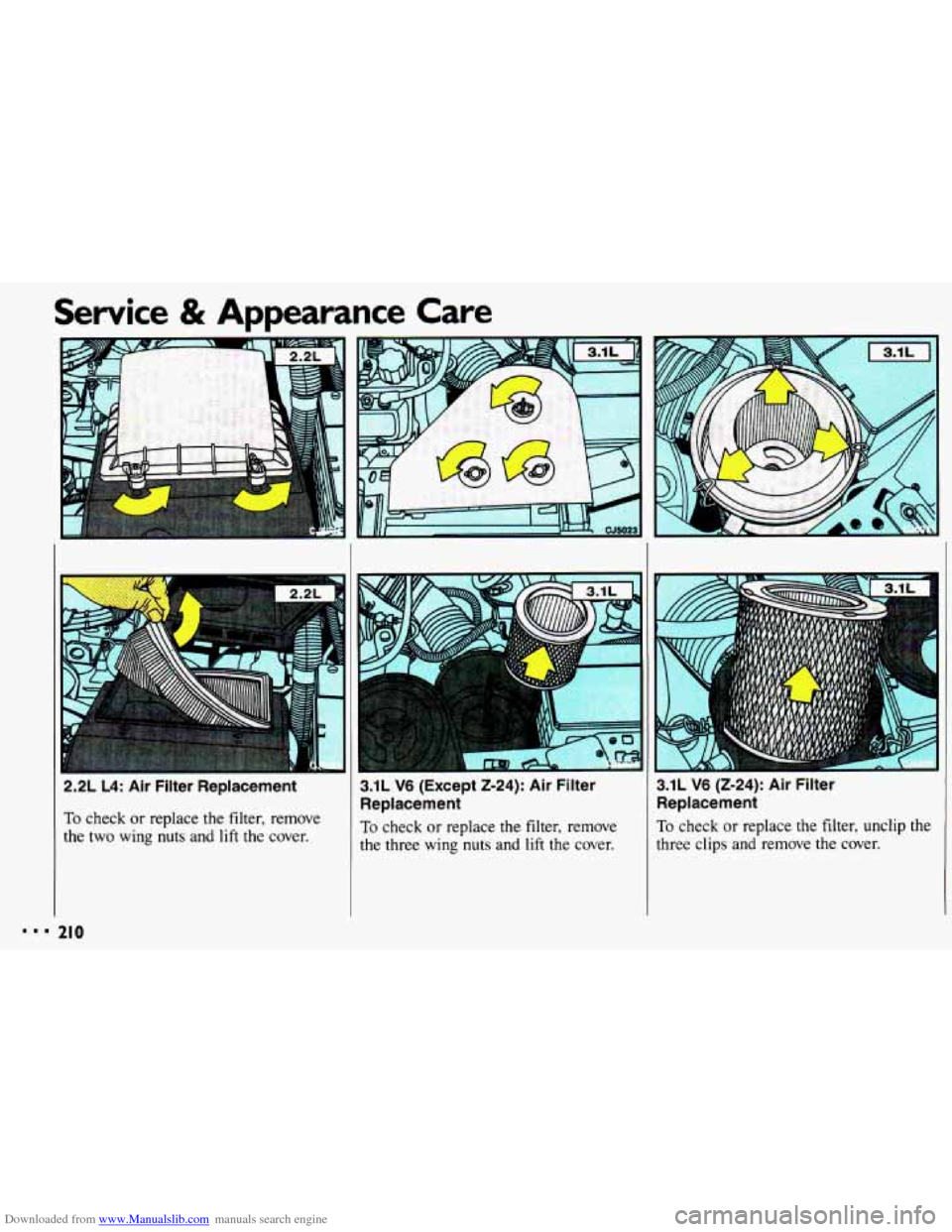
2.2L L4: Air Filter Replacement
To check or replace the filter, remove
the two wing nuts and lift the cover.
21 0
3.1L V6 (Except 2-24): Air Filter
Replacement
To check or replace the filter, remove
the three wing nuts
and lift the cover.
3.1L V6 (2-24): Air Filter
Replacement
To check or replace the filter, unclip the
three clips and remove the cover.
Page 213 of 308
Downloaded from www.Manualslib.com manuals search engine Automaric Transaxle Fluid
When to Check and Change:
A good time to check your automatic
transaxle fluid level is when the engine
oil is changed. Refer to the Maintenance
Schedule to determine when to change
your fluid. See the
Index under
Scheduled Maintenance Services.
How to Check:
Because this operation can be a little
difficult, you may choose to have this
done at a Chevrolet dealership Service
Department.
If you do it yourself, be sure to follow
all the instructions here, or you could
get a false reading on the dipstick.
Too much or too little fluid can
damage
your transaxle. Too much
can mean that some of the fluid
could come out and fall
on hot
engine parts, starting a fire. Be
sure to get an accurate reading
if
you check your transaxle fluid. Wait
at least 30 minutes before checking
the transaxle fluid level if you have been
driving:
When outside temperatures are above
At high speed for quite a while.
In heavy traffic-especially in hot
To get the right reading, the fluid should
be at normal operating temperature,
which is 180°F to 200°F (82°C to
93" C).
Get the vehicle warmed up by driving
about 15 miles (24
km) when outside
temperatures are above
50°F (10OC). If
it's colder than 50" F (10" C), you may
have to drive longer.
90°F (32°C).
weather.
21 I
Page 214 of 308
Downloaded from www.Manualslib.com manuals search engine Service & Appearance Care
Automatic Transaxle Fluid (CONT.)
To Check the Fluid Level:
Park your vehicle on a level place.
Place the shift lever in P (Park) with
With your foot on the brake pedal,
the
parking brake applied.
move the shift lever through each gear
range, pausing for about three seconds
in each range. Then, position the shift
lever in
P (Park).
Then, Without Shutting Off the
Engine,
Follow These Steps:
1. Pull out the dipstick and wipe it with
a clean rag or paper towel.
2. Push it back in all the way, wait three
seconds and then pull it back out
again.
3. Check both sides of the dipstick, and
read the lower level. The fluid level
must be in the cross-hatched area.
4. If the fluid level is where it should
be, push the dipstick back in all the
way.
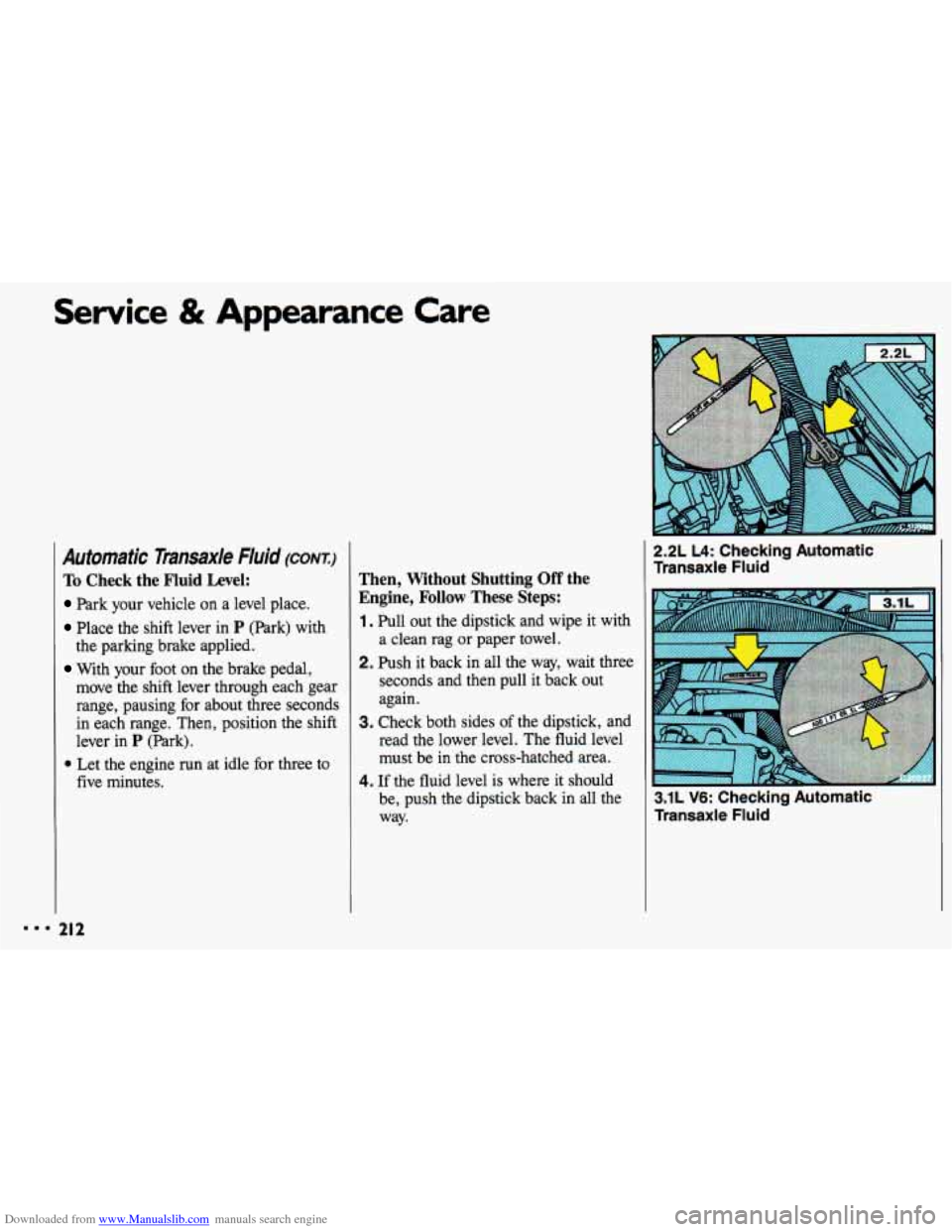
2.2L L4: Checking Automatic
Transaxle Fluid
3.1L V6: Checking Automatic
Transaxle Fluid
Page 216 of 308
Downloaded from www.Manualslib.com manuals search engine Service & Appearance Care
Manual Transax/e Fluid (CONT.)
How to Check: Because this operation
can be a little difficult, you may choose
to have this done at a Chevrolet
dealership Service Department.
If you do it yourself, be sure to follow
all the instructions here, or you could
get a false reading on the dipstick.
Too much or too little fluid can
damage your transaxle.
Too much
can mean that some
of the fluid
could come out and fall on hot
engine parts, starting a fire. Be
sure to get an accurate reading if
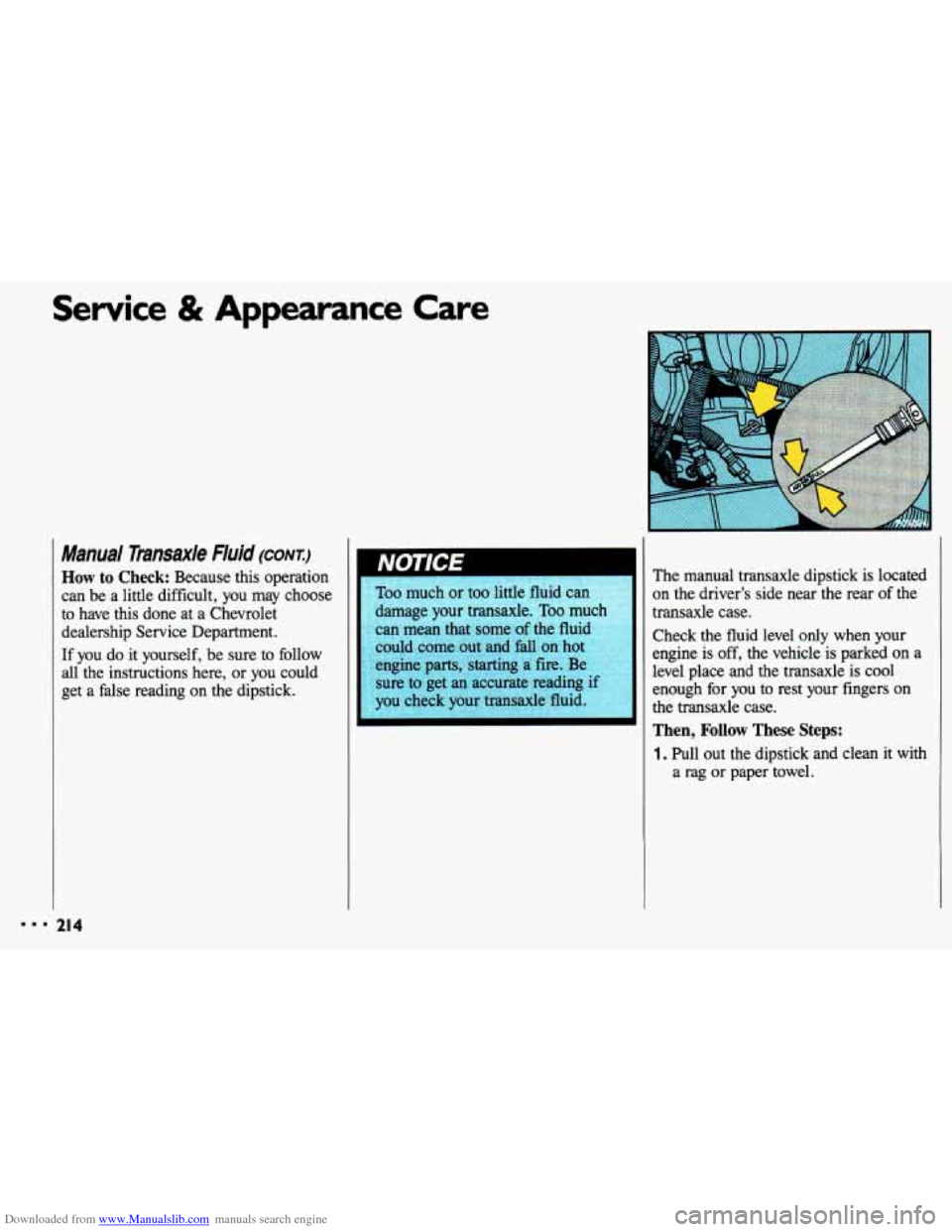
you check your transaxle fluid. The manual transaxle dipstick is located
on the driver’s side near the
rear
of the
transaxle case.
Check the fluid level only
when your
engine is off, the vehicle is parked on a
level place and the transaxle is cool
enough for you to rest your fingers
on
the transaxle case.
Then, Follow These Steps:
1. Pull out the dipstick and clean it with
a rag or paper towel.
Page 217 of 308
Downloaded from www.Manualslib.com manuals search engine 2. Push it back in all the way and
remove it.
3. Check both sides of the dipstick and
read the lower level. The fluid level
must be between the
ADD and
FULL marks. (Note: Fluid may
appear at the bottom of the dipstick
even when the fluid level
is several
pints low.)
4. If the fluid level is where it should
be, push the dipstick back
in all the
way.
How to Add Fluid:
Here’s how to add fluid. Refer to the
Maintenance Schedule to determine
what kind
of fluid to use. See the Index
under Fluids & Lubricants.
Remove the dipstick.
Add fluid at the dipstick hole.
Add only enough fluid to bring the fluid
level up to the
FULL mark on the
dipstick.
Push the dipstick back in all the way.
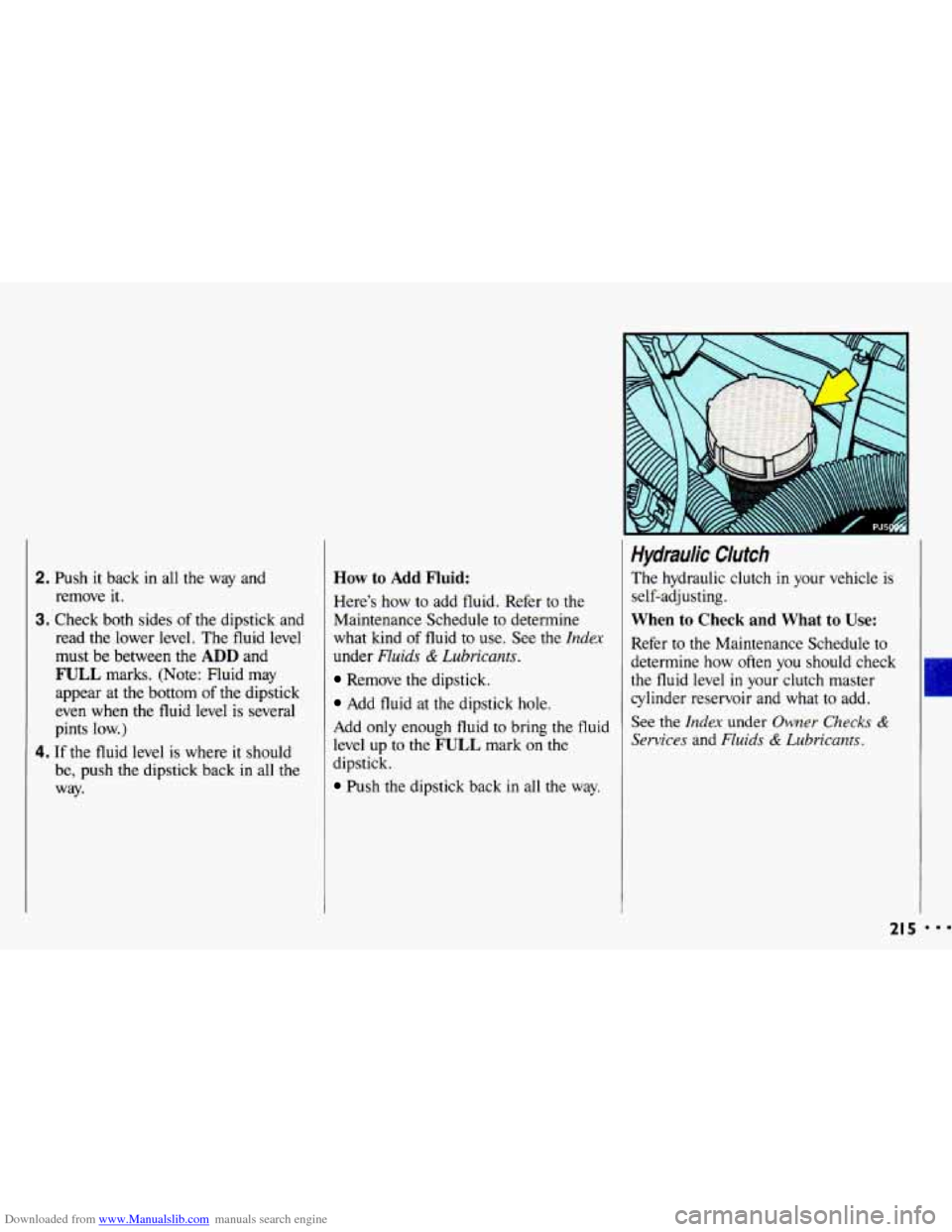
Hydraulic Clutch
The hydraulic clutch in your vehicle is
self-adjusting.
When to Check and What to Use:
Refer to the Maintenance Schedule to
determine how often you should check
the fluid level
in your clutch master
cylinder reservoir and what
to add.
See the
Index under Owner Checks &
Services and Fluids & Lubricants.
I
21 5 ...
Page 218 of 308
Downloaded from www.Manualslib.com manuals search engine 888
Service rance Care
Hydraulic Clutch (CONTJ
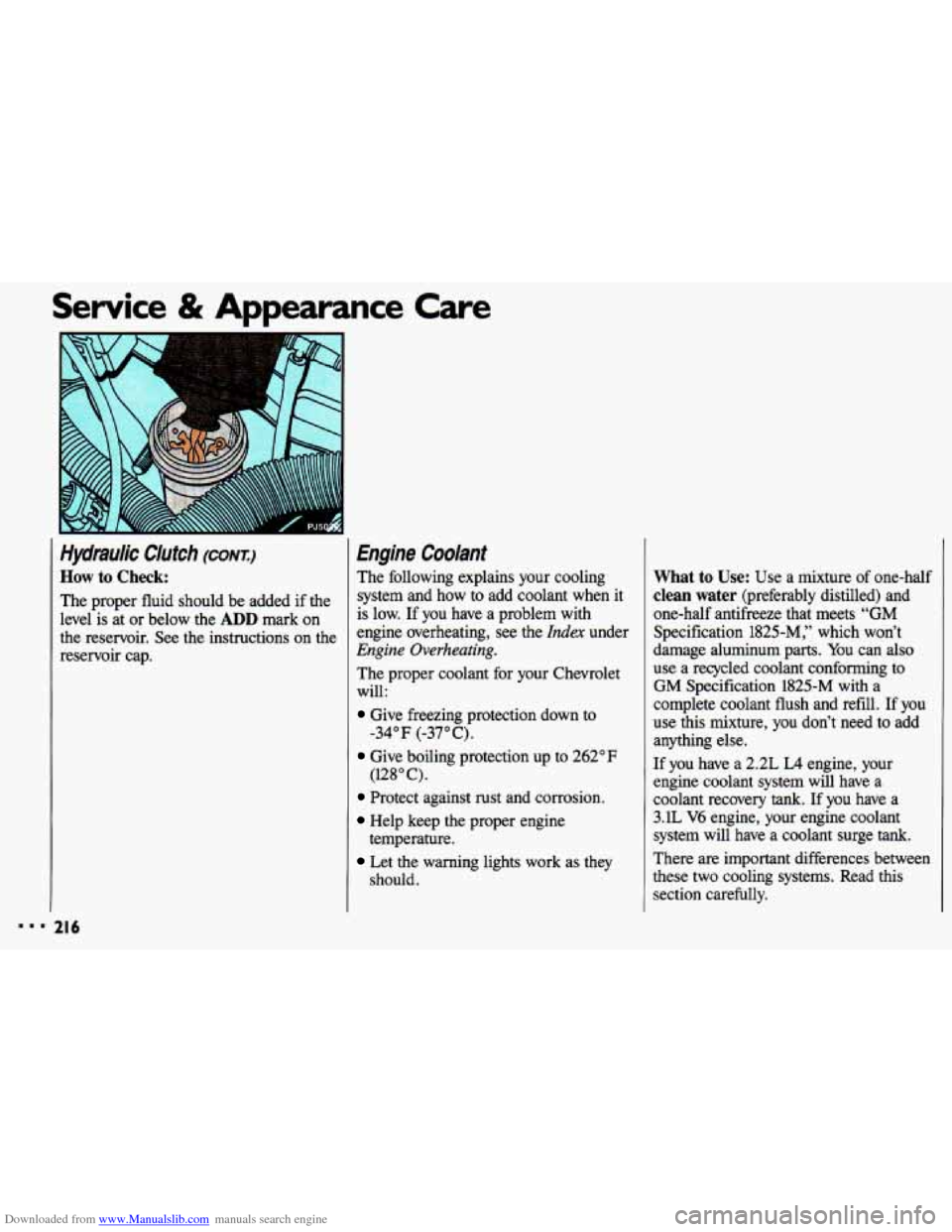
How to Check:
The proper fluid should be added if the
level is at or below the
ADD mark on
the reservoir.
See the instructions on the
reservoir cap.
216
Engine Coolant
The following explains your cooling
system and how to add coolant when it
is low. If you have a problem with
engine overheating,
see the Index under
Engine Overheating.
The proper coolant for your Chevrolet
will:
Give freezing protection down to
Give boiling protection up to 262°F
Protect against rust and corrosion.
Help keep the proper engine
Let the warning lights work as they
-34" F (-37" C).
(128" C).
temperature.
should.
What to Use: Use a mixture of one-half
clean water (preferably distilled) and
one-half antifreeze that meets "GM
Specification 1825-M," which won't
damage aluminum parts.
You can also
use a recycled coolant conforming to
GM Specification 1825-M with a
complete coolant flush and refill.
If you
use this mixture, you don't need to add
anything else.
If you have a 2.2L LA engine, your
engine coolant system will have a
coolant recovery
tank. If you have a
3.1L V6 engine, your engine coolant
system will have a coolant surge
tank.
There are important differences between
these two cooling systems. Read this section carefully.
Page 220 of 308
Downloaded from www.Manualslib.com manuals search engine Service & Appearance Care
I
Adding Co01ant-2~2L L4 Engine
(CONT.)
A
Turning the radiator pressure
cap
when the engine and
radiator are hot can allow steam
and scalding liquids
to blow out
and
burn you badly. With the
coolant
recovery tank, you will
almost never have to add coolant at
the radiator. Never turn the
radiator
pressure cap-even a
little-when the engine and radiator are hot.
II
1 I Adding C00lant-3~IL V6 Engine
You can be burned if you spill
coolant on hot engine parts. Coolant
contains ethylene glycol,
and it will burh if the engine parts
are hot enough. Don’t spill coolant
II
on a hot eniine.
I 31
II
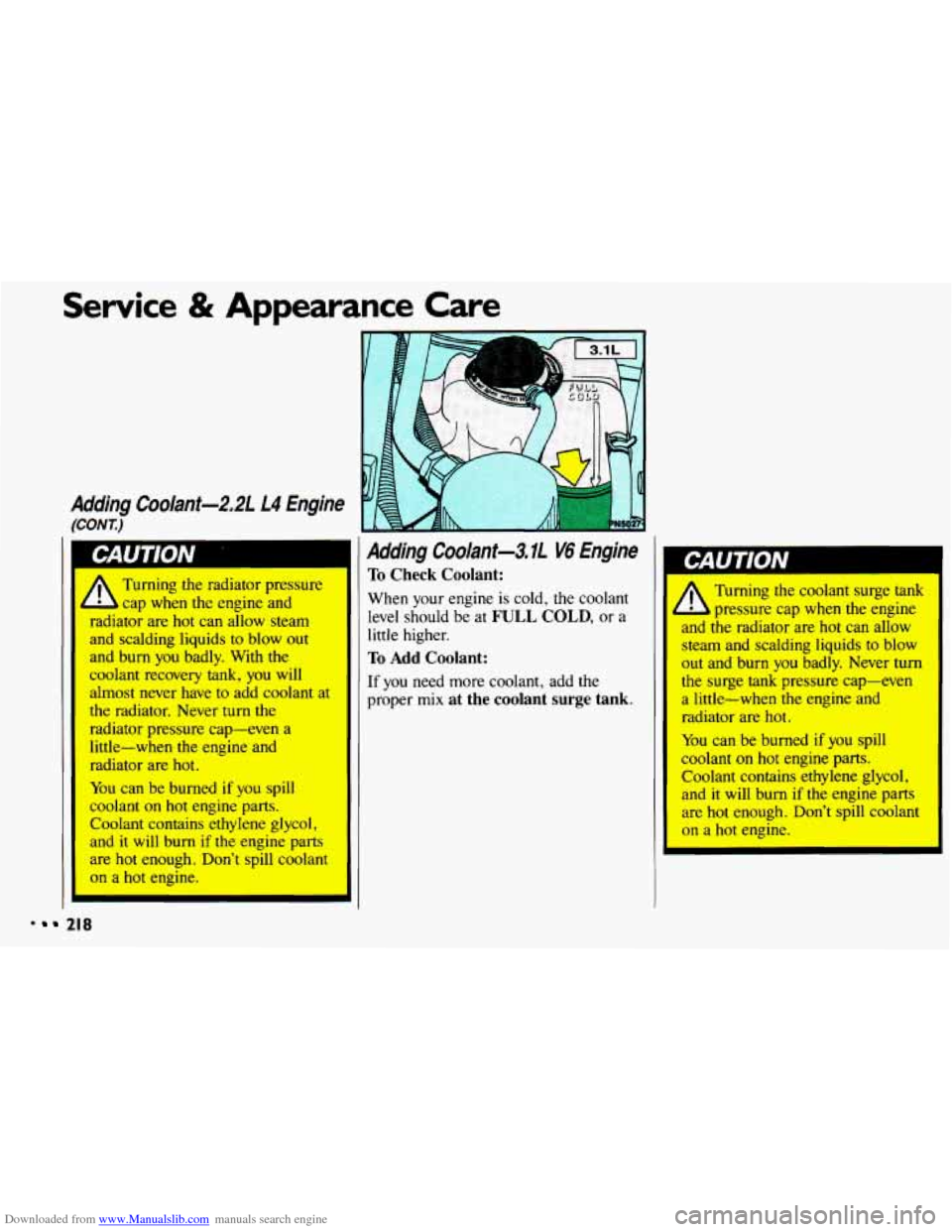
To Check Coolant:
When your engine is cold, the coolant
level should be at
FULL COLD, or a
little higher.
To Add Coolant:
If you need more coolant, add the
proper
mix at the coolant surge tank
1 I
Turning the coolant surge tank
d L pressure cap when the engine
and the radiator are hot c~ln allow
steam and scalding liquids to blow
out and
bum you badly. Never turn
the surge tank pressure cap-even
a little-when the engine and
radiator are hot.
You can be burned if you spill
coolant on
hot engine parts.
Coolant contains ethylene glycol, and
it will bum if the engine parts
are hot enough. Don’t spill coalant
on a hot engine.
- 218