check engine CHEVROLET CAVALIER 1993 1.G Workshop Manual
[x] Cancel search | Manufacturer: CHEVROLET, Model Year: 1993, Model line: CAVALIER, Model: CHEVROLET CAVALIER 1993 1.GPages: 308, PDF Size: 15.62 MB
Page 251 of 308
Downloaded from www.Manualslib.com manuals search engine Headlight Wiring
The headlight wiring is protected by a
circuit breaker in the fuseblock. An
electrical overload will cause the lights
to go on and
off, or in some cases to
remain
off. If this happens, have your
headlight system checked right away.
To access the headlight circuit breaker,
squeeze the plastic clip together and
remove.
Windsheld Wipers
The windshield wiper motor is protected
by a circuit breaker and a fuse.
If the
motor overheats due to heavy snow, etc.,
the wiper will stop until the motor
cools.
If the overload is caused by some
electrical problem, have it fixed.
Power Windows and Other
Power Options
Circuit breakers in the fuse panel protect
the power windows and other power
accessories. When the current load is
too heavy, the circuit breaker opens and
closes, protecting the circuit until the
problem is fixed.
249
Page 261 of 308
Downloaded from www.Manualslib.com manuals search engine I IMPORTANT
KEEP ENGINE OIL
AT THE PROPER
LEVEL AND CHANGE AS
RECOMMENDED
This part covers the maintenance
required for your Chevrolet. Your
vehicle needs these services to
retain its safety, dependability and
emission control performance.
Pian I
Section
Part 7
Maintenance Schedule
Have you purchased the
GM Protection Plan?
The Plan supplements your new vehicle warranties.
See your Chevrolet dealer for details.
Introduction
A Word About Maintenance . . . . . . . . . . . . . . . . . . . . . . . . . . . . . .260
Your Vehicle and the Environment
. . . . . . . . . . . . . . . . . . . . . . . , .260
How This
Part is Organized . . . . . . . . . . . . . . . . . . . . . . . . . . . . . . .261
Using Your Maintenance Schedules
. . . . . . . . . . . . . . . . . . . . . . . .262
Selecting the Right Schedule
. . . . . . . . . . . . . . . . . . . . . . . . . . . . . .262
Schedule1
............................................ 264
Schedule11
........................................... 266
Explanation of Scheduled Maintenance Services . . . . . . . . . . . . . .268
AtEachFuelFill
....................................... 271
AtLeastOnceaMonth
.................................. 271
At Least Twice a Year
. . . . . . . . . . . . . . . . . . . . . , . , . . . . . . . . . . .272
At Least Once a Year
. . . . . . . . . . . . . . . . . . . . . . . . . . . . . . . . . . . .272
C. Periodic Maintenance Inspections . . . . . . . . . . . . . . . . . . . . . . . . . . .275
D. Recommended Fluids & Lubricants . . . . . . . . . . . . . . . . . . . . . . . . .276
E. MaintenanceRecord ...................................... 279
A. Scheduled Maintenance Services
B. Owner Checks & Services
259 888
Page 262 of 308
Downloaded from www.Manualslib.com manuals search engine Maintenance Schedule
Introduction
A Word About Maintenance
We at General Motors want to help you keep your vehicle in
good working condition. But
we don’t know exactly how
you’ll drive it. You may drive very
short distances only a
few times a week. Or
you may drive long distances all the
time in very hot, dusty weather.
You may use your vehicle in
making deliveries.
Or you may drive it to work, to do
errands or in many other ways.
Because of all the different ways people use their GM vehicles,
maintenance needs vary. You may even need more frequent
checks and replacements than you will find in the schedules
in this part.
So please read this part and note how you drive.
If you have
any questions on how to keep your vehicle in
good condition, see your Chevrolet dealer, the place many
GM owners choose to have their maintenance work done.
Your dealer can be relied upon to use proper parts and
practices.
260
Your Vehicle and the Environment
Proper vehicle maintenance not only helps to keep your
vehicle in good working condition, but also helps the
environment. All recommended maintenance procedures are
important. Improper vehicle maintenance or the removal
of
important components can significantly affect the quality of
the air we breathe. Improper fluid levels or even the wrong
tire inflation can increase the level
of emissions from your
vehicle.
To help protect our environment, and to help keep
your vehicle in
good condition, please maintain your vehicle
properly.
Page 263 of 308
Downloaded from www.Manualslib.com manuals search engine How This Part is Organized
The remainder of this part is divided into five sections:
Section
A: Scheduled Maintenance Services shows what to
have done and how often. Some
of these services can be
complex,
so unless you are technically qualified and have
the necessary equipment, you should let your dealer’s
service department
or another qualified service center do
these jobs.
Performing maintenance work
on a vehicle can be
dangerous. In trying to do some jobs, you can be
seriously injured. Do your own maintenance work
only if you have the required know-how and the proper
tools and equipment for the job.
If you have any doubt,
have
a qualified technician do the work.
If you are skilled enough to do some work on your vehicle,
you will probably want to get the service information GM
publishes. You
will find a list of publications and how to get
them in this manual.
See the Index under Service
Publications.
Section B: Owner Checks & Services tells you what should
be checked whenever
you stop for fuel. It also explains what
you can easily do to help keep your vehicle
in good
condition.
Section
C: Periodic Maintenance Inspections explains
important inspections that your Chevrolet dealer’s service
department or another qualified service center should
perform.
Section
D: Recommended Fluids & Lubricants lists some
products GM recommends to help keep your vehicle
properly maintained. These products, or their equivalents,
should be used whether you do the work yourself or have it
done.
Section
E: Maintenance Record provides a place for you to
record the maintenance performed on your vehicle.
Whenever
any maintenance is performed, be sure to write it
down in this section. This
will help you determine when
your next maintenance should be done. In addition,
it is a
good idea to keep your maintenance receipts. They may be
needed to qualify your vehicle for warranty repairs.
26 I
Page 270 of 308
Downloaded from www.Manualslib.com manuals search engine Maintenance Schedule
Section A: Scheduled Maintenance Services (cont.)
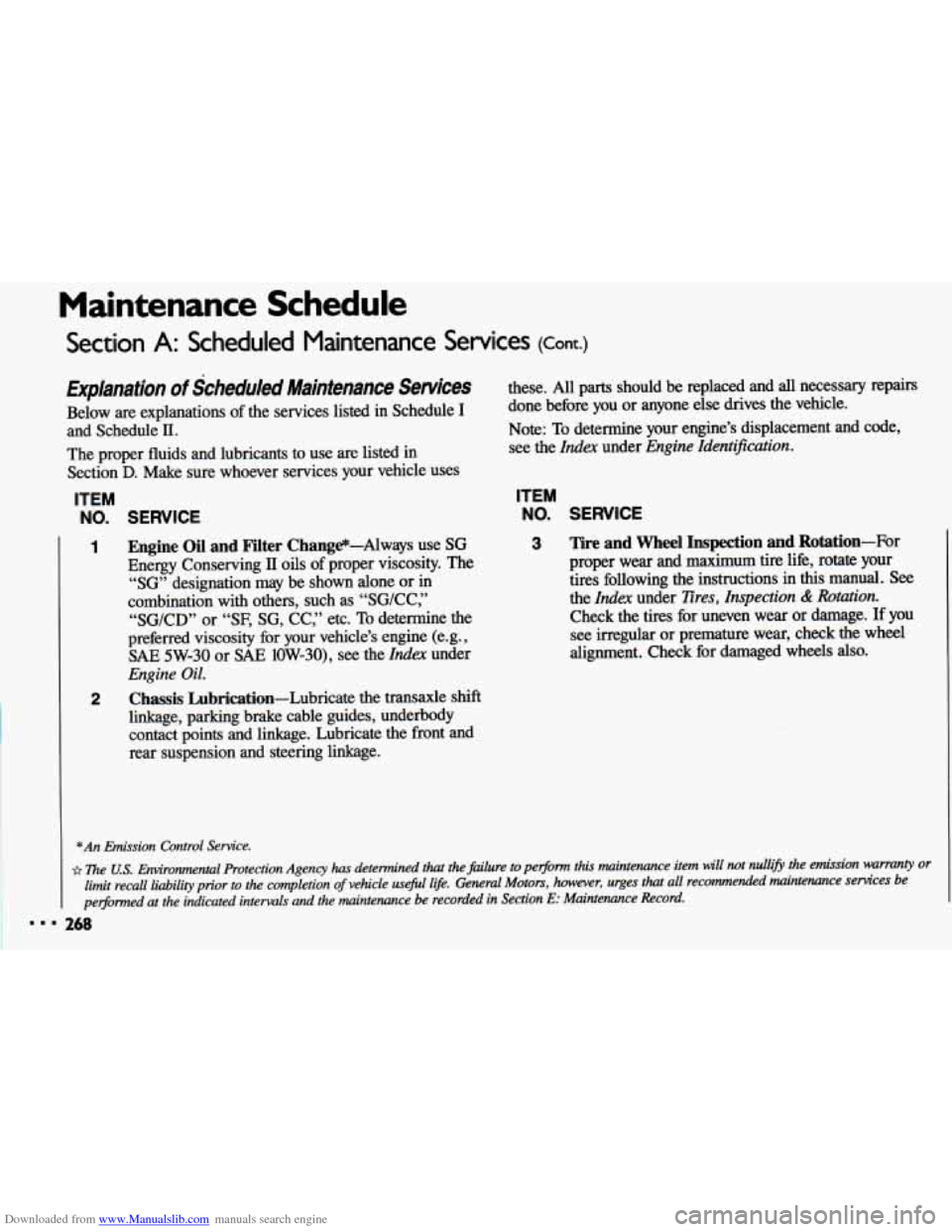
Explanation of Scheduled Maintenance Services
Below are explanations of the services listed in Schedule I
and Schedule II.
The proper fluids and lubricants to use are listed in
Section
D. Make sure whoever services your vehicle uses
ITEM
NO. SERVICE
1
2 Engine Oil and Filter Change-Always use SG
Energy Conserving
11 oils of proper viscosity. The
“SG’ designation may be shown alone or in
combination with others, such as “SG/CC,”
“SG/CD” or “SF,
SG, CC,” etc. To determine the
preferred viscosity
for your vehicle’s engine (e.g.,
SAE 5W-30 or SAE 10W-30), see the Index under
Engine Oil.
Chassis Lubrication-Lubricate the transaxle shift
linkage, parking brake cable guides, underbody
contact points and linkage. Lubricate the front and
rear suspension and steering linkage.
Emission Control
Service.
these. All parts should be replaced and all necessary repairs
done before you or anyone else drives the vehicle.
Note: To determine your engine’s displacement and code,
see the Index under Engine Identification.
ITEM
NO.
3
SERVICE
Tire and Wheel Inspection and Rotation-For
proper wear and maximum tire life, rotate your
tires following the instructions
in this manual. See
the Index under Eres, Inspection & Rotation.
Check the tires for uneven wear or damage. If you
see irregular or premature wear, check the wheel
alignment. Check for damaged wheels also.
Page 271 of 308
Downloaded from www.Manualslib.com manuals search engine ITEM
NO. SERVICE ITEM NO. SERVICE
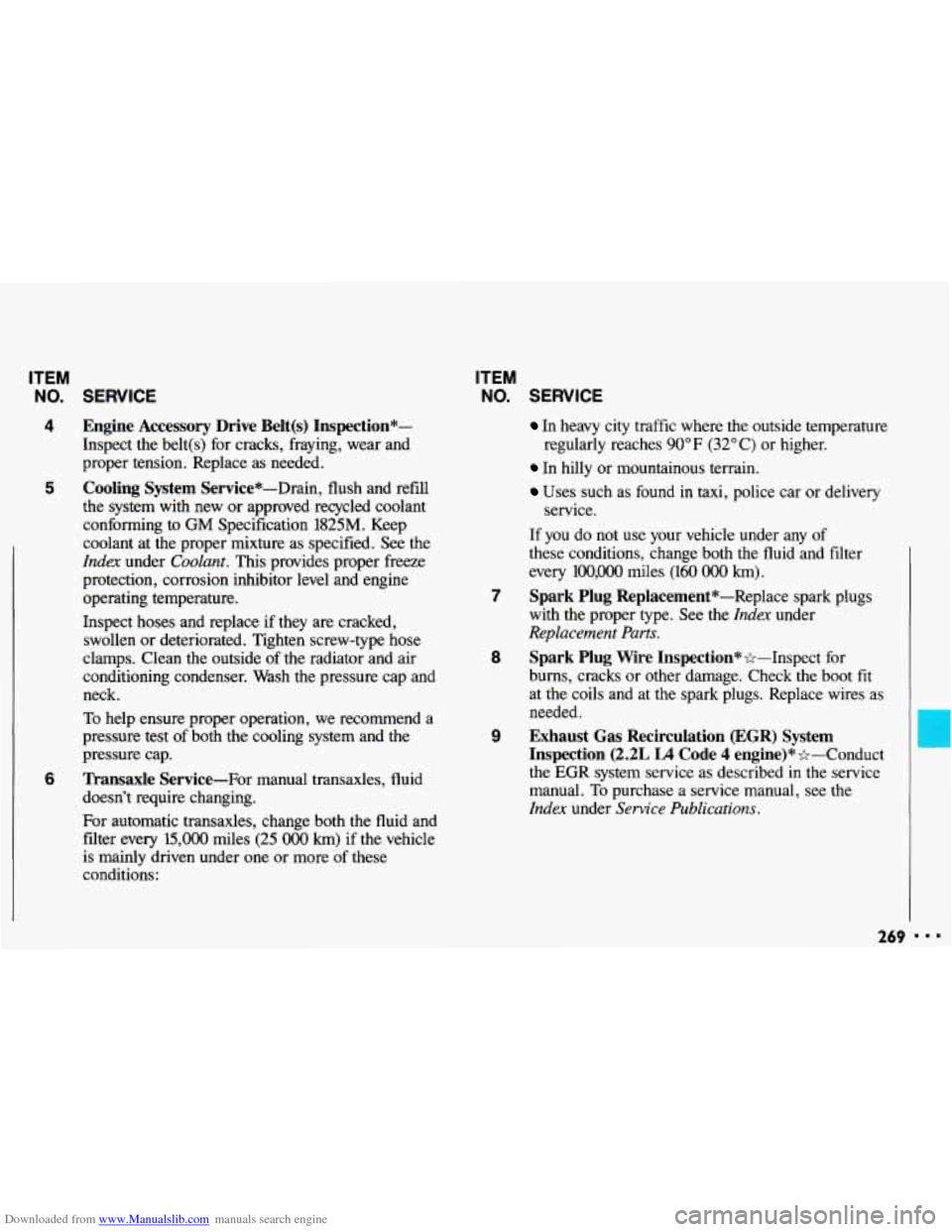
4
5
Engine
Accessory Drive Belt(s) Inspection*-
Inspect the belt(s) for cracks, fraying, wear and
proper tension. Replace as needed.
Cooling System Service*-Drain, flush and refill
the system with
new or approved recycled coolant
conforming to
GM Specification 1825M. Keep
coolant at the proper mixture as specified. See the
Index under Coolant. This provides proper freeze
protection, corrosion inhibitor level and engine
operating temperature.
Inspect hoses and replace if they are cracked,
swollen or deteriorated. Tighten screw-type hose
clamps. Clean the outside of the radiator and air
conditioning condenser. Wash
the pressure cap and
neck.
To help ensure proper operation, we recommend a
pressure test of both the cooling system and the
pressure cap.
6
7
8
9
Transaxle Service-For manual transaxles, fluid
doesn't require changing.
For automatic transaxles, change both the fluid and
filter every
15,000 miles (25 000 km) if the vehicle
is mainly driven under one or more of these
conditions:
In heavy city traffic where the outside temperature
In hilly or mountainous terrain.
Uses such as found in taxi, police car or delivery
regularly reaches
90" F (32" C) or higher.
service.
If you do not use your vehicle under any of
these conditions, change both the fluid and filter
every 100,000 miles (160
0oO km).
Spark Plug Replacement*-Replace spark plugs
with the proper type. See
the Index under
Replacement Parts.
Spark Plug Wire Inspection* *-Inspect for
burns, cracks or other damage. Check the boot
fit
at the coils and at the spark plugs. Replace wires as
needed.
Exhaust Gas Recirculation (EGR) System
Inspection
(2.2L L4 Code 4 engine)" *-Conduct
the
EGR system service as described in the service
manual. To purchase a service manual
, see the
Index under Service Publications.
Page 273 of 308
Downloaded from www.Manualslib.com manuals search engine Section B: Owner Checks & Services
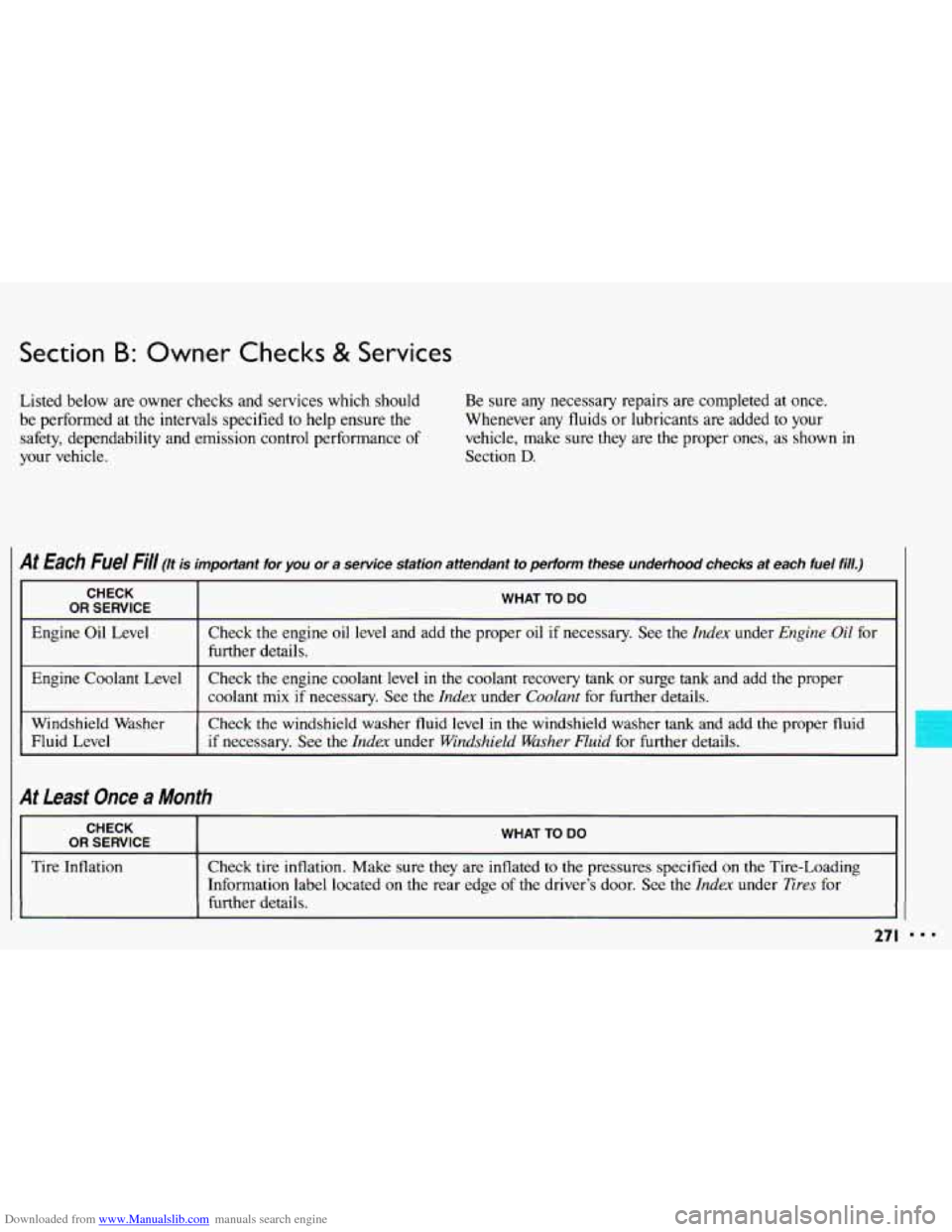
Listed below are owner checks and services which should
be performed at the intervals specified to help
ensure the
safety, dependability and emission control performance of
your vehicle. Be
sure any necessary repairs are completed at once.
Whenever any fluids or lubricants are added to your
vehicle, make sure they are the proper ones, as shown in
Section D.
At Each Fuel Fill (It is important for you or a service station attendant to perform these underhood checks at \
each fuel fill.)
CHECK
OR SERVICE I WHAT TO DO
Engine Oil Level
1
Check the engine oil level and add the proper oil if necessary. See the Index under Engine Oil for
further details.
Engine Coolant Level Check the engine coolant level
in the coolant recovery tank or surge tank and add the proper
coolant
mix if necessary. See the Index under Coolant for further details.
Windshield Washer Check the windshield washer fluid level
in the windshield washer tank and add the proper fluid
Fluid Level if necessary. See the
Index under Windshield Washer Fluid for further details. I
At Least Once a Month
CHECK
I OR SERVICE I WHAT TO DO
Tire Inflation
Check tire inflation. Make sure they are inflated to the pressures specified on the Tire-Loading
Information label located on the rear edge of
the driver’s door. See the Index under fires for
further details.
27 I I..
Page 274 of 308
Downloaded from www.Manualslib.com manuals search engine Maintenance Schedule
Section B: Owner Checks & Services (Cont.)
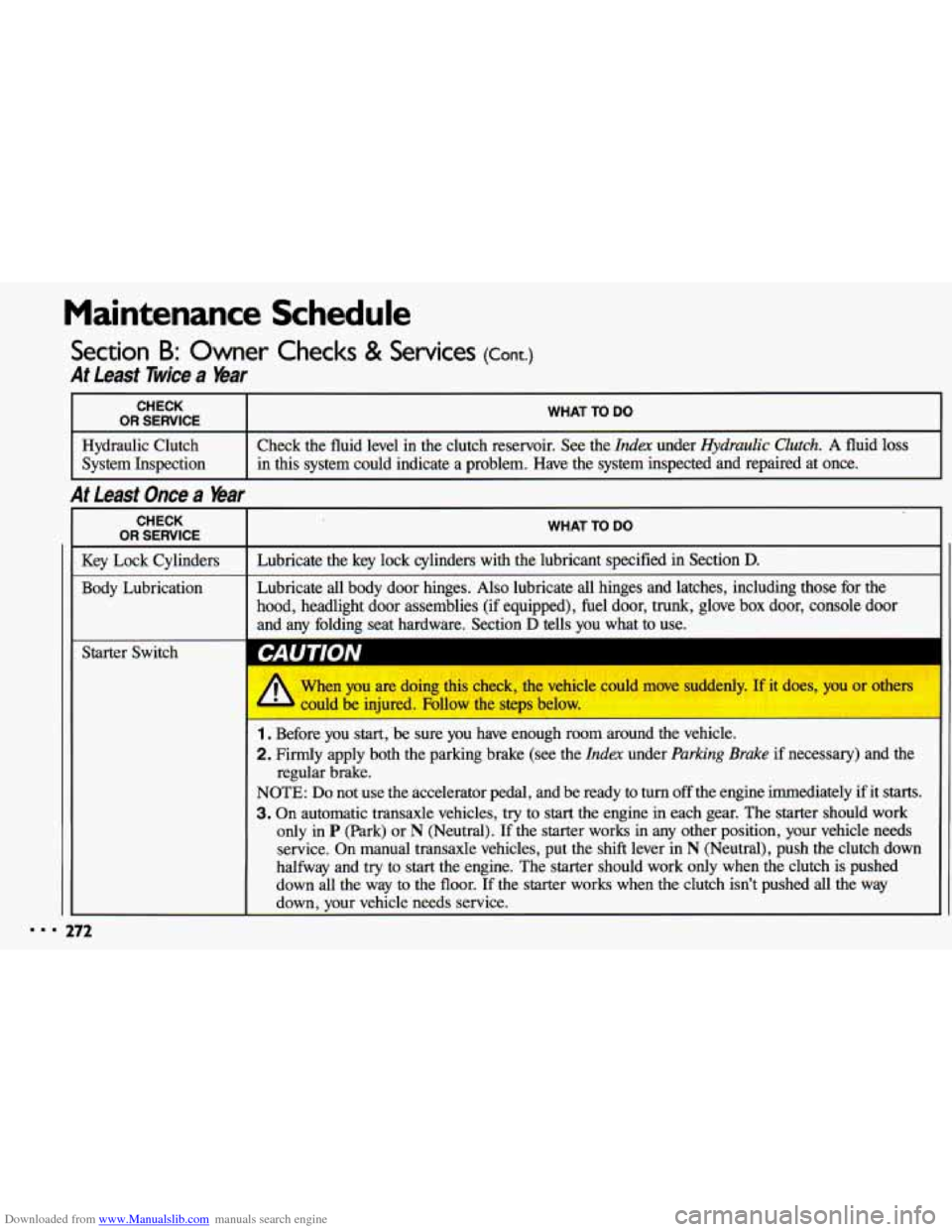
At Least Twice a Year
... L
CHECK
I OR SERVICE I WHAT TO DO
Hydraulic Clutch
in this system could indicate a problem. Have the system inspected and repaired at once. System Inspection
Check
the fluid level in the clutch reservoir. See the Index under Hydraulic Clutch. A fluid loss
At Least Once a Year
CHECK
I OR SERVICE I WHAT TO DO
I
Key Lock Cylinders I Lubricate the key lock cylinders with the lubricant specified in Section D.
Body Lubrication Lubricate all body
door hinges. Also lubricate all hinges and latches, including those \
for the
hood, headlight door assemblies (if equipped), fuel door, trunk, glove box door, console door
and any folding seat hardware. Section
D tells you what to use.
L
272
I CAUTION
1. Before you start, be sure you have enough room around the vehicle.
2. Firmly apply both the parking brake (see the Index under Parking Brake if necessary) and the
NOTE:
Do not use the accelerator pedal, and be ready to turn off the engine immediately if it starts.
3. On automatic transaxle vehicles, try to start the engine in each gear. The starter should work
only in P (Park) or N (Neutral). If the starter works in any other position, your vehicle needs
service. On manual transaxle vehicles, put the shift lever in
N (Neutral), push the clutch down
halfway and
try to start the engine. The starter should work only when the clutch is pushed
down all the way to the floor. If the starter works when the clutch isn’t pushed all the way
down, your vehicle needs service.
regular brake.
I
Page 275 of 308
Downloaded from www.Manualslib.com manuals search engine CHECK
OR SERVICE WHAT TO DO
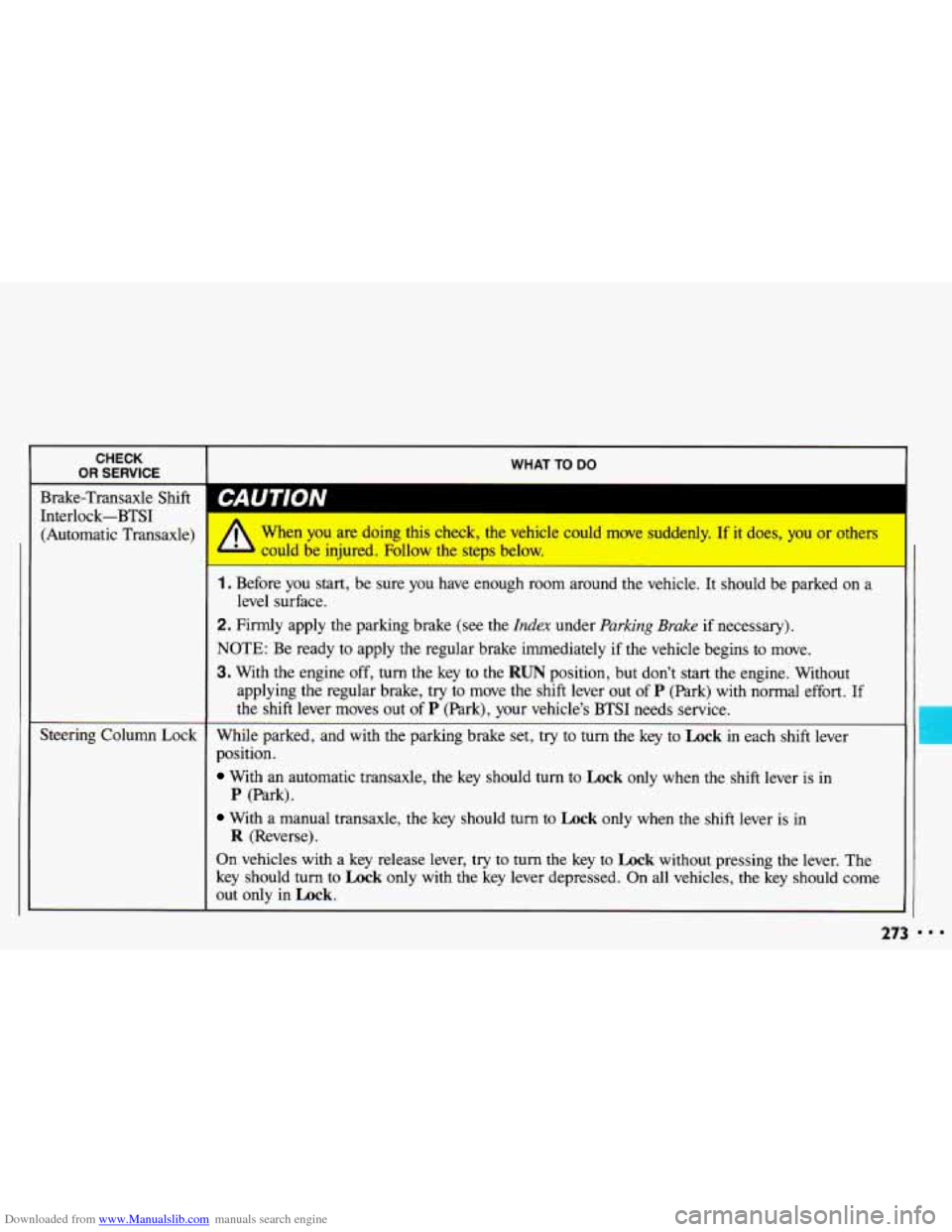
Interlock-BTSI (Automatic Transaxle
Steering Column Lock When
you are doing this check, the vehicle could move suddenly. If
it does, you or others
could be injured. Follow the steps below.
I
1. Before you start, be sure you have enough room around the vehicle. It should be parked on h
2. Firmly apply the parking brake (see the Ida under Parking Brake if necessary).
NOTE: Be ready to apply the regular brake immediately if the vehicle begins to move.
level surface.
3. With
the engine off, turn the key to the RUN position, but don’t start the engine. Without
applying the regular brake, try to move the shift lever
out of P (Park) with normal effort. If
the shift lever moves
out of P (Park), your vehicle’s BTSI needs service.
While parked, and with the parking brake set, try to turn the key
to Luck in each shift lever
position.
With an automatic transaxle, the key should turn to Lock only when the shift lever is in
P (Park).
With a manual transaxle, the key should turn to Lock only when the shift lever is in
R (Reverse).
On vehicles with a key release lever, try to turn the key to Lock without pressing the lever. The
key should
turn to Lock only with the key lever depressed. On all vehicles, the key should come
out only in
Lock.
273
Page 276 of 308
Downloaded from www.Manualslib.com manuals search engine Maintenance Schedule
Section B: Owner Checks & Services (Cont.)
At Least Once a Year (CONT:)
CHECK
OR SERVICE WHAT TO DO ~~
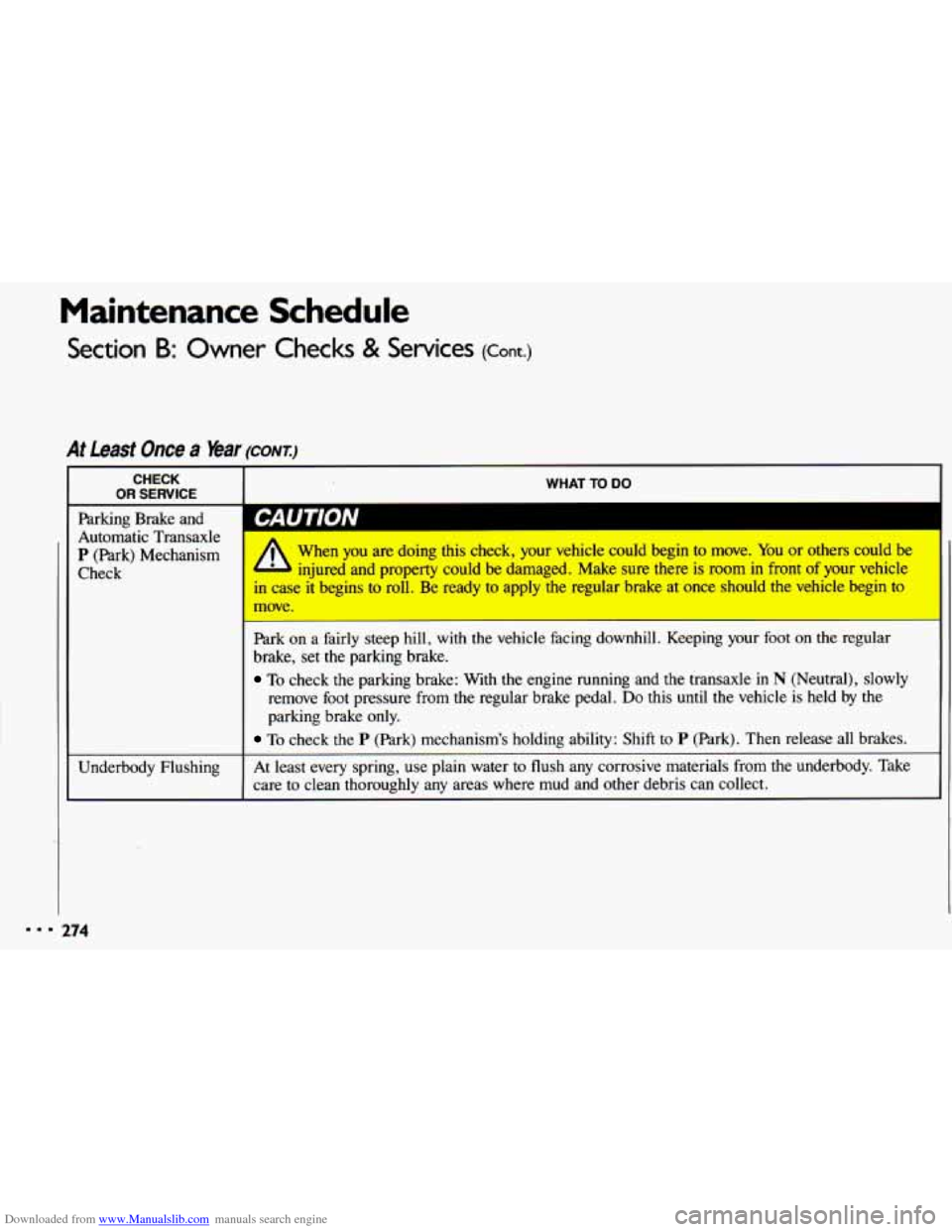
Parking Brake and
Automatic
Transaxle
P (Park) Mechanism When you are doing this check, your vehicle could begin to move. You or others could be I
Check A injured and property could be damaged. Make sure there is room in front of your vehicle
in case it begins to roll. Be ready to ~ ~ )ly the -gular brake at onc - Thould the vehicle begin to
Park on a fairly steep
hill, with the vehicle facing downhill. Keeping your foot on the regular
brake, set the parking brake.
To check the parking brake: With the engine running and the transaxle in N (Neutral), slowly
remove
foot pressure from the regular brake pedal. Do this until the vehicle is held by the
parking brake only.
To check the P (Park) mechanism’s holding ability: Shift to P (Park). Then release all brakes.
Underbody Flushing At least every spring, use plain water to flush any corrosive materials from the unde\
rbody. Take
I care to clean thoroughly any areas where mud and other debris can collect.
274