check engine light CHEVROLET CAVALIER 1994 1.G User Guide
[x] Cancel search | Manufacturer: CHEVROLET, Model Year: 1994, Model line: CAVALIER, Model: CHEVROLET CAVALIER 1994 1.GPages: 243, PDF Size: 15.06 MB
Page 121 of 243
Downloaded from www.Manualslib.com manuals search engine Your Driving and the Road
Treat a green light as a warning
signal.
A traffic light is there because
the corner is busy enough to need it.
When a light turns green, and just
before you start to move, check both
ways for vehicles that have not
cleared the intersection
or may be
running the red light. flow. Try
to merge into the gap at close
to the prevailing speed. Switch on your
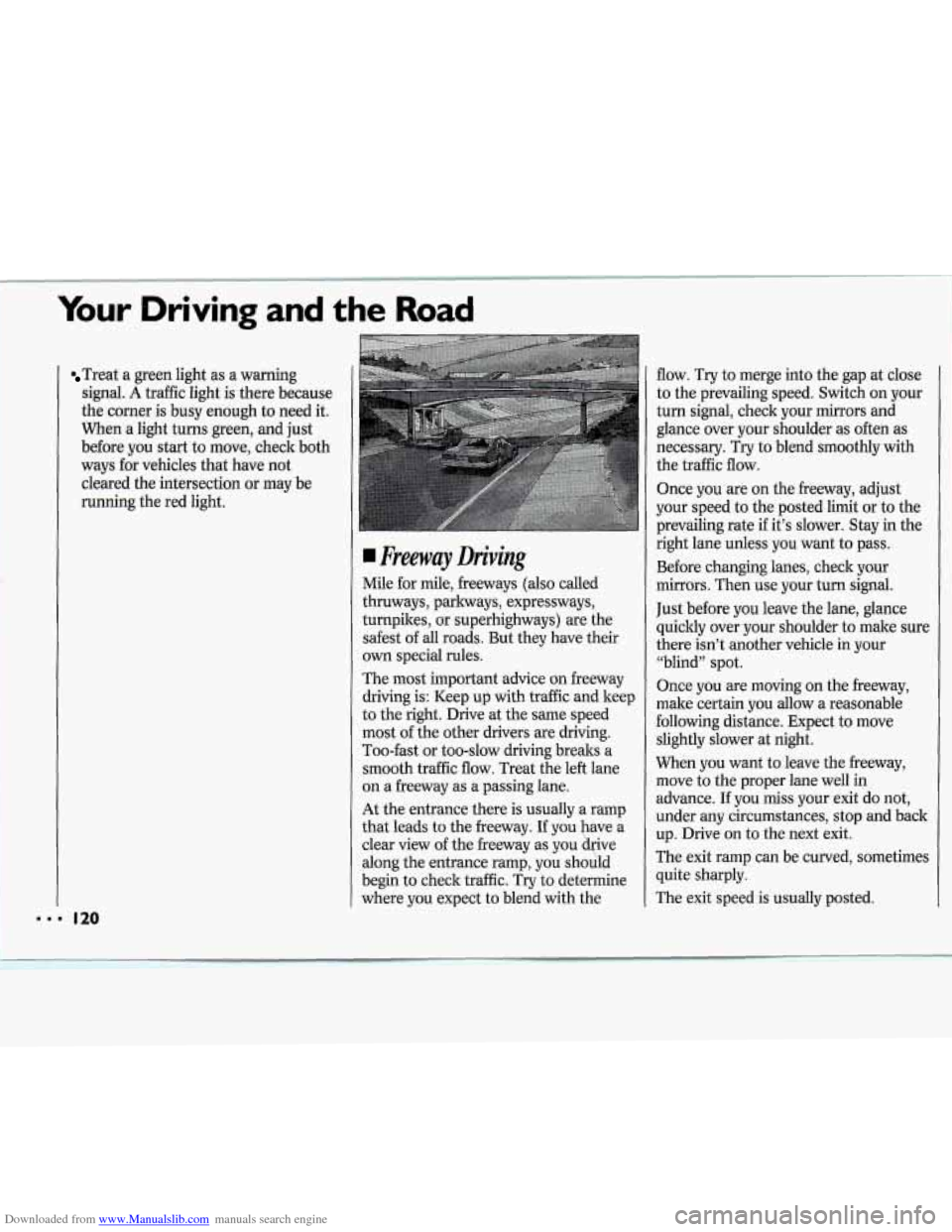
Freeway Driving ~
Mile for mile, freeways (also called
thruways, parkways, expressways,
turnpikes, or superhighways) are the
safest of all roads. But they have their
own special rules.
The most important advice on freeway
driving is: Keep up with traffic and keep
to the right. Drive at the same speed
most of the other drivers are driving.
Too-fast or too-slow driving breaks a
smooth traffic flow. Treat the left lane
on a freeway as a passing lane.
At the entrance there is usually a ramp
that leads to the freeway. If you have a
clear view of the freeway as you &ive
along the entrance ramp, you should
begin to check traffic. Try to determine
where you expect to blend with the turn
signal, check your mirrors and
glance over your shoulder as often as
necessary. Try to blend smoothly with
the traffic flow.
Once you are on the freeway, adjust
your speed to the posted limit or to the
prevailing rate if it’s slower. Stay in the
right lane unless
you want to pass.
Before changing lanes, check your
mirrors. Then use your turn signal.
Just before you leave the lane, glance
quickly over your shoulder to make sure
there isn’t another vehicle in your
“blind” spot.
Once you are moving on the freeway,
make certain you allow a reasonable
following distance. Expect to move
slightly slower at night.
When you want to leave the freeway,
move to the proper lane well in
advance. If you miss your exit do not,
under any circumstances, stop and back
up. Drive on to the next exit.
The exit ramp can be curved, sometimes
quite sharply.
The exit speed is usually posted.
.Irn I20
Page 122 of 243
Downloaded from www.Manualslib.com manuals search engine Reduce your speed according to your
speedometer, not to your sense of motion.
After driving for any distance at higher
speeds, you may tend
to think you are
going slower than you actually are.
Before Leaving on a Long
Trip
Make sure you’re ready. Try to be well
rested.
If you must start when you’re
not fresh
- such as after a day’s work
- don’t plan to make too many miles
that first part
of the journey. Wear
comfortable clothing and shoes you can
easily drive in.
Is your vehicle ready for a long trip? If
you keep it serviced and maintained, it’s
ready to
go. If it needs service, have it
done before starting out. Of course,
you’ll find experienced and able service
experts in Chevrolet dealerships all
across North America. They’ll be ready
and willing to help
if you need it.
Here are some things you can check
before a trip:
Windshield Washer Fluid Is the
reservoir full? Are all windows clean
inside and outside?
Wiper Blades: Are they in good
shape?
Fuel, Engine Oil, Other Fluids: Have
you checked all levels?
Lights: Are they all working? Are the
lenses clean?
Tires: They are vitally important to a
safe, trouble-free trip.
Is the tread
good enough for long-distance
driving? Are the tires all inflated to
the recommended pressure?
weather outlook along your route?
Should you delay your trip a short
time to avoid a major storm system?
Maps: Do you have up-to-date maps?
Weather Forecasts: What’s the
Highway Hypnosis
Is there actually such a condition as
“highway hypnosis”? Or is it just plain
falling asleep at the wheel? Call it
highway hypnosis, lack
of awareness, or
whatever.
There is something about an easy
stretch of road with the same scenery,
along with the hum of the tires on the
road, the drone
of the engine, and the rush
of the wind against the vehicle that
can make you sleepy. Don’t let it
happen to you! If it does, your vehicle
can leave the road in
less than a
second,
and you could crash and be
injured.
What can you do about highway
hypnosis? First, be aware that it can
happen.
Then here are some tips:
Make sure your vehicle is well
ventilated, with a comfortably cool
interior.
Keep your eyes moving. Scan the road
ahead and to the. sides. Check your
rearview mirrors and your
instruments frequently.
If you get sleepy, pull off the road into
a rest, service, or parking area and
take a nap, get some exercise, or both.
For safety, treat drowsiness
on the
highway as an emergency.
a
Page 130 of 243
Downloaded from www.Manualslib.com manuals search engine NOTICE:
Ignoring these steps could result in
costly damage to your vehicle that
wouldn’t be covered by your
warranty. Trying to start your
Chevrolet by pushing or pulling it
could damage your vehicle, even if
you have a manual transaxle. And
if
you have an automatic transaxle, it
won’t start that way.
To Jump Start Your Chevrolet:
1. Check the other vehicle. It must have
a 12-volt battery with a negative
ground system.
NOTICE:
If the other system isn’t a 12-volt
system with
a negative ground,
both vehicles can be damaged.
2. Get the vehicles. close enough so the
jumper cables can reach, Ijut be suke
the vehicles aren’t touching each
other. If they are, it could cause a
ground connection you don’t want.
You wouldn’t be able to start your
Chevrolet, and the bad grounding
could damage the electrical systems.
You could be injured if the vehicles roll.
Set the parking brake
firmly on each
vehicle. Put an automatic transaxle in
P (Park) or a manual transaxle in
N (Neutral).
3.
Turn off the ignition on both
vehicles. Turn
off all lights that aren’t
needed, and radios. This
will avoid
sparks and help save both batteries.
And
it could save your radio!
NOTICE:
If you leave your radio on, it could
be badly damaged. The repairs
wouldn’t
be covered by your warranty.
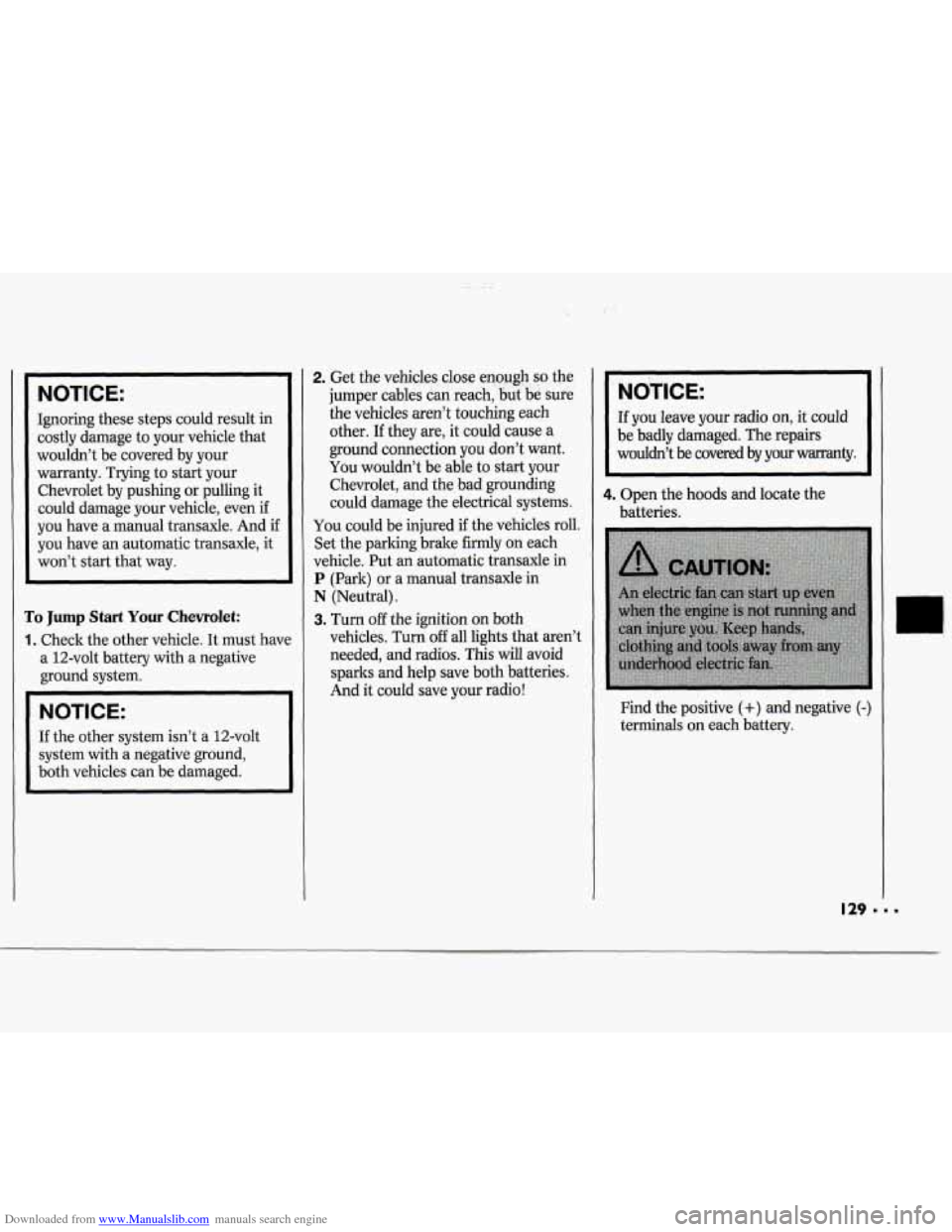
4. Open the hoods and locate the
batteries.
Find the positive
(+) and negative (-)
terminals on each battery.
Page 163 of 243
Downloaded from www.Manualslib.com manuals search engine Service & Appearance Care
Engine Oil
If the oil warning light on the
instrument panel comes on, it means
you need to check your engine oil level
right away. For more information, see
Engine Oil Warning Light in the Index.
You should check your engine oil level
regularly; this is an added reminder.
It’s a good idea to check your engine oil
every time you get fuel. In order to get
an accurate reading, the oil must be
warm and the vehicle must be on level
ground.
Turn
off the engine and give the oil a
few minutes to drain back into the oil
pan. If you don’t, the oil dipstick might
not show the actual level.
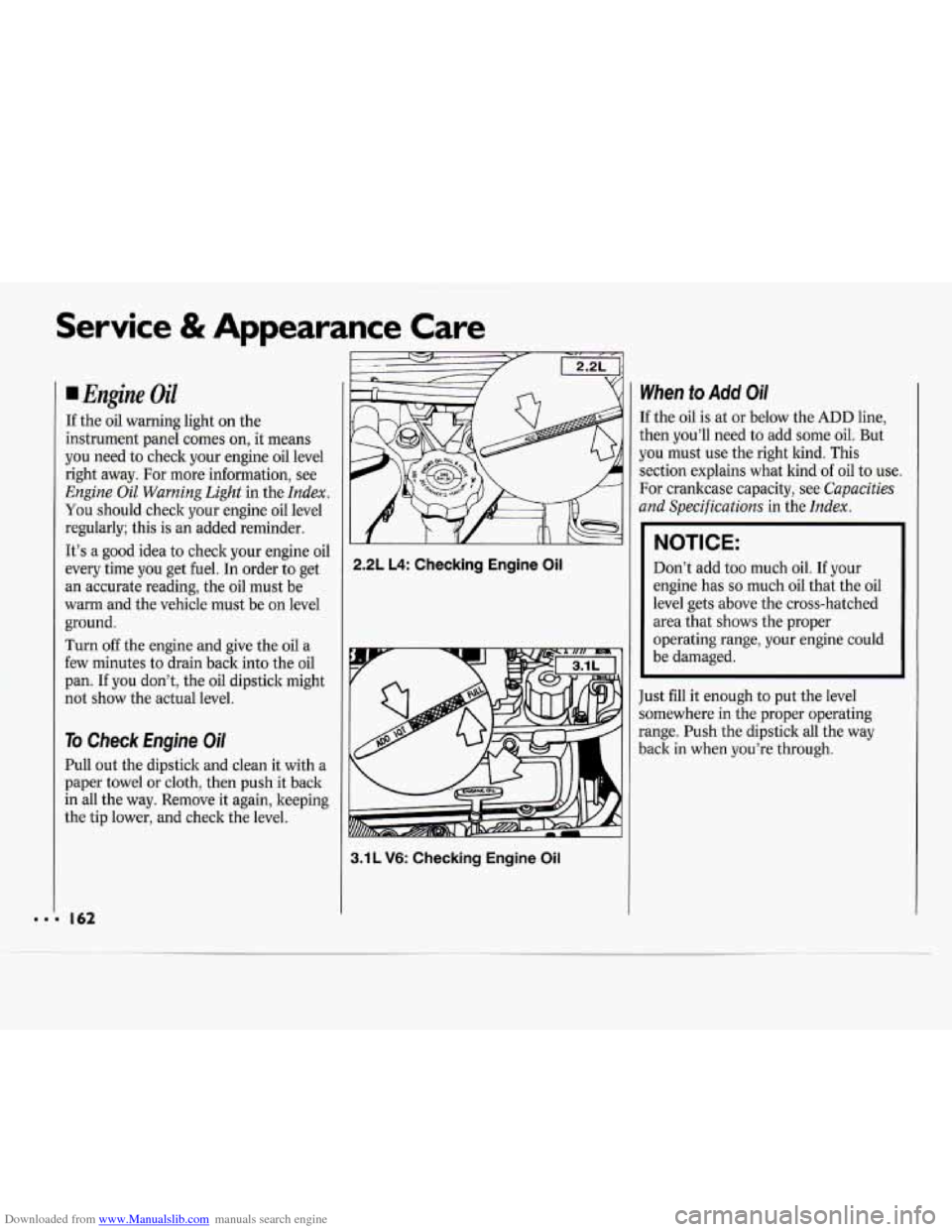
To Check Engine Oil
Pull out the dipstick and clean it with a
paper towel or cloth, then push it back
in all the way. Remove it again, keeping
the tip lower, and check the level.
2.2L L4: Checking Engine Oil
3.1 L V6: Checking Engine Oil
When to Add Oi/
If the oil is at or below the ADD line,
then you’ll need to add some oil. But
you must use the right kind. This
section explains what kind of oil to use.
For crankcase capacity, see
Capacities
and Specifications
in the Index.
NOTICE:
Don’t add too much oil. If your
engine has
so much oil that the oil
level gets above the cross-hatched
area that shows the proper
operating range, your engine could
be damaged.
Just
fill it enough to put the level
somewhere in the proper operating
range. Push the dipstick all the way
back in when you’re through.
Page 171 of 243
Downloaded from www.Manualslib.com manuals search engine ~~ ~ Service & Appearance Care
170
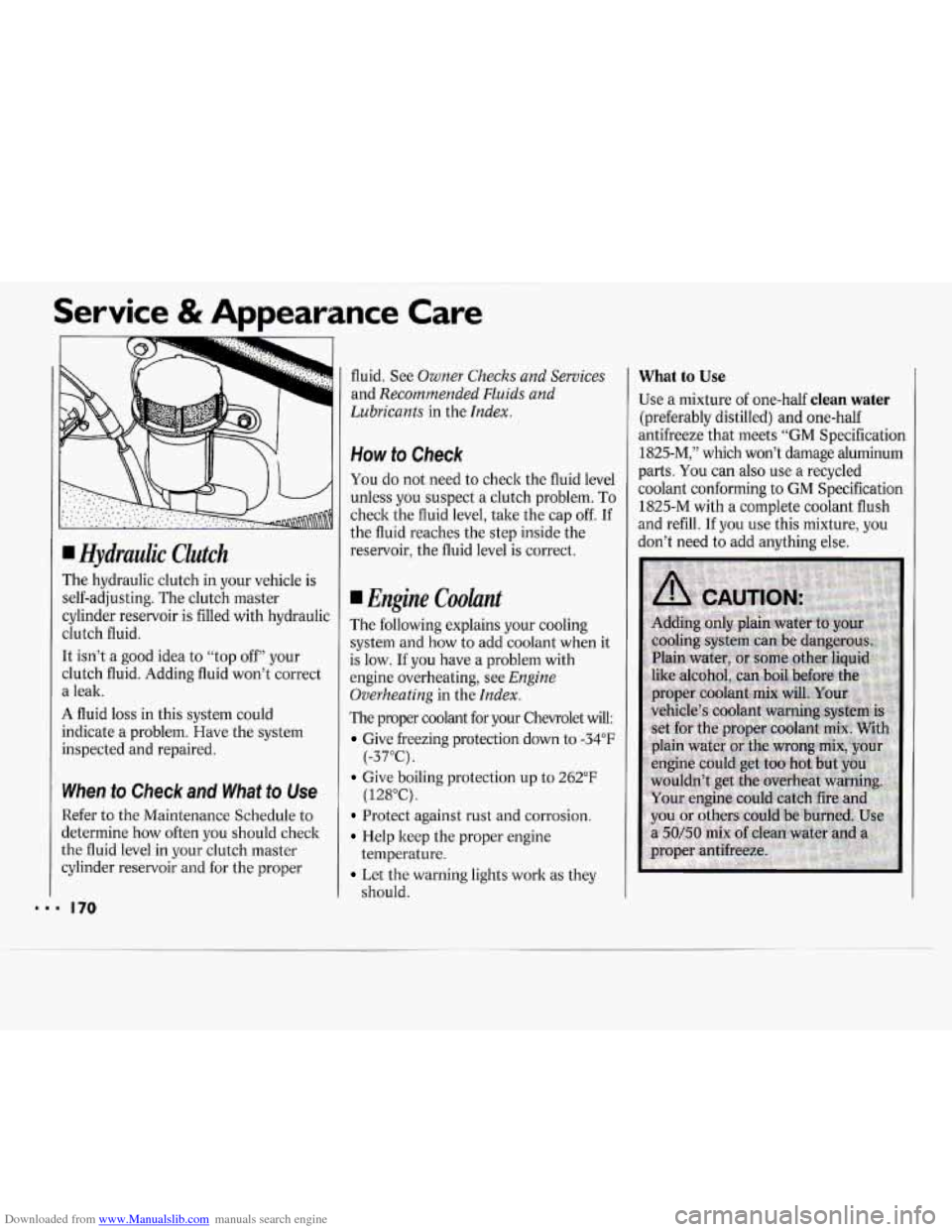
I Hydraulic Clutch
The hydraulic clutch
in your vehicle is
self-adjusting. The clutch master
cylinder reservoir is filled with hydraulic
clutch fluid.
It isn’t
a good idea to “top off” your
clutch fluid. Adding fluid won’t correct
a leak.
A fluid loss in this system could
indicate a problem. Have the system
inspected and repaired.
When to Check and What to Use
Refer to the Maintenance Schedule to
determine how often
you should check
the fluid level in your clutch master
cylinder reservoir and for the proper fluid. See
Owner Checks and
Services
and Recommended Fluids and
Lubricants
in the Index.
How to Check
You do not need to check the fluid level
unless you suspect a clutch problem.
To
check the fluid level, take the cap off. If
the fluid reaches the step inside the
reservoir, the fluid level is correct.
I Engine Coolunt
The following explains your cooling
system and how
to add coolant when it
is low.
If you have a problem with
engine overheating, see
Engine
Overheating
in the Index.
The proper coolant for your Chevrolet will:
Give freezing protection down to -34°F
Give boiling protection up to 262°F
Protect against rust and corrosion.
Help keep the proper engine
Let the warning lights work as they
(-37°C).
(128°C).
temperature.
should.
What to Use
Use a mixture
of one-half clean water
(preferably distilled) and one-half
antifreeze that meets “GM Specification
1825-M,” which won’t damage aluminum
parts. You can also use a recycled
coolant conforming to GM Specification
1825-M with
a complete coolant flush
and refill. If you use this mixture, you
don’t need to add anything else.
Page 197 of 243
Downloaded from www.Manualslib.com manuals search engine Service & Appearance Care
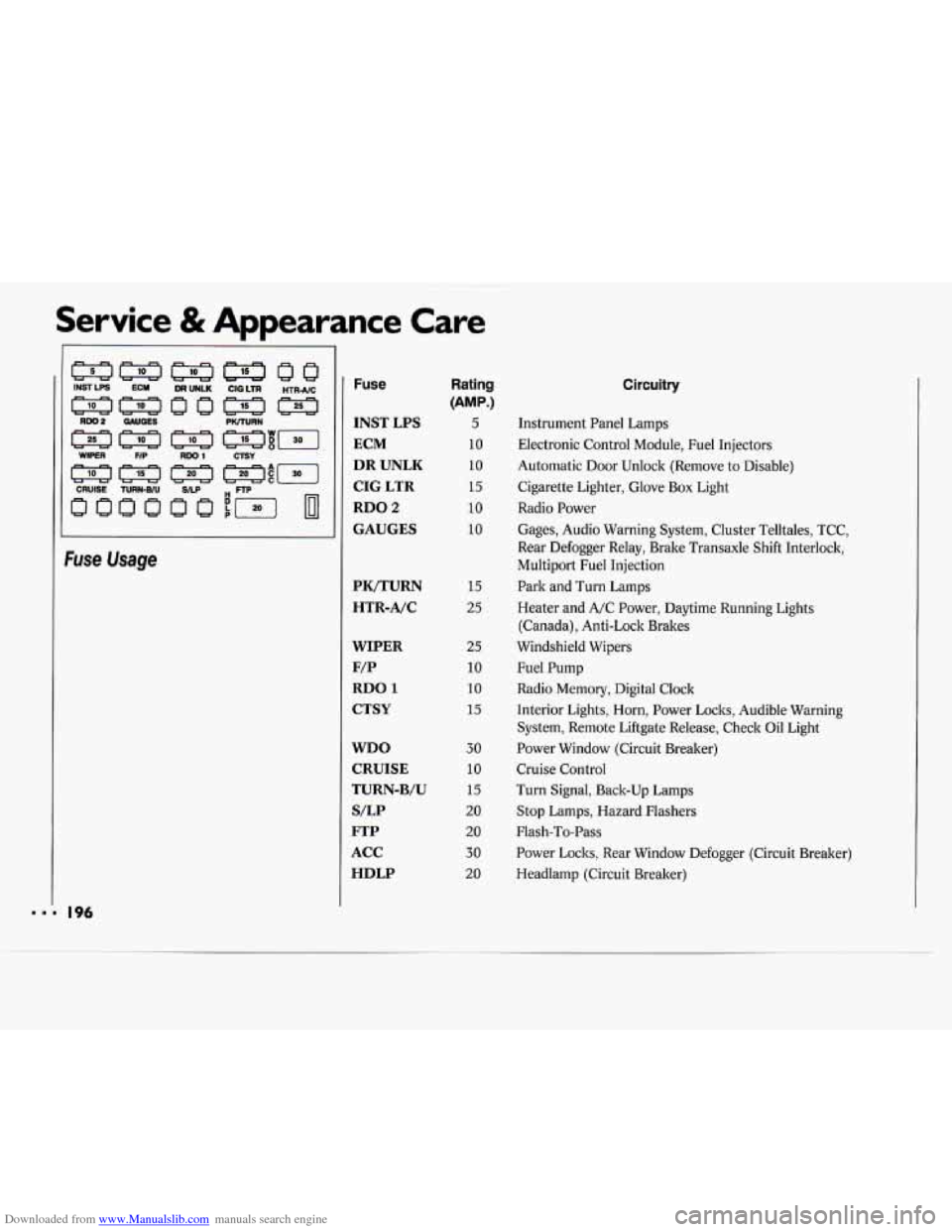
Vse Usage 1
196
Fuse
INST LPS
ECM
DR UNLK
CIG LTR
RDO 2
GAUGES
PIUTURN
HTR-A/C
WIPER
F/P
RDO
1
CTSY
WDO CRUISE
TURN-B/U S/LP
FTP
ACC HDLP
Rating
(AMP.)
5
10
10
15
10
10
15
25
25
10
10
15
30
10
15
20
20
30
20
Circuitry
Instrument Panel Lamps
Electronic Control Module, Fuel Injectors
Automatic Door Unlock (Remove to Disable)
Cigarette Lighter, Glove Box Light
Radio Power
Gages, Audio Warning System, Cluster Telltales, TCC,
Rear Defogger Relay, Brake Transaxle Shift Interlock,
Multiport Fuel Injection
Park and Turn Lamps
Heater and A/C Power, Daytime Running Lights
(Canada), Anti-Lock Brakes
Windshield Wipers
Fuel Pump Radio Memory, Digital Clock
Interior Lights, Horn, Power Locks, Audible Warning
System, Remote Liftgate Release, Check Oil Light
Power Window (Circuit Breaker)
Cruise Control
Turn Signal, Back-Up Lamps
Stop Lamps, Hazard Flashers
Flash-To-Pass
Power Locks, Rear Window Defogger (Circuit Breaker)
Headlamp (Circuit Breaker)
Page 198 of 243
Downloaded from www.Manualslib.com manuals search engine Headlight Wiring
The headlight wiring is protected by a
circuit breaker in the fuseblock. An
electrical overload will cause the lights
to go on and off, or in some cases
to
remain off. If this happens, have your
headlight system checked right away.
To access the headlight circuit breaker,
squeeze the plastic clip together and
remove.
Windshield Wipers
The windshield wiper motor is
protected by
a circuit breaker and a
fuse. If the motor overheats due to
heavy snow, etc., the wiper will stop
until the motor cools.
If the overload is
caused by some electrical problem, have
it fixed.
Power Windows and Other Power
Options
Circuit breakers in the fuse panel
protect the power windows and other
power accessories. When the current
load is too heavy, the circuit breaker
opens and closes, protecting the circuit
until the problem is fixed.
Page 217 of 243
Downloaded from www.Manualslib.com manuals search engine Maintenance Schedule
Section C: Periodic Maintenance Inspections
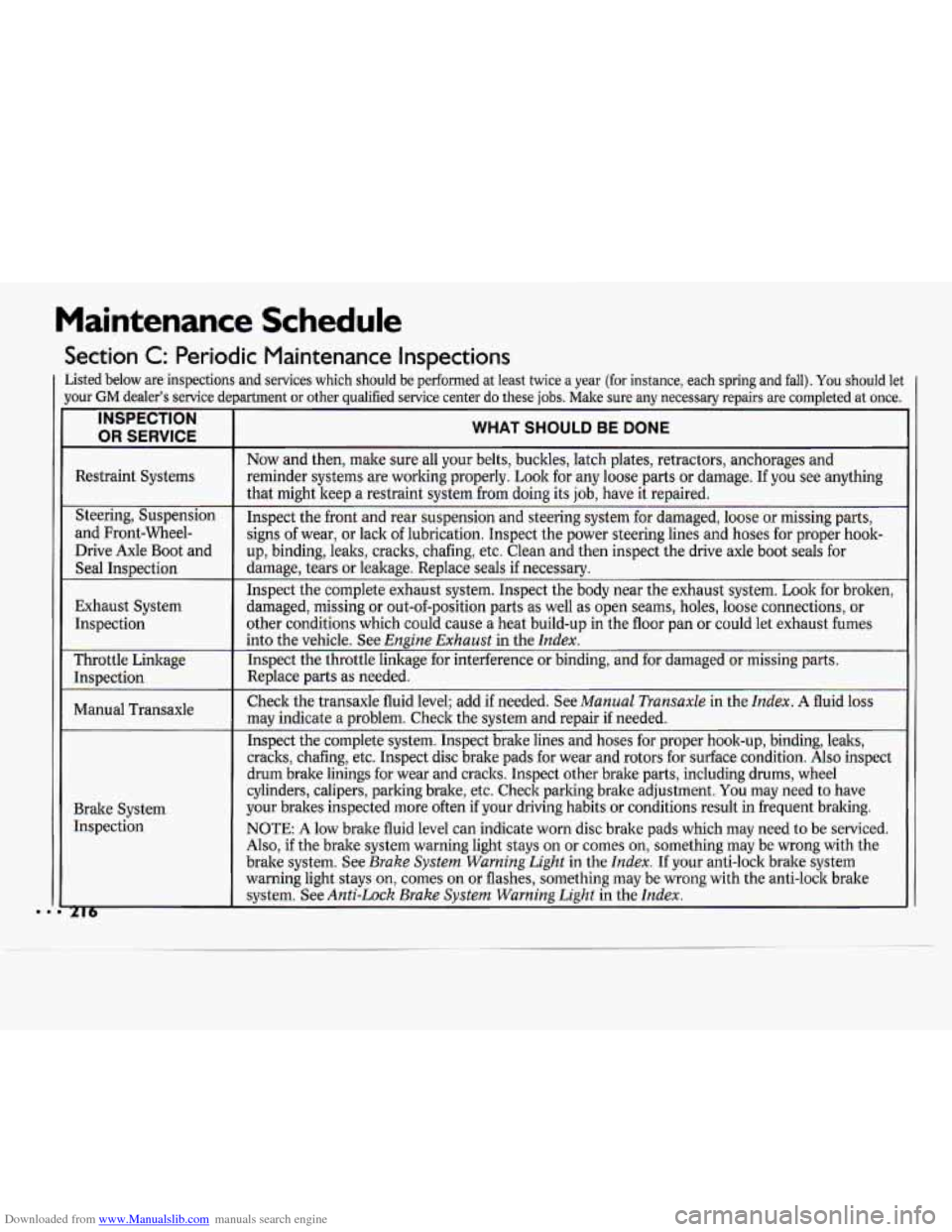
Listed below are inspections and services which should be performed at least twice a year (for instance, each spring and fall). You should let
Jour
GM dealer’s service department or other qualified service center \
do these jobs. Make sure any necessary repairs are completed at once.
INSPECTION
OR SERVICE
Restraint Systems
Steering, Suspension
and Front-Wheel-
Drive Axle Boot and
Seal InsDection
Exhaust System Inspection
Throttle Linkage Inspection
Manual Transaxle
Brake System Inspection
216
WHAT SHOULD BE DONE
Now and then, make sure all your belts, bucltles, latch plates, retractors, anchorages and
reminder systems are worlting properly. Look for any loose parts or damage. If you see anything
that might keep a restraint system from doing its job, have it repaired.
Inspect the front and rear suspension and steering system for damaged, loose or \
missing parts,
signs of wear, or lack
of lubrication. Inspect the power steering lines and hoses for proper hook-
up, binding, leaks, cracks, chafing, etc. Clean and then inspect the drive axle boot seals for
damage, tears or leakage. Replace seals if necessary.
~ ~~~~~~
Inspect the complete exhaust system. Inspect the body near the exhaust system. Look for broken,
damaged, missing or out-of-position parts as well as open seams, holes, loose connections, or
other conditions which could cause a heat build-up in the floor pan or could let exhaust fumes
into the vehicle. See
Engine Exhaust in the Index.
Inspect the throttle linkage for interference or binding, and for damaged or missing parts.
Replace parts as needed.
.-
Check the transaxle fluid level; add if needed. See Manual Transaxle in the Index. A fluid loss
may indicate a problem. Check the system and repair if needed.
Inspect the complete system. Inspect brake lines and hoses for proper hook-\
up, binding, leaks,
cracks, chafing, etc. Inspect disc brake pads for wear and rot\
ors for surface condition. Also inspect
drum brake linings for wear and cracks. Inspect other brake parts, including drums, wheel
cylinders, calipers, parking brake, etc. Check parking brake adj\
ustment. You may need to have
your brakes inspected more often if your driving habits or conditions result in frequent braking.
NOTE: A low brake fluid level can indicate worn disc brake pads which \
may need to be serviced.
Also, if the brake system warning light stays on or comes
on, something may be wrong with the
brake system. See
Brake System Warning Light in the Index. If your anti-lock brake system
warning light stays on, comes on or flashes, something may be wrong with the anti-lock brake
system. See
Anti-Lock Brake System Warning Light in the Index.
11
.
Page 234 of 243
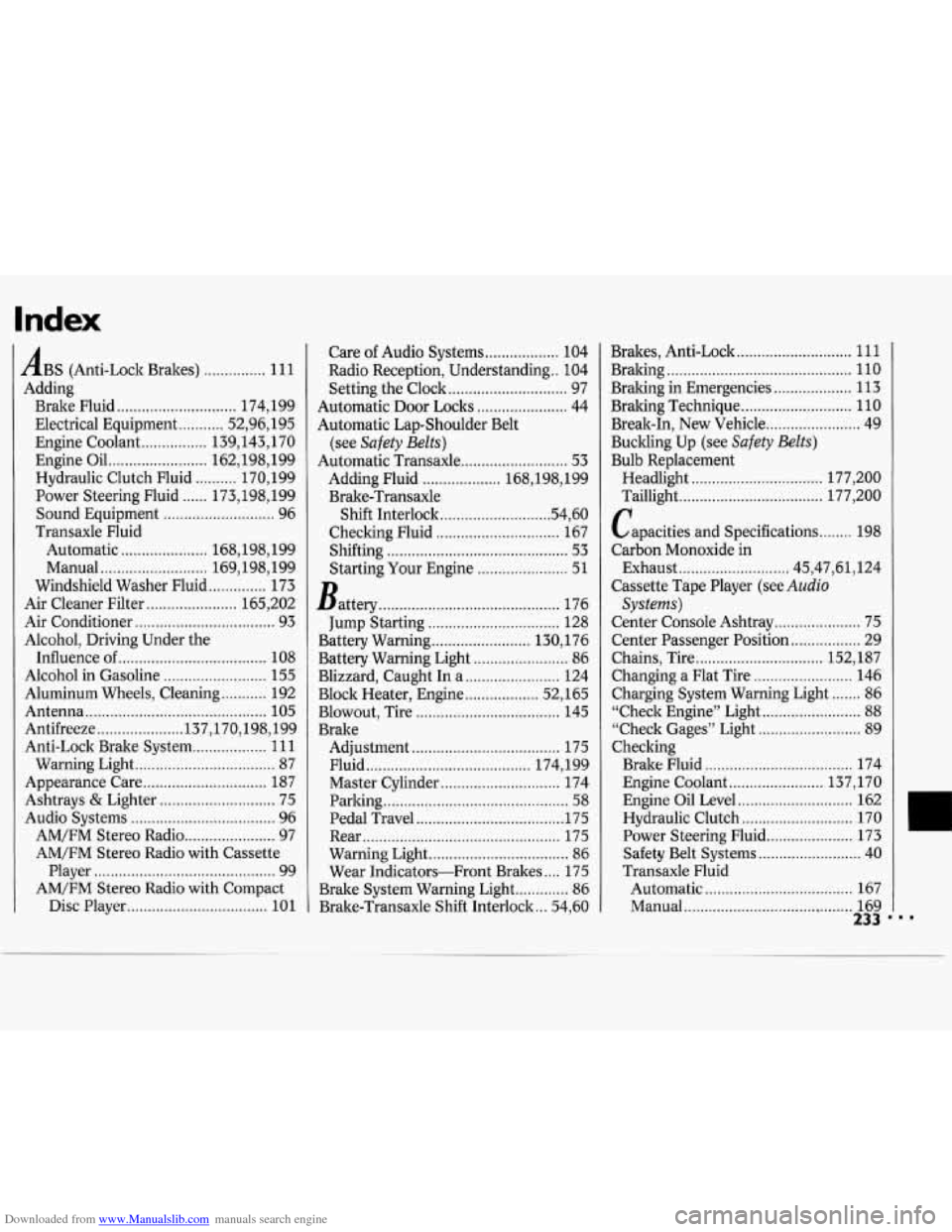
Downloaded from www.Manualslib.com manuals search engine Index
ABS (Anti-Lock Brakes) ............... 11 1
Adding
Brake Fluid
............................. 174. 199
Engine Coolant
................ 139.143. 170
Engine Oil
........................ 162,198, 199
Hydraulic Clutch Fluid
.......... 170, 199
Power Steering Fluid
...... 173,198, 199
Sound Equipment ........................... 96
Transaxle Fluid
Automatic
..................... 168,198, 199
Manual
.......................... 169,198, 199
Windshield Washer Fluid
.............. 173
Air Cleaner Filter
...................... 165, 202
Air Conditioner
.................................. 93
Alcohol. Driving Under the
Influence of
.................................... 108
Alcohol in Gasoline
......................... 155
Antenna ............................................ 105
Antifreeze ..................... 137,170,198, 199
Anti-Lock Brake System
.................. 111
Warning Light .................................. 87
Appearance Care
.............................. 187
Ashtrays & Lighter ............................ 75
Audio Systems
................................... 96
AM/FM Stereo Radio
...................... 97
AM/FM Stereo Radio with Cassette
Player
............................................ 99
AM/FM Stereo Radio with Compact
Disc Player
.................................. 101
Electrical
Equipment
........... 52.96. 195
Aluminum Wheels, Cleaning
........... 192 Care
of Audio
Systems .................. 104
Radio Reception. Understanding
.. 104
Setting the Clock
............................. 97
Automatic Door Loclts
...................... 44
Automatic Lap-Shoulder Belt
(see
Safety Belts)
Automatic Transaxle .......................... 53
Adding Fluid ................... 168.198. 199
Brake-Transaxle Shift Interlock..
........................ .54. 60
Checking Fluid
.............................. 167
Shifting
............................................ 53
Starting Your Engine ...................... 51
Battery
............................................ 176 .
Jump Starting ................................ 128
Battery Warning
........................ 130. 176
Battery Warning Light
....................... 86
Blizzard. Caught In
a ....................... 124
Block Heater. Engine
.................. 52. 165
Blowout. Tire
................................... 145
Brake Adjustment
.................................... 175
Fluid
........................................ 174. 199
Master Cylinder ............................. 174
Parking
............................................. 58
Pedal Travel .................................... 175
Rear
................................................ 175
Warning Light
.................................. 86
Wear Indicators-Front Brakes .... 175
Brake System Warning Light
............. 86
Brake-Transaxle Shift Interlock ... 54. 60 Brakes. Anti-Lock
............................ 111
Bralcing ............................................. 110
Bralcing in Emergencies
................... 113
Braking Technique ........................... 110
Break-In. New Vehicle
....................... 49
Buckling
Up (see Safety Belts)
Bulb Replacement
Headlight
................................ 177, 200
Taillight
................................... 177, 200
Capacities and Specifications
........ 198
Carbon Monoxide in
Exhaust
........................... 45,47,61, 124
Cassette Tape Player (see
Audio
Systems)
Center Console Ashtray ..................... 75
Center Passenger Position
................. 29
Chains, Tire
............................... 152, 187
Changing
a Flat Tire ........................ 146
Charging System Warning Light
....... 86
“Check Engine” Light ........................ 88
“Check Gages” Light ......................... 89
Checking
Brake Fluid
.................................... 174
Engine Coolant
....................... 137, 170
Engine Oil Level
............................ 162
Hydraulic Clutch
........................... 170
Power Steering Fluid
..................... 173
Safety Belt Systems
......................... 40
Transaxle Fluid
Automatic
.................................... 167
Manual
................................ ,. ........ 169
233
Page 235 of 243
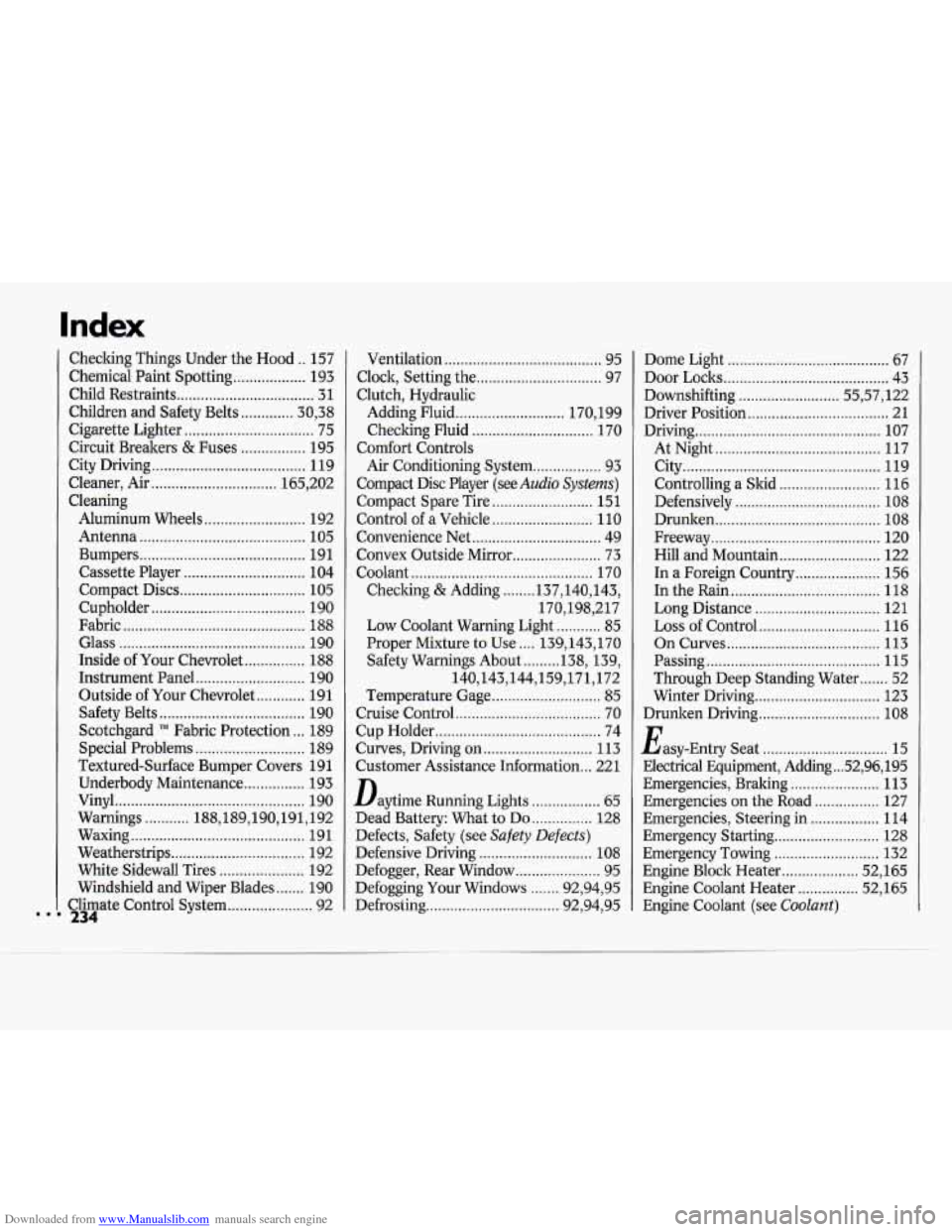
Downloaded from www.Manualslib.com manuals search engine Checking Things Under the Hood .. 157
Child Restraints
.................................. 31
Children and Safety Belts ............. 30. 38
Cigarette Lighter
................................ 75
Circuit Breakers
& Fuses ................ 195
City Driving.,
.................................... 119
Cleaner. Air ............................... 165. 202
Cleaning Chemical
Paint Spotting
.................. 193
Aluminum Wheels
......................... 192
Antenna
......................................... 105
Bumpers
......................................... 191
Cassette Player .............................. 104
Compact Discs
............................... 105
Cupholder
...................................... 190
Fabric
............................................. 188
Glass .............................................. 190
Inside of Your Chevrolet
............... 188
Instrument Panel ........................... 190
Outside of Your Chevrolet
............ 191
Safety Belts
.................................... 190
Scotchgard
TM Fabric Protection ... 189
Textured-Surface Bumper Covers 191
Underbody Maintenance
............... 193
Vinyl
............................................... 190
Warnings
........... 188,189,190,191, 192
Waxing
........................................... 191
Weatherstrips
................................. 192
White Sidewall Tires
..................... 192
Windshield and Wiper Blades
....... 190
Climate Control System
..................... 92
Special Problems
........................... 189
234
Ventilation ....................................... 95
Clock. Setting the
............................... 97
Clutch, Hydraulic Adding Fluid
........................... 170, 199
Checking Fluid
.............................. 170
Comfort Controls
Compact Disc Player (see
Audio Systems)
Compact Spare Tire ......................... 151
Control of
a Vehicle ......................... 110
Convenience Net
................................ 49
Convex Outside Mirror
...................... 73
Coolant
............................................. 170
Checking
& Adding ........ 137,140,143,
170,198, 217
Low Coolant Warning Light ........... 85
Proper Mixture to Use .... 139,143, 170
140,143,144,159,171, 172
Temperature Gage
........................... 85
Cruise Control .................................... 70
Cup Holder
......................................... 74
Customer Assistance Information
... 22 1
Daytime Running Lights ................. 65
Dead Battery: What to Do ............... 128
Defects, Safety (see
Safety Defects)
Defensive Driving ............................ 108
Air Conditioning System
................. 93
Safety Warnings About
......... 138, 139,
Curves, Driving on
........................... 113
Defogger, Rear Window ..................... 95
Defogging Your Windows
...... .92,94, 95
Defrosting
................................. 92,94, 95 Dome Light
........................................ 67
Door Locks
......................................... 43
Downshifting
......................... 55.57. 122
Driver Position
................................... 21
Drnmg 107
At Night
......................................... 117
City
................................................. 119
Controlling a Slid
......................... 116
Defensively
.................................... 108
Drunken
......................................... 108
Freeway
.......................................... 120
Hill and Mountain
......................... 122
In a Foreign Country
..................... 156
In the Rain
..................................... 118
Long Distance ............................... 121
Loss of Control
.............................. 116
On Curves ...................................... 113
Passing ........................................... 115
Through Deep Standing Water ....... 52
Winter Driving
............................... 123
.. ..............................................
..............................
E
Drunken Driving 108
asy-Entry Seat
............................... 15
Electrical Equipment, Adding ... 52,96, 195
Emergencies, Braking
...................... 113
Emergencies on the Road ................ 127
Emergencies, Steering in
................. 114
Emergency Starting
.......................... 128
Emergency Towing
.......................... 132
Engine Block Heater
................... 52, 165
Engine Coolant Heater
............... 52, 165
Engine Coolant (see
Coolant)