seats CHEVROLET CAVALIER 1994 1.G User Guide
[x] Cancel search | Manufacturer: CHEVROLET, Model Year: 1994, Model line: CAVALIER, Model: CHEVROLET CAVALIER 1994 1.GPages: 243, PDF Size: 15.06 MB
Page 27 of 243
Downloaded from www.Manualslib.com manuals search engine Seats & Restraint Systems
Pear Seat Outside Passenger
Dositions
Lap-Shoulder Belt
The positions next to the windows have
ap-shoulder belts. Here's how to wear
me properly.
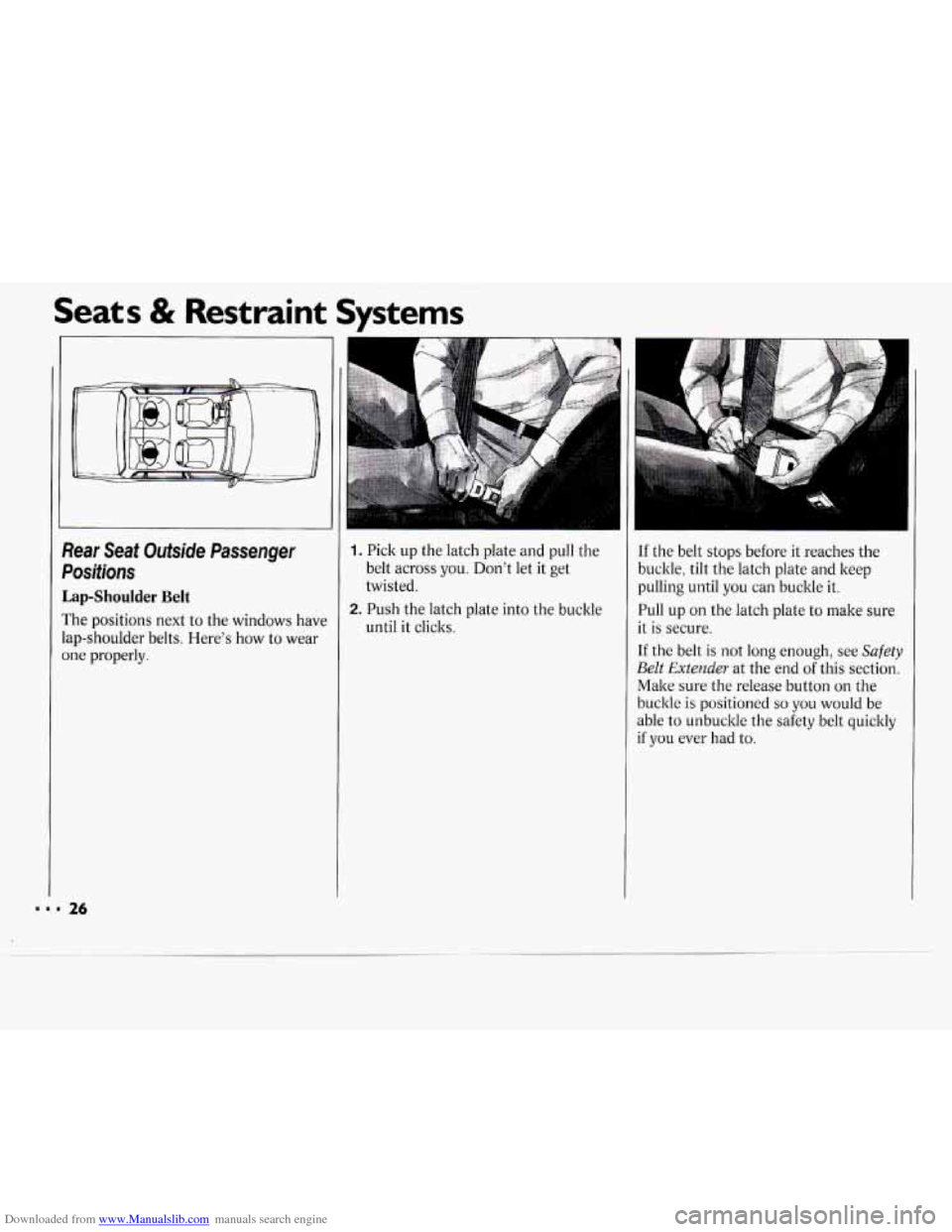
1. Pick up the latch plate and pull the
belt across you. Don't let it get
twisted.
until it clicks.
2. Push the latch plate into the buckle
If the belt stops before it reaches the
buckle, tilt the latch plate and keep
pulling until
you can buckle it.
Pull
up on the latch plate to make sure
it is secure.
If the belt is not long enough, see Safety
Belt Extender at the end of this section.
Make sure the release button on the
buckle is positioned
so you would be
able to unbuckle the safety belt quickly
if you ever had to.
Page 29 of 243
Downloaded from www.Manualslib.com manuals search engine .I
Seats & Restraint Systems
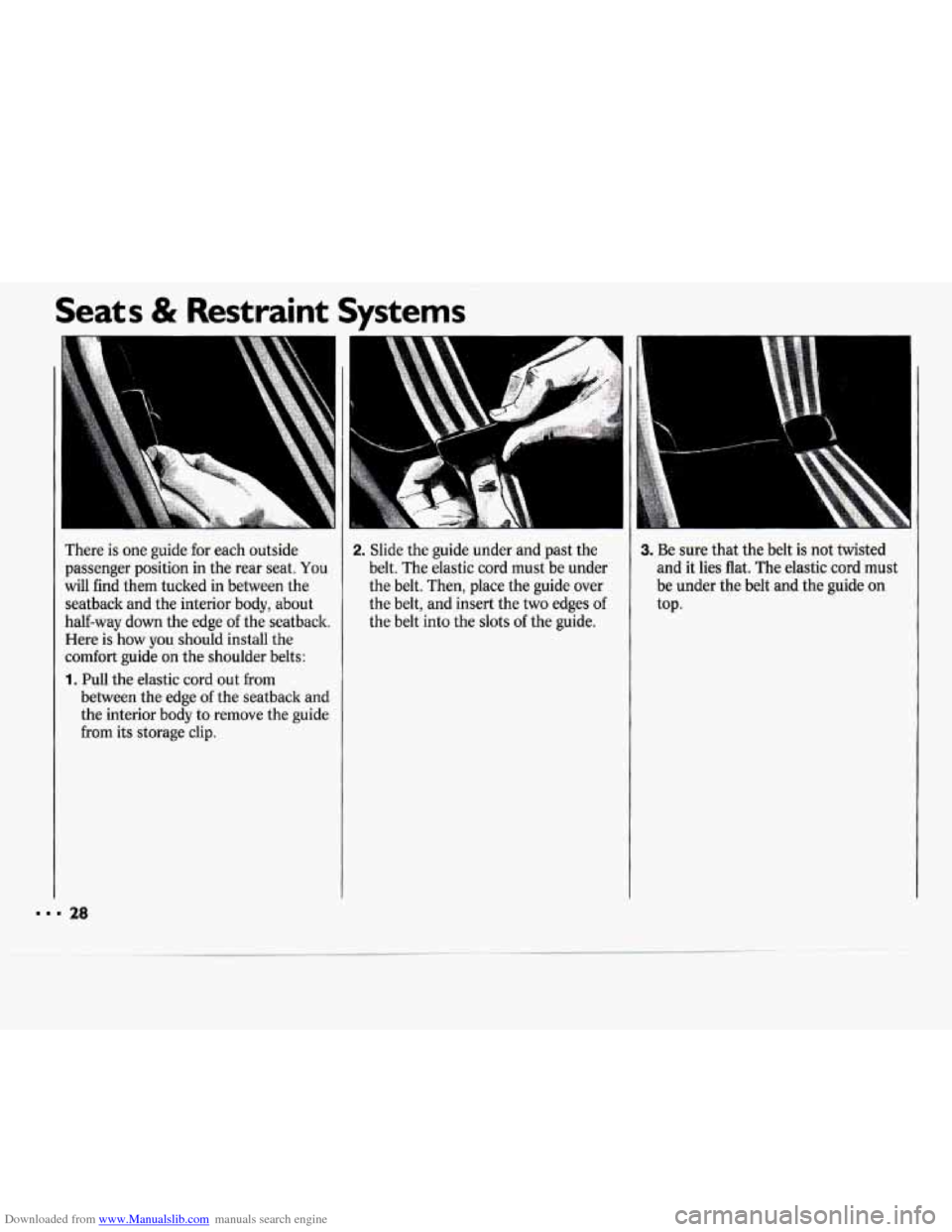
There is one guide for each outside
passenger position in the rear seat.
You
will find them tucked in between the
seatback and the interior body, about
half-way down the edge
of the seatback.
Here is how you should install the
comfort guide on the shoulder belts:
1. Pull the elastic cord out from
between the edge of the seatback and
the interior body to remove the guide
from its storage clip.
28
2. Slide the guide under and past the
belt. The elastic cord must be under
the belt. Then, place the guide over
the belt, and insert the two edges
of
the belt into the slots of the guide.
3. Be sure that the belt is not twisted
and it lies flat. The elastic
cord must
be under the belt and the guide on
top.
Page 31 of 243
Downloaded from www.Manualslib.com manuals search engine Seats & Restraint Systems
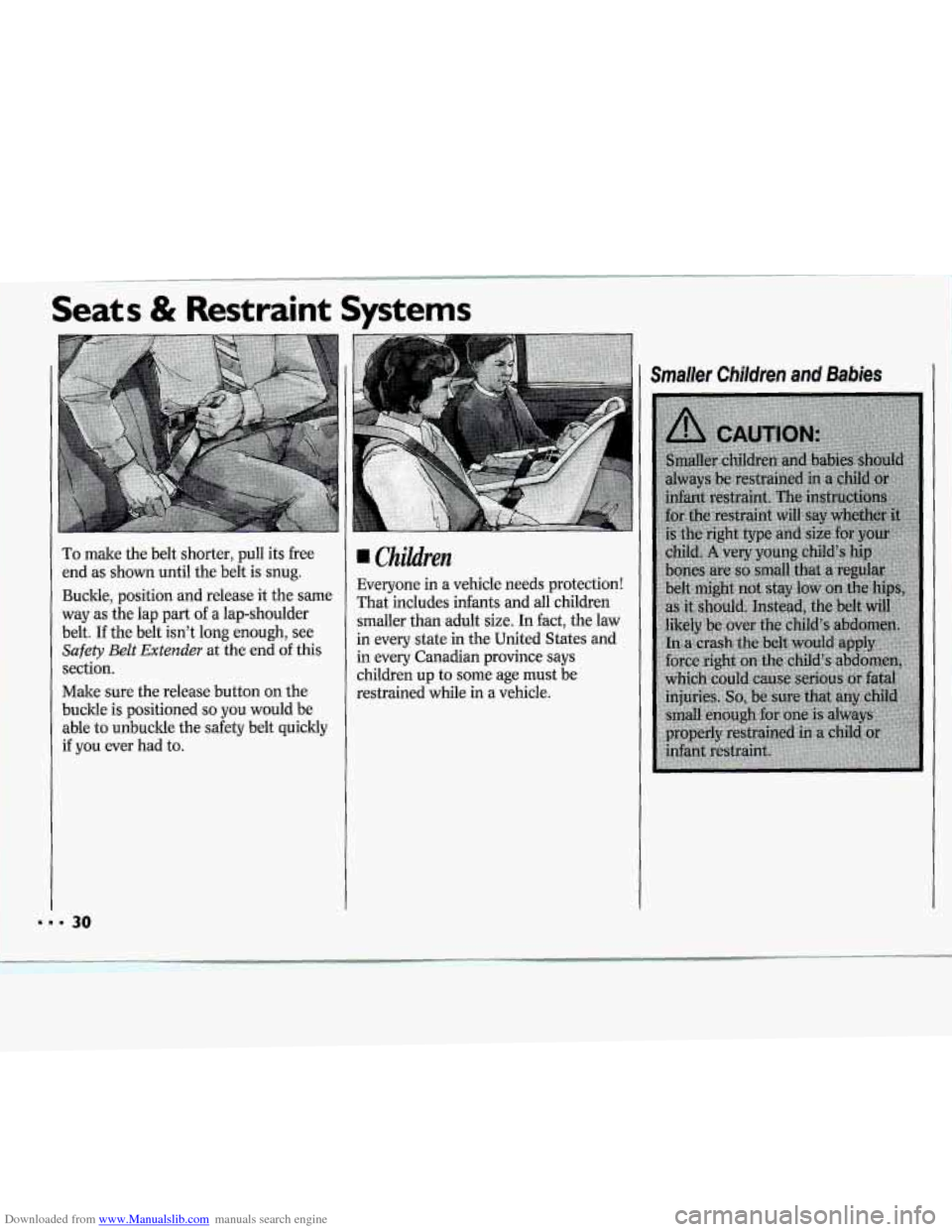
To make the belt shorter, pull its free
end as shown until the belt is
snug.
Buckle, position and release it the same
way as the lap part
of a lap-shoulder
belt.
If the belt isn’t long enough, see
Safety Belt Extender at the end of this
section.
Make sure the release button
on the
buckle
is positioned so you would be
able to unbuckle the safety belt quickly
if you ever had to.
I Children
Everyone in a vehicle needs protection!
That includes infants and all children
smaller than adult size.
In fact, the law
in every state in the United States and
in every Canadian province says
children up to some age must be
restrained while
in a vehicle.
Smaller Children and Babies
Page 33 of 243
Downloaded from www.Manualslib.com manuals search engine Seats & Restraint Systems
Top Strap
If your child restraint has a top strap, it
should be anchored.
If you need to have an anchor installed,
you can ask your Chevrolet dealer to
put it in for you.
If you want to install
an anchor yourself, your dealer can tell
you how to do it.
For cars first sold in Canada, child
restraints with a top strap must be
anchored according to Canadian Law.
Your dealer can obtain the hardware kit
and install it for you, or you may install
it yourself using the instructions
provided in the kit.
Use the tether hardware
kit available from
the dealer. The hardware and installation
instructions were specifically designed
for this vehicle.
Securing a Child Restraint in a
Rear Outside Position
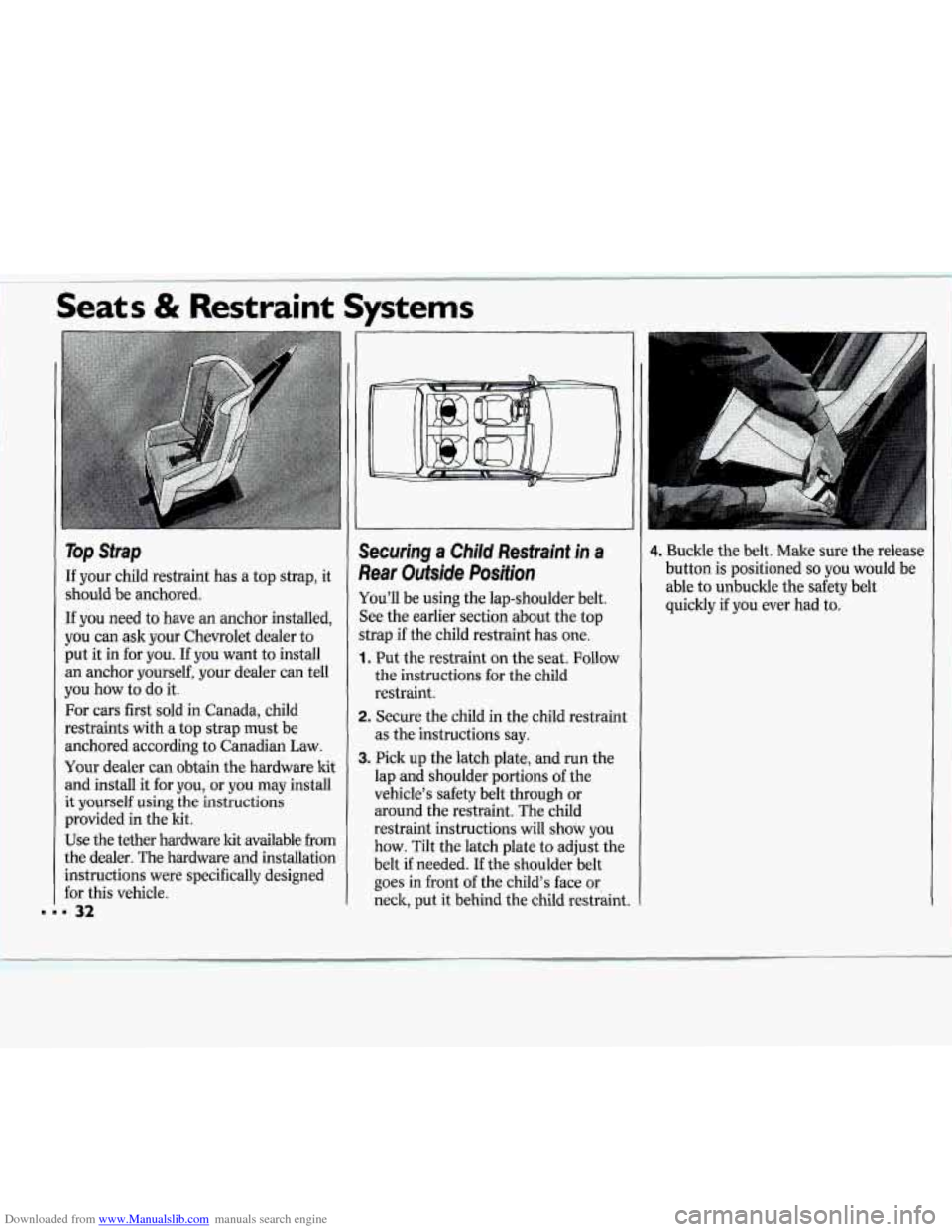
You’ll be using the lap-shoulder belt.
See the earlier section about the top
strap
if the child restraint has one.
1. Put the restraint on the seat. Follow
the instructions for the child
restraint.
2. Secure the child in the child restraint
as the instructions say.
3. Pick up the latch plate, and run the
lap and shoulder portions of the
vehicle’s safety belt through or
around the restraint. The child
restraint instructions will show you
how. Tilt the latch plate to adjust the
belt if needed.
If the shoulder belt
goes in front of the child’s face or
neck, put
it behind the child restraint.
4. Buckle the belt. Make sure the release
button is positioned
so you would be
able to unbuckle the safety belt
quickly
if you ever had to.
Page 35 of 243
Downloaded from www.Manualslib.com manuals search engine Seats & Restraint Systems
34
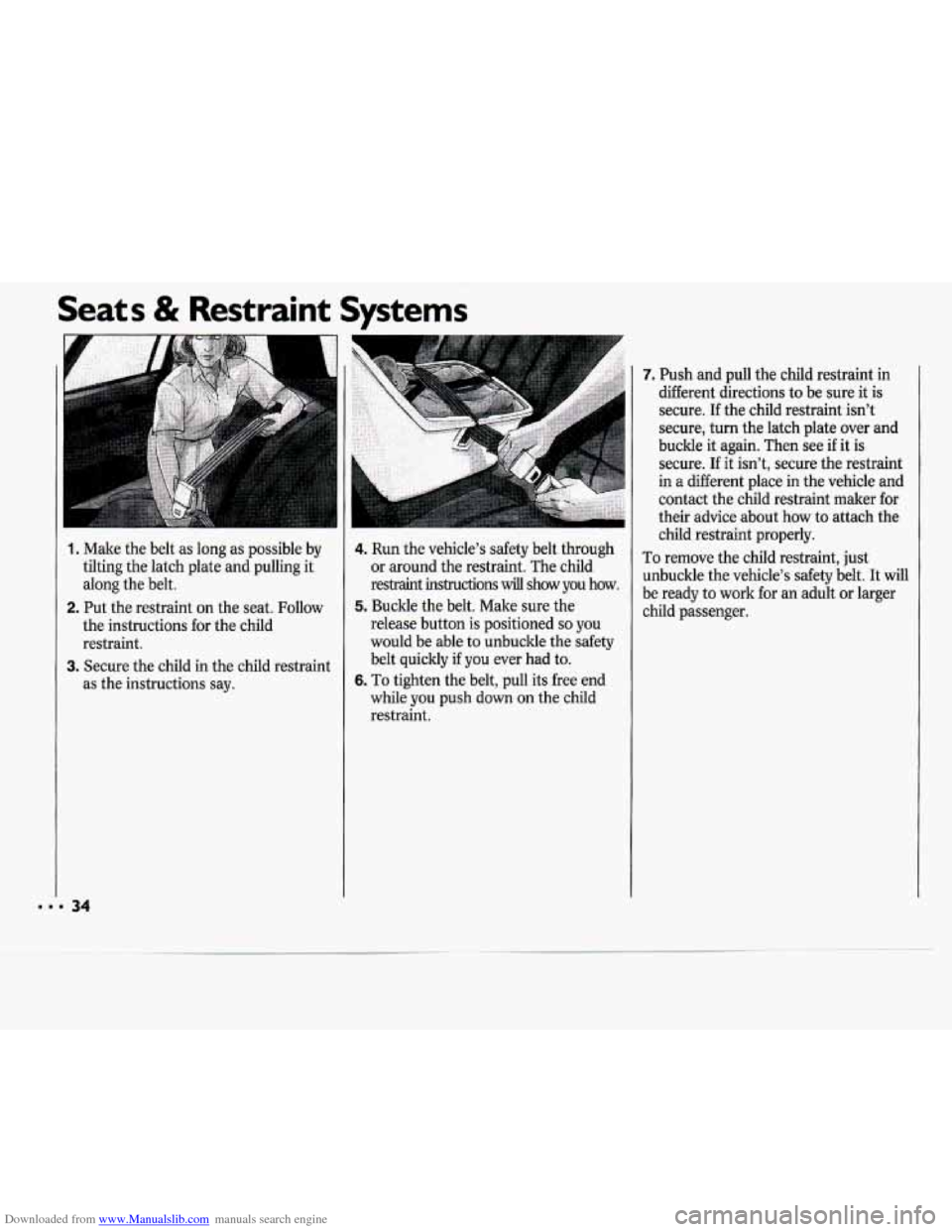
1, Make the belt as long as possible by
tilting the latch plate and pulling it
along the belt.
2. Put the restraint on the seat. Follow
the instructions for the child
restraint.
as the instructions say.
3. Secure the child in the child restraint
4. Run the vehicle’s safety belt through
or around the restraint. The child
restraint instructions
will show you how.
release button is positioned
so you
would be able to unbuckle the safety
belt quickly if you ever had to.
6. To tighten the belt, pull its free end
while you push down on the child
restraint.
5. Buckle the belt. Make sure the different dtlrections
to be sure it is
secure. If the child restraint isn’t
secure, turn the latch plate over and
buckle it again. Then see if it is
secure. If it isn’t, secure the restraint
in a different place in the vehicle and
contact the child restraint maker for
their advice about how to attach the
child restraint properly.
To remove the child restraint, just
unbuckle the vehicle’s safety belt.
It will
be ready to work for an adult or larger
child passenger.
Page 37 of 243
Downloaded from www.Manualslib.com manuals search engine Seats & Restraint Systems
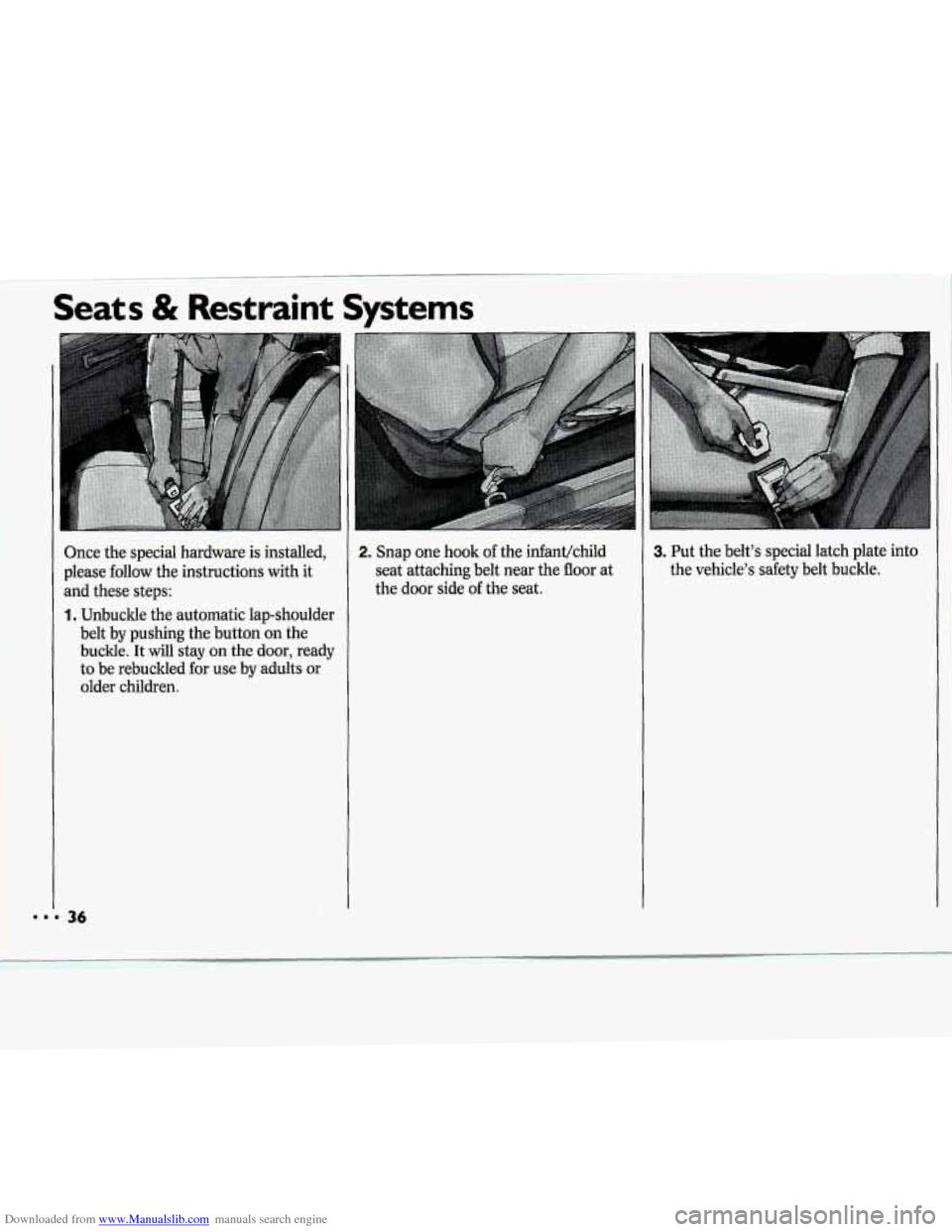
1. Unbuckle the automatic lap-shoulder
belt by pushing the button on the
buckle. It
will stay on the door, ready
to be rebuckled
for use by adults or
older children.
Once
the special hardware is installed,
2. Snap one hook of the infant/child
please
follow the instructions with it seat attaching
belt near the floor at
and these steps: the
door side of the
seat.
I
3. Put the belt's special latch plate into
the vehicle's safety belt buckle. P
Page 41 of 243
Downloaded from www.Manualslib.com manuals search engine Seats & Restraint Systems
4 Safety Belt Eaeder
If the vehicle’s safety belt will fasten
around you, you should use it. The
automatic lap-shoulder belt has plenty
of extra length built in, so it will fasten
around almost all people.
But if a safety belt isn’t long enough to
fasten, your dealer will order you
an
extender. It’s free. When you go in to
order it, take the heaviest coat you will
wear,
so the extender will be long
enough for you. The extender will be
just for you, and just for the seat in your
vehicle that you choose. Don’t let
someone else use it, and use it only for
the seat
it is made to fit. To wear it, just
attach it to the regular safety belt.
Checking Your Restraint
Systems
Now and then, make sure all your belts,
buckles, latch plates, retractors,
anchorages and reminder systems are
working properly.
Look for any loose
parts
or damage. If you see anything
that might keep a restraint system from
doing its job, have it repaired.
Replacing Safety Belts AjFer
a Crash
If you’ve had a crash, do you need new
belts?
After
a very minor collision, nothing
may be necessary. But
if the belts were
stretched, as they would be
if worn
during a more severe crash, then you
need new belts.
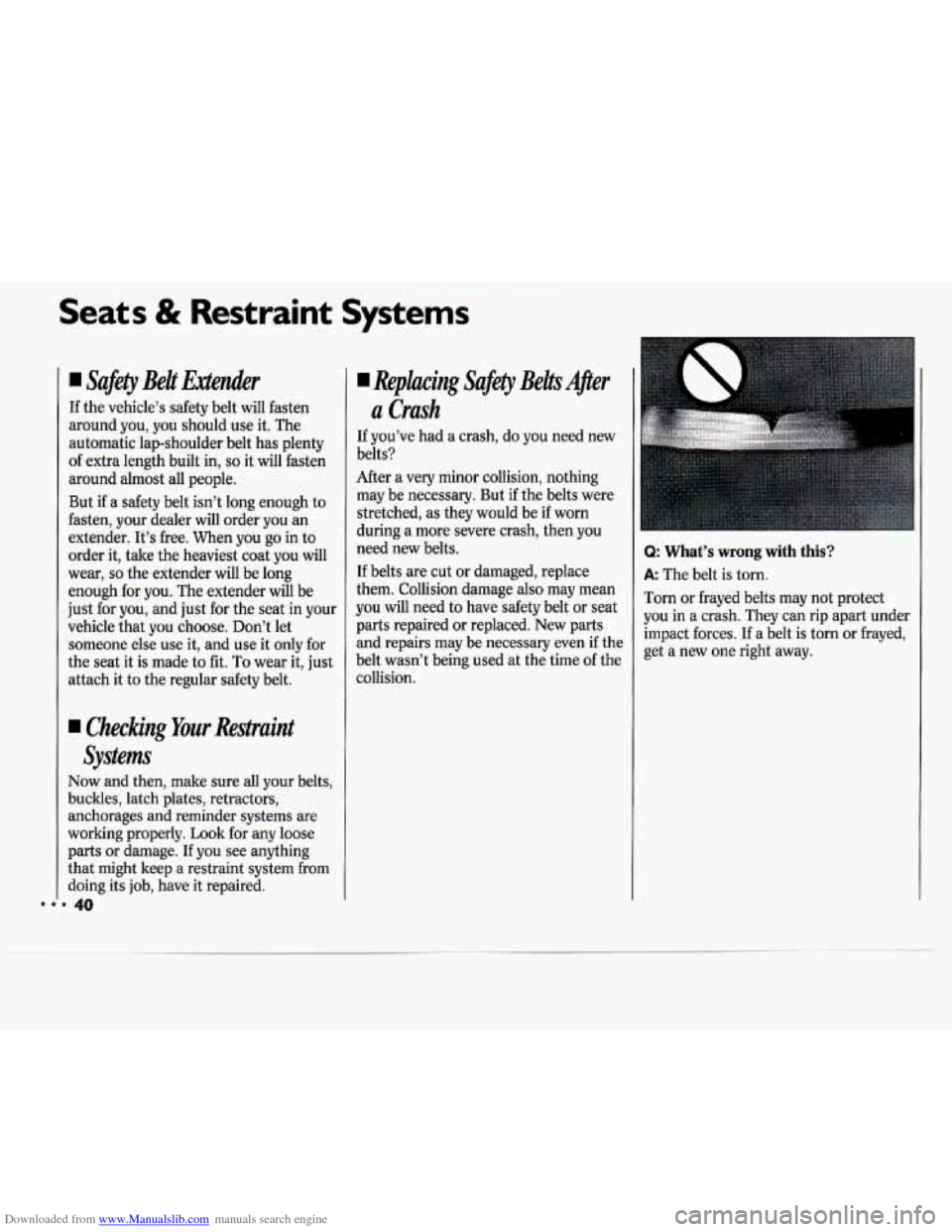
If belts are cut or damaged, replace
them. Collision damage
also may mean
you will need to have safety belt or seat
parts repaired or replaced. New parts
and repairs may be necessary even
if the
belt wasn’t being used at the time of the
collision.
S
Q: What’s wrong with this?
A: The belt is torn.
Torn or frayed belts may not protect
you in a crash. They can rip apart under
impact forces. If a belt is torn or frayed,
get a new one right away.
Page 50 of 243
Downloaded from www.Manualslib.com manuals search engine Convenience Net (OPTION)
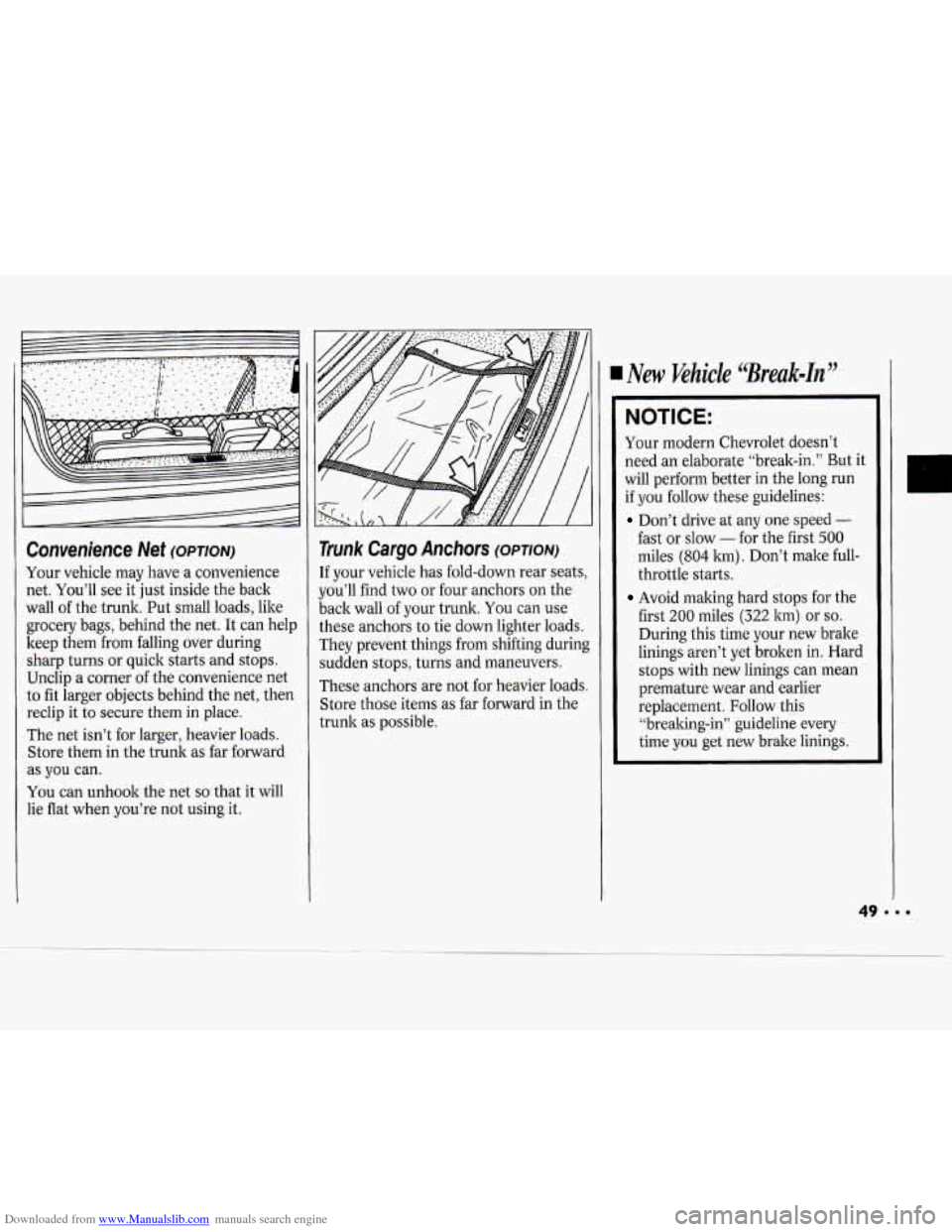
Your vehicle may have a convenience
net. You’ll see it just inside the back
wall of the trunk. Put small loads, like
grocery bags, behind the net. It can help
keep them
from falling over during
sharp turns or quick starts and stops.
Unclip a corner of the convenience net
to fit larger objects behind the net, then
reclip it to secure them in place.
The net isn’t for larger, heavier loads.
Store them in the trunk as far forward
as
you can.
You can unhook the net
so that it will
lie flat when you’re not using it.
Trunk Cargo Anchors (OPTION)
If your vehicle has fold-down rear seats,
you’ll find two or four anchors on the
back wall of your trunk.
You can use
these anchors to tie down lighter loads.
They prevent things from shifting during
sudden stops, turns and maneuvers.
These anchors are not for heavier loads.
Store those items as far forward in the
trunk as possible.
New Khicle ‘Break-in"
NOTICE:
Your modern Chevrolet doesn’t
need an elaborate “break-in.” But it
will perform better in the long run
if you follow these guidelines:
Don’t drive at any one speed -
fast or slow - for the fist 500
miles (804 km) . Don’t make full-
throttle starts.
Avoid making hard stops for the
first
200 miles (322 km) or so.
During this time your new brake
linings aren’t yet broken in. Hard
stops with new linings can mean
premature wear and earlier
replacement. Follow this
“brealring-in” guideline every
time you get new brake linings.
Page 54 of 243
Downloaded from www.Manualslib.com manuals search engine How long should you keep the coolant
heater plugged in? The answer depends
on the weather, the kind of oil you
have, and some other things. Instead of
trying
to list everything here, we ask
that you contact a Chevrolet dealer in
the area where you’ll be parking your
vehicle. The dealer can give you the best
advice for that particular area.
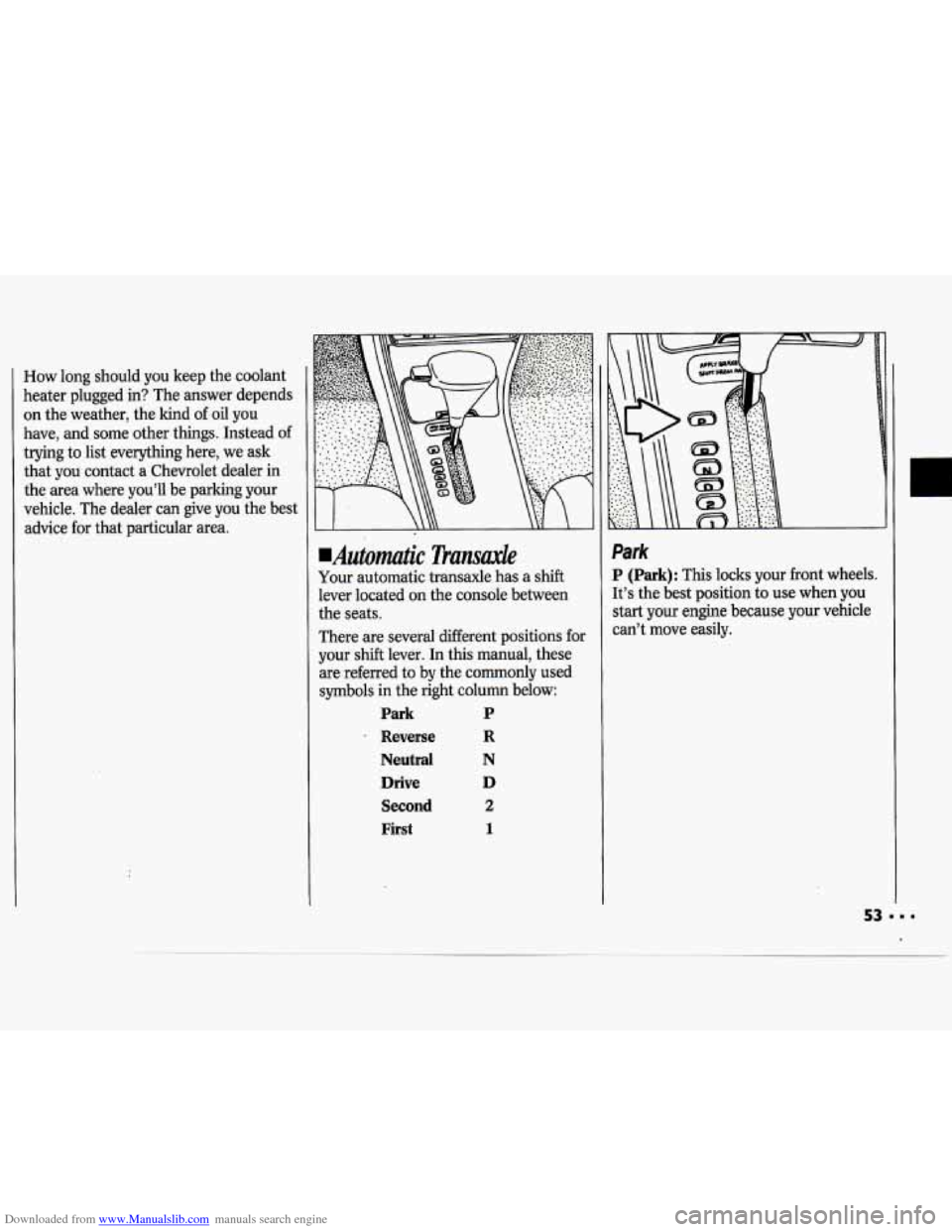
.Automatic Transaxle
Your automatic transaxle has a shift
lever located on the console between
the seats.
There are several different positions for
your shift lever. In this manual, these
are referred to by the commonly used
symbols in the right column below:
Park P
. Reverse R
Neutral N
Drive D
Second 2
First 1
Park
P (Park): This locks your front wheels.
It’s the best position to use when you
start your engine because your vehicle
can’t move easily.
.
Page 59 of 243
Downloaded from www.Manualslib.com manuals search engine Features & Controls
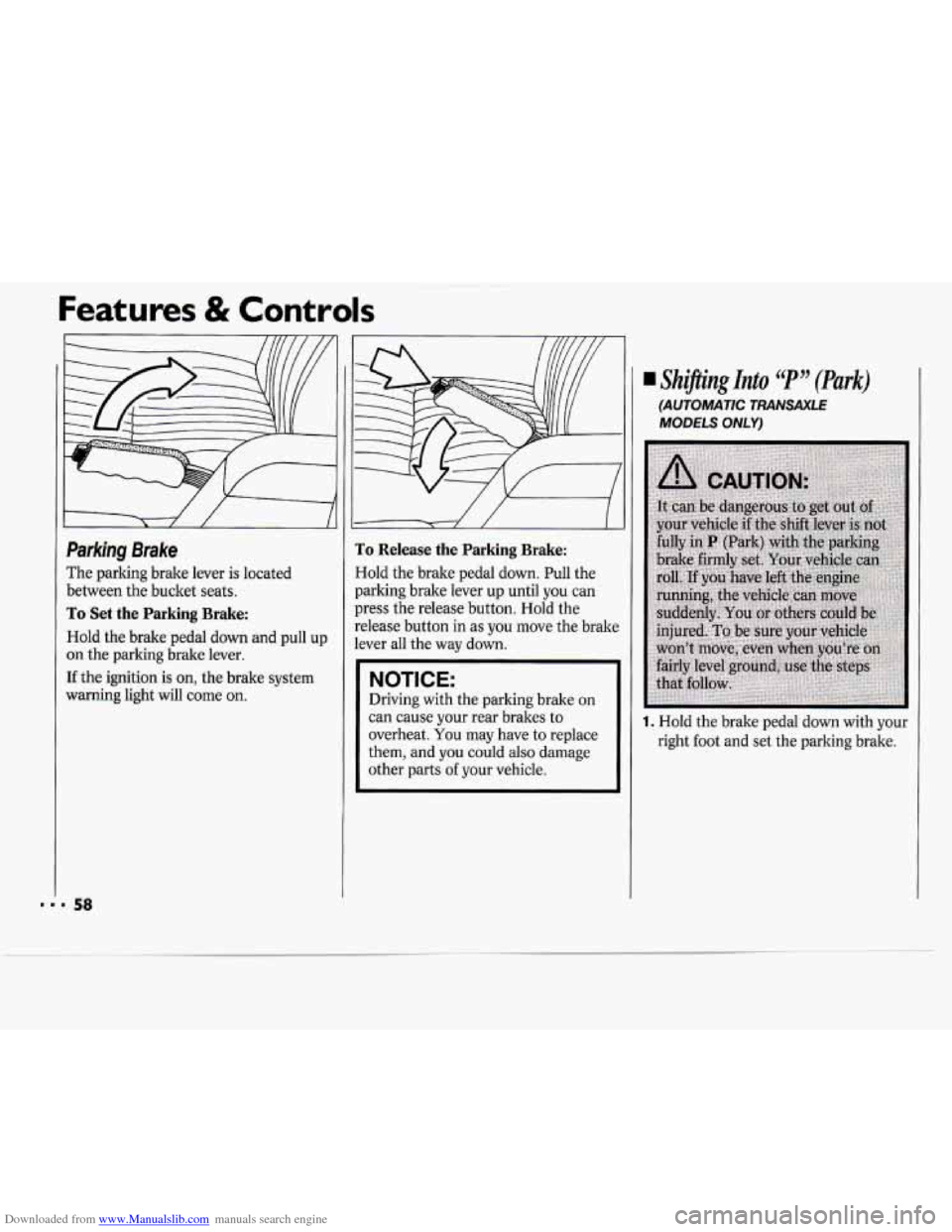
Parking Brake
The parking brake lever is located
between the bucket seats.
To Set the Parking Brake:
Hold the brake pedal down and pull up
on the parking brake lever.
If the ignition is on, the brake system
warning light will come
on.
J
To Release the Parking Brake:
Hold the brake pedal down. Pull the
parking brake lever up until you can
press the release button. Hold the
release button
in as you move the brake
lever all the way down.
NOTICE:
Driving with the parking brake on
can cause your rear brakes to
overheat.
You may have to replace
them, and you could also damage
other parts
of your vehicle.
Shijling Into C( P JJ (Park)
(AUTOMATIC TRANSAXLE
MODELS ONLY)
1. Hold the brake pedal down with your
right foot and set the parking brake.