wheel CHEVROLET CAVALIER 1994 1.G Owner's Manual
[x] Cancel search | Manufacturer: CHEVROLET, Model Year: 1994, Model line: CAVALIER, Model: CHEVROLET CAVALIER 1994 1.GPages: 243, PDF Size: 15.06 MB
Page 147 of 243
Downloaded from www.Manualslib.com manuals search engine Problems on the Road
If a front tire fails, the flat tire will
create a drag that pulls the vehicle
toward that side. Take your foot off the
accelerator pedal and grip the steering
wheel firmly. Steer to maintain lane
position, then gently brake to
a stop
well out
of the traffic lane.
A rear blowout, particularly on a curve,
acts much like a skid and may require
the same correction you’d use in a skid.
In any rear blowout, remove your foot
from the accelerator pedal. Get the
vehicle under control by steering the
way
you want the vehicle to go. It may
be very bumpy and noisy, but you can
still steer. Gently brake to a stop, well
off the road if possible.
If a tire goes flat, the next section shows
how to use your jacking equipment to
change a flat tire safely.
Changing a Flat Tire
If a tire goes flat, avoid further tire and
wheel damage by driving slowly to a
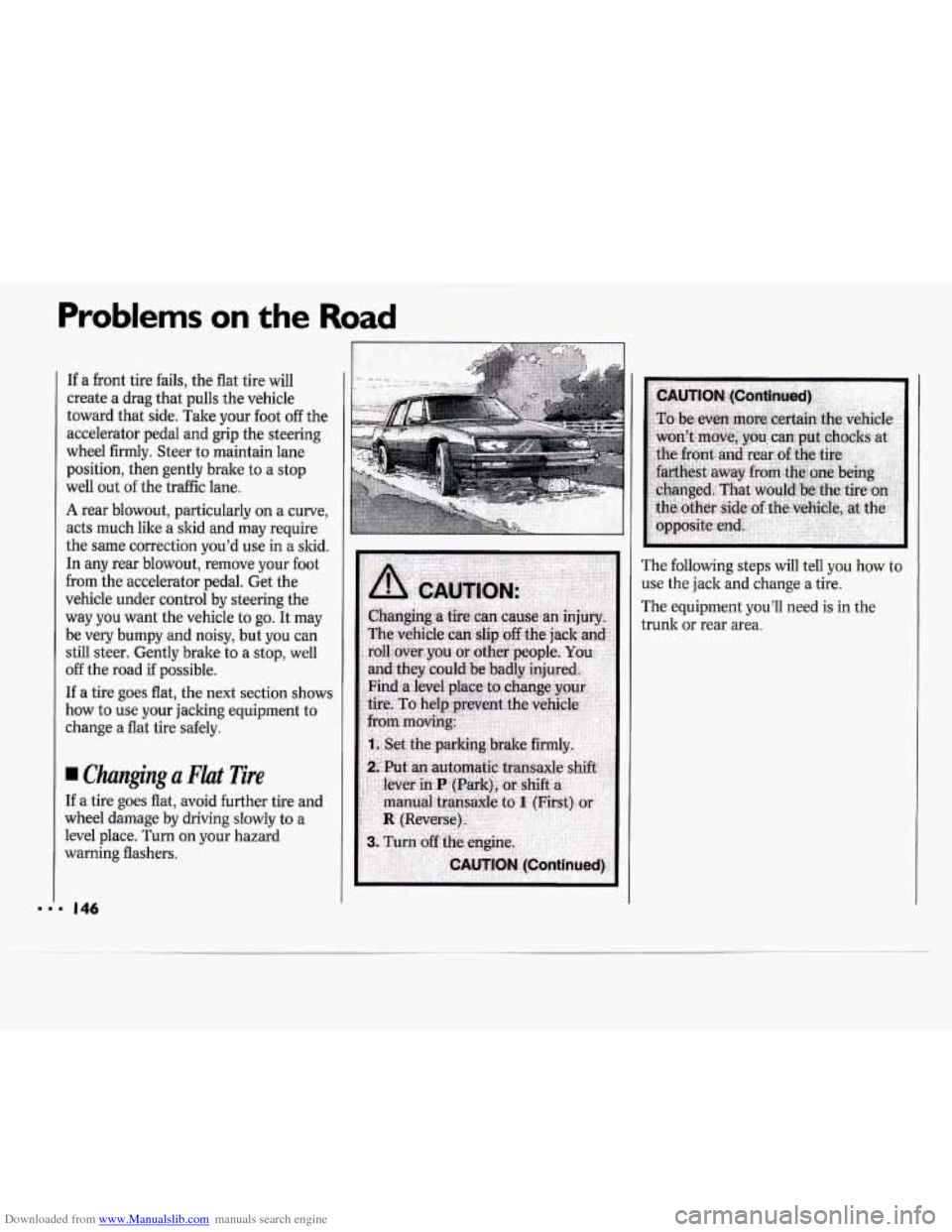
level place. Turn on your hazard
warning flashers. The
following steps will tell you how to
use the jack and change a tire.
The equipment you’ll need
is in the
trunk
or rear area.
Page 148 of 243
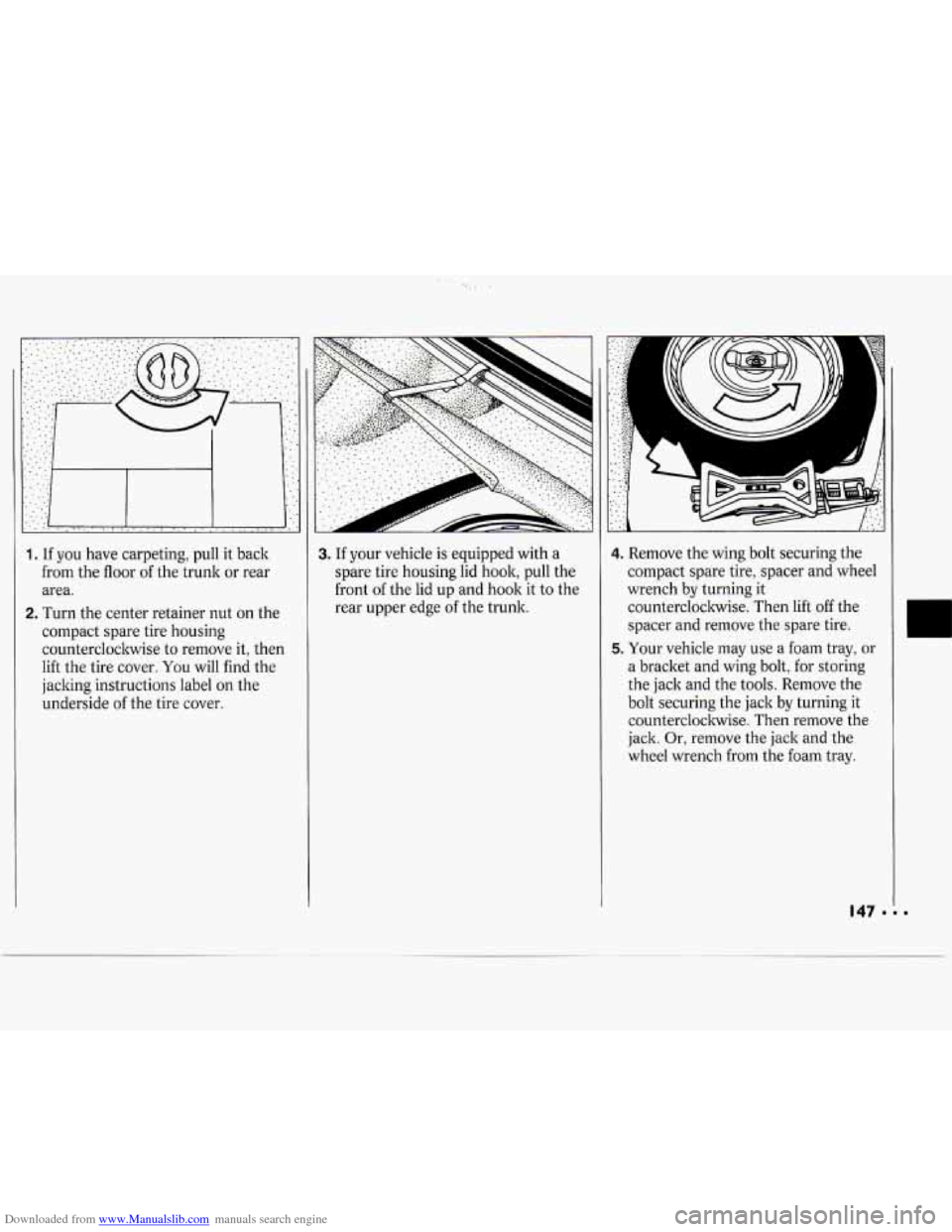
Downloaded from www.Manualslib.com manuals search engine 1. If you have carpeting, pull it back
from the floor of the trunk or rear
area.
2. Turn the center retainer nut on the
compact spare tire housing counterclockwise to remove it, then
lift the tire cover.
You will find the
jacking instructions label
on the
underside
of the tire cover.
..
3. If your vehicle is equipped with a
spare tire housing lid hook, pull the
front
of the lid up and hook it to the
rear upper edge
of the trunk.
4. Remove the wing bolt securing the
compact spare tire, spacer and wheel
wrench by turning it
counterclockwise. Then lift off the
spacer and remove the spare tire.
5. Your vehicle may use a foam tray, or
a bracket and wing bolt, for storing
the jack and the tools. Remove the
bolt securing the jack by turning it
counterclockwise. Then remove the
jack. Or, remove the jack and the
wheel wrench from the foam tray.
I
Page 149 of 243
Downloaded from www.Manualslib.com manuals search engine Problems on the Road
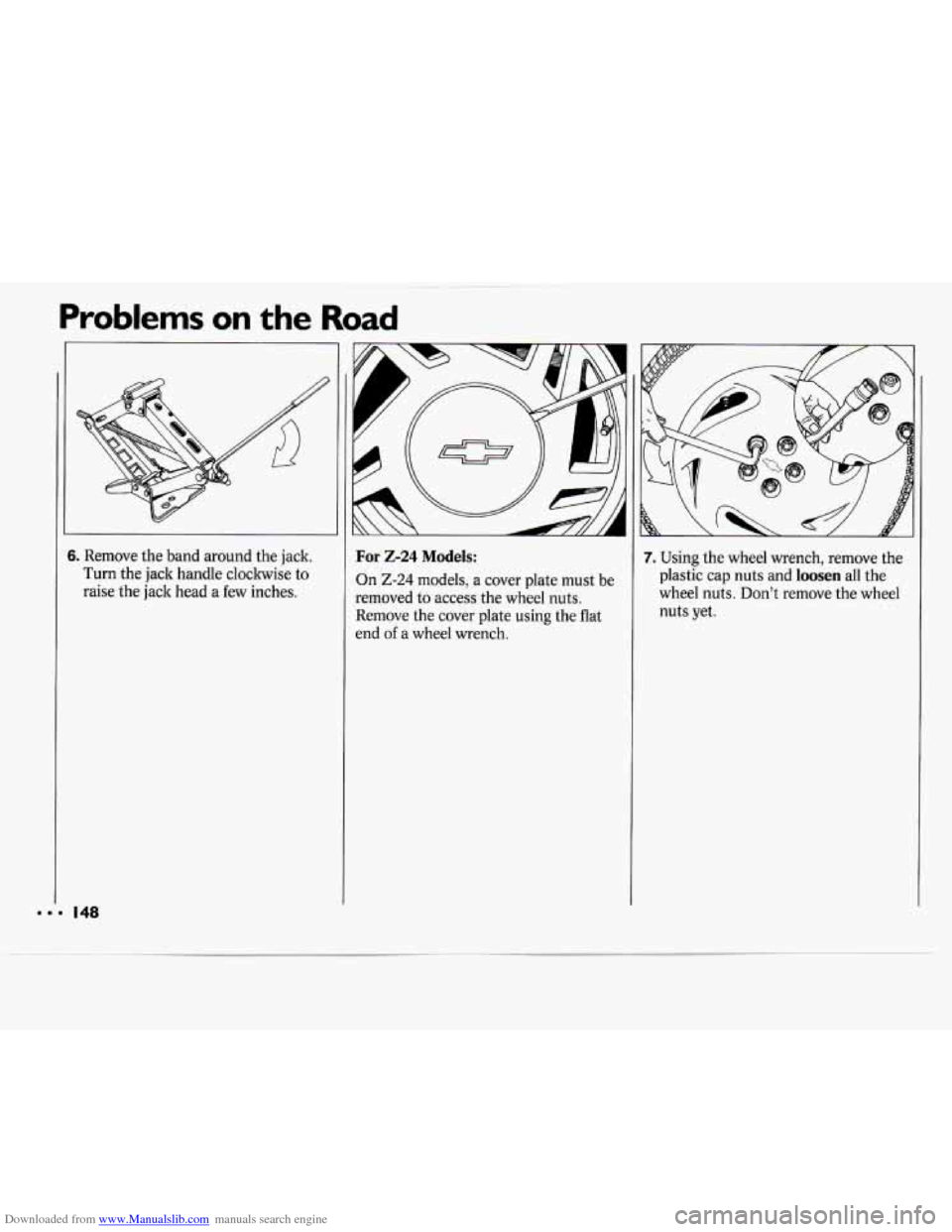
5. Remove the band around the jack.
Turn the jack handle cloclnvise to
raise the jack head a few inches. For 2-24 Models:
On 2-24 models, a cover plate must be
removed to access the wheel nuts.
Remove the cover plate using the flat
end
of a wheel wrench.
7. Using the wheel wrench, remove the
plastic cap nuts and
loosen all the
wheel nuts.
Don’t remove the wheel
nuts yet.
Page 150 of 243
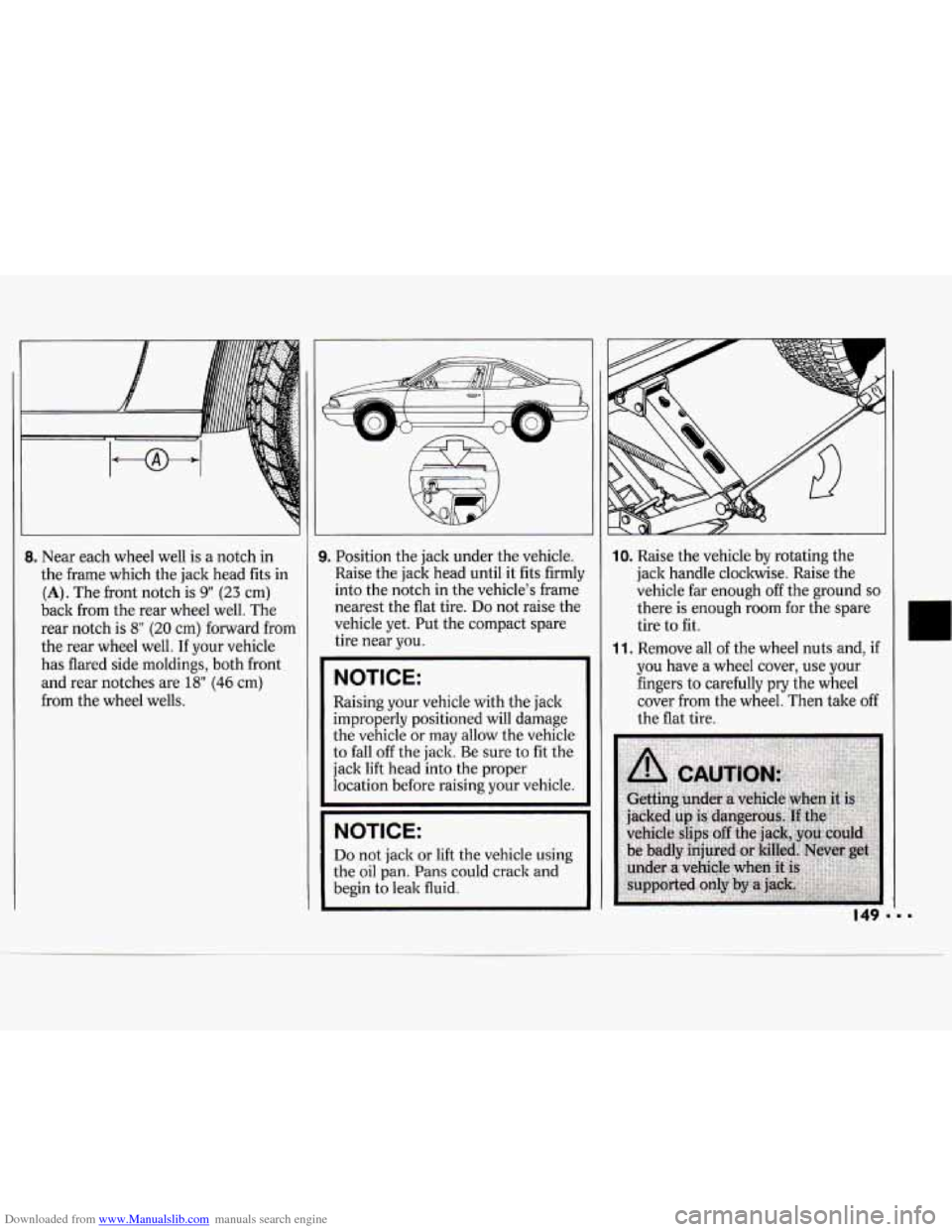
Downloaded from www.Manualslib.com manuals search engine 8. Near each wheel well is a notch in
the frame which the jack head fits in
(A). The front notch is 9" (23 cm)
back from the rear wheel well. The
rear notch is
8" (20 cm) forward from
the rear wheel well.
If your vehicle
has flared side moldings, both front
and rear notches are
18" (46 cm)
from the wheel wells.
I
~~ ~ ~~
9. Position the jack under the vehicle.
Raise the jack head until
it fits firmly
into the notch in the vehicle's frame
nearest the flat tire.
Do not raise the
vehicle yet. Put the compact spare
tire near you.
NOTICE:
Raising your vehicle with the jack
improperly positioned will damage
the vehicle or may allow the vehicle
to fall off the jack. Be sure to fit the
jack lift head into the proper
location before raising your vehicle.
NOTICE:
Do not jack or lift the vehicle using
the oil pan. Pans could crack and
begin to leak fluid.
10. Raise the vehicle by rotating the
jack handle cloclnvise. Raise the
vehicle far enough off the ground
so
there is enough room for the spare
tire to fit.
11. Remove all of the wheel nuts and, if
you have a wheel cover, use your
fingers to carefully pry the wheel
cover from the wheel. Then take off
the flat tire.
149 I
Page 151 of 243
Downloaded from www.Manualslib.com manuals search engine Problems on the Road
J
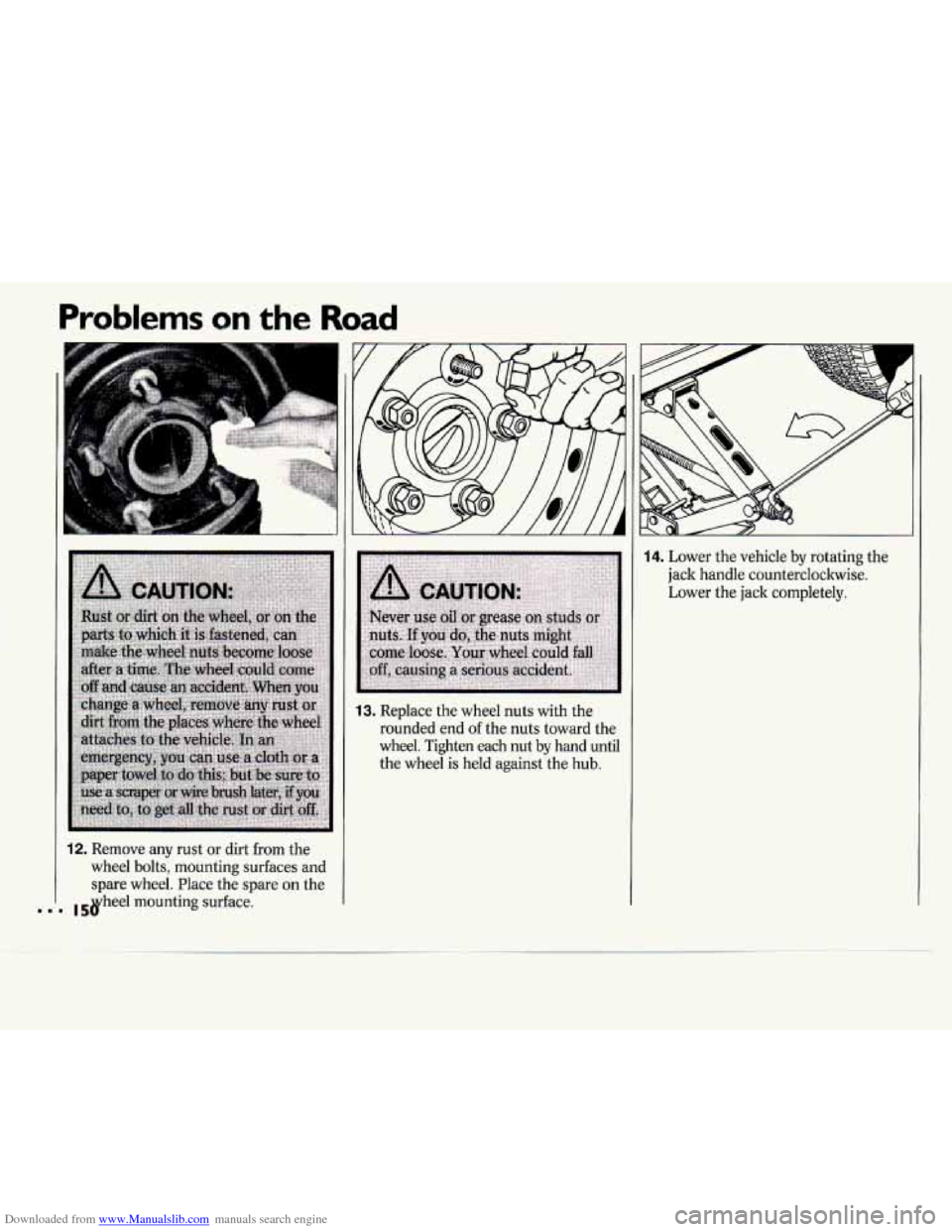
12. Remove any rust or dirt from the
wheel bolts, mounting surfaces and
spare wheel. Place the spare
on the
mounting surface.
F
13. Replace the wheel nuts with the
rounded end of the nuts toward the
wheel. Tighten each nut by hand until
the wheel
is held against the hub.
14. Lower the vehicle by rotating the
jack handle counterclockwise.
Lower the jack completely.
Page 152 of 243
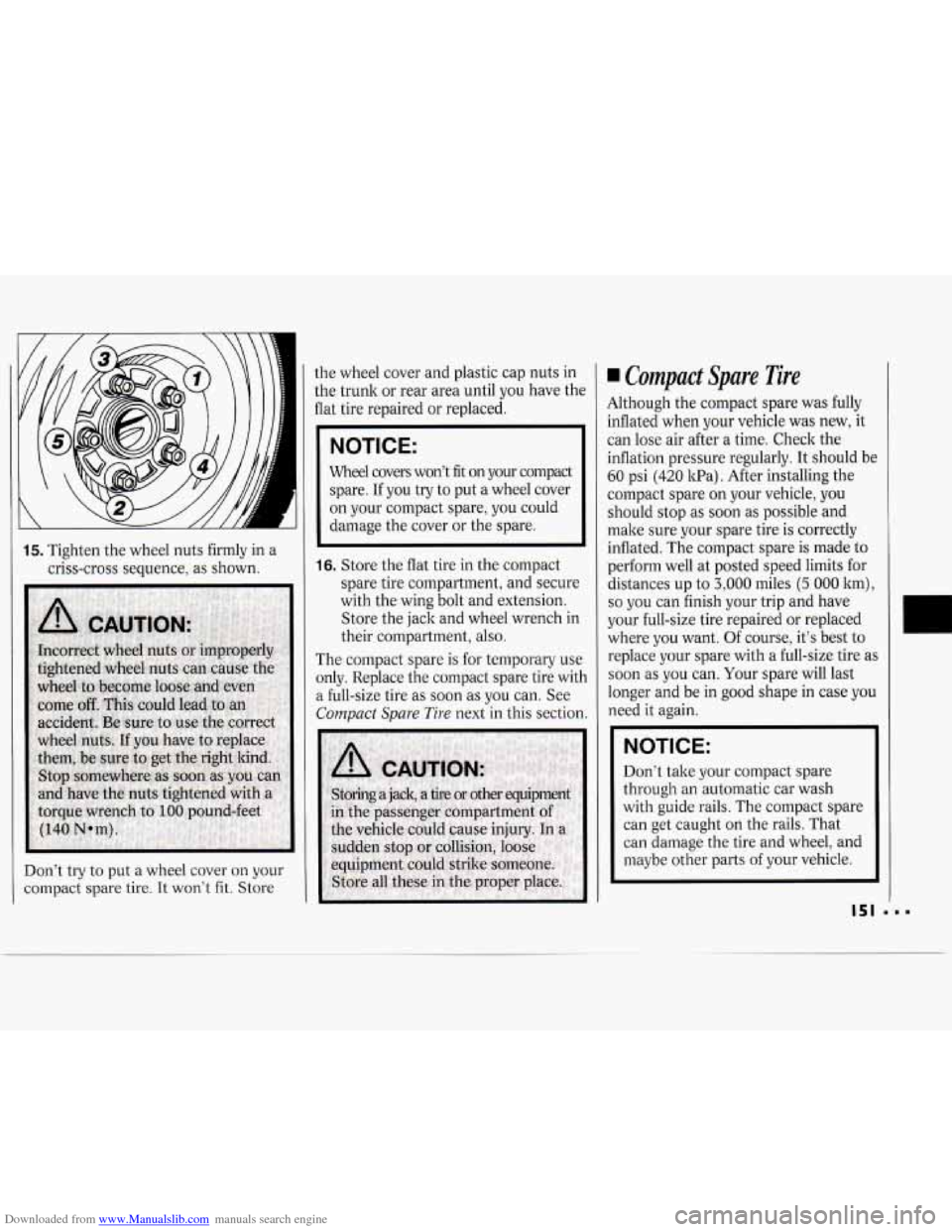
Downloaded from www.Manualslib.com manuals search engine 15. Tighten the wheel nuts firmly in a
criss-cross sequence, as shown.
Don’t try to put a wheel cover
on your
compact spare tire.
It won’t fit. Store the
wheel cover and plastic cap nuts in
the trunk or rear area until you have the
flat tire repaired or replaced.
IICE: I
Wheel covers won’t fit on your compact
spare. If you try to put a wheel cover
on your compact spare, you could
damage the cover or the spare.
16. Store the flat tire in the compact
spare tire compartment, and secure
with the wing bolt and extension.
Store the jack and wheel wrench in
their compartment, also.
The compact spare
is for temporary use
only. Replace the compact spare tire with
a full-size tire as soon as you can. See
Compact Spare Tire next in this section.
Compact Spare Tire
Although the compact spare was fully
inflated when your vehicle was new, it
can lose air after a time. Check the
inflation pressure regularly. It should be
60 psi (420 1cPa). After installing the
compact spare on your vehicle, you
should stop as soon as possible and
make sure your spare tire is correctly
inflated. The compact spare is made
to
perform well at posted speed limits for
distances up to
3,000 miles (5 000 lcm),
so you can finish your trip and have
your full-size tire repaired or replaced
where you want. Of course, it‘s best
to
replace your spare with a full-size tire as
soon as
you can. Your spare will last
longer and be in good shape in case you
need it again.
NOTICE:
Don’t take your compact spare
through an automatic car wash
with guide rails. The compact spare
can get caught on the rails. That
can damage the tire and wheel, and
maybe other parts
of your vehicle.
151
Page 153 of 243
Downloaded from www.Manualslib.com manuals search engine Problems on the Road
Don’t use your compact spare on some
other vehicle.
And don’t mix
your compact spare or
wheel with other wheels or tires. They
won’t fit. Keep your spare and its wheel
together.
NOTICE:
Tire chains won’t fit your compact
spare. Using them will damage your
vehicle and destroy the chains too.
Don’t use tire chains on your
compact spare.
If You’re Stuck: In Sand,
Mud, Ice or Snow
What you don’t want to do when your
vehicle is stuck is to spin your wheels.
The method known as “rocking” can
help you get out when you’re stuck, but
you must use caution.
NOTICE:
Spinning your wheels can destroy
parts of your vehicle as well as the
tires.
If you spin the wheels too fast
while shifting your transaxle back
and forth, you can destroy your
transaxle.
Rocking your vehicle to get it out:
First, turn your steering wheel left and
right. That will clear the area around
your front wheels. Then shift back and
forth between
R (Reverse) and a
fonGard gear (or with a manual
transaxle, between First or Second gear
and Reverse), spinning the wheels as
little as possible. Release the accelerator
pedal while you shift, and press lightly
on the accelerator pedal when the
transaxle is in gear.
If that doesn’t get
you out after a few tries, you may need
to be towed out. If
you do need to be
towed out, see
Towing Your Vehicle in
the
Index.
Page 184 of 243
Downloaded from www.Manualslib.com manuals search engine When to Check
Check your tires once a month or more.
Don't forget your compact spare tire. It
should be at
60 psi (420 1tPa).
How to Check
Use a good quality pocket-type gage to
check tire pressure. Simply looking at
the tires
will not tell you the pressure,
especially if you have radial tires
-
which may look properly inflated even if
they're underinflated.
If your tires have valve caps, be sure to
put them back on. They help prevent
leaks by keeping out dirt and moisture.
x
Tire lnspection and Rotation
To make your tires last longer, have
them inspected and rotated at the
mileages recommended in the
Maintenance Schedule. See
Scheduled
Maintenance Services
in the Index.
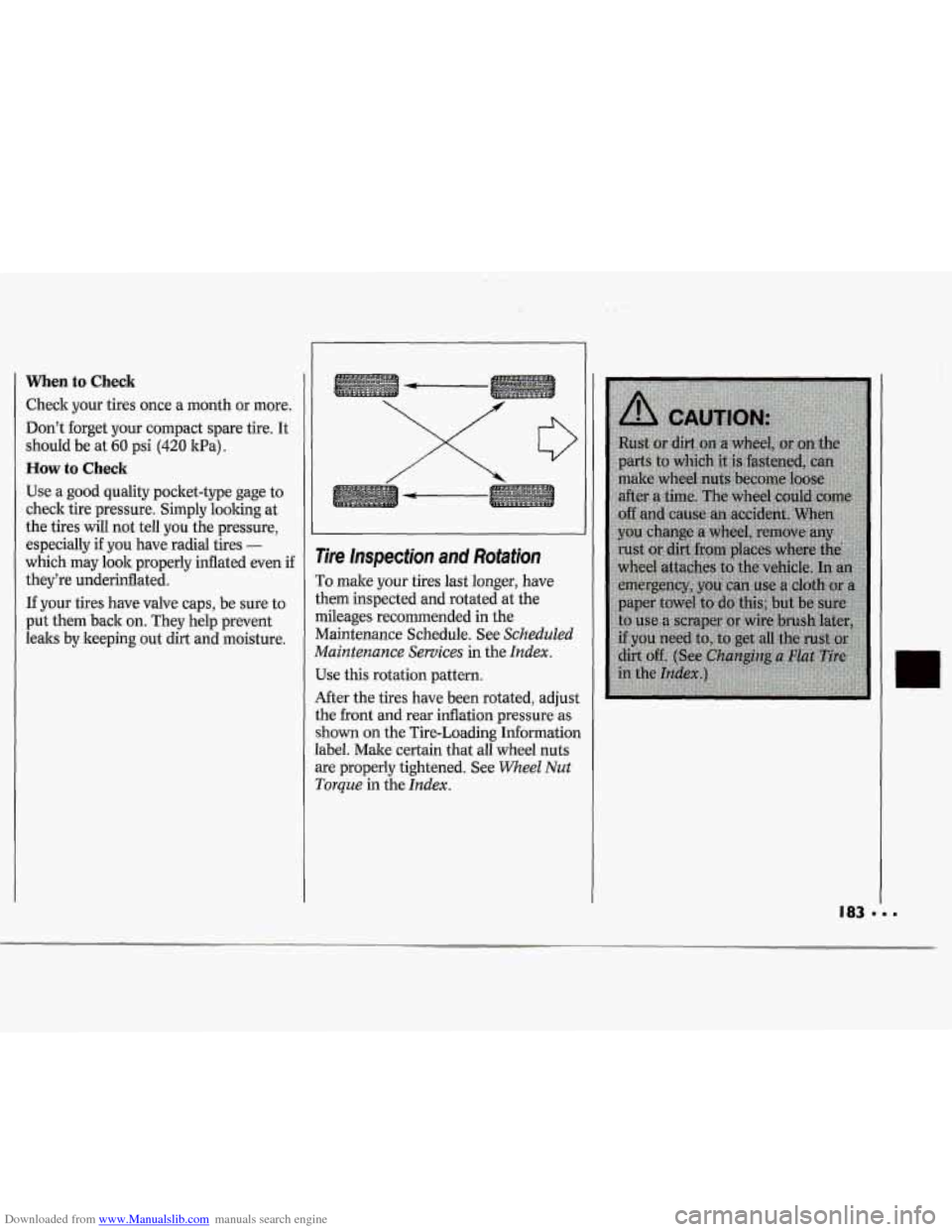
Use this rotation pattern.
After the tires have been rotated, adjust
the front and rear inflation pressure as
shown on the Tire-Loading Information
label. Make certain that all wheel nuts
are properly tightened. See
Wheel Nut
Torque in the Index.
Page 186 of 243
Downloaded from www.Manualslib.com manuals search engine Uniform Tire Qualify Grading
The following information relates to the
system developed by the United States
National Highway Traffic Safety
Administration which grades tires by
treadwear, traction and temperature
performance. (This applies only to
vehicles sold in the United States.)
Treadwear
The treadwear grade is a comparative
rating based on the wear rate
of the tire
when tested under controlled
conditions on a specified government
test course. For example, a tire graded
150 would wear one and a half (1 Yz)
times as well on the government course
as a tire graded
100. The relative
performance of tires depends upon the
actual conditions
of their use, however,
and may depart significantly from the
norm due to variations in driving habits,
service practices and differences in road
characteristics and climate.
Traction-A, B, C
The traction grades, from highest to
lowest are: A,
B, and C. They represent
the tire’s ability to stop on wet
pavement as measured under controlled
conditions on specified government test
surfaces
of asphalt and concrete. A tire
marked
C may have poor traction
performance.
Warning: The traction grade assigned to
this tire
is based on braking (straight-
ahead) traction tests and does not
include cornering (turning) traction.
Temperature-A, B, C
The temperature grades are A (the
highest),
B, and C, representing the
tire’s resistance to the generation
of
heat and its ability to dissipate heat
when tested under controlled conditions on a specified indoor
laboratory test wheel. Sustained high
temperature can cause the material of
the tire to degenerate and reduce tire
life, and excessive temperature can lead
to sudden tire failure. The grade
C
corresponds to a level of performance
which all passenger car tires must meet
under the Federal Motor Vehicle Safety Standard
No.
109. Grades B and A
represent higher levels
of performance
on the laboratory test wheel than the
minimum required by law.
Warning: The temperature grade for
this tire is established for a tire that is
properly inflated and not overloaded.
Excessive speed, underinflation, or
excessive loading, either separately or in
combination, can cause heat buildup
and possible tire failure.
These grades are molded on the
sidewalls of passenger car tires.
While the tires available as standard or
optional equipment
on General Motors
vehicles may vary with respect to these
grades, all such tires meet General
Motors performance standards and
have been approved for use on General
Motors vehicles. All passenger type
(P
Metric) tires must conform to Federal
safety requirements in addition to these
grades.
1
Page 187 of 243
Downloaded from www.Manualslib.com manuals search engine Service & Appearance Care
Wheel Alignment and Tire Balance
The wheels on your vehicle were
aligned and balanced carefully at the
factory
to give you the longest tire life
and best overall performance.
In most cases, you will not need to have
your wheels aligned again. However, if
you notice unusual tire wear or your
vehicle pulling one way or the other, the
alignment may need
to be reset. If you
notice your vehicle vibrating when
driving on
a smooth road, your wheels
may need to be rebalanced.
Wheel Replacement
Replace any wheel that is bent, cracked
or badly rusted.
If wheel nuts keep
coming loose, the wheel, wheel bolts,
and wheel nuts should be replaced.
If
the wheel leaks air, replace it (except
some aluminum wheels, which can
sometimes be repaired). See your
Chevrolet dealer if any
of these
conditions exist.
Your dealer will know the kind of wheel
you need.
Each new wheel should have the same
load carrying capacity, diameter, width,
offset, and be mounted the same way as
the one it replaces.
If you need to replace any of your
wheels, wheel bolts, or wheel nuts,
replace them only with new
GM
original equipment parts. This way, you
will be sure
to have the right wheel,
wheel bolts, and wheel nuts for your
Chevrolet model.
I NOTICE:
The wrong wheel can also cause
problems with bearing life, brake
cooling, speedometer/odometer
calibration, headlight aim, bumper
height, vehicle ground clearance,
and tire or tire chain clearance to
the body and chassis.