radiator cap CHEVROLET CAVALIER 1994 1.G Owners Manual
[x] Cancel search | Manufacturer: CHEVROLET, Model Year: 1994, Model line: CAVALIER, Model: CHEVROLET CAVALIER 1994 1.GPages: 243, PDF Size: 15.06 MB
Page 138 of 243
Downloaded from www.Manualslib.com manuals search engine I
NOTICE:
If your engine catches fire because
you keep driving with no coolant,
your vehicle can be badly damaged.
The costly repairs would not be
covered by your warranty.
If No Steam Is Coming From your
Engine
If you get the overheat warning but see
or hear no steam, the problem may not
be too serious. Sometimes the engine
can get a little too hot when you:
Climb a long hill on a hot day.
Stop after high speed driving.
Idle for long periods in traffic.
If you get the overheat warning with no
sign
of steam, try this for a minute or so:
1. If you have an air conditioner, turn it
2. Turn on your heater to full hot at the
Off.
highest fan speed and open the
windows as necessary.
3.
Try to keep your engine under load
(in
a drive gear where the engine
runs slower).
If you no longer have the overheat
warning, you can drive. Just
to be safe,
drive slower for about ten minutes.
If
the warning doesn’t come back on, you
can drive normally.
If the warning continues, pull over,
stop, and park your vehicle right away.
If there’s still no sign
of steam, you can
idle the engine for two or three minutes
while you’re parked, to see if the
warning stops. But then, if you still
have the warning, TURN
OFF THE
ENGINE AND
GET EVERYONE OUT
OF THE VEHICLE until it cools down.
You may decide not
to lift the hood but
to get service help right away.
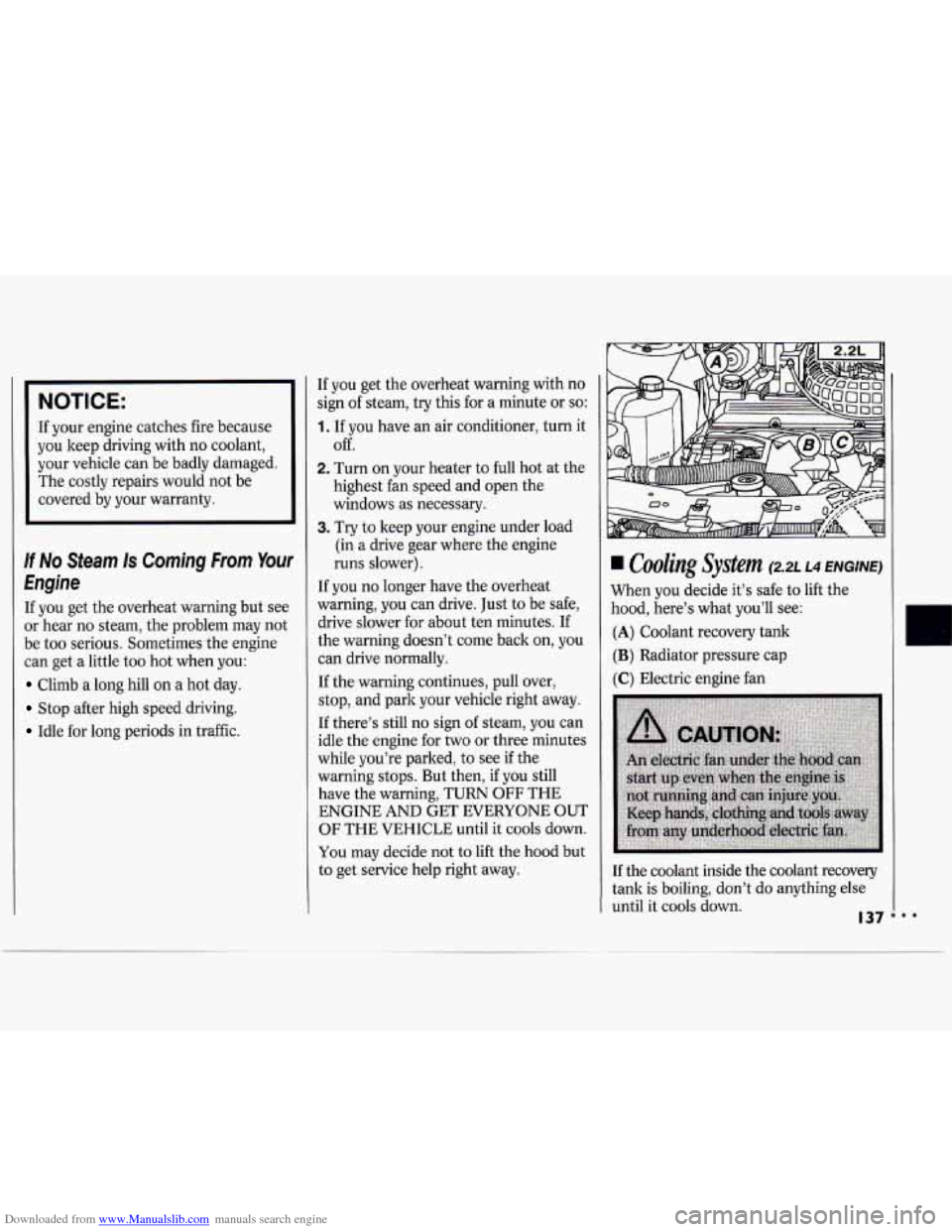
hdirtg system (2.2L L4 ENGINE)
When you decide it’s safe to lift the
hood, here’s what you’ll see:
(A) Coolant recovery tank
(B) Radiator pressure cap
(C) Electric engine fan
If the coolant inside the coolant recovery
tank is boiling, don’t do anything else
until
it cools down. I37
Page 139 of 243
Downloaded from www.Manualslib.com manuals search engine Problems on the Road
The coolant level should be at or above
FULL COLD. If it isn’t, you may have
a leak in the radiator hoses, heater
hoses, radiator, water pump or
somewhere else in the cooling system.
I.. ’ 138
NOTICE:
Engine damage from running your
engine without coolant isn’t
covered by your warranty.
If there seems to be no leak, check to
see if the electric engine fan is running.
If the engine is overheating, the fan
should be running. If it isn’t, your
vehicle needs service.
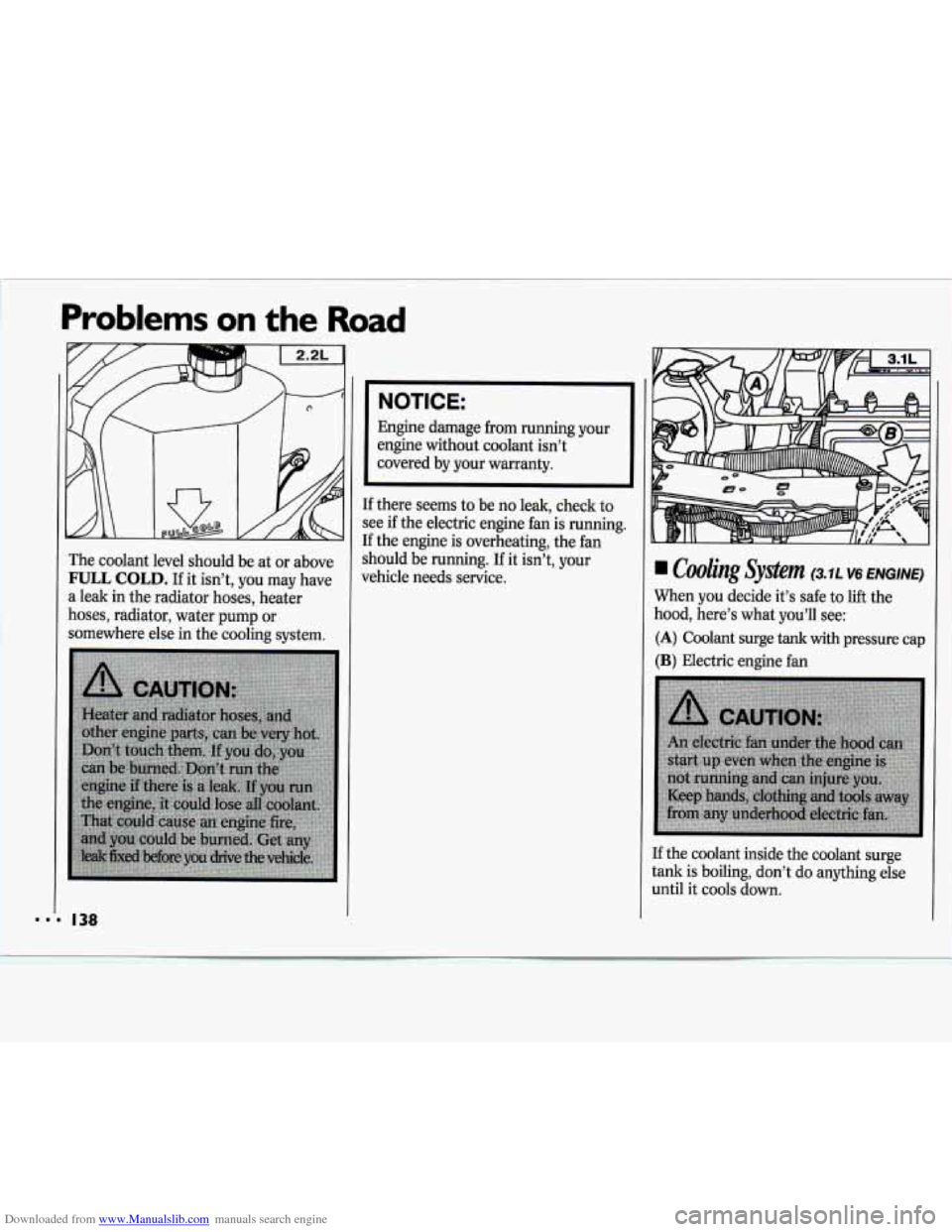
coohg Sy&n (3.1 L V6 ENGINE)
When you decide it’s safe to lift the
hood, here’s what you’ll see:
(A) Coolant surge tank with pressure cap
(B) Electric engine fan
If the coolant inside the coolant surge
tank
is boiling, don’t do anything else
until it cools down.
Page 142 of 243
![CHEVROLET CAVALIER 1994 1.G Owners Manual Downloaded from www.Manualslib.com manuals search engine I
I 2.2L ]
How to Add Coolant to the 2.21
14 Engne at the Radiator
1. You can remove the radiator pressure
cap when the cooling sys](/img/24/8078/w960_8078-141.png "CHEVROLET CAVALIER 1994 1.G Owners Manual Downloaded from www.Manualslib.com manuals search engine I
I 2.2L ]
How to Add Coolant to the 2.21
14 Engne at the Radiator
1. You can remove the radiator pressure
cap when the cooling sys")
Downloaded from www.Manualslib.com manuals search engine I
I 2.2L ]
How to Add Coolant to the 2.21
14 Engne at the Radiator
1. You can remove the radiator pressure
cap when the cooling system,
including the radiator pressure cap
and upper radiator hose, is no longer
hot. Turn the pressure cap slowly to
the left until
it first stops. (Don’t
press down while turning the
pressure cap.) If you hear a hiss, wait
for that to stop. A hiss means there is
still some pressure left.
I 2.2L
n
2. Then keep turning the pressure cap,
but now push down as you turn it.
Remove the pressure cap. 3. Fill the radiator with the proper mix,
up to the base of the filler neck.
Page 143 of 243
Downloaded from www.Manualslib.com manuals search engine Problems on the Road
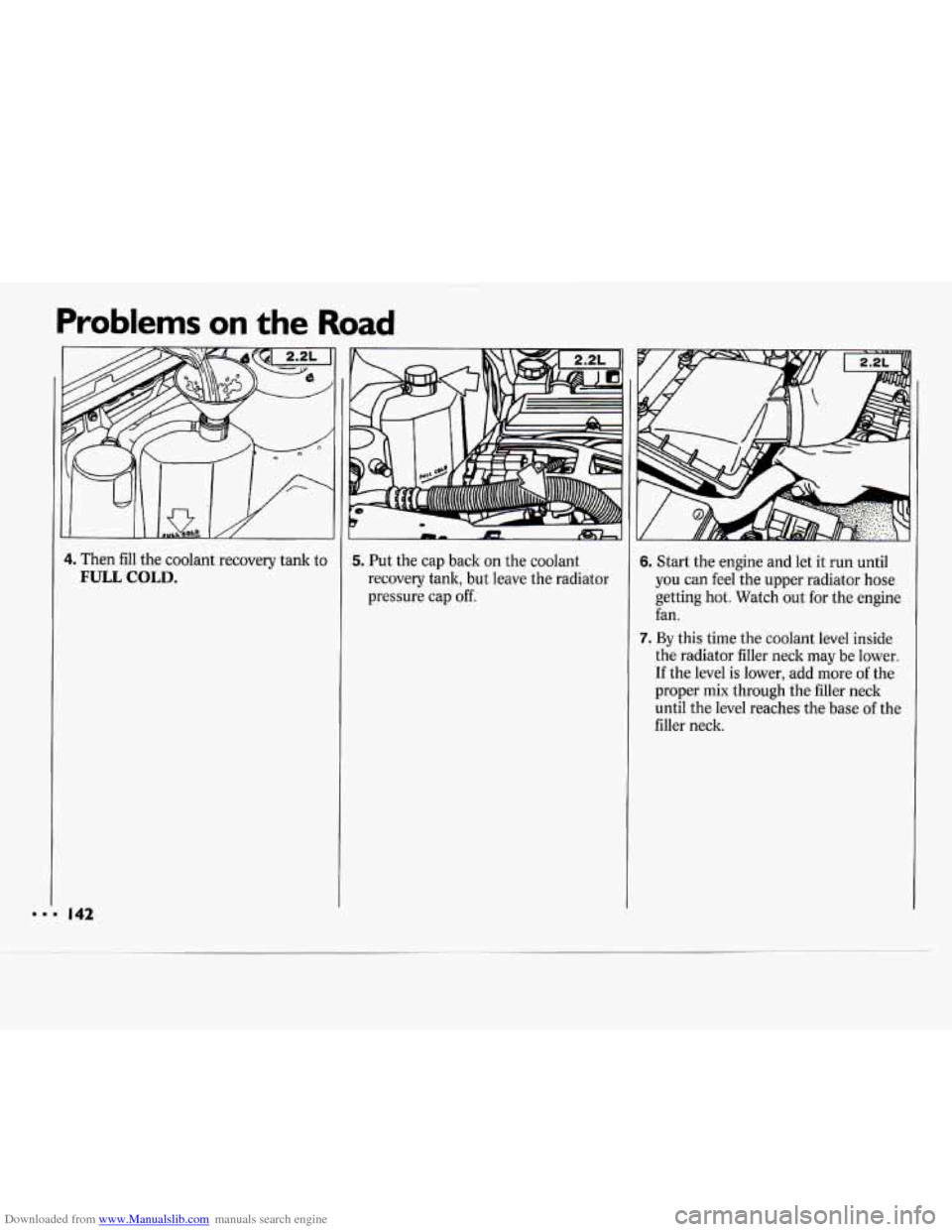
4. Then fill the coolant recovery tank to
FULL COLD.
I
m.4 142
II- m
5. Put the cap back on the coolant
recovery tank, but leave the radiator
pressure cap off. 6. Start the engine and let it run until
you can feel the upper radiator hose
getting hot. Watch out for the engine
fan.
7. By this time the coolant level inside
the radiator filler neck may be lower.
If the level is lower, add more
of the
proper
mix through the filler neck
until the level reaches the base of the
filler neck.
Page 144 of 243
Downloaded from www.Manualslib.com manuals search engine II
R
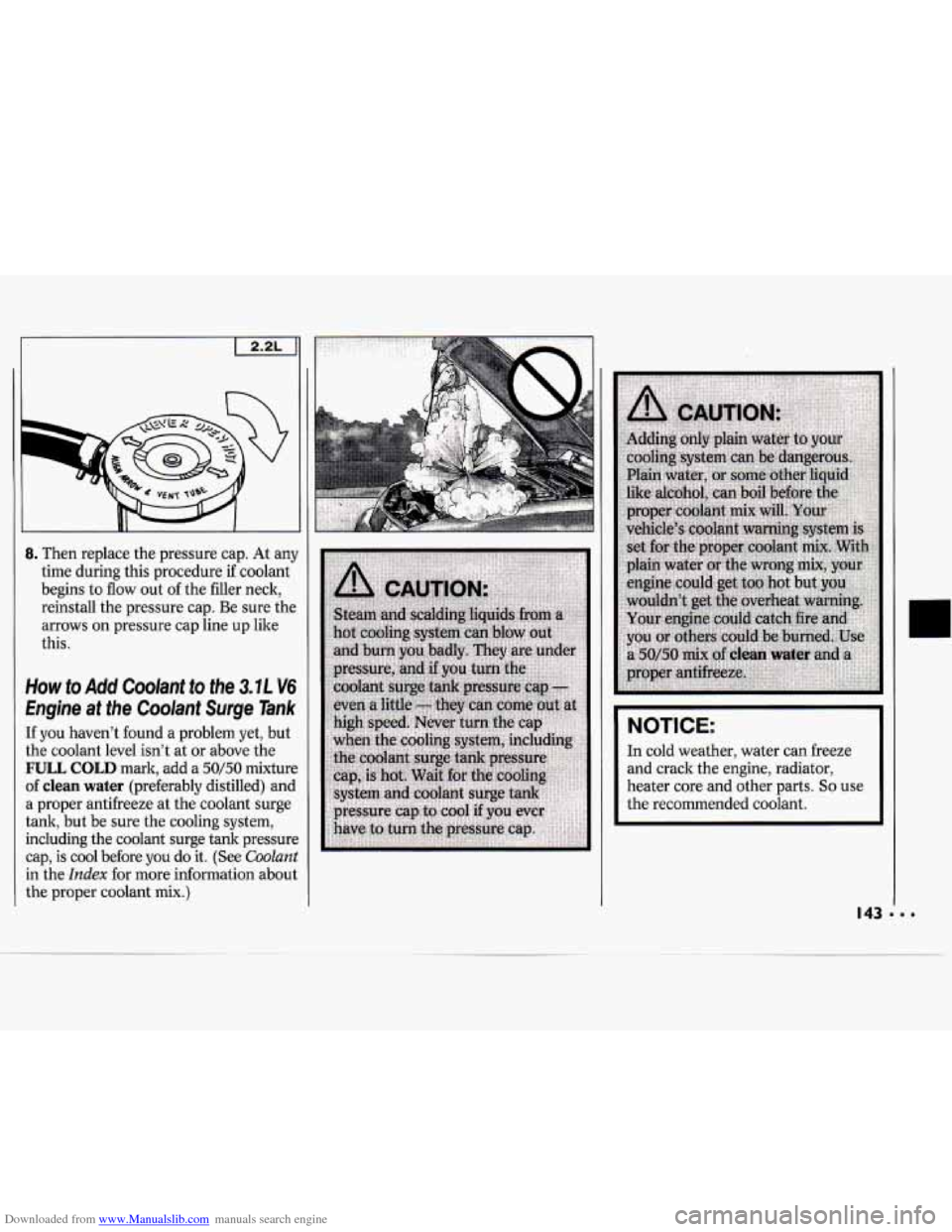
8. Then replace the pressure cap. At anj
time during this procedure
if coolant
begins to flow
out of the filler neck,
reinstall the pressure cap. Be sure the
arrows
on pressure cap line up like
this.
How to Add Coolant to the 3.7L V6
€ngine at the Coolant Surge Tank
If you haven't found a problem yet, but
the coolant level isn't at or above the
FULL COLD mark, add a 50/50 mixture
of clean water (preferably distilled) and
a proper antifreeze at the coolant surge
tank, but be sure the cooling system,
including the coolant surge tank pressure
cap,
is cool before you do it. (See CooZuni
in the Index for more information about
the proper coolant mix.)
NOTICE:
In cold weather, water can freeze
and crack the engine, radiator,
heater core and other parts.
So use
the recommended coolant.
Page 145 of 243
Downloaded from www.Manualslib.com manuals search engine Problems on the Road
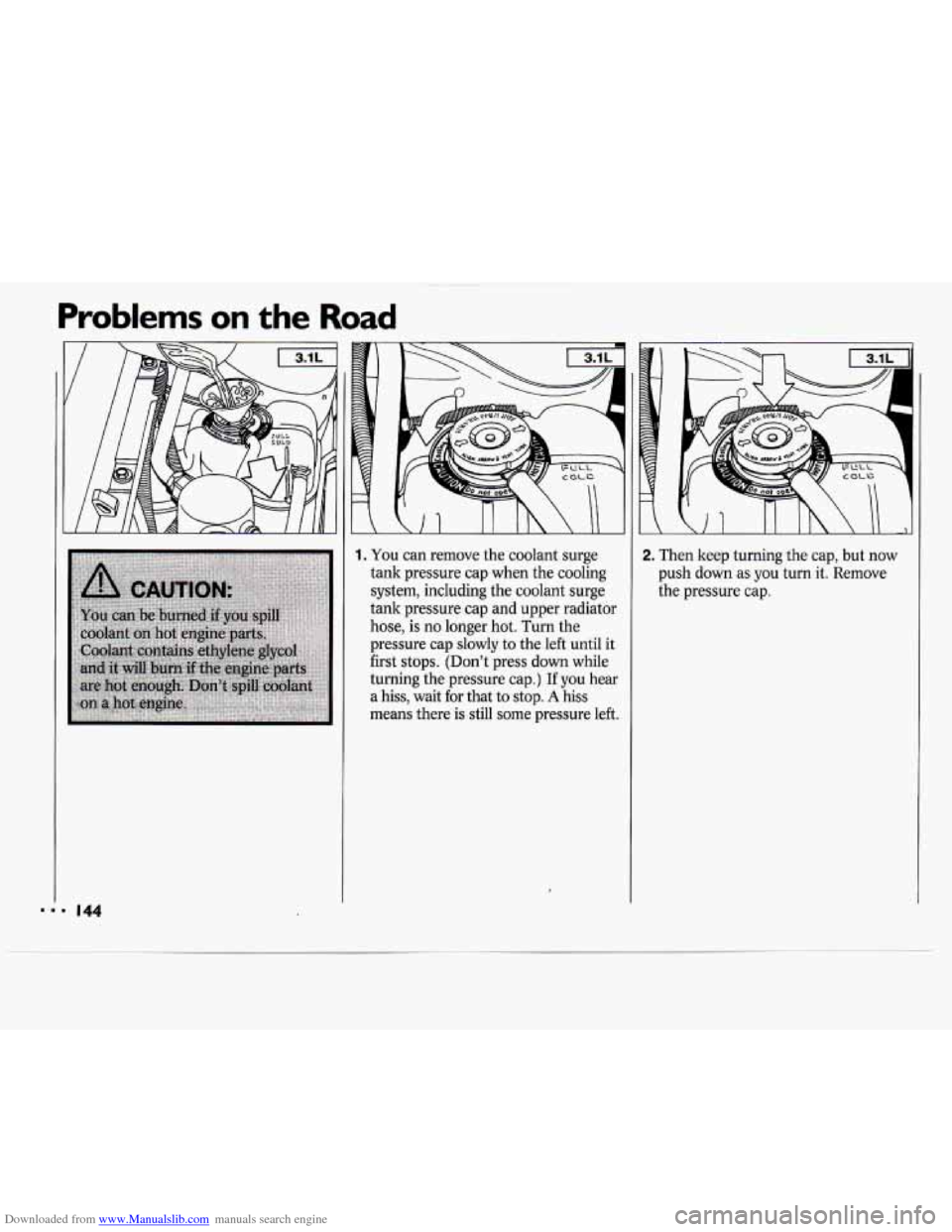
1. You can remove the coolant surge
tank pressure cap when the cooling
system, including the coolant surge
tank pressure cap and upper radiator
hose, is no longer hot. Turn the
pressure
cap slowly to the left until it
first stops. (Don't press down while
turning the pressure cap.)
If you hear
a hiss, wait for that to stop.
A hiss
means there is still some pressure left.
2. Then keep turning the cap, but now
push down as you turn it. Remove
the pressure cap.
Page 146 of 243
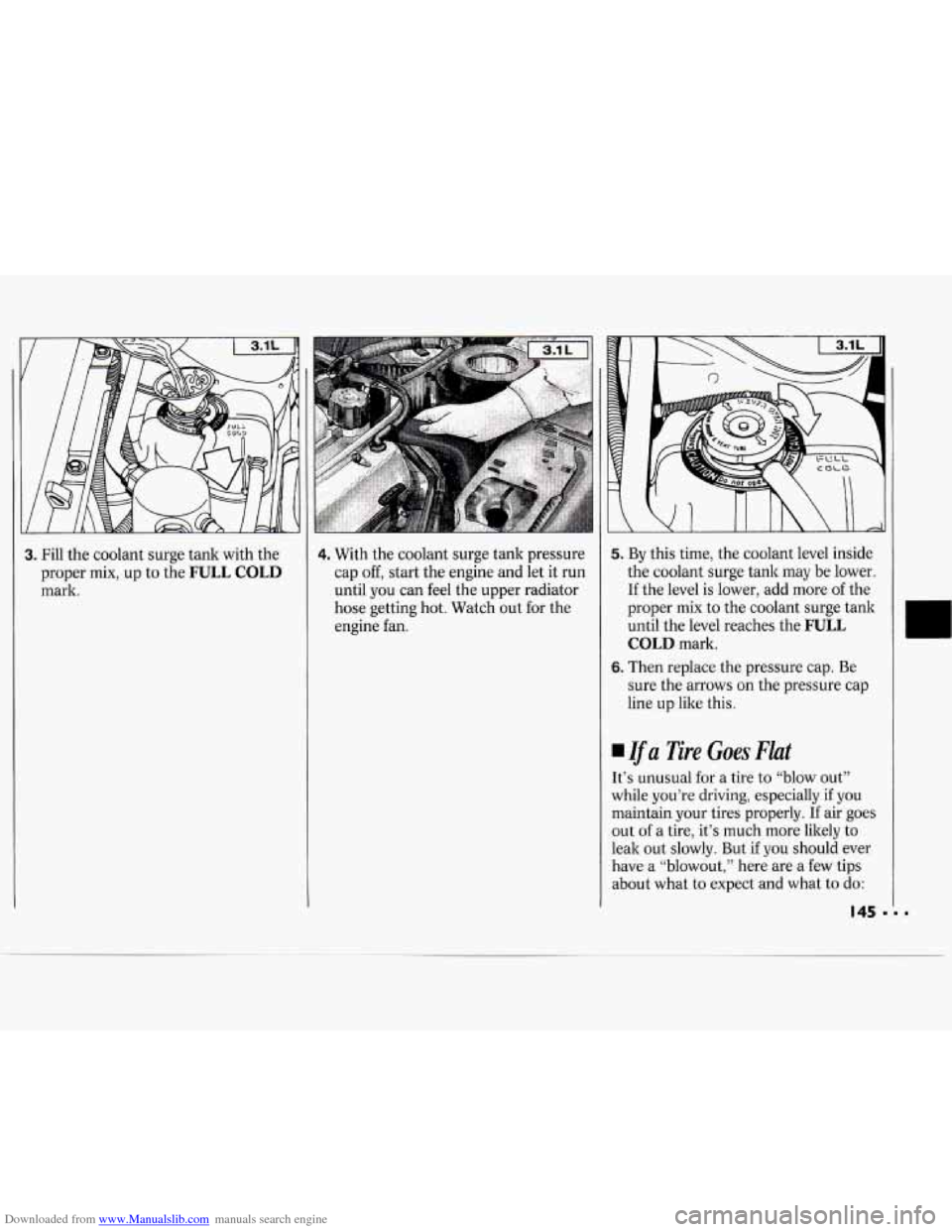
Downloaded from www.Manualslib.com manuals search engine 3. Fill the coolant surge tank with the
proper mix, up to the
FULL COLD
mark.
4. With the coolant surge tank pressure
cap
off, start the engine and let it run
until you can feel the upper radiator
hose getting hot. Watch out for the
engine fan.
5. By this time, the coolant level inside
the coolant surge tank may be lower.
If the level is lower, add more of the
proper mix to the coolant surge tank
until the level reaches the
FULL
COLD mark.
6. Then replace the pressure cap. Be
sure the arrows
on the pressure cap
line up like this.
Ifa Tire Goes Flat
It’s unusual for a tire to “blow out”
while you’re driving, especially
if you
maintain your tires properly. If air goes
out of a tire, it’s much more likely to
leak out slowly. But
if you should ever
have a
blowout^" here are a few tips
about what to expect and what
to do:
Page 173 of 243
Downloaded from www.Manualslib.com manuals search engine Dl
~ ~~ ~~ ~
Service & Appearance Care
ID
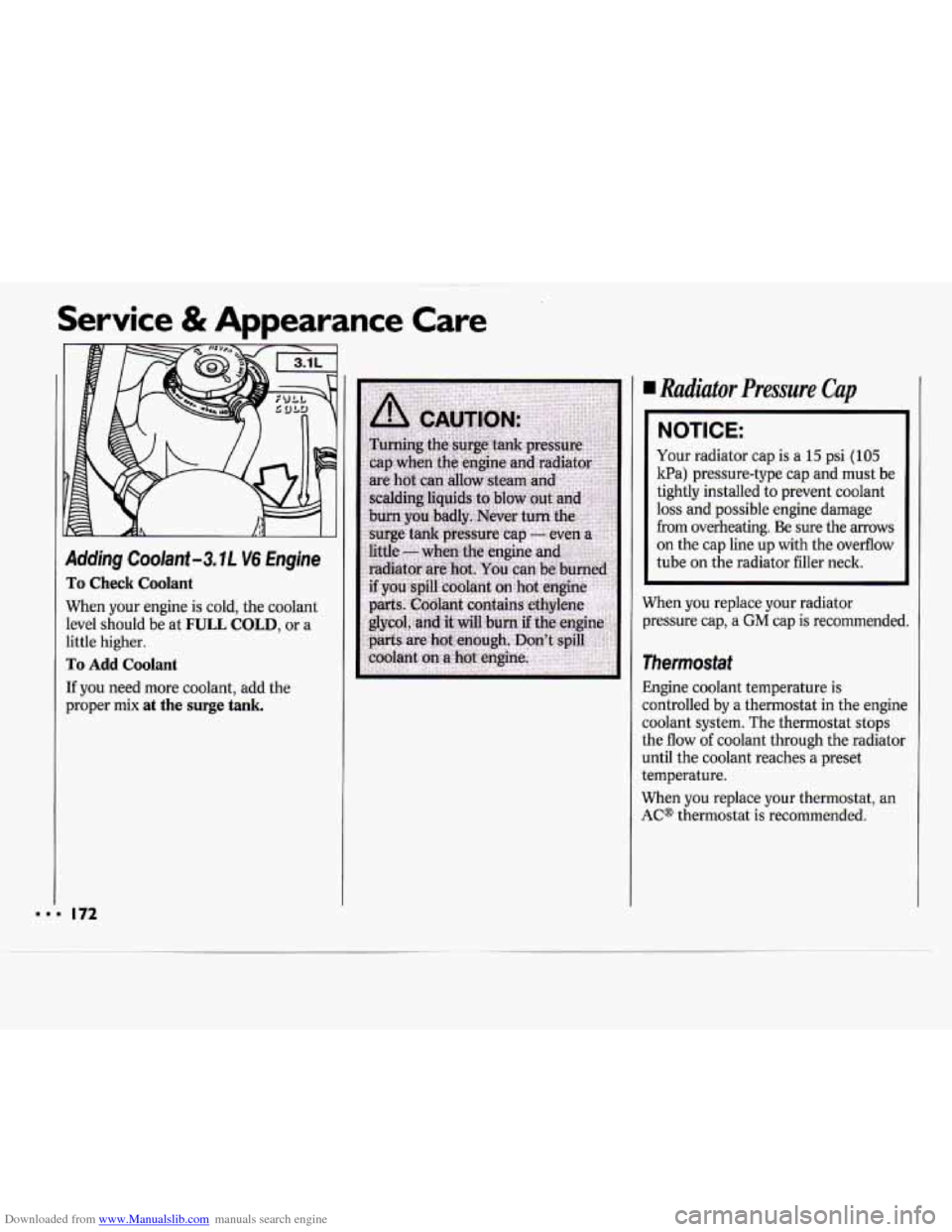
Adding Coolant -3. IL V6 Engine
To Check Coolant
When your engine is cold, the coolant
level should be at
FULL COLD, or a
little
higher.
To Add Coolant
If you need more coolant, add the
proper
mix at the surge tank.
I72
Radiator Pressure Cap
NOTICE:
Your radiator cap is a 15 psi (105
kPa) pressure-type cap and must be
tightly installed to prevent coolant
loss and possible engine damage
from overheating. Be sure the arrows
on the cap line up with the overflow
tube on the radiator filler neck.
When
you replace your radiator
pressure cap, a
GM cap is recommended.
Thermostat
Engine coolant temperature is
controlled by a thermostat in the engine
coolant system. The thermostat stops
the flow of coolant through the radiator
until the coolant reaches a preset
temperature.
When
you replace your thermostat, an
AC@ thermostat is recommended.
Page 211 of 243
Downloaded from www.Manualslib.com manuals search engine Maintenance Schedule
Explanation of Scheduled
Maintenance Services
Following are explanations of the
services listed in Schedule
I and
Schedule 11.
The proper fluids and lubricants to use
are listed in Section
D. Make sure
whoever services your vehicle uses
these. All parts should be replaced and
all necessary repairs done before you or
anyone else drives the vehicle.
ITEM SERVICE
NO.
1. Engine Oil and Filter Change* -
Always use SH or SG Energy
Conserving I1 oils of proper viscosity.
The
“SH” or “SG” designation may
be shown alone or in combination
with others, such as “SH/CD,”
“SH,
SG, CD,” “SG/CD,” etc. To
determine the preferred viscosity for
your vehicle’s engine (e.g., SAE 5W-
30 or SAE 10W-30), see
Engine Oil
in the Index.
the suspension and steering linkage.
Lubricate the transaxle shift linkage.
Inspection - For proper wear and
maximum tire life, rotate your tires
following the instructions in this
manual. See
Tires, Inspection G
Rotation in the Index. Check the
tires for uneven wear or damage. If
you see irregular or premature wear,
check the wheel alignment. Check for
damaged wheels also.
2. Chassis Lubrication - Lubricate
3. Tire and Wheel Rotation and
4. Engine Accessory Drive Belt(s)
Inspection
* - Inspect the belt (s)
for cracks, fraying, wear and proper
tension. Replace as needed. (Belts
can have many small cracks in
individual ribs without affecting
performance.)
5. Cooling System Service* - Drain,
flush and refill the system with new
or approved recycled coolant
conforming to
GM Specification
1825M. Keep coolant at the proper
mixture as specified. See
Coolant in
the
Index. This provides proper
freeze and boil protection, corrosion
inhibitor level and maintains proper
engine operating temperature.
Inspect hoses and replace if they are
cracked, swollen or deteriorated.
Tighten screw-type hose clamps.
Clean the outside of the radiator and
air conditioning condenser. Wash the
pressure cap and neck.
To help ensure proper operation, we
recommend a pressure test
of both the
cooling system and the pressure cap.
Page 238 of 243
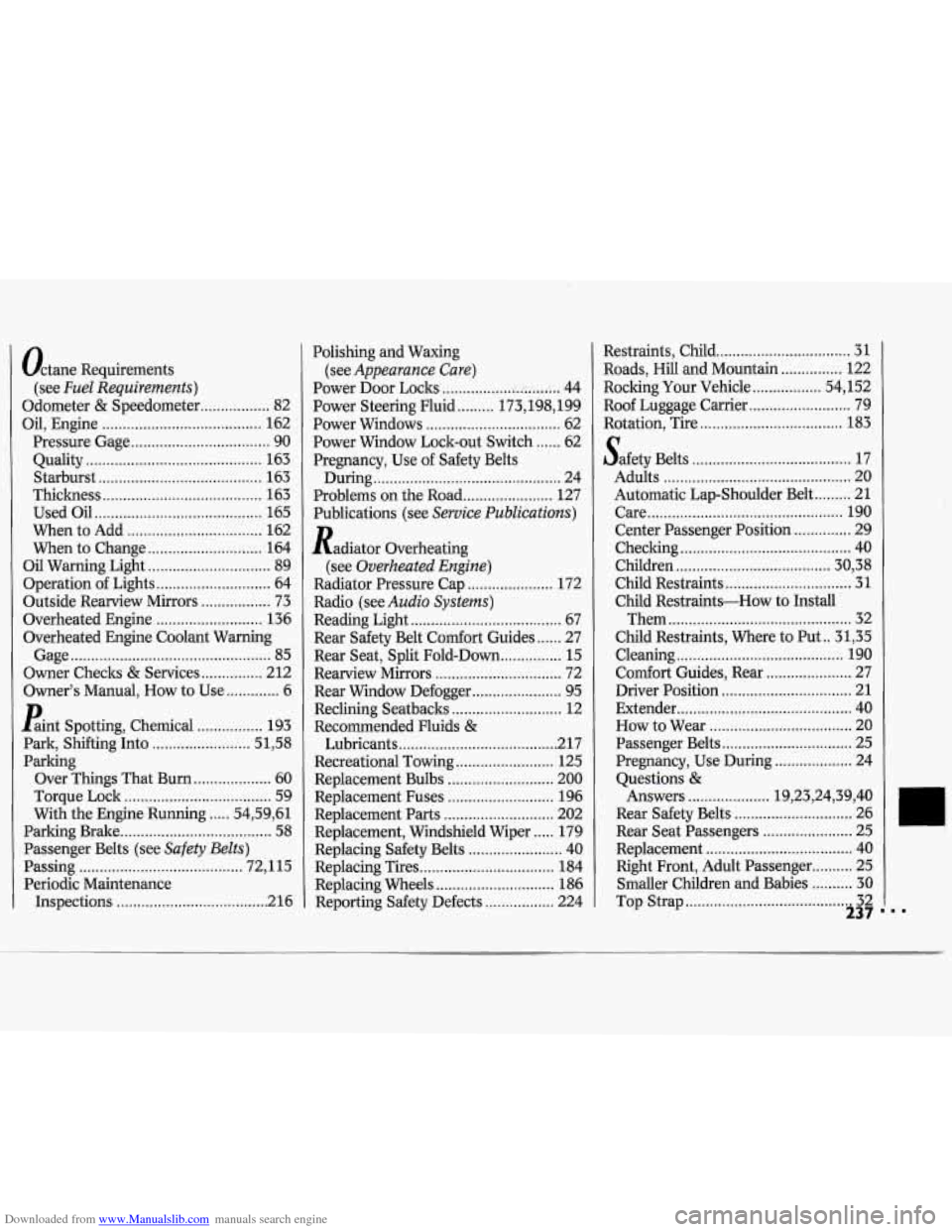
Downloaded from www.Manualslib.com manuals search engine Octane Requirements
Odometer
& Speedometer ................. 82
(see
Fuel
Requirements)
Oil. Engine ....................................... 162
Pressure Gage
.................................. 90
Quality
........................................... 163
Starburst
........................................ 163
Thickness
....................................... 163
Used Oil
......................................... 165
When
to Add ................................. 162
When to Change
............................ 164
Oil Warning Light
.............................. 89
Operation of Lights
............................ 64
Outside Rearview Mirrors
................. 73
Overheated Engine
.......................... 136
Overheated Engine Coolant Warning Gage
................................................. 85
Owner Checks & Services ............... 212
Owner’s Manual. How to Use
............. 6
paint Spotting. Chemical
................ 193
Park. Shifting Into
........................ 51. 58
Parking
Over Things That Burn
................... 60
With the Engine Running
..... 54.59. 61
Passing
........................................ 72. 115
Inspections
..................................... 2 16
Torque
Lock
.................................... 59
Parking Brake
..................................... 58
Passenger Belts (see Safety Belts)
Periodic Maintenance Polishing
and Waxing
Power Door Locks
................. i. ........ ;. 44
Power Steering Fluid
......... 173,198, 199
Power Windows
................................. 62
Power Window Lock-out Switch
...... 62
Pregnancy, Use of Safety Belts
During
.............................................. 24
Problems on the Road
...................... 127
Publications (see
Service Publications)
Radiator Overheating
(see
Overheated Engine)
Radiator Pressure Cap ..................... 172
Radio (see
Audio Systems)
Reading Light ..................................... 67
Rear Safety Belt Comfort Guides
...... 27
Rear Seat, Split Fold-Down
............... 15
Rearview Mirrors ............................... 72
(see
Appearance
Care)
Rear Window Defogger ...................... 95
Reclining Seatbacks
........................... 12
Recreational Towing
........................ 125
Recommended Fluids
&
Lubricants ....................................... 217
Replacement Bulbs
.......................... 200
Replacement Fuses
.......................... 196
Replacement Parts
........................... 202
Replacement, Windshield Wiper
..... 179
Replacing Safety Belts
....................... 40
Replacing Tires
................................. 184
Reporting Safety Defects
................. 224
Replacing Wheels
............................. 186
Restraints. Child ................................. 31
Roads. Hill and Mountain
............... 122
Rocking Your Vehicle
................. 54. 152
Rotation. Tire
................................... 183
Roof Luggage
Carrier
......................... 79
S afety Belts ....................................... 17
Adults .............................................. 20
Automatic Lap-Shoulder Belt
......... 21
Care
................................................ 190
Center Passenger Position
.............. 29
Checking
.......................................... 40
Children
...................................... 3 0, 38
Child Restraints
............................... 31
Child Restraints-How to Install
Them
............................................. 32
Child Restraints, Where to Put
.. 31, 35
Cleaning
......................................... 190
Comfort Guides, Rear
..................... 27
Driver Position
................................ 21
Extender
........................................... 40
How to Wear ................................... 20
Passenger Belts
................................ 25
Pregnancy, Use During
................... 24
Questions
&
Answers .................... 19,23,24,39, 40
Rear Safety Belts ............................. 26
Rear Seat Passengers
...................... 25
Right Front, Adult Passenger
.......... 25
Smaller Children and Babies
.......... 30
Replacement .................................... 40
Top Strap
......................................... 32
237