warning CHEVROLET CAVALIER 1995 3.G User Guide
[x] Cancel search | Manufacturer: CHEVROLET, Model Year: 1995, Model line: CAVALIER, Model: CHEVROLET CAVALIER 1995 3.GPages: 340, PDF Size: 17.09 MB
Page 117 of 340
Downloaded from www.Manualslib.com manuals search engine When one of the warning lights comes on and stays on
when
you are driving, or when one of the gages shows
there may be a problem, check
the section that tells you
what to do about
it. Please follow this manual’s advice.
Waiting to do repairs can be costly
-- and even
dangerous.
So please get to know your warning lights
and gages. They’re
a big help.
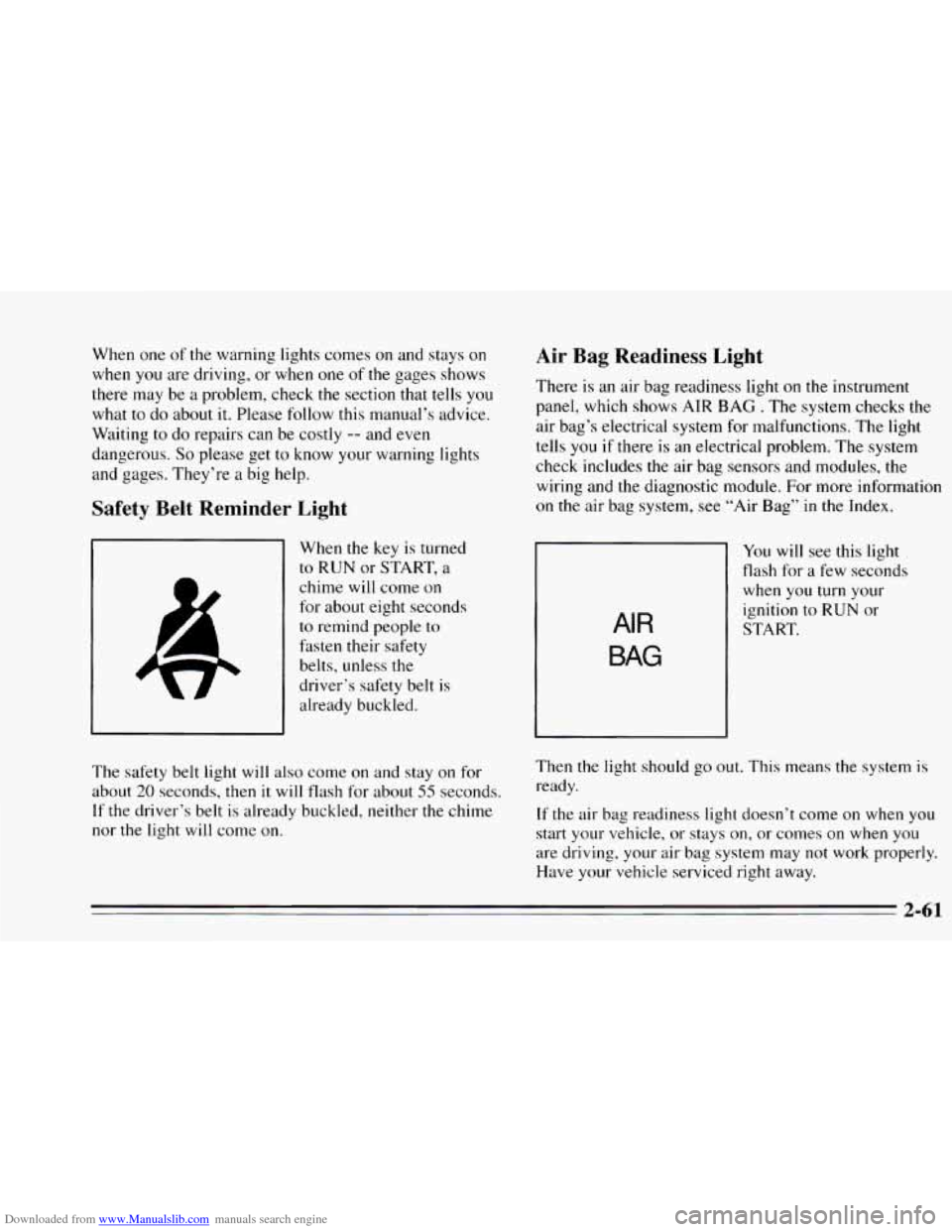
Safety Belt Reminder Light
When the key is turned
to RUN or START, a
chime will come on
for about eight seconds
to remind people to
fasten their safety
belts, unless
the
driver’s safety belt is
already buckled.
Air Bag Readiness Light
There is an air bag readiness light on the instrument
panel, which shows AIR
BAG . The system checks the
air bag’s electrical system for malfunctions. The light
tells
you if there is an electrical problem. The system
check includes the air bag sensors and modules, the
wiring and the diagnostic module.
For more information
on the air bag system, see “Air Bag” in the Index.
rl
You will see this light
flash for
a few seconds
when you turn your
ignition
to RUN or
AIR
BAG
START.
The safety belt light
will also come on and stay on for
about
20 seconds, then it will flash for about 55 seconds.
If the driver’s belt is already buckled, neither the chime
nor
the light will come on. Then
the light should
go out. This means the system is
ready.
If the air bag readiness light doesn’t come on when you
start your vehicle, or stays on, or comes on
when you
are driving. your air bag system may not work properly.
Have your vehicle serviced right away.
2-61
Page 118 of 340
Downloaded from www.Manualslib.com manuals search engine Brake System Warning Light
BRAKE
Your Chevrolet’s hydraulic
brake system is divided
into
two parts. If one part isn’t
working, the other part can
still work and stop you. For
good braking, though, you
need both parts working
well.
If the warning light comes on, there could be a brake
problem. Have your brake system inspected right away.
This light should come on briefly as you start the
vehicle. If it doesn’t come on then, have it fixed so it
will be ready to warn you if there’s a problem.
If the light comes on while you are driving, pull off the
road and stop carefully.
You may notice that the pedal is
harder to push. Or, the pedal may go closer to the floor.
It may take longer to stop. If the light is still on, or if the
anti-lock brake system warning light is flashing, have
the vehicle towed for service. (See “Anti-Lock Brake
System Warning Light” and “Towing Your Vehicle”
in
the Index.)
The brake system warning light will
also come on when
you set your parking brake, and
it will stay on if your
parking brake doesn’t release
fully. If it stays on after
your parking brake
is fully released, it means you have a
brake problem.
2-62
Page 119 of 340
Downloaded from www.Manualslib.com manuals search engine Anti-Lock Brake System Warning Light
1 With the anti-lock brake
’ system, this light will come
on when you start your
engine and it will stay on
for three seconds. That’s
normal.
If the light doesn’t come on, have it fixed
so it will be
ready to warn you if there is a problem.
If the light flashes when you’re driving,
you don’t have
anti-lock brakes and there could be a problem with your
regular brakes. Pull off the road and stop carefully. You
may notice that the pedal is harder to push. Or, the pedal
may
go closer to the floor. It may take longer to stop.
Have the vehicle towed for service. (See “Towing Your
Vehicle” in the Index.) If
the anti-lock brake system warning light stays on
longer than normal after you’ve started your engine, turn
the ignition off. Or, if the light comes on and stays on
when you’re driving, stop as soon as possible and turn
the ignition
off. Then start the engine again to reset the
system. If the light still stays on, or comes
on again
while you’re driving, your Chevrolet needs service.
If
the light is on but not flashing and the regular brake
system warning light isn’t on,
you still have brakes, but
you don’t have anti-lock brakes.
2-63
Page 120 of 340
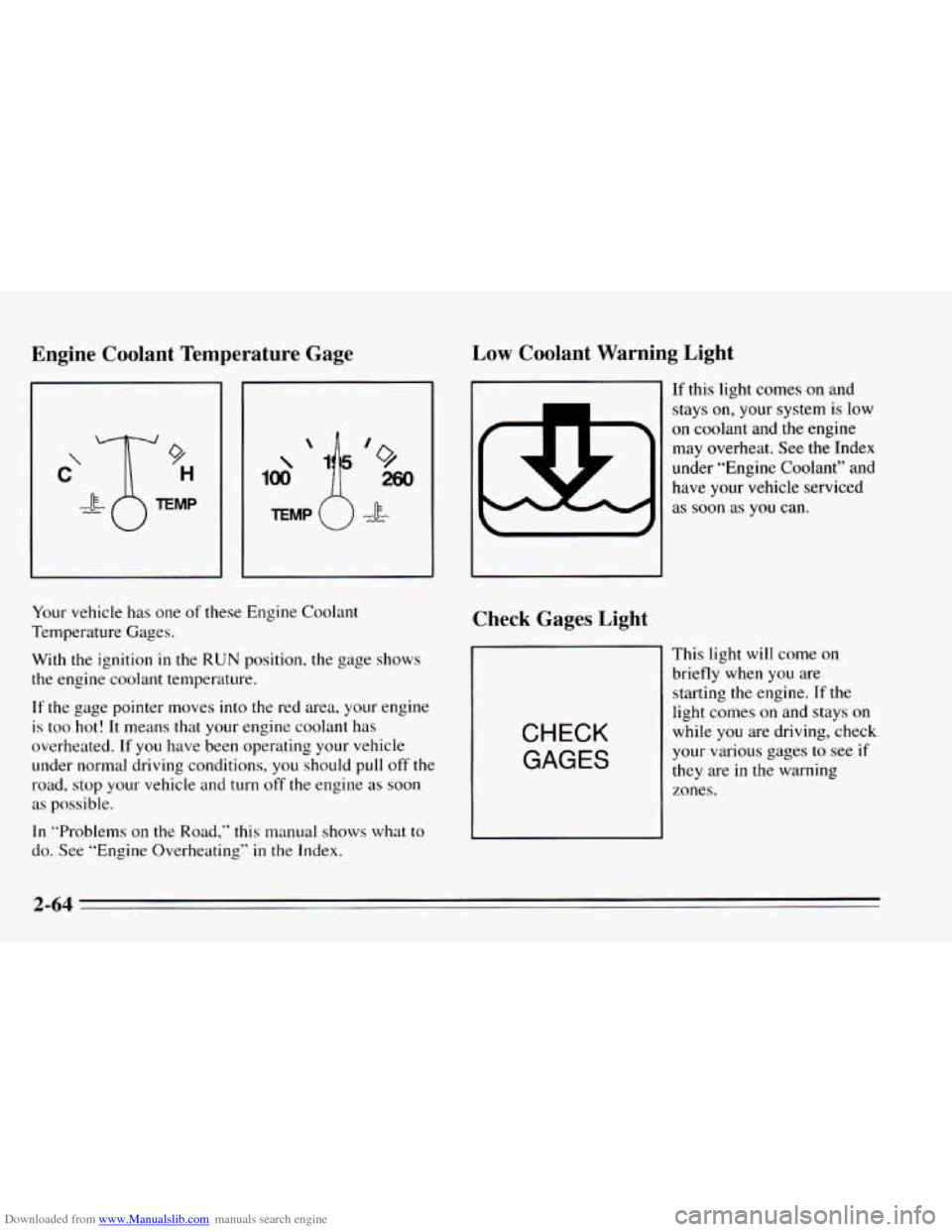
Downloaded from www.Manualslib.com manuals search engine Engine Coolant Temperature Gage
100 \‘+’” 260
Your vehicle has one of these Engine Coolant
Temperature Gages.
With the ignition
in the RUN position, the gage shows
the engine coolant temperature.
If the gage pointer tnoves into the red area, your engine
is too
hot! It means that your engine coolant has
overheated.
If you have been operating your vehicle
under normal driving conditions, you should pull
off’ the
road, stop your vehicle and turn
off’ the engine as soon
as possible.
In “Problems on the Road,“ this manual shows what to
do. See “Engine Overheating”
in the Index.
Low Coolant Warning Light
Check Gages Light
CHECK
GAGES
If this light comes on and
stays on, your system is low
on coolant and the engine
may overheat. See the Index
under “Engine Coolant” and
have your vehicle serviced
as soon as you can.
This light will come on
briefly when
you are
starting the engine.
If the
light comes on and stays
on
while you are driving, check
your various gages
to see if
they are in the warning
I
zones.
2-64
Page 121 of 340
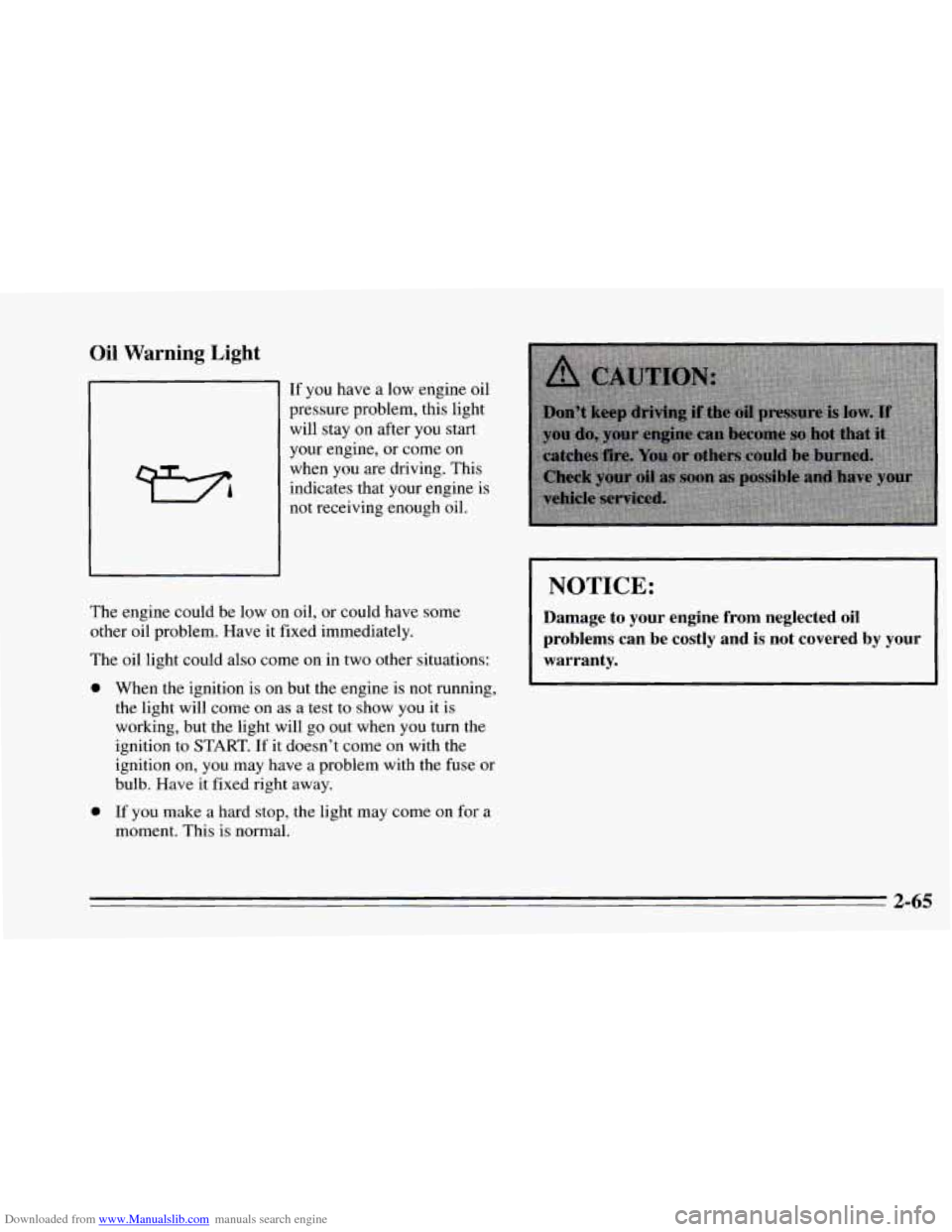
Downloaded from www.Manualslib.com manuals search engine Oil Warning Light
If you have a low engine oil
pressure problem, this light
will stay
on after you start
your engine, or come on
when you are driving. This
indicates that your engine is
not receiving enough oil.
The engine could be low on oil,
or could have some
other oil problem. Have it fixed immediately.
The oil light could also come on in two other situations:
0
0 When the ignition is on but the engine is not running,
the light will come on as a test to show
you it is
working, but the light will go out when you turn the
ignition to
START. If it doesn’t come on with the
ignition
on, you may have a problem with the fuse or
bulb. Have it fixed right away.
If you make a hard stop, the light may come on for a
moment. This is normal.
NOTICE:
Damage to your engine from neglected oil
problems can be costly and is not covered by your
warranty.
2-65
Page 126 of 340
Downloaded from www.Manualslib.com manuals search engine These following conditions also may cause the CHECK
ENGINE light to come
on:
0
0
Low Fuel/Out of Fuel: As the vehicle starts to run
out of fuel, the CHECK ENGINE light may come on
as a result of an engine misfire. Filling your fuel tank
should correct this condition. Make sure to install
the
gas cap fully. It will require a few driving trips to
turn the light off.
Poor Quality Fuel: Be sure to fuel your vehicle with
quality fuel. Your engine may
not run efficiently on
poor fuel. Poor fuel may cause stalling, hesitation or
misfire. These conditions may
go away when the
engine
is warmed-up. However, poor quality fuel
may cause the
CHECK ENGINE light to come on.
Have a dealer check the vehicle. If no problems are
found, you may want
to change to another brand of
fuel.
Driving Through Standing Water: Driving your
vehicle through puddles
of deep standing water may
result in
a temporary misfire condition. This
condition will usually correct itself shortly after
the
electrical system dries out. it will require a few
driving trips
to turn the light off.
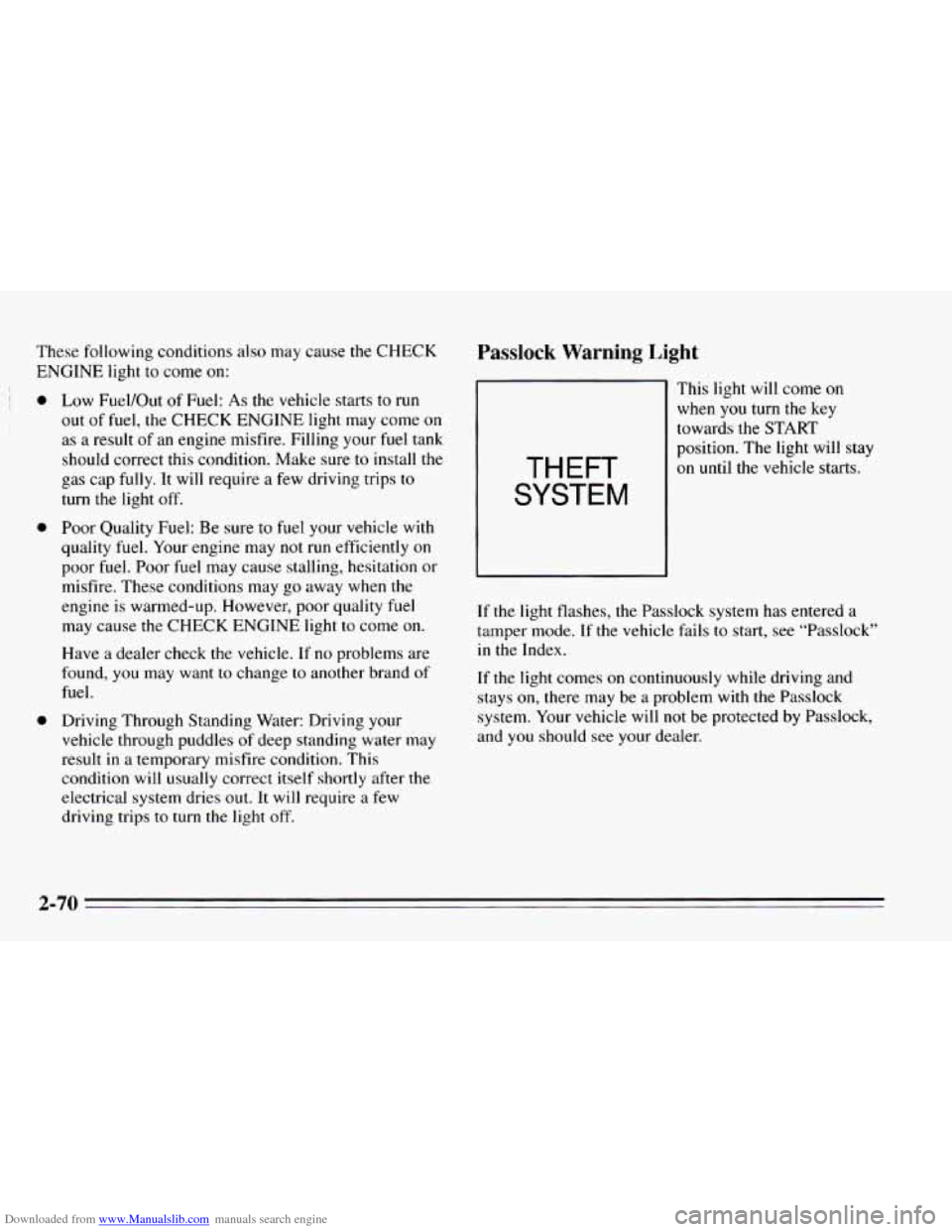
Passlock Warning Light
THEFT
SYSTEM
This light will come on
when you turn the key
towards the
START
position. The light will stay
on until the vehicle starts.
If the light flashes, the Passlock system has entered a
tamper mode.
If the vehicle fails to start, see “Passlock”
in the Index.
If
the light comes on continuously while driving and
stays
on, there may be a problem with the Passlock
system. Your vehicle will not be protected
by Passlock,
and
you should see your dealer.
2-70
Page 146 of 340

Downloaded from www.Manualslib.com manuals search engine Avoid needless heavy braking. Some people drive in
spurts
-- heavy acceleration followed by heavy braking
-- rather than keeping pace with traffic. This is a
mistake. Your brakes may not have time to cool between
hard stops. Your brakes will wear out much faster
if you
do a lot of heavy braking. If you keep pace with the
traffic and allow realistic following distances, you will
eliminate a lot
of unnecessary braking. That means
better braking and longer brake life.
If your engine ever stops while you’re driving, brake
normally but don’t pump
your brakes. If you do, the
pedal may get harder to push down. If your engine
stops,
you will still have some power brake assist. But
you will
use it when you brake. Once the power assist is
used up, it may take longer to stop and the brake pedal
will be harder to push.
Anti-Lock Brakes (ABS)
Your Chevrolet has an advanced electronic braking
system that will help prevent
a braking skid.
This light on
the
instrument panel will
come on briefly when
you start your vehicle.
When you start
your vehicle, or when you begin to drive
away,
you may hear a momentary motor or clicking
noise. And you may even notice that
your brake pedal
moves
a little while this is going on. This is the ABS
system testing itself. If there’s a problem with the
anti-lock brake system,
the anti-lock brake system
warning light will stay
on or flash.
See “Anti-Lock Brake System Warning Light” in the
Index.
Page 152 of 340
Downloaded from www.Manualslib.com manuals search engine Loss of Control
Let’s review what driving experts say about what
happens when
the three control systems (brakes, steering
and acceleration) don’t have enough friction where the
tires meet the road to do what the driver has asked.
In any emergency, don’t give up. Keep trying to steer
and constantly seek an escape route or area
of less
danger.
Skidding
In a skid, a driver can lose control of the vehicle.
Defensive drivers avoid most skids by taking reasonable
care suited
to existing conditions, and by not
“overdriving” those conditions. But skids are always
possible.
The three types
of skids correspond to your Chevrolet’s
three control systems. In the braking skid your wheels
aren’t rolling.
In the steering or cornering skid, too
much speed or steering in
a curve causes tires to slip and
lose cornering force. And
in the acceleration skid too
much throttle causes
the driving wheels to spin.
A cornering skid and an acceleration skid are best
handled by easing your
foot off the accelerator pedal.
If your vehicle starts to slide, ease your foot off the
accelerator pedal and quickly steer the way
you want the
vehicle
to go. If you start steering quickly enough, your
vehicle may straighten
out. Always be ready for a
second skid if
it occurs.
Of course, traction
is reduced when water, snow, ice,
gravel, or other material is
on the road. For safety, you’ll
want to slow down and adjust your driving to these
conditions. It is important
to slow down on slippery
surfaces because stopping distance will be longer and
vehicle control more limited.
While driving
on a surface with reduced traction, try
your best to avoid sudden steering, acceleration, or
braking (including engine braking by shifting to a lower
gear). Any sudden changes could cause the tires to slide.
You may
not realize the surfxe is slippery until your
vehicle is skidding. Learn to recognize warning
clues
-- such as enough water, ice or packed snow
on the road to make a “mirrored surface”
-- and slow
down when you have any doubt.
Remember: Any anti-lock brake system
(ABS) helps
avoid
only the braking skid.
4-12
Page 157 of 340
Downloaded from www.Manualslib.com manuals search engine City Driving
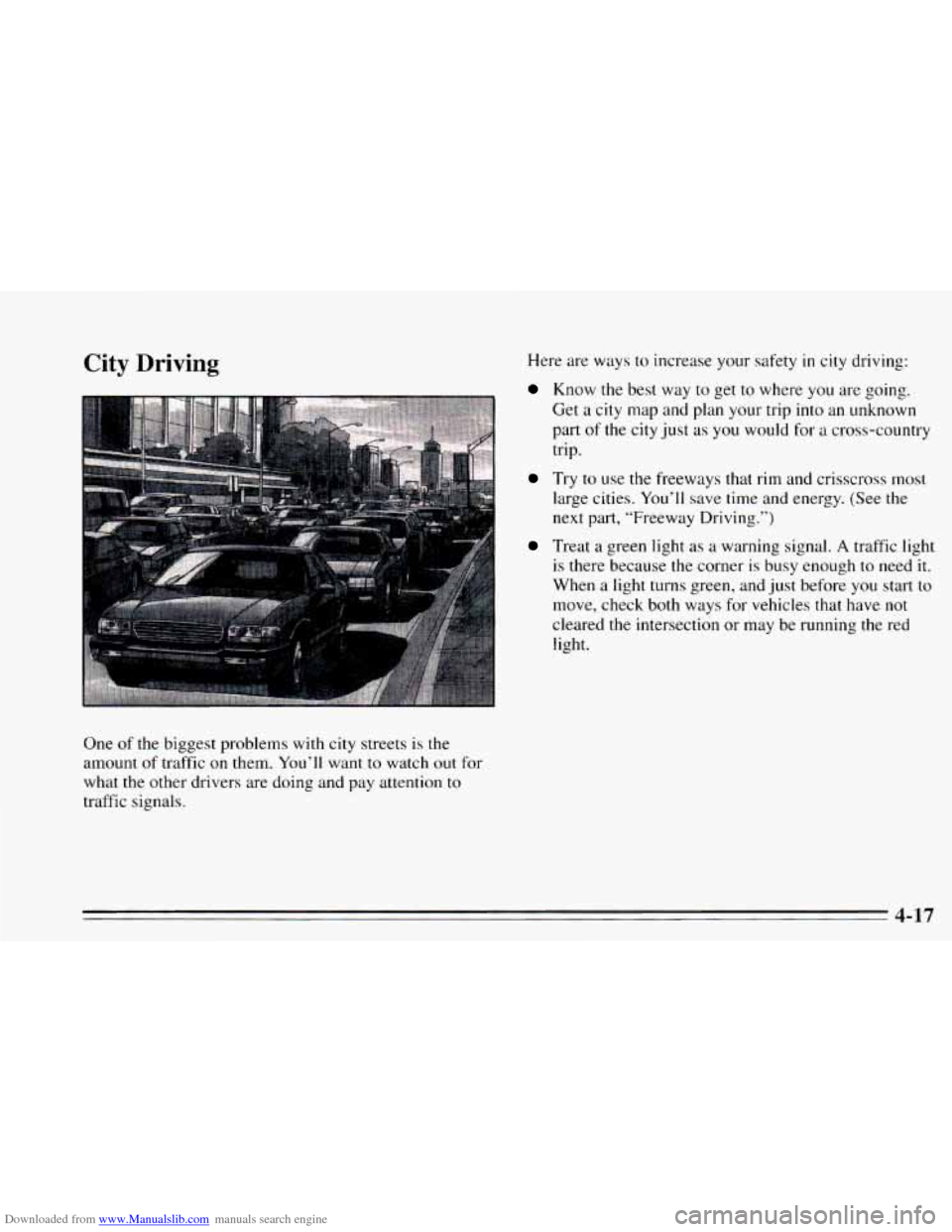
One of the biggest problems with city streets is the
amount of traffic
on them. You’ll want to watch out for
what the other drivers are doing and pay attention
to
traffic signals. Here
are ways to increase your safety
in city driving:
Know the best way to get to where you are going.
Get
a city map and plan your trip into an unknown
part of the city just as you would for a cross-country
trip.
Try to use the freeways that rim and crisscross most
large cities.
You’ll save time and energy. (See the
next part, “Freeway Driving.”)
Treat a green light as a warning signal. A traffic light
is there because the corner is busy enough to need
it.
When a light turns green, and just before you start to
move, check both ways for vehicles that have
not
cleared the intersection or may be running the red
light.
4-17
Page 162 of 340
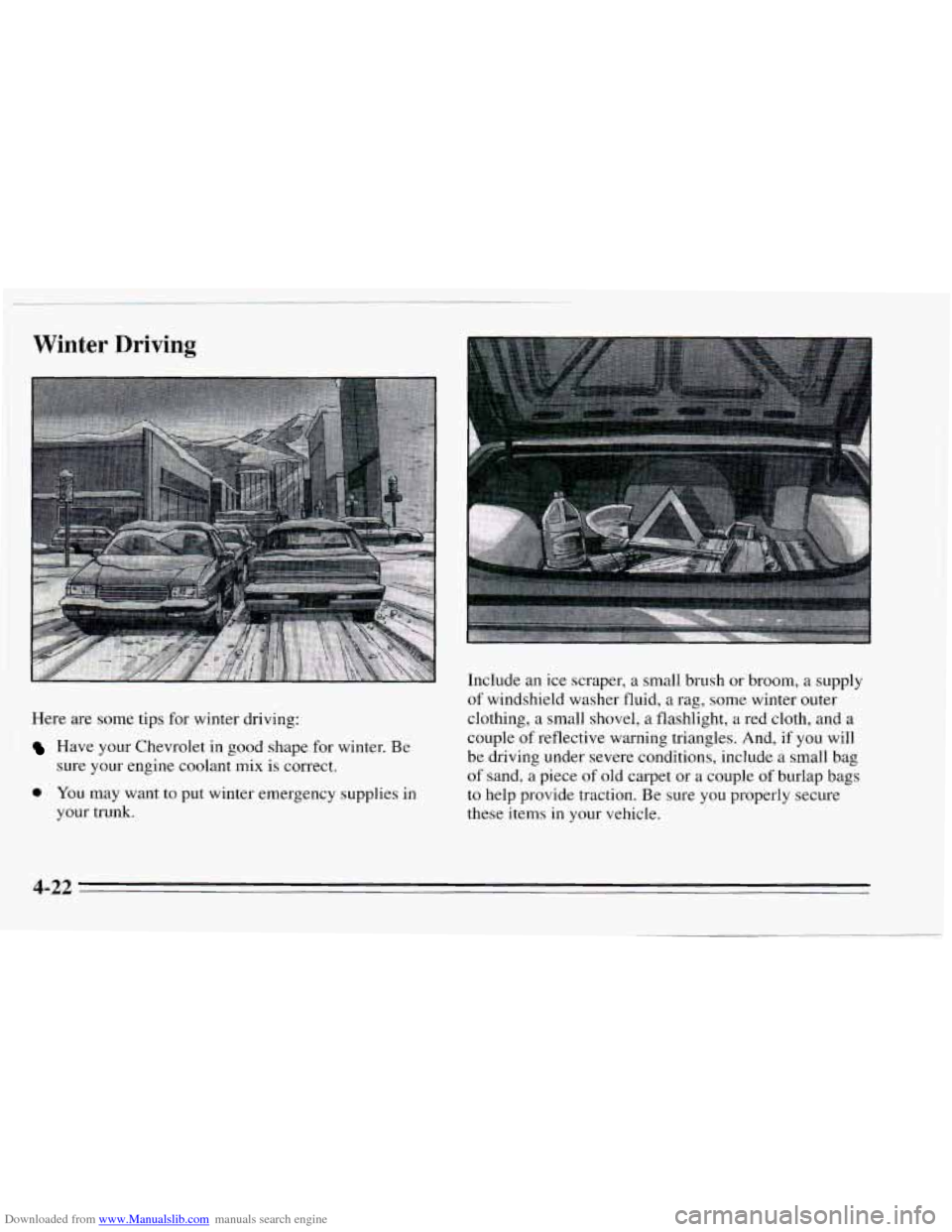
Downloaded from www.Manualslib.com manuals search engine Winter Driving
Here are some tips for winter driving:
Have your Chevrolet in good shape for winter. Be
sure your engine coolant
mix is correct.
0 YOU may want to put winter emergency supplies in
your trunk. Include
an ice scraper, a small brush or broom, a supply
of windshield washer fluid, a rag, some winter outer
clothing, a small shovel, a flashlight, a red cloth, and a
couple of reflective warning triangles. And, if you will
be driving under severe conditions, include a small bag
of sand, a piece of old carpet or a couple of burlap bags
to help provide traction. Be sure you properly secure
these items in your vehicle.
4-22