lock CHEVROLET CAVALIER 1995 3.G Workshop Manual
[x] Cancel search | Manufacturer: CHEVROLET, Model Year: 1995, Model line: CAVALIER, Model: CHEVROLET CAVALIER 1995 3.GPages: 340, PDF Size: 17.09 MB
Page 199 of 340
Downloaded from www.Manualslib.com manuals search engine NOTICE:
Raising your vehicle with the jack improperly
positioned will damage the vehicle or may allow
the vehicle
to fall off the jack. Be sure to fit the
jack lift head into the proper location before
raising your vehicle.
I
NOTICE:
Do not jack or lift the vehicle using the oil pan.
Pans could crack and begin to leak fluid.
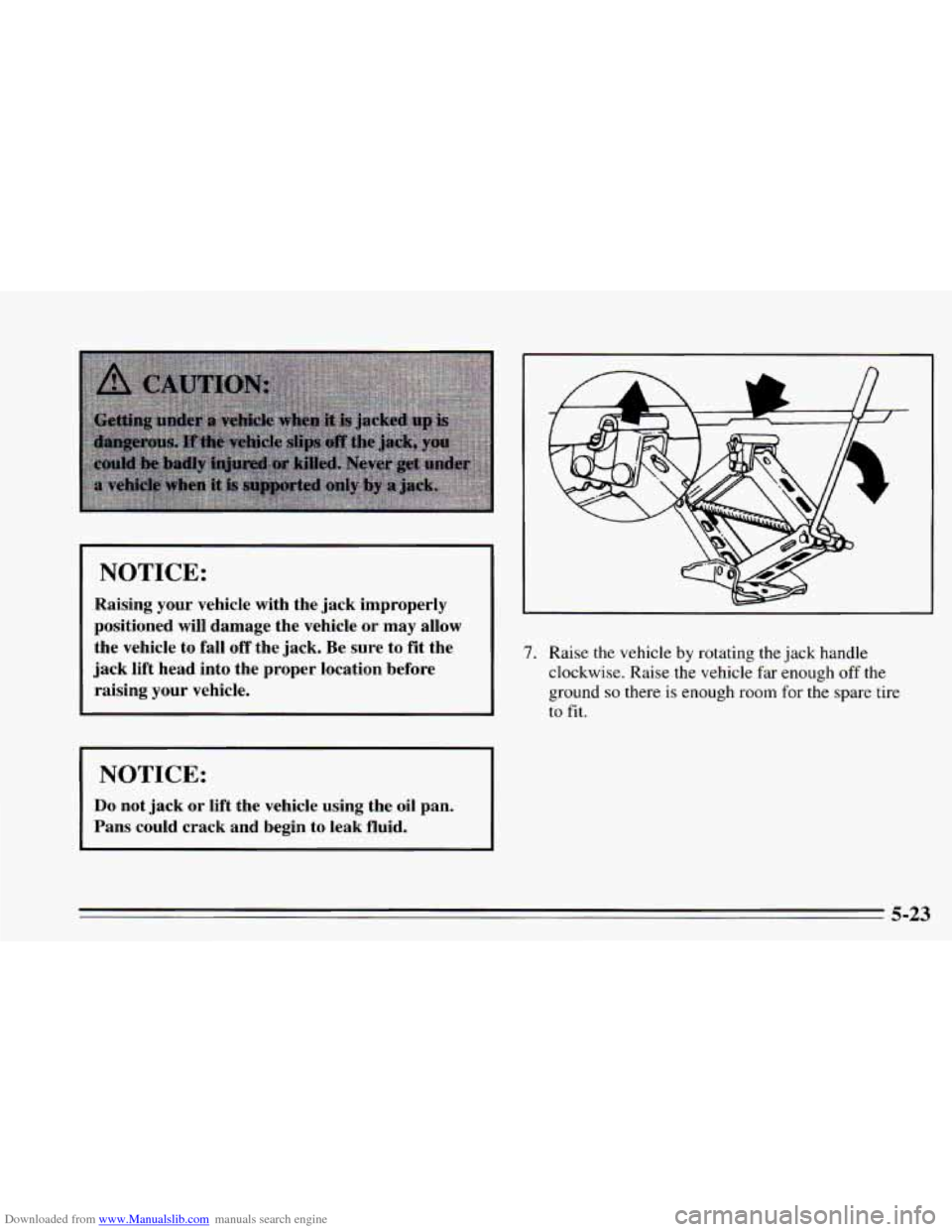
7. Raise the vehicle by rotating the jack handle
clockwise. Raise the vehicle
far enough off the
ground
so there is enough room for the spare tire
to fit.
5-23
Page 201 of 340
Downloaded from www.Manualslib.com manuals search engine c
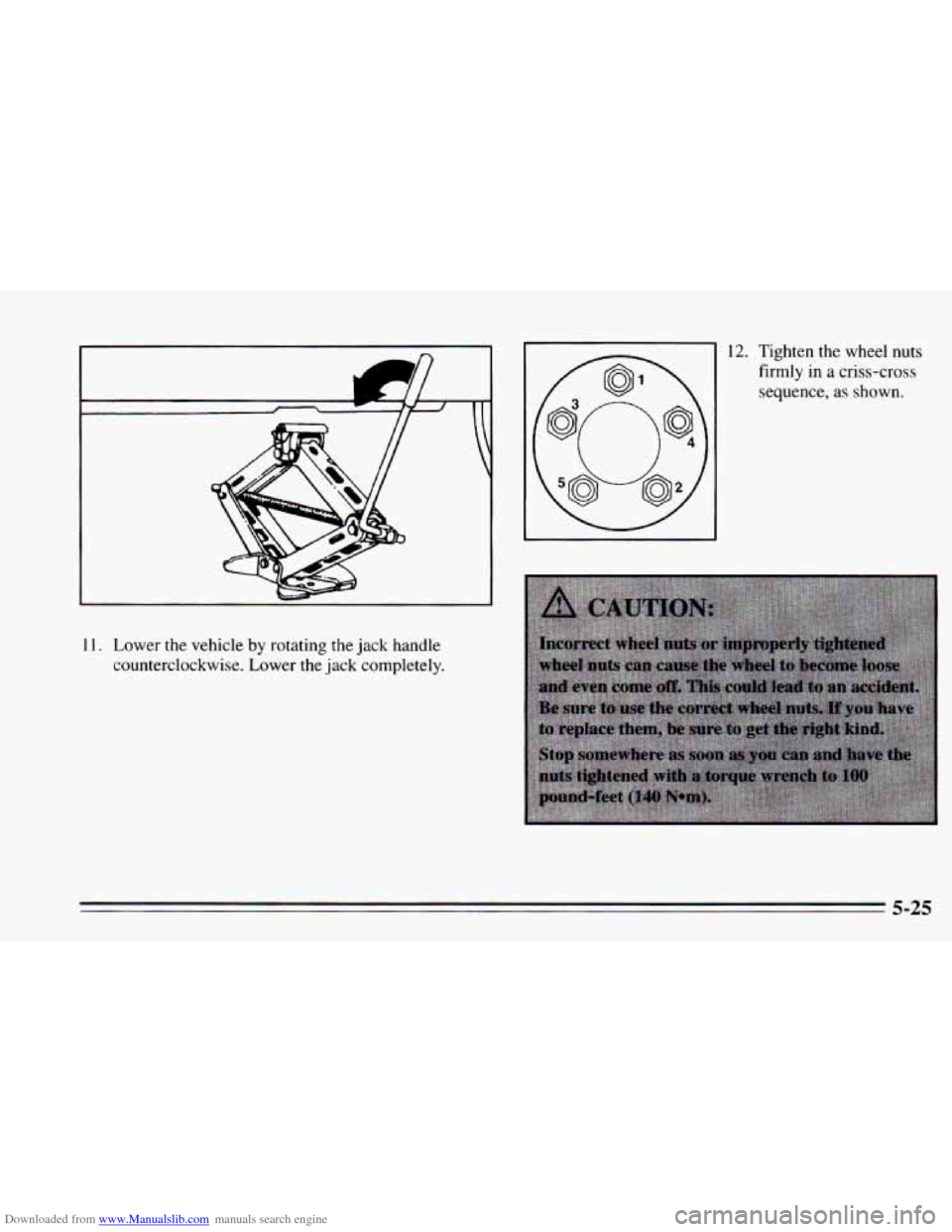
11. Lower the vehicle by rotating the jack handle
counterclockwise. Lower the jack completely.
12. Tighten the wheel nuts
firmly in
a criss-cross
sequence, as shown.
5-25
Page 209 of 340
Downloaded from www.Manualslib.com manuals search engine P
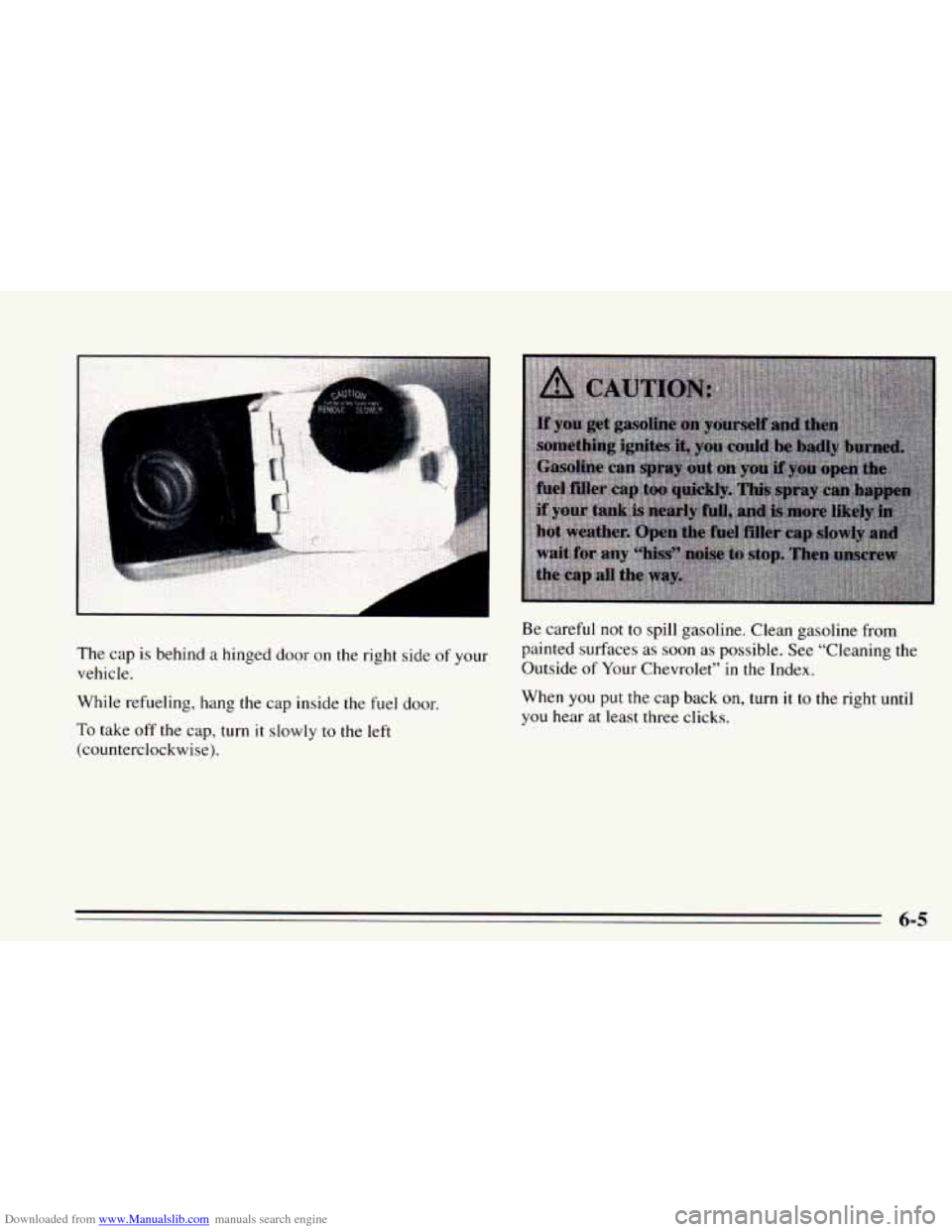
The cap is behind a hinged door on the right side of your
vehicle.
While refueling, hang the cap inside the
fuel door.
To take off the cap, turn it slowly to the left
(counterclockwise).
Be careful not to spill gasoline. Clean gasoline from
painted surfaces as soon
as possible. See “Cleaning the
Outside of
Your Chevrolet” in the Index.
When
you put the cap back on, turn it to the right until
you hear at least three clicks.
6-5
Page 224 of 340
Downloaded from www.Manualslib.com manuals search engine Then, follow these steps: How to Add Fluid
Here’s how to add fluid. Refer to the Maintenance
Schedule
to determine what kind of fluid to use. See
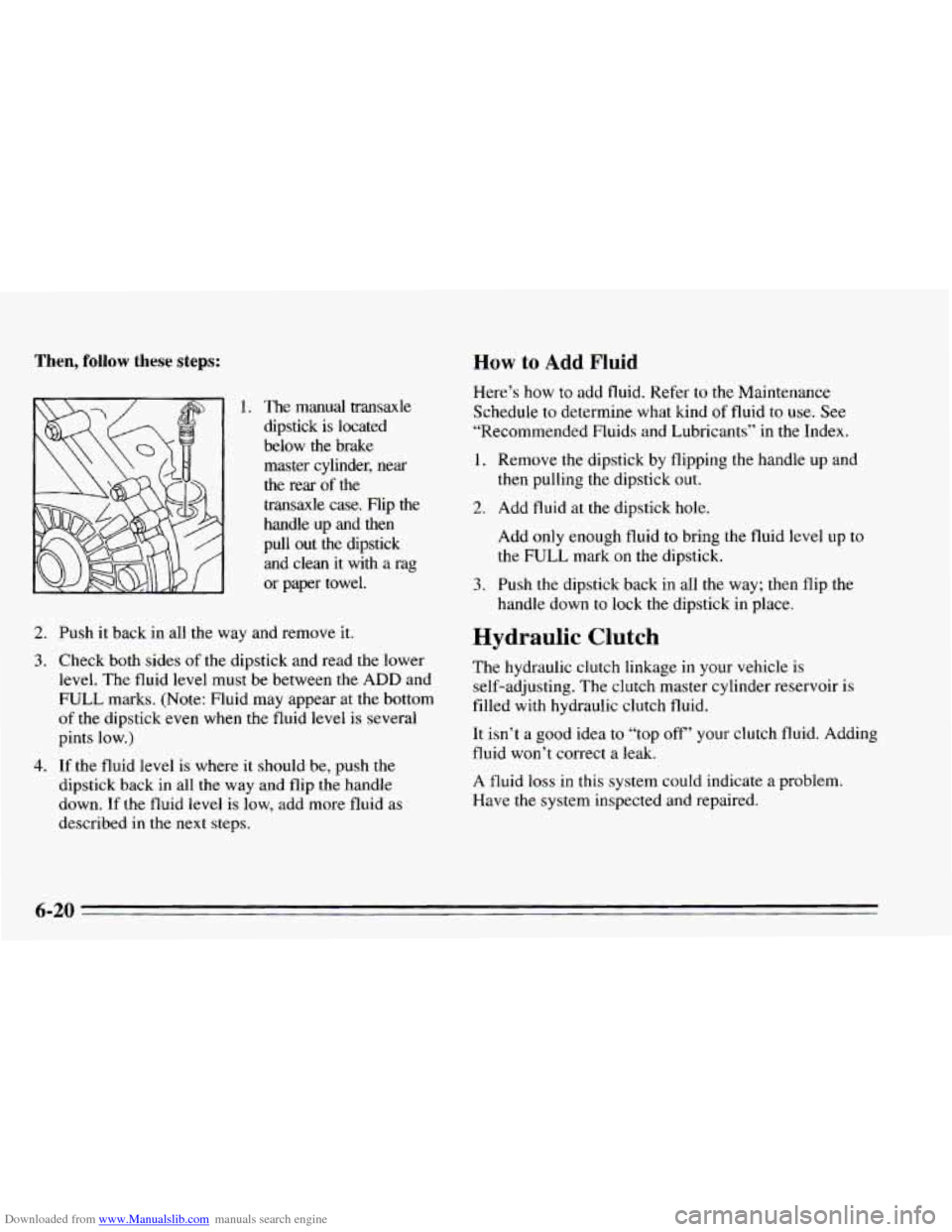
“Recommended Fluids and Lubricants” in the Index. ~ , 1. The manual transaxle
dipstick is located
below the brake
master cylinder, near the rear
of the
transaxle case. Flip the
handle up and then pull out the dipstick
and clean it with a rag
or paper towel.
2. Push it back in all the way and remove it.
3. Check both sides of the dipstick and read the lower
level. The fluid level must be between the
ADD and
FULL
marks. (Note: Fluid may appear at the bottom
of the dipstick even when the fluid level is several
pints
low.)
4. If the fluid level is where it should be, push the
dipstick back in all the way and flip the handle
down.
If the fluid level is low, add more fluid as
described
in the next steps.
1. Remove the dipstick by flipping the handle up and
then pulling the dipstick out.
2. Add fluid at the dipstick hole.
Add only enough fluid to bring the fluid level up to
the FULL mark on the dipstick.
3. Push the dipstick back in all the way; then flip the
handle down to lock the dipstick in place.
Hydraulic Clutch
The hydraulic clutch linkage in your vehicle is
self-adjusting. The clutch master cylinder reservoir
is
filled with hydraulic clutch fluid.
It isn’t
a good idea to “top off’ your clutch fluid. Adding
fluid won’t correct a leak.
A fluid loss in this system could indicate a problem.
Have the system inspected and repaired.
6-20
Page 235 of 340
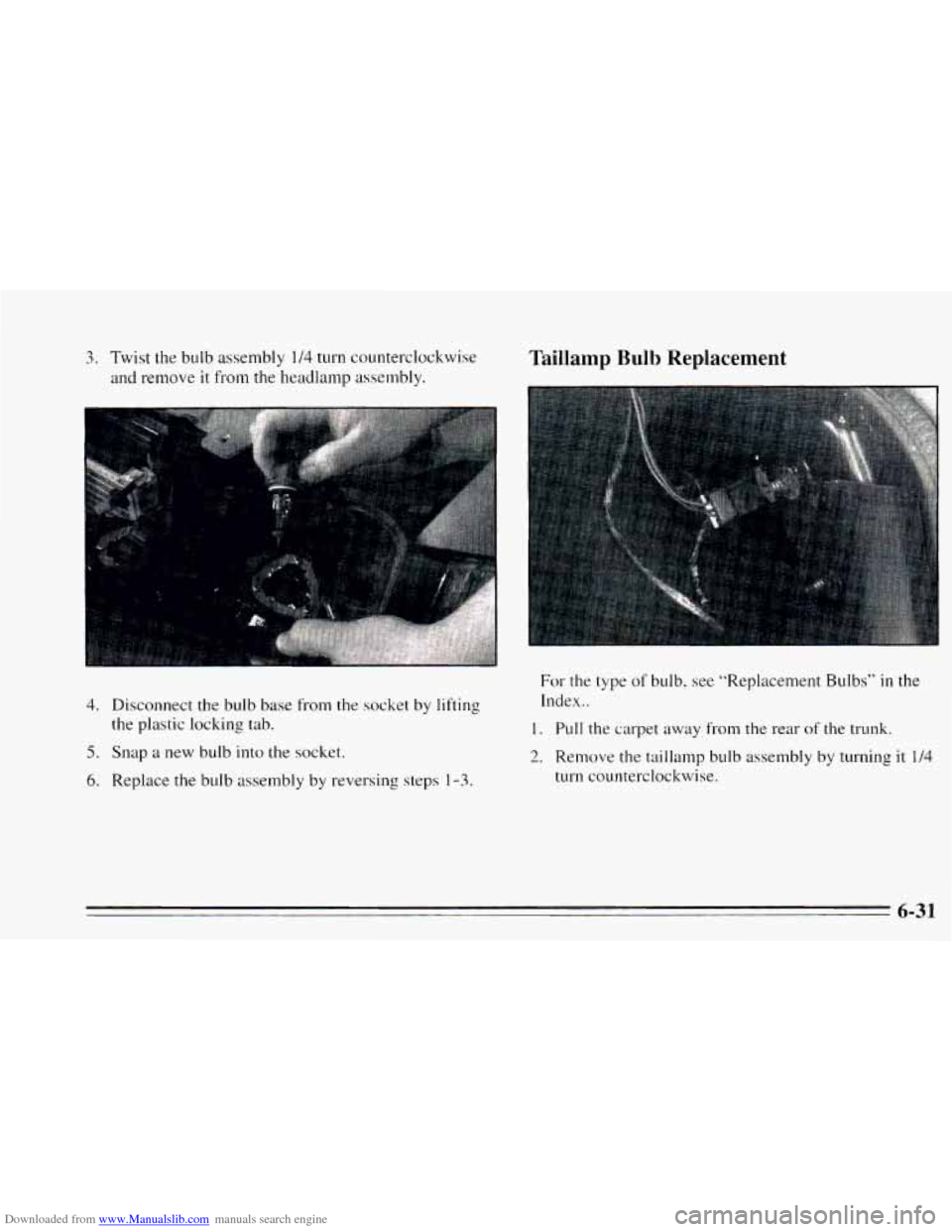
Downloaded from www.Manualslib.com manuals search engine 4. Disconnect the bulb base from the socket by lifting
the plastic locking tab.
5. Snap a new bulb into the socket.
6. Replace the bulb assembly by reversing steps 1-3.
For the type of bulb, see “Replacement Bulbs” in the
Index..
1. Pull the carpet away from the rear of the trunk.
2. Remove the taillamp bulb assembly by turning it 1/4
turn counterclockwise.
6-31
Page 256 of 340
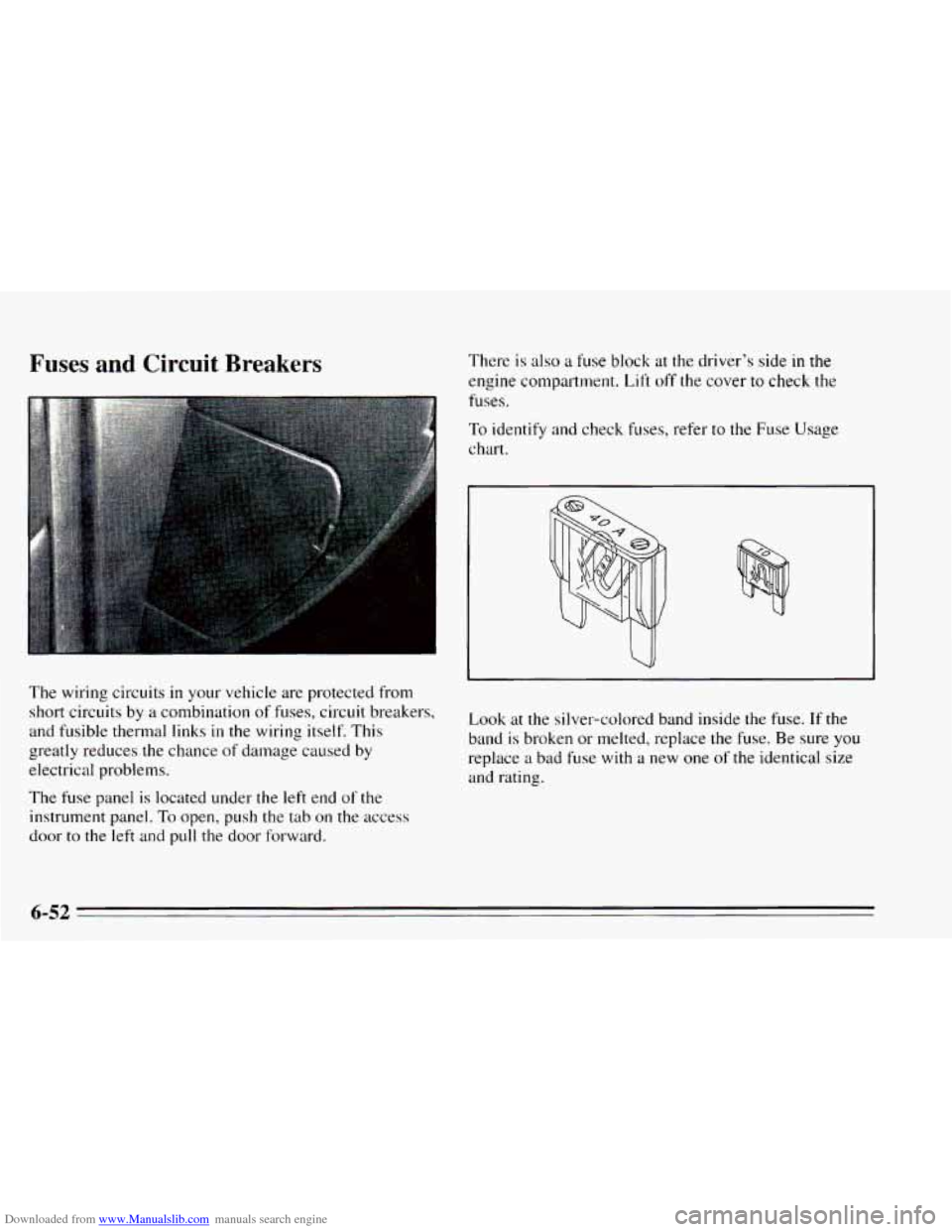
Downloaded from www.Manualslib.com manuals search engine Fuses and Circuit Breakers There is also a fuse block at the driver’s side in the
engine compartment. Lift off the cover to check the
fuses.
To identify and check fuses, refer to the Fuse Usage
chart.
The wiring circuits
in your vehicle are protected from
short circuits by
a combination of fuses, circuit breakers, Look at the silver-colored band inside the fuse. If the
and fusible thermal links in the wiring itself. This
band is broken or melted, replace the fuse. Be sure you greatly reduces the chance of damage caused by
replace a bad fuse with a new one of the identical size
electrical problems. and rating.
The fuse panel is located under the left end of the
instrument panel.
To open, push the tab on the access
door
to the left and pull the door forward.
6-52
Page 257 of 340
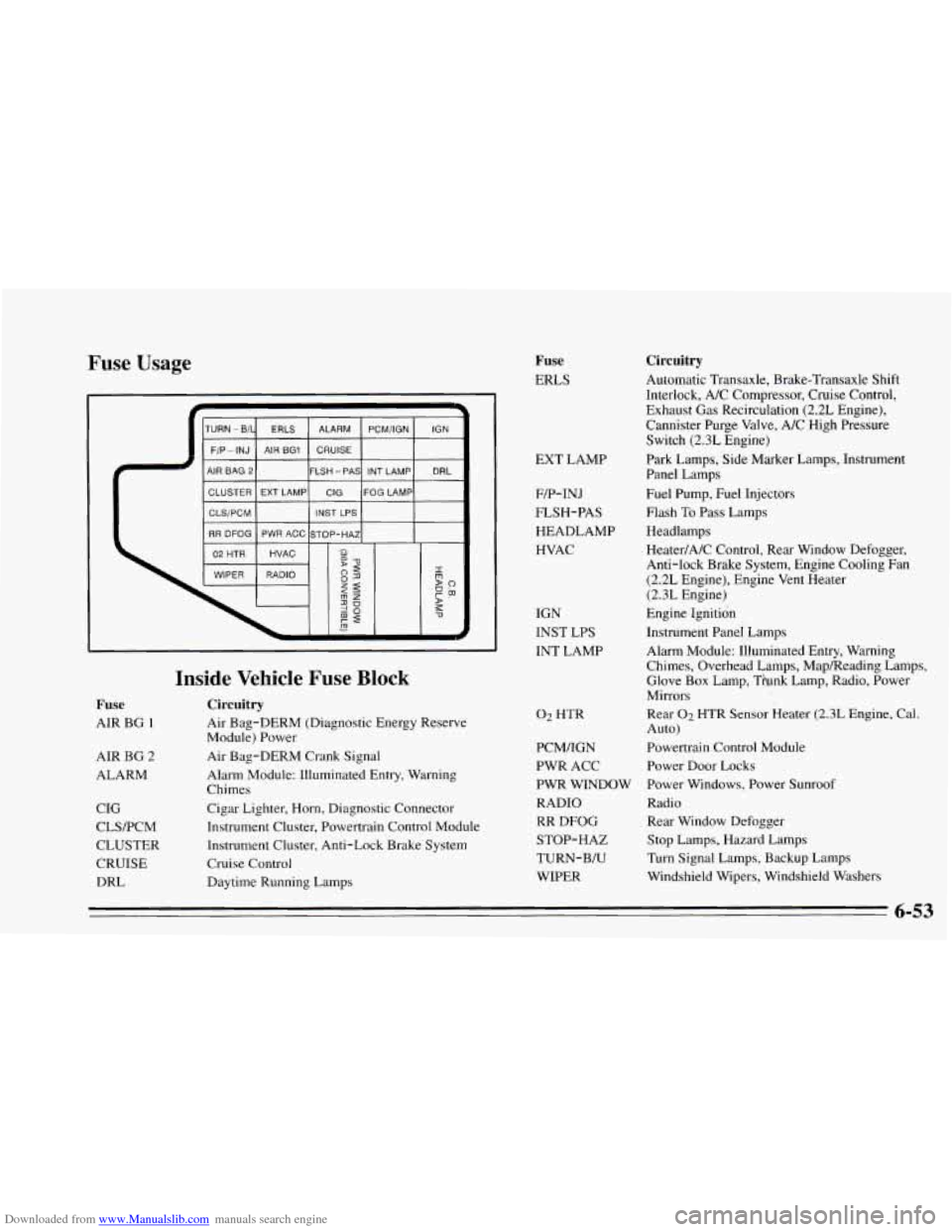
Downloaded from www.Manualslib.com manuals search engine Fuse Usage
S ALARM PCM/IGN IGN
Fuse
AIR BG 1
AIR BG 2
ALARM
CIG
CLSPCM
CLUSTER
CRUISE DRL
Inside Vehicle Fuse Block
Circuitry
Air Bag-DERM (Diagnostic Energy Reserve
Module) Power
Air Bag-DERM Crank Signal
Alarm Module: Illuminated Entry, Warning
Chimes
Cigar Lighter, Horn, Diagnostic Connector
Instrument Cluster, Powertrain Control Module
Instrument Cluster, Anti-Lock Brake System Cruise Control
Daytime Running Lamps IGN
INST
LPS
INT LAMP
Fuse
ERLS
EXT LAMP
F/P-INJ
FLSH-PAS
HEADLAMP
HVAC
Circuitry
Automatic Transaxle, Brake-Transaxle Shift
Interlock, A/C Compressor, Cruise Control,
Exhaust Gas Recirculation (2.2L Engine),
Cannister Purge Valve, A/C High Pressure
Switch (2.3L Engine)
Park Lamps, Side Marker Lamps, Instrument
Panel Lamps
Fuel Pump, Fuel Injectors
Flash To Pass Lamps
Headlamps
Heater/A/C Control, Rear Window Defogger,
Anti-lock Brake System, Engine Cooling Fan
(2.2L Engine), Engine Vent Heater
(2.3L Engine)
Engine Ignition
Instrument PaneiLamps
Alarm Module: 11,luminated Entry, Warning
Chimes, Overhead Lamps, MapReading Lamps,
Glove Box Lamp, Thnk Lamp, Radio, Power
Mirrors
Auto)
02 HTR Rear 02 HTR Sensor keater (2.3L Engine, Cal.
PCM/IGN Powertrain Control Module
PWR ACC Power
Door Locks
PWR WINDOW Power Windows, Power Sunroof
RADIO Radio
RR DFOG Rear Window Defogger
STOP-HAZ Stop Lamps, Hazard Lamps
TURN-B/U Turn
Signal Lamps, Backup Lamps
WIPER Windshield
Wipers, Windshield Washers
6-53
Page 258 of 340
Downloaded from www.Manualslib.com manuals search engine I 1
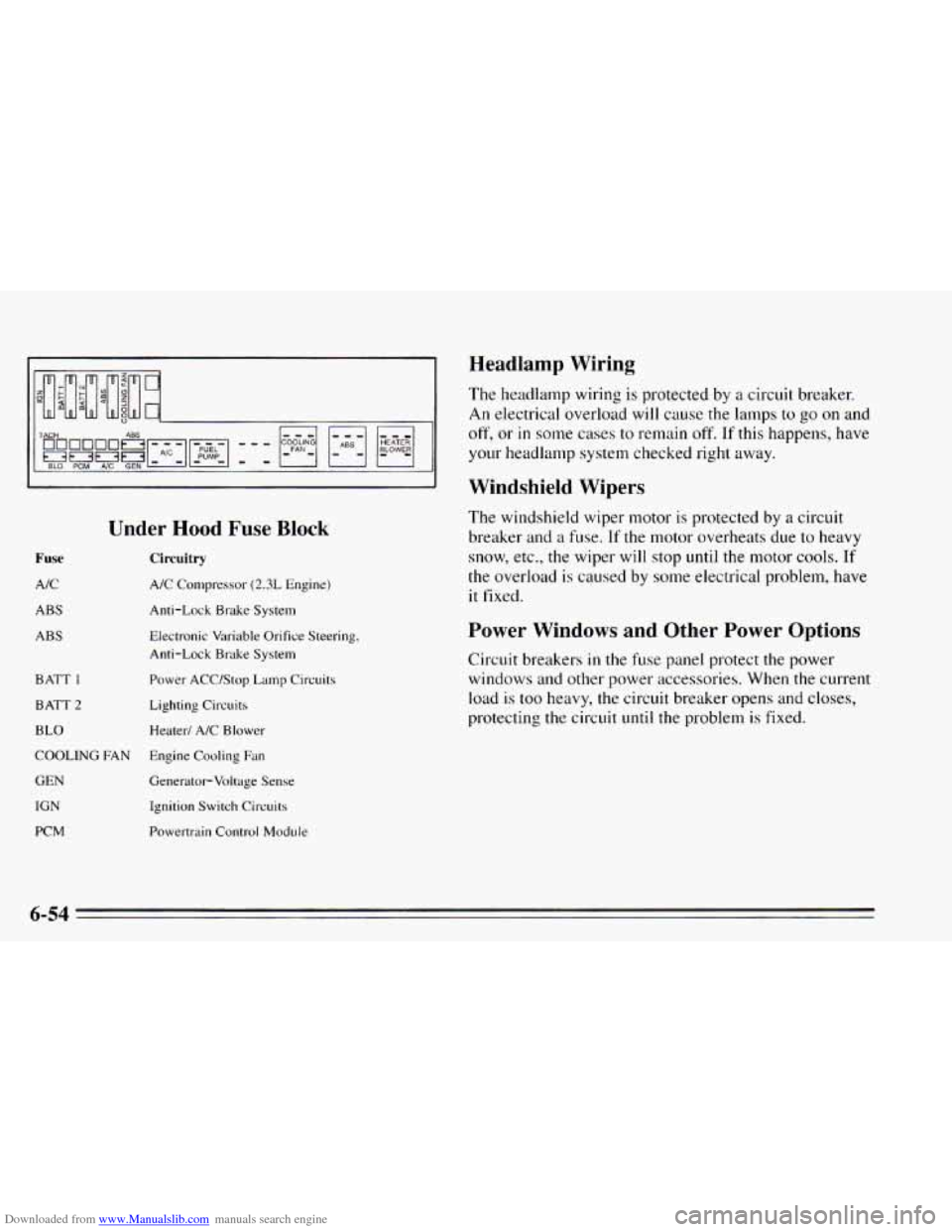
Under Hood Fuse Block
Fuse
AIC
ABS
ABS
BATT 1
BATT 2
BLO
COOLING FAN
GEN
IGN
PCM
Circuitry
A/C Compressor (2.3L Engine)
Anti-Lock Brake System
Electronic Variable Orifice Steering,
Anti-Lock Brake System
Power ACC/Stop
Lamp Circuits
Lighting Circuits
Heater/ A/C Blower
Engine Cooling Fan
Generator-Voltage Sense
Ignition Switch Circuits
Powertrain Control Module
Headlamp Wiring
The headlamp wiring is protected by a circuit breaker.
An electrical overload will cause the lamps to go on and
off, or
in some cases to remain off. If this happens, have
your headlamp system checked right away.
Windshield Wipers
The windshield wiper motor is protected by a circuit
breaker and a fuse.
If the motor overheats due to heavy
snow, etc., the wiper will stop until the motor cools. If
the overload is caused by some electrical problem, have
it fixed.
Power Windows and Other Power Options
Circuit breakers in the fuse panel protect the power
windows and other power accessories. When the current
load is too heavy, the circuit breaker
opens and closes,
protecting the circuit
until the problem is fixed.
Page 301 of 340
Downloaded from www.Manualslib.com manuals search engine At Least Once a Year
Key Lock Cylinders
Lubricate the key lock cylinders with the lubricant
specified
in Part D.
Body Lubrication
Lubricate all body door and rear compartment hinges.
Also lubricate all hinges and latches, including those for
the hood, glove box door, console door and any folding
seat hardware. Part
D tells you what to use. More
frequent lubrication may be required when exposed
to a
corrosive envlronment.
Starter Switch
1. Before you start, be sure you have enough room
around the vehicle.
2. Firmly apply both the parking brake (see “Parking
Brake”
in the Index if necessary) and the regular
brake.
NOTE:
Do not use the accelerator pedal, and be
ready
to turn off the engine immediately if it starts.
3. On automatic transaxle vehicles, try to start the
engine
in each gear. The starter should work only in
PARK (P) or NEUTRAL (N). If the starter works in
any other position, your vehicle needs service.
On manual transaxle vehicles, put the shift lever in
NEUTRAL
(N), push the clutch down halfway and
try to start the engine.
The starter should work only
when the clutch is pushed down all the way
to the
floor. If the starter works when the clutch isn’t
pushed
all the way down, your vehicle needs service.
7-39
Page 302 of 340
Downloaded from www.Manualslib.com manuals search engine Brake-Transaxle Shift Interlock -- BTSI (Automatic
Transaxle)
1.
2.
3.
Before you start, be sure you have enough room
around the vehicle. It should be parked
on a level
surface.
Firmly apply the parking brake (see “Parking Brake”
in the Index
if necessary).
NOTE: Be ready to apply the regular brake
immediately
if the vehicle begins to move.
With the engine off, turn the key to the RUN
position, but don’t start the engine. Without applying
the regular brake, try
to move the shift lever out of
PARK (P) with normal effort, If the shift lever
moves
out of PARK (P), your vehicle’s BTSI needs
service.
Steering Column Lock
While parked, and with the parking brake set, try to turn
the key to
LOCK in each shift lever position.
0 With an automatic transaxle, the key should turn to
LOCK only when the shift lever
is in PARK (P).
With a manual transaxle, the key should turn to
LOCK only when the shift lever is in
REVERSE
(R).
On vehicles with a key release button, try to turn the key
to LOCK without pressing the button. The key should
turn to
LOCK only with the key button depressed.
On all vehicles, the
key should come out only in LOCK.
Turn the steering wheel to
the left and to the right. It
should only lock when turned
to the right.
7-40