engine CHEVROLET CAVALIER 2003 3.G Manual Online
[x] Cancel search | Manufacturer: CHEVROLET, Model Year: 2003, Model line: CAVALIER, Model: CHEVROLET CAVALIER 2003 3.GPages: 364, PDF Size: 2.44 MB
Page 303 of 364

Headlamp Wiring
The headlamp wiring is protected by fuses. Should your
headlamps fail to function, have your headlamp
system checked right away.
Windshield Wiper Fuses
The windshield wiper motor is protected by a circuit
breaker and a fuse. If the motor overheats due to heavy
snow or ice, the wiper will stop until the motor cools.
If the overload is caused by some electrical problem,
have it ®xed.
Power Windows and Other Power
Options
Circuit breakers in the fuse panel protect the power
windows and other power accessories. When the current
load is too heavy, the circuit breaker opens and
closes, protecting the circuit until the problem is ®xed.
Fuses and Circuit Breakers
The wiring circuits in your vehicle are protected from
short circuits by a combination of fuses, circuit breakers
and fusible thermal links. This greatly reduces the
chance of damage caused by electrical problems.
Look at the silver-colored band inside the fuse. If the
band is broken or melted, replace the fuse. Be sure you
replace a bad fuse with a new one of the identical
size and rating.
If you ever have a problem on the road and don't have
a spare fuse, you can ªborrowº one that has the
same amperage. Just pick some feature of your vehicle
that you can get along without ± like the radio or
cigarette lighter ± and use its fuse if it is the correct
amperage. Replace it as soon as you can.
There are two fuse blocks in your vehicle: the instrument
panel fuse block and the engine compartment fuse
block.
5-81
Page 304 of 364
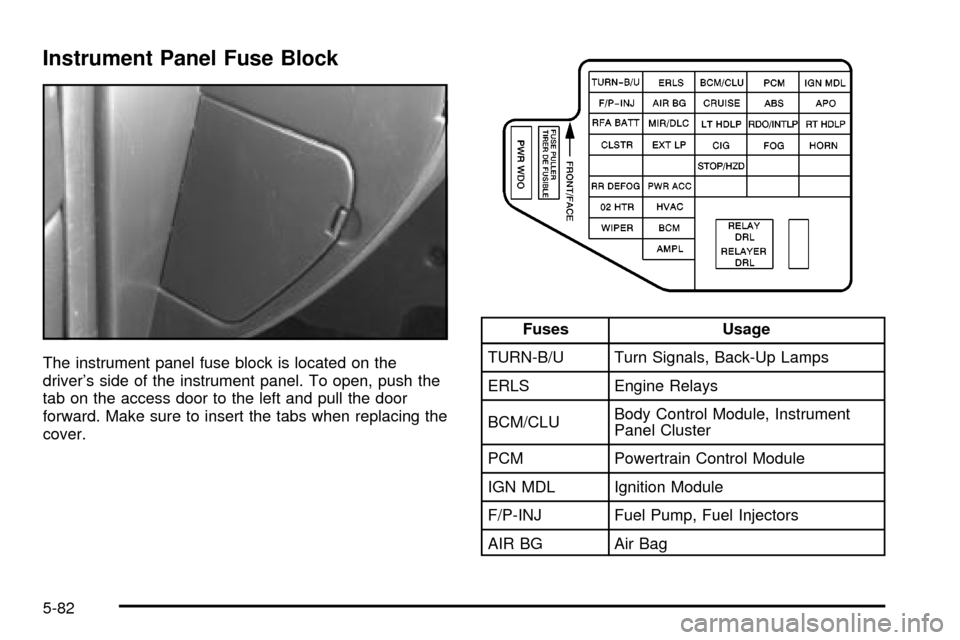
Instrument Panel Fuse Block
The instrument panel fuse block is located on the
driver's side of the instrument panel. To open, push the
tab on the access door to the left and pull the door
forward. Make sure to insert the tabs when replacing the
cover.
Fuses Usage
TURN-B/U Turn Signals, Back-Up Lamps
ERLS Engine Relays
BCM/CLUBody Control Module, Instrument
Panel Cluster
PCM Powertrain Control Module
IGN MDL Ignition Module
F/P-INJ Fuel Pump, Fuel Injectors
AIR BG Air Bag
5-82
Page 306 of 364
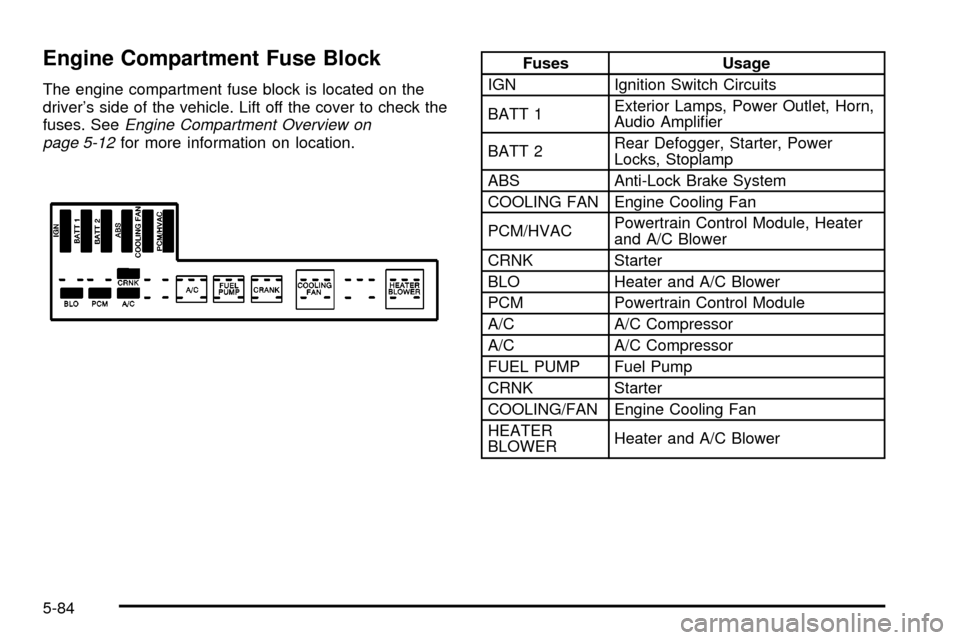
Engine Compartment Fuse Block
The engine compartment fuse block is located on the
driver's side of the vehicle. Lift off the cover to check the
fuses. See
Engine Compartment Overview on
page 5-12for more information on location.
Fuses Usage
IGN Ignition Switch Circuits
BATT 1Exterior Lamps, Power Outlet, Horn,
Audio Ampli®er
BATT 2Rear Defogger, Starter, Power
Locks, Stoplamp
ABS Anti-Lock Brake System
COOLING FAN Engine Cooling Fan
PCM/HVACPowertrain Control Module, Heater
and A/C Blower
CRNK Starter
BLO Heater and A/C Blower
PCM Powertrain Control Module
A/C A/C Compressor
A/C A/C Compressor
FUEL PUMP Fuel Pump
CRNK Starter
COOLING/FAN Engine Cooling Fan
HEATER
BLOWERHeater and A/C Blower
5-84
Page 307 of 364
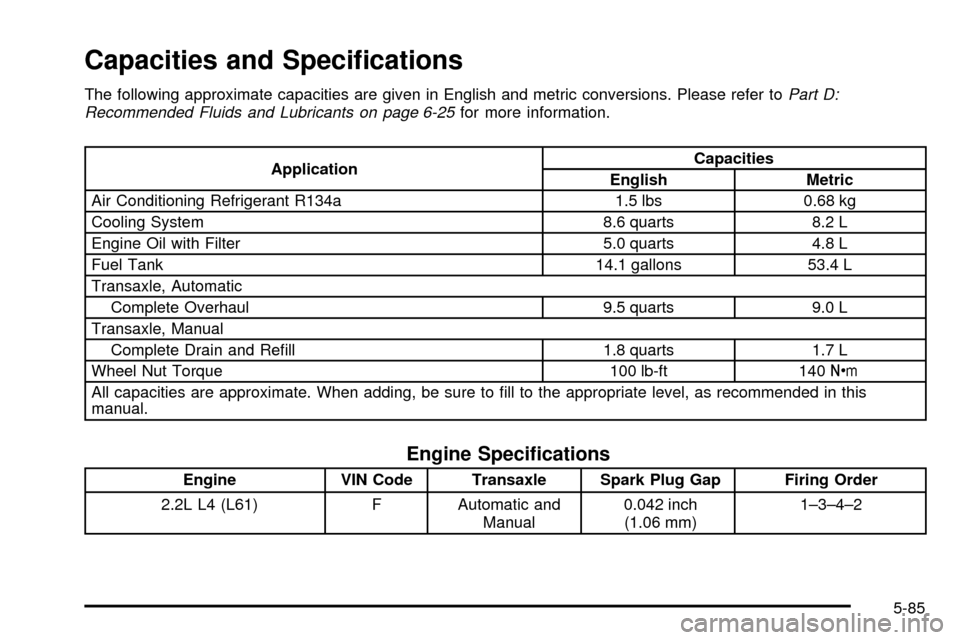
Capacities and Speci®cations
The following approximate capacities are given in English and metric conversions. Please refer toPart D:
Recommended Fluids and Lubricants on page 6-25for more information.
ApplicationCapacities
English Metric
Air Conditioning Refrigerant R134a 1.5 lbs 0.68 kg
Cooling System 8.6 quarts 8.2 L
Engine Oil with Filter 5.0 quarts 4.8 L
Fuel Tank 14.1 gallons 53.4 L
Transaxle, Automatic
Complete Overhaul 9.5 quarts 9.0 L
Transaxle, Manual
Complete Drain and Re®ll 1.8 quarts 1.7 L
Wheel Nut Torque 100 lb-ft 140Y
All capacities are approximate. When adding, be sure to ®ll to the appropriate level, as recommended in this
manual.
Engine Speci®cations
Engine VIN Code Transaxle Spark Plug Gap Firing Order
2.2L L4 (L61) F Automatic and
Manual0.042 inch
(1.06 mm)1±3±4±2
5-85
Page 308 of 364
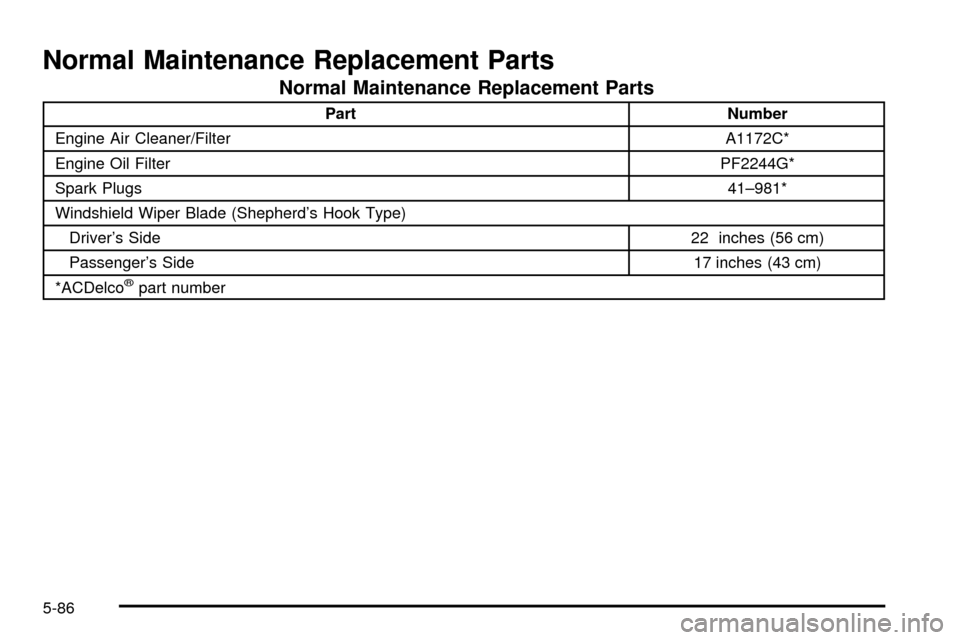
Normal Maintenance Replacement Parts
Normal Maintenance Replacement Parts
Part Number
Engine Air Cleaner/Filter A1172C*
Engine Oil FilterPF2244G*
Spark Plugs41±981*
Windshield Wiper Blade (Shepherd's Hook Type)
Driver's Side22 inches (56 cm)
Passenger's Side 17 inches (43 cm)
*ACDelco
žpart number
5-86
Page 309 of 364

Maintenance Schedule......................................6-2
Introduction...................................................6-2
Your Vehicle and the Environment....................6-2
Maintenance Requirements..............................6-2
How This Section is Organized.........................6-3
Part A: Scheduled Maintenance Services...........6-4
Using Your Maintenance Schedule....................6-4
Selecting the Right Schedule...........................6-5
Short Trip/City Scheduled Maintenance..............6-6
Long Trip/Highway Scheduled Maintenance......6-14
Part B: Owner Checks and Services................6-19
At Each Fuel Fill..........................................6-19
At Least Once a Month.................................6-19
At Least Twice a Year...................................6-19At Least Once a Year...................................6-20
Part C: Periodic MaintenanceInspections.........6-23
Steering, Suspension and Front Drive Axle
Boot and Seal Inspection............................6-23
Exhaust System Inspection............................6-23
Fuel System Inspection..................................6-23
Engine Cooling System Inspection...................6-23
Throttle System Inspection.............................6-23
Brake System Inspection................................6-24
Caliper/Knuckle MaintenanceInspection...........6-24
Part D: Recommended Fluids and
Lubricants................................................6-25
Part E: Maintenance Record...........................6-27
Section 6 Maintenance Schedule
6-1
Page 310 of 364

Maintenance Schedule
Introduction
Important: Keep engine oil at the proper level and
change as recommended.
Have you purchased the GM Protection Plan? The Plan
supplements your new vehicle warranties. See your
Warranty and Owner Assistance booklet or your dealer
for details.
Your Vehicle and the Environment
Proper vehicle maintenance not only helps to keep your
vehicle in good working condition, but also helps the
environment. Improper vehicle maintenance can
even affect the quality of the air we breathe. Improper
¯uid levels or the wrong tire in¯ation can increase
the level of emissions from your vehicle. To help protect
our environment, and to keep your vehicle in good
condition, be sure to maintain your vehicle properly.
Maintenance Requirements
Maintenance intervals, checks, inspections and
recommended ¯uids and lubricants as prescribed in this
manual are necessary to keep your vehicle in good
working condition. Any damage caused by failure
to follow scheduled maintenance may not be covered by
warranty.
6-2
Page 313 of 364

Selecting the Right Schedule
First you'll need to decide which of the two schedules is
right for your vehicle. Here's how to decide which
schedule to follow:
Short Trip/City De®nition
Follow the Short Trip/City Scheduled Maintenance if any
one of these conditions is true for your vehicle:
·Most trips are less than 5 miles (8 km). This is
particularly important when outside temperatures
are below freezing.
·Most trips include extensive idling, such as frequent
driving in stop-and-go traffic.
·You frequently tow a trailer or use a carrier on top
of your vehicle. With some models, you should
never tow a trailer. See
Towing a Trailer (Automatic
Transaxle) on page 4-34orTowing a Trailer
(Manual Transaxle) on page 4-40.
·If the vehicle is used for delivery service, police,
taxi or other commercial application.
One of the reasons you should follow this schedule if
you operate your vehicle under any of these conditions
is that these conditions cause engine oil to break
down sooner.
Short Trip/City Intervals
Every 3,000 Miles (5 000 km):Engine Oil and Filter
Change (or 3 months, whichever occurs ®rst).
Every 6,000 Miles (10 000 km):Chassis Lubrication (or
6 months, whichever occurs ®rst). Tire Rotation.
Every 15,000 Miles (25 000 km):Engine Air Cleaner
Filter Inspection.
Every 30,000 Miles (50 000 km):Engine Air Cleaner
Filter Replacement.
Every 50,000 Miles (83 000 km):Automatic Transaxle
Service (severe conditions only).
Every 100,000 Miles (166 000 km):Spark Plug Wire
Inspection. Spark Plug Replacement.
Every 150 000 Miles (240 000 km):Cooling System
Service (or every 60 months, whichever occurs
®rst). Engine Accessory Drive Belt Inspection.
These intervals only summarize maintenance services.
Be sure to follow the complete scheduled maintenance
on the following pages.
6-5
Page 314 of 364

Long Trip/Highway De®nition
Follow this scheduled maintenanceonlyif none of the
conditions from the Short Trip/City Scheduled
Maintenance are true. Do not use this schedule if the
vehicle is used for trailer towing, driven in a dusty area
or used off paved roads. Use the Short Trip/City
schedule for these conditions.
Driving a vehicle with a fully warmed engine under
highway conditions will cause engine oil to break down
slower.
Long Trip/Highway Intervals
Every 7,500 Miles (12 500 km):Engine Oil and Filter
Change (or every 12 months, whichever occurs
®rst). Chassis Lubrication (or 12 months, whichever
occurs ®rst). Tire Rotation.
Every 15,000 Miles (25 000 km):Engine Air Cleaner
Filter Inspection.
Every 30,000 Miles (50 000 km):Engine Air Cleaner
Filter Replacement.
Every 50,000 Miles (83 000 km):Automatic Transaxle
Service (severe conditions only).Every 100,000 Miles (166 000 km):Spark Plug Wire
Inspection. Spark Plug Replacement.
Every 150,000 Miles (240 000 km):Cooling System
Service (or every 60 months, whichever occurs
®rst). Engine Accessory Drive Belt Inspection.
These intervals only summarize maintenance services.
Be sure to follow the complete scheduled maintenance
on the following pages.
Short Trip/City Scheduled
Maintenance
The services shown in this schedule up to 100,000 miles
(166 000 km) should be repeated after 100,000 miles
(166 000 km) at the same intervals for the life of
this vehicle. The services shown at 150,000 miles
(240 000 km) should be repeated at the same interval
after 150,000 miles (240 000 km) for the life of this
vehicle.
See
Part B: Owner Checks and Services on page 6-19andPart C: Periodic MaintenanceInspections on
page 6-23.
6-6
Page 315 of 364

Footnotes
²The U.S. Environmental Protection Agency or the
California Air Resources Board has determined that the
failure to perform this maintenance item will not nullify
the emission warranty or limit recall liability prior to
the completion of the vehicle's useful life. We, however,
urge that all recommended maintenance services be
performed at the indicated intervals and the
maintenance be recorded.
#Lubricate the suspension, steering linkage and the
transaxle shift linkage.
+A good time to check your brakes is during tire
rotation. See Brake System Inspection on page 6-24.
++
If you drive in a highly corrosive environment,
your brake calipers may require additional inspection
and service, at every other tire rotation. See
Caliper/Knuckle Maintenance
Inspection on page 6-24.
3,000 Miles (5 000 km)
qChange engine oil and ®lter (or every 3 months,
whichever occurs ®rst).An Emission Control Service.
6,000 Miles (10 000 km)
qChange engine oil and ®lter (or every 3 months,
whichever occurs ®rst).An Emission Control Service.
qLubricate chassis components (or every 6 months,
whichever occurs ®rst).(See footnote #.)
qRotate tires. SeeTire Inspection and Rotation on
page 5-53for proper rotation pattern and additional
information.(See footnote +.)
9,000 Miles (15 000 km)
qChange engine oil and ®lter (or every 3 months,
whichever occurs ®rst).An Emission Control Service.
12,000 Miles (20 000 km)
qChange engine oil and ®lter (or every 3 months,
whichever occurs ®rst).An Emission Control Service.
qLubricate chassis components (or every 6 months,
whichever occurs ®rst).(See footnote #.)
qRotate tires. SeeTire Inspection and Rotation on
page 5-53for proper rotation pattern and additional
information.(See footnote +.) (Also see footnote ++.)
6-7