lock CHEVROLET CITY EXPRESS 2018 Service Manual
[x] Cancel search | Manufacturer: CHEVROLET, Model Year: 2018, Model line: CITY EXPRESS, Model: CHEVROLET CITY EXPRESS 2018Pages: 287, PDF Size: 4.19 MB
Page 128 of 287
Chevrolet City Express Owner Manual (GMNA-Localizing-U.S./Canada-
11683523) - 2018 - CRC - 7/10/17
Infotainment System 127
Training
To train a voice:1. Park the vehicle in a reasonably quiet outdoor
location.
2. Sit in the driver seat with the engine running and the parking
brake on.
3. Press and hold
g Vfor more
than five seconds.
4. The system responds with, “Press the PHONE/SEND
(
gV) for the hands-free
phone system to enter the
voice adaptation mode or press
the PHONE/END (
V) to select
a different language.” See
“Language” previously in this
section.
5. Voice memory A or B is automatically selected. If both
memory locations are already
used, the system will prompt
you to overwrite one. Follow
the instructions provided by the
system. 6. When the preparation is
complete and you are ready to
begin, press
gV.
7. The VA mode will be explained. Follow the instructions
provided by the system.
8. When the training is finished, the system will tell you that an
adequate number of phrases
have been recorded.
9. The system will announce that VA has been completed and
the system is ready.
The VA mode will stop if:
. The
gVcontrol is pressed for
more than five seconds in
VA mode.
. The vehicle begins moving
during VA mode.
. The ignition switch is placed in
the OFF or LOCK position.
Manual Control
While using the voice recognition
system, it is possible to select menu
options to use the steering wheel
controls instead of speaking voice
commands. This can be especially
helpful if the noise of driving makes
it difficult for the voice recognition
system to accurately interpret
commands. The manual control
mode does not allow dialing a
phone number by digits. The user
may select an entry from the
Phonebook or Recent Calls lists. To
re-activate voice recognition, exit
the manual control mode by
pressing and holding
V, then press
gVto start the Hands Free Phone
System.
To start Manual Control Mode:
1. From an active Phone book or Recent Call list, press
Q
TUNE/FF-REW FOLDERRup
or down.
2. The system responds with “Showing Manual Options.”
Page 130 of 287
Chevrolet City Express Owner Manual (GMNA-Localizing-U.S./Canada-
11683523) - 2018 - CRC - 7/10/17
Climate Controls 129
Climate Controls
Climate Control Systems
Climate Control Systems . . . . . 129
Air Vents
Air Vents . . . . . . . . . . . . . . . . . . . . . 131
Maintenance
Service . . . . . . . . . . . . . . . . . . . . . . . 132
Climate Control
Systems
The vehicle’s heating, cooling, and
ventilation can be controlled with
this system.
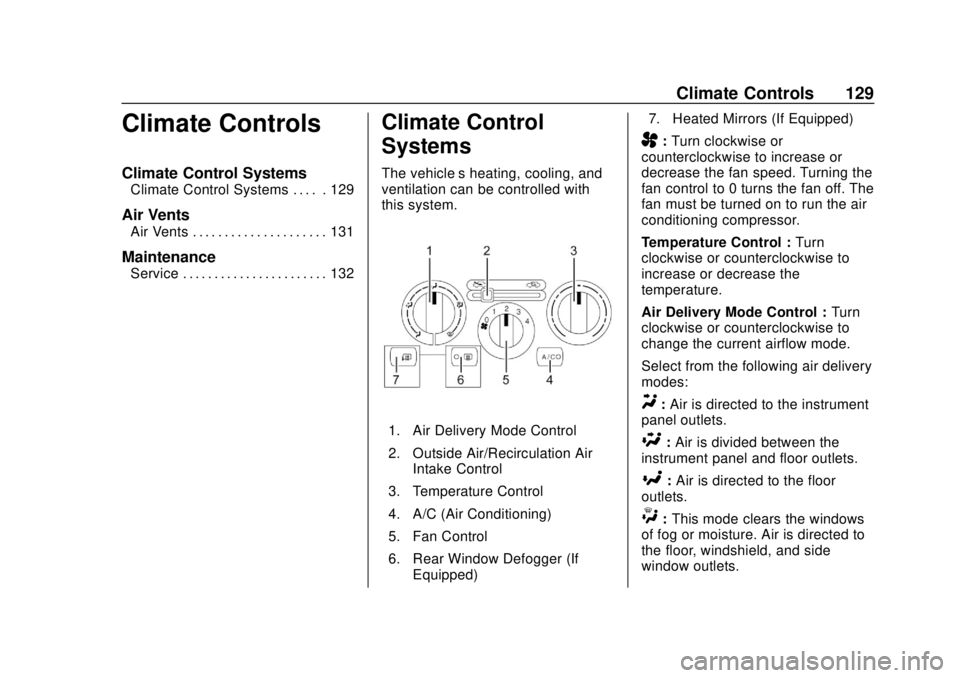
1. Air Delivery Mode Control
2. Outside Air/Recirculation AirIntake Control
3. Temperature Control
4. A/C (Air Conditioning)
5. Fan Control
6. Rear Window Defogger (If Equipped) 7. Heated Mirrors (If Equipped)
A:
Turn clockwise or
counterclockwise to increase or
decrease the fan speed. Turning the
fan control to 0 turns the fan off. The
fan must be turned on to run the air
conditioning compressor.
Temperature Control : Turn
clockwise or counterclockwise to
increase or decrease the
temperature.
Air Delivery Mode Control : Turn
clockwise or counterclockwise to
change the current airflow mode.
Select from the following air delivery
modes:
Y: Air is directed to the instrument
panel outlets.
\: Air is divided between the
instrument panel and floor outlets.
[: Air is directed to the floor
outlets.
W: This mode clears the windows
of fog or moisture. Air is directed to
the floor, windshield, and side
window outlets.
Page 131 of 287
Chevrolet City Express Owner Manual (GMNA-Localizing-U.S./Canada-
11683523) - 2018 - CRC - 7/10/17
130 Climate Controls
1:This mode clears the
windshield of fog or frost more
quickly. Air is directed to the
windshield and side window outlets.
Do not drive the vehicle until all
windows are clear.
In defrost or defog mode, excessive
air conditioning use can cause the
windows to fog. If this happens,
change the air delivery mode to
Y
and reduce the fan speed.
Move the air intake control to
%
orMto select the outside air or
recirculation modes.
%: This mode pulls outside air
inside the vehicle.
M: This mode recirculates and
helps to quickly cool the air inside
the vehicle. It can be used to reduce
the outside air and odors that may
enter the vehicle.
Using the recirculation mode for
extended periods may cause the
windows to fog. If this happens,
select the defrost mode. To allow outside air to enter in these
conditions, move the air intake
control to
%.
A/C : Turn the fan control to the
desired speed and press A/C . The
air conditioning does not operate
when the fan control knob is in the
off position. Press A/C to turn the air
conditioning on and off. When A/C
is pressed, an indicator light comes
on to show that the air conditioning
is on.
For quick cool down on hot days:
1. Open the windows to let hot air escape.
2. Move the air intake control to
M.
3. Press A/C .
4. Select the coolest temperature.
5. Select the highest
Aspeed.
Using these settings together for
long periods of time may cause the
air inside the vehicle to become too
dry. To prevent this from happening, after the air in the vehicle has
cooled, move the air intake control
to
%
Rear Window Defogger and
Heated Outside Mirrors
N:
If equipped, press to turn
the rear window defogger on or off.
An indicator light comes on in the
display to show that the feature is
on. This helps to clear frost from the
rear window and outside mirrors.
The ignition must be on for the
defogger to work.
The rear window defogger can be
turned off by pressing
1again or
by turning the ignition to ACC/
ACCESSORY or LOCK.
M: If equipped, press to turn on
or off. An indicator light comes on in
the display to show that the feature
is on. This helps to clear fog or frost
from the surface of the mirror. The
ignition must be in the ON position
for the heated outside mirrors
to work.
Page 132 of 287
Chevrolet City Express Owner Manual (GMNA-Localizing-U.S./Canada-
11683523) - 2018 - CRC - 7/10/17
Climate Controls 131
Caution
Using a razor blade or sharp
object on the inside rear window
can damage the antenna or
defogger. Repairs would not be
covered by the vehicle warranty.
Do not stick anything to the rear
window.
Air Vents
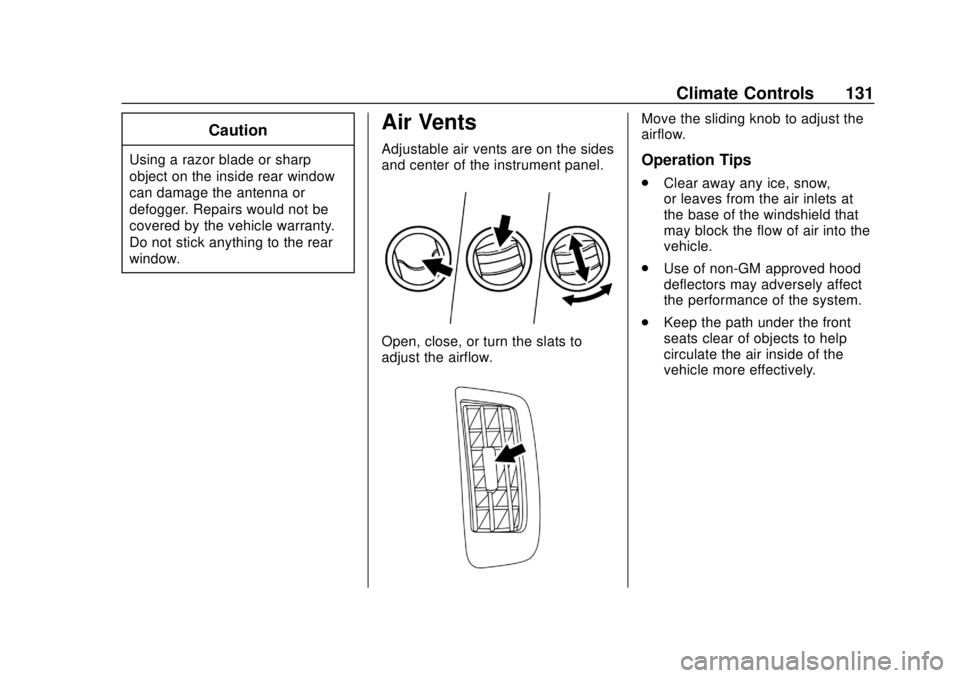
Adjustable air vents are on the sides
and center of the instrument panel.
Open, close, or turn the slats to
adjust the airflow.
Move the sliding knob to adjust the
airflow.
Operation Tips
.Clear away any ice, snow,
or leaves from the air inlets at
the base of the windshield that
may block the flow of air into the
vehicle.
. Use of non-GM approved hood
deflectors may adversely affect
the performance of the system.
. Keep the path under the front
seats clear of objects to help
circulate the air inside of the
vehicle more effectively.
Page 134 of 287
Chevrolet City Express Owner Manual (GMNA-Localizing-U.S./Canada-
11683523) - 2018 - CRC - 7/10/17
Driving and Operating 133
Driving and
Operating
Driving Information
Distracted Driving . . . . . . . . . . . . 134
Defensive Driving . . . . . . . . . . . . . 134
Drunk Driving . . . . . . . . . . . . . . . . . 135
Control of a Vehicle . . . . . . . . . . . 135
Braking . . . . . . . . . . . . . . . . . . . . . . . 135
Steering . . . . . . . . . . . . . . . . . . . . . . 135
Off-Road Recovery . . . . . . . . . . . 136
Loss of Control . . . . . . . . . . . . . . . 136
Driving on Wet Roads . . . . . . . . 137
Hill and Mountain Roads . . . . . 138
Winter Driving . . . . . . . . . . . . . . . . 138
If the Vehicle Is Stuck . . . . . . . . 140
Vehicle Load Limits . . . . . . . . . . . 140
Starting and Operating
New Vehicle Break-In . . . . . . . . . 144
Ignition Positions . . . . . . . . . . . . . 145
Starting the Engine . . . . . . . . . . . 146
Engine Heater . . . . . . . . . . . . . . . . 147
Parking over ThingsThat Burn . . . . . . . . . . . . . . . . . . . 149
Engine Exhaust
Engine Exhaust . . . . . . . . . . . . . . 149 Running the Vehicle While
Parked . . . . . . . . . . . . . . . . . . . . . . 150
Automatic Transmission
Continuously VariableTransmission (CVT) . . . . . . . . . 150
Brakes
Antilock BrakeSystem (ABS) . . . . . . . . . . . . . . . 155
Parking Brake . . . . . . . . . . . . . . . . 156
Hill Start Assist (HSA) . . . . . . . . 157
Ride Control Systems
Traction Control/Electronic Stability Control . . . . . . . . . . . . . 158
Cruise Control
Cruise Control . . . . . . . . . . . . . . . . 161
Driver Assistance Systems
Rear Vision Camera (RVC) . . . 163
Parking Assist . . . . . . . . . . . . . . . . 169
Fuel
Fuel . . . . . . . . . . . . . . . . . . . . . . . . . . 170
California FuelRequirements . . . . . . . . . . . . . . . 171
Fuels in Foreign Countries . . . 171
Fuel Additives . . . . . . . . . . . . . . . . 171
Filling the Tank . . . . . . . . . . . . . . . 172 Filling a Portable Fuel
Container . . . . . . . . . . . . . . . . . . . 173
Trailer Towing
General TowingInformation . . . . . . . . . . . . . . . . . . 174
Conversions and Add-Ons
Add-On ElectricalEquipment . . . . . . . . . . . . . . . . . . 174
Page 137 of 287
Chevrolet City Express Owner Manual (GMNA-Localizing-U.S./Canada-
11683523) - 2018 - CRC - 7/10/17
136 Driving and Operating
If the steering wheel is turned until it
reaches the end of its travel and is
held against that position for an
extended period of time, power
steering assist may be reduced.
Normal use of the power steering
assist should return when the
system cools down.
See your dealer if there is a
problem.
Curve Tips
.Take curves at a reasonable
speed.
. Reduce speed before entering a
curve.
. Maintain a reasonable steady
speed through the curve.
. Wait until the vehicle is out of
the curve before accelerating
gently into the straightaway.
Steering in Emergencies
.There are some situations when
steering around a problem may
be more effective than braking. .
Holding both sides of the
steering wheel allows you to turn
180 degrees without removing
a hand.
. The Antilock Brake System
(ABS) allows steering while
braking.
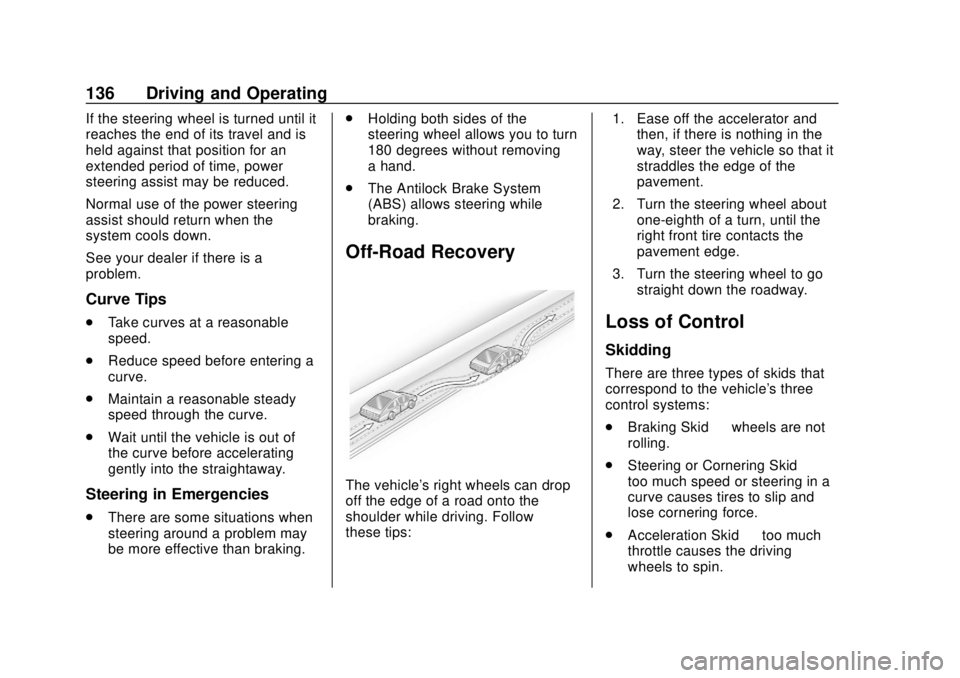
Off-Road Recovery
The vehicle's right wheels can drop
off the edge of a road onto the
shoulder while driving. Follow
these tips: 1. Ease off the accelerator and
then, if there is nothing in the
way, steer the vehicle so that it
straddles the edge of the
pavement.
2. Turn the steering wheel about one-eighth of a turn, until the
right front tire contacts the
pavement edge.
3. Turn the steering wheel to go straight down the roadway.
Loss of Control
Skidding
There are three types of skids that
correspond to the vehicle's three
control systems:
.Braking Skid —wheels are not
rolling.
. Steering or Cornering Skid —
too much speed or steering in a
curve causes tires to slip and
lose cornering force.
. Acceleration Skid —too much
throttle causes the driving
wheels to spin.
Page 138 of 287
Chevrolet City Express Owner Manual (GMNA-Localizing-U.S./Canada-
11683523) - 2018 - CRC - 7/10/17
Driving and Operating 137
Defensive drivers avoid most skids
by taking reasonable care suited to
existing conditions, and by not
overdriving those conditions. But
skids are always possible.
If the vehicle starts to slide, follow
these suggestions:
.Ease your foot off the
accelerator pedal and steer the
way you want the vehicle to go.
The vehicle may straighten out.
Be ready for a second skid if it
occurs.
. Slow down and adjust your
driving according to weather
conditions. Stopping distance
can be longer and vehicle
control can be affected when
traction is reduced by water,
snow, ice, gravel, or other
material on the road. Learn to
recognize warning clues —such
as enough water, ice, or packed
snow on the road to make a
mirrored surface —and slow
down when you have any doubt. .
Try to avoid sudden steering,
acceleration, or braking,
including reducing vehicle speed
by shifting to a lower gear. Any
sudden changes could cause
the tires to slide.
Remember: Antilock brakes help
avoid only the braking skid.
Driving on Wet Roads
Rain and wet roads can reduce
vehicle traction and affect your
ability to stop and accelerate.
Always drive slower in these types
of driving conditions and avoid
driving through large puddles and
deep-standing or flowing water.
{Warning
Wet brakes can cause crashes.
They might not work as well in a
quick stop and could cause
pulling to one side. You could
lose control of the vehicle. (Continued)
Warning (Continued)
After driving through a large
puddle of water or a car/vehicle
wash, lightly apply the brake
pedal until the brakes work
normally.
Flowing or rushing water creates
strong forces. Driving through
flowing water could cause the
vehicle to be carried away. If this
happens, you and other vehicle
occupants could drown. Do not
ignore police warnings and be
very cautious about trying to drive
through flowing water.
Hydroplaning
Hydroplaning is dangerous. Water
can build up under the vehicle's
tires so they actually ride on the
water. This can happen if the road is
wet enough and you are going fast
enough. When the vehicle is
hydroplaning, it has little or no
contact with the road.
Page 140 of 287
Chevrolet City Express Owner Manual (GMNA-Localizing-U.S./Canada-
11683523) - 2018 - CRC - 7/10/17
Driving and Operating 139
.Turn on Traction Control. See
Traction Control/Electronic
Stability Control 0158.
. The Antilock Brake System
(ABS) improves vehicle stability
during hard stops, but the
brakes should be applied sooner
than when on dry pavement.
See Antilock Brake System
(ABS) 0155.
. Allow greater following distance
and watch for slippery spots. Icy
patches can occur on otherwise
clear roads in shaded areas.
The surface of a curve or an
overpass can remain icy when
the surrounding roads are clear.
Avoid sudden steering
maneuvers and braking while
on ice.
. Turn off cruise control.Blizzard Conditions
Stop the vehicle in a safe place and
signal for help. Stay with the vehicle
unless there is help nearby.
If possible, use Roadside
Assistance. See Roadside
Assistance Program 0267. To get
help and keep everyone in the
vehicle safe:
. Turn on the hazard warning
flashers.
. Tie a red cloth to an outside
mirror.
{Warning
Snow can trap engine exhaust
under the vehicle. This may
cause exhaust gases to get
inside. Engine exhaust contains
carbon monoxide (CO), which
cannot be seen or smelled. It can
cause unconsciousness and even
death.
(Continued)
Warning (Continued)
If the vehicle is stuck in snow:
. Clear snow from the base of
the vehicle, especially any
blocking the exhaust pipe.
. Open a window about 5 cm
(2 in) on the vehicle side
that is away from the wind,
to bring in fresh air.
. Fully open the air outlets on
or under the instrument
panel.
. Adjust the climate control
system to circulate the air
inside the vehicle and set
the fan speed to the highest
setting. See “Climate
Control Systems.”
For more information about CO,
see Engine Exhaust 0149.
Page 146 of 287
Chevrolet City Express Owner Manual (GMNA-Localizing-U.S./Canada-
11683523) - 2018 - CRC - 7/10/17
Driving and Operating 145
Caution (Continued)
premature wear and earlier
replacement. Follow this
breaking-in guideline every
time you get new brake
linings.
Following break-in, engine speed
and load can be gradually
increased.
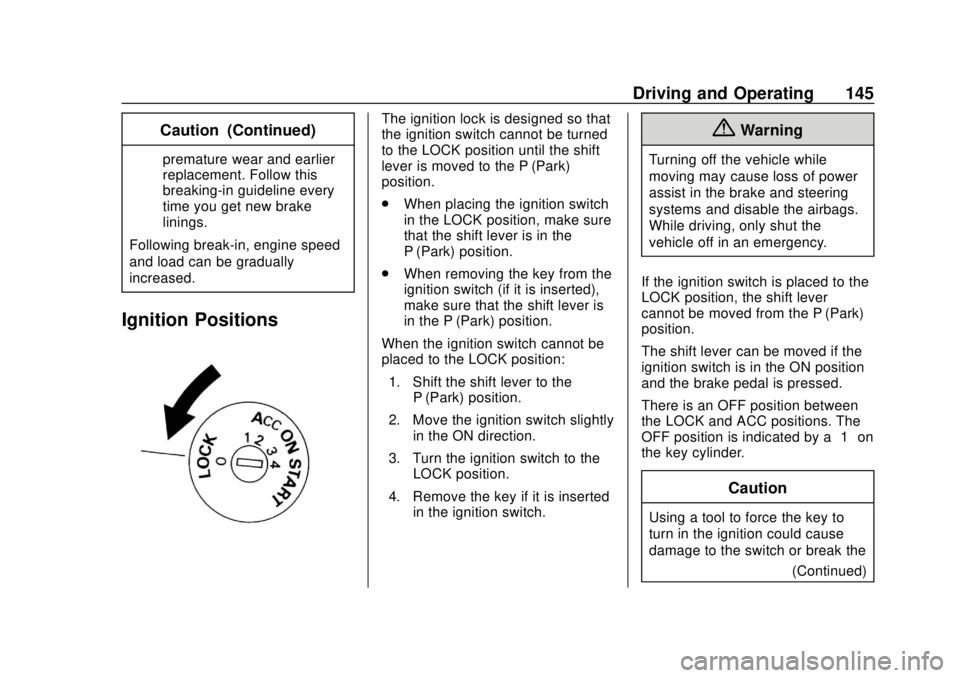
Ignition Positions
The ignition lock is designed so that
the ignition switch cannot be turned
to the LOCK position until the shift
lever is moved to the P (Park)
position.
. When placing the ignition switch
in the LOCK position, make sure
that the shift lever is in the
P (Park) position.
. When removing the key from the
ignition switch (if it is inserted),
make sure that the shift lever is
in the P (Park) position.
When the ignition switch cannot be
placed to the LOCK position: 1. Shift the shift lever to the P (Park) position.
2. Move the ignition switch slightly in the ON direction.
3. Turn the ignition switch to the LOCK position.
4. Remove the key if it is inserted in the ignition switch.{Warning
Turning off the vehicle while
moving may cause loss of power
assist in the brake and steering
systems and disable the airbags.
While driving, only shut the
vehicle off in an emergency.
If the ignition switch is placed to the
LOCK position, the shift lever
cannot be moved from the P (Park)
position.
The shift lever can be moved if the
ignition switch is in the ON position
and the brake pedal is pressed.
There is an OFF position between
the LOCK and ACC positions. The
OFF position is indicated by a “1”on
the key cylinder.
Caution
Using a tool to force the key to
turn in the ignition could cause
damage to the switch or break the
(Continued)
Page 147 of 287
Chevrolet City Express Owner Manual (GMNA-Localizing-U.S./Canada-
11683523) - 2018 - CRC - 7/10/17
146 Driving and Operating
Caution (Continued)
key. Use the correct key, make
sure it is all the way in, and turn it
only with your hand. If the key
cannot be turned by hand, see
your dealer.
Ignition Switch Positions
LOCK (0) : Normal parking position.
OFF (1) : The engine can be turned
off without locking the steering
wheel.
ACC (2) : Accessories. This position
activates electrical accessories such
as the radio when the engine is not
running.
ON (3) : Normal operating position.
This position turns on the ignition
system and the electrical
accessories.
START (4) : This position starts the
engine. As soon as the engine has
started, release the key.
It automatically returns to the ON
position.
Starting the Engine
To place the transmission in the
proper gear:
Move the shift lever to P (Park) or
N (Neutral). The engine will not start
in any other position. To restart the
engine when the vehicle is already
moving, use N (Neutral) only.
Caution
If you add electrical parts or
accessories, you could change
the way the engine operates. Any
resulting damage would not be
covered by the vehicle warranty.
See Add-On Electrical Equipment
0 174.
Caution
Do not try to shift to P (Park) if the
vehicle is moving. If you do, you
could damage the transmission.
Shift to P (Park) only when the
vehicle is stopped. Starting Procedure
1. Apply the parking brake.
2. Move the shift lever to P (Park) or N (Neutral). P (Park) is
recommended.
The shift lever cannot be
moved out of P (Park) and into
any of the other gear positions
if the ignition switch is turned to
the OFF position or if the key is
removed from the ignition
switch.
The starter is designed not to
operate if the shift lever is in
any of the driving positions.
3. Crank the engine with your foot off the accelerator pedalby
placing the ignition switch in
the START position. Release
the key when the engine starts.
If the engine starts, but fails to
run, repeat the above
procedure.
.If the engine is very hard to
start in extremely cold
weather or when restarting,
press the accelerator pedal