lock CHEVROLET CITY EXPRESS 2018 Repair Manual
[x] Cancel search | Manufacturer: CHEVROLET, Model Year: 2018, Model line: CITY EXPRESS, Model: CHEVROLET CITY EXPRESS 2018Pages: 287, PDF Size: 4.19 MB
Page 183 of 287
Chevrolet City Express Owner Manual (GMNA-Localizing-U.S./Canada-
11683523) - 2018 - CRC - 7/10/17
182 Vehicle Care
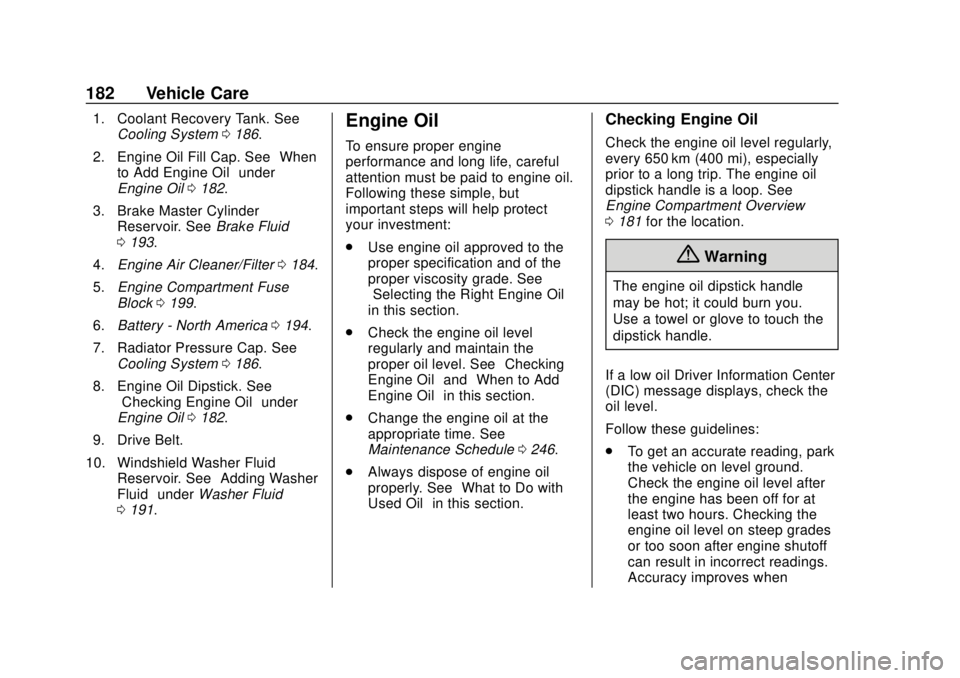
1. Coolant Recovery Tank. SeeCooling System 0186.
2. Engine Oil Fill Cap. See “When
to Add Engine Oil” under
Engine Oil 0182.
3. Brake Master Cylinder Reservoir. See Brake Fluid
0 193.
4. Engine Air Cleaner/Filter 0184.
5. Engine Compartment Fuse
Block 0199.
6. Battery - North America 0194.
7. Radiator Pressure Cap. See Cooling System 0186.
8. Engine Oil Dipstick. See “Checking Engine Oil” under
Engine Oil 0182.
9. Drive Belt.
10. Windshield Washer Fluid Reservoir. See “Adding Washer
Fluid” under Washer Fluid
0 191.Engine Oil
To ensure proper engine
performance and long life, careful
attention must be paid to engine oil.
Following these simple, but
important steps will help protect
your investment:
.
Use engine oil approved to the
proper specification and of the
proper viscosity grade. See
“Selecting the Right Engine Oil”
in this section.
. Check the engine oil level
regularly and maintain the
proper oil level. See “Checking
Engine Oil” and“When to Add
Engine Oil” in this section.
. Change the engine oil at the
appropriate time. See
Maintenance Schedule 0246.
. Always dispose of engine oil
properly. See “What to Do with
Used Oil” in this section.
Checking Engine Oil
Check the engine oil level regularly,
every 650 km (400 mi), especially
prior to a long trip. The engine oil
dipstick handle is a loop. See
Engine Compartment Overview
0181 for the location.
{Warning
The engine oil dipstick handle
may be hot; it could burn you.
Use a towel or glove to touch the
dipstick handle.
If a low oil Driver Information Center
(DIC) message displays, check the
oil level.
Follow these guidelines:
. To get an accurate reading, park
the vehicle on level ground.
Check the engine oil level after
the engine has been off for at
least two hours. Checking the
engine oil level on steep grades
or too soon after engine shutoff
can result in incorrect readings.
Accuracy improves when
Page 196 of 287
Chevrolet City Express Owner Manual (GMNA-Localizing-U.S./Canada-
11683523) - 2018 - CRC - 7/10/17
Vehicle Care 195
Vehicle Storage
{Warning
Batteries have acid that can burn
you and gas that can explode.
You can be badly hurt if you are
not careful. SeeJump Starting -
North America 0227 for tips on
working around a battery without
getting hurt.
Extended Storage Switch
If any electrical equipment does not
operate, remove the extended
storage switch and check for an
open fuse.
The extended storage switch is
used for long term vehicle storage.
Even if the extended storage switch
is broken it is not necessary to
replace it. Replace only the open
fuse in the switch with a new fuse.
To replace the extended storage
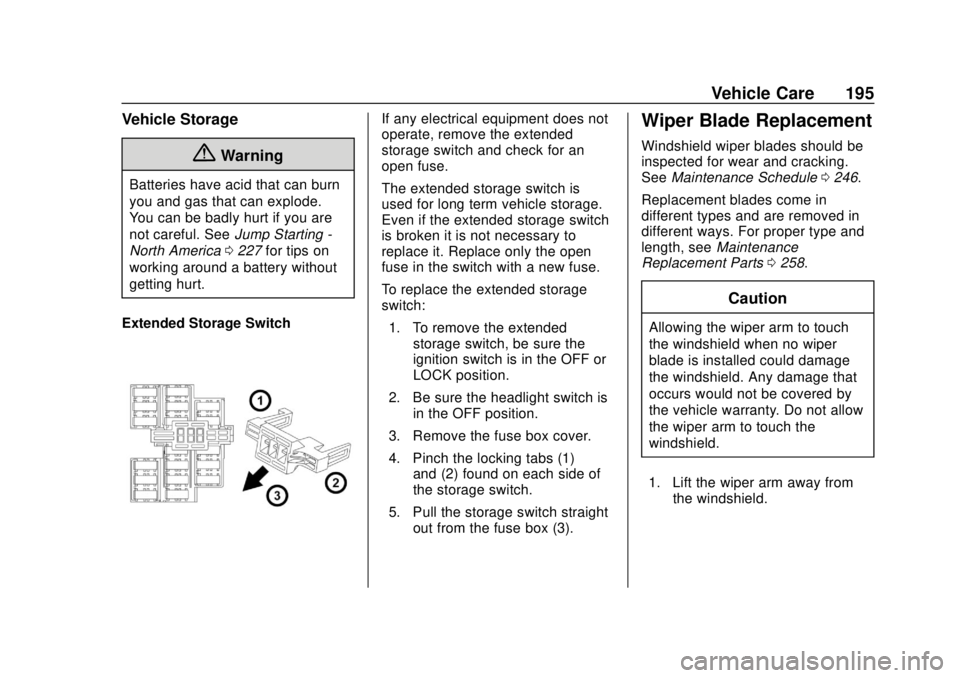
switch: 1. To remove the extended storage switch, be sure the
ignition switch is in the OFF or
LOCK position.
2. Be sure the headlight switch is in the OFF position.
3. Remove the fuse box cover.
4. Pinch the locking tabs (1) and (2) found on each side of
the storage switch.
5. Pull the storage switch straight out from the fuse box (3).Wiper Blade Replacement
Windshield wiper blades should be
inspected for wear and cracking.
See Maintenance Schedule 0246.
Replacement blades come in
different types and are removed in
different ways. For proper type and
length, see Maintenance
Replacement Parts 0258.
Caution
Allowing the wiper arm to touch
the windshield when no wiper
blade is installed could damage
the windshield. Any damage that
occurs would not be covered by
the vehicle warranty. Do not allow
the wiper arm to touch the
windshield.
1. Lift the wiper arm away from the windshield.
Page 199 of 287

Chevrolet City Express Owner Manual (GMNA-Localizing-U.S./Canada-
11683523) - 2018 - CRC - 7/10/17
198 Vehicle Care
Headlamps, Front Turn
Signal and Parking
Lamps
High-Beam Headlamp/
Low-Beam Headlamp
1. Open the hood.
2. Release the clip on theconnector.
3. Turn the bulb counterclockwise and pull straight back.
Turn Signal and Parking Lamp
1. Open the hood.
2. Turn the bulb counterclockwise
and pull straight back.
Electrical System
Electrical System
Overload
The vehicle has fuses and circuit
breakers to protect against an
electrical system overload.
When the current electrical load is
too heavy, the circuit breaker opens
and closes, protecting the circuit
until the current load returns to
normal or the problem is fixed. This
greatly reduces the chance of circuit
overload and fire caused by
electrical problems.
Fuses and circuit breakers protect
power devices in the vehicle.
Replace a bad fuse with a new one
of the identical size and rating.
If there is a problem on the road and
a fuse needs to be replaced, the
same amperage fuse can be
borrowed. Choose some feature of
the vehicle that is not needed to use
and replace it as soon as possible.
Headlamp Wiring
An electrical overload may cause
the lamps to go on and off, or in
some cases to remain off. Have the
headlamp wiring checked right away
if the lamps go on and off or
remain off.
Windshield Wipers
If the wiper motor overheats due to
heavy snow or ice, the windshield
wipers will stop until the motor cools
and will then restart.
Although the circuit is protected
from electrical overload, overload
due to heavy snow or ice may
cause wiper linkage damage.
Always clear ice and heavy snow
from the windshield before using the
windshield wipers.
If the overload is caused by an
electrical problem and not snow or
ice, be sure to get it fixed.
Page 200 of 287

Chevrolet City Express Owner Manual (GMNA-Localizing-U.S./Canada-
11683523) - 2018 - CRC - 7/10/17
Vehicle Care 199
Fuses and Circuit
Breakers
{Danger
Fuses and circuit breakers are
marked with their ampere rating.
Do not exceed the
specified amperage rating when
replacing fuses and circuit
breakers. Use of an oversized
fuse or circuit breaker can result
in a vehicle fire. You and others
could be seriously injured or
killed.
The wiring circuits in the vehicle are
protected from short circuits by a
combination of fuses and circuit
breakers. This greatly reduces the
chance of fires caused by electrical
problems.
Look at the silver-colored band
inside the fuse. If the band is broken
or melted, replace the fuse. Be sure
you replace a bad fuse with a new
one of the identical size and rating. Spare fuses are provided and can
be found in the passenger
compartment fuse box.
Engine Compartment
Fuse Block
The fuse block is in the engine
compartment of the vehicle.
Remove the cover by pushing the
tab and lifting the cover up.
Fusible Links
If the electrical equipment does not
operate and fuses are in good
condition, check the fusible links.
If any of these fusible links are
melted, replace with only Genuine
GM parts.
Caution
Spilling liquid on any electrical
component on the vehicle may
damage it. Always keep the
covers on any electrical
component.
Page 201 of 287
Chevrolet City Express Owner Manual (GMNA-Localizing-U.S./Canada-
11683523) - 2018 - CRC - 7/10/17
200 Vehicle Care
Instrument Panel Fuse
Block
Caution
Spilling liquid on any electrical
component on the vehicle may
damage it. Always keep the
covers on any electrical
component.
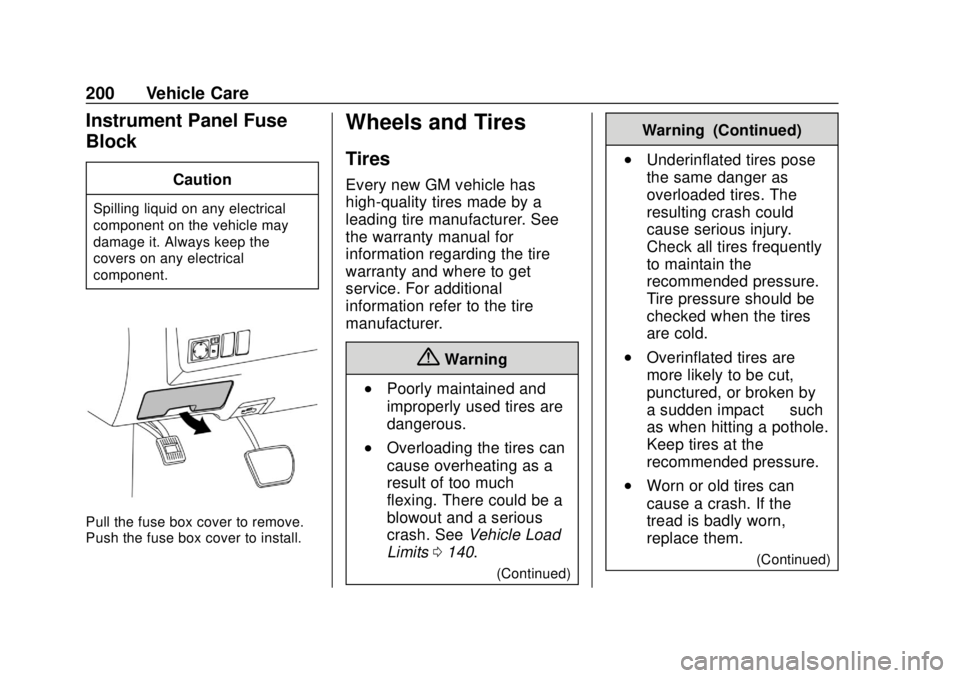
Pull the fuse box cover to remove.
Push the fuse box cover to install.
Wheels and Tires
Tires
Every new GM vehicle has
high-quality tires made by a
leading tire manufacturer. See
the warranty manual for
information regarding the tire
warranty and where to get
service. For additional
information refer to the tire
manufacturer.
{Warning
.Poorly maintained and
improperly used tires are
dangerous.
.Overloading the tires can
cause overheating as a
result of too much
flexing. There could be a
blowout and a serious
crash. SeeVehicle Load
Limits 0140.
(Continued)
Warning (Continued)
.Underinflated tires pose
the same danger as
overloaded tires. The
resulting crash could
cause serious injury.
Check all tires frequently
to maintain the
recommended pressure.
Tire pressure should be
checked when the tires
are cold.
.Overinflated tires are
more likely to be cut,
punctured, or broken by
a sudden impact —such
as when hitting a pothole.
Keep tires at the
recommended pressure.
.Worn or old tires can
cause a crash. If the
tread is badly worn,
replace them.
(Continued)
Page 217 of 287
Chevrolet City Express Owner Manual (GMNA-Localizing-U.S./Canada-
11683523) - 2018 - CRC - 7/10/17
216 Vehicle Care
Warning (Continued)
and wheel assembly with a
similar overall diameter as the
road tires and wheels, so it is
all right to drive on it. The
spare tire was developed for
use on this vehicle and will not
affect vehicle handling.
{Warning
Using bias-ply tires on the
vehicle may cause the wheel
rim flanges to develop cracks
after many miles of driving.
A tire and/or wheel could fail
suddenly and cause a crash.
Use only radial-ply tires with
the wheels on the vehicle.
Winter tires with the same speed
rating as the original equipment
tires may not be available for H,
V, W, Y and ZR speed rated tires. Never exceed the winter
tires’
maximum speed capability
when using winter tires with a
lower speed rating.
When replacement tires are
needed, GM strongly
recommends buying the same
original equipment spec tires.
This vehicle is equipped with
special high load tires with a
load index of 94.
When purchasing replacement
tires, this load index must be
followed, or max payload
capacity will be reduced.
Refer to the tire information
label.
Size Cold Tire
Inflation
Pressure
Front Original Tire:
185/60R15C 94/92T 44 psi
(300 kPa)
Rear Original Tire:
185/60R15C 94/92T 48 psi
(325 kPa) Size
Cold Tire
Inflation
Pressure
Spare Tire (Front):
185/60R15C 94/92T 44 psi
(300 kPa)
Spare Tire (Rear):
185/60R15C 94/92T 48 psi
(325 kPa)
The Tire and Loading
Information label indicates the
original equipment tires on the
vehicle. See Vehicle Load Limits
0 140 for the label location and
more information about the Tire
and Loading Information label.
Different Size Tires and
Wheels
If wheels or tires are installed that
are a different size than the original
equipment wheels and tires, vehicle
performance, including its braking,
ride and handling characteristics,
stability, and resistance to rollover
may be affected. If the vehicle has
electronic systems such as antilock
brakes, rollover airbags, traction
Page 222 of 287
Chevrolet City Express Owner Manual (GMNA-Localizing-U.S./Canada-
11683523) - 2018 - CRC - 7/10/17
Vehicle Care 221
Warning (Continued)
2. Put an automatictransmission in P (Park) or a
manual transmission in
1 (First) or R (Reverse).
3. Turn off the engine and do not restart while the vehicle
is raised.
4. Do not allow passengers to remain in the vehicle.
5. Place wheel blocks, if equipped, on both sides of
the tire at the opposite
corner of the tire being
changed.
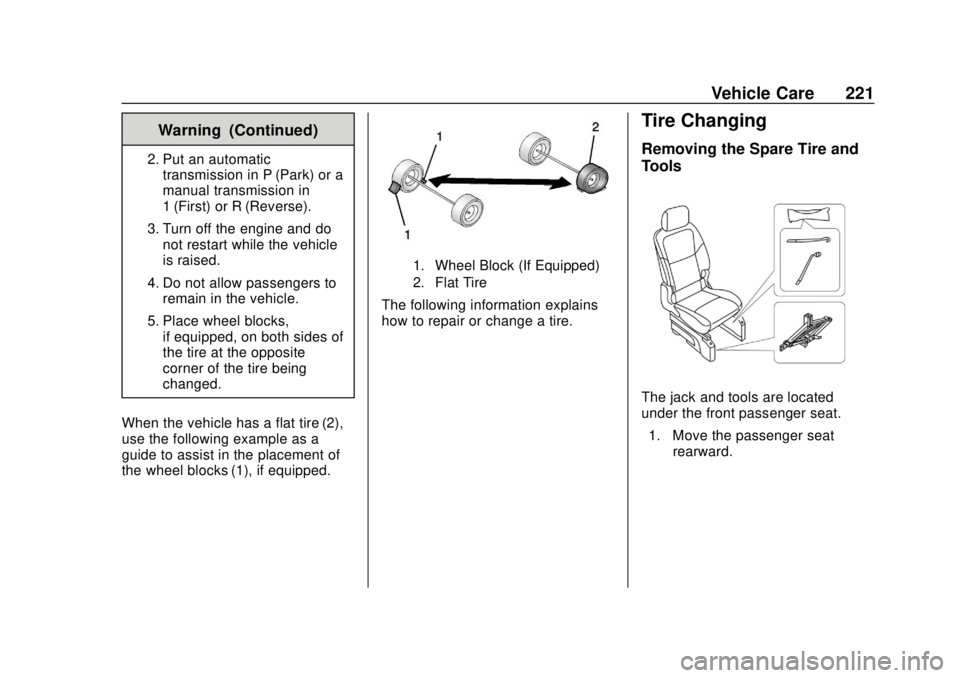
When the vehicle has a flat tire (2),
use the following example as a
guide to assist in the placement of
the wheel blocks (1), if equipped.
1. Wheel Block (If Equipped)
2. Flat Tire
The following information explains
how to repair or change a tire.
Tire Changing
Removing the Spare Tire and
Tools
The jack and tools are located
under the front passenger seat. 1. Move the passenger seat rearward.
Page 223 of 287
Chevrolet City Express Owner Manual (GMNA-Localizing-U.S./Canada-
11683523) - 2018 - CRC - 7/10/17
222 Vehicle Care
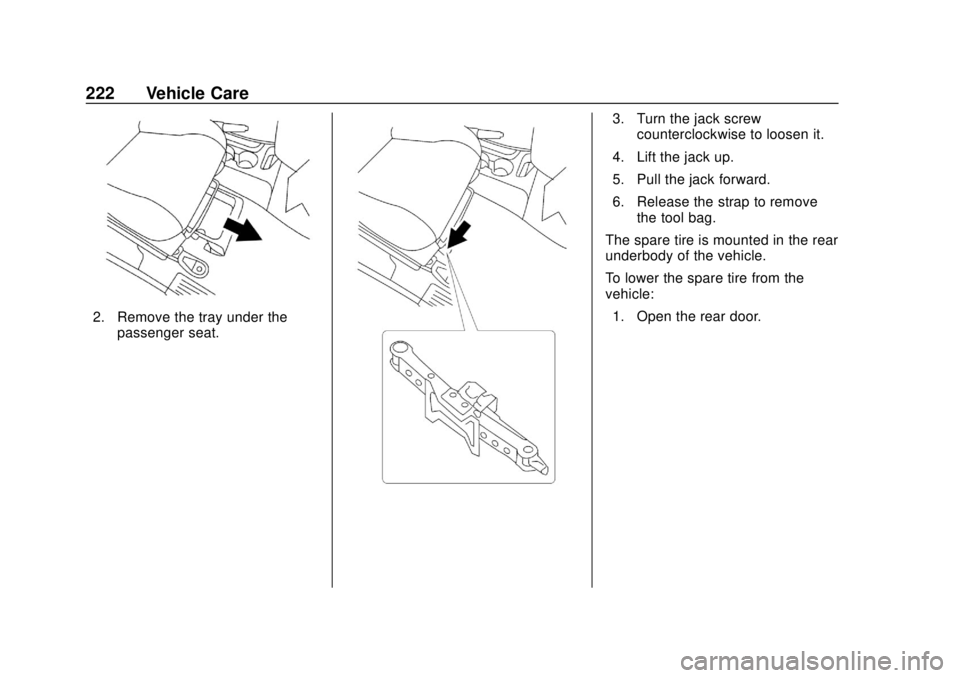
2. Remove the tray under thepassenger seat.
3. Turn the jack screwcounterclockwise to loosen it.
4. Lift the jack up.
5. Pull the jack forward.
6. Release the strap to remove the tool bag.
The spare tire is mounted in the rear
underbody of the vehicle.
To lower the spare tire from the
vehicle: 1. Open the rear door.
Page 224 of 287
Chevrolet City Express Owner Manual (GMNA-Localizing-U.S./Canada-
11683523) - 2018 - CRC - 7/10/17
Vehicle Care 223
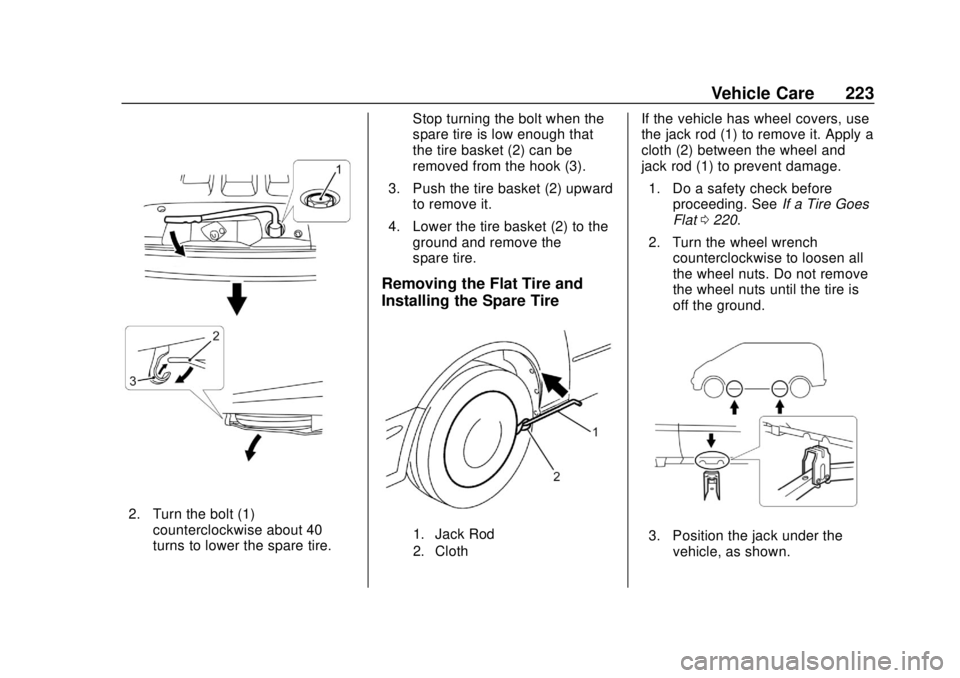
2. Turn the bolt (1)counterclockwise about 40
turns to lower the spare tire. Stop turning the bolt when the
spare tire is low enough that
the tire basket (2) can be
removed from the hook (3).
3. Push the tire basket (2) upward to remove it.
4. Lower the tire basket (2) to the ground and remove the
spare tire.
Removing the Flat Tire and
Installing the Spare Tire
1. Jack Rod
2. Cloth
If the vehicle has wheel covers, use
the jack rod (1) to remove it. Apply a
cloth (2) between the wheel and
jack rod (1) to prevent damage.
1. Do a safety check before proceeding. See If a Tire Goes
Flat 0220.
2. Turn the wheel wrench counterclockwise to loosen all
the wheel nuts. Do not remove
the wheel nuts until the tire is
off the ground.
3. Position the jack under the
vehicle, as shown.
Page 225 of 287
Chevrolet City Express Owner Manual (GMNA-Localizing-U.S./Canada-
11683523) - 2018 - CRC - 7/10/17
224 Vehicle Care
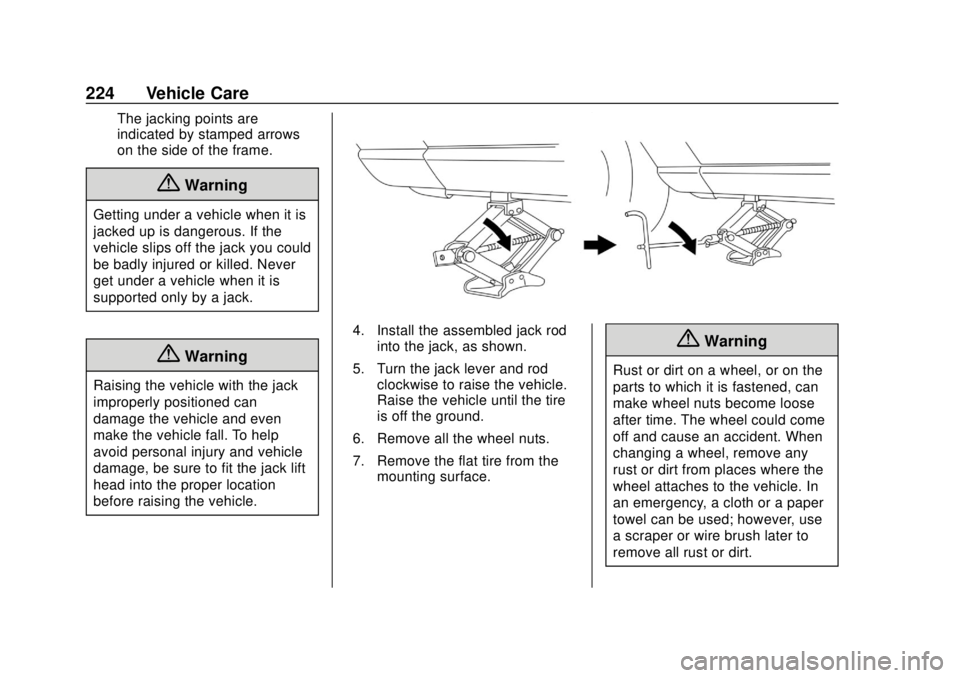
The jacking points are
indicated by stamped arrows
on the side of the frame.
{Warning
Getting under a vehicle when it is
jacked up is dangerous. If the
vehicle slips off the jack you could
be badly injured or killed. Never
get under a vehicle when it is
supported only by a jack.
{Warning
Raising the vehicle with the jack
improperly positioned can
damage the vehicle and even
make the vehicle fall. To help
avoid personal injury and vehicle
damage, be sure to fit the jack lift
head into the proper location
before raising the vehicle.
4. Install the assembled jack rodinto the jack, as shown.
5. Turn the jack lever and rod clockwise to raise the vehicle.
Raise the vehicle until the tire
is off the ground.
6. Remove all the wheel nuts.
7. Remove the flat tire from the mounting surface.{Warning
Rust or dirt on a wheel, or on the
parts to which it is fastened, can
make wheel nuts become loose
after time. The wheel could come
off and cause an accident. When
changing a wheel, remove any
rust or dirt from places where the
wheel attaches to the vehicle. In
an emergency, a cloth or a paper
towel can be used; however, use
a scraper or wire brush later to
remove all rust or dirt.