engine CHEVROLET CLASSIC 2005 Manual PDF
[x] Cancel search | Manufacturer: CHEVROLET, Model Year: 2005, Model line: CLASSIC, Model: CHEVROLET CLASSIC 2005Pages: 320, PDF Size: 4.86 MB
Page 221 of 320
{CAUTION:
Fans or other moving engine parts can injure
you badly. Keep your hands away from moving
parts once the engine is running.
5. Check that the jumper cables do not have loose or
missing insulation. If they do, you could get a
shock. The vehicles could be damaged too.
Before you connect the cables, here are some
things you should know. Positive (+) will go
to positive (+) or to a remote positive (+) terminal
if the vehicle has one. Negative (−) will go to a
heavy, unpainted metal engine part or to a remote
negative (−) terminal if the vehicle with the dead
battery has one.
Do not connect positive (+) to negative (−)oryou
will get a short that would damage the battery
and maybe other parts too. And do not connect the
negative (−) cable to the negative (−) terminal on
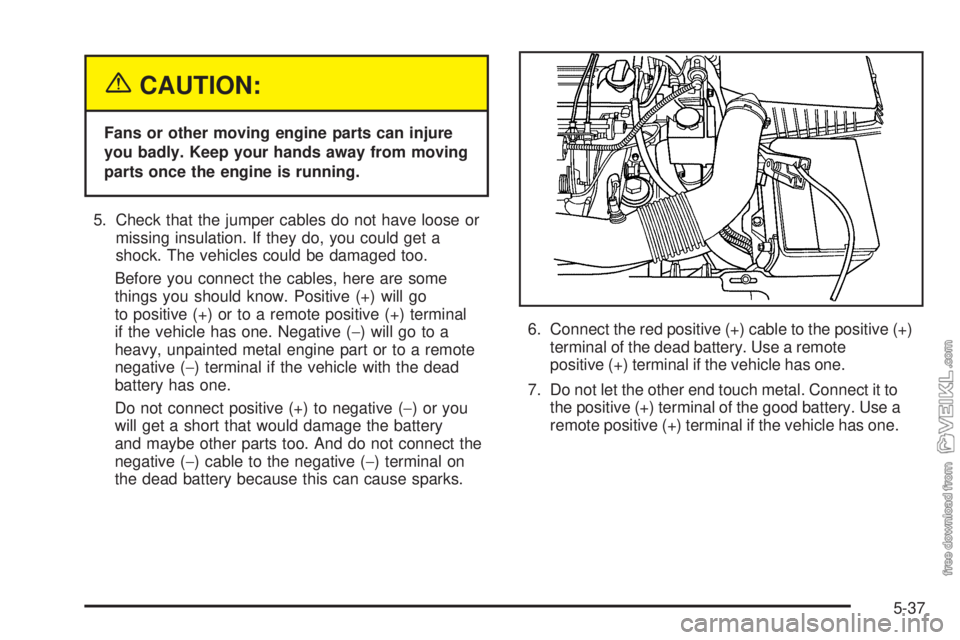
the dead battery because this can cause sparks.6. Connect the red positive (+) cable to the positive (+)
terminal of the dead battery. Use a remote
positive (+) terminal if the vehicle has one.
7. Do not let the other end touch metal. Connect it to
the positive (+) terminal of the good battery. Use a
remote positive (+) terminal if the vehicle has one.
5-37
Page 222 of 320
8. Now connect the black negative (−) cable to the
negative (−) terminal of the good battery. Use a
remote negative (−) terminal if the vehicle has one.
Do not let the other end touch anything until the
next step. The other end of the negative (−) cable
does not go to the dead battery. It goes to a
heavy, unpainted metal engine part or to a remote
negative (−) terminal on the vehicle with the
dead battery.
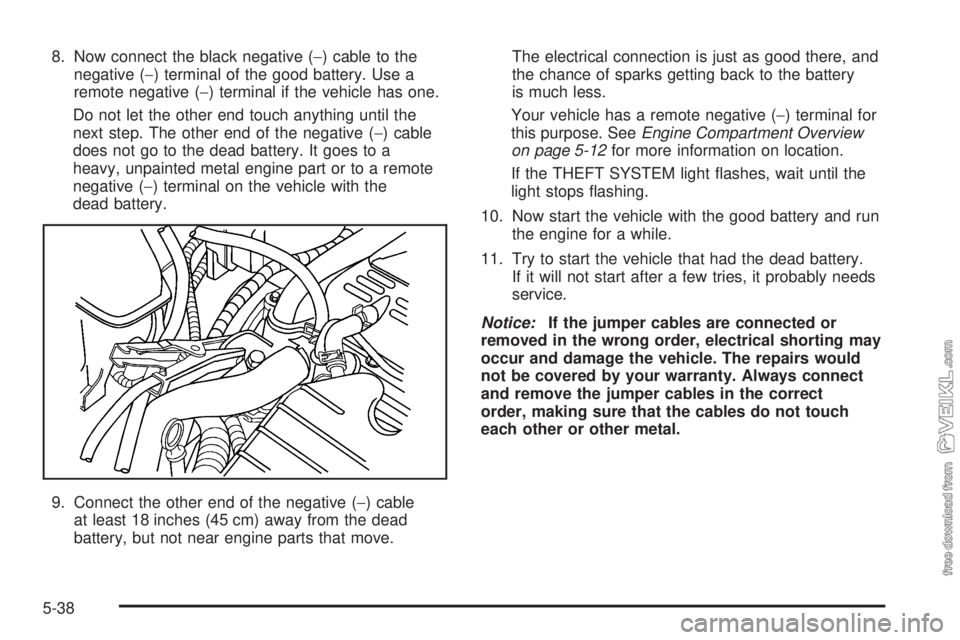
9. Connect the other end of the negative (−) cable
at least 18 inches (45 cm) away from the dead
battery, but not near engine parts that move.The electrical connection is just as good there, and
the chance of sparks getting back to the battery
is much less.
Your vehicle has a remote negative (−) terminal for
this purpose. SeeEngine Compartment Overview
on page 5-12for more information on location.
If the THEFT SYSTEM light flashes, wait until the
light stops flashing.
10. Now start the vehicle with the good battery and run
the engine for a while.
11. Try to start the vehicle that had the dead battery.
If it will not start after a few tries, it probably needs
service.
Notice:If the jumper cables are connected or
removed in the wrong order, electrical shorting may
occur and damage the vehicle. The repairs would
not be covered by your warranty. Always connect
and remove the jumper cables in the correct
order, making sure that the cables do not touch
each other or other metal.
5-38
Page 223 of 320
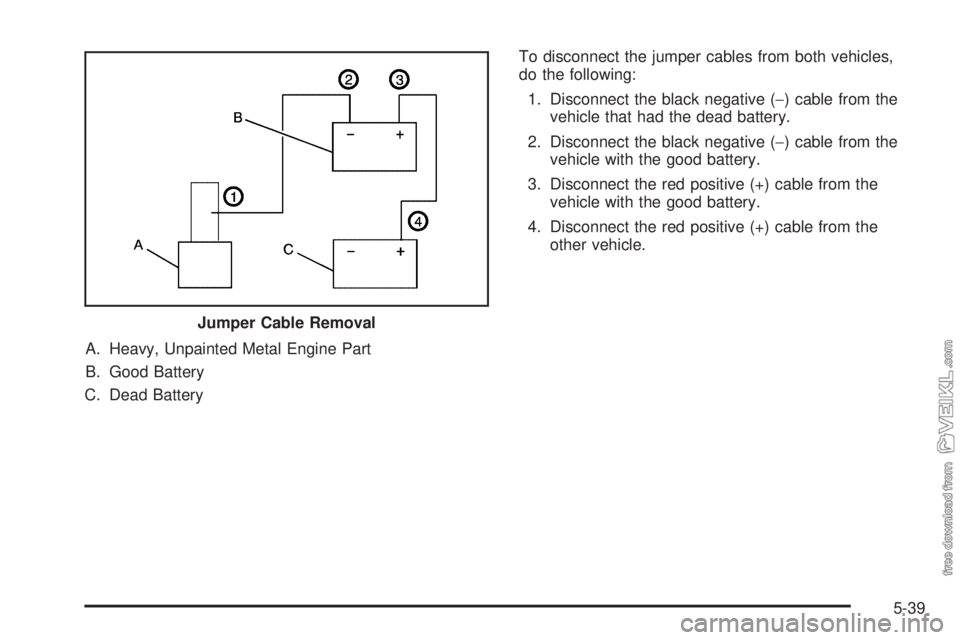
A. Heavy, Unpainted Metal Engine Part
B. Good Battery
C. Dead BatteryTo disconnect the jumper cables from both vehicles,
do the following:
1. Disconnect the black negative (−) cable from the
vehicle that had the dead battery.
2. Disconnect the black negative (−) cable from the
vehicle with the good battery.
3. Disconnect the red positive (+) cable from the
vehicle with the good battery.
4. Disconnect the red positive (+) cable from the
other vehicle.
Jumper Cable Removal
5-39
Page 234 of 320
Tire Size
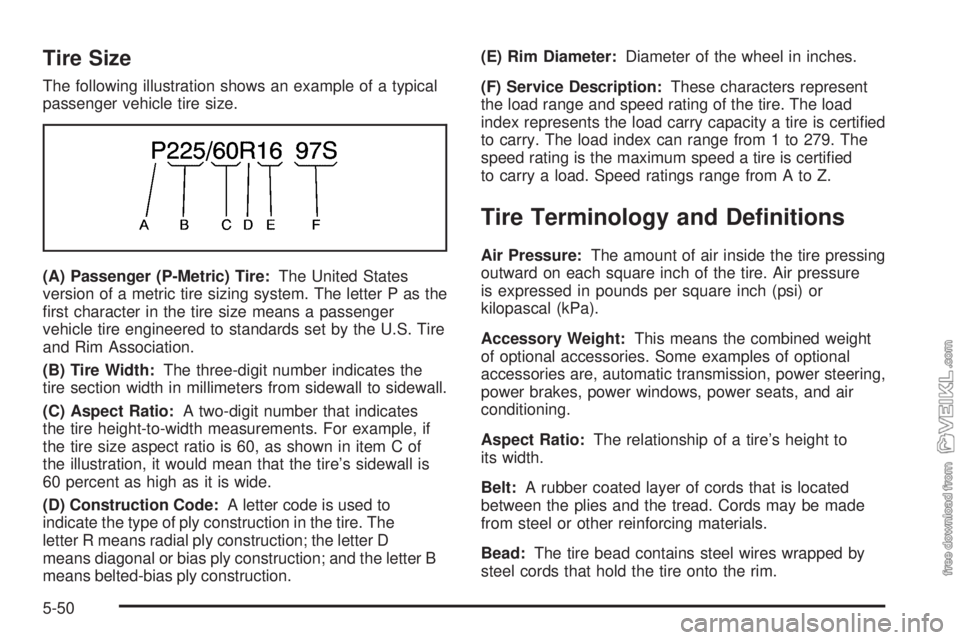
The following illustration shows an example of a typical
passenger vehicle tire size.
(A) Passenger (P-Metric) Tire:The United States
version of a metric tire sizing system. The letter P as the
first character in the tire size means a passenger
vehicle tire engineered to standards set by the U.S. Tire
and Rim Association.
(B) Tire Width:The three-digit number indicates the
tire section width in millimeters from sidewall to sidewall.
(C) Aspect Ratio:A two-digit number that indicates
the tire height-to-width measurements. For example, if
the tire size aspect ratio is 60, as shown in item C of
the illustration, it would mean that the tire’s sidewall is
60 percent as high as it is wide.
(D) Construction Code:A letter code is used to
indicate the type of ply construction in the tire. The
letter R means radial ply construction; the letter D
means diagonal or bias ply construction; and the letter B
means belted-bias ply construction.(E) Rim Diameter:Diameter of the wheel in inches.
(F) Service Description:These characters represent
the load range and speed rating of the tire. The load
index represents the load carry capacity a tire is certified
to carry. The load index can range from 1 to 279. The
speed rating is the maximum speed a tire is certified
to carry a load. Speed ratings range from A to Z.
Tire Terminology and Denitions
Air Pressure:The amount of air inside the tire pressing
outward on each square inch of the tire. Air pressure
is expressed in pounds per square inch (psi) or
kilopascal (kPa).
Accessory Weight:This means the combined weight
of optional accessories. Some examples of optional
accessories are, automatic transmission, power steering,
power brakes, power windows, power seats, and air
conditioning.
Aspect Ratio:The relationship of a tire’s height to
its width.
Belt:A rubber coated layer of cords that is located
between the plies and the tread. Cords may be made
from steel or other reinforcing materials.
Bead:The tire bead contains steel wires wrapped by
steel cords that hold the tire onto the rim.
5-50
Page 245 of 320
{CAUTION:
Changing a tire can be dangerous. The vehicle
can slip off the jack and roll over or fall on you
or other people. You and they could be badly
injured or even killed. Find a level place to
change your tire. To help prevent the vehicle
from moving:
1. Set the parking brake rmly.
2. Put the shift lever in PARK (P).
3. Turn off the engine and do not restart
while the vehicle is raised.
4. Do not allow passengers to remain in
the vehicle.
To be even more certain the vehicle will not
move, you should put blocks at the front and
rear of the tire farthest away from the one
being changed. That would be the tire, on the
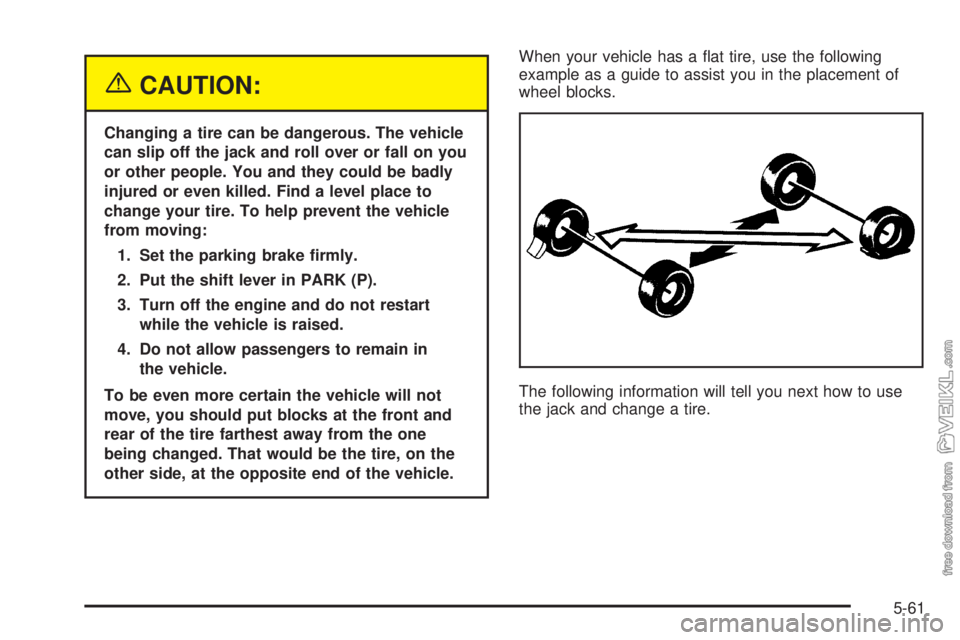
other side, at the opposite end of the vehicle.When your vehicle has a flat tire, use the following
example as a guide to assist you in the placement of
wheel blocks.
The following information will tell you next how to use
the jack and change a tire.
5-61
Page 262 of 320
Vehicle Identication
Vehicle Identication Number (VIN)
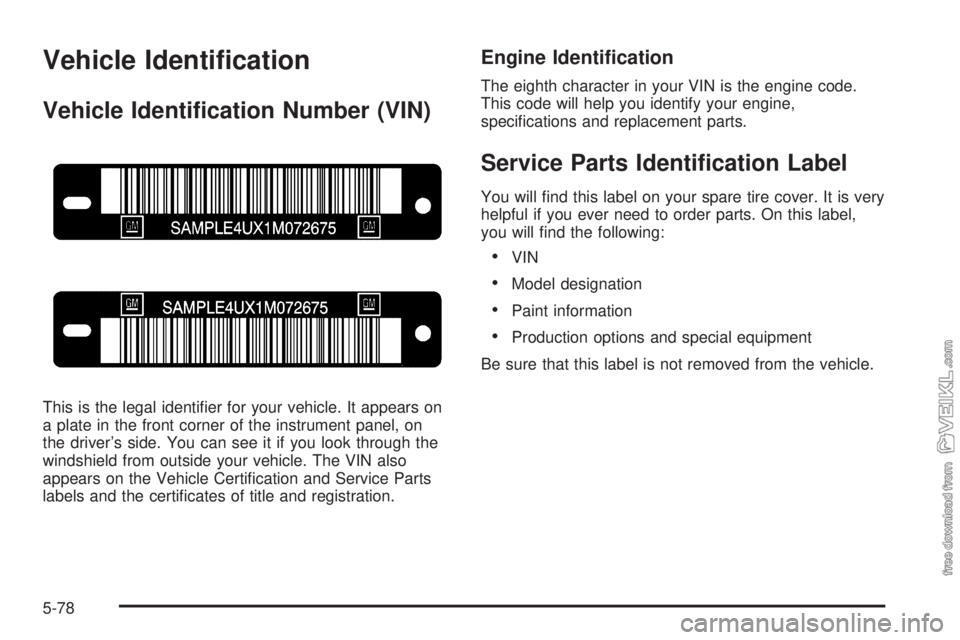
This is the legal identifier for your vehicle. It appears on
a plate in the front corner of the instrument panel, on
the driver’s side. You can see it if you look through the
windshield from outside your vehicle. The VIN also
appears on the Vehicle Certification and Service Parts
labels and the certificates of title and registration.
Engine Identication
The eighth character in your VIN is the engine code.
This code will help you identify your engine,
specifications and replacement parts.
Service Parts Identication Label
You will find this label on your spare tire cover. It is very
helpful if you ever need to order parts. On this label,
you will find the following:
•VIN
•Model designation
•Paint information
•Production options and special equipment
Be sure that this label is not removed from the vehicle.
5-78
Page 264 of 320
Fuses and Circuit Breakers
The wiring circuits in your vehicle are protected from
short circuits by a combination of fuses, circuit breakers
and fusible thermal links in the wiring itself.
Look at the silver-colored band inside the fuse. If the
band is broken or melted, replace the fuse. Be sure you
replace a bad fuse with a new one of the identical
size and rating.
If you ever have a problem on the road and don’t have
a spare fuse, you can borrow one that has the same
amperage. Just pick a feature of your vehicle that
you can get along without — like the radio or cigarette
lighter — and use its fuse, if it is the correct amperage.
Replace it as soon as you can.
There are three fuse blocks in your vehicle:
two instrument panel fuse blocks and the engine
compartment fuse block.
There is a fuse puller located on the engine
compartment fuse block. It can be used to easily
remove fuses from the fuse block.
Instrument Panel Fuse Block
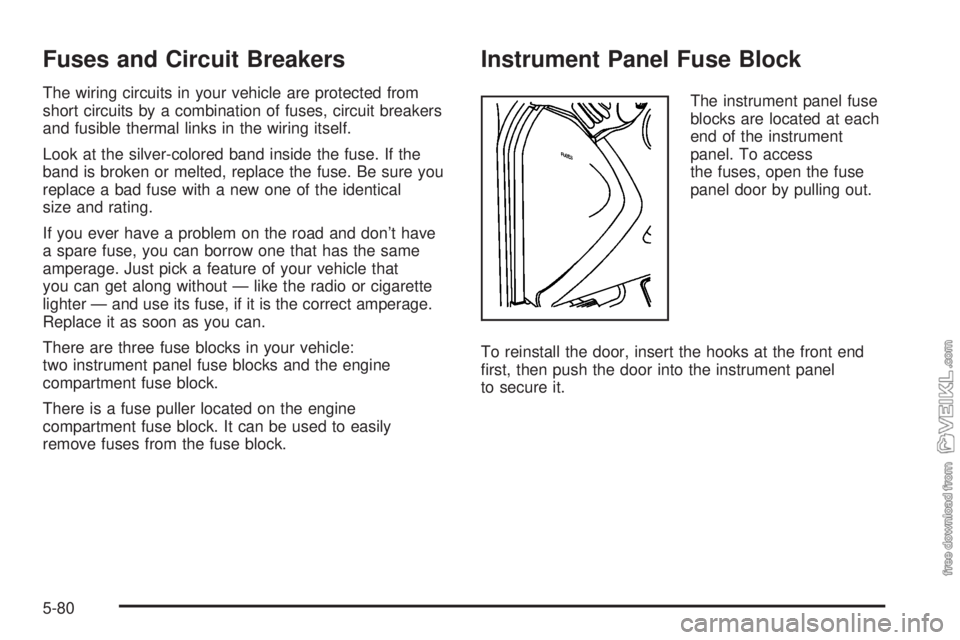
The instrument panel fuse
blocks are located at each
end of the instrument
panel. To access
the fuses, open the fuse
panel door by pulling out.
To reinstall the door, insert the hooks at the front end
first, then push the door into the instrument panel
to secure it.
5-80
Page 267 of 320
Engine Compartment Fuse Block
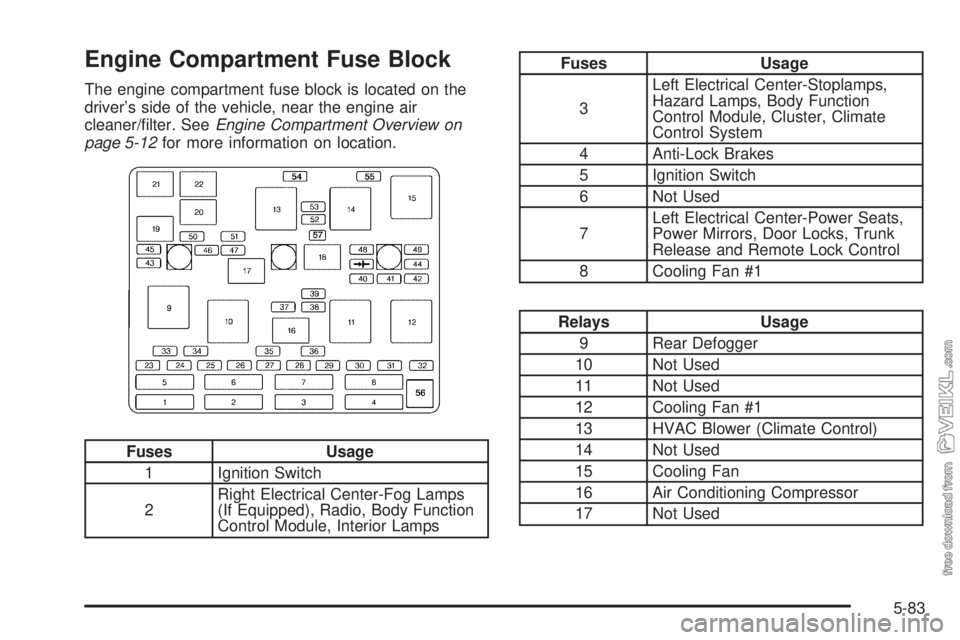
The engine compartment fuse block is located on the
driver’s side of the vehicle, near the engine air
cleaner/filter. SeeEngine Compartment Overview on
page 5-12for more information on location.
Fuses Usage
1 Ignition Switch
2Right Electrical Center-Fog Lamps
(If Equipped), Radio, Body Function
Control Module, Interior Lamps
Fuses Usage
3Left Electrical Center-Stoplamps,
Hazard Lamps, Body Function
Control Module, Cluster, Climate
Control System
4 Anti-Lock Brakes
5 Ignition Switch
6 Not Used
7Left Electrical Center-Power Seats,
Power Mirrors, Door Locks, Trunk
Release and Remote Lock Control
8 Cooling Fan #1
Relays Usage
9 Rear Defogger
10 Not Used
11 Not Used
12 Cooling Fan #1
13 HVAC Blower (Climate Control)
14 Not Used
15 Cooling Fan
16 Air Conditioning Compressor
17 Not Used
5-83
Page 269 of 320
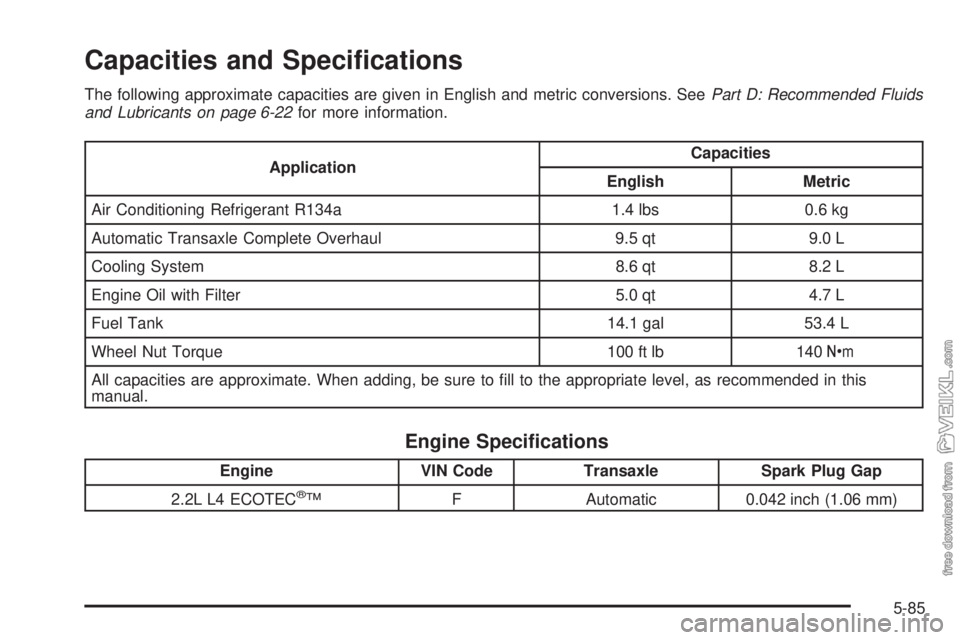
Capacities and Specications
The following approximate capacities are given in English and metric conversions. SeePart D: Recommended Fluids
and Lubricants on page 6-22for more information.
ApplicationCapacities
English Metric
Air Conditioning Refrigerant R134a 1.4 lbs 0.6 kg
Automatic Transaxle Complete Overhaul 9.5 qt 9.0 L
Cooling System 8.6 qt 8.2 L
Engine Oil with Filter 5.0 qt 4.7 L
Fuel Tank 14.1 gal 53.4 L
Wheel Nut Torque 100 ft lb 140Y
All capacities are approximate. When adding, be sure to fill to the appropriate level, as recommended in this
manual.
Engine Specications
Engine VIN Code Transaxle Spark Plug Gap
2.2L L4 ECOTEC
®™ F Automatic 0.042 inch (1.06 mm)
5-85
Page 270 of 320
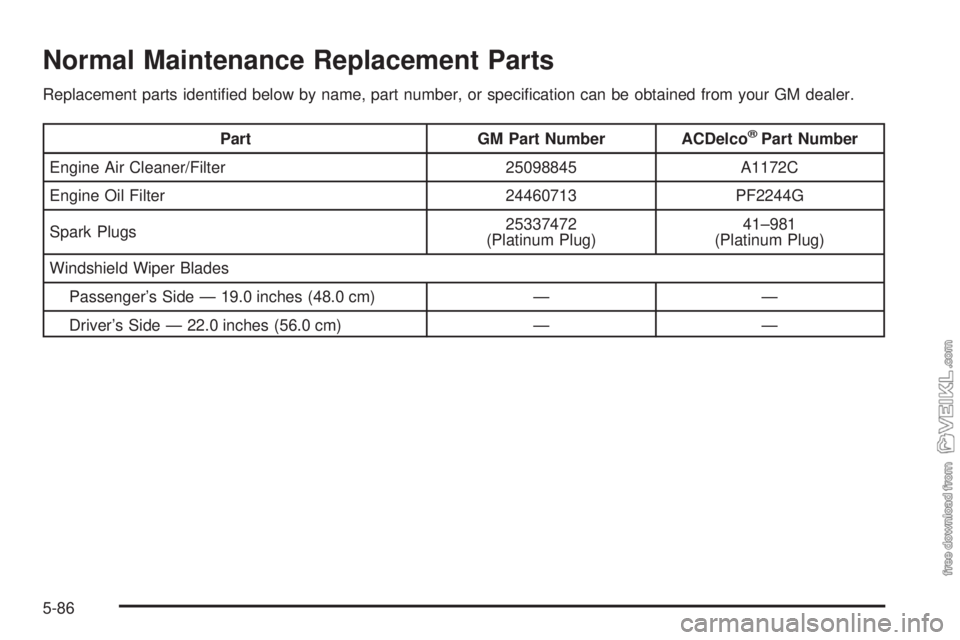
Normal Maintenance Replacement Parts
Replacement parts identified below by name, part number, or specification can be obtained from your GM dealer.
Part GM Part Number ACDelco®Part Number
Engine Air Cleaner/Filter 25098845 A1172C
Engine Oil Filter 24460713 PF2244G
Spark Plugs25337472
(Platinum Plug)41–981
(Platinum Plug)
Windshield Wiper Blades
Passenger’s Side — 19.0 inches (48.0 cm) — —
Driver’s Side — 22.0 inches (56.0 cm) — —
5-86