light CHEVROLET COLORADO 2007 1.G Owners Manual
[x] Cancel search | Manufacturer: CHEVROLET, Model Year: 2007, Model line: COLORADO, Model: CHEVROLET COLORADO 2007 1.GPages: 496, PDF Size: 2.7 MB
Page 389 of 496
Step 2. To let air-pressure out of a tire you
can use the pointed end of the valve cap,
a pencil-style air pressure gage, or a key.
6. Proceed to the passenger’s side front tire,
and repeat the procedure in Step 5.
7. Proceed to the passenger’s side rear tire,
and repeat the procedure in Step 5.
8. Proceed to the driver’s side rear tire, and
repeat the procedure in Step 5.
9. After hearing the conrming horn chirp for the
driver side rear tire, check to see if the TPMS
low tire warning light and the DIC LOW TIRE
messages have turned off. If yes, the TPMS
sensors have been relearned. Turn the ignition
switch to LOCK.
If the low tire warning light and the DIC SERV
TPM messages are on after completing Step 5
for the driver side rear tire, the sensor relearn
process has not been successful. Turn the
ignition switch to LOCK and repeat the
matching process beginning with Step 2.
10. Set all four tires to the recommended air
pressure level as indicated on the Tire and
Loading Information label.
11. Put the valve caps back on the valve stems.Federal Communications
Commission (FCC) and Industry
and Science Canada
The Tire Pressure Monitor System (TPMS)
operates on a radio frequency and complies with
Part 15 of the FCC Rules. Operation is subject
to the following two conditions:
1. This device may not cause harmful
interference.
2. This device must accept any interference
received, including interference that may
cause undesired operation.
The Tire Pressure Monitor System (TPMS)
operates on a radio frequency and complies with
RSS-210 of Industry and Science Canada.
Operation is subject to the following two conditions:
1. This device may not cause interference.
2. This device must accept any interference
received, including interference that may
cause undesired operation of the device.
Changes or modications to this system by
other than an authorized service facility could
void authorization to use this equipment.
389
Page 395 of 496
Uniform Tire Quality Grading
Quality grades can be found where applicable
on the tire sidewall between tread shoulder
and maximum section width. For example:
Treadwear 200 Traction AA Temperature A
The following information relates to the system
developed by the United States National
Highway Traffic Safety Administration (NHTSA),
which grades tires by treadwear, traction, and
temperature performance. This applies only
to vehicles sold in the United States. The grades
are molded on the sidewalls of most passenger
car tires. The Uniform Tire Quality Grading
(UTQG) system does not apply to deep tread,
winter-type snow tires, space-saver, or temporary
use spare tires, tires with nominal rim diameters
of 10 to 12 inches (25 to 30 cm), or to some
limited-production tires.
While the tires available on General Motors
passenger cars and light trucks may vary with
respect to these grades, they must also conform
to federal safety requirements and additional
General Motors Tire Performance Criteria (TPC)
standards.
Treadwear
The treadwear grade is a comparative rating based
on the wear rate of the tire when tested under
controlled conditions on a specied government
test course. For example, a tire graded 150 would
wear one and a half (1.5) times as well on the
government course as a tire graded 100. The
relative performance of tires depends upon the
actual conditions of their use, however, and may
depart signicantly from the norm due to variations
in driving habits, service practices, and differences
in road characteristics and climate.
Traction – AA, A, B, C
The traction grades, from highest to lowest, are AA,
A, B, and C. Those grades represent the tire’s
ability to stop on wet pavement as measured under
controlled conditions on specied government test
surfaces of asphalt and concrete. A tire marked C
may have poor traction performance.
Warning:The traction grade assigned to this tire
is based on straight-ahead braking traction tests,
and does not include acceleration, cornering,
hydroplaning, or peak traction characteristics.
395
Page 422 of 496
Appearance Care
Cleaning the Inside of Your Vehicle
Your vehicle’s interior will continue to look its
best if it is cleaned often. Although not always
visible, dust and dirt can accumulate on your
upholstery. Dirt can damage carpet, fabric, leather,
and plastic surfaces. Regular vacuuming is
recommended to remove particles from your
upholstery. It is important to keep your upholstery
from becoming and remaining heavily soiled.
Soils should be removed as quickly as possible.
Your vehicle’s interior may experience extremes
of heat that could cause stains to set rapidly.
Lighter colored interiors may require more frequent
cleaning. Use care because newspapers and
garments that transfer color to your home
furnishings may also transfer color to your
vehicle’s interior.
When cleaning your vehicle’s interior, only use
cleaners specically designed for the surfaces
being cleaned. Permanent damage may result from
using cleaners on surfaces for which they were
not intended. Use glass cleaner only on glass.Remove any accidental over-spray from other
surfaces immediately. To prevent over-spray, apply
cleaner directly to the cleaning cloth.
Notice:If you use abrasive cleaners when
cleaning glass surfaces on your vehicle, you
could scratch the glass and/or cause damage
to the rear window defogger. When cleaning
the glass on your vehicle, use only a soft cloth
and glass cleaner.
Many cleaners contain solvents that may become
concentrated in your vehicle’s breathing space.
Before using cleaners, read and adhere to all safety
instructions on the label. While cleaning your
vehicle’s interior, maintain adequate ventilation by
opening your vehicle’s doors and windows.
Dust may be removed from small buttons and
knobs using a small brush with soft bristles.
Your dealer/retailer has a product for cleaning your
vehicle’s glass. Should it become necessary, you
can also obtain a product from your dealer/retailer
to remove odors from your vehicle’s upholstery.
422
Page 431 of 496
Vehicle Care/Appearance Materials
Description Usage
Polishing Cloth
Wax-TreatedInterior and exterior
polishing cloth.
Tar and Road
Oil RemoverRemoves tar, road oil,
and asphalt.
Chrome Cleaner
and PolishUse on chrome or
stainless steel.
White Sidewall
Tire CleanerRemoves soil and black
marks from whitewalls.
Vinyl Cleaner Cleans vinyl.
Glass CleanerRemoves dirt, grime,
smoke and ngerprints.
Chrome and Wire
Wheel CleanerRemoves dirt and grime
from chrome wheels and
wire wheel covers.
Finish EnhancerRemoves dust,
ngerprints, and surface
contaminants. Spray on
and wipe off.
Description Usage
Swirl Remover PolishRemoves swirl marks, ne
scratches, and other light
surface contamination.
Cleaner WaxRemoves light scratches
and protects nish.
Foaming Tire Shine
Low GlossCleans, shines, and
protects in one step.
No wiping necessary.
Wash Wax ConcentrateMedium foaming
shampoo. Cleans
and lightly waxes.
Biodegradable and
phosphate free.
Spot LifterQuickly removes spots
and stains from carpets,
vinyl, and cloth
upholstery.
Odor EliminatorOdorless spray odor
eliminator used on fabrics,
vinyl, leather and carpet.
431
Page 433 of 496
Windshield Wiper Fuses
The windshield wiper motor is protected by a
circuit breaker and a fuse. If the motor overheats
due to heavy snow or ice, the wiper will stop
until the motor cools. If the overload is caused by
some electrical problem, be sure to get it xed.
Fuses and Circuit Breakers
The wiring circuits in your vehicle are protected
from short circuits by a combination of fuses
and circuit breakers. This greatly reduces
the chance of res caused by electrical problems.
Look at the silver-colored band inside the fuse.
If the band is broken or melted, replace the
fuse. Be sure you replace a bad fuse with a
new one of the identical size and rating.
If you ever have a problem on the road and do not
have a spare fuse, you can borrow one that has the
same amperage. Just pick some feature of your
vehicle that you can get along without — like
the radio or cigarette lighter — and use its fuse,
if it is the correct amperage. Replace it as soon
as you can.
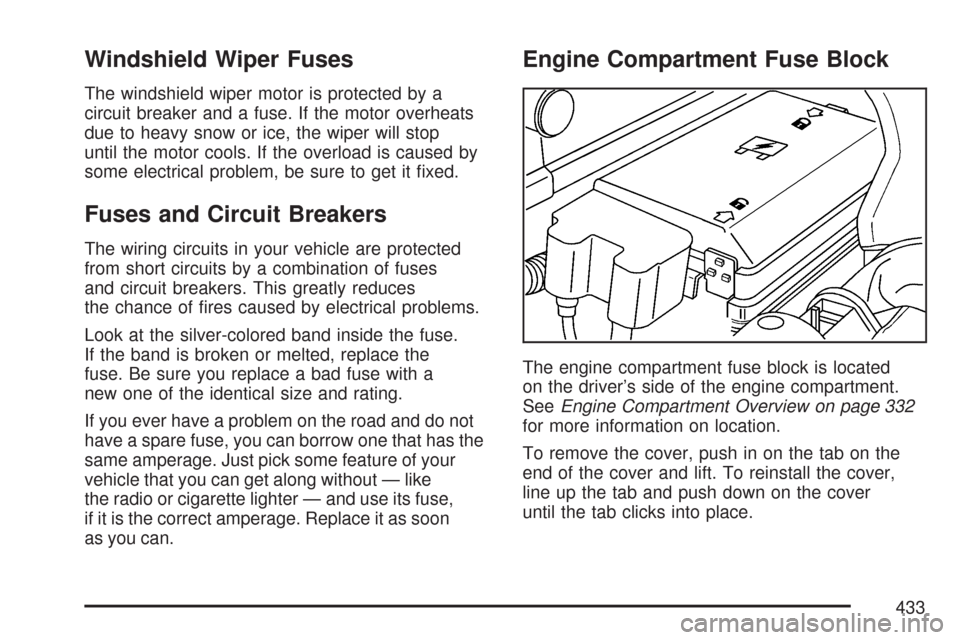
Engine Compartment Fuse Block
The engine compartment fuse block is located
on the driver’s side of the engine compartment.
SeeEngine Compartment Overview on page 332
for more information on location.
To remove the cover, push in on the tab on the
end of the cover and lift. To reinstall the cover,
line up the tab and push down on the cover
until the tab clicks into place.
433
Page 434 of 496
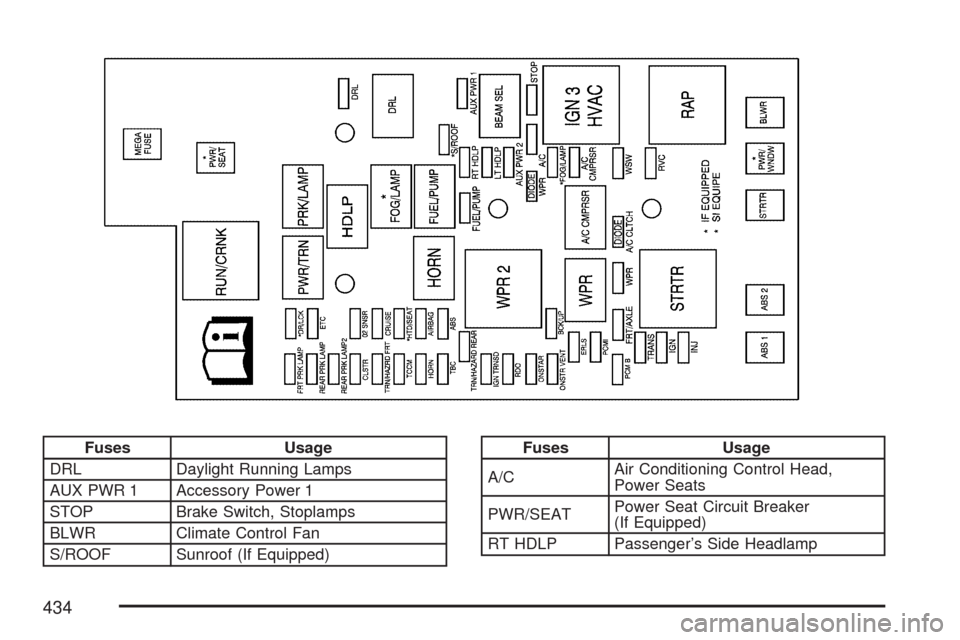
Fuses Usage
DRL Daylight Running Lamps
AUX PWR 1 Accessory Power 1
STOP Brake Switch, Stoplamps
BLWR Climate Control Fan
S/ROOF Sunroof (If Equipped)Fuses Usage
A/CAir Conditioning Control Head,
Power Seats
PWR/SEATPower Seat Circuit Breaker
(If Equipped)
RT HDLP Passenger’s Side Headlamp
434
Page 435 of 496
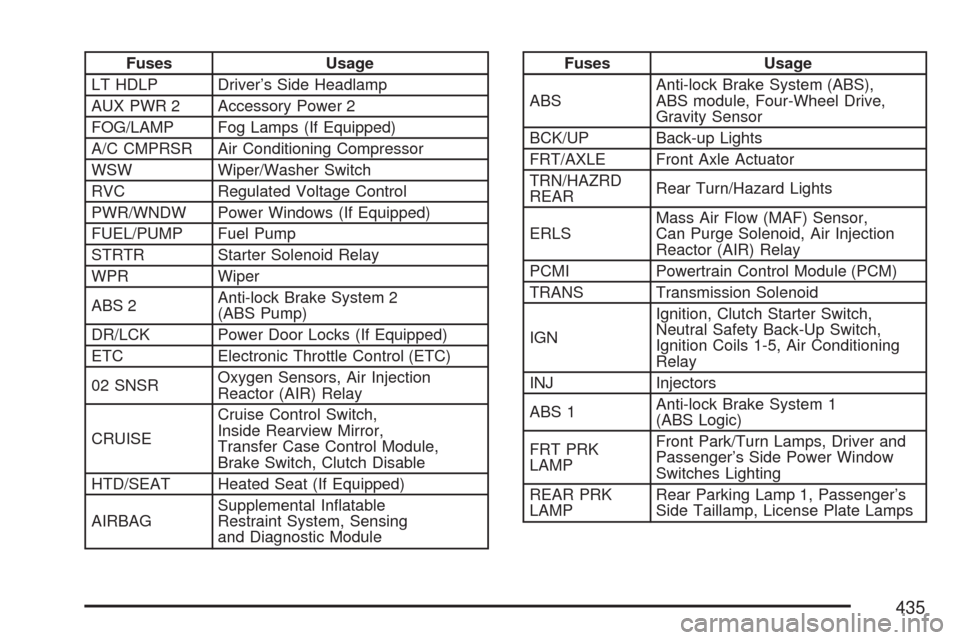
Fuses Usage
LT HDLP Driver’s Side Headlamp
AUX PWR 2 Accessory Power 2
FOG/LAMP Fog Lamps (If Equipped)
A/C CMPRSR Air Conditioning Compressor
WSW Wiper/Washer Switch
RVC Regulated Voltage Control
PWR/WNDW Power Windows (If Equipped)
FUEL/PUMP Fuel Pump
STRTR Starter Solenoid Relay
WPR Wiper
ABS 2Anti-lock Brake System 2
(ABS Pump)
DR/LCK Power Door Locks (If Equipped)
ETC Electronic Throttle Control (ETC)
02 SNSROxygen Sensors, Air Injection
Reactor (AIR) Relay
CRUISECruise Control Switch,
Inside Rearview Mirror,
Transfer Case Control Module,
Brake Switch, Clutch Disable
HTD/SEAT Heated Seat (If Equipped)
AIRBAGSupplemental Inatable
Restraint System, Sensing
and Diagnostic ModuleFuses Usage
ABSAnti-lock Brake System (ABS),
ABS module, Four-Wheel Drive,
Gravity Sensor
BCK/UP Back-up Lights
FRT/AXLE Front Axle Actuator
TRN/HAZRD
REARRear Turn/Hazard Lights
ERLSMass Air Flow (MAF) Sensor,
Can Purge Solenoid, Air Injection
Reactor (AIR) Relay
PCMI Powertrain Control Module (PCM)
TRANS Transmission Solenoid
IGNIgnition, Clutch Starter Switch,
Neutral Safety Back-Up Switch,
Ignition Coils 1-5, Air Conditioning
Relay
INJ Injectors
ABS 1Anti-lock Brake System 1
(ABS Logic)
FRT PRK
LAMPFront Park/Turn Lamps, Driver and
Passenger’s Side Power Window
Switches Lighting
REAR PRK
LAMPRear Parking Lamp 1, Passenger’s
Side Taillamp, License Plate Lamps
435
Page 436 of 496
Fuses Usage
REAR PRK
LAMP2Driver’s Side Rear Taillamp,
Passenger Side Airbag Indicator
Lighting, Instrument Panel Dimming
Power (2WD/4WD switch lighting)
CLSTR Cluster
TRN/HAZRD
FRTTurn/Hazard/Courtesy/
Cargo Lamps/Mirrors
TCCM Transfer Case Control Module
HORN Horn
TBC Truck Body Controller
IGN TRNSD Ignition Transducers
RDO Radio
ONSTAR OnStar
®
CNSTR VENT Fuel Canister Vent Solenoid
PCM B Powertrain Control Module (PCM) B
Relays Usage
DRL Daylight Running Lamps
BEAM SEL Beam Selection
IGN 3 HVACIgnition 3, Climate Control,
Climate Control Head Fuse,
Power Seat Fuse
RAPRetained Accessory Power
(Power Window Fuse,
Wiper/Washer Switch Fuse),
Sunroof Fuse
Relays Usage
PRK/LAMPFront Parking Lamp Fuse,
Rear Parking Lamps
HDLP Headlamps
FOG/LAMP Fog Lamps (If Equipped)
FUEL/PUMP Fuel Pump, Fuel Pump Fuse
A/C CMPRSR Air Conditioning Compressor
RUN/CRNKRun/Crank, Airbag System Fuse,
Cruise Control Fuse, Ignition Fuse,
Back-Up Lamps, ABS Fuse,
Front Axle, PCM-1, Injectors Fuse,
Transmission Fuse, ERLS
PWR/TRNPowertrain, Electronic Throttle
Control Fuse, Oxygen Sensor Fuse
HORN Horn
WPR 2 Wiper 2 (High/Low)
WPR Wipers (On/Off)
STRTR Starter Relay (PCM Relay)
Miscellaneous Usage
WPR Diode — Wiper
A/C CLTCH Diode — Air Conditioning, Clutch
MEGA FUSE Mega Fuse
436
Page 446 of 496
Maintenance Footnotes
(a)Visually inspect brake lines and hoses for
proper hook-up, binding, leaks, cracks, chang,
etc. Inspect disc brake pads for wear and rotors
for surface condition. Inspect drum brake
linings/shoes for wear or cracks. Inspect other
brake parts, including drums, wheel cylinders,
calipers, parking brake, etc. Check parking
brake adjustment.
(b)Visually inspect front and rear suspension
and steering system for damaged, loose, or
missing parts or signs of wear. Inspect power
steering lines and hoses for proper hook-up,
binding, leaks, cracks, chang, etc. Visually check
constant velocity joints, rubber boots, and axle
seals for leaks.
(c)Visually inspect hoses and have them replaced
if they are cracked, swollen, or deteriorated.
Inspect all pipes, ttings, and clamps; replace
with genuine parts as needed. To help ensure
proper operation, a pressure test of the cooling
system and pressure cap and cleaning the outside
of the radiator and air conditioning condenser is
recommended at least once a year.(d)Inspect wiper blades for wear, cracking,
or contamination. Clean the windshield and wiper
blades, if contaminated. Replace wiper blades
that are worn or damaged. See Windshield
Wiper Blade Replacement on page 375and
Windshield and Wiper Blades on page 427for
more information.
(e)Make sure the safety belt reminder light and
all your belts, buckles, latch plates, retractors, and
anchorages are working properly. Look for any
other loose or damaged safety belt system parts.
If you see anything that might keep a safety
belt system from doing its job, have it repaired.
Have any torn or frayed safety belts replaced.
Also look for any opened or broken airbag
coverings, and have them repaired or replaced.
The airbag system does not need regular
maintenance.
(f)Lubricate all key lock cylinders, body door
and fuel door hinges, latches and locks (including
glove box and console doors), hood latch
assembly, secondary latch, pivots, spring anchor,
release pawl, and any moving seat hardware.
446
Page 467 of 496
Trip Routing Service (Canada only):Upon
request, Roadside Assistance will send you
detailed, computer personalized maps,
highlighting your choice of either the most
direct route or the most scenic route to your
destination, anywhere in North America,
along with helpful travel information pertaining
to your trip.
We will make every attempt to send your
personalized trip routing as quickly as possible,
but it is best to allow three weeks before your
planned departure date. Trip routing requests
will be limited to six per calendar year.
Trip Interruption Benets and Assistance
(Canada only):In the event of a warranty
related vehicle disablement, while en route and
over 250 kilometres from original point of
departure, you may qualify for trip interruption
expense assistance. This assistance covers
reasonable reimbursement of up to a maximum
of $500 (Canadian) for (A) meals (maximum of
$50/day), (B) lodging (maximum of $100/night)
and (C) alternate ground transportation
(maximum of $40/day). This benet is to assist
you with some of the unplanned expense
you may incur while waiting for your vehicle
to be repaired.Pre-authorization, original detailed receipts and
a copy of the repair order are required.
Once authorization has been given, your
advisor will help you make any necessary
arrangements and explain how to claim for trip
interruption expense assistance.
Alternative Service (Canada only):There
may be times, when Roadside Assistance
cannot provide timely assistance, your advisor
may authorize you to secure local emergency
road service, and you will be reimbursed up to
$100 upon submission of the original receipt to
Roadside Assistance.
In many instances, mechanical failures are
covered under Chevrolet’s Bumper-to-Bumper
warranty, and the duration of the Base Warranty
Coverage for Canadian customers of the new
Vehicle Limited Warranty. However, any cost for
parts and labor for non-warranty repairs are
the responsibility of the driver.
467