engine CHEVROLET COLORADO 2007 1.G User Guide
[x] Cancel search | Manufacturer: CHEVROLET, Model Year: 2007, Model line: COLORADO, Model: CHEVROLET COLORADO 2007 1.GPages: 496, PDF Size: 2.7 MB
Page 125 of 496
Make sure the shift lever is fully in PARK (P)
before starting the engine. Your vehicle has an
automatic transmission shift lock control system.
You must fully apply your regular brakes before
you can shift from PARK (P) when the ignition
key is in ON. If you cannot shift out of PARK (P),
ease pressure on the shift lever by pushing
the shift lever all the way into PARK (P) as
you maintain brake application. Then move the
shift lever into another gear. SeeShifting Out
of Park (P) (Automatic Transmission) on page 137.
REVERSE (R):Use this gear to back up.
Notice:Shifting to REVERSE (R) while your
vehicle is moving forward could damage the
transmission. The repairs would not be covered
by your warranty. Shift to REVERSE (R) only
after your vehicle is stopped.
To rock your vehicle back and forth to get out
of snow, ice, or sand without damaging your
transmission, seeIf Your Vehicle is Stuck in Sand,
Mud, Ice, or Snow on page 290.NEUTRAL (N):In this position, your engine does
not connect with the wheels. To restart when
you are already moving, use NEUTRAL (N) only.
{CAUTION:
Shifting into a drive gear while your
engine is running at high speed is
dangerous. Unless your foot is rmly on
the brake pedal, your vehicle could move
very rapidly. You could lose control and
hit people or objects. Do not shift into a
drive gear while your engine is running
at high speed.
Notice:Shifting out of PARK (P) or
NEUTRAL (N) with the engine running at
high speed may damage the transmission.
The repairs would not be covered by your
warranty. Be sure the engine is not running
at high speed when shifting your vehicle.
125
Page 127 of 496
Here is how to operate your manual transmission:
FIRST (1):Press the clutch pedal and shift into
FIRST (1). Then, slowly let up on the clutch pedal
as you slowly press down on the accelerator pedal.
You can shift into FIRST (1) when you are going
less than 20 mph (30 km/h). If you have come to a
complete stop and it is hard to shift into FIRST (1),
put the shift lever in NEUTRAL and let up on the
clutch. Then press the clutch pedal back down and
shift into FIRST (1).
SECOND (2):Press the clutch pedal as you
let up on the accelerator pedal and shift into
SECOND (2). Then, slowly let up on the clutch
pedal as you press the accelerator pedal.
THIRD, FOURTH AND FIFTH (3, 4 and 5):
Shift into THIRD (3), FOURTH (4) and FIFTH (5)
the same way you do for SECOND (2). Slowly
let up on the clutch pedal as you press the
accelerator pedal.
To stop, let up on the accelerator pedal and press
the brake pedal. Just before the vehicle stops,
press the clutch pedal and the brake pedal,
and shift to NEUTRAL.NEUTRAL:Use this position when you start or
idle your engine.
REVERSE (R):To back up, press the clutch pedal.
After the vehicle stops, shift into REVERSE (R).
Slowly let up on the clutch pedal as you press the
accelerator pedal. If it is hard to shift, let the shift
lever return to NEUTRAL and release the clutch
pedal. Then press the clutch again and shift into
REVERSE (R). Do not attempt to shift into the fth
gear position prior to shifting into REVERSE (R).
Your transmission has a lock out feature which
prevents a fth gear to reverse gear shift.
Notice:Shifting to REVERSE (R) while your
vehicle is moving forward could damage
the transmission. The repairs would not
be covered by your warranty. Shift to
REVERSE (R) only after your vehicle is
stopped.
Use REVERSE (R), along with the parking brake,
for parking your vehicle.
127
Page 129 of 496
Four-Wheel Drive
If your vehicle has four-wheel drive, you can send
your engine’s driving power to all four wheels for
extra traction. To get the best performance out of
four-wheel drive, you must be familiar with its
operation. Read the part that follows before using
four-wheel drive. You should use two-wheel-drive
high for most normal driving conditions.
Notice:Driving on clean, dry pavement in
four-wheel drive for an extended period of
time can cause premature wear on your
vehicle’s powertrain. Do not drive on clean,
dry pavement in Four-Wheel Drive for
extended periods of time.
Notice:If your vehicle has four-wheel drive
and the compact spare tire is installed on
your vehicle, do not drive in four-wheel drive
until you can have your at tire repaired and/or
replaced. You could damage your vehicle,
and the repair costs would not be covered
by your warranty. Never use four-wheel drive
when the compact spare tire is installed
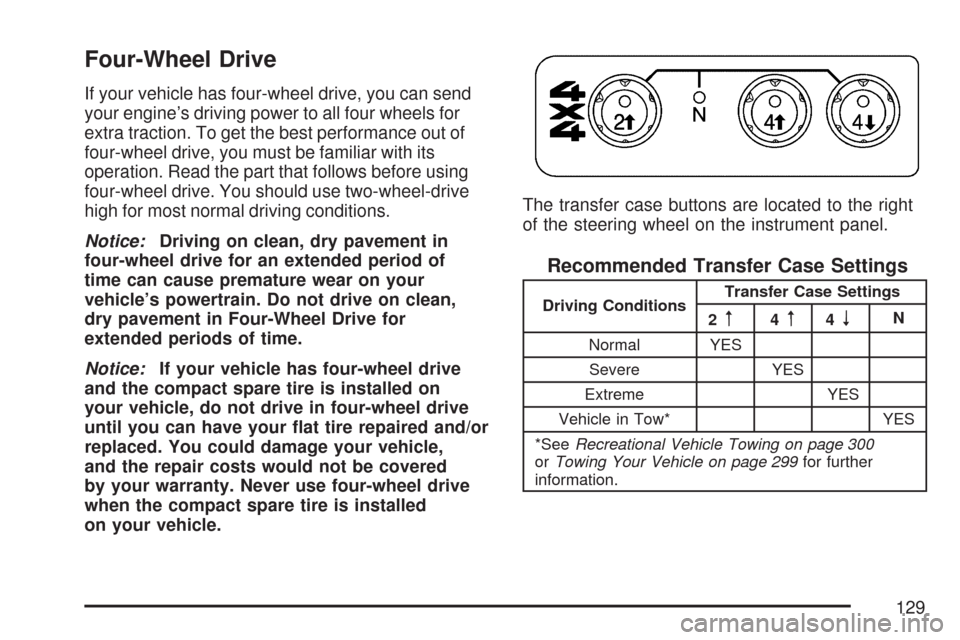
on your vehicle.The transfer case buttons are located to the right
of the steering wheel on the instrument panel.
Recommended Transfer Case Settings
Driving ConditionsTransfer Case Settings
2m4m4nN
Normal YES
Severe YES
Extreme YES
Vehicle in Tow* YES
*SeeRecreational Vehicle Towing on page 300
orTowing Your Vehicle on page 299for further
information.
129
Page 132 of 496
Press and release the Four-Wheel High or
Two-Wheel High button. You must wait for the
Four-Wheel High or Two-Wheel High indicator light
to stop ashing and stay on before shifting the
transmission into gear or releasing the clutch pedal.
If the Four-Wheel High or Two-Wheel High button
is pressed when your vehicle is in gear and/or
moving faster than 3 mph (5km/h), the Four-Wheel
High or Two Wheel High indicator light will ash
for 30 seconds but not complete the shift.
Shifting to NEUTRAL
Use NEUTRAL when you plan to tow your vehicle.
SeeRecreational Vehicle Towing on page 300
for towing instructions. To shift the transfer case
into NEUTRAL do the following:
1. Set the parking brake.
2. Start the vehicle.
3. Press the regular brake pedal and shift
the transmission in NEUTRAL (N), or
press in the clutch for vehicles with a
manual transmission.4. Shift the transfer case to Two-Wheel High.
5. Press and hold the Two-Wheel High and
Four-Wheel Low buttons at the same time
for 10 seconds. The NEUTRAL (N) light
will come on when the transfer case shift to
NEUTRAL (N) is complete.
6. Press and hold the regular brake pedal and
shift the transmission to REVERSE (R) for
one second, then shift the transmission
to DRIVE (D) for one second, or FIRST (1) for
vehicles with manual transmissions, and let
out the clutch to insure the transfer case is in
NEUTRAL. If the vehicle is not in NEUTRAL,
repeat this procedure starting at Step 3.
7. Turn the engine off by turning the key to ACC.
8. Place the transmission shift lever in PARK (P),
or FIRST (1) for vehicles that have a manual
transmission.
9. Turn the ignition to LOCK.
132
Page 135 of 496
Shifting Into Park (P)
(Automatic Transmission)
{CAUTION:
It can be dangerous to get out of your
vehicle if the shift lever is not fully in
PARK (P) with the parking brake rmly
set. Your vehicle can roll. If you have
left the engine running, the vehicle can
move suddenly. You or others could
be injured. To be sure your vehicle will
not move, even when you are on fairly
level ground, use the steps that follow.
If you are pulling a trailer, seeTowing
a Trailer on page 306.
1. Hold the brake pedal down with your right
foot and set the parking brake.
SeeParking Brake on page 133for more
information.
{CAUTION:
If you have four-wheel drive, your vehicle
will be free to roll — even if your shift
lever is in PARK (P) — if your transfer
case is in NEUTRAL. So, be sure the
transfer case is in a drive gear, two-wheel
high (2H) or four-wheel high (4H) or
four-wheel low (4L) — not in NEUTRAL.
2. Move the shift lever into PARK (P) by
pulling the lever toward you and moving
it up as far as it will go.
3. Turn the ignition key to LOCK.
4. Remove the key and take it with you.
If you can leave your vehicle with the
key, your vehicle is in PARK (P).
135
Page 136 of 496
Leaving Your Vehicle With the Engine
Running (Automatic Transmission)
{CAUTION:
It can be dangerous to leave your vehicle
with the engine running. Your vehicle
could move suddenly if the shift lever is
not fully in PARK (P) with the parking
brake rmly set. And, if you leave the
vehicle with the engine running, it could
overheat and even catch re. You or
others could be injured. Do not leave
your vehicle with the engine running.
If you have to leave your vehicle with the engine
running, be sure your vehicle is in PARK (P)
and your parking brake is rmly set before you
leave it. After you have moved the shift lever
into PARK (P), hold the regular brake pedal down.
Then, see if you can move the shift lever away
from PARK (P) without rst pulling it toward you.
If you can, it means that the shift lever was
not fully locked into PARK (P).
Torque Lock (Automatic Transmission)
If you are parking on a hill and you do not shift
your transmission into PARK (P) properly,
the weight of the vehicle may put too much
force on the parking pawl in the transmission.
You may nd it difficult to pull the shift lever out
of PARK (P). This is called torque lock. To prevent
torque lock, set the parking brake and then shift
into PARK (P) properly before you leave the
driver’s seat. To nd out how, seeShifting Into
Park (P) (Automatic Transmission) on page 135.
When you are ready to drive, move the shift
lever out of PARK (P) before you release the
parking brake.
If torque lock does occur, you may need to
have another vehicle push yours a little uphill to
take some of the pressure from the parking pawl
in the transmission, so you can pull the shift
lever out of PARK (P).
136
Page 139 of 496
Engine Exhaust
{CAUTION:
Engine exhaust can kill. It contains the
gas carbon monoxide (CO), which you
cannot see or smell. It can cause
unconsciousness and death.
You might have exhaust coming in if:
The exhaust system sounds strange
or different.
Your vehicle gets rusty underneath.
Your vehicle was damaged in a
collision.
CAUTION: (Continued)
CAUTION: (Continued)
Your vehicle was damaged when
driving over high points on the road
or over road debris.
Repairs were not done correctly.
Your vehicle or the exhaust system
has been modied improperly.
If you ever suspect exhaust is coming
into your vehicle:
Drive it only with all the windows
down to blow out any CO; and
Have your vehicle xed immediately.
139
Page 140 of 496
Running the Engine While Parked
It is better not to park with the engine running. But if
you ever have to, here are some things to know.
{CAUTION:
Idling the engine with the climate control
system off could allow dangerous exhaust
into your vehicle. See the earlier caution
underEngine Exhaust on page 139.
Also, idling in a closed-in place can let
deadly carbon monoxide (CO) into your
vehicle even if the climate control fan is
at the highest setting. One place this
can happen is a garage. Exhaust — with
CO — can come in easily. NEVER park
in a garage with the engine running.
Another closed-in place can be a blizzard.
SeeWinter Driving on page 286.
{CAUTION:
It can be dangerous to get out of your
vehicle if the automatic transmission shift
lever is not fully in PARK (P) with the
parking brake rmly set. Your vehicle can
roll. Do not leave your vehicle when the
engine is running unless you have to.
If you have left the engine running, the
vehicle can move suddenly. You or others
could be injured. To be sure your vehicle
will not move, even when it is on fairly
level ground, always set the parking brake
and move the automatic transmission
shift lever to PARK (P), or the manual
transmission shift lever to NEUTRAL.
140
Page 158 of 496
Brake System Warning Light..................... 189
Anti-Lock Brake System Warning Light...... 190
Engine Coolant Temperature Gage............ 191
Tire Pressure Light.................................... 191
Malfunction Indicator Lamp........................ 192
Oil Pressure Light..................................... 195
Security Light............................................ 196
Cruise Control Light.................................. 196
Highbeam On Light................................... 196
Daytime Running Lamps (DRL)
Indicator Light........................................ 197
Fuel Gage................................................. 197
Driver Information Center (DIC).................. 198
DIC Controls and Displays........................ 198
DIC Warnings and Messages.................... 202Audio System(s)......................................... 206
Setting the Time........................................ 208
AM-FM Radio............................................ 209
Radio with CD (MP3)................................ 212
Radio with Six-Disc CD............................. 222
Using an MP3........................................... 234
XM Radio Messages................................. 240
Theft-Deterrent Feature............................. 242
Radio Reception........................................ 242
Care of Your CDs..................................... 243
Care of the CD Player.............................. 243
Fixed Mast Antenna.................................. 244
XM™ Satellite Radio Antenna System....... 244
Chime Level Adjustment............................ 244
Section 3 Instrument Panel
158
Page 175 of 496
Dome Lamp Override
E(Dome Override):Press this button, located
below the exterior lamp control, to turn the
dome lamp off even when a door is opened.
SeeExterior Lamps on page 170for more
information on location.
To return the lamp to automatic operation,
press the button again.
Exit Lighting
With exit lighting, the interior lamps will come
on when you remove the key from the ignition.
The lamps will not come on if the dome override
button is pressed in.
Electric Power Management
The vehicle has Electric Power Management (EPM)
that estimates the battery’s temperature and state
of charge. It then adjusts the voltage for best
performance and extended life of the battery.When the battery’s state of charge is low, the
voltage is raised slightly to quickly put the charge
back in. When the state of charge is high, the
voltage is lowered slightly to prevent overcharging.
If the vehicle has a voltmeter gage, you may
see the voltage move up or down. This is normal.
If there is a problem, an alert will be displayed.
The battery can be discharged at idle if the electrical
loads are very high. This is true for all vehicles.
This is because the generator (alternator) may not
be spinning fast enough at idle to produce all the
power that is needed for very high electrical loads.
A high electrical load occurs when several of the
following loads are on: headlamps, high beams,
fog lamps, rear window defogger, climate
control fan at high speed, heated seats, engine
cooling fans, trailer loads, and loads plugged
into accessory power outlets.Battery Run-Down Protection
This feature shuts off the dome lamp if it is left
on for more than 20 minutes when the ignition
is in LOCK. This will help prevent your battery
from running down.
175